

|
시장보고서
상품코드
2097329
에너지용 ESO(엔지니어링 서비스 아웃소싱) : 시장 점유율 분석, 산업 동향 및 통계 데이터, 성장 예측(2026-2031년)Energy Engineering Services Outsourcing (ESO) - Market Share Analysis, Industry Trends & Statistics, Growth Forecasts (2026 - 2031) |
||||||
 Mordor Intelligence
Mordor Intelligence에 의하면, 에너지용 ESO(엔지니어링 서비스 아웃소싱) 시장 규모는 2025년 5,300억 달러에서 2026년에는 6,400억 달러로 확대되고, 2026-2031년 CAGR 20.83%로 성장을 지속하여 2031년에는 1조 6,400억 달러에 이를 것으로 예측됩니다.

본 보고서는 서비스 유형(구조·레이아웃, 디지털화 등), 도입 방식(온쇼어, 오프쇼어), 조달 모델(캡티브 아웃소싱, 써드파티 아웃소싱), 에너지원(재생에너지 등), 지역(북미, 유럽, 아시아태평양, 남미, 중동 및 아프리카)별로 분류되어 있습니다. 시장 전망은 금액(달러)으로 제시되어 있습니다.
전 세계 에너지 분야 ESO(엔지니어링 서비스 아웃소싱) 시장 동향과 고찰
탈탄소화 의무화로 인해 재생에너지 통합이 복잡해짐
유럽연합(EU)의 'Fit for 55' 패키지나 미국의 '인플레이션 감축법'과 같은 구속력 있는 기후 변화 관련 법규에 따라, 전력 사업자는 제한된 기간 내에 대량의 간헐성 재생에너지를 전력계에 통합해야 합니다. 계통 운영 사업자는 전력 전자 모델링, 고조파 관리, 하이브리드 에너지 저장 시스템 설계에 관한 사내 역량이 부족하기 때문에 인버터 사양, 동적 라인 레이팅 전략, 첨단 에너지 관리 알고리즘의 공동 설계를 전문 엔지니어링 파트너에게 위탁하는 사례가 증가하고 있습니다. 신뢰성 지표를 유지하면서 노후화된 변전소를 개보수해야 할 필요성으로 인해 그 복잡성은 더욱 가중되고 있습니다. 현재 아웃소싱 제공업체들은 그리드 코드 준수, 보호 설계, 시운전 서비스를 패키지화하여 프로젝트 승인을 가속화하고 일정상의 위험을 줄여주는 원스톱 솔루션을 제공합니다. 2030년 넷제로 목표를 계기로, 수십억 달러 규모의 송전망 강화 및 유연한 전력원 추가가 진행되고 있는 성숙한 시장에서 그 수요가 가장 높게 나타나고 있습니다.
비용 압박으로 인해 아웃소싱을 통한 운영 효율성 향상이 가속화되고 있습니다.
인건비 격차는 에너지 분야 ESO(엔지니어링 서비스 아웃소싱) 시장의 주요 촉진요인으로 계속 작용하고 있습니다. 2025년 현재, 인도에는 에너지 분야에 특화된 77개의 세계 역량 센터가 있으며, 약 5만 명의 전문가가 근무하고 있습니다. 셰브론사의 10억 달러 규모 방갈로르 거점만 해도, 업스트림 자산의 프런트엔드 설계에 특화된 엔지니어 600명을 추가로 채용할 계획입니다. 휴스턴에서 동등한 직무의 급여는 인도의 3배에 달하기 때문에 사업자는 국내 직원을 전략적 기획 업무에 재배치하는 한편, 다른 시간대에서 활동하는 해외 팀이 배관 아이소메 도면, 루프 도면, 수량 산출을 담당할 수 있습니다. 쉘의 인도 내 직원 수는 2025년에 1만 3,000명을 넘어설 전망이며, 사이클 타임 단축과 이익률 향상에 기여하는 LNG 터미널 엔지니어링 및 디지털 지원 서비스를 제공합니다. 이직률은 여전히 과제로 남아 있지만, 원격 근무 도구, 표준화된 설계 라이브러리, 자동화된 품질 검사를 통해 급여 인플레이션이 진행되는 상황에서도 단위 비용 절감을 도모하고 있습니다.
사이버 보안에 대한 우려로 인해 중요 인프라의 아웃소싱이 제한되고 있습니다.
2024년 NIST SP 800-82 개정으로 인해 산업용 제어 시스템의 보안 기준이 강화되었으며, 제3자 접근에 관한 규정이 엄격해졌습니다. 현재, 유틸리티자들은 공급망 추적성, 제로 트러스트 아키텍처, 소프트웨어 부품표(BOM) 공개 등을 포괄하는 보다 엄격한 공급업체 위험 평가를 실시했습니다. 재생에너지의 출력 억제를 최소화하고 전압 라이드스루(voltage ride-through) 준수를 뒷받침하는 첨단 제어 알고리즘의 경우, 지적 재산권 유출에 대한 우려가 특히 큽니다. 일부 중요 국가 인프라 소유자는 비용이 25-30% 증가하더라도 국내 엔지니어링 센터를 요구하고 있으며, 이로 인해 계약 체결까지의 기간이 지연되고 공급업체 선택의 폭이 제한되고 있습니다. NERC CIP, ISO 27001 및 지역 개인정보 보호 관련 법규 준수는 거래 비용을 증가시키고, 특히 멀티 클라우드 모델에 의한 호스팅의 경우 국경을 넘는 파일 교환을 지연시키고 있습니다.
부문 분석
디지털화 관련 수주액은 2026년부터 2031년까지 연평균 성장률(CAGR) 25.6%로 확대될 것으로 예측되며, 에너지 분야 ESO(엔지니어링 서비스 아웃소싱) 시장 전체를 상회하는 속도로 성장할 전망입니다. 2025년에는 LNG 플랜트, 해상 플랫폼 및 유틸리티 규모의 태양광 발전소에서 고도의 3차원 모델링과 부지 계획 최적화가 요구됨에 따라, ‘구조 설계 및 레이아웃’ 부문이 매출 점유율의 33.3%를 차지하며 시장을 주도했습니다. 현재 디지털화를 통해 클라우드 협업, 생성적 설계, 예측 분석이 이러한 기존 업무 범위에 통합되어 변경 지시 주기를 단축하고 설치 비용을 절감하고 있습니다. 예를 들어, 지멘스의 디지털 트윈은 제조 전에 잠재적인 간섭의 15%를 사전에 방지했습니다. 또한 타타 컨설팅 서비스(Tata Consultancy Services)는 스마트 미터 데이터 세트를 AI 모델에 통합하여 배전망 업그레이드에 소요되는 수억 달러의 비용을 연기하는 데 기여했습니다. 따라서 디지털화와 관련된 에너지 분야 ESO(엔지니어링 서비스 아웃소싱) 시장 규모는 2029년까지 기존 도면 작성 업무의 매출과 어깨를 나란히 할 전망입니다. 발주처가 더 신속한 반복 작업과 수정 작업 감소를 요구함에 따라, 시장 점유율 지표는 계속해서 소프트웨어를 많이 활용하는 업무 분야로 이동할 것입니다.
프로젝트 개발자가 타당성 조사나 신규 자재 선정을 필요로 할 경우, 연구개발(R&D) 및 설계 서비스가 혜택을 받게 됩니다. 그러나 이러한 서비스는 희소한 고위 인력에 의존하고 있기 때문에 그 성장률은 디지털화 관련 성장률보다 약간 낮은 수준에 머물고 있습니다. 도입 및 유지보수 활동은 설치된 자산 규모에 따라 규모가 확대되어 안정적인 수익원을 제공하지만, 성장률은 비교적 완만합니다. 환경 및 해체 서비스는 포트폴리오를 보완하는 역할을 하며, 배출 규제가 강화됨에 따라 수요가 증가하고 있습니다. 이러한 사업 분야 전반에 걸쳐, 에너지 분야 ESO(엔지니어링 서비스 아웃소싱) 시장 역학은 전문 분야 엔지니어와 데이터 사이언스자를 융합하여 개념 모델에서 실행에 이르는 과정을 단축할 수 있는 공급업체에게 유리하게 작용하고 있습니다.
해상 분야는 2031년까지 연평균 성장률(CAGR) 22.7%를 나타낼 것으로 예측되며, 이는 2025년 지출의 61.1%를 차지한 육상 부문을 능가하는 속도입니다. 수심 200미터를 초과하는 해역의 부유식 풍력 발전 시스템, 해저 HVDC 컨버터, 심해 유전 타이백에는 각각 유체역학 모델링, 계류 해석, 부식 조사가 필요하며, 이러한 요소들이 요금 프리미엄의 근거가 되고 있습니다. 에퀴노르(Equinor)사의 ‘하이윈드 탄펜(Highwind Tanpen)’은 50% 이상의 설비 가동률을 기록했으나, 이는 광범위한 위치 유지 시뮬레이션과 동적 케이블 피로 시험을 거친 후에야 가능했습니다. 캘리포니아주, 일본, 한국에서 발표된 임대 입찰이 계획대로 진행된다면, 해상 프로젝트를 대상으로 한 에너지 분야 ESO(엔지니어링 서비스 아웃소싱) 시장 규모는 2031년까지 6,000억 달러를 넘어설 가능성이 있습니다. 육상 태양광 발전의 EPC, 가스 화력 복합 사이클 발전 프로젝트 및 변전소는 건설 규모가 방대한 신흥 시장에서 여전히 매력적인 사업이지만, 소프트웨어에 의한 자동화의 진전으로 인해 이익률은 압박받고 있습니다. 따라서 에너지 분야 ESO(엔지니어링 서비스 아웃소싱) 시장에 진출한 기업들은 포트폴리오의 균형을 맞추고 있습니다. 해상 프로젝트 계약은 수익성이 높은 반면 입찰 주기가 길어지는 반면, 육상 프로젝트는 가동률을 유지할 수 있기 때문입니다.
지역별 분석
아시아태평양은 인도의 풍부한 엔지니어 인력, 중국의 해상 풍력 발전 확대, 그리고 동남아시아의 LNG 수입 계획에 힘입어 2025년 매출의 43.4%를 차지했습니다. 에너지 분야 ESO(엔지니어링 서비스 아웃소싱) 시장은 임금 격차의 혜택을 지속적으로 누리고 있으며, 인도 엔지니어의 평균 연봉은 미국 동종 직종의 약 35% 수준에 그치고 있습니다. 중국의 해상 풍력 발전 용량은 2025년에 급증하여 2030년까지 최소 120GW를 목표로 하고 있으며, 블레이드 설계 및 해저 케이블 설치에 대한 수요가 지속되고 있습니다. 데이터 주권 관련 법률로 인해 일부 국경을 넘는 협력이 제한될 가능성이 있지만, 말레이시아와 필리핀에 위치한 니어쇼어 서비스 센터가 유럽 및 미국 고객들에게 대안으로 부상하고 있습니다.
북미 시장은 재생에너지 세액 공제, LNG 수출 터미널, 그리고 미국 연방 정부의 보조금으로 뒷받침되는 수소 허브를 원동력으로 삼아 2031년까지 연평균 성장률(CAGR) 24.9%를 나타낼 것으로 예측됩니다. '칼카슈 패스 2', '골든 패스 LNG', '알래스카 LNG' 프로젝트 등의 총 자본 지출은 700억 달러를 초과하며, 수년에 걸친 엔지니어링 업무를 뒷받침하고 있습니다. 뉴욕 베이 및 캘리포니아의 해상 풍력 발전 전망은 매우 밝지만, 임대 계약의 일시 중단 및 조달 비용 상승이 위험 요인으로 작용하고 있습니다.
유럽의 해상 풍력 시장은 인허가 취득에 5년에서 7년이 소요됨에도 불구하고 여전히 중요한 부문입니다. NKT 및 Prysmian사에 대한 케이블 수주는 지속적인 투자를 뒷받침하고 있으며, 한편 독일과 덴마크에서의 수소 대응 파이프라인 전환은 다운스트림 부문의 사업 범위를 확대되고 있습니다. 데이터 보호 규제로 인해 지역 내 데이터센터 구축이 의무화됨에 따라, 각 벤더사는 EU에 거점을 둔 안전한 엔지니어링 인프라 구축을 추진하고 있습니다.
중동에서는 기가와트 규모의 그린 수소, 태양광 발전과 에너지 저장 시스템의 결합, 그리고 새로운 LNG 허브에 자본이 투입되고 있습니다. 사우디아라비아의 NEOM 그린 수소 프로젝트는 4GW 규모의 재생에너지 발전과 일일 600톤의 수소 생산 능력을 갖추고 있으며, 현재 진행 중인 세계 최대 규모의 외부 위탁 엔지니어링 프로그램 중 하나입니다.
남미와 아프리카는 규모는 작지만 전략적인 사업 기회를 제공합니다. 페트로브라스의 프레솔트층 해저 시스템과 남아프리카공화국의 재생에너지 입찰은 각각 틈새 수요를 견인하고 있지만, 환율 변동과 현지 조달 의무로 인해 국제 공급업체의 이익률은 압박을 받고 있습니다.
기타 혜택:
- Excel 형식 시장 예측(ME) 시트
- 3개월간의 애널리스트 지원
자주 묻는 질문
목차
제1장 서론
제2장 분석 방법
제3장 주요 요약
제4장 시장 구도
제5장 시장 규모·성장률 예측
제6장 경쟁 구도
제7장 시장 기회와 향후 전망
KTH 26.08.06According to Mordor Intelligence, the energy engineering services outsourcing market size is expected to grow from USD 0.53 trillion in 2025 to USD 0.64 trillion in 2026 and is forecast to reach USD 1.64 trillion by 2031 at 20.83% CAGR over 2026-2031.
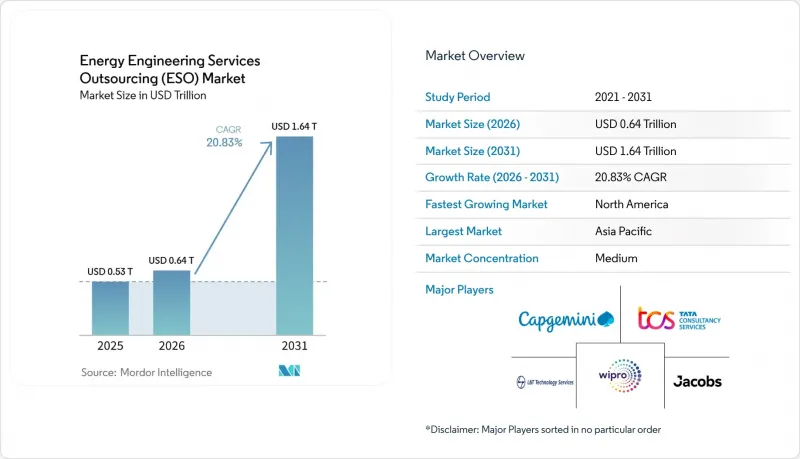
This report is Segmented by Service Type (Structuring and Layout, Digitization, and More), Deployment Model (Onshore and Offshore), Sourcing Model (Captive Outsourcing and Third-Party Outsourcing), Energy Source (Renewable, and More), and Geography (North America, Europe, Asia-Pacific, South America, Middle East and Africa). Market Forecasts are Provided in Value (USD).
Global Energy Engineering Services Outsourcing (ESO) Market Trends and Insights
Decarbonization Mandates Drive Renewable Integration Complexity
Binding climate legislation, such as the European Union Fit for 55 package and the United States Inflation Reduction Act, requires utilities to integrate large volumes of intermittent renewables within compressed timelines. As grid operators lack in-house skills in power-electronics modeling, harmonics management, and hybrid storage design, they increasingly contract specialist engineering partners to co-design inverter specifications, dynamic line-rating strategies, and advanced energy-management algorithms. The complexity is magnified by the need to retrofit aging substations while maintaining reliability indices. Outsourcing providers now bundle grid-code compliance, protection studies, and commissioning services, creating a one-stop solution that accelerates project approval and reduces schedule risk. Demand is strongest in mature markets where 2030 net-zero targets trigger multibillion-dollar transmission reinforcements and flexible-resource additions.
Cost Pressures Accelerate Operational Efficiency Through Outsourcing
Labor arbitrage remains a key driver of the energy engineering services outsourcing market. In 2025, India hosted 77 energy-focused global capability centers employing approximately 50,000 professionals. Chevron's USD 1 billion Bengaluru hub alone plans to add 600 engineers focused on front-end design for upstream assets. Comparable roles in Houston can cost three times Indian salaries, allowing operators to redeploy domestic staff toward strategic planning while offshore teams working across time zones handle piping isometrics, loop diagrams, and quantity take-offs. Shell's India workforce exceeded 13,000 in 2025, providing LNG terminal engineering and digital support services that reduce cycle times and support margins. Attrition remains a challenge; however, remote tools, standardized design libraries, and automated quality checks help keep unit costs down even as salary inflation rises.
Cyber-security Concerns Limit Critical Infrastructure Outsourcing
The 2024 revision of NIST SP 800-82 elevated security baselines for industrial control systems and tightened third-party access provisions. Utilities now conduct more stringent vendor risk assessments covering supply chain pedigree, zero-trust architectures, and software bill-of-materials disclosure. Intellectual property leakage concerns are significant in advanced control algorithms that underpin renewable curtailment minimization and voltage-ride-through compliance. Some critical national infrastructure owners require onshore engineering centers even at 25-30% cost premiums, which delays award timelines and limits provider pools. Compliance with NERC CIP, ISO 27001, and regional privacy statutes increases transaction costs and slows cross-border file exchange, particularly for multi-cloud model hosting.
Other drivers and restraints analyzed in the detailed report include:
- Digital Transformation Enables Advanced Engineering Service Models
- LNG Infrastructure Expansion Creates Specialized Engineering Demand
- Oil Price Volatility Constrains Energy CAPEX Investment
For complete list of drivers and restraints, kindly check the Table Of Contents.
Segment Analysis
Digitization bookings are forecast to expand at a 25.6% CAGR between 2026 and 2031, outpacing the overall energy engineering services outsourcing market. In 2025, Structuring and Layout dominated with a 33.3% revenue share, as LNG trains, offshore platforms, and utility-scale solar farms required intensive three-dimensional modeling and plot-plan optimization. Digitization now incorporates cloud collaboration, generative design, and predictive analytics into these traditional scopes, reducing change-order cycles and lowering installed costs. For instance, Siemens digital twins prevented 15% of potential clashes before fabrication, while Tata Consultancy Services integrated smart-meter datasets into AI models that helped defer hundreds of millions of USD in distribution upgrades. The energy engineering services outsourcing market size tied to digitization is therefore on a trajectory to match traditional drafting revenue by 2029. Market share metrics will continue to shift toward software-heavy scopes as owners demand faster iterations and lower rework.
R&D and designing services benefit when project developers require feasibility studies and novel material selection. However, they rely on scarce senior talent, so growth remains just below that of digitization. Implementation and maintenance activities scale with the installed asset base, contributing steady fee streams but at a slower growth rate. Environmental and decommissioning services round out the portfolio and are rising in line with stricter emissions regulations. Across these workstreams, energy engineering services outsourcing market dynamics favor vendors that combine domain engineers with data scientists, shortening the path from conceptual model to execution.
Offshore scopes are projected to grow at a 22.7% CAGR through 2031, outpacing the onshore segment, which accounted for 61.1% of 2025 spending. Floating wind systems in waters deeper than 200 m, subsea HVDC converters, and deepwater oil tie-backs each require hydrodynamic modeling, mooring analysis, and corrosion studies that support rate premiums. Equinor's Hywind Tampen recorded capacity factors above 50%, but only after extensive station-keeping simulations and dynamic-cable fatigue testing. The energy engineering services outsourcing market size for offshore scopes could surpass USD 600 billion by 2031 if announced lease rounds in California, Japan, and South Korea proceed as planned. Onshore solar EPC, gas-fired combined-cycle projects, and substations remain attractive in emerging markets where build-out volumes are high, though margins face pressure from software automation. Energy engineering services outsourcing market participants therefore balance their portfolios: offshore contracts deliver higher profitability but longer bid cycles, while onshore work maintains utilization rates.
Complete Report Scope:
- By Service Type
- Structuring & Layout
- Digitization
- R&D & Designing
- Implementation & Maintenance
- Other Services
- By Deployment Model
- Onshore
- Offshore
- By Sourcing Model (Qualitative Analysis Only)
- Captive Outsourcing
- Third-party Outsourcing
- By Energy Source
- Renewable
- Non-renewable
- Chemical Processing
- By Geography
- North America
- United States
- Canada
- Mexico
- Europe
- Germany
- United Kingdom
- France
- Italy
- NORDIC Countries
- Russia
- Rest of Europe
- Asia-Pacific
- China
- India
- Japan
- South Korea
- ASEAN Countries
- Rest of Asia-Pacific
- South America
- Brazil
- Argentina
- Rest of South America
- Middle East and Africa
- Saudi Arabia
- United Arab Emirates
- South Africa
- Egypt
- Rest of Middle East and Africa
- North America
Geography Analysis
Asia-Pacific accounted for 43.4% of 2025 revenue, supported by India's large engineering talent pool, China's offshore wind expansion, and Southeast Asia's LNG import plans. The energy engineering services outsourcing market continues to benefit from wage differences, with average Indian engineering salaries at approximately 35% of U.S. equivalents. China's offshore capacity increased sharply in 2025 and targets at least 120 GW by 2030, sustaining demand for blade design and subsea cable routing. Data sovereignty laws may limit some cross-border collaboration, though near-shore service centers in Malaysia and the Philippines are emerging as alternatives for Western clients.
North America is projected to grow at a 24.9% CAGR through 2031, driven by renewables tax credits, LNG export terminals, and hydrogen hubs supported by U.S. federal grants. Projects such as Calcasieu Pass 2, Golden Pass LNG, and the Alaska LNG venture collectively exceed USD 70 billion in capital expenditure and support multi-year engineering workstreams. Offshore wind prospects in the New York Bight and California are substantial, though lease moratoriums and procurement cost inflation present risks.
Europe's offshore wind market remains a key segment despite permitting timelines of five to seven years. Cable awards to NKT and Prysmian confirm continued spending, while hydrogen-ready pipeline conversions in Germany and Denmark expand downstream scopes. Data protection regulations require in-region data centers, prompting vendors to establish EU-based secure engineering infrastructure.
The Middle East is directing capital into gigawatt-scale green hydrogen, solar-plus-storage, and new LNG hubs. Saudi Arabia's NEOM Green Hydrogen project, with 4 GW of renewable generation and 600 t/d hydrogen output, is among the largest ongoing outsourced engineering programs globally.
South America and Africa contribute smaller but strategic workloads. Petrobras' pre-salt subsea systems and South Africa's renewables auctions each drive niche demand, though currency volatility and local-content mandates narrow margins for international vendors.
- AECOM
- AFRY AB
- Alten S.A.
- Altran Technologies S.A.
- AtkinsRealis Group Inc.
- Black & Veatch Holding Company
- Capgemini SE
- Cyient Limited
- HCL Technologies Limited
- Hitachi Energy Ltd.
- Infosys Limited
- Jacobs Solutions Inc.
- Larsen & Toubro Technology Services Limited (LTTS)
- Ramboll Group A/S
- SNC-Lavalin Group Inc.
- Tata Consultancy Services Limited (TCS)
- Tech Mahindra Limited
- Wipro Limited
- Wood plc
- Worley Limited
Additional Benefits:
- The market estimate (ME) sheet in Excel format
- 3 months of analyst support
TABLE OF CONTENTS
1 Introduction
- 1.1 Study Assumptions & Market Definition
- 1.2 Scope of the Study
2 Research Methodology
3 Executive Summary
4 Market Landscape
- 4.1 Market Overview
- 4.2 Market Drivers
- 4.2.1 Decarbonization mandates & renewable integration
- 4.2.2 Cost pressure & need for operational efficiency
- 4.2.3 Digitalization & Industry 4.0 adoption
- 4.2.4 Expansion of LNG & gas infrastructure
- 4.2.5 Subsea power-cable engineering for offshore wind clusters
- 4.2.6 Hydrogen-ready pipeline retrofit demand
- 4.3 Market Restraints
- 4.3.1 Cyber-security & IP concerns in outsourcing
- 4.3.2 Oil-price volatility dampening CAPEX
- 4.3.3 Shortage of niche renewable domain experts
- 4.3.4 Geopolitical data-transfer restrictions
- 4.4 Supply-Chain Analysis
- 4.5 Regulatory Landscape
- 4.6 Technological Outlook
- 4.7 Porters Five Forces Analysis
- 4.7.1 Threat of New Entrants
- 4.7.2 Bargaining Power of Buyers
- 4.7.3 Bargaining Power of Suppliers
- 4.7.4 Threat of Substitutes
- 4.7.5 Competitive Rivalry
5 Market Size & Growth Forecasts
- 5.1 By Service Type
- 5.1.1 Structuring & Layout
- 5.1.2 Digitization
- 5.1.3 R&D & Designing
- 5.1.4 Implementation & Maintenance
- 5.1.5 Other Services
- 5.2 By Deployment Model
- 5.2.1 Onshore
- 5.2.2 Offshore
- 5.3 By Sourcing Model (Qualitative Analysis Only)
- 5.3.1 Captive Outsourcing
- 5.3.2 Third-party Outsourcing
- 5.4 By Energy Source
- 5.4.1 Renewable
- 5.4.2 Non-renewable
- 5.4.3 Chemical Processing
- 5.5 By Geography
- 5.5.1 North America
- 5.5.1.1 United States
- 5.5.1.2 Canada
- 5.5.1.3 Mexico
- 5.5.2 Europe
- 5.5.2.1 Germany
- 5.5.2.2 United Kingdom
- 5.5.2.3 France
- 5.5.2.4 Italy
- 5.5.2.5 NORDIC Countries
- 5.5.2.6 Russia
- 5.5.2.7 Rest of Europe
- 5.5.3 Asia-Pacific
- 5.5.3.1 China
- 5.5.3.2 India
- 5.5.3.3 Japan
- 5.5.3.4 South Korea
- 5.5.3.5 ASEAN Countries
- 5.5.3.6 Rest of Asia-Pacific
- 5.5.4 South America
- 5.5.4.1 Brazil
- 5.5.4.2 Argentina
- 5.5.4.3 Rest of South America
- 5.5.5 Middle East and Africa
- 5.5.5.1 Saudi Arabia
- 5.5.5.2 United Arab Emirates
- 5.5.5.3 South Africa
- 5.5.5.4 Egypt
- 5.5.5.5 Rest of Middle East and Africa
- 5.5.1 North America
6 Competitive Landscape
- 6.1 Market Concentration
- 6.2 Strategic Moves (M&A, Partnerships, PPAs)
- 6.3 Market Share Analysis (Market Rank/Share for key companies)
- 6.4 Company Profiles (includes Global level Overview, Market level overview, Core Segments, Financials as available, Strategic Information, Products & Services, and Recent Developments)
- 6.4.1 AECOM
- 6.4.2 AFRY AB
- 6.4.3 Alten S.A.
- 6.4.4 Altran Technologies S.A.
- 6.4.5 AtkinsRealis Group Inc.
- 6.4.6 Black & Veatch Holding Company
- 6.4.7 Capgemini SE
- 6.4.8 Cyient Limited
- 6.4.9 HCL Technologies Limited
- 6.4.10 Hitachi Energy Ltd.
- 6.4.11 Infosys Limited
- 6.4.12 Jacobs Solutions Inc.
- 6.4.13 Larsen & Toubro Technology Services Limited (LTTS)
- 6.4.14 Ramboll Group A/S
- 6.4.15 SNC-Lavalin Group Inc.
- 6.4.16 Tata Consultancy Services Limited (TCS)
- 6.4.17 Tech Mahindra Limited
- 6.4.18 Wipro Limited
- 6.4.19 Wood plc
- 6.4.20 Worley Limited
7 Market Opportunities & Future Outlook
- 7.1 White-Space & Unmet-Need Assessment


