

|
시장보고서
상품코드
2097341
솔라 트리 시장 : 시장 점유율 분석, 산업 동향 및 통계 데이터, 성장 예측(2026-2031년)Solar Tree - Market Share Analysis, Industry Trends & Statistics, Growth Forecasts (2026 - 2031) |
||||||
 Mordor Intelligence
Mordor Intelligence에 의하면, 솔라 트리 시장 규모는 2025년에 2억 7,693만 달러로 평가되었고, 2026년에 2억 9,335만 달러에서 2031년까지 3억 8,686만 달러에 이를 것으로 예측되며, 2026-2031년 CAGR 5.69%로 성장할 전망입니다.
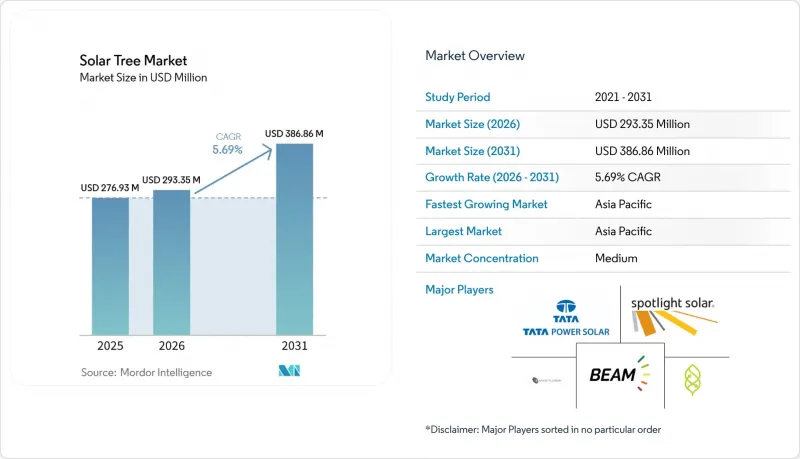
본 보고서는 제품 유형별(계통 연계형, Off-grid형, 하이브리드형), 태양전지 기술별(단결정, 기타), 출력별(1kW 이하, 1-5kW, 5kW 초과), 설치 방식별(자립형, 기타), 용도별(도시 경관, 기타), 지역별(북미, 유럽, 아시아태평양, 남미, 중동 및 아프리카)로 분류되어 있습니다. 시장 예측은 금액(달러)으로 제시되어 있습니다.
세계의 솔라 트리 시장 동향 및 인사이트
70개국 이상에서의 재생에너지 도입 의무
정책 목표에 따라 분산형 발전 도입이 촉진되고 있으며, 토지나 지붕의 제약으로 인해 평판형 패널 설치가 어려운 경우, 솔라 트리 시장이 혜택을 보고 있습니다. 유럽연합(EU)의 개정 재생에너지 지침에서는 회원국들에게 2030년까지 재생에너지 발전에 의한 전력 공급 비율을 42.5%로 높일 것을 의무화하고 있습니다. 캘리포니아주의 SB 100 및 타이틀 24 건축 기준에 따라, 신축 주차장 시설에는 태양광 발전 대응 인프라가 의무화되어 있으며, 소유주는 캐노피형 솔라 트리 도입으로 유도되고 있습니다. 메릴랜드주의 HB 1036에 따르면, 2030년까지 주 정부 기관 주차 공간의 50%에 태양광 발전 설비를 설치해야 하며, 이로 인해 즉시 200메가와트 시장 기회가 창출되고 있습니다. 인도의 ‘국가 태양광 미션’은 2030년까지 500기가와트의 재생에너지 도입을 목표로 하고 있으며, ‘스마트 시티 미션’ 자금을 발전 기능을 갖춘 도로 시설에 투입하고 있습니다. 솔라 트리를 명시적으로 규정하는 규칙은 거의 없지만, 옥상 설치 공간이 포화 상태이거나 건축상 보호 대상인 장소에서는 지자체 계획 담당자가 솔라 트리를 선택하는 사례가 늘고 있습니다.
도시 녹화 및 스마트시티 설비에 대한 수요
각 시의회는 에너지를 생산하는 설비를 도입함으로써 탄소 중립 목표와 ‘플레이스메이킹(공간 조성)’을 연계하고 있습니다. 두바이 시 당국은 하루 7.2kWh의 전력을 생산하면서 Wi-Fi 및 기기 충전 기능을 제공하는 ‘스마트 팜’ 103기를 설치하여, 이를 관광 명소로 자리매김시켰습니다. 이와 유사한 전략이 아세안(ASEAN)의 메가시티에서도 확산되고 있으며, 솔라 트리가 보도에 그늘을 만들어 조명 비용을 절감하고, 내장 센서를 통해 데이터를 수집하고 있습니다. 일반 시민의 관심과 소셜 미디어에서의 주목도가 높아지면서 예산 승인이 가속화되고 있으며, 이를 통해 공급업체들은 본래 보수적인 조달 채널에 진입할 기회를 얻고 있습니다. 또한 통합형 디자인은 설치 장소 주변의 지가를 끌어올리고 있으며, 개발업자들은 이를 활용하여 자본 비용을 회수하고 있습니다.
높은 초기 설비 투자(CAPEX) 대 옥상 태양광 발전
미국 에너지부(DOE)의 벤치마크에 따르면, 설치 비용은 1W당 4.50-6달러로, 평지붕에 설치하는 것에 비해 여전히 30-50% 더 비쌉니다. 주차장의 그늘이나 브랜딩을 통해 추가 수익을 얻을 수 있는 경우 이 차이는 줄어들지만, 지자체 예산에서는 대부분의 경우 더 저렴한 카포트형 태양광 패널이 우선적으로 채택되고 있습니다. 브라질의 분산형 발전에 대한 지출은 2026년을 향해 감소 추세를 보이고 있어, 고부가가치 제품에 압박이 가해지고 있습니다. 자금 조달 옵션은 진화하고 있으며, 코네티컷 그린 뱅크(Connecticut Green Bank)가 2026년 2월에 발표한 RFP에서는 공간이 제한된 부지에 솔라 트리(Solar Tree) 설치를 명시적으로 허용하고 있지만, 이러한 구조물은 여전히 일반적이지 않아 판매 주기에 걸림돌이 되고 있습니다.
부문 분석
2025년 매출의 65.1%를 Off-grid형 시스템이 차지했습니다. 이는 주로 농촌 지역 대상 프로그램이나 재난 대응 기관이 ‘플러그 앤 플레이’ 방식의 신뢰성을 우선시하기 때문입니다. ECOSUN사의 컨테이너형 ‘Mobil-Grid’는 외딴 지역의 광산에서 디젤 발전을 대체하고 있으며, 연료비가 0.40달러/kWh를 초과할 경우 투자 회수 기간은 4년 미만이 됩니다. 하이브리드 시스템은 배터리 비용이 75달러/kWh 수준으로 하락함에 따라 연평균 성장률(CAGR) 7.4%로 성장하고 있으며, 이를 통해 도시 지역에서는 현장 에너지 저장을 통해 정전 시 전력 공급을 유지하면서 고정가격임베디드제도(FIT)에 따른 크레딧을 획득할 수 있게 되었습니다. 유럽의 FIT 시장에서는 여전히 계통 연계 전용 설계가 존재하지만, 기타 지역에서는 점유율이 하락하고 있습니다.
지자체에서 실시하는 실증 실험에서는 용도에 관계없이 기능의 융합이 진행되고 있음이 나타나고 있습니다. 플로리다 파워 앤 라이트(Florida Power & Light)사의 ‘SolarNow’ 프로그램에서는 2025년 종료 시까지 70곳에 100대 이상의 하이브리드 유닛이 도입되었으며, 허리케인 발생 시 방문자 센터가 백업 전원의 혜택을 받는다는 사실이 입증되었습니다. 다야난다 사갈 칼리지(Dayananda Sagar College) 등 공학계 교육 기관에서는 솔라 트리에 소형 풍력 로터를 통합하고 있으며, 설비 투자 비용이 25% 증가함에도 불구하고 연구 자금을 확보하고 있습니다. 먼지가 많은 사헬 지역 설치 사례에서는 정기적인 청소를 하지 않으면 연간 15-20%의 에너지 손실이 발생하는 것으로 밝혀졌으며, 이에 따라 각 제조업체들은 발수 코팅 적용을 추진하고 있습니다.
2025년에는 양산에 따른 비용 면에서의 우위를 바탕으로 단결정 실리콘이 74.7%의 시장 점유율을 차지했습니다. JinkoSolar사의 TOPCon 셀은 23% 이상의 효율을 실현하여, 설치당 패널 수를 줄이고 마스트 구조의 경량화가 가능해졌습니다. 역사적 건축물에서는 반사 유리가 기피되는 경향이 있어, 박막형 및 건축 일체형(BIPV) 시장 점유율은 상승할 것으로 예측됩니다. 두바이의 ASCA가 개발한 유기 태양전지를 탑재한 야자수는 기존 하드웨어로는 충족할 수 없는 설계 요건을 플렉서블 모듈이 어떻게 충족시키는지를 입증하고 있습니다.
페로브스카이트-탠덤에 관한 조사에서는 25%의 잠재적 발전 효율과 70%의 경량화가 제시되고 있지만, 보증 기간은 여전히 10년 미만에 그치고 있어 20년 보증을 요건으로 하는 지자체 계약에서의 채택을 제한하고 있습니다. 양면 수광 모듈은 지표면의 알베도 효과로 인해 10-18%의 추가 발전량을 얻을 수 있으며, 일본에서는 동서 방향의 지지대 설치를 통해 피크 시간대의 가격 차이를 활용한 수익화가 진행되고 있습니다. 다각화가 진행됨에 따라 패널 공급업체들은 모바일 키트용 경량 필름이나 계통 연계 설비용 TOPCon 단결정 등 전문화를 추진하고 있어, 시장 전체의 조달 제휴 관계에 변화가 생기고 있습니다.
지역별 분석
아시아태평양은 2024년 매출의 45.5%를 차지했으며, 고밀도 도시화, 적극적인 재생에너지 포트폴리오 기준, 그리고 하드웨어 비용을 절감하는 지역적 공급망 확충을 배경으로 2030년까지 연평균 성장률(CAGR) 6.2%를 기록할 전망입니다. 중국이 추진하는 8GW 규모의 사막 복합 시설 건설은 지역 지자체 프로젝트의 부품 가격에도 파급 효과를 미치는 규모의 경제 효과를 입증하고 있습니다. 싱가포르와 태국에서는 수입 전력 및 지역 간 송전망 연결에 대한 정책적 인센티브가 중첩되어 있어, 토지가 제한된 대도시권에서 콤팩트하고 고효율적인 솔루션에 대한 지속적인 수요가 확보되고 있습니다.
북미와 유럽은 정책 주도형의 성숙한 시장을 형성하고 있으며, 탄소 중립 건축 기준과 기업의 ESG 목표 덕분에 인건비 급등에도 불구하고 안정적인 수주가 유지되고 있습니다. 캘리포니아주의 상업용 태양광 발전 의무화 및 뉴욕시의 지방법 제92호·제94호는 지붕을 최대한 활용하는 경우 수직 배치를 우선시하는 규정 준수 최소 기준을 정하고 있습니다. 유럽에서는 독일의 30% 세액 공제부터 이탈리아의 ‘슈퍼 보너스’에 이르기까지, 국가별 세액 공제 차이가 각국의 성장 궤적을 형성하고 있지만, 역사적 중심지에서 공통적으로 발생하는 토지 부족 문제로 인해 구매자들은 조각적인 디자인을 갖춘 태양광 발전 옵션을 선호하는 경향이 있습니다. 2027년까지의 연간 태양광 발전 도입량 전망치인 93.1 GW는 엄격한 도시 설계 기준과 공존하는 특수한 형태의 프로젝트 파이프라인을 더욱 확대시키고 있습니다.
남미, 중동 및 아프리카는 총 수익 점유율은 작지만, 장기적으로는 매우 큰 잠재력을 보이고 있습니다. 모듈 가격 하락으로 니제르에서는 패널 판매량이 두 배로 증가했으며, 취약한 송전망을 우회할 수 있는 수직형 어레이에 대한 수요가 생겨났습니다. 가나의 16.8 MW 옥상 태양광 발전 프로젝트는 기부자 지원 프로그램이 열대 환경에서의 성능을 입증하는 선구적인 프로젝트를 어떻게 가속화할 수 있는지를 보여주고 있습니다. 자금 조달 수단이 성숙해짐에 따라, 이 지역에서는 관개, 의료, 통신탑 용도로 모듈식 Off-grid형 ‘솔라 트리’로 직접 전환할 것으로 기대됩니다.
기타 혜택 :
- Excel 형식 시장 예측(ME) 시트
- 3개월간의 애널리스트 지원
자주 묻는 질문
목차
제1장 서론
제2장 분석 방법
제3장 주요 요약
제4장 시장 구도
제5장 시장 규모 및 성장률 예측
제6장 경쟁 구도
제7장 시장 기회 및 향후 전망
AJY 26.08.07According to Mordor Intelligence, the solar tree market size is projected to be USD 276.93 million in 2025, USD 293.35 million in 2026, and reach USD 386.86 million by 2031, growing at a CAGR of 5.69% from 2026 to 2031.
This report is Segmented by Product Type (On-Grid, Off-Grid, Hybrid), Solar-Panel Technology (Monocrystalline, and Others), Power Output (Up To 1 KW, 1-5 KW, Above 5 KW), Installation Mode (Free-Standing, and Others), Application (Urban Landscaping, and Others), and Geography (North America, Europe, Asia-Pacific, South America, Middle East and Africa). Market Forecasts are Provided in Value (USD).
Global Solar Tree Market Trends and Insights
Renewable-Energy Mandates From Over 70 Countries
Policy targets are steering procurement toward distributed generation, and the solar tree market benefits when land or roof constraints rule out flat panels. The European Union's revised Renewable Energy Directive compels member states to hit 42.5% renewable electricity by 2030. California's SB 100 and Title 24 codes now require solar-ready infrastructure on new parking structures, nudging owners toward canopy-style solar trees. Maryland's HB 1036 demands solar on 50% of state-agency parking space by 2030, instantly creating a 200-megawatt opportunity. India's National Solar Mission seeks 500 gigawatts of renewables by 2030 and channels Smart Cities Mission funds into energy-generating street furniture. Although few rules explicitly name solar trees, municipal planners increasingly select them where rooftops are saturated or architecturally protected.
Urban Greening and Smart-City Furniture Demand
City councils are combining carbon-neutrality goals with placemaking by adopting energy-producing amenities. Dubai Municipality installed 103 Smart Palm units that generate 7.2 kWh per day while offering Wi-Fi and device charging, establishing these as tourist landmarks. Similar strategies are emerging across ASEAN mega-cities, where solar trees shade walkways, reduce lighting costs, and collect data via embedded sensors. Public interest and social media visibility are accelerating budget approvals, giving suppliers an entry point into otherwise conservative procurement channels. Integrated designs are also increasing land value around deployment sites, which developers use to recoup capital costs.
High Initial CAPEX vs. Rooftop PV
Installed costs of USD 4.50-6.00 per W remain 30-50% above flat roof installations, according to DOE benchmarks. This gap narrows where parking shade or branding generates additional revenue; however, municipal budgets often default to lower-cost carport arrays. Brazil's distributed-generation outlays are declining for 2026, putting pressure on premium products. Financing options are evolving, with Connecticut Green Bank's February 2026 RFP explicitly permitting solar trees on constrained sites, but such structures remain uncommon, maintaining friction in the sales cycle.
Other drivers and restraints analyzed in the detailed report include:
- Space-Efficient Power for Land-Scarce Metros
- Surge in EV-Charging Nodes Needing Solar Trees
- Low Consumer / EPC Familiarity Outside EU
For complete list of drivers and restraints, kindly check the Table Of Contents.
Segment Analysis
Off-grid systems accounted for 65.1% of 2025 revenue, primarily because rural programs and disaster response agencies prioritize plug-and-play reliability. ECOSUN's containerized Mobil-Grid replaces diesel at remote mines, with payback periods of under four years when fuel costs exceed USD 0.40 /kWh. Hybrid systems are growing at a 7.4% CAGR as battery costs decline toward USD 75/kWh, enabling cities to capture feed-in credits while maintaining power during outages through on-site storage. On-grid-only designs remain present in European feed-in-tariff markets but are losing share elsewhere.
Municipal pilots demonstrate functional convergence across applications. Florida Power & Light's SolarNow program deployed more than 100 hybrid units across 70 venues before the program ended in 2025, showing that visitor centers benefit from backup power during hurricanes. Engineering institutions such as Dayananda Sagar College are integrating small wind rotors onto solar trees, attracting research funding despite a 25% higher capital expenditure. Installations in dusty Sahel environments show 15-20% annual energy losses without regular cleaning, prompting manufacturers to adopt hydrophobic coatings.
Monocrystalline silicon held a 74.7% market share in 2025, driven by cost advantages from mass production. JinkoSolar's TOPCon cells exceed 23% efficiency, enabling fewer panels per installation and lighter mast structures. The market share of thin-film and building-integrated variants is expected to rise, as heritage sites reject reflective glass. Dubai's ASCA organic-photovoltaic palms demonstrate how flexible modules meet design requirements that conventional hardware cannot fulfill.
Perovskite tandem research indicates potential efficiency of 25% alongside 70% weight savings; however, warranties remain under ten years, limiting adoption in municipal contracts that require 20-year coverage. Bifacial modules capture 10-18% additional yield from ground albedo, with Japan's east-west rack installations monetizing this through peak-price arbitrage. Growing diversification is prompting panel suppliers to specialize, lightweight film for mobile kits and TOPCon monocrystalline for grid-tied installations, reshaping procurement alliances across the market.
Complete Report Scope:
- By Product Type
- On-grid Solar Trees
- Off-grid Solar Trees
- Hybrid Solar Trees
- By Solar-Panel Technology
- Monocrystalline Silicon
- Polycrystalline Silicon
- Thin-film and BIPV
- By Power Output
- Up to 1 kW
- 1 to 5 kW
- Above 5 kW
- By Installation Mode
- Free-standing Foundation
- Rooftop / Terrace Mounted
- Modular Kit and Mobile Units
- By Application
- Urban Landscaping and Parks
- Commercial and Industrial Estates
- Educational and Research Campuses
- Residential Micro-PV
- EV-Charging and Transport Hubs
- Rural Electrification and Agri-uses
- By Geography
- North America
- United States
- Canada
- Mexico
- Europe
- Germany
- United Kingdom
- France
- Italy
- NORDIC Countries
- Russia
- Rest of Europe
- Asia-Pacific
- China
- India
- Japan
- South Korea
- ASEAN Countries
- Rest of Asia-Pacific
- South America
- Brazil
- Argentina
- Rest of South America
- Middle East and Africa
- Saudi Arabia
- United Arab Emirates
- South Africa
- Egypt
- Rest of Middle East and Africa
- North America
Geography Analysis
Asia-Pacific retained 45.5% of 2024 revenue and is on track for a 6.2% CAGR to 2030, supported by dense urbanization, aggressive renewable-portfolio standards, and regional supply-chain depth that lowers hardware costs. China's build-out of an 8 GW desert complex demonstrates the scale benefits that spill into component pricing for regional municipal projects. Singapore and Thailand layer policy incentives on imported electricity and regional grid links, ensuring continuous demand for compact, high-yield solutions in land-scarce metros.
North America and Europe form a mature, policy-driven corridor where zero-carbon building codes and corporate ESG targets sustain steady orders despite higher labor costs. California's commercial solar mandate and New York City's Local Laws 92/94 set compliance floors that favor vertical arrays when roofs are fully utilized. In Europe, differential tax credits-from Germany's 30% write-off to Italy's Superbonus-shape country-level growth trajectories, yet shared land-scarcity issues in historic cores tilt buyers toward sculptural solar options. The 93.1 GW annual solar-addition outlook through 2027 deepens the pipeline for specialty formats that coexist with strict urban-design codes.
South America, the Middle East, and Africa collectively account for a smaller revenue slice but exhibit outsized long-run potential. Falling module prices doubled panel sales in Niger and seeded demand for vertical arrays that can bypass fragile grids. Ghana's 16.8 MW rooftop showcase illustrates how donor-backed programs accelerate first-mover projects that validate performance under tropical conditions. As financing tools mature, these regions are expected to leapfrog directly to modular, off-grid trees for irrigation, healthcare, and telecom towers.
- Arka Energy
- Beam Global
- Big Sun Energy Technology Inc.
- Cofly Energy
- CSIR - Central Mechanical Engineering Research Institute (CSIR-CMERI)
- ENGO Planet
- Envision Solar International, Inc.
- Heliatronics, Inc.
- Ideematec Deutschland GmbH
- JinkoSolar Holding Co., Ltd.
- NXTGEN NanoTree
- Smartflower Solar GmbH
- Solar Vertical SAS
- SolarBotanic Trees Ltd.
- Solarix B.V.
- Spotlight Solar LLC
- Su-Kam Power Systems Limited
- SunRobotics Technologies Private Limited
- Tata Power Solar Systems Limited (Solar-Tree Division)
- Tree Power Co., Ltd.
Additional Benefits:
- The market estimate (ME) sheet in Excel format
- 3 months of analyst support
TABLE OF CONTENTS
1 Introduction
- 1.1 Study Assumptions & Market Definition
- 1.2 Scope of the Study
2 Research Methodology
3 Executive Summary
4 Market Landscape
- 4.1 Market Overview
- 4.2 Market Drivers
- 4.2.1 Renewable-energy mandates from Over 70 countries
- 4.2.2 Urban greening & smart-city furniture demand
- 4.2.3 Space-efficient power for land-scarce metros
- 4.2.4 Surge in EV-charging nodes needing solar trees
- 4.2.5 Lightweight bio-resin mast reduces install time
- 4.3 Market Restraints
- 4.3.1 High initial CAPEX vs. rooftop PV
- 4.3.2 Low consumer/EPC familiarity outside EU
- 4.3.3 Height & aesthetic by-laws in heritage districts
- 4.3.4 Complex O&M for articulated petal designs
- 4.4 Supply-Chain Analysis
- 4.5 Regulatory Landscape
- 4.6 Technological Outlook
- 4.7 Porter's Five Forces
- 4.7.1 Threat of New Entrants
- 4.7.2 Bargaining Power of Buyers
- 4.7.3 Bargaining Power of Suppliers
- 4.7.4 Threat of Substitutes
- 4.7.5 Competitive Rivalry
5 Market Size & Growth Forecasts
- 5.1 By Product Type
- 5.1.1 On-grid Solar Trees
- 5.1.2 Off-grid Solar Trees
- 5.1.3 Hybrid Solar Trees
- 5.2 By Solar-Panel Technology
- 5.2.1 Monocrystalline Silicon
- 5.2.2 Polycrystalline Silicon
- 5.2.3 Thin-film and BIPV
- 5.3 By Power Output
- 5.3.1 Up to 1 kW
- 5.3.2 1 to 5 kW
- 5.3.3 Above 5 kW
- 5.4 By Installation Mode
- 5.4.1 Free-standing Foundation
- 5.4.2 Rooftop / Terrace Mounted
- 5.4.3 Modular Kit and Mobile Units
- 5.5 By Application
- 5.5.1 Urban Landscaping and Parks
- 5.5.2 Commercial and Industrial Estates
- 5.5.3 Educational and Research Campuses
- 5.5.4 Residential Micro-PV
- 5.5.5 EV-Charging and Transport Hubs
- 5.5.6 Rural Electrification and Agri-uses
- 5.6 By Geography
- 5.6.1 North America
- 5.6.1.1 United States
- 5.6.1.2 Canada
- 5.6.1.3 Mexico
- 5.6.2 Europe
- 5.6.2.1 Germany
- 5.6.2.2 United Kingdom
- 5.6.2.3 France
- 5.6.2.4 Italy
- 5.6.2.5 NORDIC Countries
- 5.6.2.6 Russia
- 5.6.2.7 Rest of Europe
- 5.6.3 Asia-Pacific
- 5.6.3.1 China
- 5.6.3.2 India
- 5.6.3.3 Japan
- 5.6.3.4 South Korea
- 5.6.3.5 ASEAN Countries
- 5.6.3.6 Rest of Asia-Pacific
- 5.6.4 South America
- 5.6.4.1 Brazil
- 5.6.4.2 Argentina
- 5.6.4.3 Rest of South America
- 5.6.5 Middle East and Africa
- 5.6.5.1 Saudi Arabia
- 5.6.5.2 United Arab Emirates
- 5.6.5.3 South Africa
- 5.6.5.4 Egypt
- 5.6.5.5 Rest of Middle East and Africa
- 5.6.1 North America
6 Competitive Landscape
- 6.1 Market Concentration
- 6.2 Strategic Moves (M&A, Partnerships, PPAs)
- 6.3 Market Share Analysis (Market Rank/Share for key companies)
- 6.4 Company Profiles (includes Global level Overview, Market level overview, Core Segments, Financials as available, Strategic Information, Products & Services, and Recent Developments)
- 6.4.1 Arka Energy
- 6.4.2 Beam Global
- 6.4.3 Big Sun Energy Technology Inc.
- 6.4.4 Cofly Energy
- 6.4.5 CSIR - Central Mechanical Engineering Research Institute (CSIR-CMERI)
- 6.4.6 ENGO Planet
- 6.4.7 Envision Solar International, Inc.
- 6.4.8 Heliatronics, Inc.
- 6.4.9 Ideematec Deutschland GmbH
- 6.4.10 JinkoSolar Holding Co., Ltd.
- 6.4.11 NXTGEN NanoTree
- 6.4.12 Smartflower Solar GmbH
- 6.4.13 Solar Vertical SAS
- 6.4.14 SolarBotanic Trees Ltd.
- 6.4.15 Solarix B.V.
- 6.4.16 Spotlight Solar LLC
- 6.4.17 Su-Kam Power Systems Limited
- 6.4.18 SunRobotics Technologies Private Limited
- 6.4.19 Tata Power Solar Systems Limited (Solar-Tree Division)
- 6.4.20 Tree Power Co., Ltd.
7 Market Opportunities & Future Outlook
- 7.1 White-space & Unmet-need Assessment


