

|
시장보고서
상품코드
2097344
자동차용 제스처 인식 시스템 시장 : 시장 점유율 분석, 산업 동향 및 통계 데이터, 성장 예측(2026-2031년)Automotive Gesture Recognition Systems - Market Share Analysis, Industry Trends & Statistics, Growth Forecasts (2026 - 2031) |
||||||
 Mordor Intelligence
에 의하면, 자동차용 제스처 인식 시스템 시장 규모는 2025년에 25억 5,000만 달러로 평가되었고, 2026년 29억 8,000만 달러에서 2031년까지 64억 9,000만 달러에 이를 것으로 예측되며, CAGR은 16.86%로 성장할 전망입니다.

본 보고서는 컴포넌트별(터치식 시스템, 터치리스 시스템), 인증 방식별(손 및 지문, 얼굴, 시각 및 홍채, 기타), 용도별(멀티미디어 인포테인먼트 내비게이션, 조명 시스템, 기타), 기술별(카메라식 시스템 등), 지역별(북미 등)로 분류되어 있습니다. 시장 예측은 금액(달러) 기준으로 제시되어 있습니다.
세계의 자동차용 제스처 인식 시스템 시장 동향 및 인사이트
고급 HMI에 대한 수요가 프리미엄 차량의 차별화를 주도
각 고급차 제조업체들은 경쟁이 치열해지는 럭셔리 부문에서 제스처 인식을 핵심적인 차별화 요인으로 도입하고 있습니다. BMW의 ‘Panoramic iDrive’와 메르세데스-벤츠의 ‘MBUX Interior Assist’ 시스템은 터치리스 조작이 어떻게 기술적 우위를 창출하는지 보여주고 있습니다. 콘티넨탈이 CES 2025에서 공개한 생체 인식 데모 차량은 제스처와 생체 인식을 통합한 시스템을 특징으로 하며, 운전자가 도로에 계속 주의를 기울인 채 간단한 손 동작으로 차량 설정을 개인화할 수 있도록 합니다. 이러한 통합은 인포테인먼트에 그치지 않고, 공조 제어, 시트 조절, 앰비언트 조명까지 확장되어 있으며, 재규어 랜드로버의 비접촉식 터치스크린 기술은 초음파 햅틱스를 통해 촉각 피드백을 유지하면서도 물리적 접촉을 배제하고 있습니다. 이러한 추세는 특히 기존 기계적 차별화가 각 차종 부문에서 상품화되는 가운데, 제스처 제어가 정서적 몰입과 혁신의 가치를 창출하여 프리미엄 가격 책정을 정당화한다는 OEM 각사의 인식을 반영하고 있습니다.
규제 체계가 운전자 모니터링 통합 가속화
2024년 7월까지 신형 대형 상용차에 실시간 운전자 모니터링을 의무화하는 유럽연합(EU)의 ‘고도 운전자 주의 산만 경고(ADDW)’ 규제는 종합적인 운전자 상태 평가 시스템의 일환으로 제스처 인식 도입을 촉진하는 계기가 되었습니다. 미국 도로교통안전국(NHTSA)의 운전자 주의 산만 관련 지침과 유로 NCAP 프로토콜에서는 특정 주의 요구 임계값을 충족하고 페일세이프(fail-safe) 장치가 내장되어 있다는 조건을 전제로, 제스처 기반 조작이 터치스크린 조작을 대체하는 더 안전한 대안으로 점점 더 인정받고 있습니다. 규제의 영향은 안전 기준 준수에 그치지 않고 데이터 개인정보 보호 요건에도 미치고 있습니다. GDPR(EU 개인정보보호규정) 및 새로 제정되고 있는 중국의 데이터 보안법에서는 개인 데이터 전송을 최소화하기 위해 제스처 인식 처리를 단말기 내에서 수행할 것을 요구하고 있습니다. 상용차 사업자들의 보고에 따르면, 제스처 기반 운전자 모니터링 시스템이 실시간 피드백을 제공했을 때 과속 위반이 37% 감소하고, 안전벨트 미착용이 56% 감소했다고 합니다. 이는 규제 도입을 뒷받침하는 측정 가능한 안전성 향상을 입증하는 사례입니다.
비용 제약이 일반 시장으로의 보급을 방해하고 있습니다.
고급 AI 탑재 플랫폼은 시스템 비용을 증가시켜, 가격에 민감한 시장 부문, 특히 구매자들이 여전히 비용에 민감한 신흥 시장에서 도입을 지연시킬 가능성이 있습니다. 이러한 비용은 전용 카메라, 적외선 센서, 전용 처리 장치, 소프트웨어 라이선스 비용 등 여러 구성 요소에서 비롯됩니다. 또한 카메라 기반 시스템에는 다양한 조명 조건에서 안정적으로 작동하는 고해상도 센서도 필요합니다. 게다가 OEM 업체들은 자동차 안전 기준을 준수하기 위해 수천 가지의 이용 사례와 환경 조건에 걸쳐 제스처 인식 시스템을 테스트하고 검증해야 하므로, 통합에 추가 비용이 발생합니다. 이러한 검증 주기는 기존 HMI 개발 일정보다 18-24개월 더 오래 걸릴 수 있습니다. 이러한 비용 측면의 과제는 차량 운영사가 신속한 투자 회수를 기대하는 상용차 부문에서 더욱 두드러집니다. 따라서 제스처 시스템은 추가 비용을 정당화하기 위해 측정 가능한 생산성 향상 및 규제 준수 이점을 입증해야 합니다.
부문별 분석
2025년에는 터치리스 시스템이 자동차용 제스처 인식 시장에서 62.01%의 점유율을 차지하며 시장을 주도했습니다. 2031년까지 연평균 성장률(CAGR) 17.23%로 확대될 것으로 예측되며, 위생에 대한 우려와 첨단 AI 기능이 프리미엄 차량 및 상용차 부문에서의 채택을 촉진함에 따라 터치 기반 방식의 대안을 훨씬 능가하는 속도로 성장할 것으로 전망됩니다. 비접촉 부문은 팬데믹 이후 비접촉식 조작으로의 행동 변화와 운전 중 주의 산만을 줄이기 위한 규제 압력이라는 호재를 타고 있습니다. 메르세데스-벤츠의 ‘MBUX Interior Assist’나 BMW의 ‘Panoramic iDrive’와 같은 시스템은 인포테인먼트 및 공조 기능에서 에어 제스처 조작이 소비자들에게 받아들여지고 있음을 보여줍니다.
Aptiv사의 AI 기반 'Advanced Occupancy Classification' 플랫폼은 신장, 체중, 신체 위치에 따라 탑승자를 식별하며, 이는 단순한 제스처 인식을 넘어 생체 인증을 통한 접근 및 개인화된 설정을 포함하는 종합적인 비접촉형 차량 상호작용 생태계로의 수렴을 시사합니다. 이 부문의 성장 추세는 각 OEM 업체들이 터치리스 인터페이스를 프리미엄 차별화 요소로 전략적으로 포지셔닝하는 동시에, 공유 모빌리티 용도에서 발생하는 운전자의 주의 산만 및 운영상의 위생 문제에 대한 실질적인 우려에도 대응하고 있음을 반영합니다.
2025년에는 손 및 지문 인증이 48.47%의 시장 점유율을 유지한 것으로 평가되었으며, 이는 확립된 신뢰성과 사용자의 익숙함을 반영한 것입니다. 한편, 비전 및 홍채 인증은 Smart Eye사와 Fingerprint Cards사 간의 450만 달러 규모의 홍채 인증 라이선싱 계약과 같은 획기적인 제휴에 힘입어, 2031년까지 연평균 성장률(CAGR) 19.38%를 기록하며 가장 빠르게 성장이 전망되는 부문으로 부상하고 있습니다.
이러한 인증 동향은 개인화와 보안을 지향하는 자동차 업계 전반의 추세를 반영하고 있으며, 여러 사용자가 물리적 접촉 없이 신속하고 위생적인 인증을 필요로 하는 공유 모빌리티 시나리오에서 시각 기반 시스템이 우위를 점하고 있습니다. 메르세데스-벤츠가 취득한 생체 인증을 통한 차량 접근 관련 특허는 기존의 열쇠 기반 시스템을 배제하면서도 다중 요소 생체 인증을 통해 보안을 강화하는 원활한 인증 경험을 실현하려는 각 OEM 업체들의 노력을 보여줍니다.
지역별 분석
유럽은 운전 중 주의 산만을 규제하는 엄격한 법규와 프리미엄 부문에서의 조기 도입에 힘입어 2025년 매출의 34.18%를 차지했습니다. 독일은 콘티넨탈, 보쉬, 인피니온이 수직 통합형 솔루션을 제공함으로써 해당 지역에서 주도적인 입지를 확립하고 있습니다. BMW의 2025년형 7시리즈에는 에어 스와이프를 통한 시트 마사지 기능 작동이 탑재되어 있으며, 이 기능은 현재 중형 세단인 5시리즈의 일부 트림에도 채택되고 있어 기술의 트리클다운 현상을 보여주고 있습니다. 프랑스공급업체인 발레오(Valeo)는 구형 차량에 사후 장착이 가능한 듀얼 카메라식 미러 모듈을 탑재하여, 유럽 애프터마켓의 잠재적 수요를 확대되고 있습니다.
아시아태평양은 중국의 스마트 커넥티드카 관련 규제와 일본의 센서 기술 혁신 파이프라인에 힘입어 18.72%라는 가장 높은 연평균 성장률(CAGR)을 기록하고 있습니다. 베이징과 상하이 정부의 인센티브에 따라 운전자 모니터링 기능에 대해 세액 공제가 적용되고 있으며, 수출 규제를 준수하려는 국내 브랜드들의 제스처 시스템 채택이 급속히 확대되고 있습니다. 소니는 제스처 및 모니터링 수요를 전망하여 2026 회계연도까지 자동차용 이미지 센서 세계 시장 점유율 43%를 목표로 하고 있습니다. 한국의 각 OEM 업체들은 스트리밍 이용 확대를 활용하기 위해 제스처 기능을 5G 인포테인먼트에 통합하고 있는 반면, 인도의 이륜차 스타트업 기업들은 전기 스쿠터용 헬멧 장착형 제스처 모듈의 시범 운영을 진행 중이며, 이는 미개척 틈새 시장의 존재를 시사하고 있습니다.
북미에서는 상용차 차량군이 안전 텔레매틱스를 우선시하고 있어 꾸준히 발전하고 있습니다. Lytx사와 Netradyne사의 손 신호와 AI 이벤트 감지를 결합한 솔루션은 라스트 마일 사업자들 사이에서 높은 보급률을 보이고 있으며, 책임 문제로 인한 승용차 도입 지연을 상쇄하고 있습니다. 캐나다에서는 제스처 기반 지원 기술에 대한 연구개발 세액 공제가 시행되고 있어, 국경 북쪽에 위치한 공급업체의 소프트웨어 연구소가 지원을 받고 있습니다. 라틴아메리카, 중동 및 아프리카에서는 현재 도입 규모가 작지만, 4G 연결 및 라이드셰어링이 성숙해짐에 따라 장기적인 확대가 예상되어, 클라우드 연동형 제스처 분석에 있어 유망한 시장으로 부상하고 있습니다.
기타 혜택 :
- Excel 형식 시장 예측(ME) 시트
- 3개월간의 애널리스트 지원
자주 묻는 질문
목차
제1장 서론
제2장 분석 방법
제3장 주요 요약
제4장 시장 구도
제5장 시장 규모 및 성장률 예측
제6장 경쟁 구도
제7장 시장 기회 및 향후 전망
AJY 26.08.07According to Mordor Intelligence, the automotive gesture recognition systems market size was valued at USD 2.55 billion in 2025 and is projected to reach USD 6.49 billion by 2031 from USD 2.98 billion in 2026, expanding at a 16.86% CAGR.
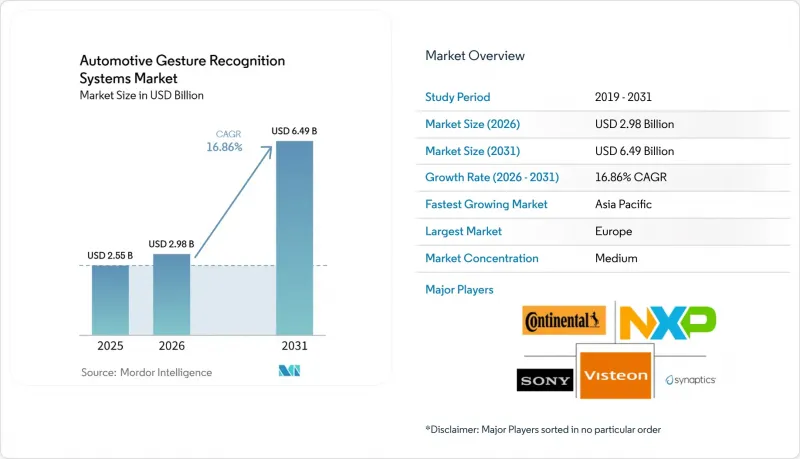
This report is Segmented by Component (Touch-Based System, Touchless System), Authentication Type (Hand/Fingerprint, Face, Vision/Iris, Others), Application (Multimedia/Infotainment/Navigation, Lighting System, Others), Technology (Camera-Based Systems, and More), and Geography (North America, and More). The Market Forecasts are Provided in Terms of Value (USD).
Global Automotive Gesture Recognition Systems Market Trends and Insights
Advanced HMI Demand Drives Premium Vehicle Differentiation
Premium vehicle manufacturers are deploying gesture recognition as a core differentiator in increasingly competitive luxury segments, with BMW's Panoramic iDrive and Mercedes MBUX Interior Assist systems demonstrating how touchless controls create perceived technological superiority. Continental's CES 2025 biometric demonstration car showcased integrated gesture and biometric authentication, enabling personalized vehicle settings through simple hand movements while maintaining driver attention on the road. The integration extends beyond infotainment to climate control, seat adjustment, and ambient lighting, with Jaguar Land Rover's contactless touchscreen technology eliminating physical contact while preserving tactile feedback through ultrasonic haptics. This trend reflects OEMs' recognition that gesture control creates emotional engagement and perceived innovation value that justifies premium pricing, particularly as traditional mechanical differentiation becomes commoditized across vehicle segments.
Regulatory Frameworks Accelerate Driver Monitoring Integration
European Union Advanced Driver Distraction Warning (ADDW) regulations mandating real-time driver monitoring in new heavy commercial vehicles by July 2024 have catalyzed gesture recognition adoption as part of comprehensive driver state assessment systems. NHTSA driver distraction guidelines and Euro NCAP protocols increasingly recognize gesture-based controls as safer alternatives to touchscreen interaction, provided they meet specific attention-demand thresholds and incorporate fail-safe mechanisms. The regulatory influence extends beyond safety compliance to data privacy requirements, with GDPR and emerging Chinese data security laws requiring on-device processing for gesture recognition to minimize personal data transmission. Commercial vehicle operators report a 37% reduction in speeding violations and a 56% decrease in seatbelt non-compliance when gesture-enabled driver monitoring systems provide real-time feedback, demonstrating measurable safety improvements that support regulatory adoption.
Cost Constraints Limit Mass Market Penetration
Advanced AI-enabled platforms add incremental system costs that can slow adoption in price-sensitive market segments, especially in emerging markets where buyers remain highly cost-conscious. These costs come from several components, including specialized cameras, infrared sensors, dedicated processing units, and software licensing fees. Camera-based systems also need high-resolution sensors that can perform reliably across varying lighting conditions. Integration adds another layer of cost because OEMs must test and validate gesture recognition systems across thousands of use cases and environmental conditions to comply with automotive safety standards. These validation cycles can take 18-24 months longer than traditional HMI development timelines. The cost challenge becomes more pronounced in commercial vehicle segments, where fleet operators expect a rapid return on investment. Therefore, gesture systems need to show measurable productivity gains or regulatory compliance benefits to justify the additional costs.
Other drivers and restraints analyzed in the detailed report include:
- AI Software Platforms Enable Context-Aware Recognition
- Commercial Vehicle Efficiency Drives Contactless Adoption
- Environmental Performance Limitations Challenge Reliability
For complete list of drivers and restraints, kindly check the Table Of Contents.
Segment Analysis
Touchless systems dominated the automotive gesture recognition market with 62.01% share in 2025 and are projected to expand at 17.23% CAGR through 2031, significantly outpacing touch-based alternatives as hygiene concerns and advanced AI capabilities drive adoption across premium and commercial vehicle segments. The touchless segment benefits from post-pandemic behavioral shifts toward contactless interaction and regulatory pressure for driver distraction reduction, with systems like Mercedes MBUX Interior Assist and BMW Panoramic iDrive demonstrating consumer acceptance of air gesture controls for infotainment and climate functions.
Aptiv's AI-based Advanced Occupancy Classification platform identifies occupants by height, weight, and body position, suggesting convergence toward comprehensive contactless vehicle interaction ecosystems that extend beyond gesture recognition to include biometric access and personalized settings. The segment's growth trajectory reflects OEMs' strategic positioning of touchless interfaces as premium differentiators while addressing practical concerns about driver distraction and operational hygiene in shared mobility applications.
Hand/fingerprint recognition maintained 48.47% market share in 2025, reflecting established reliability and user familiarity, while vision/iris authentication emerges as the fastest-growing segment at 19.38% CAGR through 2031, supported by breakthrough partnerships like Smart Eye's USD 4.5 million iris recognition licensing deal with Fingerprint Cards.
The authentication landscape reflects broader automotive trends toward personalization and security, with vision-based systems offering advantages in shared mobility scenarios where multiple users require rapid, hygienic authentication without physical contact. Mercedes-Benz patents for biometric vehicle access demonstrate OEM commitment to seamless authentication experiences that eliminate traditional key-based systems while enhancing security through multi-factor biometric verification.
Complete Report Scope:
- By Component
- Touch-Based System
- Touchless System
- By Authentication Type
- Hand/Fingerprint
- Face
- Vision/Iris
- Others
- By Application
- Multimedia/Infotainment/Navigation
- Lighting System
- Others
- By Technology
- Camera-Based Systems
- Capacitive/Infra-red Proximity Sensors
- Ultrasonic/Radar Gesture Sensors
- AI Software Platforms
- By Geography
- North America
- United States
- Canada
- Rest of North America
- South America
- Brazil
- Argentina
- Rest of South America
- Europe
- United Kingdom
- Germany
- Spain
- Italy
- France
- Russia
- Rest of Europe
- Asia-Pacific
- India
- China
- Japan
- South Korea
- Rest of Asia-Pacific
- Middle East and Africa
- United Arab Emirates
- Saudi Arabia
- Turkey
- Egypt
- South Africa
- Rest of Middle-East and Africa
- North America
Geography Analysis
Europe commanded 34.18% of 2025 revenue, driven by strict distraction regulations and early premium-segment deployments. Germany anchors regional leadership with Continental, Bosch, and Infineon providing vertically integrated solutions. BMW's 2025 7-Series offers air-swipe seat massage activation, a feature now migrating to mid-range 5-Series trims, signaling trickle-down diffusion. French supplier Valeo embeds dual-camera mirror modules that retrofit older fleets, broadening Europe's aftermarket potential.
Asia-Pacific posts the fastest 18.72% CAGR, fueled by China's intelligent connected vehicle mandate and Japan's sensor innovation pipeline. Government incentives in Beijing and Shanghai grant tax credits for driver-monitoring features, jump-starting gesture system adoption in domestic brands aiming for export compliance. Sony targets 43% global share of automotive image sensors by fiscal 2026, banking on gesture and monitoring demand. Korean OEMs integrate gesture with 5G infotainment to capitalize on high streaming uptake, while Indian two-wheeler startups trial helmet-mounted gesture modules for e-scooters, hinting at untapped niches.
North America progresses steadily as commercial fleets prioritize safety telematics. Lytx and Netradyne packages that knit hand signals with AI event detection enjoy strong uptake among last-mile operators, offsetting slower passenger-car rollout due to liability concerns. Canada funds R&D tax credits for gesture-based assistive tech, supporting suppliers' north-of-border software labs. Latin America, the Middle East, and Africa yield modest volumes today but represent long-range expansion as 4G connectivity and ride-hailing mature, creating fertile ground for cloud-linked gesture analytics.
- Continental AG
- Sony Corporation
- Synaptics Incorporated
- Visteon Corporation
- NXP Semiconductors
- Infineon Technologies AG
- Cipia Vision Ltd.
- Alps Alpine Co., Ltd.
- Panasonic Holdings Corporation
- Hyundai Mobis Co., Ltd.
- Valeo SA
- Harman International (Samsung)
- Aptiv PLC
- Robert Bosch GmbH
- Ultraleap Ltd.
Additional Benefits:
- The market estimate (ME) sheet in Excel format
- 3 months of analyst support
TABLE OF CONTENTS
1 Introduction
- 1.1 Study Assumptions and Market Definition
- 1.2 Scope of the Study
2 Research Methodology
3 Executive Summary
4 Market Landscape
- 4.1 Market Overview
- 4.2 Market Drivers
- 4.2.1 Advanced HMI Demand for Premium In-Vehicle Experience
- 4.2.2 Regulatory Focus on Driver-Distraction Mitigation
- 4.2.3 OEM Differentiation Through Gesture-Controlled Infotainment
- 4.2.4 Commercial-Vehicle Hygiene and Efficiency Requirements
- 4.2.5 Post-Pandemic Preference for Touch-Free Interaction
- 4.2.6 AI-Enabled Multimodal In-Cabin Monitoring Integration
- 4.3 Market Restraints
- 4.3.1 High Incremental System Cost
- 4.3.2 Performance Limits Under Lighting and Vibration Extremes
- 4.3.3 Data-Privacy Concerns With Camera Monitoring
- 4.3.4 Absence of Standardized Gesture Vocabulary
- 4.4 Value/Supply-Chain Analysis
- 4.5 Regulatory Landscape
- 4.6 Technological Outlook
- 4.7 Porter's Five Forces
- 4.7.1 Threat of New Entrants
- 4.7.2 Bargaining Power of Suppliers
- 4.7.3 Bargaining Power of Buyers
- 4.7.4 Threat of Substitutes
- 4.7.5 Competitive Rivalry
5 Market Size and Growth Forecasts (Value (USD))
- 5.1 By Component
- 5.1.1 Touch-Based System
- 5.1.2 Touchless System
- 5.2 By Authentication Type
- 5.2.1 Hand/Fingerprint
- 5.2.2 Face
- 5.2.3 Vision/Iris
- 5.2.4 Others
- 5.3 By Application
- 5.3.1 Multimedia/Infotainment/Navigation
- 5.3.2 Lighting System
- 5.3.3 Others
- 5.4 By Technology
- 5.4.1 Camera-Based Systems
- 5.4.2 Capacitive/Infra-red Proximity Sensors
- 5.4.3 Ultrasonic/Radar Gesture Sensors
- 5.4.4 AI Software Platforms
- 5.5 By Geography
- 5.5.1 North America
- 5.5.1.1 United States
- 5.5.1.2 Canada
- 5.5.1.3 Rest of North America
- 5.5.2 South America
- 5.5.2.1 Brazil
- 5.5.2.2 Argentina
- 5.5.2.3 Rest of South America
- 5.5.3 Europe
- 5.5.3.1 United Kingdom
- 5.5.3.2 Germany
- 5.5.3.3 Spain
- 5.5.3.4 Italy
- 5.5.3.5 France
- 5.5.3.6 Russia
- 5.5.3.7 Rest of Europe
- 5.5.4 Asia-Pacific
- 5.5.4.1 India
- 5.5.4.2 China
- 5.5.4.3 Japan
- 5.5.4.4 South Korea
- 5.5.4.5 Rest of Asia-Pacific
- 5.5.5 Middle East and Africa
- 5.5.5.1 United Arab Emirates
- 5.5.5.2 Saudi Arabia
- 5.5.5.3 Turkey
- 5.5.5.4 Egypt
- 5.5.5.5 South Africa
- 5.5.5.6 Rest of Middle-East and Africa
- 5.5.1 North America
6 Competitive Landscape
- 6.1 Market Concentration
- 6.2 Strategic Moves
- 6.3 Market Share Analysis
- 6.4 Company Profiles (Includes Global Level Overview, Market Level Overview, Core Segments, Financials as Available, Strategic Information, Market Rank/Share for Key Companies, Products and Services, SWOT Analysis, and Recent Developments)
- 6.4.1 Continental AG
- 6.4.2 Sony Corporation
- 6.4.3 Synaptics Incorporated
- 6.4.4 Visteon Corporation
- 6.4.5 NXP Semiconductors
- 6.4.6 Infineon Technologies AG
- 6.4.7 Cipia Vision Ltd.
- 6.4.8 Alps Alpine Co., Ltd.
- 6.4.9 Panasonic Holdings Corporation
- 6.4.10 Hyundai Mobis Co., Ltd.
- 6.4.11 Valeo SA
- 6.4.12 Harman International (Samsung)
- 6.4.13 Aptiv PLC
- 6.4.14 Robert Bosch GmbH
- 6.4.15 Ultraleap Ltd.
7 Market Opportunities and Future Outlook
- 7.1 White-space and Unmet-need Assessment


