

|
시장보고서
상품코드
2097369
유럽의 소비자 산업용 반도체 디바이스 시장 : 시장 점유율 분석, 산업 동향 및 통계 데이터, 성장 예측(2025-2030년)Europe Semiconductor Device In Consumer Industry - Market Share Analysis, Industry Trends & Statistics, Growth Forecasts (2025 - 2030) |
||||||
 Mordor Intelligence
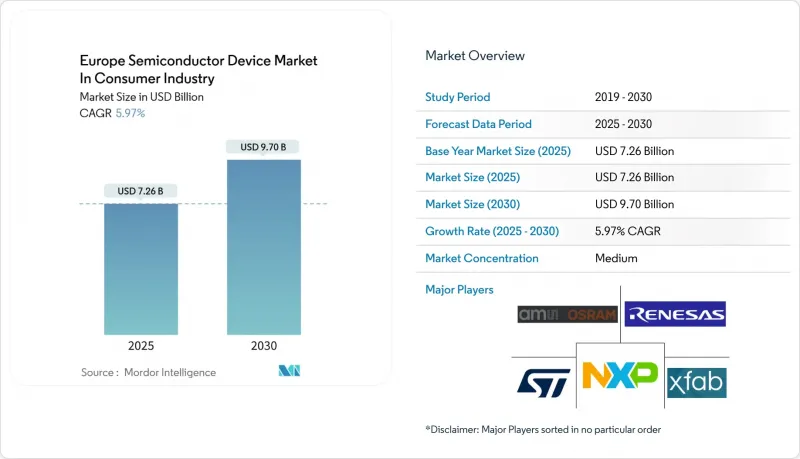
Mordor Intelligence에 의하면, 유럽의 소비자 산업용 반도체 디바이스 시장 규모는 2025년에 72억 6,000만 달러로 평가되었고, 2030년까지 97억 달러에 이를 것으로 예측되며, 2025-2030년 CAGR은 5.97%를 나타낼 전망입니다.
본 보고서는 디바이스 유형별(디스크리트 반도체, 옵토일렉트로닉스 등), 용도별(스마트폰 및 태블릿, 웨어러블 기기 등), 기술 노드별(28 nm 이상, 14-22 nm, 10 nm 미만), 소재별(실리콘, 실리콘 카바이드 등), 지역별(영국, 독일 등)로 분류되어 있습니다. 시장 전망은 금액(달러) 기준으로 제시되어 있습니다.
유럽의 소비자 산업용 반도체 디바이스 시장 동향 및 인사이트
5G 지원 스마트폰 및 웨어러블 단말기의 보급
유럽의 통신 사업자들은 2024년 중반까지 도시 인구의 87%를 커버하는 5G 독립형(SA) 코어 네트워크를 구축하고 있으며, 이에 따라 스마트폰 및 스마트 워치의 무선 주파수(RF) 프런트엔드 모듈의 급속한 교체가 촉진되고 있습니다. 3.4-3.8GHz 중대역 주파수 할당은 갈륨 질화물(GaN) 전력 증폭기 및 실리콘 온 인슐레이터(SOI) 스위치의 채택을 뒷받침하고 있으며, 이를 통해 와트당 비용을 18% 절감할 수 있습니다. 배터리 용량이 300 mAh 미만인 웨어러블 기기에는 현재 엔벨로프 트래킹 방식의 PMIC가 채택되어 있어 통화 시간을 22% 연장하고 있습니다. Nordic Semiconductor의 nRF91은 2024년에 14건의 설계 채택을 기록하며, 셀룰러 기능과 Cortex-M33 로직을 통합한 솔루션이 디스크리트 베이스밴드를 대체할 수 있음을 입증했습니다. 2025년판 ‘무선 기기 지침’의 사이버 보안 조항에서는 보안 부팅과 펌웨어 인증이 의무화되어, 이에 따라 NXP 및 STMicroelectronics의 임베디드 보안 요소에 대한 수요가 증가하고 있습니다.
스마트 홈 생태계로의 전환 가속화
2024년, Matter 1.2는 Thread, Zigbee, Wi-Fi 6를 단일 용도 계층 아래로 통합하여, 게이트웨이 제조업체가 개별 무선 모듈을 단일 다이 솔루션으로 통합할 수 있게 했습니다. Silicon Labs 및 Nordic Semiconductor의 SoC는 Matter 인증 제품 출시의 60%를 차지하며, 부품표(BOM)를 12% 절감했습니다. 장거리 음성 어시스턴트 지원 스피커에는 현재 듀티 사이클 제어를 통한 웨이크 워드 감지를 통해 0.3W라는 에코 디자인 규격의 대기 전력 상한선을 준수하는 ST마이크로일렉트로닉스의 MEMS 마이크가 탑재되어 있습니다. 인증받은 KNX 스마트 홈 설치 건수는 전년 대비 31% 증가하여, 조명 및 HVAC 노드용 MCU 출하를 견인했습니다. 802.15.4의 PHY 계층이 표준화됨에 따라 칩 공급업체는 RF 블록을 재사용할 수 있게 되었으며, 설계 비용을 대량 생산 분량에 따라 분산시켜 중급 가전제품으로의 보급을 가속화하고 있습니다.
첨단 노드 제조의 높은 자본 집약도
현재 유럽에서 5nm급 팹을 건설하려면 150억 유로(174억 7,000만 달러)가 넘는 비용이 소요되지만, 현지 IDM 중 그 전액을 소비자용 워크로드 전용으로 배정하고 있는 기업은 없습니다. 크롤 공장은 18nm FD-SOI에, 드레스덴 공장은 28-40nm 파워 디바이스에 주력하고 있으며, 스마트폰이나 태블릿용 프로세서는 아시아의 파운드리 업체에 맡겨져 있습니다. ‘칩법’은 자동차 및 방위 분야를 우선시하고 있어, 민수용 범용 IC는 뒷전으로 밀려나 있습니다. 그 결과, 유럽 브랜드들은 첨단 로직 반도체 분야에서 대만이나 한국에 의존할 수밖에 없게 되었으며, 공급망이 단절되어 리드타임이 4-6개월 연장되고 있습니다. 또한, 인근에 첨단 노드 제조 거점이 없다는 점은 지역 내 팹리스 기업들에게 설계와 공정의 공동 최적화를 저해하는 요인이 되고 있습니다.
부문별 분석
2030년까지 센서 시장의 연평균 성장률(CAGR)은 6.28%로, 2024년 매출의 48.20%를 차지한 집적회로(IC)를 포함해 다른 모든 디바이스 카테고리를 상회하고 있습니다. 유럽의 센서용 반도체 디바이스 시장 규모는 피트니스 트래커, 스마트 스피커, 공기질 모니터 등에 엣지 인텔리전스를 확장하는 환경 센서, 관성 센서, 생체 인식 센서에 의해 뒷받침되고 있습니다. ST마이크로일렉트로닉스의 LSM6DSV16X 관성 모듈은 칩 상에서 제스처 인식을 수행하여 MCU의 웨이크 이벤트를 47% 줄이는 동시에 스마트 워치의 배터리 수명을 2일 연장합니다. 보쉬 센서테크는 2024년에 1억 8,000만 개의 MEMS 디바이스를 출하할 예정이며, 기압 센서와 가스 센서가 앰비언트 인텔리전스의 이용 사례를 뒷받침하고 있습니다. 옵토일렉트로닉스는 스마트폰 OLED 드라이버 시장에서 점유율을 독점하고 있는 반면, 디스크리트 GaN 트랜지스터는 방열량이 30% 감소함에 따라 급속 충전 어댑터 분야에서 실리콘 MOSFET을 대체하고 있습니다.
비용 효율을 중시하는 가전용 병렬 MCU는 여전히 130nm 공정에 머물러 있지만, 센서 분야에서는 40nm 및 22nm FD-SOI를 통한 고집적화의 이점을 누리고 있으며, 누설 전류 감소로 인해 코인형 배터리의 수명이 연장되고 있습니다. 유럽 반도체 소자 시장에서 집적 회로의 점유율은 전원 관리 장치, 이미지 센서, 로직 컨트롤러가 센서 주도형 아키텍처 선택에 의해 지배되는 멀티칩 모듈로 전환됨에 따라 소폭 하락할 전망입니다. 센서, 연결 기능, PMIC 레퍼런스 설계를 묶어 제공하는 공급업체는 Matter 및 KNX 도입에 있어 더 대규모의 플랫폼 수주를 확보할 전망입니다.
2024년 매출에서 스마트폰 및 태블릿이 차지하는 비중은 35.70%였으나, EU의 MDR(의료기기 규정)에 따라 승인된 건강 원격 측정 기술을 배경으로 웨어러블 기기는 연평균 성장률(CAGR) 7.01%로 성장하고 있습니다. Nordic사의 nRF5340과 같은 듀얼 코어 블루투스 SoC를 통해 연속 심박수 모니터링 시 소비 전류를 5mA 미만으로 억제할 수 있게 됨에 따라, 유럽 웨어러블 기기용 반도체 디바이스 시장 규모는 더욱 확대될 전망입니다. 스마트 가전도 Matter의 표준화와 독일의 KNX 기존 설비에 대한 사후 도입으로 성장하고 있으며, 멀티 프로토콜 지원 마이크로컨트롤러 수요를 견인하고 있습니다. 시장 점유율은 작지만, 게임 및 AR/VR 분야에서는 여전히 고대역폭 그래픽 프로세서가 필요하며, 이에 대한 첨단 패키징 공정이 조만간 TSMC의 드레스덴 공장에서 시행될 전망이어서 물류 지연 문제가 해소될 것으로 보입니다.
웨어러블 기기가 초저 누설 전류 FD-SOI 공정에 의존하고 있기 때문에 유럽의 기판 공급업체들은 유리한 입장에 있습니다. 한편, 스마트폰은 계속해서 단위당 실리콘 면적이 가장 큰 비중을 차지하며, 3nm 이하로 노드 전환이 지속될 전망입니다. 스마트폰, 스마트 워치, 스마트홈용 프로세서의 로드맵을 통합하는 브랜드는 공통된 다이 간 상호 연결을 활용함으로써 연구개발비용의 시간적 배분을 최적화하고, 전체 디바이스의 부품표(BOM)를 개선할 수 있습니다.
기타 혜택 :
- Excel 형식 시장 예측(ME) 시트
- 3개월간의 애널리스트 지원
자주 묻는 질문
목차
제1장 서론
제2장 분석 방법
제3장 주요 요약
제4장 시장 구도
제5장 시장 규모 및 성장률 예측
제6장 경쟁 구도
제7장 시장 기회 및 향후 전망
AJY 26.08.07According to Mordor Intelligence, the Europe semiconductor device market size in the consumer segment reached USD 7.26 billion in 2025 and is projected to touch USD 9.70 billion by 2030, translating into a 5.97% CAGR over 2025-2030.
This report is Segmented by Device Type (Discrete Semiconductors, Optoelectronics, and More), Application (Smartphones and Tablets, Wearables, and More), Technology Node (>=28 Nm, 14-22 Nm, <10 Nm), Material (Silicon, Silicon Carbide, and More), and Geography (United Kingdom, Germany, and More). The Market Forecasts are Provided in Terms of Value (USD).
Insights and Trends of Europe Semiconductor Device Market In Consumer Industry
Proliferation Of 5G-Enabled Smartphones And Wearables
European operators had built 5G standalone cores that covered 87% of city populations by mid-2024, prompting rapid refresh of radio-frequency front-end modules in smartphones and smartwatches. Mid-band allocations at 3.4-3.8 GHz favor gallium-nitride power amplifiers and silicon-on-insulator switches that lower cost per watt by 18%. Wearables with sub-300 mAh batteries now rely on envelope-tracking PMICs, extending talk time by 22%. Nordic Semiconductor's nRF91 secured 14 design wins in 2024, proving that integrated cellular plus Cortex-M33 logic displaces discrete basebands. Cyber-security clauses in the 2025 Radio Equipment Directive mandate secure boot and firmware attestation, which lifts demand for embedded secure elements from NXP and STMicroelectronics.
Accelerated Shift Toward Smart-Home Ecosystems
Matter 1.2 unified Thread, Zigbee and Wi-Fi 6 under one application layer in 2024, letting gateway makers collapse discrete radios into single-die solutions. Silicon Labs and Nordic Semiconductor SoCs captured 60% of Matter-certified launches, trimming bill-of-materials by 12%. Far-field voice-assistant speakers now embed STMicroelectronics MEMS microphones that respect the 0.3 W Ecodesign standby ceiling through duty-cycled wake-word detection. Certified KNX smart-home installations climbed 31% year-on-year, stimulating MCU shipments for lighting and HVAC nodes. Shared 802.15.4 PHY layers let chip vendors reuse RF blocks, spreading design cost over larger volumes and accelerating penetration into mid-tier appliances.
High Capital Intensity Of Advanced-Node Fabrication
Building a 5 nm-class fab in Europe now costs beyond EUR 15 billion(USD 17.47 billion), and no local IDM has earmarked that sum exclusively for consumer workloads. Crolles focuses on 18 nm FD-SOI, Dresden on 28-40 nm power devices, leaving phone and tablet processors to Asian foundries. Chips Act grants prioritize automotive and defense, sidelining commodity consumer ICs. Consequently, European brands depend on Taiwan and Korea for advanced logic, fragmenting supply chains and extending lead times by four to six months. Lack of proximal advanced nodes also hinders co-optimization of design and process for regional fabless firms.
Other drivers and restraints analyzed in the detailed report include:
- Emergence Of Chiplet-Based Modular Architectures
- EU Ecodesign Regulations For Ultra-Low-Standby Power ICs
- Stricter EU Chemicals Restriction (PFAS Ban)
For complete list of drivers and restraints, kindly check the Table Of Contents.
Segment Analysis
Sensors' 6.28% CAGR through 2030 outflanks all other device categories even though integrated circuits owned 48.20% of 2024 revenue. The Europe semiconductor device market size for sensors is buoyed by environmental, inertial and biometric arrays that extend edge intelligence into fitness trackers, smart speakers and air-quality monitors. STMicroelectronics' LSM6DSV16X inertial module executes gesture-recognition on-chip, cutting MCU wake events 47% and adding two days to smartwatch battery life. Bosch Sensortec shipped 180 million MEMS devices in 2024, with barometric and gas sensors underpinning ambient-intelligence use cases. Optoelectronics command share in smartphone OLED drivers, while discrete GaN transistors are replacing silicon MOSFETs in fast-charge adapters due to 30% lower heat dissipation.
Parallel cost-sensitive appliance MCUs remain entrenched at 130 nm, but sensors benefit from tighter integration at 40 nm and 22 nm FD-SOI, where reduced leakage prolongs coin-cell life. The Europe semiconductor device market share for integrated circuits will decline modestly as power-management units, image sensors and logic controllers migrate into multi-chip modules dominated by sensor-driven architectural choices. Suppliers that bundle sensor, connectivity and PMIC reference designs stand to capture bigger platform wins in Matter and KNX deployments.
Smartphones and tablets owned 35.70% of 2024 revenue, yet wearables are growing at 7.01% CAGR on the back of health telemetry cleared under EU MDR. The Europe semiconductor device market size for wearables will strengthen further as dual-core Bluetooth SoCs such as Nordic's nRF5340 trim continuous heart-rate monitoring current to sub-5 mA. Smart-home appliances also climb due to Matter standardization and retrofits in Germany's KNX base, driving demand for multi-protocol microcontrollers. Gaming and AR/VR, a smaller slice, still require high-bandwidth graphics processors whose advanced packaging may soon be performed in TSMC's Dresden facility, cutting logistics lag.
Wearables' reliance on ultra-low-leakage FD-SOI processes positions European substrate providers favorably. Meanwhile, smartphones will keep absorbing the largest silicon area per unit, sustaining node migration toward 3 nm and below. Brands that harmonize phone, watch and smart-home processor roadmaps can leverage shared die-to-die interconnects to time-slice R&D spend and improve bill-of-materials across devices.
Complete Report Scope:
- By Device Type
- Discrete Semiconductors
- Optoelectronics
- Sensors
- Integrated Circuits
- Analog
- Logic
- Memory
- Micro
- Microprocessor
- Microcontroller
- Digital Signal Processors
- By Application
- Smartphones and Tablets
- Wearables
- Smart Home Appliances
- Gaming Consoles and AR-VR Devices
- By Technology Node
- >=28 nm
- 14-22 nm
- <10 nm
- By Material
- Silicon
- Silicon Carbide
- Gallium Nitride
- Other Compound Semiconductors
- By Country
- United Kingdom
- Germany
- France
- Spain
- Italy
- Rest of Europe
List of Companies Covered in this Report:
- Infineon Technologies AG
- STMicroelectronics N.V.
- NXP Semiconductors N.V.
- Dialog Semiconductor Plc (Renesas Electronics Corporation)
- AMS-OSRAM AG
- X-FAB Silicon Foundries SE
- SOITEC S.A.
- Soitec S.A.
- Silicon Labs
- Qualcomm Technologies Inc.
- Nordic Semiconductor ASA
- ON Semiconductor Corporation
- Microchip Technology Inc.
- Texas Instruments Incorporated
- Broadcom Inc.
- MediaTek Inc.
- Skyworks Solutions Inc.
- Analog Devices Inc.
- Murata Manufacturing Co. Ltd.
Additional Benefits:
- The market estimate (ME) sheet in Excel format
- 3 months of analyst support
TABLE OF CONTENTS
1 INTRODUCTION
- 1.1 Study Assumptions and Market Definition
- 1.2 Scope of the Study
2 RESEARCH METHODOLOGY
3 EXECUTIVE SUMMARY
4 MARKET LANDSCAPE
- 4.1 Market Overview
- 4.2 Market Drivers
- 4.2.1 Rising Demand for Consumer Electronics Products
- 4.2.2 Growing Adoption of Consumer IoT Devices
- 4.2.3 Proliferation of 5G-Enabled Smartphones and Wearables
- 4.2.4 Accelerated Shift Toward Smart Home Ecosystems
- 4.2.5 Emergence of Chiplet-Based Modular Architectures in Low-Power Consumer Devices
- 4.2.6 EU Ecodesign Regulations Driving Demand for Ultra-Low-Standby Power ICs
- 4.3 Market Restraints
- 4.3.1 Persistent Semiconductor Supply Chain Disruptions
- 4.3.2 High Capital Intensity of Advanced Node Fabrication in Europe
- 4.3.3 Fragmented Consumer OEM Design Cycles Increasing NRE Cost Volatility
- 4.3.4 Stricter EU Chemicals Restriction (PFAS Ban) Complicating Lithography Materials
- 4.4 Industry Value Chain Analysis
- 4.5 Regulatory Landscape
- 4.6 Technological Outlook
- 4.7 Porter's Five Forces Analysis
- 4.7.1 Bargaining Power of Suppliers
- 4.7.2 Bargaining Power of Buyers
- 4.7.3 Threat of New Entrants
- 4.7.4 Threat of Substitutes
- 4.7.5 Intensity of Competitive Rivalry
- 4.8 Impact of Macroeconomic Factors on the Market
- 4.9 Investment Analysis
5 MARKET SIZE AND GROWTH FORECASTS
- 5.1 By Device Type
- 5.1.1 Discrete Semiconductors
- 5.1.2 Optoelectronics
- 5.1.3 Sensors
- 5.1.4 Integrated Circuits
- 5.1.4.1 Analog
- 5.1.4.2 Logic
- 5.1.4.3 Memory
- 5.1.4.4 Micro
- 5.1.4.4.1 Microprocessor
- 5.1.4.4.2 Microcontroller
- 5.1.4.4.3 Digital Signal Processors
- 5.2 By Application
- 5.2.1 Smartphones and Tablets
- 5.2.2 Wearables
- 5.2.3 Smart Home Appliances
- 5.2.4 Gaming Consoles and AR-VR Devices
- 5.3 By Technology Node
- 5.3.1 >=28 nm
- 5.3.2 14-22 nm
- 5.3.3 <10 nm
- 5.4 By Material
- 5.4.1 Silicon
- 5.4.2 Silicon Carbide
- 5.4.3 Gallium Nitride
- 5.4.4 Other Compound Semiconductors
- 5.5 By Country
- 5.5.1 United Kingdom
- 5.5.2 Germany
- 5.5.3 France
- 5.5.4 Spain
- 5.5.5 Italy
- 5.5.6 Rest of Europe
6 COMPETITIVE LANDSCAPE
- 6.1 Market Concentration
- 6.2 Strategic Moves
- 6.3 Market Share Analysis
- 6.4 Company Profiles (includes Global level Overview, Market level overview, Core Segments, Financials as available, Strategic Information, Market Rank/Share for key companies, Products and Services, and Recent Developments)
- 6.4.1 Infineon Technologies AG
- 6.4.2 STMicroelectronics N.V.
- 6.4.3 NXP Semiconductors N.V.
- 6.4.4 Dialog Semiconductor Plc (Renesas Electronics Corporation)
- 6.4.5 AMS-OSRAM AG
- 6.4.6 X-FAB Silicon Foundries SE
- 6.4.7 SOITEC S.A.
- 6.4.8 Soitec S.A.
- 6.4.9 Silicon Labs
- 6.4.10 Qualcomm Technologies Inc.
- 6.4.11 Nordic Semiconductor ASA
- 6.4.12 ON Semiconductor Corporation
- 6.4.13 Microchip Technology Inc.
- 6.4.14 Texas Instruments Incorporated
- 6.4.15 Broadcom Inc.
- 6.4.16 MediaTek Inc.
- 6.4.17 Skyworks Solutions Inc.
- 6.4.18 Analog Devices Inc.
- 6.4.19 Murata Manufacturing Co. Ltd.
7 MARKET OPPORTUNITIES AND FUTURE OUTLOOK
- 7.1 White-space and Unmet-need Assessment


