

|
시장보고서
상품코드
2097386
시신 운반용 가방 : 시장 점유율 분석, 업계 동향과 통계, 성장 예측(2026-2031년)Mortuary Bags - Market Share Analysis, Industry Trends & Statistics, Growth Forecasts (2026 - 2031) |
||||||
 Mordor Intelligence
Mordor Intelligence에 의하면, 시신 운반용 가방 시장 규모는 2025년 17억 5,000만 달러, 2026년 18억 9,000만 달러에서 2031년까지 26억 9,000만 달러에 달할 것으로 예측되며, 2026-2031년 연평균 복합 성장률(CAGR)은 7.31%를 나타낼 전망입니다.
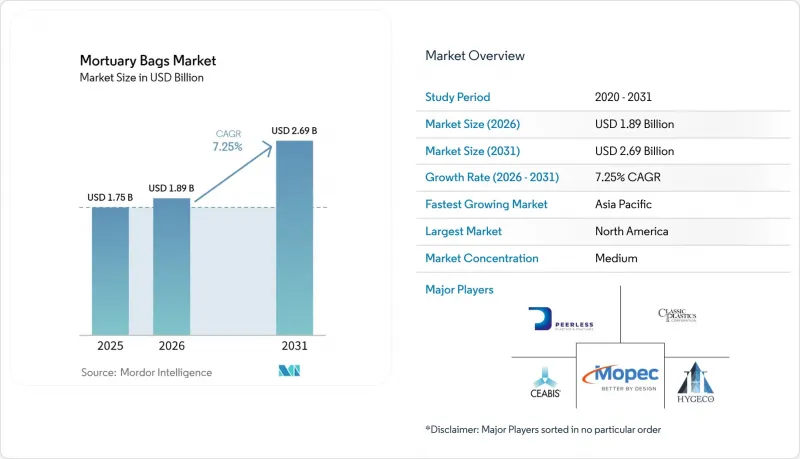
본 보고서는 원재료별(폴리에틸렌, 폴리염화비닐(PVC), 나일론, 폴리에스터 등), 크기별(성인용, 비만자용, 소아·영아용), 내하중(표준, 중등도, 고하중), 최종 사용자(병원, 유체 안치소·장례식장, 재난 구호·군사, 기타), 지역(북미, 유럽, 기타)별로 분류되어 있습니다. 시장 전망은 금액(달러) 기준으로 제시되어 있습니다.
전 세계 시신 운반용 가방 시장 동향 및 인사이트
감염병 발생 건수 증가
지역적인 에볼라 출혈열 및 마르부르크열 유행으로 인해, ISO 16604의 혈액 침투 저항성 기준을 충족하고 누출 방지 기능을 갖춘 이중 봉투 솔루션에 대한 필요성이 더욱 높아지고 있습니다. 미국 질병통제예방센터(CDC)의 2024년 지침에서는 이중 봉쇄 층과 명확한 생물학적 위험 표시를 의무화하고 있으며, 이로 인해 시신 1구당 봉투 사용량이 즉시 증가하고 있습니다. 사하라 이남 아프리카의 조달 팀은 현재 감염 확산의 핫스팟 인근에 시신 봉투를 사전 배치하고 있으며, 이는 전 세계 공급망 전반에 파급되는 급격하고 단기적인 수요 급증을 초래하고 있습니다. 신속한 납기와 규격에 부합하는 밀봉성을 보장할 수 있는 제조업체는 긴급 계약의 우선 수주 대상이 되고 있으며, 이는 시신 봉투 시장의 현저한 상승을 뒷받침하고 있습니다. 규격에 부합하는 소재에 대한 수요 증가는 규모를 갖춘 공급업체에게 단기적인 가격 결정력을 공고히 하고 있습니다.
세계적인 고령화와 사망률 상승
유엔의 예측에 따르면, 전 세계 사망자 수는 2025년에 6,100만 명, 2050년에는 8,200만 명에 달할 것으로 예상되며, 이러한 급증은 고령화와 만성 질환 유병률 상승에 기인합니다. 북미 및 유럽에서는 2030년까지 시민 4명 중 1명이 65세 이상이 될 것으로 예상되며, 이로 인해 시신 처리용 일회용 제품에 대한 기초 수요가 확대될 것입니다. 이에 대응하여 장례업체와 병원은 가격 인상 조항이 포함된 다년 계약을 체결함으로써 대처하고 있으며, 이를 통해 보장된 판매 물량이 확보되어 시신 봉투 시장이 안정되고 있습니다. 고령층의 비만 증가세는 비만 체형용 사이즈에 대한 수요로 직접 이어지고 있으며, 인구 동향의 변화와 제품 구성의 변화가 맞물려 진행되고 있습니다. 예측 기간 동안 사망자 수의 꾸준한 증가는 제조업체의 생산 능력 확대 결정에 대한 견고한 뒷받침이 될 것입니다.
폴리머 원료 가격 변동
폴리에틸렌의 현물 가격은 원유 벤치마크 가격과 밀접하게 연관되어 있어, 헤지 조치를 취하지 않은 제조업체의 투입 비용을 급등락시키고 있습니다. 통화 약세는 수지 수입이 공급의 대부분을 차지하는 라틴아메리카와 남아시아에서 상황을 더욱 악화시키고 있습니다. 연간 계약에 묶여 있는 구매자들은 중기적인 가격 전가에 저항하고 있으며, 이로 인해 중소 제조업체들이 압박을 받아 합병이 진행되고 있습니다. 최종 사용자들은 수지 지수에 연동된 가격 조정 조항을 계약에 포함하기 시작했으며, 이로 인해 업무 처리의 복잡성은 증가하지만 예산의 예측 가능성은 유지되고 있습니다. 이러한 불확실성으로 인해 시신용 봉투 시장 전체에서 단기적인 이익률 전망은 둔화되고 있습니다.
부문 분석
폴리에틸렌은 비용, 인열 저항성, 열밀봉 적합성 간의 균형이 잘 잡혀 있어 2025년 시신용 봉투 시장에서 32.55%의 점유율을 차지했습니다. 그러나 생분해성 및 퇴비화 가능한 폴리머를 사용한 시신용 봉투 시장은 확대된 생산자 책임(EPR) 수수료와 PFAS 금지 조치로 인해 구매 기준이 재검토됨에 따라, 2031년까지 연평균 성장률(CAGR) 9.25%로 확대될 것으로 예측됩니다. 유럽 및 호주의 보건 당국은 이미 EN 13432 규격 준수를 입찰 서류에 명시하고 있으며, 이 규정은 6개월 이내에 분해되는 전분계 및 PLA 혼합 제품을 우대하는 내용입니다. 각 공급업체들은 폴리에틸렌과 동등한 체액 보유 성능을 유지하면서 매립 폐기물을 줄일 수 있는 강화 다층 필름 및 진공 잠금 구조를 주요 판매 포인트로 내세우고 있습니다. PVC는 가격에 민감한 아프리카 및 남아시아 계약에서 일정한 입지를 유지하고 있지만, OECD 국가들의 소각 규제 강화로 인해 전망은 악화되고 있습니다. 생분해성 제품 라인을 조기에 도입한 기업들은 프리미엄 가격 책정과 폐기 처리 비용 절감을 활용하여 시신 운반용 가방 업계 전체의 이익률 구조를 강화하고 있습니다.
폴리에스테르와 나일론의 틈새 용도는 내마모성이나 적외선 시그니처 마스킹이 중요한 군사 분야나 법의학 연구소에서 여전히 존재합니다. 이러한 사용자에게는 조달 사양에서 환경적 특성보다 인장 강도가 우선시되므로, 단가가 높아지더라도 고성능 합성 수지가 계속해서 채택되고 있습니다. 시장을 선도하는 기업들은 기존 수지와 바이오 수지를 전환하여 사용할 수 있는 블렌드 라인에 투자함으로써 수요 변동을 완화하고 있습니다. 기존 플라스틱에서 전환된다고 해서 폴리에틸렌이 하룻밤 사이에 사라지는 것은 아닙니다. 오히려 지속 가능한 소재가 신규 계약의 성장을 잠식하는 한편, 범용 등급이 기존 계약을 뒷받침하는 두 가지 궤도를 병행하는 양상이 진행되고 있습니다. 따라서 수지 조달의 유연성은 시신 운반용 가방 시장에서 전략적 차별화 요인으로 부상하고 있습니다.
2025년 기준, 성인용 시신 운반용 가방 시장 규모는 매출 점유율의 46.53%를 차지했으나, 비만자용 부문은 2031년까지 연평균 성장률(CAGR) 8.85%를 나타낼 것으로 예측됩니다. 특히 미국과 독일에서 고령층의 비만율이 증가하고 있어, 정하중 300파운드 이상의 내하중이 보장된 시신 운반용 가방가 필요시되고 있습니다. 호주의 개정된 지침에서는 6개의 손잡이와 보강된 솔기가 의무화되어 있으며, 이로 인해 평균 판매 가격이 상승하고 있습니다. 각 제조업체는 고밀도 폴리에틸렌 필름과 무게를 고르게 분산시키는 이중 봉제 웹 핸들을 채택하여 이에 대응하고 있습니다. 소아 및 영아용 제품은 판매량이 적지만, 비탄에 잠긴 유가족의 시각적 트라우마를 완화하기 위해 더 부드럽고 유색 소재를 요구하는 표준화된 병원 프로토콜을 통해 수요가 유지되고 있습니다.
비만 환자용 제품의 도입은 기계식 리프트 보조 기구 및 대형 냉장 랙에 대한 광범위한 투자와 연계되어, 견고한 가방에 대한 시너지 효과를 창출하고 있습니다. 피셔 사이언티픽(Fisher Scientific) 등의 카탈로그에는 2025년에 체중 136kg을 초과하는 환자를 위한 40개 이상의 SKU가 추가되어 시장의 성장세를 보여주고 있습니다. 비만율이 급격히 상승하고 있는 라틴아메리카의 의료 시스템에서는 미국의 선례를 따라 비만 환자용 용품에 대한 중앙 일괄 입찰을 시작하고 있습니다. 하중 기준과 누수 방지 기준을 모두 준수함을 입증할 수 있는 공급업체는 우위를 점하고 있습니다. 그 결과, 비만 환자용이라는 틈새 시장은 규모는 작지만 시신 운반용 가방 시장에서 두드러진 매출 성장을 기록하고 있습니다.
지역별 분석
2025년, 북미는 시신 운반용 가방 시장의 32.13%를 차지했습니다. 이는 누출 방지 및 라벨 표시가 의무화된 봉쇄 조치를 규정하는 OSHA 및 FDA 지침에 힘입은 결과입니다. 미국의 연간 사망자 수는 증가할 것으로 예상되어, 안정적인 국내 수요가 더욱 강화될 전망입니다. 캐나다에서는 화장이 선호되어 방부 처리 시간이 단축되고 있지만, 광활한 지리적 거리를 가로지르는 안전한 이송용 가방은 여전히 필요합니다. 멕시코의 공립 병원에서는 범미주 생물학적 위험 기준이 채택되어 시신 안치소 인프라가 정비되고, 새로운 입찰이 촉진되고 있습니다.
아시아태평양은 가장 빠르게 성장하는 지역으로, 2031년까지 연평균 성장률(CAGR)이 8.51%를 나타낼 것으로 전망됩니다. 이는 중국, 일본, 한국의 고령화와 인도 및 동남아시아의 의료 체계 확충이 원동력이 되고 있습니다. 중국의 각 성 보건국은 현급 장례 시설 개보수를 위한 특정 목적 자금을 지원받고 있으며, 소각으로 인한 오염을 억제하기 위해 생분해성 봉투의 시범 도입이 진행되고 있습니다. 인도에서는 평균 수명 연장에 따라 고령층이 증가하고 있어, 민간 병원 체인들은 신축 프로젝트에 시신 안치소 계획을 포함시키고 있습니다. 호주의 각 주는 비만 수술 관련 지침 및 퇴비화 가능한 소재 도입에 있어 계속해서 선도적인 역할을 하고 있으며, 고품질 사양의 시험장으로서의 역할을 수행하고 있습니다.
유럽에서는 PFAS 금지 및 폐기물 운송 규제로 인해 규정을 준수하는 재활용 가능한 제품을 제공하는 공급업체가 우대받고 있으며, 한 자릿수 중반대의 안정적인 성장을 유지하고 있습니다. 친환경 조달이 주류를 이루는 스칸디나비아 국가들에서는 생분해성 봉투에 관한 통합적인 체계가 마련되어 있는 반면, 남유럽 국가들은 예산 제약으로 인해 여전히 기존의 폴리에틸렌에 의존하고 있습니다. 중동에서는 하즈 등 대규모 집회 행사를 위해 내구성이 높은 파우치로 전환이 진행되고 있는 반면, 걸프협력회의(GCC) 회원국에서는 이에 대응하는 봉투 키트가 장착된 냉장 트레일러가 수입되고 있습니다. 남미 수요는 브라질과 아르헨티나에 집중되어 있으며, 이들 국가에서는 도시 지역의 병원 통합이 진행됨에 따라 구매력과 표준화가 강화되고 있습니다.
기타 혜택:
- 엑셀 형식 시장 예측(ME) 시트
- 3개월간의 애널리스트 지원
자주 묻는 질문
목차
제1장 서론
제2장 조사 방법
제3장 주요 요약
제4장 시장 구도
제5장 시장 규모와 성장 예측
제6장 경쟁 구도
제7장 시장 기회와 향후 전망
KTH 26.08.06According to Mordor Intelligence, the mortuary bags market size is projected to expand from USD 1.75 billion in 2025 and USD 1.89 billion in 2026 to USD 2.69 billion by 2031, registering a CAGR of 7.31% between 2026 to 2031.
This report is Segmented by Raw Material (Polyethylene, Polyvinyl Chloride (PVC), Nylon, Polyester, and More), Size (Adult, Bariatric, and Child & Infant), Weight Duty (Standard Duty, Medium Duty, and Heavy Duty), End-User (Hospitals, Mortuaries & Funeral Homes, Disaster Relief & Military, and More), and Geography (North America, Europe, and More). The Market Forecasts are Provided in Terms of Value (USD).
Global Mortuary Bags Market Trends and Insights
Rising Incidence of Infectious-Disease Outbreaks
Regional Ebola and Marburg flare-ups reinforce the need for leak-proof, double-bag solutions that meet ISO 16604's blood-penetration resistance. The Centers for Disease Control and Prevention's 2024 guidance mandates dual containment layers and explicit biohazard labeling, instantly lifting per-case bag consumption. Procurement teams in Sub-Saharan Africa now pre-stage bags near outbreak hotspots, causing sharp, short-term volume spikes that ripple through global supply chains. Manufacturers able to certify rapid lead times and compliant seals are first in line for emergency contracts, underpinning a noticeable upswing in the mortuary bags market. The premium placed on compliant materials cements near-term pricing power for suppliers with scale.
Global Aging Population and Higher Mortality
United Nations projections put worldwide deaths at 61 million in 2025 and 82 million in 2050, a surge driven by greying demographics and higher chronic-disease prevalence. North America and Europe expect one in four citizens to be 65 years or older by 2030, which will inflate baseline demand for body-handling disposables. Funeral homes and hospitals have responded by signing multi-year framework agreements with price-escalation clauses, locking in guaranteed volumes that stabilize the mortuary bags market. Increased obesity among seniors feeds directly into bariatric sizes, merging demographic and product-mix shifts. Over the forecast horizon, steady mortality escalation provides a durable underpinning for manufacturers' capacity-expansion decisions.
Polymer Raw-Material Price Volatility
Spot polyethylene prices correlate closely with crude benchmarks, whipsawing input costs for manufacturers without hedging coverage. Currency depreciation compounds pain in Latin America and South Asia, where resin imports dominate supply. Buyers tied to annual contracts resist mid-term price pass-throughs, squeezing smaller fabricators and encouraging mergers. End-users begin specifying price-adjustment clauses pegged to resin indices, adding administrative complexity but preserving budget predictability. The uncertainty dampens near-term margin expectations across the mortuary bags market.
Other drivers and restraints analyzed in the detailed report include:
- Stricter Biohazard Regulations on Corpse Handling
- Adoption of RFID-Enabled Traceability Solutions
- Environmental Regulations on Plastic Disposal
For complete list of drivers and restraints, kindly check the Table Of Contents.
Segment Analysis
Polyethylene accounted for 32.55% of the mortuary bags market in 2025 due to its balance of cost, tear resistance, and compatibility with heat seals. The mortuary bags market for biodegradable and compostable polymers, however, is projected to expand at a 9.25% CAGR to 2031 as extended producer responsibility fees and PFAS bans reset purchasing criteria. European and Australian health agencies already include EN 13432 compliance in tender documents, a stipulation that favors starch-based and PLA blends that degrade within 6 months. Suppliers tout reinforced multilayer films and vacuum-lock designs to match polyethylene's fluid retention while reducing landfill waste. PVC maintains a foothold in price-sensitive African and South Asian contracts, yet tightening incineration rules in OECD economies erode its outlook. Early adopters of biodegradable lines exploit premium pricing and lower disposal tariffs, bolstering margin mix across the mortuary bags industry.
Polyester and nylon niche applications persist in military and forensic labs where abrasion resistance and infrared signature masking matter. For these users, procurement specifications prioritize tensile strength above environmental attributes, keeping high-performance synthetics in play despite elevated unit costs. Market leaders invest in blending lines that can toggle between conventional and bio-based resins, mitigating demand swings. The shift away from legacy plastic does not eliminate polyethylene overnight; instead, a dual-track trajectory is unfolding, with sustainable materials cannibalizing growth on new contracts while commodity grades service legacy agreements. Flexibility in resin sourcing, therefore, emerges as a strategic differentiator in the mortuary bags market.
The mortuary bags market size for adult variants accounted for 46.53% of revenue share in 2025, while the bariatric segment is forecast to post an 8.85% CAGR through 2031. Rising obesity among seniors, particularly in the United States and Germany, necessitates pouches rated for static loads above 300 lb. Updated Australian guidelines mandate six-handle configurations and reinforced seams, lifting average selling prices. Manufacturers respond with high-density polyethylene films and double-stitched web handles that evenly distribute weight. Pediatric and infant ranges occupy a smaller volume but sustain demand through standardized hospital protocols that now call for softer, tinted materials to reduce visual trauma for grieving families.
Bariatric adoption aligns with broader investments in mechanical lifting aids and larger refrigeration racks, creating complementary pull for heavy-duty bags. Catalogs such as Fisher Scientific added 40+ SKUs in 2025 tailored to patients weighing over 136 kg, indicating commercial momentum. Latin American health systems, where obesity rates are climbing quickly, begin issuing central tenders for bariatric supplies, echoing earlier moves in the United States. Suppliers that can demonstrate compliance with both load-bearing and leak-proof standards gain premium positioning. Consequently, the bariatric niche, though numerically smaller, generates outsized revenue growth within the mortuary bags market.
Complete Report Scope:
- By Raw Material
- Polyethylene
- Polyvinyl Chloride (PVC)
- Nylon
- Polyester
- Biodegradable/Compostable Polymers
- Others
- By Size
- Adult
- Bariatric
- Child & Infant
- By Weight Duty
- Standard Duty
- Medium Duty
- Heavy Duty
- By End-User
- Hospitals
- Mortuaries & Funeral Homes
- Disaster Relief & Military
- Research & Anatomy Labs
- Others
- By Geography
- North America
- United States
- Canada
- Mexico
- Europe
- Germany
- United Kingdom
- France
- Italy
- Spain
- Rest of Europe
- Asia-Pacific
- China
- India
- Japan
- Australia
- South Korea
- Rest of Asia-Pacific
- Middle East and Africa
- GCC
- South Africa
- Rest of Middle East and Africa
- South America
- Brazil
- Argentina
- Rest of South America
- North America
Geography Analysis
North America accounted for 32.13% of the mortuary bags market in 2025, driven by OSHA and FDA guidelines that codify leak-proof, labeled containment. U.S. annual deaths are expected to rise, reinforcing dependable domestic demand. Canada's cremation preference reduces embalming time yet still necessitates secure transport bags across vast geographic distances. Mexico's public hospitals adopt pan-American biohazard benchmarks, upgrading morgue infrastructure and catalyzing new tenders.
Asia-Pacific is the fastest-growing region, with an 8.51% CAGR through 2031, driven by aging populations in China, Japan, and South Korea, and by healthcare capacity expansion in India and Southeast Asia. Provincial health bureaus in China receive earmarked funds for county-level funeral upgrades, prompting trials of biodegradable bags to curb incineration pollution. India's life-expectancy gains translate into a larger elderly cohort, prompting private hospital chains to integrate mortuary planning into new-build projects. Australian states remain early adopters of bariatric guidelines and compostable materials, serving as test beds for premium specifications.
Europe maintains stable mid-single-digit growth as PFAS bans and waste-shipment rules reward suppliers with compliant, recyclable products. Scandinavian nations, where green procurement dominates, issue centralized biodegradable bag frameworks, whereas Southern Europe still relies on conventional polyethylene due to budget limits. The Middle East migrates toward heavy-duty pouches for mass-gathering events such as the Hajj, while Gulf Cooperation Council countries import refrigerated trailers with matching bag kits. South America's demand concentrates in Brazil and Argentina, where urban hospital consolidation enhances purchasing power and standardization.
- 3D Barrier Bags
- Affordable Funeral Supply
- Associated Bag
- Auden Funeral Supplies Ltd.
- Bi Quadro
- Busse Hospital Disposables
- CEABIS
- China Heaven Funeral Supplies
- Classic Plastics Corp.
- Coccato & Mezzetti S.r.l.
- Deluxe Scientific Surgico Pvt. Ltd. (DESCO)
- Dongguan Bright Sea Industrial Co., Ltd.
- EIHF Isofroid
- Extra Packaging Corp.
- Hygeco
- Mopec Inc.
- Mortech Manufacturing Company, Inc.
- Peerless Plastics
- Shen Zhen Flowkin Tech Co., Ltd.
- Span Surgical Co.
- Track Manufacturing Co. Pvt. Ltd.
Additional Benefits:
- The market estimate (ME) sheet in Excel format
- 3 months of analyst support
TABLE OF CONTENTS
1 Introduction
- 1.1 Study Assumptions & Market Definition
- 1.2 Scope of the Study
2 Research Methodology
3 Executive Summary
4 Market Landscape
- 4.1 Market Overview
- 4.2 Market Drivers
- 4.2.1 Rising Incidence of Infectious-Disease Outbreaks
- 4.2.2 Global Aging Population and Higher Mortality
- 4.2.3 Stricter Biohazard Regulations on Corpse Handling
- 4.2.4 Adoption of RFID-Enabled Traceability Solutions
- 4.2.5 Demand for Eco-Friendly Biodegradable Body Bags
- 4.2.6 Hospital Supply-Chain Digitization and Predictive Stockpiling
- 4.3 Market Restraints
- 4.3.1 Polymer Raw-Material Price Volatility
- 4.3.2 Environmental Regulations on Plastic Disposal
- 4.3.3 Rising Popularity of Direct Cremation Services
- 4.3.4 Specialty-Zipper Supply-Chain Congestion
- 4.4 Supply-Chain Analysis
- 4.5 Regulatory Landscape
- 4.6 Technological Outlook
- 4.7 Porter's Five Forces
- 4.7.1 Bargaining Power of Suppliers
- 4.7.2 Bargaining Power of Buyers
- 4.7.3 Threat of New Entrants
- 4.7.4 Threat of Substitutes
- 4.7.5 Competitive Rivalry
5 Market Size & Growth Forecasts (Value, USD)
- 5.1 By Raw Material
- 5.1.1 Polyethylene
- 5.1.2 Polyvinyl Chloride (PVC)
- 5.1.3 Nylon
- 5.1.4 Polyester
- 5.1.5 Biodegradable/Compostable Polymers
- 5.1.6 Others
- 5.2 By Size
- 5.2.1 Adult
- 5.2.2 Bariatric
- 5.2.3 Child & Infant
- 5.3 By Weight Duty
- 5.3.1 Standard Duty
- 5.3.2 Medium Duty
- 5.3.3 Heavy Duty
- 5.4 By End-User
- 5.4.1 Hospitals
- 5.4.2 Mortuaries & Funeral Homes
- 5.4.3 Disaster Relief & Military
- 5.4.4 Research & Anatomy Labs
- 5.4.5 Others
- 5.5 By Geography
- 5.5.1 North America
- 5.5.1.1 United States
- 5.5.1.2 Canada
- 5.5.1.3 Mexico
- 5.5.2 Europe
- 5.5.2.1 Germany
- 5.5.2.2 United Kingdom
- 5.5.2.3 France
- 5.5.2.4 Italy
- 5.5.2.5 Spain
- 5.5.2.6 Rest of Europe
- 5.5.3 Asia-Pacific
- 5.5.3.1 China
- 5.5.3.2 India
- 5.5.3.3 Japan
- 5.5.3.4 Australia
- 5.5.3.5 South Korea
- 5.5.3.6 Rest of Asia-Pacific
- 5.5.4 Middle East and Africa
- 5.5.4.1 GCC
- 5.5.4.2 South Africa
- 5.5.4.3 Rest of Middle East and Africa
- 5.5.5 South America
- 5.5.5.1 Brazil
- 5.5.5.2 Argentina
- 5.5.5.3 Rest of South America
- 5.5.1 North America
6 Competitive Landscape
- 6.1 Market Concentration
- 6.2 Market Share Analysis
- 6.3 Company Profiles (includes Global level Overview, Market level overview, Core Segments, Financials as available, Strategic Information, Market Rank/Share for key companies, Products & Services, and Recent Developments)
- 6.3.1 3D Barrier Bags
- 6.3.2 Affordable Funeral Supply
- 6.3.3 Associated Bag
- 6.3.4 Auden Funeral Supplies Ltd.
- 6.3.5 Bi Quadro
- 6.3.6 Busse Hospital Disposables
- 6.3.7 CEABIS
- 6.3.8 China Heaven Funeral Supplies
- 6.3.9 Classic Plastics Corp.
- 6.3.10 Coccato & Mezzetti S.r.l.
- 6.3.11 Deluxe Scientific Surgico Pvt. Ltd. (DESCO)
- 6.3.12 Dongguan Bright Sea Industrial Co., Ltd.
- 6.3.13 EIHF Isofroid
- 6.3.14 Extra Packaging Corp.
- 6.3.15 Hygeco
- 6.3.16 Mopec Inc.
- 6.3.17 Mortech Manufacturing Company, Inc.
- 6.3.18 Peerless Plastics
- 6.3.19 Shen Zhen Flowkin Tech Co., Ltd.
- 6.3.20 Span Surgical Co.
- 6.3.21 Track Manufacturing Co. Pvt. Ltd.
7 Market Opportunities & Future Outlook
- 7.1 White-space & Unmet-Need Assessment


