

|
시장보고서
상품코드
2097388
온열 자가면역성 용혈성 빈혈 : 시장 점유율 분석, 업계 동향과 통계, 성장 예측(2026-2031년)Warm Autoimmune Hemolytic Anemia - Market Share Analysis, Industry Trends & Statistics, Growth Forecasts (2026 - 2031) |
||||||
 Mordor Intelligence
Mordor Intelligence에 의하면, 온열 자가면역성 용혈성 빈혈 시장 규모는 2026년에 9억 3,000만 달러로 추정되며, 예측 기간(2026-2031년)에 CAGR 10.85%로 성장을 지속하여 2031년까지 15억 7,000만 달러에 이를 전망입니다.
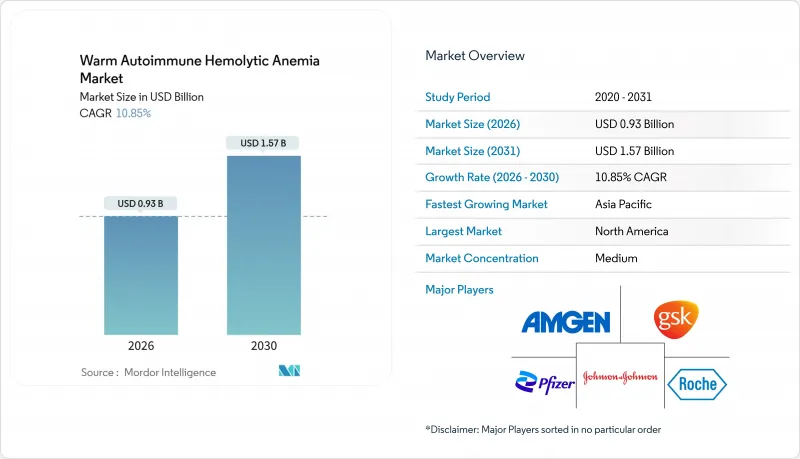
본 보고서는 약물 분류별(코르티코스테로이드, 면역억제제, 단일클론 항체, 정맥 내 면역글로불린, 비장 적출 및 외과적 치료, 신흥 치료법), 최종 사용자(병원, 전문 클리닉, 학술·연구 기관), 지역(북미, 유럽, 아시아태평양, 중동 및 아프리카, 남미)별로 분류되어 있습니다. 시장 전망은 금액(달러) 기준으로 제시되어 있습니다.
전 세계 온형 자가면역 용혈성 빈혈 시장 동향 및 인사이트
적응증 외 사용 생물학적 제제의 채택 확대
북미 및 유럽에서는 2차 치료 사례의 40% 가까이에서 리툭시맙이 적응증 외로 처방되고 있습니다. 이러한 경향은 프레드니솔론과 병용 투여 시 12개월 시점에서 75%의 완전 반응이 확인된 반면, 스테로이드 단독 투여 시에는 36%에 그쳤다는 무작위 임상시험 데이터에 근거합니다. 항-CD20 약물의 효능에 대한 신뢰가 높아짐에 따라, 스테로이드 요법 실패 후 생물학적 제제 투여 시작까지의 기간이 단축되고 있습니다. 임상의들이 불완전 반응 사례를 구제하기 위해 항체를 순환적으로 사용함에 따라, 오비누츠주맙이나 오파툼맙의 도입이 진행되며 항-CD20 약물 군이 확대되고 있습니다. 유럽의 3차 의료기관에서 시행된 비장 적출술 건수는 2020년부터 2025년 사이에 30% 감소했습니다. 이는 지속성 생물학적 제제를 이용한 치료 요법이 돌이킬 수 없는 수술을 지연시켰기 때문입니다. 니포칼리맙에 대한 FDA의 ‘획기적 치료제(Breakthrough Therapy)’ 지정은 이러한 적응증 외 사용의 추세를 제도적으로 뒷받침하는 것이며, 공식적인 적응증 획득을 위한 명확한 규제적 경로를 제시하고 있습니다.
FDA의 희귀질환 의약품 인센티브 가속화
7년간의 독점권, 세액 공제 및 수수료 면제로 인해 희귀질환 관련 신청이 급증했습니다. 사노피의 릴자부르티닙은 2b상 임상시험 데이터에서 스테로이드 구제 요법 없이 64%의 헤모글로빈 반응률을 보인 데 따라, 2025년 4월에 희귀질환 치료제로 지정되었습니다. 유럽에서는 이에 상응하는 인센티브로 10년간의 독점권이 제공되고 있어, 소규모 환자 집단에서도 비용을 회수할 수 있는 중견 개발 기업들을 뒷받침하고 있습니다. 보체 억제제인 페그세타코플란은 그 잠재력과 과제를 동시에 보여주고 있습니다. 11명의 환자 코호트에서 초기 징후는 나타나고 있으나, 그 효과에 편차가 관찰되어 표본 크기가 너무 작을 경우 통계적 검정력이 저하될 가능성이 있음을 여실히 드러내고 있습니다.
대형 제약사에게 낮은 상업적 매력
세계 유병률이 10만 명당 약 17명으로 대상 환자 기반이 극히 작기 때문에 블록버스터급 수익을 목표로 하는 초대형 기업에게는 매력이 부족합니다. 리겔(Rigel)사의 포스타마티닙은 희귀질환 치료제에 대한 독점권을 보유하고 있었음에도 불구하고, 2024년 매출액은 고작 4,200만 달러에 그쳤으며, 이후 3상 임상시험의 평가 지표를 달성하지 못하면서 재정적 및 임상적 위험이 부각되었습니다. 대기업들은 유병률이 높은 면역학 분야로 자원을 전환하고 있어 기동성이 높은 바이오테크 기업들에게 활약의 여지를 남기고 있지만, 이들 기업은 영업팀이 소규모인 탓에 신흥국 시장으로의 진출이 더딘 실정입니다.
부문 분석
단일클론 항체는 2026년부터 2031년까지 연평균 성장률(CAGR) 11.07%를 나타낼 것으로 예측되며, 온식 자가면역 용혈성 빈혈 시장 전체의 성장률을 상회할 것으로 전망됩니다. 코르티코스테로이드는 2025년에 36.81%의 점유율을 유지했으나, 혈액 전문의들이 지속적인 관해와 독성 감소를 중시하게 되면서 현재는 점유율이 하락하고 있습니다. 리툭시맙과 프레드니솔론을 병용한 덴마크의 임상시험에서는 완전 관해율이 39포인트의 절대적 증가를 보였으며, 항 CD20 제제가 표준 2차 치료제로서의 입지를 확립했습니다. FcRn 억제제나 BTK 억제제가 오프타겟 효과가 적은 표적 지향적 작용기전을 약속하고 있기 때문에 면역억제제 시장 점유율은 축소되는 추세입니다. IVIG는 용혈성 위기 시의 틈새 가교 요법으로 여전히 자리 잡고 있지만, 혈장 공급 부족으로 인해 투여량 확대에는 한계가 있습니다. 생물학적 제제로 인해 불가역적인 수술이 연기됨에 따라 비장 절제술 시행은 계속해서 감소하는 추세입니다.
새로운 치료법이 기대의 양상을 바꾸고 있습니다. 사노피사의 경구용 약물 릴자부르티닙은 편의성을 갖추고 있으며, 3상 임상시험 데이터를 통해 유효성과 안전성이 확인된다면 시장 점유율을 확대할 가능성이 있습니다. 존슨앤드존슨의 니포칼리맙은 IgG의 제거를 가속화하는 FcRn을 표적으로 하는 새로운 접근법을 도입하고 있어, 재발 사례에서 주류 치료법이 될 가능성이 있습니다. 개발 중인 CAR-T 요법은 1회성 세포 재교육을 목표로 하고 있으나, 발병률이 낮은 질환에서의 실현 가능성에 대해서는 아직 입증되어야 합니다. 전반적으로, 이러한 치료법들은 치료 선택지를 확대하고 자가면역 용혈성 빈혈 시장의 꾸준한 성장을 뒷받침하고 있습니다.
지역별 분석
북미는 2025년 온식 자가면역 용혈성 빈혈 시장에서 41.93%의 점유율을 차지했습니다. 이는 긴밀한 학술 네트워크, 풍부한 희귀질환 의약품 보상 제도, 그리고 신속 심사를 촉진하는 규제 체계에 힘입은 결과입니다. 획기적인 치료법(Breakthrough Therapy) 및 희귀질환 치료제(Orphan Drug) 지정을 통해 시판까지의 기간이 단축되어, 신규 진출기업은 주요 임상시험 결과 발표 후 18개월 이내에 시장에 진입할 수 있게 되었습니다. 캐나다는 주마다 환급 제도가 달라 미국에 뒤처지고 있지만, 멕시코의 ‘세구로 포풀라르(Seguro Popular)’는 AIHA 치료제를 필수 의약품 목록에 포함하고 있는 반면, 주요 대도시권 외 지역에서는 혈액 전문의 부족 문제에 직면해 있습니다.
유럽에서는 10년간의 독점권을 수반하는 성숙한 희귀질환 체계가 마련되어 있으며, 이것이 발생률이 낮은 질환에 대한 높은 가격 책정을 뒷받침하고 있습니다. 독일의 IQWiG는 리툭시맙을 ‘중간 정도의 유익성’으로 평가하며 보험 급여 태도를 강화했으나, 남유럽에서는 예산 부족으로 인해 사용이 제한되고 있습니다. 영국에서는 바이오시밀러에 관한 AIHA의 확고한 데이터가 여전히 부족하여 증거 요약이 유지되고 있으며, 이로 인해 경쟁이 제한되고 있습니다. 레지스트리 데이터를 통해 불균일성이 드러나고 있습니다. 스테로이드 치료가 더 이상 효과를 보이지 않은 후 6개월 이내에 리툭시맙을 투여받는 이탈리아 환자는 불과 22%인 반면, 프랑스에서는 64%에 달하며, 이러한 격차는 지역별 예산 한도와 관련이 있습니다.
아시아태평양은 2026년부터 2031년까지 연평균 성장률(CAGR) 13.03%를 나타낼 것으로 예측되며, 이는 전 세계에서 가장 빠른 성장률입니다. 중국에서 리툭시맙 바이오시밀러가 국가기본의약품목록(NRDL)에 등재됨에 따라 환자의 본인 부담금이 68% 감소했고, 1선 도시 이외 지역에서도 정맥 주입 투여량이 확대되었습니다. 일본은 2024년, 해당 지역에서 최초로 AIHA(온열성 자가면역성 혈구증)에 대한 렙티크시맙의 적응증을 공식 승인하고, 도도부현 간 보험 적용을 통일했습니다. 인도에서는 유세포 분석기 부족으로 인해 여전히 진단 지연이 발생하고 있지만, 민간 의료 체인이 혈액 질환 전문센터에 투자함에 따라 진료 의뢰까지의 지연은 점차 줄어들고 있습니다. 호주에서는 적응증 외 사용 리툭시맙에 대해 보험 적용을 하고 있으나, 전문의의 승인이 필요하기 때문에 지방에서의 접근성이 제한되고 있습니다.
기타 혜택:
- 엑셀 형식 시장 예측(ME) 시트
- 3개월간의 애널리스트 지원
자주 묻는 질문
목차
제1장 서론
제2장 조사 방법
제3장 주요 요약
제4장 시장 구도
제5장 시장 규모와 성장 예측
제6장 경쟁 구도
제7장 시장 기회와 향후 전망
KTH 26.08.06According to Mordor Intelligence, the warm autoimmune hemolytic anemia market size is estimated at USD 0.93 billion in 2026, and is expected to reach USD 1.57 billion by 2031, at a CAGR of 10.85% during the forecast period (2026-2031).
This report is Segmented by Drug Class (Corticosteroids, Immunosuppressants, Monoclonal Antibodies, Intravenous Immunoglobulin, Splenectomy & Surgical, Emerging Therapies), End User (Hospitals, Specialty Clinics, Academic & Research Centers), and Geography (North America, Europe, Asia-Pacific, Middle East & Africa, South America). The Market Forecasts are Provided in Terms of Value (USD).
Global Warm Autoimmune Hemolytic Anemia Market Trends and Insights
Rising Adoption of Off-Label Biologics
Rituximab is prescribed off-label in close to 40% of second-line cases across North America and Europe, a pattern grounded in randomized data that showed 75% complete responses at 12 months when combined with prednisolone compared with 36% for steroids alone. Growing confidence in anti-CD20 activity now shortens the interval between steroid failure and biologic initiation. Uptake of obinutuzumab and ofatumumab expands the anti-CD20 class as clinicians rotate antibodies to salvage incomplete responders. Splenectomy referrals at tertiary European centers fell by 30% between 2020 and 2025, as durable biologic regimens delayed irreversible surgery. Recognition by the FDA through Breakthrough Therapy status for nipocalimab codifies this off-label momentum by signaling a clear regulatory pathway toward formal indications.
Accelerated FDA Orphan-Drug Incentives
Seven-year exclusivity, tax credits, and fee waivers have spurred a surge in rare-disease filings. Sanofi's rilzabrutinib received orphan drug designation in April 2025 after Phase 2b data showed 64% hemoglobin response rates without rescue steroids. Comparable incentives in Europe supply 10-year exclusivity, motivating mid-size developers who can recoup costs in small populations. Complement inhibitor pegcetacoplan illustrates both promise and challenge: early signals, yet variable benefit, in an 11-patient cohort underscore how modest sample sizes can compromise statistical power.
Limited Commercial Attractiveness for Big Pharma
Global prevalence of about 17 per 100,000 yields a tiny addressable base, discouraging mega-cap firms that target blockbuster returns. Rigel's fostamatinib generated only USD 42 million in 2024 despite orphan exclusivity and then failed to meet its Phase 3 endpoint, illustrating financial and clinical risk. Larger companies have diverted resources toward higher-prevalence immunology, leaving room for agile biotechs, yet their smaller sales teams slow penetration in emerging economies.
Other drivers and restraints analyzed in the detailed report include:
- Increasing Autoimmune Prevalence in Aging Cohorts
- Launch of FcRn & Complement Inhibitors
- Diagnostic Complexity & Under-Diagnosis
For complete list of drivers and restraints, kindly check the Table Of Contents.
Segment Analysis
Monoclonal antibodies are projected to grow at 11.07% CAGR from 2026 to 2031, outpacing the overall warm autoimmune hemolytic anemia market. Corticosteroids maintained a 36.81% share in 2025 but now decline as hematologists prize durable remission and reduced toxicity. The Danish trial that combined rituximab with prednisolone delivered a 39-point absolute increase in complete responses, anchoring anti-CD20 agents as standard second-line therapy. Immunosuppressants cede ground as FcRn inhibitors and BTK blockers promise targeted mechanisms with fewer off-target effects. IVIG remains a niche bridge during hemolytic crises, yet plasma shortages limit volume gains. Splenectomy keeps waning because biologics defer irreversible surgery.
Emerging therapies reshape expectations. Sanofi's oral rilzabrutinib offers convenience that could tilt share if Phase 3 data confirm efficacy and safety. Johnson & Johnson's nipocalimab introduces an FcRn blueprint that accelerates IgG clearance and may dominate relapsed settings. Pipeline CAR-T constructs aim for one-time cellular re-education, though the feasibility in low-incidence diseases remains to be proven. Collectively, these modalities expand therapeutic options, supporting steady growth in the autoimmune hemolytic anemia market.
Complete Report Scope:
- By Drug Class
- Corticosteroids
- Immunosuppressants
- Monoclonal Antibodies
- Intravenous Immunoglobulin (IVIG)
- Splenectomy & Surgical
- Emerging Therapies
- By End User
- Hospitals
- Specialty Clinics
- Academic & Research Centers
- By Geography
- North America
- United States
- Canada
- Mexico
- Europe
- Germany
- United Kingdom
- France
- Italy
- Spain
- Rest of Europe
- Asia-Pacific
- China
- Japan
- India
- Australia
- South Korea
- Rest of Asia-Pacific
- Middle East & Africa
- GCC
- South Africa
- Rest of Middle East & Africa
- South America
- Brazil
- Argentina
- Rest of South America
- North America
Geography Analysis
North America held 41.93 of % warm autoimmune hemolytic anemia market share in 2025, driven by dense academic networks, generous orphan-drug reimbursement, and regulatory frameworks that champion accelerated review. Breakthrough Therapy and orphan designations compress launch timelines, enabling new entrants to reach the market within 18 months of pivotal readout. Canada lags the United States because reimbursement is province-specific, while Mexico's Seguro Popular adds warm AIHA drugs to essential lists yet grapples with hematologist shortages outside major metros.
Europe has a mature orphan framework with 10-year exclusivity, which supports high prices for low-volume diseases. Germany's IQWiG deemed rituximab moderately beneficial, strengthening its reimbursement stance, whereas Southern Europe's tighter budgets curb utilization. The United Kingdom maintains evidence summaries because biosimilars still lack robust AIHA data, which constrains competition. Registry data reveal heterogeneity: only 22% of Italian patients receive rituximab within 6 months of steroid failure, compared with 64% in France, a disparity linked to regional funding envelopes.
Asia-Pacific is forecast to register a 13.03% CAGR from 2026 to 2031, the fastest worldwide. China's NRDL listing of rituximab biosimilars slashed out-of-pocket expense by 68%, lifting infusion volumes beyond tier-1 cities. Japan issued the region's first formal warm AIHA rituximab indication in 2024, harmonizing coverage across prefectures. India's flow cytometry scarcity still drives underdiagnosis, yet private chains invest in hematology centers, thereby shrinking referral delays. Australia reimburses off-label rituximab but requires specialist authorization, which limits rural access.
- Amgen
- Amneal Pharmaceuticals
- Apellis Pharma
- Argenx SE
- BioCryst Pharma
- CSL Behring
- Roche
- GlaxoSmithKline
- Grifols
- Johnson & Johnson
- Momenta Pharma
- Novartis
- Pfizer
- Rigel Pharmaceuticals
- Sanofi
- Sobi AB
- Takeda Pharmaceuticals
- UCB
Additional Benefits:
- The market estimate (ME) sheet in Excel format
- 3 months of analyst support
TABLE OF CONTENTS
1 Introduction
- 1.1 Study Assumptions & Market Definition
- 1.2 Scope of the Study
2 Research Methodology
3 Executive Summary
4 Market Landscape
- 4.1 Market Overview
- 4.2 Market Drivers
- 4.2.1 Rising Adoption of Off-Label Biologics
- 4.2.2 Accelerated FDA Orphan-Drug Incentives
- 4.2.3 Increasing Autoimmune Prevalence In Ageing Cohorts
- 4.2.4 Launch of FCRN & Complement Inhibitors
- 4.2.5 AI-Driven Earlier Diagnosis in Hematology Labs
- 4.2.6 Growing Patient-Advocacy Registries & Epidemiology Clarity
- 4.3 Market Restraints
- 4.3.1 Limited Commercial Attractiveness for Big Pharma
- 4.3.2 Diagnostic Complexity & Under-Diagnosis
- 4.3.3 Safety Concerns Over Chronic Immunosuppression
- 4.3.4 High Cost of Biologics in Emerging Markets
- 4.4 Regulatory Landscape
- 4.5 Technological Outlook
- 4.6 Porter's Five Forces Analysis
- 4.6.1 Threat of New Entrants
- 4.6.2 Bargaining Power of Buyers
- 4.6.3 Bargaining Power of Suppliers
- 4.6.4 Threat of Substitutes
- 4.6.5 Competitive Rivalry
5 Market Size & Growth Forecasts
- 5.1 By Drug Class
- 5.1.1 Corticosteroids
- 5.1.2 Immunosuppressants
- 5.1.3 Monoclonal Antibodies
- 5.1.4 Intravenous Immunoglobulin (IVIG)
- 5.1.5 Splenectomy & Surgical
- 5.1.6 Emerging Therapies
- 5.2 By End User
- 5.2.1 Hospitals
- 5.2.2 Specialty Clinics
- 5.2.3 Academic & Research Centers
- 5.3 By Geography
- 5.3.1 North America
- 5.3.1.1 United States
- 5.3.1.2 Canada
- 5.3.1.3 Mexico
- 5.3.2 Europe
- 5.3.2.1 Germany
- 5.3.2.2 United Kingdom
- 5.3.2.3 France
- 5.3.2.4 Italy
- 5.3.2.5 Spain
- 5.3.2.6 Rest of Europe
- 5.3.3 Asia-Pacific
- 5.3.3.1 China
- 5.3.3.2 Japan
- 5.3.3.3 India
- 5.3.3.4 Australia
- 5.3.3.5 South Korea
- 5.3.3.6 Rest of Asia-Pacific
- 5.3.4 Middle East & Africa
- 5.3.4.1 GCC
- 5.3.4.2 South Africa
- 5.3.4.3 Rest of Middle East & Africa
- 5.3.5 South America
- 5.3.5.1 Brazil
- 5.3.5.2 Argentina
- 5.3.5.3 Rest of South America
- 5.3.1 North America
6 Competitive Landscape
- 6.1 Market Concentration
- 6.2 Market Share Analysis
- 6.3 Company Profiles (includes Global level Overview, Market-level Overview, Core Segments, Financials, Strategic Information, Market Rank/Share, Products & Services, Recent Developments)
- 6.3.1 Amgen Inc.
- 6.3.2 Amneal Pharmaceuticals
- 6.3.3 Apellis Pharma
- 6.3.4 Argenx SE
- 6.3.5 BioCryst Pharma
- 6.3.6 CSL Behring
- 6.3.7 F. Hoffmann-La Roche Ltd
- 6.3.8 GlaxoSmithKline plc
- 6.3.9 Grifols S.A.
- 6.3.10 Johnson & Johnson
- 6.3.11 Momenta Pharma
- 6.3.12 Novartis AG
- 6.3.13 Pfizer Inc
- 6.3.14 Rigel Pharmaceuticals
- 6.3.15 Sanofi S.A.
- 6.3.16 Sobi AB
- 6.3.17 Takeda Pharmaceutical
- 6.3.18 UCB S.A.
7 Market Opportunities & Future Outlook
- 7.1 White-space & Unmet-need Assessment


