

|
시장보고서
상품코드
2097396
배터리용 리튬 화합물 : 시장 점유율 분석, 업계 동향과 통계, 성장 예측(2026-2031년)Lithium Compound for Battery Application - Market Share Analysis, Industry Trends & Statistics, Growth Forecasts (2026 - 2031) |
||||||
 Mordor Intelligence
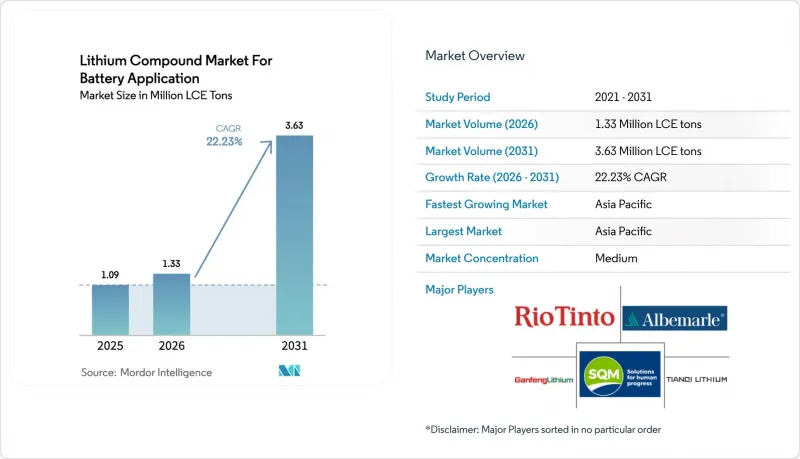
Mordor Intelligence에 의하면, 배터리용 리튬 화합물 시장 규모는 2025년에 1.09 LCE백만 톤으로 평가되었고, 2026년 1.33 LCE백만 톤에서 2031년까지 3.63 LCE백만 톤에 이를 것으로 예측되며, 2026년부터 2031년까지 연평균 복합 성장률(CAGR)은 22.23%를 나타낼 전망입니다.
본 보고서는 화합물별(탄산리튬, 수산화리튬, 염화리튬, 기타), 최종 사용자 산업별(자동차, 소비자 가전, 에너지 저장 시스템, 기타 산업), 지역별(아시아태평양, 북미, 유럽, 남미, 중동 및 아프리카)로 분류되어 있습니다. 시장 전망은 수량(LCE 톤) 기준으로 제시되어 있습니다.
전 세계 배터리용 리튬 화합물 시장 동향 및 인사이트
전기차 보급 확대
2025년, 승용차 및 상용 전기차(EV)의 전 세계 판매 대수는 중요한 분기점을 넘어섰으며, 배터리 등급 리튬 화합물에 대한 견고한 수요를 확고히 했습니다. 유럽 및 북미의 차량 플릿에서는 주행 거리 연장이 중시되고 있어, 니켈 함량이 높은 배터리로의 전환이 진행되고 있습니다. 이러한 배터리가 수산화리튬의 채택 확대를 주도하고 있습니다. 한편, 중국은 매우 중요한 역할을 하고 있습니다. 국내 자동차 제조업체들은 탄산리튬을 원료로 하는 비용 효율이 뛰어난 인산철리튬(LFP) 팩을 활용하여 막대한 수의 전기차를 출하했습니다. ‘인플레이션 억제법’에 따른 우대 조치 덕분에 북미에서는 배터리 공장 건설이 잇달아 결정되었습니다. 각 공장은 연간 탄산리튬 환산량(LCE)에 상당하는 공급량을 확보할 전망입니다. 고니켈 전략과 LFP 전략 간의 격차가 확대됨에 따라, 탄산리튬 시장과 수산화리튬 시장이 동시에 성장할 것으로 예측됩니다. 또한, 시내버스에서 중형 트럭에 이르는 상용차의 전기화로 인해 연중 안정적인 수요가 창출되고 있습니다.
재생에너지 저장 시스템 도입 확대
태양광 및 풍력 발전의 확대에 따라 계통 안정화 능력이 요구됨에 따라, 유틸리티 규모의 배터리 도입은 앞으로도 계속 증가할 것으로 예측됩니다. 캘리포니아주의 ‘자가 발전 장려 프로그램(Self-Generation Incentive Program)’에서는 주로 탄산리튬에 의존하는 LFP 셀을 사용하는 주택용 시스템에 대해 막대한 자금 지원이 승인되었습니다. 중국에서 새로 도입된 풍력·태양광 발전소 대상의 에너지 저장 의무화 정책은 LFP 모듈 수요를 뒷받침하고 있습니다. 인도에서는 에너지 저장 시스템에 대한 입찰이 진행되고 있으며, 자금 조달 모델이 리튬 의존도를 낮춘 단시간 에너지 저장형 자산으로 기울고 있음에도 불구하고, 인도의 계통 조정 수요가 증가하고 있음이 부각되고 있습니다. 철-공기 전지와 같은 장시간 축전형 화학 전지는 향후 10년 후반에 틈새 시장을 개척할 전망이지만, 상용화는 아직 초기 단계에 있으므로 적어도 2031년까지는 리튬이 지배적인 지위를 유지할 것으로 보입니다.
공급망 병목 현상과 스포듀멘 부족
2025년, 호주의 각 광산 기업들은 가격 하락에 따라 스포듀멘 정광 생산을 축소했습니다. 이러한 움직임으로 인해 중국 정제업체에 대한 원료 공급이 감소했을 뿐만 아니라, 정제소의 재고도 최소 수준으로 떨어졌습니다. 일반적으로 신규 경암 광산의 생산 능력은 최종 투자 결정부터 첫 제품 생산까지 수개월이 소요됩니다. 따라서 현재의 프로젝트 중단은 2020년대 후반에 확대될 것으로 예상되는 전기차(EV) 시장에서 공급 부족이 발생할 가능성을 시사합니다. 라이온타운(Liontown)사의 캐슬린 밸리(Kathleen Valley) 프로젝트 연기는 공급망에서 또 다른 공급원이 사라진다는 것을 의미합니다. 전기차 판매 대수가 해마다 증가할 것으로 예상에 따라, 향후 몇 년 동안 스포주멘에 대한 수요가 경제적으로 수익성이 있는 공급량을 초과할 가능성이 있습니다. 염수에서 추출하는 방식은 어느 정도 완화책이 될 수 있지만, 환경적 문제를 수반하며, 리튬 직접 추출 기술은 여전히 시험 단계에 있습니다. 광산의 현금 흐름을 뒷받침할 지속적인 가격 회복이 없다면, 리튬 화합물 시장은 주기적인 공급 부족에 직면하게 되어 다운스트림 공정에서의 안정적인 계획 수립이 위태로워질 수 있습니다.
부문 분석
탄산리튬은 2025년 공급량의 64.31%를 차지하고 있으며, 이는 주로 LFP 양극재에서 탄산리튬이 수행하는 매우 중요한 역할 때문입니다. 이러한 양극재는 중국에서 급성장하고 있는 대중형 전기차(EV) 및 고정형 에너지 분야의 기반이 되고 있습니다. LFP 배터리 팩은 경쟁력을 뒷받침하는 총 시스템 비용을 달성하는 주목할 만한 이정표를 맞이하며, 니켈계 화학 조성에 비해 큰 우위를 부각시켜 리튬 탄산염 수요를 더욱 부추겼습니다. 탄산리튬 용도의 리튬 화합물 시장 규모는 이륜차의 급속한 전기화와 에너지 저장 분야에 대한 관심 증가에 힘입어 연평균 성장률(CAGR) 22.79%로 확대될 것으로 예측됩니다. 한편, 수산화 리튬은 2025년 생산량의 대부분을 차지하는 반면, 프리미엄 가격이 책정되어 있어 매출에서 차지하는 비중이 불균형할 정도로 높습니다. 이는 주로 배터리 등급의 프리미엄 가격 때문입니다. 이 두 제품 간의 역학 관계에서는 전략적인 균형이 엿보입니다. 탄산리튬이 판매량의 안정성을 확보하는 반면, 수산화리튬은 이익률 향상과 더 큰 협상력을 가져다줍니다.
염화리튬, 불화리튬, 산화리튬, 황화리튬과 같은 2급 화합물은 2025년 생산량의 약 6%에 불과하지만, 틈새 용도에서는 그 중요성이 매우 큽니다. 예를 들어, 전고체 전해질 개발자들은 황화물계 필름 제조에 필수적인 고순도 염화리튬을 채택하고 있습니다. 이러한 필름은 10 mS/cm를 초과하는 이온 전도도를 자랑하는데, 이는 주류인 탄산염계 방식으로는 달성하기 어려운 기준치입니다. 한편, 리튬 플루오라이드는 고전압 전해질 첨가제로서 중요한 역할을 수행하며, 4.5V NM 양극에서 전이 금속의 용해를 방지합니다. 특히, 이러한 특수 염의 가격은 탄산염 계열 제품의 기준 가격을 상회하는 경우가 있습니다. 또한, 이러한 화합물에 대한 수요는 주요 OEM 업체들이 설정한 연구개발(R&D) 마일스톤과 밀접하게 연동되어 있습니다. 파일럿 생산 라인이 그램 규모의 실험에서 톤 규모의 가동으로 전환됨에 따라, 특수 화학제품 제조업체들은 수익성이 높은 틈새 시장을 개척할 준비를 갖추고 있습니다. 지적 재산권이 풍부한 이러한 시장은 취급량은 많지 않을 수 있으나, 큰 가치를 창출할 것으로 기대됩니다.
지역별 분석
아시아태평양은 2025년 시장 규모의 64.86%를 차지할 것으로 예상되며, 2031년까지 연평균 성장률(CAGR)은 23.85%를 나타낼 것으로 전망되어, 이 지역이 리튬 화합물 시장을 주도하는 입지를 공고히 하고 있습니다. 주요 기업인 중국은 광둥성, 장쑤성, 쓰촨성의 배터리 공장을 주된 공급 대상으로 하여 상당한 양의 LCE를 정제했습니다. 간펑(Ganfen)의 신위(Xinyu) 정제소는 연간 생산 능력을 갖추고 있으며, 니켈 가격 변동에 따라 탄산리튬과 수산화리튬의 생산을 유연하게 전환하고 있습니다. 인도는 2025년에 LCE 수요의 상당 부분을 수입에 의존했으나, 잠무-카슈미르 주에서 국내 탐사 활동을 가속화하고 있으며, 향후 10년 말까지 수입 의존도를 낮추는 것을 목표로 하고 있습니다. 일본과 한국은 모두 순수입국이지만, 파나소닉이나 LG 에너지솔루션과 같은 대기업을 통해 가공 기술을 활용하고 있으며, 원통형 배터리 및 파우치형 배터리 생산에 LCE를 공동으로 사용하고 있습니다.
북미는 2025년 수요에서 두드러진 점유율을 차지했습니다. 알베마르(Albemarle)사의 실버 피크(Silver Peak) 염수 채굴장에서는 탄산리튬이 생산되고 있으며, 이 회사는 킹스 마운틴(Kings Mountain)에 수산화리튬 제조 시설을 건설할 계획을 추진 중이며, 2027년 가동을 목표로 하고 있습니다. 리튬 아메리카스(Lithium Americas)의 사커 패스(Sacker Pass) 프로젝트는 연방 정부의 승인을 받아 2027년에 탄산리튬 생산을 시작할 예정입니다. 캐나다 퀘벡주에서는 네마스카(Nemasc)사가 수력발전을 활용한 보다 친환경적인 처리 방식을 통해 수산화리튬 생산을 확대하기 위해 가동을 재개했습니다. 한편, 멕시코 누에보레온주에 위치한 급성장 중인 전기차 거점에서는 2028년까지 연간 LCE 수요가 예상되며, 그 공급원으로는 남미의 염수 및 소노라주의 잠재 자원이 기대되고 있습니다.
유럽은 2025년, 현지 광석 부족으로 인해 어려움을 겪었음에도 불구하고 세계 리튬 생산량의 일부를 확보했습니다. 독일의 발칸 에너지(Balkan Energy)사는 지열 염수에서 리튬을 추출하는 작업을 선도적으로 추진하고 있으며, 2026년 수산화리튬 생산을 목표로 하고, 2028년까지 생산 규모를 확대하겠다는 야심찬 계획을 가지고 있습니다. 프랑스에서는 이메리스(Imerys)사가 2028년부터 보부아르(Bovoy) 거점에서의 수산화리튬 추출 실현 가능성을 평가했습니다. 영국은 자동차 변혁 기금(Automotive Transformation Fund)을 통한 배터리 조립 지원금의 혜택을 받고 있지만, 여전히 정제 능력 부족에 직면해 있어 아시아산 수산화리튬 수입에 의존할 수밖에 없는 상황입니다. 남미에서는 2025년 1차 리튬 생산량의 대부분을 칠레와 아르헨티나가 차지했습니다. 한편, 중동에서는 사우디아라비아가 홍해의 염수를 이용한 직접 리튬 추출(DLE) 시범 사업에 투자하고 있어, 새로운 저탄소 공급원의 부상을 시사하고 있습니다.
기타 혜택:
- 엑셀 형식 시장 예측(ME) 시트
- 3개월간의 애널리스트 지원
자주 묻는 질문
목차
제1장 서론
제2장 조사 방법
제3장 주요 요약
제4장 시장 구도
제5장 시장 규모와 성장 예측
제6장 경쟁 구도
제7장 시장 기회와 향후 전망
KTH 26.08.06According to Mordor Intelligence, the lithium compound for Battery Application Market Industry size was valued at 1.09 LCE million tons in 2025 and is estimated to grow from 1.33 LCE million tons in 2026 to reach 3.63 LCE million tons by 2031, at a CAGR of 22.23% during the forecast period (2026-2031).
This report is Segmented by Compound (Lithium Carbonate, Lithium Hydroxide, Lithium Chloride, and Others), End-User Industry (Automotive, Consumer Electronics, Energy Storage Systems, and Other Industries), and Geography (Asia-Pacific, North America, Europe, South America, and Middle-East and Africa). Market Forecasts are Provided in Terms of Volume (LCE Tons).
Global Lithium Compound for Battery Application Market Trends and Insights
Surge in Electric-Vehicle Adoption
In 2025, global sales of passenger and commercial electric vehicles (EVs) surpassed significant milestones, solidifying a robust demand for battery-grade lithium compounds. Fleets in Europe and North America, emphasizing higher mileage, are gravitating towards nickel-rich cells. These cells are driving a surge in hydroxide adoption. Meanwhile, China plays a crucial role: domestic OEMs dispatched a substantial number of EVs, capitalizing on cost-effective lithium iron phosphate (LFP) packs derived from carbonate feedstock. Thanks to incentives from the Inflation Reduction Act, North America saw a flurry of commitments for cell plants. Each plant is poised to draw in an annual supply of lithium carbonate equivalent (LCE). As the divide between high-nickel and LFP strategies widens, both carbonate and hydroxide markets are set for simultaneous growth. Furthermore, the electrification of commercial vehicles, spanning from city buses to medium-duty trucks, introduces a consistent demand throughout the year.
Growth in Renewable-Energy Storage Deployments
Utility-scale battery installations are expected to continue climbing as solar and wind build-outs require firming capacity. California's Self-Generation Incentive Program has authorized significant funding for residential systems, predominantly utilizing LFP cells that depend on lithium carbonate. China's newly introduced storage-mandate policy for wind and solar plants is spurring demand for LFP modules. In India, a tender for storage underscores the nation's escalating grid-balancing demands, even as financing models lean towards shorter-duration assets with reduced lithium reliance. While long-duration chemistries like iron-air are poised to carve out niches in the latter part of the decade, they remain in their commercial infancy, ensuring lithium's dominance at least until 2031.
Supply-Chain Bottlenecks and Spodumene Shortages
In 2025, Australian miners curtailed spodumene concentrate production as prices fell. This move reduced feedstock for Chinese converters and brought refinery inventories down to minimal levels. Typically, new hard-rock capacities take several months from the final investment decision to produce their first product. Thus, today's cancellations hint at potential shortages for the growing electric vehicle (EV) market in the late decade. Liontown's delay of the Kathleen Valley project means a loss of additional supply from the chain. With EV sales set to grow annually, demand for spodumene could surpass economically viable supply in the coming years. While brines offer some respite, they come with environmental challenges, and direct lithium extraction technologies are still in the pilot phase. Without a consistent price rebound to bolster mine cash flows, the lithium compound market may face periodic squeezes, jeopardizing stable planning downstream.
Other drivers and restraints analyzed in the detailed report include:
- Localization of Battery Supply Chains in Emerging Economies
- Higher Li-Intensity from High-Nickel and Solid-State Chemistries
- Stringent Water-Use and Environmental Regulations
For complete list of drivers and restraints, kindly check the Table Of Contents.
Segment Analysis
Lithium carbonate held 64.31% of the 2025 volume, primarily due to its pivotal role in LFP cathodes. These cathodes are the backbone of China's burgeoning mass-market electric vehicle (EV) and stationary energy segments. LFP battery packs achieved a notable milestone, reaching total system costs that underscored their competitiveness and highlighted a significant advantage over nickel-based chemistries, further bolstering the demand for lithium carbonate. The lithium compound market size for carbonate applications is projected to advance at a 22.79% CAGR, driven by the swift electrification of two-wheelers and a growing emphasis on energy storage. Meanwhile, lithium hydroxide, while accounting for a significant portion of the 2025 output, commanded a premium, contributing a disproportionately higher share of revenue. This was largely due to battery-grade premiums. The dynamics between the two products reveal a strategic balance: while lithium carbonate ensures volume stability, lithium hydroxide offers enhanced profit margins and greater bargaining power.
While second-tier compounds like lithium chloride, fluoride, oxide, and sulfide constituted about 6% of the 2025 volume, their significance looms large in niche applications. For instance, developers of solid-state electrolytes turn to high-purity lithium chloride, essential for crafting sulfide-based films. These films boast ionic conductivities exceeding 10 mS/cm, a benchmark that mainstream carbonate routes struggle to achieve. Lithium fluoride, on the other hand, plays a crucial role as a high-voltage electrolyte additive, preventing transition-metal dissolution in 4.5-V NM cathodes. Notably, prices for these specialty salts can outstrip carbonate benchmarks. Furthermore, demand for these compounds closely follows research and development milestones set by major OEMs. As pilot production lines transition from gram-scale experiments to ton-scale operations, specialty producers stand poised to carve out lucrative micro-markets. These markets, rich in intellectual property, may not boast high tonnage but promise significant value.
Complete Report Scope:
- By Compound
- Lithium Carbonate
- Lithium Hydroxide
- Lithium Chloride
- Others (Lithium Oxide, Lithium Fluoride, Lithium Sulfide, and Lithium Sulfate)
- By End-user Industry
- Automotive (Electric Vehicles)
- Consumer Electronics
- Energy Storage Systems
- Other Industries (Power tools, Aerospace, etc.)
- By Geography
- Asia-Pacific
- China
- Japan
- India
- South Korea
- Rest of Asia-Pacific
- North America
- United States
- Canada
- Mexico
- Europe
- Germany
- United Kingdom
- France
- Italy
- Rest of Europe
- South America
- Brazil
- Argentina
- Rest of South America
- Middle-East and Africa
- Saudi Arabia
- South Africa
- Rest of Middle-East and Africa
- Asia-Pacific
Geography Analysis
Asia-Pacific controlled 64.86% of the 2025 volume and 23.85% CAGR through 2031, reinforcing the region's stewardship of the lithium compound market. China, a significant player, refined a substantial amount of LCE, primarily servicing cell plants in its Guangdong, Jiangsu, and Sichuan provinces. Ganfeng's Xinyu refinery, with an annual capacity, adeptly shifts between producing carbonate and hydroxide, responding to fluctuations in nickel prices. While India imported a substantial percentage of its LCE requirement in 2025, the nation is accelerating domestic exploration efforts in Jammu and Kashmir, with hopes of curbing its import reliance by the decade's end. Both Japan and South Korea, despite being net importers, leverage their processing expertise through giants like Panasonic and LG Energy Solution, collectively utilizing LCE for their cylindrical and pouch-cell productions.
North America accounted for a notable share of the 2025 demand. At Albemarle's Silver Peak brine site, carbonate was produced, and the company is pushing forward with plans for an annual capacity hydroxide facility at Kings Mountain, aiming for a 2027 launch. Lithium Americas' Thacker Pass project, having navigated federal approvals, is set to commence in 2027 with an output of carbonate. In Quebec, Canada's Nemaska is reviving operations to add hydroxide, utilizing hydropower for a greener processing approach. Meanwhile, Mexico's growing electric vehicle hub in Nuevo Leon anticipates a demand of LCE annually by 2028, with supplies expected from both South American brines and potential resources in Sonora.
Europe secured a portion of the global lithium volume in 2025, hampered by a scarcity of local ore. Germany's Vulcan Energy is pioneering geothermal-brine extraction, targeting an output of hydroxide in 2026, with ambitions to scale up by 2028. In France, Imerys is evaluating the feasibility of extracting hydroxide from its Beauvoir site starting in 2028. The UK, while benefiting from grants under the Automotive Transformation Fund for cell assembly, still faces refining shortfalls, leading to a reliance on hydroxide imports from Asia. In South America, both Chile and Argentina were responsible for a significant share of the primary lithium output in 2025. Meanwhile, in the Middle East, Saudi Arabia is investing in direct lithium extraction (DLE) pilots on Red Sea brines, hinting at the emergence of new low-carbon supply sources.
- Albemarle Corporation
- Jiangxi Ganfeng Lithium Group Co., Ltd.
- LevertonHELM Limited
- Lithium Americas Corp.
- Lithium Argentina AG
- Mineral Resources
- PLS (Pilbara Minerals)
- Rio Tinto
- Shandong Ruifu Lithium Co., Ltd.
- SQM S.A.
- Tianqi Lithium Co., Ltd.
Additional Benefits:
- The market estimate (ME) sheet in Excel format
- 3 months of analyst support
TABLE OF CONTENTS
1 Introduction
- 1.1 Study Assumptions and Market Definition
- 1.2 Scope of the Study
2 Research Methodology
3 Executive Summary
4 Market Landscape
- 4.1 Market Overview
- 4.2 Market Drivers
- 4.2.1 Surge in electric-vehicle adoption
- 4.2.2 Growth in renewable-energy storage deployments
- 4.2.3 Expansion of consumer electronics and power tools
- 4.2.4 Localization of battery supply chains in emerging economies
- 4.2.5 Higher Li-intensity from high-nickel and solid-state chemistries
- 4.3 Market Restraints
- 4.3.1 Supply-chain bottlenecks and spodumene shortages
- 4.3.2 Stringent water-use and environmental regulations
- 4.3.3 Lithium-price volatility driven by speculation
- 4.4 Value Chain Analysis
- 4.5 Porter's Five Forces Analysis
- 4.5.1 Bargaining Power of Suppliers
- 4.5.2 Bargaining Power of Buyers
- 4.5.3 Threat of New Entrants
- 4.5.4 Threat of Substitutes
- 4.5.5 Degree of Competition
5 Market Size and Growth Forecasts (Volume)
- 5.1 By Compound
- 5.1.1 Lithium Carbonate
- 5.1.2 Lithium Hydroxide
- 5.1.3 Lithium Chloride
- 5.1.4 Others (Lithium Oxide, Lithium Fluoride, Lithium Sulfide, and Lithium Sulfate)
- 5.2 By End-user Industry
- 5.2.1 Automotive (Electric Vehicles)
- 5.2.2 Consumer Electronics
- 5.2.3 Energy Storage Systems
- 5.2.4 Other Industries (Power tools, Aerospace, etc.)
- 5.3 By Geography
- 5.3.1 Asia-Pacific
- 5.3.1.1 China
- 5.3.1.2 Japan
- 5.3.1.3 India
- 5.3.1.4 South Korea
- 5.3.1.5 Rest of Asia-Pacific
- 5.3.2 North America
- 5.3.2.1 United States
- 5.3.2.2 Canada
- 5.3.2.3 Mexico
- 5.3.3 Europe
- 5.3.3.1 Germany
- 5.3.3.2 United Kingdom
- 5.3.3.3 France
- 5.3.3.4 Italy
- 5.3.3.5 Rest of Europe
- 5.3.4 South America
- 5.3.4.1 Brazil
- 5.3.4.2 Argentina
- 5.3.4.3 Rest of South America
- 5.3.5 Middle-East and Africa
- 5.3.5.1 Saudi Arabia
- 5.3.5.2 South Africa
- 5.3.5.3 Rest of Middle-East and Africa
- 5.3.1 Asia-Pacific
6 Competitive Landscape
- 6.1 Market Concentration
- 6.2 Strategic Moves
- 6.3 Market Share/Ranking Analysis
- 6.4 Company Profiles (includes Global-level Overview, Market-level Overview, Core Segments, Financials as available, Strategic Information, Products and Services, Recent Developments)
- 6.4.1 Albemarle Corporation
- 6.4.2 Jiangxi Ganfeng Lithium Group Co., Ltd.
- 6.4.3 LevertonHELM Limited
- 6.4.4 Lithium Americas Corp.
- 6.4.5 Lithium Argentina AG
- 6.4.6 Mineral Resources
- 6.4.7 PLS (Pilbara Minerals)
- 6.4.8 Rio Tinto
- 6.4.9 Shandong Ruifu Lithium Co., Ltd.
- 6.4.10 SQM S.A.
- 6.4.11 Tianqi Lithium Co., Ltd.
7 Market Opportunities and Future Outlook
- 7.1 White-space and Unmet-Need Assessment


