

|
시장보고서
상품코드
2097404
로봇 및 스마트 제조용 GPU : 시장 점유율 분석, 업계 동향과 통계, 성장 예측(2026-2031년)GPU In Robotics and Smart Manufacturing - Market Share Analysis, Industry Trends & Statistics, Growth Forecasts (2026 - 2031) |
||||||
 Mordor Intelligence
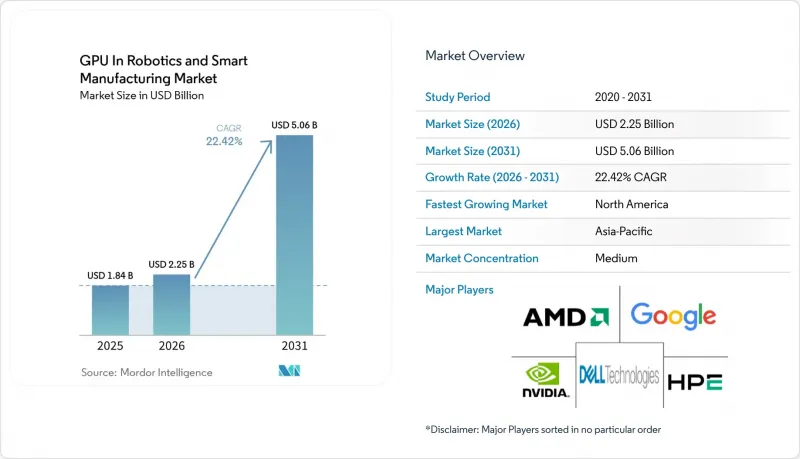
Mordor Intelligence에 의하면, 로봇 및 스마트 제조용 GPU 시장 규모는 2025년 18억 4,000만 달러에서 2026년에는 22억 5,000만 달러로 확대되고, 2031년까지 50억 6,000만 달러에 이를 것으로 예상되고 있으며, 2026-2031년 CAGR 22.42%를 기록할 전망입니다.
본 보고서는 용도별(머신 비전 및 품질 검사, 자율형 로봇 및 협동 로봇 등), 로봇 유형별(산업용 로봇, 협동 로봇 등), 도입 환경별(On-Premise형 엣지 시스템 등), 최종 사용자 산업별(자동차 제조 등) 및 지역별로 분류되어 있습니다. 시장 전망은 금액(달러) 단위로 제시되어 있습니다.
전 세계 로봇 및 스마트 제조용 GPU 시장 동향과 인사이트
AI를 활용한 머신 비전을 통한 품질 검사 급증
현대 전자기기 및 반도체 제조 라인에서는 컨베이어의 최고 속도로 기가픽셀급 이미지를 처리하고 있지만, 이러한 데이터 전송 속도는 CPU의 파이프라인을 압도하는 수준입니다. 새로운 검사 플랫폼에서는 200메가픽셀 센서와 텐서 코어가 탑재된 GPU를 결합하여 누락률을 5ppm 미만으로 낮추고, 피드백 루프를 라인 끝단에서 단일 로트 내로 단축하고 있습니다. 자동차 업계의 1차 공급업체에 따르면, 오감지율이 25-40% 감소하여 공장당 연간 최대 500만 달러의 비용 절감으로 이어지고 있습니다. 기존의 컨볼루션 모델에 비해 약 10배의 연산 능력을 필요로 하는 트랜스포머형 비전 네트워크 덕분에, GPU는 차세대 품질 관리 분야에서 유일하고 실용적인 추론 엔진으로서의 입지를 확고히 하고 있습니다.
자동차 및 전자 공장에서 협업 로봇 도입 확대
레트로핏용 가속기 카드는 기존 협업 로봇에 삽입하기만 하면, 기계 팔을 교체할 필요 없이 실시간 힘·토크 감지 및 적응형 그립 기능을 실현합니다. 자동차 배터리 생산 라인에서는 100밀리초의 클라우드 왕복 시간을 허용할 수 없는 서브mm 단위의 정밀 위치 조정이 요구됩니다. 따라서 임베디드 GPU가 비전, 안전성 및 동작 계획 처리를 로컬에서 수행합니다. 주변 케이지를 철거함으로써 설치 비용을 최대 40% 절감하고, 추가 공구를 설치할 수 있는 바닥 면적을 확보할 수 있습니다. 이는 빈번한 모델 변경에 대응해야 하는 공장에 있어 매우 매력적인 투자 대비 효과를 제공합니다.
산업용 GPU 시스템의 높은 초기 비용과 총 소유 비용
수냉 기능을 갖춘 견고한 4GPU 엣지 박스의 가격은 10만 달러를 초과할 수 있으며, 이는 CPU 자동화 컨트롤러 가격의 4배에 달할 전망입니다. 냉수 순환 시스템, 라이선싱, 그리고 IEC 62443 준수 사이버 보안 대책으로 인해 5년 동안 추가로 20-30%의 비용이 가중됩니다. 비용에 민감한 경제권의 중소 제조업체들은 매력적인 투자 회수 기간이 있음에도 불구하고 업그레이드를 미루고 있어, Tier 1 기업 이외의 분야에서는 단기적인 보급이 제한적입니다.
부문 분석
로봇 및 스마트 제조용 GPU 시장 규모 내역을 살펴보면, 2025년 매출의 38%를 머신 비전이 차지하고 있습니다. 반도체 팹에서는 서브미크론 수준의 결함 검출이 요구되고 있어, 모든 검사 베이에 GPU가 도입되어 있습니다. 디지털 트윈 및 시뮬레이션 워크로드는 가장 빠르게 성장하고 있는데, 이는 자동차 OEM 각사가 가상 환경에서 수십 가지의 라인 레이아웃을 테스트하여 양산 개시까지의 일정을 절반으로 단축하고 있기 때문입니다. 엣지 서버가 과도한 연산 리소스를 소비하지 않고도 1kHz의 센서 퓨전을 처리할 수 있게 됨에 따라, 예측 유지보수는 꾸준히 확대되고 있습니다. 자율형 자재관리은 여전히 가장 작은 점유율을 차지하고 있지만, 전자상거래 허브가 50밀리초 미만의 로컬 추론을 필요로 하는 이동 로봇 군을 개조함에 따라 급증할 전망입니다.
디지털 트윈 사용자들은 하이엔드 GPU 클러스터를 통해 도장 공장의 로봇을 최적화한 결과, 최대 12%의 에너지 절감과 약 8%의 사이클 타임 단축을 달성했다고 보고하고 있습니다. 기존 CNN의 10배 규모를 가진 트랜스포머형 비전 모델 덕분에 실리콘에 대한 수요는 앞으로도 지속될 것으로 확실시되고 있습니다. 예지 보전 분야의 사용자들은 가동 중단 시간이 25-40% 감소하여 연간 수백만 달러에 달하는 효과를 거두었습니다고 보고하고 있습니다. 자율형 자재관리이 주목을 받고 있는 이유는 200대 이상의 AMR(자율 이동 로봇) 함대가 고정형 로봇의 암을 단계적으로 업그레이드하는 경우보다 누적적인 GPU 수요를 훨씬 더 크게 창출하기 때문입니다.
로봇 및 스마트 제조용 GPU 시장의 2025년 매출액 중 49%는 산업용 로봇이 차지하고 있으며, 이는 이미 확립된 자동차 및 전자 분야 프로그램에 의해 주도되고 있습니다. AMR과 AGV는 현재 규모는 작지만, 창고 내 경로가 시시각각 변화하여 클라우드에서의 판단을 기다릴 수 없기 때문에 가장 빠르게 성장하고 있습니다. 협업 로봇(코봇)의 점유율은 뒤처지고 있지만, 기존 로봇 군을 최신화하기 위한 추가형 GPU 카드를 통해 두 자릿수 성장을 보이고 있습니다. 새로운 코봇 모델에는 손목 부분에 카메라와 임베디드 GPU가 통합되어 있으며, 그립력을 조절함으로써 깨지기 쉬운 부품의 불량률을 최대 50%까지 줄이고 있습니다.
2026년 초, 북미의 창고에서는 1,000대 이상의 새로운 AMR이 도입되었습니다. 이는 엣지 GPU를 통해 과거 로봇의 속도를 제한하던 100-200밀리초의 지연이 해소되었음을 입증합니다. 현재 산업용 로봇 팔은 GPU를 활용한 빈 피킹 기술을 통해 분당 120회의 피킹을 실현하고 있으며, 자동차 업계의 ‘저스트 인 시퀀싱(Just-in-Sequence)’ 방식의 납품에 대응하고 있습니다. 협동형 유닛은 GPU를 통한 안전 인식의 고속화 혜택을 받아, 고가의 안전 펜스를 설치하지 않고도 인간과 협동 로봇의 협업 작업이 가능해졌습니다.
지역별 분석
아시아태평양은 한국, 중국, 일본의 정책에 힘입은 대규모 도입으로 인해 2025년 로봇 및 스마트 제조용 GPU 시장에서 매출의 64%를 차지했습니다. 한국의 컨소시엄은 2027년까지 26만 대의 GPU 도입을 계획하고 있는 반면, 중국은 3만 곳의 스마트 공장에서 AI를 활용한 품질 검사를 의무화하고 있습니다. 일본에서는 GPU 비전 시스템을 도입하는 정밀 가공 분야의 중소기업에 보조금이 지급되고 있으며, 인도에서는 전자 산업 클러스터를 대상으로 한 생산 연계형 인센티브에 GPU가 포함되어 있습니다.
북미는 2026-2031년 가장 급속히 성장할 지역으로, GPU를 활용한 결함 감지를 요건으로 하는 2,020억 달러 규모의 반도체 및 전기차(EV) 투자에 힘입고 있습니다. 애리조나주에는 GPU 광학 기술을 접목한 수십억 달러 규모의 팹이 있으며, 테네시주의 새로운 전기차 캠퍼스에서는 온보드 추론 기능을 갖춘 1,200대의 코봇이 가동될 예정입니다. 멕시코에서는 미국 수준의 생산 능력을 실현하기 위해 니어쇼어화된 자동차 생산 라인을 GPU 비전으로 업그레이드하고 있으며, 이로 인해 라틴아메리카에서의 GPU 도입이 낮은 수준에서 확대되고 있습니다.
유럽은 3위를 차지하고 있지만, 독일에서 1만 대의 최신 세대 GPU를 갖춘 산업용 AI 클라우드가 출범함에 따라 그 기세가 더욱 거세지고 있습니다. 유럽연합(EU)의 ‘AI 팩토리’ 이니셔티브에서는 기가팩토리 전체의 프로세서를 위해 200억 유로(220억 달러)가 배정되어, 수냉식 서버 인클로저에 대한 수요가 확대되고 있습니다. 중동 및 아프리카에서는 석유화학 및 물류 분야에서 초기 시범 프로젝트가 진행 중이며, 남미에서는 자동차 산업 클러스터에서 첫 성과가 나타나고 있습니다.
기타 혜택:
- 엑셀 형식 시장 예측(ME) 시트
- 3개월간의 애널리스트 지원
자주 묻는 질문
목차
제1장 서론
제2장 조사 방법
제3장 주요 요약
제4장 시장 구도
제5장 시장 규모와 성장 예측
제6장 경쟁 구도
제7장 시장 기회와 향후 전망
KTH 26.08.06According to Mordor Intelligence, the GPU in robotics and smart manufacturing market size is expected to increase from USD 1.84 billion in 2025 to USD 2.25 billion in 2026 and reach USD 5.06 billion by 2031, growing at a CAGR of 22.42% over 2026-2031.
This report is Segmented by Application (Machine Vision and Quality Inspection, Autonomous and Collaborative Robots, and More), Robot Type (Industrial Robots, Collaborative Robots, and More), Deployment Environment (On-Premise Edge Systems, and More), End-User Industry (Automotive Manufacturing, and More), and Geography. The Market Forecasts are Provided in Terms of Value (USD).
Global GPU In Robotics and Smart Manufacturing Market Trends and Insights
Surge in AI-Driven Machine Vision Quality Inspection
Modern electronics and semiconductor lines process gigapixel images at full conveyor speed, a data rate that overwhelms CPU pipelines. New inspection platforms pair 200-megapixel sensors with tensor-core GPUs, cutting escape rates below five parts per million and shrinking feedback loops from end-of-line to within a single lot. Automotive tier-1 suppliers report 25-40% fewer false positives, saving up to USD 5 million per plant each year. Transformer vision networks, which demand roughly ten times more compute than legacy convolutional models, cement GPUs as the only viable inference engine for next-generation quality control.
Expanding Adoption of Collaborative Robots in Automotive and Electronics Factories
Retrofit accelerator cards now slide into existing cobots, bringing real-time force-torque sensing and adaptive grasping without replacing mechanical arms. Automotive battery lines need sub-millimeter alignment that cannot tolerate 100-millisecond cloud roundtrips, so embedded GPUs handle vision, safety and motion planning locally. Eliminating perimeter cages reduces installation costs by up to 40% and frees floor space for additional tooling, a compelling return on investment for plants juggling frequent model changes.
High Upfront Cost and Total Cost of Ownership of Industrial GPU Systems
A rugged four-GPU edge box with liquid cooling can list above USD 100,000, quadruple the price of a CPU automation controller. Chilled-water loops, software licenses and IEC 62443 cybersecurity add another 20-30% over five years. Small and medium manufacturers in cost-sensitive economies postpone upgrades despite attractive payback windows, limiting near-term penetration outside tier-1 enterprises.
Other drivers and restraints analyzed in the detailed report include:
- Demand for Real-Time Predictive Maintenance Powered by Edge GPUs
- Rising Investment in Industry 4.0 Smart Factories Across Asia-Pacific
- Integration Complexity with Legacy PLC and Control Architectures
For complete list of drivers and restraints, kindly check the Table Of Contents.
Segment Analysis
GPU in robotics and smart manufacturing market size allocation shows machine vision claimed 38% of 2025 revenue. Semiconductor fabs demand sub-micron defect detection, locking GPUs into every inspection bay. Digital twin and simulation workloads are the fastest climber because automotive OEMs now test dozens of line layouts in virtual environments, compressing ramp-up schedules by half. Predictive maintenance steadily scales as edge servers handle 1 kHz sensor fusion without overspending on compute. Autonomous material handling remains the smallest slice but is poised to surge as e-commerce hubs retrofit fleets of mobile robots that require sub-50-millisecond local inference.
Digital-twin users note energy savings up to 12% and cycle-time cuts near 8% after optimizing paint-shop robotics on high-end GPU clusters. Transformer vision models, ten times heavier than previous CNNs, guarantee continued silicon demand. Predictive maintenance users report downtime reductions of 25-40%, translating to millions of dollars annually. Autonomous material handling is gaining traction because an AMR fleet of 200-plus units creates larger cumulative GPU demand than incremental arm upgrades on fixed robots.
Industrial robots delivered 49% of 2025 revenue for the GPU in robotics and smart manufacturing market, driven by established automotive and electronics programs. AMRs and AGVs, though smaller today, are expanding quickest because warehouse paths change second-by-second and cannot wait for cloud decisions. Collaborative robots trail in share but show double-digit growth as bolt-on GPU cards modernize installed fleets. New cobot models integrate wrist cameras and embedded GPUs that moderate grip force, trimming scrap on fragile components by up to 50%.
North American warehouses added more than 1,000 new AMRs in early 2026, proving that edge GPUs erase the 100-200 ms latency that once capped robot speed. Industrial arms now rely on GPU-guided bin picking to achieve 120 picks per minute, aligning with just-in-sequence automotive delivery. Collaborative units benefit from GPU-accelerated safety perception that allows human-robot co-work without expensive cages.
Complete Report Scope:
- By Application
- Machine Vision and Quality Inspection
- Autonomous and Collaborative Robots (Cobots)
- Industrial AI and Predictive Maintenance
- Digital Twin and Simulation
- Autonomous Material Handling
- By Robot Type
- Industrial Robots
- Collaborative Robots (Cobots)
- Autonomous Mobile Robots (AMRs/AGVs)
- By Deployment Environment
- On-Premise Edge Systems
- Cloud-Connected Smart Factories
- Hybrid
- By End-User Industry
- Automotive Manufacturing
- Electronics and Semiconductor
- Heavy Machinery and Industrial
- Logistics and Warehousing
- By Geography
- North America
- United States
- Canada
- Mexico
- Europe
- Germany
- United Kingdom
- France
- Rest of Europe
- Asia-Pacific
- China
- Japan
- South Korea
- India
- Rest of Asia-Pacific
- South America
- Middle East and Africa
- North America
Geography Analysis
Asia-Pacific contributed 64% of 2025 revenue to the GPU in robotics and smart manufacturing market due to massive policy-backed rollouts in South Korea, China and Japan. South Korea's consortia plan 260,000 GPUs by 2027, while China mandates AI quality inspection in 30,000 smart factories. Japan subsidizes precision-machining SMEs that deploy GPU vision systems, and India includes GPUs in production-linked incentives for electronics clusters.
North America is the fastest-growing region over 2026-2031, buoyed by USD 202 billion of semiconductor and EV investments that specify GPU-accelerated defect detection. Arizona hosts multibillion-dollar fabs that embed GPU optics, and Tennessee's new EV campus will run 1 200 cobots with on-board inference. Mexico upgrades nearshored automotive lines with GPU vision to match U.S. throughput, lifting Latin American adoption from a small base.
Europe ranks third but gains momentum from an industrial AI cloud launched in Germany with 10 000 latest-generation GPUs. The European Union's AI Factories initiative allocates EUR 20 billion (USD 22 billion) for processors across Gigafactories, expanding demand for liquid-cooled server enclosures. The Middle East and Africa host early pilots in petrochemicals and logistics, while South America sees initial traction in automotive clusters.
- NVIDIA Corporation
- Advanced Micro Devices, Inc.
- Intel Corporation
- Dell Technologies Inc.
- Hewlett Packard Enterprise Company
- Super Micro Computer, Inc.
- ADLINK Technology Inc.
- Advantech Co., Ltd.
- Aetina Corporation
- Neousys Technology Inc.
- Kontron AG
- Siemens AG
- ABB Ltd.
- Fanuc Corporation
- Yaskawa Electric Corporation
- KUKA AG
- Universal Robots A/S
- Boston Dynamics, Inc.
- Geekplus Technology Co., Ltd.
Additional Benefits:
- The market estimate (ME) sheet in Excel format
- 3 months of analyst support
TABLE OF CONTENTS
1 INTRODUCTION
- 1.1 Study Assumptions and Market Definition
- 1.2 Scope of the Study
2 RESEARCH METHODOLOGY
3 EXECUTIVE SUMMARY
4 MARKET LANDSCAPE
- 4.1 Market Overview
- 4.2 Market Drivers
- 4.2.1 Surge in AI-Driven Machine Vision Quality Inspection
- 4.2.2 Expanding Adoption of Collaborative Robots in Automotive and Electronics Factories
- 4.2.3 Demand for Real-Time Predictive Maintenance Powered by Edge GPUs
- 4.2.4 Rising Investment in Industry 4.0 Smart Factories Across Asia-Pacific
- 4.2.5 Availability of Compact Liquid-Cooled 4-GPU Edge Servers Enabling In-Cell Deployment
- 4.2.6 Quantized Visual-Language-Action Models Enabling On-Robot Inference on Consumer GPUs
- 4.3 Market Restraints
- 4.3.1 High Upfront Cost and Total Cost of Ownership of Industrial GPU Systems
- 4.3.2 Integration Complexity with Legacy PLC and Control Architectures
- 4.3.3 Thermal Management Challenges in Enclosed Robot Bases
- 4.3.4 Supply-Chain Risks for Advanced Packaging Substrates in HBM-Based GPUs
- 4.4 Industry Value Chain Analysis
- 4.5 Regulatory Landscape
- 4.6 Technological Outlook
- 4.7 Porter's Five Forces Analysis
- 4.7.1 Bargaining Power of Suppliers
- 4.7.2 Bargaining Power of Buyers
- 4.7.3 Threat of New Entrants
- 4.7.4 Threat of Substitutes
- 4.7.5 Competitive Rivalry
- 4.8 Impact of Macroeconomic Factors on the Market
5 MARKET SIZE AND GROWTH FORECASTS (VALUE, USD)
- 5.1 By Application
- 5.1.1 Machine Vision and Quality Inspection
- 5.1.2 Autonomous and Collaborative Robots (Cobots)
- 5.1.3 Industrial AI and Predictive Maintenance
- 5.1.4 Digital Twin and Simulation
- 5.1.5 Autonomous Material Handling
- 5.2 By Robot Type
- 5.2.1 Industrial Robots
- 5.2.2 Collaborative Robots (Cobots)
- 5.2.3 Autonomous Mobile Robots (AMRs/AGVs)
- 5.3 By Deployment Environment
- 5.3.1 On-Premise Edge Systems
- 5.3.2 Cloud-Connected Smart Factories
- 5.3.3 Hybrid
- 5.4 By End-User Industry
- 5.4.1 Automotive Manufacturing
- 5.4.2 Electronics and Semiconductor
- 5.4.3 Heavy Machinery and Industrial
- 5.4.4 Logistics and Warehousing
- 5.5 By Geography
- 5.5.1 North America
- 5.5.1.1 United States
- 5.5.1.2 Canada
- 5.5.1.3 Mexico
- 5.5.2 Europe
- 5.5.2.1 Germany
- 5.5.2.2 United Kingdom
- 5.5.2.3 France
- 5.5.2.4 Rest of Europe
- 5.5.3 Asia-Pacific
- 5.5.3.1 China
- 5.5.3.2 Japan
- 5.5.3.3 South Korea
- 5.5.3.4 India
- 5.5.3.5 Rest of Asia-Pacific
- 5.5.4 South America
- 5.5.5 Middle East and Africa
- 5.5.1 North America
6 COMPETITIVE LANDSCAPE
- 6.1 Market Concentration
- 6.2 Strategic Moves
- 6.3 Market Share Analysis
- 6.4 Company Profiles (includes Global Level Overview, Market Level Overview, Core Segments, Financials as available, Strategic Information, Market Rank/Share, Products and Services, Recent Developments)
- 6.4.1 NVIDIA Corporation
- 6.4.2 Advanced Micro Devices, Inc.
- 6.4.3 Intel Corporation
- 6.4.4 Dell Technologies Inc.
- 6.4.5 Hewlett Packard Enterprise Company
- 6.4.6 Super Micro Computer, Inc.
- 6.4.7 ADLINK Technology Inc.
- 6.4.8 Advantech Co., Ltd.
- 6.4.9 Aetina Corporation
- 6.4.10 Neousys Technology Inc.
- 6.4.11 Kontron AG
- 6.4.12 Siemens AG
- 6.4.13 ABB Ltd.
- 6.4.14 Fanuc Corporation
- 6.4.15 Yaskawa Electric Corporation
- 6.4.16 KUKA AG
- 6.4.17 Universal Robots A/S
- 6.4.18 Boston Dynamics, Inc.
- 6.4.19 Geekplus Technology Co., Ltd.
7 MARKET OPPORTUNITIES AND FUTURE OUTLOOK
- 7.1 White-Space and Unmet-Need Assessment


