|
시장보고서
상품코드
2097407
미국의 제제 개발 아웃소싱 : 시장 점유율 분석, 업계 동향과 통계, 성장 예측(2026-2031년)U.S. Formulation Development Outsourcing - Market Share Analysis, Industry Trends & Statistics, Growth Forecasts (2026 - 2031) |
||||||
 Mordor Intelligence
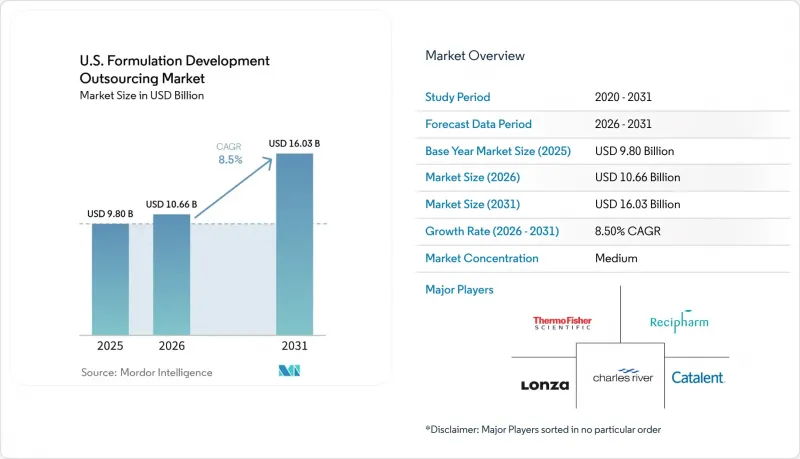
Mordor Intelligence에 의하면, 미국의 제제 개발 아웃소싱 시장 규모는 2025년 98억 달러에서 2026년에는 106억 6,000만 달러로 확대되고, 2031년까지 160억 3,000만 달러에 이를 것으로 예상되고 있으며, 2026-2031년 CAGR 8.5%를 기록할 전망입니다.
본 보고서는 서비스 유형(프리포뮬레이션, 제형 개발), 제형(경구, 주사제, 외용제, 흡입제, 점안제, 기타), 치료 분야(종양학, 감염증, 신경학, 순환기, 호흡기, 혈액학, 피부과, 희귀질환, 자가면역질환, 기타), 최종 사용자(제약·바이오의약품, 정부·학술 기관, 기타)별로 분류되어 있습니다. 예측치는 금액(달러)으로 표시되어 있습니다.
미국의 제제 개발 아웃소싱 시장 동향과 인사이트
비용 절감과 제제 개발 전문 지식 활용을 목적으로 한 아웃소싱
미국의 제제 개발 서비스 시장은 자산을 최소화한 연구개발(R&D) 모델로 진화하고 있으며, 소수의 풀서비스형 CDMO로의 아웃소싱에 중점을 두고 있습니다. 2025년에는 FDA 승인 건의 73%에서 API(원료의약품) 제조 아웃소싱이 활용되었으며, 이는 2024년의 74%와 거의 동일한 수준이었습니다. 한편, 65%의 사례에서는 완제 의약품 제조 아웃소싱에 의존하고 있었습니다. 대형 제약사는 마일스톤 및 로열티 요소를 포함한 위험 분담 계약을 채택하고 있으며, 규제 대응 실적이 풍부한 공급업체를 우선적으로 선택하고 있습니다. 이러한 동향으로 인해 소규모 CDMO는 시장에서 배제되고 있으며, 공급업체 변경의 장벽이 높아지고 있습니다. 또한 임상 및 상업 프로그램 전반에 걸쳐 수요가 확대됨에 따라, 입지를 굳힌 공급업체들은 더 큰 가격 결정력을 확보하고 있습니다.
바이오의약품 및 주사제의 복잡성 심화
미국의 제제 개발 서비스 시장은 바이오의약품 및 무균 주사제의 기술적 요구 사항이 높아짐에 따라 확대되고 있습니다. 2025년 FDA 승인 건수의 45%를 바이오의약품이 차지하고 있으며, 항체-약물 복합체(ADC) 및 지질 나노입자 RNA 치료법 등 첨단 치료법에 초점이 맞추어져 있습니다. WuXi Biologics사의 ‘WuXiHigh 2.0’과 같은 플랫폼은 기술적 차별화의 중요성을 부각시키고 있습니다. 현재 단일클론 항체 제품의 20% 이상이 고농도 제형을 채택하고 있으며, 자가 투여형 피하 투여가 보급되고 있습니다. 충전 및 마무리 공정에서의 만성적인 제약으로 인해 국내 무균 제조 능력의 가치가 높아지고 있으며, 고도의 무균 충전 능력을 갖춘 CDMO가 그 혜택을 보고 있습니다.
FDA의 엄격한 CMC 및 임상시험 규정 준수
FDA의 엄격한 규정 준수 요건은 비용 증가와 개발 기간 연장을 초래하여, 미국의 제제 개발 서비스 시장에 지속적인 과제로 남아 있습니다. 2020년부터 2024년에 걸쳐, 완전 답변 요청서(CRL)의 74%가 CMC 및 분석상의 미비 사항과 관련되어 있으며, 이러한 문제들은 막대한 투자를 한 후 심사 과정의 후반부에 발견되는 경우가 많습니다. 신규 생물학적 제제의 경우, 동등성 계획, 대체 공급업체 확보, 검증된 콜드체인 물류에 대한 조기 집중이 요구되어 소규모 팀에 더 큰 압박이 가해지고 있습니다. 규제 자문 서비스를 패키지로 제공하는 CDMO는 실험실 업무 수행만 제공하는 기업에 비해 우위를 점하고 있습니다. 한편, FDA의 CDRP 프로그램은 ‘획기적(Breakthrough)’ 지정을 받은 프로그램을 가속화하지만, 그 영향은 대상 사례로 한정되어 있습니다.
부문 분석
2025년, 제제 개발 서비스는 미국 의약품 제제 개발 서비스 시장의 75.69%를 차지할 것으로 예상되며, 이는 분석, 공정, 스케일업 각 업무를 단일 품질 시스템 내에 통합하는 종합적인 파트너십을 스폰서가 선호하는 경향을 반영합니다. 2031년까지 연평균 성장률(CAGR) 16.20%를 나타낼 것으로 예측되는 제형 전단계 서비스는 초기 위험 식별로의 전환을 부각시키고 있으며, 스폰서는 바이오의약품, ADC, 지질 나노입자 치료 분야에서 점도, 응집 경향 및 부형제의 적합성에 주력하고 있습니다. 이러한 접근 방식을 통해 후기 단계에서의 제형 변경 및 규제상의 혼란을 최소화할 수 있습니다.
미국 제형 개발 서비스 시장에서 주사제 및 비경구제가 가장 빠르게 성장하는 부문이며, 2031년까지 연평균 성장률(CAGR)은 16.99%로 예측됩니다. 이러한 성장은 바이오의약품이 주를 이루는 승인 동향과, 복잡한 개발 업무를 처리할 수 있는 무균 인프라가 후원사 측에 부족한 점이 요인으로 작용하고 있습니다. 고농도 피하 투여 제품 및 독자적인 부형제 시스템에 대한 수요가 증가하고 있으며, 무균 제제에 관한 전문적인 노하우가 높이 평가받고 있습니다.
기타 혜택:
- 엑셀 형식 시장 예측(ME) 시트
- 3개월간의 애널리스트 지원
자주 묻는 질문
목차
제1장 서론
제2장 조사 방법
제3장 주요 요약
제4장 시장 구도
제5장 시장 규모와 성장 예측
제6장 경쟁 구도
제7장 시장 기회와 향후 전망
KTH 26.08.06According to Mordor Intelligence, the U.S. formulation development outsourcing market size is expected to increase from USD 9.80 billion in 2025 to USD 10.66 billion in 2026 and reach USD 16.03 billion by 2031, growing at a CAGR of 8.5% over 2026-2031.
This report is Segmented by Service Type (Preformulation, Formulation Development), Dosage Form (Oral, Injectable, Topical, Inhalation, Ophthalmic, Others), Therapeutic Area (Oncology, Infectious Disease, Neurology, Cardiovascular, Respiratory, Hematology, Dermatology, Rare Disease, Autoimmune, Others), End User (Pharma/Biopharma, Govt/Academic, Others). Forecasts in Value (USD).
U.S. Formulation Development Outsourcing Market Trends and Insights
Outsourcing To Control Cost And Access Formulation Expertise
The United States pharmaceutical formulation development services market is evolving with an asset-light R&D model, concentrating on outsourcing with a few full-service CDMOs. In 2025, 73% of FDA approvals used outsourced API manufacturing, consistent with 74% in 2024, while 65% relied on outsourced finished-dose manufacturing. Large pharmaceutical companies are adopting risk-sharing contracts with milestone and royalty components, favoring providers with strong regulatory performance. This trend is sidelining smaller CDMOs and increasing switching barriers, granting established providers greater pricing power as demand grows across clinical and commercial programs.
Rising Biologics And Injectable Complexity
The United States pharmaceutical formulation development services market is expanding due to the technical demands of biologics and sterile injectables. Biologics accounted for 45% of FDA approvals in 2025, with a focus on advanced therapies like antibody-drug conjugates and lipid nanoparticle RNA therapies. Platforms like WuXi Biologics' WuXiHigh 2.0 highlight the importance of technical differentiation. Over 20% of monoclonal antibody products now use high-concentration formulations, with self-administered subcutaneous delivery gaining traction. Persistent fill-finish constraints have increased the value of domestic sterile capacity, benefiting CDMOs with advanced aseptic filling capabilities.
Stringent FDA CMC And Clinical Trial Compliance
Stringent FDA compliance continues to challenge the United States pharmaceutical formulation development services market by increasing costs and extending development timelines. From 2020 to 2024, 74% of complete response letters were linked to CMC and analytical gaps, often identified late in the review process after significant investments. For novel biologics, early focus on comparability planning, secondary supplier coverage, and validated cold-chain logistics adds pressure on smaller teams. CDMOs offering bundled regulatory advisory services gain an edge over those providing only laboratory execution. While the FDA's CDRP program accelerates breakthrough-designated programs, its impact remains limited to eligible cases.
Other drivers and restraints analyzed in the detailed report include:
- Oncology And Specialty Pipeline Expansion
- Dense US Clinical Trial Activity And Faster Development Timelines
- Early-Stage Biotech Funding Volatility
For complete list of drivers and restraints, kindly check the Table Of Contents.
Segment Analysis
In 2025, Formulation Development Services accounted for 75.69% of the United States pharmaceutical formulation development services market, reflecting sponsors' preference for integrated partnerships that consolidate analytical, process, and scale-up tasks within a single quality system. Preformulation Services, growing at a 16.20% CAGR through 2031, highlights a shift toward early risk identification, with sponsors focusing on viscosity, aggregation tendencies, and excipient compatibility in biologics, ADCs, and lipid nanoparticle therapies. This approach minimizes late-stage reformulation and regulatory disruptions.
Injectable and Parenteral forms are the fastest-growing segment in the United States pharmaceutical formulation development services market, with a projected 16.99% CAGR through 2031. This growth is driven by the biologics-heavy approval landscape and the lack of sterile infrastructure among sponsors for complex development tasks. High-concentration subcutaneous products and proprietary excipient systems are increasingly in demand, rewarding specialized sterile formulation expertise.
Complete Report Scope:
- By Service Type
- Preformulation Services
- Formulation Development Services
- By Dosage Form
- Oral
- Injectable and Parenteral
- Topical and Transdermal
- Inhalation and Nasal
- Ophthalmic
- Buccal, Sublingual, Rectal, and Vaginal
- By Therapeutic Area
- Oncology
- Infectious Disease
- Neurology
- Cardiovascular
- Respiratory
- Hematology
- Dermatology
- Rare Disease and Genetic Disorders
- Autoimmune and Inflammatory Disorders
- Others
- By End User
- Pharmaceutical and Biopharmaceutical Companies
- Government and Academic Institutes
- Others
List of Companies Covered in this Report:
- Adare Pharma Solutions
- Alcami
- Bend Bioscience
- Cambrex
- Catalent
- Charles River
- Curia Global, Inc.
- Evonik Health Care
- Intertek Group
- Jubilant HollisterStier LLC
- Lonza Group
- National Resilience
- PCI Pharma Services
- Piramal Group
- Quotient Sciences
- Recipharm
- Seran Bioscience
- SGS
- Simtra BioPharma Solutions
- Thermo Fisher Scientific Inc. (Patheon)
Additional Benefits:
- The market estimate (ME) sheet in Excel format
- 3 months of analyst support
TABLE OF CONTENTS
1 Introduction
- 1.1 Study Assumptions & Market Definition
- 1.2 Scope of the Study
2 Research Methodology
3 Executive Summary
4 Market Landscape
- 4.1 Market Overview
- 4.2 Market Drivers
- 4.2.1 Outsourcing to Control Cost and Access Formulation Expertise
- 4.2.2 Rising Biologics and Injectable Complexity
- 4.2.3 Oncology and Specialty Pipeline Expansion
- 4.2.4 Dense U.S. Clinical Trial Activity and Faster Development Timelines
- 4.2.5 505(B)(2) Reformulation Opportunity Set
- 4.2.6 Reshoring and Biosecure-Driven Vendor Requalification
- 4.3 Market Restraints
- 4.3.1 Stringent FDA CMC and Clinical Trial Compliance
- 4.3.2 Early-Stage Biotech Funding Volatility
- 4.3.3 Tariff Exposure Across Excipients and Packaging Inputs
- 4.3.4 Bridging Study Burden After Formulation Changes
- 4.4 Value Chain Analysis
- 4.5 Regulatory Landscape
- 4.6 Technological Outlook
- 4.7 Porter's Five Forces Analysis
- 4.7.1 Threat of New Entrants
- 4.7.2 Bargaining Power of Suppliers
- 4.7.3 Bargaining Power of Buyers
- 4.7.4 Threat of Substitutes
- 4.7.5 Industry Rivalry
5 Market Size & Growth Forecasts (Value, USD)
- 5.1 By Service Type
- 5.1.1 Preformulation Services
- 5.1.2 Formulation Development Services
- 5.2 By Dosage Form
- 5.2.1 Oral
- 5.2.2 Injectable and Parenteral
- 5.2.3 Topical and Transdermal
- 5.2.4 Inhalation and Nasal
- 5.2.5 Ophthalmic
- 5.2.6 Buccal, Sublingual, Rectal, and Vaginal
- 5.3 By Therapeutic Area
- 5.3.1 Oncology
- 5.3.2 Infectious Disease
- 5.3.3 Neurology
- 5.3.4 Cardiovascular
- 5.3.5 Respiratory
- 5.3.6 Hematology
- 5.3.7 Dermatology
- 5.3.8 Rare Disease and Genetic Disorders
- 5.3.9 Autoimmune and Inflammatory Disorders
- 5.3.10 Others
- 5.4 By End User
- 5.4.1 Pharmaceutical and Biopharmaceutical Companies
- 5.4.2 Government and Academic Institutes
- 5.4.3 Others
6 Competitive Landscape
- 6.1 Market Concentration
- 6.2 Strategic Moves
- 6.3 Market Share Analysis
- 6.4 Company Profiles {(includes Global level Overview, Market level overview, Core Segments, Financials as available, Strategic Information, Market Rank/Share for key companies, Products & Services, and Recent Developments)}
- 6.4.1 Adare Pharma Solutions
- 6.4.2 Alcami Corporation
- 6.4.3 Bend Bioscience
- 6.4.4 Cambrex Corporation
- 6.4.5 Catalent, Inc.
- 6.4.6 Charles River Laboratories International, Inc.
- 6.4.7 Curia Global, Inc.
- 6.4.8 Evonik Health Care
- 6.4.9 Intertek Group plc
- 6.4.10 Jubilant HollisterStier LLC
- 6.4.11 Lonza Group AG
- 6.4.12 National Resilience, Inc.
- 6.4.13 PCI Pharma Services
- 6.4.14 Piramal Pharma Solutions
- 6.4.15 Quotient Sciences
- 6.4.16 Recipharm AB
- 6.4.17 Seran Bioscience
- 6.4.18 SGS SA
- 6.4.19 Simtra BioPharma Solutions
- 6.4.20 Thermo Fisher Scientific Inc. (Patheon)
7 Market Opportunities & Future Outlook
- 7.1 White-space & Unmet-need Assessment