

|
시장보고서
상품코드
2097408
RAID 컨트롤러 카드 : 시장 점유율 분석, 업계 동향과 통계, 성장 예측(2026-2031년)RAID Controller Card - Market Share Analysis, Industry Trends & Statistics, Growth Forecasts (2026 - 2031) |
||||||
 Mordor Intelligence
Mordor Intelligence에 의하면, RAID 컨트롤러 카드 시장 규모는 2025년 73억 4,000만 달러, 2026년 79억 9,000만 달러에서 2031년까지 121억 8,000만 달러로 확대되고, 2026-2031년 CAGR 8.8%를 나타낼 것으로 예측됩니다.
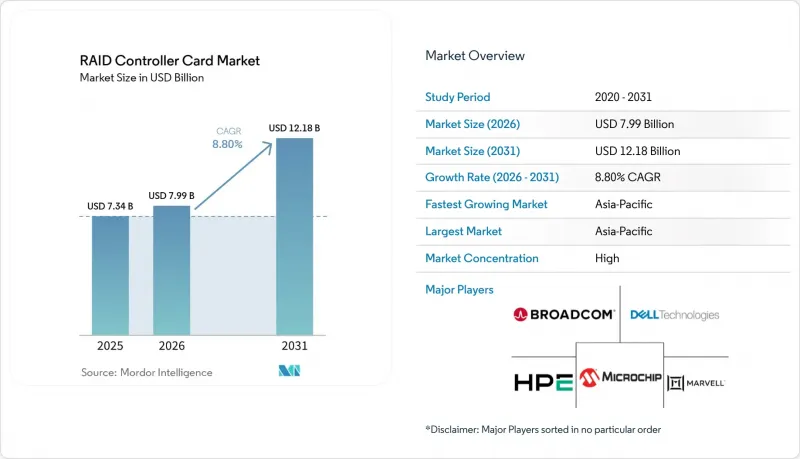
본 보고서는 인터페이스(SATA, SAS, NVMe, 파이버 채널 등), 폼 팩터(PCIe RAID 컨트롤러 카드, 외장형 RAID 컨트롤러 카드 등), 용도(서버, 스토리지 시스템 등), 최종 사용자(데이터센터, 클라우드 서비스 제공업체, 기업, 정부·국방, 의료, 제조 등) 및 지역별로 분류되어 있습니다. 시장 전망은 금액(달러) 기준으로 제시되어 있습니다.
전 세계 RAID 컨트롤러 카드 시장 동향 및 인사이트
하이퍼스케일 및 엔터프라이즈 데이터센터의 확대
하이퍼스케일 분야의 설비 투자를 통해 RAID(Redundant Array of Independent Disks) 컨트롤러 카드 시장의 조달 수준은 일반적인 서버 교체 주기를 상회하는 수준으로 끌어올려지고 있습니다. AWS는 미국 정부용 클라우드 리전의 AI 및 고성능 컴퓨팅(HPC) 용량을 확대하기 위해 500억 달러를 투자했으며, 이 프로그램은 2026년에 약 1.3 GW의 용량 증설을 수반하며 본격적인 개발 단계에 접어들었습니다. 이는 랙 밀도 향상 목표에 따라 각 서버 내에서 컨트롤러 지원을 필요로 하는 고속 스토리지 장치의 수가 증가하기 때문에 중요한 의미를 지닙니다. 또한, 엔터프라이즈 시장의 구매자들도 PCIe Gen5로의 전환을 추진하고 있으며, 이로 인해 새로운 서버의 기본 사양에서는 더 빠른 NVMe 백플레인 및 24Gbps SAS 연결을 지원할 수 있는 최신 세대의 컨트롤러가 필요하게 되었습니다. 하이퍼스케일 확장과 엔터프라이즈 플랫폼의 갱신이 겹치면서, RAID 컨트롤러 카드 시장 수요 파급 주기는 이전 PCIe Gen3에서 Gen4로 전환할 때보다 더 광범위해졌습니다.
스토리지 백플레인의 NVMe 및 PCIe Gen5로의 전환
PCIe Gen5의 도입으로 인해 RAID(Redundant Array of Independent Disks) 컨트롤러 카드 시장은 최근 몇 년간 가장 중요한 플랫폼 전환 중 하나를 맞이하고 있습니다. 브로드컴의 97xx MegaRAID 어댑터는 PCIe 5.0 x16 호스트 인터페이스와 혼합 드라이브 환경을 위한 24Gbps SAS 트라이모드 지원을 결합하고 있어, 현재 엔터프라이즈 분야의 표준으로 자리 잡고 있습니다. Dell의 PERC13 H975i는 테스트에서 최대 처리량 52.5GB/s, 1,250만 IOPS를 기록했으며, 쓰기 대역폭은 이전 세대 대비 318% 향상되었습니다. 이로 인해 새로운 하드웨어 RAID와 호스트 기반 대체 솔루션 간의 성능 격차가 더욱 뚜렷해졌습니다. Gen5의 속도가 향상됨에 따라 소프트웨어 RAID에서는 패리티 처리에 더 많은 CPU 사이클이 필요하게 되어, RAID 컨트롤러 카드 시장에서 전용 오프로드 엔진의 가치가 더욱 명확해지고 있습니다. 마이크로칩(Microchip)의 Adaptec SmartRAID 4300은 CPU에서 NVMe로의 직접 데이터 경로를 유지하면서 XOR 처리를 전용 가속기 실리콘으로 이전함으로써 이러한 변화에 대응했습니다. 이 회사는 이전 세대의 하드웨어 RAID와 비교해 최대 7배의 성능 향상을 달성했다고 밝혔습니다.
소프트웨어 정의 스토리지 및 이레이저 코딩으로의 전환
소프트웨어 정의 스토리지로의 전환은 RAID 컨트롤러 카드 시장에서 가장 뚜렷한 구조적 제약 중 하나입니다. 오브젝트 스토리지, 스케일아웃형 파일 시스템, 하이퍼컨버지드 환경에서는 노드 수준의 컨트롤러 로직 대신 분산형 내결함성이 점점 더 많이 채택되고 있어, 일부 도입 환경에서는 전용 카드의 필요성이 줄어들고 있습니다. 이러한 압력은 Ceph, Lustre, MinIO 및 이와 유사한 플랫폼을 핵심으로 하는 아키텍처에서 가장 강하게 나타나며, 이러한 환경에서는 중복성이 단일 서버 내부가 아닌 클러스터 전체에서 관리됩니다. 또한 대용량 NVMe SSD의 보급으로 인해 재구축 동작이 설계상의 과제로 더욱 부각되면서, 구매자들은 기존 하드웨어 RAID가 여전히 최적의 절충점을 제공하는 상황을 재평가했습니다. 그럼에도 불구하고 RAID 컨트롤러 카드 시장은 규제 대상 데이터베이스, 베어메탈 시스템, 그리고 성능에 민감한 환경에서는 여전히 견조한 수요를 유지하고 있습니다. 이러한 환경에서는 결정론적 지연 시간, 캐시 보호 쓰기, 그리고 정전 보호 기능을 소프트웨어만으로 대체하기 어렵기 때문입니다.
부문 분석
2025년, SAS는 RAID 컨트롤러 카드 시장 점유율의 45.38%를 차지하고 있으며, 이는 엔터프라이즈 어레이, 미션 크리티컬 클러스터 및 테이프 연결형 스토리지 환경 전반에 걸쳐 그 도입 기반이 얼마나 방대한지를 보여줍니다. 이러한 도입 환경에서의 교체 주기는 고속 인터페이스의 노후화보다는 서버 세대 변경에 의해 좌우되기 때문에 이 도입 기반은 중요한 의미를 지닙니다. 구매자들은 핵심 엔터프라이즈 환경에서 컨트롤러를 교체할 때, 여전히 하위 호환성, 예측 가능한 펌웨어 동작, 그리고 오랜 인증 실적을 중시하고 있습니다. SATA는 여전히 비용을 중시하는 스토리지나 아카이브 이용 사례에서 활용되고 있지만, SSD의 밀도가 향상되고 용량을 중시하는 설계에서도 NVMe의 매력이 높아짐에 따라 그 역할은 점차 축소되고 있습니다. 파이버 채널 컨트롤러는 SAN 연결 환경, 특히 레거시 인프라나 인증 요건이 여전히 중요하게 여겨지는 금융 서비스 및 의료 분야에서 전문적인 선택지로 남아 있습니다.
NVMe는 2031년까지 연평균 성장률(CAGR) 9.0%를 기록하며 가장 빠르게 성장하는 인터페이스가 될 것으로 예측되고 있으며, 이에 따라 RAID 컨트롤러 카드 시장 전체의 설계 우선순위가 꾸준히 변화하고 있습니다. Silicon Motion사의 SM8008은 엔지니어링의 초점이 Gen5 NVMe 인프라로 얼마나 이동했는지를 보여주고 있으며, 이 회사는 엔터프라이즈용 컨트롤러 플랫폼에서 최대 14GB/s의 순차 처리량과 5 W 미만의 작동 전력을 강조하고 있습니다. 또한, 많은 기업이 단계적인 리프레시 주기에서 레거시 SAS 드라이브와 새로운 NVMe 드라이브를 혼합하여 사용해야 하기 때문에 트라이 모드 컨트롤러의 중요성도 높아지고 있습니다. 브로드컴의 현행 97xx 제품군은 SAS, SATA, NVMe 기능을 결합하여 이러한 가교 역할을 지원하며, 이를 통해 인터페이스 전환은 스토리지의 전면적인 교체가 아닌 플랫폼 설계상의 결정 사항이 됩니다. RAID 컨트롤러 카드 업계에서 트라이 모드 검증 실적이 풍부한 벤더는 OEM 및 엔터프라이즈 구매자의 인증 작업을 경감시킬 수 있으므로, 혼합 리프레시 프로젝트를 수주하는 데 유리한 입장에 있습니다.
2025년에는 PCIe RAID 컨트롤러 카드가 64.56%의 점유율을 차지하며, 대부분의 엔터프라이즈용 서버 및 스토리지 조달에서 기본 폼 팩터로서의 지위를 유지했습니다. 이러한 우위는 폭넓은 호환성, 성숙한 관리 소프트웨어, 그리고 주요 OEM 서버 플랫폼에서의 오랜 인증 실적에서 비롯됩니다. 표준 하프 하이·하프 길이 카드는 익숙한 교체 경로와 명확한 현장 지원 절차를 제공하기 때문에 많은 기업이 스토리지 하드웨어를 구매 및 유지보수할 때 여전히 적합합니다. HPE의 현재 플랫폼 문서에서도 컨트롤러 관리가 iLO 및 관련 서버 관리 프레임워크와 같은 시스템 수준 도구와 점점 더 긴밀하게 연계되고 있음이 나타나며, 이는 RAID 컨트롤러 카드 시장에서 HPE의 기존 입지를 강화하고 있습니다. 외부 컨트롤러는 직접 어태치(Direct Attach)나 인클로저 기반 이용 사례에서 여전히 중요하지만, RAID 로직이 서버 보드나 인클로저 컨트롤러에 가까워짐에 따라 더 이상 성장의 중심이 되고 있지는 않습니다.
OCP 및 임베디드형 RAID 모듈은 2031년까지 연평균 성장률(CAGR) 9.12%를 나타낼 것으로 예측되며, RAID 컨트롤러 카드 시장에서 가장 빠르게 확대되고 있는 폼 팩터입니다. 이러한 변화를 주도하고 있는 것은 하이퍼스케일 사업자들입니다. OCP 준수 하드웨어를 통해 도입을 표준화할 수 있을 뿐만 아니라, GPU 및 네트워크용 PCIe 슬롯을 확보할 수 있기 때문입니다. HPE가 발표한 'MR416i-o Gen11' 및 'MR216i-o Gen11'은 각 OEM 업체들이 스토리지 보호 기능을 OCP 지향 서버 설계에 어떻게 통합하고 있는지를 보여줍니다. 또한, 내장형 모듈은 전용 애드인 카드를 할당하지 않고도 미러링된 운영 체제 볼륨이 필요한 ‘부팅 내결함성’ 역할에도 적합합니다. RAID 컨트롤러 카드 업계에서 이는 폼 팩터 선택이 컨트롤러의 기능 그 자체보다 서버 아키텍처 및 워크로드 밀도와 더욱 밀접하게 연결되고 있음을 의미합니다.
지역별 분석
아시아태평양은 2025년에 RAID 컨트롤러 카드 시장 점유율의 40.67%를 차지할 것으로 예상되며, 2031년까지 연평균 성장률(CAGR) 9.08%로 확대될 것으로 전망되어, 이 지역은 가장 크고 가장 빠르게 성장하는 지역 시장으로서의 지위를 유지할 것으로 보입니다. 이 지역의 우위는 새로운 하이퍼스케일 구축과 여전히 SAS 및 트라이모드 컨트롤러의 교체에 의존하고 있는 엔터프라이즈, 통신, 제조 시스템의 방대한 도입 기반이 결합되어 발생하고 있습니다. 인도는 그 가장 두드러진 사례 중 하나이며, 인도 데이터센터 협회 및 인도 재생에너지 협회의 데이터에 따르면, 인도의 데이터센터 시장 규모는 2025년에 90억-100억 달러에 달할 것으로 예상되며, 2025년 말 기준으로 675억 달러를 초과하는 하이퍼스케일러의 투자 약속에 힘입고 있습니다. 중국, 일본, 한국 및 동남아시아 역시 새로운 AI 인프라와 지속적인 기업 현대화의 시너지 효과로 인해 RAID 컨트롤러 카드 시장을 뒷받침하고 있습니다. 이 지역에서는 많은 신규 프로젝트가 최신 서버 세대를 직접 채택하여 시작되고 있기 때문에 아시아태평양은 업데이트 속도가 느린 지역보다 더 빨리 PCIe Gen5 지원 컨트롤러 플랫폼을 도입할 수 있는 유리한 위치에 있습니다.
북미는 RAID 컨트롤러 카드 시장에서 2위의 규모를 자랑하며, 가장 광범위한 하이퍼스케일 구축과 가장 선진적인 엔터프라이즈 리프레시 주기의 혜택을 누리고 있습니다. 미국 정부의 AI 및 고성능 컴퓨팅(HPC) 역량을 확대하기 위해 AWS가 500억 달러를 투자하겠다는 약속은 퍼블릭 클라우드 및 소버린 클라우드 프로그램이 여전히 대규모 서버 및 스토리지 조달 붐으로 이어지고 있음을 보여줍니다. 또한, 이 지역에서는 Dell의 PERC13, HighPoint의 Gen5 NVMe RAID 어댑터, Microchip의 SmartRAID 4300 등 몇 가지 차세대 설계가 상용 서버 플랫폼에서 처음으로 검증되었습니다. 연방 정부공급망 보안 요건 및 NIST 사이버 보안 프레임워크 2.0의 도입과 맞물려, RAID 컨트롤러 카드 시장에서는 인증된 펌웨어와 검증된 컨트롤러 보안 스택에 대한 관심이 높아지고 있습니다.
유럽의 RAID 컨트롤러 카드 시장은 데이터 주권에 관한 규제, DORA 및 NIS2 준수, 그리고 금융 서비스, 제조업, 공공 부문에서의 대규모 기업 도입 기반에 의해 형성되고 있습니다. 마이크로소프트의 폴란드 데이터센터에 대한 28억 PLN 규모의 확장 및 아마존의 스페인 AWS 인프라에 대한 337억 EUR(364억 달러) 투자 사례는 하이퍼스케일 확장이 여전히 해당 지역 전체에서 새로운 컨트롤러 수요를 창출하고 있음을 보여줍니다. 독일, 영국, 프랑스는 여전히 주요 수요 거점이지만, 러시아의 역할은 기술 수출 규제로 인해 약화되고 있습니다. 남미 시장은 규모는 작지만, 브라질, 아르헨티나, 칠레에서 새로운 수요 거점이 형성되고 있으며, 이 지역은 수입 ASIC 가격, 관세, 그리고 달러로 표시된 부품에 대한 환율 압력의 영향을 특히 받기 쉬운 상황이 지속되고 있습니다.
기타 혜택:
- 엑셀 형식 시장 예측(ME) 시트
- 3개월간의 애널리스트 지원
자주 묻는 질문
목차
제1장 서론
제2장 조사 방법
제3장 주요 요약
제4장 시장 구도
제5장 시장 규모와 성장 예측
제6장 경쟁 구도
제7장 시장 기회와 향후 전망
KTH 26.08.06According to Mordor Intelligence, the RAID controller card market size is projected to expand from USD 7.34 billion in 2025 and USD 7.99 billion in 2026 to USD 12.18 billion by 2031, registering a CAGR of 8.8% between 2026 to 2031.
This report is Segmented by Interface (SATA, SAS, Nvme, Fibre Channel, and More), Form Factor (PCIe RAID Controller Cards, External RAID Controller Cards, and More), Application (Servers, Storage Systems, and More), End User (Data Centers, Cloud Service Providers, Enterprises, Government and Defense, Healthcare, Manufacturing, and More), and Geography. The Market Forecasts are Provided in Terms of Value (USD).
Global RAID Controller Card Market Trends and Insights
Hyperscale and Enterprise Data Center Expansion
Hyperscale capital expenditure is lifting procurement levels in the RAID (Redundant Array of Independent Disks) controller card market beyond a normal server refresh cycle. AWS committed USD 50 billion to expand AI and high-performance computing capacity for U.S. government cloud regions, and the program moved into active development with nearly 1.3 GW of added capacity in 2026. This matters because higher rack density goals increase the number of high-speed storage devices that need controller support inside each server. Enterprise buyers are also moving through PCIe Gen5 transitions, which means new server baselines now require updated controller generations that can support faster NVMe backplanes and 24 Gbps SAS connectivity. The overlap between hyperscale expansion and enterprise platform refresh is creating a wider pull-through cycle for the RAID controller card market than the prior shift from PCIe Gen3 to Gen4.
NVMe and PCIe Gen5 Transition in Storage Backplanes
The PCIe Gen5 rollout is pushing the RAID (Redundant Array of Independent Disks) controller card market through one of its most important platform transitions in recent years. Broadcom's 97xx MegaRAID adapters have become a current enterprise reference point because they combine PCIe 5.0 x16 host interfaces with 24 Gbps SAS tri-mode support for mixed drive environments. Dell's PERC13 H975i showed 52.5 GB/s maximum throughput and 12.5 million IOPS in testing, and write bandwidth improved by 318% from the previous generation, which reinforced the performance gap between new hardware RAID and host-based alternatives. As Gen5 speeds rise, software RAID needs more CPU cycles for parity work, so the value of dedicated offload engines becomes clearer in the RAID controller card market. Microchip's Adaptec SmartRAID 4300 responded to that shift by moving XOR processing to dedicated accelerator silicon while keeping direct CPU-to-NVMe data paths, and the company stated performance gains of up to 7x over earlier hardware RAID generations.
Shift Toward Software-Defined Storage and Erasure Coding
The shift toward software-defined storage is one of the clearest structural limits on the RAID controller card market. Object stores, scale-out file systems, and hyper-converged environments are increasingly using distributed resiliency instead of node-level controller logic, which reduces the need for a dedicated card in some deployments. This pressure is strongest in architectures built around Ceph, Lustre, MinIO, and similar platforms where redundancy is managed across the cluster and not inside a single server. Large NVMe SSD capacities also make rebuild behavior a more visible design issue, so buyers are reevaluating where classic hardware RAID still creates the best tradeoff. Even so, the RAID controller card market remains more defensible in regulated databases, bare-metal systems, and performance-sensitive environments where deterministic latency, cache-protected writes, and power-loss protection are hard to replace with software alone.
Other drivers and restraints analyzed in the detailed report include:
- Rising Data Availability and Cyber Resilience Mandates
- AI and Analytics Workloads Needing Deterministic Low-Latency Storage
- High Controller and Cache Protection Bill of Materials and Integration Cost
For complete list of drivers and restraints, kindly check the Table Of Contents.
Segment Analysis
SAS held 45.38% of RAID controller card market share in 2025, which shows how large the installed base remains across enterprise arrays, mission-critical clusters, and tape-linked storage environments. That installed base matters because refresh cycles in these deployments are guided more by server generation changes than by fast interface obsolescence. Buyers continue to value backward compatibility, predictable firmware behavior, and long qualification histories when they replace controllers in core enterprise environments. SATA still serves cost-sensitive storage and archival use cases, but its role is narrowing as SSD density improves and NVMe becomes more attractive even for capacity-oriented designs. Fibre Channel controllers remain a specialized option in SAN-attached environments, especially in financial services and healthcare where legacy infrastructure and certification requirements still carry weight.
NVMe is projected to be the fastest-growing interface at a 9.0% CAGR through 2031, which is steadily changing design priorities across the RAID controller card market. Silicon Motion's SM8008 showed how much engineering focus has shifted toward Gen5 NVMe infrastructure, with the company highlighting up to 14 GB/s sequential throughput and active power below 5 W on its enterprise controller platform. Tri-mode controllers are also becoming more important because many enterprises need to mix legacy SAS drives with newer NVMe additions during staggered refresh cycles. Broadcom's current 97xx family supports that bridge with combined SAS, SATA, and NVMe capability, which turns interface migration into a platform design decision instead of a full storage replacement event. In the RAID controller card industry, vendors with strong tri-mode validation are better placed to capture mixed-refresh projects because they reduce certification work for OEMs and enterprise buyers.
PCIe RAID controller cards held 64.56% share in 2025, which kept them as the default form factor across most enterprise server and storage procurements. Their lead comes from broad compatibility, mature management software, and long-established qualification with major OEM server platforms. The standard half-height, half-length card still fits how many enterprises buy and service storage hardware because it gives a familiar replacement path and clear field support procedures. HPE's current platform documents also show that controller management is increasingly tied into system-level tools such as iLO and related server management frameworks, which reinforces incumbent position in the RAID controller card market. External controllers remain relevant for direct-attached and enclosure-based use cases, but they are no longer the center of growth as more RAID logic is moving closer to the server board or enclosure controller.
OCP and embedded RAID modules are forecast to grow at a 9.12% CAGR through 2031, which makes them the fastest-moving form factor in the RAID controller card market. Hyperscale operators are driving that shift because OCP-aligned hardware can standardize deployment and preserve PCIe slots for GPUs and networking. HPE's MR416i-o Gen11 and MR216i-o Gen11 releases show how OEMs are moving more storage protection into OCP-oriented server designs. Embedded modules also fit the boot-resilience role, where mirrored operating system volumes are required without dedicating a full add-in card to that task. In the RAID controller card industry, that means form factor choice is becoming more tied to server architecture and workload density than to controller function alone.
Complete Report Scope:
- By Interface
- SATA
- SAS
- NVMe
- Tri-Mode SAS, SATA, and NVMe
- Fibre Channel
- By Form Factor
- PCIe RAID Controller Cards
- External RAID Controller Cards
- OCP and Embedded RAID Modules
- By Application
- Servers
- Storage Systems
- Workstations
- Edge and Industrial Systems
- By End User
- Data Centers
- Cloud Service Providers
- Enterprises
- Government and Defense
- Healthcare
- IT and Telecommunications
- Manufacturing
- Media and Entertainment
- Other End Users
- By Geography
- North America
- United States
- Canada
- Mexico
- South America
- Brazil
- Argentina
- Chile
- Rest of South America
- Europe
- Germany
- United Kingdom
- France
- Italy
- Spain
- Russia
- Rest of Europe
- Asia-Pacific
- China
- Japan
- India
- South Korea
- Rest of Asia-Pacific
- Middle East
- Saudi Arabia
- United Arab Emirates
- Turkey
- Rest of Middle East
- Africa
- South Africa
- Egypt
- Nigeria
- Rest of Africa
- North America
Geography Analysis
Asia-Pacific held 40.67% of RAID controller card market share in 2025 and is forecast to expand at a 9.08% CAGR through 2031, which keeps it as both the largest and the fastest-growing regional market. The regional advantage comes from a mix of greenfield hyperscale builds and a large installed base of enterprise, telecom, and manufacturing systems that still rely on SAS and tri-mode controller refresh. India is one of the clearest examples, with the country's data center market valued at USD 9 billion to USD 10 billion in 2025 and supported by more than USD 67.5 billion in hyperscaler pledges as of late 2025 according to the Data Center Association of India and the Renewable Energy Society of India. China, Japan, South Korea, and Southeast Asia are also supporting the RAID controller card market through a combination of new AI infrastructure and continuing enterprise modernization. Because many new projects in the region are starting directly on recent server generations, Asia-Pacific is well placed to adopt PCIe Gen5-aligned controller platforms earlier than slower refresh regions.
North America is the second-largest regional market for RAID controller cards, and it benefits from the deepest hyperscale footprint and one of the most advanced enterprise refresh cycles. AWS's USD 50 billion commitment to expand U.S. government AI and high-performance computing capacity shows how public cloud and sovereign cloud programs still translate into large server and storage procurement waves. The region is also where several next-generation designs were first validated in commercial server platforms, including Dell's PERC13, HighPoint's Gen5 NVMe RAID adapters, and Microchip's SmartRAID 4300. Federal supply-chain security expectations and use of the NIST Cybersecurity Framework 2.0 are also keeping attention on attested firmware and validated controller security stacks in the RAID controller card market.
Europe's RAID controller card market is shaped by data sovereignty rules, DORA and NIS2 compliance, and a large enterprise installed base in financial services, manufacturing, and the public sector. Microsoft's PLN 2.8 billion expansion of Polish data centers and Amazon's EUR 33.7 billion (USD 36.40 billion) investment in Spain for AWS infrastructure show that hyperscale expansion is still adding fresh controller demand across the region. Germany, the United Kingdom, and France remain the main demand centers, while Russia's role has weakened because of technology export restrictions. South America is smaller, but Brazil, Argentina, and Chile are creating an emerging pocket of demand, and the region remains especially sensitive to imported ASIC pricing, tariffs, and currency pressure against USD-denominated components.
- Broadcom Inc.
- Microchip Technology Incorporated
- Marvell Technology, Inc.
- Dell Technologies Inc.
- Hewlett Packard Enterprise Company
- Lenovo Group Limited
- Fujitsu Limited
- Intel Corporation
- International Business Machines Corporation
- Areca Technology Corporation
- HighPoint Technologies, Inc.
- ATTO Technology, Inc.
- PROMISE Technology, Inc.
- Super Micro Computer, Inc.
- Huawei Technologies Co., Ltd.
- Cisco Systems, Inc.
- NEC Corporation
- Advantech Co., Ltd.
- Infortrend Technology, Inc.
- Graid Technology Inc.
Additional Benefits:
- The market estimate (ME) sheet in Excel format
- 3 months of analyst support
TABLE OF CONTENTS
1 INTRODUCTION
- 1.1 Study Assumptions and Market Definition
- 1.2 Scope of the Study
2 RESEARCH METHODOLOGY
3 EXECUTIVE SUMMARY
4 MARKET LANDSCAPE
- 4.1 Market Overview
- 4.2 Impact of Macroeconomic Factors on the Market
- 4.3 Market Drivers
- 4.3.1 Hyperscale and Enterprise Data Center Expansion
- 4.3.2 NVMe and PCIe Gen5 Transition in Storage Backplanes
- 4.3.3 Rising Data Availability and Cyber Resilience Mandates
- 4.3.4 AI and Analytics Workloads Needing Deterministic Low-Latency Storage
- 4.3.5 Tri-Mode Controllers Simplifying Mixed SAS, SATA, and NVMe Refresh Cycles
- 4.3.6 Edge Servers Needing Compact Boot and Local Resilience RAID
- 4.4 Market Restraints
- 4.4.1 Shift Toward Software-Defined Storage and Erasure Coding
- 4.4.2 High Controller and Cache Protection Bill of Materials and Integration Cost
- 4.4.3 Secure Firmware and Encryption Validation Lengthening Design Cycles
- 4.4.4 Tariff and ASIC Supply Concentration Inflating Landed Costs
- 4.5 Industry Value Chain Analysis
- 4.6 Regulatory Landscape
- 4.7 Technological Outlook
- 4.8 Industry Life Cycle Analysis
- 4.9 Customer Purchase Criteria
- 4.10 Porter's Five Forces Analysis
- 4.10.1 Bargaining Power of Buyers
- 4.10.2 Bargaining Power of Suppliers
- 4.10.3 Threat of New Entrants
- 4.10.4 Threat of Substitutes
- 4.10.5 Intensity of Competitive Rivalry
5 MARKET SIZE AND GROWTH FORECASTS (VALUE)
- 5.1 By Interface
- 5.1.1 SATA
- 5.1.2 SAS
- 5.1.3 NVMe
- 5.1.4 Tri-Mode SAS, SATA, and NVMe
- 5.1.5 Fibre Channel
- 5.2 By Form Factor
- 5.2.1 PCIe RAID Controller Cards
- 5.2.2 External RAID Controller Cards
- 5.2.3 OCP and Embedded RAID Modules
- 5.3 By Application
- 5.3.1 Servers
- 5.3.2 Storage Systems
- 5.3.3 Workstations
- 5.3.4 Edge and Industrial Systems
- 5.4 By End User
- 5.4.1 Data Centers
- 5.4.2 Cloud Service Providers
- 5.4.3 Enterprises
- 5.4.4 Government and Defense
- 5.4.5 Healthcare
- 5.4.6 IT and Telecommunications
- 5.4.7 Manufacturing
- 5.4.8 Media and Entertainment
- 5.4.9 Other End Users
- 5.5 By Geography
- 5.5.1 North America
- 5.5.1.1 United States
- 5.5.1.2 Canada
- 5.5.1.3 Mexico
- 5.5.2 South America
- 5.5.2.1 Brazil
- 5.5.2.2 Argentina
- 5.5.2.3 Chile
- 5.5.2.4 Rest of South America
- 5.5.3 Europe
- 5.5.3.1 Germany
- 5.5.3.2 United Kingdom
- 5.5.3.3 France
- 5.5.3.4 Italy
- 5.5.3.5 Spain
- 5.5.3.6 Russia
- 5.5.3.7 Rest of Europe
- 5.5.4 Asia-Pacific
- 5.5.4.1 China
- 5.5.4.2 Japan
- 5.5.4.3 India
- 5.5.4.4 South Korea
- 5.5.4.5 Rest of Asia-Pacific
- 5.5.5 Middle East
- 5.5.5.1 Saudi Arabia
- 5.5.5.2 United Arab Emirates
- 5.5.5.3 Turkey
- 5.5.5.4 Rest of Middle East
- 5.5.6 Africa
- 5.5.6.1 South Africa
- 5.5.6.2 Egypt
- 5.5.6.3 Nigeria
- 5.5.6.4 Rest of Africa
- 5.5.1 North America
6 COMPETITIVE LANDSCAPE
- 6.1 Market Concentration
- 6.2 Strategic Moves
- 6.3 Market Share Analysis
- 6.4 Company Profiles (includes Global Level Overview, Market Level Overview, Core Segments, Financials as available, Strategic Information, Market Rank/Share, Products and Services, Recent Developments)
- 6.4.1 Broadcom Inc.
- 6.4.2 Microchip Technology Incorporated
- 6.4.3 Marvell Technology, Inc.
- 6.4.4 Dell Technologies Inc.
- 6.4.5 Hewlett Packard Enterprise Company
- 6.4.6 Lenovo Group Limited
- 6.4.7 Fujitsu Limited
- 6.4.8 Intel Corporation
- 6.4.9 International Business Machines Corporation
- 6.4.10 Areca Technology Corporation
- 6.4.11 HighPoint Technologies, Inc.
- 6.4.12 ATTO Technology, Inc.
- 6.4.13 PROMISE Technology, Inc.
- 6.4.14 Super Micro Computer, Inc.
- 6.4.15 Huawei Technologies Co., Ltd.
- 6.4.16 Cisco Systems, Inc.
- 6.4.17 NEC Corporation
- 6.4.18 Advantech Co., Ltd.
- 6.4.19 Infortrend Technology, Inc.
- 6.4.20 Graid Technology Inc.
7 MARKET OPPORTUNITIES AND FUTURE OUTLOOK
- 7.1 White Space and Unmet Need Assessment


