

|
시장보고서
상품코드
2097416
미국의 맥박산소포화도 측정기 : 시장 점유율 분석, 업계 동향과 통계, 성장 예측(2026-2031년)U.S. Pulse Oximeters - Market Share Analysis, Industry Trends & Statistics, Growth Forecasts (2026 - 2031) |
||||||
 Mordor Intelligence
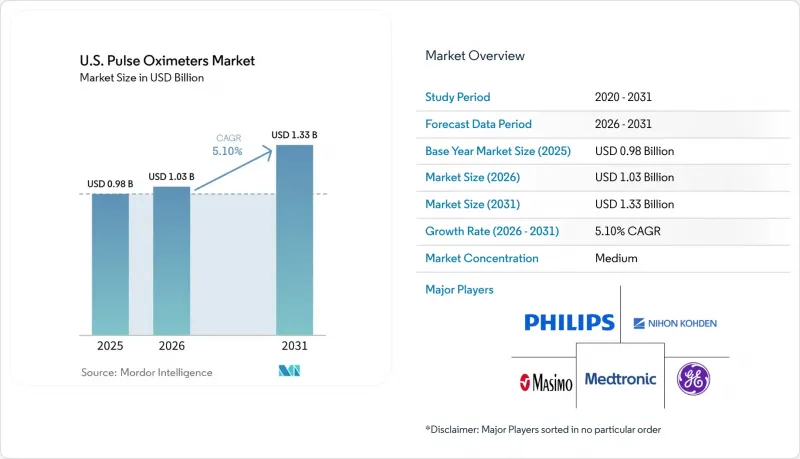
Mordor Intelligence에 의하면, 미국의 맥박산소포화도 측정기 시장 규모는 2025년 9억 8,000만 달러, 2026년 10억 3,000만 달러에서 2031년까지 13억 3,000만 달러에 달할 것으로 예측되며, 2026-2031년 연평균 복합 성장률(CAGR)은 5.10%를 나타낼 전망입니다.
본 보고서는 제품 유형(손가락형, 휴대형, 탁상·침대 옆형, 손목 착용형 등), 기술(기존, 스마트형 등), 측정 모드(간헐적 측정, 연속 측정), 환자 연령대(성인, 소아, 신생아), 최종 사용자(병원, 재택치료 등), 용도(호흡기 질환 모니터링 등)별로 분류되어 있습니다. 시장 전망은 금액(달러) 기준으로 제시되어 있습니다.
미국 맥박 산소 측정기 시장 동향과 인사이트
COPD, 천식, 수면 무호흡증 증가가 산소 포화도 모니터링 시장을 견인
만성 호흡기 질환이 미국 맥박 산소 측정기 시장 수요를 견인하고 있습니다. 2024년에는 미국 성인의 4.2%가 COPD, 폐기종 또는 만성 기관지염 진단을 받았습니다. 또한, 8,370만 명의 성인(성인 인구의 32.4%)이 폐쇄성 수면 무호흡증을 앓고 있는 것으로 추정되며, 이들 중 상당수는 미진단 상태입니다. 중증 및 중등증 사례는 각각 18%와 30%를 차지하며, 임상 등급의 야간 맥박 산소 측정기에 대한 수요를 높이고 있습니다. 수면 무호흡증 선별 검사는 가장 빠르게 성장하는 용도로, 2031년까지 연평균 성장률(CAGR)이 6.98%를 나타낼 것으로 예측됩니다. 노닌 메디컬(Nonin Medical)이 2025년에 출시할 ‘Nonin Health’ 플랫폼은 산소 공급이 필요한 150만 명 이상의 미국인을 대상으로 한 원격 야간 검사를 지원합니다. 진단 범위의 확대와 프로토콜의 보급으로 인해 장기적인 기기 수요가 유지될 것으로 전망됩니다.
FDA의 모든 피부색에 대한 정확도 확보 요구가 고가 기기로의 교체를 촉진하고 있습니다.
FDA가 2025년에 발표한 지침안은 임상시험 대상자 수 요건을 상향 조정하고 다양한 피부색의 대표성을 의무화함으로써, 미국 맥박 산소 측정기 시장에 큰 영향을 미치고 있습니다. 이러한 변경으로 인해 기존 제품보다 진보된 다파장 시스템이 우위를 점하게 되었으며, 병원들은 저비용 장비를 차세대 플랫폼으로 교체하도록 권장받고 있습니다. 이러한 변화로 인해 정기적인 장비 교체 주기가 프리미엄 업그레이드 기회로 변모하고 있습니다. 2024년 FDA 승인을 획득한 마시모(Masimo)사의 ‘MightySat Medical’은 일반 소비자도 사용할 수 있는 기기에 대한 임상적 기대감이 높아지고 있음을 여실히 보여주고 있습니다.
에지 집단에서 임상적 신뢰성을 제한하는 뿌리 깊은 정확도 편차
정확도 문제는 미국 맥박 산소 측정기 시장에서 여전히 큰 과제로 남아 있으며, 특히 신체 움직임, 저관류, 그리고 피부색이 어두운 경우에 두드러집니다. 2026년 연구에 따르면, 임상용 손가락 측정 기기의 선두 제품인 마시모사의 'MightySat Rx'는 산소 포화도가 88% 미만일 때 Arms 값이 3.52%를 기록했습니다. 이 결과는 임상적으로 허용되는 상한치에 근접한 것으로, 환자 집단이나 의료 현장에 따라 신뢰성에 편차가 있음을 여실히 보여줍니다. 이러한 과제는 순환 부전, 움직임에 따른 노이즈, 피부색조에 의한 편향과 같은 요인이 신뢰성에 영향을 미치는 중환자실(ICU), 수술 후 병동, 재택 호흡 모니터링에서 가장 두드러집니다. 또한, FDA의 2024년 메타분석에 따르면 흑인 및 아프리카계 미국인 환자에서 추정값의 과대평가 통합 평균이 1.52%인 것으로 보고되어, 형평성에 대한 우려가 더욱 부각되고 있습니다. 시장은 첨단 알고리즘을 탑재한 프리미엄 기기와 신뢰성 문제를 안고 있는 범용 제품 사이에서 양극화된 상태가 지속되고 있습니다.
부문 분석
2025년, 제품 유형별로 본 미국 맥박 산소 측정기 시장에서 손가락용 맥박 산소 측정기는 31.1%의 점유율을 차지하며, 매출액 기준 1위 제품 형태로서의 입지를 확고히 했습니다. 이러한 우위는 뛰어난 가성비와 간편한 조작, 그리고 임상 현장의 즉석 검사와 재택 모니터링 모두에 폭넓게 활용될 수 있다는 점에 기인합니다. 이 부문은 2024년 2월 마시모(Masimo)사의 ‘MightySat Medical’이 FDA로부터 OTC 판매 승인을 받은 것을 계기로 탄력을 받았으며, 소비자의 접근성 측면에서 중요한 이정표가 되었습니다. 그러나 많은 임상 현장에서는 여전히 보다 엄격한 검증과 워크플로우로의 원활한 통합이 우선시되므로, 이러한 접근성 확대가 병원용 등급 제품에 대한 수요를 감소시키지는 않을 것입니다.
2031년까지 연평균 성장률(CAGR) 6.55%를 나타낼 것으로 예측되는 휴대용 맥박 산소 포화도 측정기는 미국 시장에서 가장 빠르게 성장하는 제품 형태로 부상하고 있습니다. 주요 사용자에는 재택 간병인, 방문 간호사, 외래수술센터(ASC) 직원 등이 포함되며, 이들은 모두 기본적인 손가락형 모델보다 뛰어난 기능성과 휴대성을 겸비한 제품을 원하고 있습니다. 한편, 탁상형 및 병상형 시스템은 고정된 위치에서 모니터링이 일상적으로 이루어지는 중환자실(ICU)이나 스텝다운 병동에서 여전히 필수적인 역할을 수행하고 있습니다.
2025년에는 웨어러블 맥박 산소 측정기가 미국 시장을 휩쓸며 매출의 25.6%를 차지했습니다. 이러한 부상은 팬데믹 기간 동안 재택 모니터링 도입이 급증한 데 크게 기인합니다. 웨어러블 기기는 지속적인 환자 모니터링, 수면 진단, 원격 진료 분야에서 뛰어난 성능을 발휘하며, 기존의 고정형이나 간헐적인 방식을 능가함으로써 독자적인 틈새 시장을 개척해 왔습니다. 이러한 확고한 입지는 가정에서의 SpO2 추적을 일상적인 모니터링에 통합하고, 단순한 응급 조치의 틀에서 벗어나는 데에도 기여하고 있습니다.
2031년까지 연평균 성장률(CAGR) 7.45%를 나타낼 것으로 예측되는 커넥티드 및 무선 맥박 산소 측정기는 미국 시장의 기술 카테고리 내에서 주도적인 역할을 하고 있습니다. 의료 기관들은 데이터를 전자의무기록, 간호사용 경보 시스템, 원격 환자 모니터링 워크플로우로 원활하게 전송하여 수작업 개입을 최소화하는 기기에 주목하고 있습니다. 2025년 9월 마시모(Masimo)가 Philips(Philips)와의 제휴를 확대한 것은 이러한 추세를 뒷받침합니다. 이를 통해 SET, Radius PPG, AI를 활용한 모니터링이 Philips의 환자 모니터링 생태계에 통합되었으며, 이 제휴는 2026년 이후에도 지속될 예정입니다.
기타 혜택:
- 엑셀 형식 시장 예측(ME) 시트
- 3개월간의 애널리스트 지원
자주 묻는 질문
목차
제1장 서론
제2장 조사 방법
제3장 주요 요약
제4장 시장 구도
제5장 시장 규모와 성장 예측
제6장 경쟁 구도
제7장 시장 기회와 향후 전망
KTH 26.08.06According to Mordor Intelligence, the U.S. pulse oximeters market size is projected to expand from USD 0.98 billion in 2025 and USD 1.03 billion in 2026 to USD 1.33 billion by 2031, registering a CAGR of 5.10% between 2026 to 2031.
This report is Segmented by Product Type (Fingertip, Handheld, Tabletop and Bedside, Wrist-Worn, and More), Technology (Conventional, Smart, and More), Measurement Mode (Spot-Check, Continuous), Patient Age Group (Adult, Pediatric, Neonatal), End User (Hospitals, Home Healthcare, and More), and Application (Respiratory Disease Monitoring, and More). Market Forecasts are in Terms of Value (USD).
U.S. Pulse Oximeters Market Trends and Insights
Rising COPD, Asthma, and Sleep Apnea Burden Driving Oxygen Saturation Monitoring
Chronic respiratory diseases are driving demand in the United States pulse oximeters market. In 2024, 4.2% of adults in the United States were diagnosed with COPD, emphysema, or chronic bronchitis. Additionally, 83.7 million adults, or 32.4% of the adult population, were estimated to have obstructive sleep apnea, with many cases undiagnosed. Severe and moderate cases, accounting for 18% and 30% respectively, are increasing the need for clinical-grade overnight pulse oximetry. Sleep apnea screening is the fastest-growing application, with a 6.98% CAGR projected through 2031. Nonin Medical's 2025 launch of its Nonin Health platform addresses remote overnight testing for over 1.5 million Americans requiring supplemental oxygen. Broader diagnoses and protocol adoption are expected to sustain long-term device demand.
FDA Pressure for Accuracy Across Skin Tones Elevating Premium Device Replacement
The FDA's 2025 draft guidance significantly impacts the United States pulse oximeters market by increasing clinical study pool requirements and mandating diverse skin tone representation. These changes favor advanced multi-wavelength systems over older products, prompting hospitals to replace low-cost devices with next-generation platforms. This shift is transforming routine replacement cycles into premium upgrade opportunities. Masimo's MightySat Medical, cleared by the FDA in 2024, highlights the rising clinical expectations for consumer-accessible devices.
Persistent Accuracy Variability Limiting Clinical Confidence in Edge Populations
Accuracy issues remain a significant challenge in the United States pulse oximeters market, particularly in scenarios involving motion, low perfusion, and darker skin tones. A 2026 study revealed that the Masimo MightySat Rx, a leading clinical fingertip device, recorded an Arms of 3.52% at oxygen saturation levels below 88%. This result approaches the upper limit of clinical acceptability, highlighting variability in confidence across patient groups and care settings. These challenges are most evident in ICUs, post-surgical wards, and home respiratory monitoring, where factors like poor circulation, movement-related noise, and skin-tone biases impact reliability. Additionally, a 2024 meta-analysis by the FDA reported a pooled mean overestimation of 1.52% in Black and African American patients, further emphasizing equity concerns. The market remains divided between premium devices with advanced algorithms and commodity products facing reliability issues.
Other drivers and restraints analyzed in the detailed report include:
- Remote Patient Monitoring Reimbursement Expanding Connected Pulse Oximeter Adoption
- Shift From Spot-Check to Continuous Monitoring Restructuring the Device Mix
- Intensifying Regulatory Review Compressing Entry Windows and Raising Validation Costs
For complete list of drivers and restraints, kindly check the Table Of Contents.
Segment Analysis
In 2025, fingertip pulse oximeters captured 31.1% of the U.S. pulse oximeters market by product type, establishing themselves as the top revenue format. Their dominance stems from being cost-effective, easy to operate, and versatile for both clinical spot-checks and home monitoring. The segment gained traction when Masimo's MightySat Medical, received FDA clearance for OTC sale in February 2024, marking a significant milestone in consumer accessibility. However, this broader access doesn't diminish the demand for hospital-grade products, as many clinical settings still prioritize stronger validation and seamless workflow integration.
Forecasted to grow at a 6.55% CAGR through 2031, handheld pulse oximeters are emerging as the fastest-growing product format in the U.S. market. Their primary users include home health aides, visiting nurses, and staff at ambulatory surgical centers, all of whom seek portability combined with enhanced functionality over basic fingertip models. Meanwhile, tabletop and bedside systems maintain their essential role in ICUs and step-down units, where fixed-position monitoring is routine.
In 2025, wearable pulse oximeters dominated the U.S. market, accounting for 25.6% of the revenue. Their prominence is largely attributed to the surge in home monitoring adoption during the pandemic. Wearables have carved a niche for themselves, excelling in continuous patient monitoring, sleep diagnostics, and remote care, outpacing traditional fixed or episodic formats. This established presence has also helped integrate home-based SpO2 tracking into routine monitoring, moving it away from being solely an emergency measure.
Forecasted to grow at a 7.45% CAGR through 2031, connected and wireless pulse oximeters are leading the charge among technology categories in the U.S. market. Health systems are gravitating towards devices that seamlessly transfer data into electronic medical records, nurse alert systems, and remote patient monitoring workflows, minimizing manual intervention. Masimo's expanded partnership with Philips in September 2025 is a testament to this trend, as it weaves SET, Radius PPG, and AI-driven monitoring into Philips' patient monitoring ecosystem, extending through 2026 and beyond.
Complete Report Scope:
- By Product Type
- Fingertip Pulse Oximeters
- Handheld Pulse Oximeters
- Tabletop and Bedside Pulse Oximeters
- Wrist-Worn Pulse Oximeters
- Portable and Palm-Sized Pulse Oximeters
- By Technology
- Conventional Pulse Oximeters
- Smart Pulse Oximeters
- Connected and Wireless Pulse Oximeters
- Wearable Pulse Oximeters
- By Measurement Mode
- Spot-Check Monitoring
- Continuous Monitoring
- By Patient Age Group
- Adult
- Pediatric
- Neonatal
- By End User
- Hospitals
- Home Healthcare
- Ambulatory Surgical Centers
- Others
- By Application
- Respiratory Disease Monitoring
- Cardiac Monitoring
- Perioperative Monitoring
- Sleep Apnea Screening
- Others
List of Companies Covered in this Report:
- Beurer
- Cardinal Health
- ChoiceMMed America
- Contec Medical Systems
- GE HealthCare Technologies Inc.
- Honeywell International
- iHealth Labs, Inc.
- Koninklijke Philips
- Masimo
- Medline Industries
- Medtronic
- Nihon Kohden
- Nonin Medical
- Mindray
- Smiths Group
- Spacelabs Healthcare, Inc.
- Tenovi, Inc.
- Vivify Health, Inc.
- Withings
Additional Benefits:
- The market estimate (ME) sheet in Excel format
- 3 months of analyst support
TABLE OF CONTENTS
1 INTRODUCTION
- 1.1 Study Assumptions and Market Definition
- 1.2 Scope of the Study
2 RESEARCH METHODOLOGY
3 EXECUTIVE SUMMARY
4 MARKET LANDSCAPE
- 4.1 Market Overview
- 4.2 Market Drivers
- 4.2.1 Rising COPD, Asthma, and Sleep Apnea Burden Requiring Oxygen Saturation Screening
- 4.2.2 Shift From Spot-Check Devices to Continuous Monitoring in Home and Post-Acute Care
- 4.2.3 FDA Pressure For Better Accuracy Across Skin Tones Elevates Premium Device Replacement
- 4.2.4 Remote Patient Monitoring Reimbursement Expands Connected Pulse Oximeter Adoption
- 4.2.5 Hospital Standardization Toward Integrated Monitoring Platforms Improves Sensor Pull-Through
- 4.2.6 Consumer Awareness Of Silent Hypoxemia Sustains OTC and Retail Demand
- 4.3 Market Restraints
- 4.3.1 Persistent Accuracy Variability In Motion, Low Perfusion, and Darker Skin Tones
- 4.3.2 Intensifying Regulatory Review Increases Validation Cost and Time To Market
- 4.3.3 Reimbursement Pressure In Basic Commodity Oximeters Compresses Margins
- 4.3.4 Substitution From Multi-Parameter Wearables and Smart Rings Limits Standalone Unit Growth
- 4.4 Value/Supply Chain Analysis
- 4.5 Regulatory Landscape
- 4.6 Technological Outlook
- 4.7 Porter's Five Forces Analysis
- 4.7.1 Bargaining Power of Suppliers
- 4.7.2 Bargaining Power of Buyers
- 4.7.3 Threat of New Entrants
- 4.7.4 Threat of Substitutes
- 4.7.5 Intensity of Competitive Rivalry
5 MARKET SIZE AND GROWTH FORECASTS (VALUE, USD)
- 5.1 By Product Type
- 5.1.1 Fingertip Pulse Oximeters
- 5.1.2 Handheld Pulse Oximeters
- 5.1.3 Tabletop and Bedside Pulse Oximeters
- 5.1.4 Wrist-Worn Pulse Oximeters
- 5.1.5 Portable and Palm-Sized Pulse Oximeters
- 5.2 By Technology
- 5.2.1 Conventional Pulse Oximeters
- 5.2.2 Smart Pulse Oximeters
- 5.2.3 Connected and Wireless Pulse Oximeters
- 5.2.4 Wearable Pulse Oximeters
- 5.3 By Measurement Mode
- 5.3.1 Spot-Check Monitoring
- 5.3.2 Continuous Monitoring
- 5.4 By Patient Age Group
- 5.4.1 Adult
- 5.4.2 Pediatric
- 5.4.3 Neonatal
- 5.5 By End User
- 5.5.1 Hospitals
- 5.5.2 Home Healthcare
- 5.5.3 Ambulatory Surgical Centers
- 5.5.4 Others
- 5.6 By Application
- 5.6.1 Respiratory Disease Monitoring
- 5.6.2 Cardiac Monitoring
- 5.6.3 Perioperative Monitoring
- 5.6.4 Sleep Apnea Screening
- 5.6.5 Others
6 COMPETITIVE LANDSCAPE
- 6.1 Market Concentration
- 6.2 Market Share Analysis
- 6.3 Company Profiles (includes Global Level Overview, Market Level Overview, Core Segments, Financials as available, Strategic Information, Market Rank/Share, Products and Services, Recent Developments)
- 6.3.1 Beurer GmbH
- 6.3.2 Cardinal Health, Inc.
- 6.3.3 ChoiceMMed America
- 6.3.4 Contec Medical Systems Co., Ltd.
- 6.3.5 GE HealthCare Technologies Inc.
- 6.3.6 Honeywell International Inc.
- 6.3.7 iHealth Labs, Inc.
- 6.3.8 Koninklijke Philips N.V.
- 6.3.9 Masimo Corporation
- 6.3.10 Medline Industries, LP
- 6.3.11 Medtronic plc
- 6.3.12 Nihon Kohden Corporation
- 6.3.13 Nonin Medical, Inc.
- 6.3.14 Shenzhen Mindray Bio-Medical Electronics Co., Ltd.
- 6.3.15 Smiths Group plc
- 6.3.16 Spacelabs Healthcare, Inc.
- 6.3.17 Tenovi, Inc.
- 6.3.18 Vivify Health, Inc.
- 6.3.19 Withings
7 MARKET OPPORTUNITIES AND FUTURE OUTLOOK
- 7.1 White-Space and Unmet-Need Assessment


