

|
시장보고서
상품코드
2097432
재활용 및 바이오 바닥재 : 시장 점유율 분석, 업계 동향과 통계, 성장 예측(2026-2031년)Recycled and Bio-Based Flooring - Market Share Analysis, Industry Trends & Statistics, Growth Forecasts (2026 - 2031) |
||||||
 Mordor Intelligence
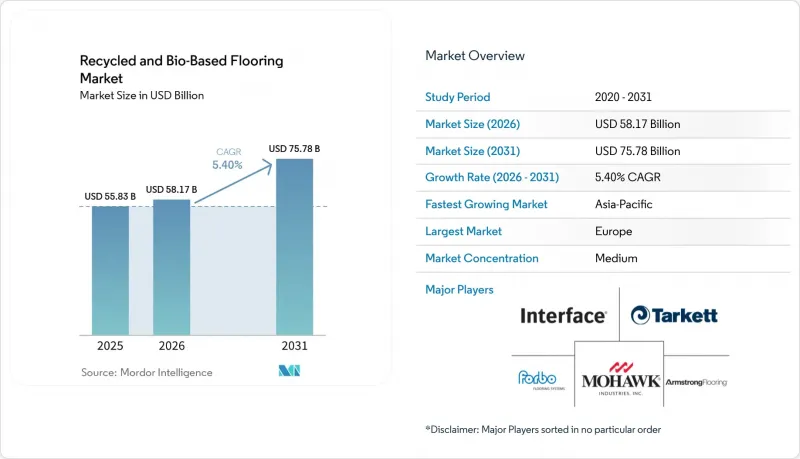
Mordor Intelligence에 의하면, 재활용 및 바이오 바닥재 시장 규모는 2025년 558억 3,000만 달러에서 2026년에는 581억 7,000만 달러로 확대되고, 2031년까지 757억 8,000만 달러에 이를 것으로 예측되며, 2026-2031년 CAGR 5.4%를 기록할 전망입니다.
본 보고서는 제품 유형(LVT, 고무 바닥재, 리놀륨 및 코르크, 엔지니어드 우드 및 대나무, 기타), 원자재(재활용 플라스틱, 재생 고무, 재생 목질 섬유, 바이오 폴리머, 바이오 유래 코르크 및 리놀륨), 최종 사용자(주거용, 상업용), 유통 채널(B2C, B2B) 및 지역별로 분류되어 있습니다. 시장 전망은 금액(달러) 단위로 제시되어 있습니다.
전 세계 재활용 및 바이오 바닥재 시장 동향과 인사이트
친환경 건축 인증의 추진
LEED v5에서는 건축자재에 대한 내재 탄소 관련 요건이 강화되었습니다. 자재의 건강성에 관한 문서화 기준이 상향 조정됨에 따라, 점수를 획득하려는 많은 상업 프로젝트에서 제3자 기관이 발급한 환경 제품 선언(EPD)이 사양 수립의 실질적인 요건이 되고 있습니다. BREEAM International은 정의된 재활용 함량 및 저탄소 기준을 충족하는 제품에 크레딧을 부여하고 있으며, 이를 통해 사양 수립자는 검증된 선언과 추적 가능한 원자재를 갖춘 탄성 바닥재, 카펫 및 목재 시스템을 선택하도록 유도되고 있습니다. WELL 빌딩 표준 v2.1은 성분을 상세한 기준까지 공개하는 라벨 표시 및 건강 관련 제품 선언을 인증함으로써 투명성을 높이고 있으며, 이러한 요건은 대규모 프로젝트 포트폴리오 전반의 실내 마감 계획에 영향을 미치고 있습니다. 이러한 프로그램은 환경 주장에 관한 ISO 14021 및 제품 선언에 관한 ISO 14025와 일치하며, 조달 팀에 바닥재 옵션을 비교하기 위한 공통된 언어와 방법을 제공합니다. 주요 관할 구역의 공공 및 기관 구매 담당자들은 입찰 서류에서 이러한 프레임워크를 참조하고 있으며, 이로 인해 전 세계 재활용 및 바이오 바닥재 시장에서 검증된 EPD와 공급망 데이터를 갖춘 바닥재에 대한 수요가 증가하고 있습니다.
확대 생산자 책임(EPR)에 따른 인센티브
건축자재에 관한 프랑스의 EPR 체계에서는 바닥재 제조업체가 회수, 선별 및 재료 회수에 자금을 지원하는 인증된 친환경 단체에 가입할 것을 의무화하고 있습니다. 해당 비용은 재활용 가능성이나 사용 후 처리를 용이하게 하는 설계 선택에 따라 단계적으로 책정됩니다. 네덜란드에서는 바닥재 회수 제도가 운영되고 있으며, 버진 소재를 포함한 LVT에는 부과금이 부과되는 반면, 인증된 재활용 소재를 포함한 제품군에는 감면 조치가 적용되어 순환형 디자인을 지향하는 조달을 장려하고 있습니다. EU 건설 제품 규정 개정에 따라 2027년에는 원산지, 재활용 소재 함유량 데이터 및 사용 후 정보를 포함하는 ‘디지털 제품 여권’이 도입되어 보고의 표준화와 회원국 간 추적성 향상이 도모될 예정입니다. 역물류 및 처리 능력에 조기에 투자해 온 제조업체들은 전 세계 재활용 및 바이오 바닥재 시장에서 회수 및 재료 검증 요건이 엄격해지더라도 이에 대응할 수 있는 체제를 갖추고 있습니다. 요금 체계와 정보 공개 규정이 맞물려 분해를 전제로 한 설계 및 단일 소재 접근 방식이 촉진되며, 이를 통해 반복적으로 사용되는 수명 주기 전반에 걸쳐 시공된 바닥재의 실질적인 재활용 가능성이 향상됩니다.
프리미엄 가격과 기존 바닥재의 비교
원료 선별, 품질 관리 및 새로운 처리 시스템의 자본 집약성으로 인해 재활용 소재 및 바이오 제품군에는 여전히 가격 프리미엄이 존재하며, 비용 중심의 프로젝트에서 대규모 비용 평준화의 실현이 지연되고 있습니다. 주요 바이오폴리머공급량은 기존 수지에 비해 여전히 소규모로 남아 있어, 이는 주류 사양에서 대량 구매자가 기대하는 수량 할인을 제한하고 있습니다. 일부 공공 프로그램에서는 인증된 재활용 소재에 대해 우대 조치가 시행되고 있지만, 전 세계 재활용 및 바이오 바닥재 시장에서 설치 비용이 기존 대체재에 비해 낮아지기 전까지는 주거용 및 저예산 상업용 부문에서의 채택에 신중한 태도가 나타날 가능성이 있습니다. EU의 ‘탄소 국경 조정 메커니즘(CBAM)’은 내재된 탄소량이 많은 수입품에 대해 단계적으로 관세를 부과하는 것으로, 이로 인해 지역별 공급망에서 비닐계 제품의 단기적인 가격 비교에 변화가 생길 가능성이 있습니다. 디지털 제품 여권 및 확대 생산자 책임(EPR) 규정에 따라 추적 가능성이 표준화됨에 따라 정보의 비대칭성은 감소할 것으로 예상되며, 그 결과 검증된 순환형 특성을 중시하는 조달 결정이 향후 점차 촉진될 것입니다.
부문 분석
2025년, LVT는 전 세계 재활용 및 바이오 바닥재 시장 점유율의 38.41%를 차지했습니다. 이는 화학적 재활용 및 물질 수지 산정 분야의 기술 혁신을 통해 순환형 PVC 원료가 프로젝트 사양을 대규모로 충족할 수 있는 길이 열렸기 때문입니다. '프로젝트 서클(Project Circle)'과 같은 투자는 사용 후 비닐을 회수·정제하여 바닥재용 수지로 재도입하는 것을 목적으로 하며, 이를 통해 재처리 원료의 편차를 줄이고 품질을 유지하는 데 기여하고 있습니다. 전 세계 재활용 및 바이오 바닥재 시장에서 매스 팀버의 채택이 확대되고, 사양 결정자들이 저탄소 구조에 부합하는 바이오 마감재를 요구하는 가운데, 엔지니어드 우드 및 대나무는 2031년까지 연평균 성장률(CAGR) 11.41%를 기록하며 가장 빠르게 성장하는 제품 카테고리가 될 전망입니다. 재생 타이어 크럼블을 원료로 하는 고무 바닥재는 안전성과 내구성이 최우선으로 요구되는 피트니스, 교육, 의료 현장에서 계속해서 활용되고 있으며, 순환형 고무 솔루션을 위한 회수 및 가공 능력 확대를 위해 새로운 투자가 이루어지고 있습니다. 리놀륨과 코르크는 구매자가 바이오 유래 함량이나 저배출량을 중시하는 분야에서 여전히 중요한 역할을 하고 있으며, 저탄소 소재를 인증하는 특정 시장의 정책적 인센티브에 힘입어 성장하고 있습니다. ISCC PLUS 인증을 받은 바이오 유래 PVC 원료의 등장으로, LVT 제품 라인은 시공 속도나 패턴의 다양성을 저해하지 않으면서도 크래들-투-게이트 단계의 탄소 배출량을 줄일 수 있게 되었습니다.
앞으로 수요가 높은 상업용 인테리어용 회수 프로그램과 제조를 확대하기 위한 자본 유입으로 인해 고무의 성장 궤도는 더욱 견고해질 전망입니다. 이러한 추세는 재활용량 증가로 이어져 매립지로 보내지는 폐기물 감축에도 기여할 것입니다. 막대한 투자를 바탕으로 한 경화 목재 플랫폼은 과거 탄성 바닥재의 영역이었던 교통량이 많은 용도를 목표로 하고 있으며, 사무실 및 소매점에서의 합성목재 적용 범위를 확대되고 있습니다. LVT 공급업체들 또한 상업시설의 브랜딩 요구를 충족하는 폭넓은 디자인 라이브러리를 유지하면서, 내재 탄소량을 현저히 줄인 것을 입증하는 바이오 컬렉션을 통해 진전을 이루고 있습니다. 투자 및 인증의 이정표를 맞이할 때마다, 전 세계 재활용 및 바이오 바닥재 시장은 수명 주기에 대한 주장을 뒷받침하는 더욱 견고한 도입 기반을 구축함으로써, 탄성 바닥재와 목재 바닥재 모두에 대한 사양 결정자들의 신뢰를 높이고 있습니다.
PET 및 PVC를 포함한 재활용 플라스틱은 2025년 출하량의 33.13%를 차지했습니다. 이는 병에서 플레이크, 그리고 바닥재에 이르는 확립된 유통 경로와 추적성 향상으로 인해 전 세계 재활용 및 바이오 바닥재 시장에서 대규모 조달이 뒷받침되었기 때문입니다. PLA 및 PHA와 같은 바이오 폴리머는 생산 능력 확대와 탄성 바닥재에서의 적용 범위 확장에 힘입어, 2031년까지 연평균 성장률(CAGR) 11.93%라는 가장 높은 성장률을 보일 것으로 예측됩니다. 디지털 소재 출처 추적 플랫폼은 재활용 함량 및 생산 이력에 대한 세부 정보를 로트 단위로 검증하는 기능을 추가하여, 제조업체와 구매자가 새롭게 도입되는 디지털 패스포트 요건을 충족하는 데 도움을 주고 있습니다. 바이오 서큘러 및 물질 수지에 대한 주장을 뒷받침하는 ISCC PLUS 인증을 통해 PVC 공급업체는 명확한 규칙과 제3자 감독 하에 바이오 유래 원료를 완제품 수지 스트림에 귀속시킬 수 있습니다. 바이오 유래 PVC 및 하류 LVT 제품군은 공급망 파트너들이 인증된 원료를 주류 상업 사양에 부합하는 저탄소 바닥재로 전환하고 있음을 보여줍니다.
예측 기간 동안, 실내 용도에서의 PAH 농도 제한 등 클램 고무에 대한 안전상의 제약이 컴파운딩 옵션을 좌우할 것이며, 규제 기준치 내에 맞추기 위해 블렌딩이 필요할 수 있습니다. PHA 생산 능력 확대 계획은 비식용 원료와 공정 개선을 통해 전 세계 재활용 및 바이오 바닥재 시장에서 성능이 중시되고 내구성이 뛰어난 제품에 바이오 폴리머의 활용이 향후 점차 확대될 것임을 시사합니다. 정책 입안자들은 순환 경제 목표에 맞추어 요금 체계를 지속적으로 조정하고 있으며, 회수 및 선별 인프라가 성숙해짐에 따라 제품 수명 종료 시의 경제성이 향상될 가능성이 있습니다. 추적성 플랫폼, 인증 제도, 재활용에 대한 투자가 결합되어 신뢰성이 더 높은 2차 원료가 시장에 공급되게 되었으며, 구매자는 마케팅상의 주장이 아닌 검증된 지표를 바탕으로 선택지를 비교할 수 있게 되었습니다.
지역별 분석
2025년에는 유럽이 30.04%의 점유율로 1위를 차지했습니다. 이는 전 세계 재활용 및 바이오 바닥재 시장에서 추적성, 재생 소재 함유율, 검증 가능한 환경 주장을 우선시하는 정책 조치에 힘입은 결과입니다. EU의 ‘건설제품규정(CPR)’ 개정에 따라 2027년에 디지털 제품 여권이 도입되어, 바닥재를 포함한 모든 대상 건설 제품에 대해 원산지, 재생 소재 함유율 및 사용 후 데이터가 QR 코드에 연결된 기록에 포함될 예정입니다. 프랑스의 확대 생산자 책임(EPR) 체계에서는 수수료가 재활용 가능성과 연동되어 있습니다. 한편, 네덜란드의 회수 제도에서는 버진 소재를 포함한 제품에 부과금을 부과하고, 검증된 재활용 소재를 포함한 제품은 면제함으로써 조달을 순환형 선택지로 전환하는 데 기여하고 있습니다. 덴마크에서는 저탄소성이 입증된 바닥재에 대해 환급금을 제공하고 있으며, 이는 검증된 탄소 발자국을 가진 바이오 및 재활용 제품에 대한 직접적인 금전적 인센티브가 되고 있습니다. 인증 및 보고 체계는 프로젝트 평가와 기업의 정보 공개에서 검증된 데이터를 핵심으로 삼음으로써 이러한 변화를 뒷받침하고 있습니다.
아시아태평양에서는 도시 개발 프로젝트와 자재의 투명성 및 탄소 성능을 향상시키는 정책 로드맵에 힘입어 2031년까지 연평균 성장률(CAGR) 8.82%를 나타낼 것으로 예측됩니다. 중국의 ‘이산화탄소 배출 정점 달성 및 탄소 중립’ 정책은 속성이 문서화된 저배출 자재를 우선시하는 투자 및 사양 기준을 계속해서 지침으로 삼고 있습니다. 싱가포르의 ‘그린마크(Green Mark)’ 프로그램은 제품 수준의 선언을 인증하며, 신축 건물 및 대규모 리모델링 공사에서 EPD(환경 제품 선언)에 기반한 마감재의 보다 광범위한 채택을 지원하고 있습니다. 각 지역의 제조 거점 또한 국제적인 지속가능성 기대에 부응하고 있으며, 수출 및 국내 프로젝트 모두에 대응하기 위해 인증된 바이오 유래 성분을 포함한 현지 생산이 이루어지고 있습니다. 호주의 공공 부문 및 교육 부문에서는 순환 경제 실현을 지원하는 리스 및 환매 모델에 대한 강한 관심이 나타나고 있으며, 이를 통해 해당 지역에서 검증된 저탄소 바닥재의 보급 확대가 촉진되고 있습니다.
북미에서는 기관 조달 지침에 따라 연방 기관이 인증된 친환경 라벨이나 기준을 채택하도록 유도되고 있으며, 이로 인해 전 세계 재생재 및 바이오 바닥재 시장에서 검증된 환경 성능과 재활용 경로를 갖춘 제품에 대한 큰 수요가 발생하고 있습니다. 브리티시컬럼비아주의 건축 기준법 개정에 따라 대규모 목조 건축이 지원되고 있으며, 캐나다 전역에서 바이오 마감재와 이를 보완하는 저탄소 바닥 시스템의 보급 확대가 진행되고 있습니다. 공공시설에 대한 인프라 자금 투입으로 인해 내구성, 배출량, 순환성 요건을 충족하는 적합한 바닥재 입찰 건수가 증가하고 있습니다. 중동의 일부 프로젝트에서는 친환경 건축에 대한 노력이 계속해서 내장재 선정에 영향을 미치고 있습니다. 한편, 라틴아메리카의 일부 지역에서는 비용 및 관세 구조가 표준 비닐 바닥재와의 가격 비교에 영향을 미치고 있어, 예산이 제한된 지역에서는 도입 속도에 영향을 주고 있습니다. 각 지역에서 디지털 제품 여권 및 EPR(생산자 책임 회수) 방식의 회수 규정 동향은 추적 가능한 재생 원료가 얼마나 신속하게 보급될지, 또한 설치된 바닥재에 대한 회수 서비스가 얼마나 일관되게 운영될지를 결정짓는 중요한 요인이 될 것입니다.
기타 혜택:
- 엑셀 형식 시장 예측(ME) 시트
- 3개월간의 애널리스트 지원
자주 묻는 질문
목차
제1장 서론
제2장 조사 방법
제3장 주요 요약
제4장 시장 구도
제5장 시장 규모와 성장 예측
제6장 경쟁 구도
제7장 시장 기회와 향후 전망
KTH 26.08.06According to Mordor Intelligence, the recycled and bio-based flooring market size is expected to increase from USD 55.83 billion in 2025 to USD 58.17 billion in 2026 and reach USD 75.78 billion by 2031, growing at a CAGR of 5.4% over 2026-2031.
This report is Segmented by Product Type (LVT, Rubber Flooring, Linoleum and Cork, Engineered Wood and Bamboo, Others), Material Source (Recycled Plastics, Recycled Rubber, Recycled Wood Fiber, Bio-Based Polymers, Bio-Derived Cork and Linoleum), End User (Residential, Commercial), Distribution Channel (B2C, B2B), and Geography. Market Forecasts are Provided in Value (USD).
Global Recycled and Bio-Based Flooring Market Trends and Insights
Green-Building Certification Push
LEED v5 tightened embodied-carbon expectations for building materials. It raised documentation thresholds for material health, making third-party Environmental Product Declarations (EPD) a practical requirement for specification in many commercial projects seeking points. BREEAM International assigns credits for products that meet defined recycled-content and low-carbon criteria, which directs specifiers toward resilient, carpet, and wood systems with verified declarations and traceable inputs. The WELL Building Standard v2.1 raises transparency by recognizing labeling and health product declarations that disclose ingredients to a fine threshold, and those expectations influence interior finish schedules across large project portfolios. These programs align with ISO 14021 on environmental claims and ISO 14025 on product declarations, providing procurement teams with a common language and method for comparing flooring alternatives. Public and institutional buyers in key jurisdictions reference these frameworks in bid documents, which increases demand for flooring with verified EPDs and supply-chain data in the global recycled and bio-based flooring market.
Extended Producer Responsibility (EPR) Incentives
France's EPR framework for building products requires flooring producers to participate in accredited eco-organizations that finance collection, sorting, and material recovery, with fees scaled to recyclability and design choices that facilitate end-of-life processing. The Netherlands operates a flooring take-back scheme that imposes a levy on virgin-content LVT while granting relief for certified recycled-content ranges, nudging procurement toward circular designs. The EU's revision of the construction products regulation introduces a digital product passport in 2027 that embeds provenance, recycled-content data, and end-of-life information, harmonizing reporting and improving traceability across member states. Manufacturers that invested early in reverse logistics and processing capacity are positioned to meet collection and material validation requirements as they tighten in the global recycled and bio-based flooring market. Fee signals and disclosure rules together reinforce design-for-disassembly and mono-material approaches, thereby enhancing the practical recyclability of installed flooring across repeated life cycles.
Premium Pricing vs. Conventional Flooring
Price premiums persist for recycled-content and bio-based ranges due to feedstock sorting, quality control, and the capital intensity of newer processing systems, which delays parity at scale in cost-sensitive projects. Supply remains subscale for key bio-polymers relative to legacy resins, which limits the volume discounts that large buyers expect in mainstream specifications. Some public programs provide favorable treatment for certified recycled content, yet adoption in residential and lower-budget commercial segments can be cautious until installed costs narrow relative to conventional alternatives in the global recycled and bio-based flooring market. The EU's Carbon Border Adjustment Mechanism phases in tariffs on imports that are embodied-carbon intensive, which can change near-term price comparisons for vinyl-based products across regional supply chains. As digital product passports and EPR rules standardize traceability, information asymmetries should decline, thereby supporting procurement decisions that reward verified circular attributes over time.
Other drivers and restraints analyzed in the detailed report include:
- Corporate Sustainable-Sourcing Mandates
- Bio-Polymer Cost Parity With PVC
- Durability Concerns in Heavy-Duty Settings
For complete list of drivers and restraints, kindly check the Table Of Contents.
Segment Analysis
LVT commanded 38.41% of the global recycled and bio-based flooring market share in 2025 as innovations in chemical recycling and mass-balance attribution opened pathways for circular PVC feedstocks to meet project specifications at scale. Investments such as Project Circle are designed to recover and purify post-use vinyl for reintroduction into flooring resins, which helps reduce variability and sustain quality in reprocessed inputs. Engineered wood and bamboo are set to be the fastest-growing product category, with a 11.41% CAGR through 2031, as mass-timber adoption expands and specifiers seek bio-based finishes that align with low-carbon structures in the global recycled and bio-based flooring market. Rubber flooring derived from reclaimed tire crumb continues to serve fitness, education, and healthcare settings where safety and resilience take priority, and new investment is scaling reclamation and processing capacity for circular rubber solutions. Linoleum and cork retain a role where buyers value bio-based content and low emissions, supported by policy incentives in select markets that recognize low embodied-carbon materials. The emergence of bio-attributed PVC feedstocks backed by ISCC PLUS claims is enabling LVT lines to report lower cradle-to-gate carbon figures without compromising installation speed or pattern variety.
Looking ahead, rubber's growth trajectory is reinforced by capital inflows that expand take-back programs and manufacturing for high-demand commercial interiors, a trend that adds reclaimed volumes and reduces waste sent to landfills. Hardened-wood platforms backed by significant investment are targeting heavy-traffic applications that were once the domain of resilient products, broadening the application scope for engineered wood in offices and retail. LVT suppliers are also advancing through bio-attributed collections that document meaningful reductions in embodied carbon while maintaining broad design libraries that support commercial branding needs. With each investment and certification milestone, the global recycled and bio-based flooring market builds a deeper installed base to validate lifecycle claims, thereby improving confidence among specifiers for both resilient and wood-based products.
Recycled plastics, including PET and PVC, accounted for 33.13% of volumes in 2025, as established bottle-to-flake-to-flooring channels and improved traceability supported procurement at scale in the global recycled and bio-based flooring market. Bio-based polymers such as PLA and PHA are projected to grow at the fastest 11.93% CAGR to 2031, supported by capacity scale-ups and expanding application ranges in resilient assemblies. Digital material provenance platforms are adding batch-level verification for recycled content and chain-of-custody details, helping manufacturers and buyers meet emerging digital passport requirements. Certification under ISCC PLUS for bio-circular and mass-balance claims allows PVC suppliers to attribute bio-based inputs to finished resin streams with clear rules and third-party oversight. Bio-attributed PVC and downstream LVT collections show how supply partners are translating certified feedstocks into lower-carbon floors that fit mainstream commercial specifications.
Over the forecast period, safety constraints on crumb rubber, including limits on PAH concentrations for indoor applications, will shape compounding choices and may require blending to stay within regulatory thresholds. PHA capacity expansion plans underscore how non-edible feedstocks and process improvements can broaden the use of bio-polymers in performance-sensitive, resilient products over time in the global recycled and bio-based flooring market. Policymakers continue to align fee structures with circularity goals, which may improve end-of-life economics as take-back and sorting infrastructure matures. The combination of traceability platforms, certification schemes, and recycling investments is bringing more reliable secondary feedstock to market, helping buyers compare options on verified metrics rather than marketing claims.
Complete Report Scope:
- By Product Type
- Luxury Vinyl Tiles (LVT)
- Rubber Flooring Rolls & Tiles
- Linoleum & Cork Sheets
- Engineered Wood & Bamboo Planks
- Others
- By Material Source
- Recycled Plastics (PET, PVC)
- Recycled Rubber (Tire-derived)
- Recycled Wood Fiber
- Bio-based Polymers (PLA, PHA etc.)
- Bio-derived Cork & Linoleum
- By End User
- Residential
- Commercial
- By Distribution Channel
- B2C/Retail
- Home Centers
- Specialty Flooring Stores
- Online
- Local Hardware Shops (unorganized market)
- Other Distribution Channels
- B2B/Contractors/Builders
- B2C/Retail
- By Geography
- North America
- Canada
- United States
- Mexico
- South America
- Brazil
- Peru
- Chile
- Argentina
- Rest of South America
- Asia-Pacific
- India
- China
- Japan
- Australia
- South Korea
- South East Asia (Singapore, Malaysia, Thailand, Indonesia, Vietnam, and Philippines)
- Rest of Asia-Pacific
- Europe
- United Kingdom
- Germany
- France
- Spain
- Italy
- BENELUX (Belgium, Netherlands, and Luxembourg)
- NORDICS (Denmark, Finland, Iceland, Norway, and Sweden)
- Rest of Europe
- Middle East And Africa
- United Arab of Emirates
- Saudi Arabia
- South Africa
- Nigeria
- Rest of Middle East And Africa
- North America
Geography Analysis
Europe led with a 30.04% share in 2025, supported by policy actions that prioritize traceability, recycled content, and verifiable environmental claims in the global recycled and bio-based flooring market. The EU's revision of the Construction Products Regulation will introduce digital product passports in 2027, embedding provenance, recycled content, and end-of-life data into QR-linked records for all covered construction products, including flooring. France's EPR framework ties fees to recyclability, while the Netherlands' take-back scheme levies on virgin-content products and relieves verified recycled-content products, helping shift procurement toward circular choices. Denmark offers rebates for documented low-carbon floors, which provide a direct financial incentive for bio-based and recycled options with verified footprints. Certification and reporting frameworks reinforce these shifts by making verified data central to both project scoring and corporate disclosures.
Asia-Pacific is projected to post an 8.82% CAGR through 2031, driven by urban projects and policy roadmaps that elevate material transparency and carbon performance. China's dual-carbon policy continues to guide investment and specification standards that favor low-emission materials with documented attributes. Singapore's Green Mark program recognizes product-level declarations and supports broader adoption of EPD-backed finishes in new buildings and major retrofits. Regional manufacturing footprints are also adapting to international sustainability expectations, including local production that incorporates certified bio-attributed content to serve both export and domestic projects. Australia's public and education sectors show strong interest in leasing and take-back models that support circular outcomes, which help scale verified low-carbon floors in the region.
In North America, institutional procurement guidance directs federal agencies toward recognized ecolabels and standards, which channels significant demand to products with verified environmental claims and recyclability pathways in the global recycled and bio-based flooring market. British Columbia's building-code updates that support mass-timber construction are helping to broaden the uptake of bio-based finishes and complementary low-carbon floor systems across Canada. Infrastructure funding across public facilities is enlarging bid pipelines for compliant surfaces that meet durability, emissions, and circularity requirements. In several Middle Eastern projects, green-building aspirations continue to shape interior finish choices, while parts of Latin America face cost and tariff structures that influence price comparisons against standard vinyl, which affects adoption pacing where budgets are constrained. Across regions, the trajectory of digital product passports and EPR-style collection rules will be a core determinant of how quickly traceable recycled inputs scale and how consistently take-back services operate for installed floors.
- Armstrong Flooring LLC
- Interface Inc.
- Forbo Holding AG
- Tarkett S.A.
- Mohawk Industries Inc.
- Shaw Industries Group Inc.
- Gerflor Group
- Beaulieu International Group
- Ecore International
- Milliken & Company
- Kahrs Group
- Amorim Cork Flooring
- Polyflor Ltd
- Congoleum Corporation
- LG Hausys
- Karndean Designflooring
- Toli Corporation
- Burke Flooring (Mannington)
- Moso International
- Bamboo Hardwoods Inc.
Additional Benefits:
- The market estimate (ME) sheet in Excel format
- 3 months of analyst support
TABLE OF CONTENTS
1 Introduction
2 Research Methodology
3 Executive Summary
4 Market Landscape
- 4.1 Market Overview
- 4.2 Market Drivers
- 4.2.1 Green-Building Certification Push
- 4.2.2 Extended Producer Responsibility (EPR) Incentives
- 4.2.3 Corporate Sustainable-Sourcing Mandates
- 4.2.4 Bio-Polymer Cost Parity With PVC
- 4.2.5 Chemical Recycling of Post-Use Vinyl Tiles
- 4.2.6 Blockchain Traceability for Recycled Content
- 4.3 Market Restraints
- 4.3.1 Premium Pricing vs. Conventional Flooring
- 4.3.2 Durability Concerns in Heavy-Duty Settings
- 4.3.3 Feed-Stock Price Volatility
- 4.3.4 Take-Back and Reverse-Logistics Gaps
- 4.4 Industry Value Chain Analysis
- 4.5 Porter's Five Forces Analysis
- 4.5.1 Threat of New Entrants
- 4.5.2 Bargaining Power of Suppliers
- 4.5.3 Bargaining Power of Buyers
- 4.5.4 Threat of Substitutes
- 4.5.5 Competitive Rivalry
- 4.6 Comparative Performance Benchmarking (Durability, Acoustics, Lifecycle Cost, Maintenance, etc.) of Traditional Flooring Types versus Recyled
- 4.7 Insights on Different Materials (both launched and ongoing research) and their Use Cases/Applications
- 4.8 Insights into the Latest Trends and Innovations in the Industry
- 4.9 Insights on Recent Developments (New Product Launches, Strategic Initiatives, Investments, Partnerships, JVs, Expansion, M&As, etc.) in the Industry
5 Market Size & Growth Forecasts (Value in USD Billion)
- 5.1 By Product Type
- 5.1.1 Luxury Vinyl Tiles (LVT)
- 5.1.2 Rubber Flooring Rolls & Tiles
- 5.1.3 Linoleum & Cork Sheets
- 5.1.4 Engineered Wood & Bamboo Planks
- 5.1.5 Others
- 5.2 By Material Source
- 5.2.1 Recycled Plastics (PET, PVC)
- 5.2.2 Recycled Rubber (Tire-derived)
- 5.2.3 Recycled Wood Fiber
- 5.2.4 Bio-based Polymers (PLA, PHA etc.)
- 5.2.5 Bio-derived Cork & Linoleum
- 5.3 By End User
- 5.3.1 Residential
- 5.3.2 Commercial
- 5.4 By Distribution Channel
- 5.4.1 B2C/Retail
- 5.4.1.1 Home Centers
- 5.4.1.2 Specialty Flooring Stores
- 5.4.1.3 Online
- 5.4.1.4 Local Hardware Shops (unorganized market)
- 5.4.1.5 Other Distribution Channels
- 5.4.2 B2B/Contractors/Builders
- 5.4.1 B2C/Retail
- 5.5 By Geography
- 5.5.1 North America
- 5.5.1.1 Canada
- 5.5.1.2 United States
- 5.5.1.3 Mexico
- 5.5.2 South America
- 5.5.2.1 Brazil
- 5.5.2.2 Peru
- 5.5.2.3 Chile
- 5.5.2.4 Argentina
- 5.5.2.5 Rest of South America
- 5.5.3 Asia-Pacific
- 5.5.3.1 India
- 5.5.3.2 China
- 5.5.3.3 Japan
- 5.5.3.4 Australia
- 5.5.3.5 South Korea
- 5.5.3.6 South East Asia (Singapore, Malaysia, Thailand, Indonesia, Vietnam, and Philippines)
- 5.5.3.7 Rest of Asia-Pacific
- 5.5.4 Europe
- 5.5.4.1 United Kingdom
- 5.5.4.2 Germany
- 5.5.4.3 France
- 5.5.4.4 Spain
- 5.5.4.5 Italy
- 5.5.4.6 BENELUX (Belgium, Netherlands, and Luxembourg)
- 5.5.4.7 NORDICS (Denmark, Finland, Iceland, Norway, and Sweden)
- 5.5.4.8 Rest of Europe
- 5.5.5 Middle East And Africa
- 5.5.5.1 United Arab of Emirates
- 5.5.5.2 Saudi Arabia
- 5.5.5.3 South Africa
- 5.5.5.4 Nigeria
- 5.5.5.5 Rest of Middle East And Africa
- 5.5.1 North America
6 Competitive Landscape
- 6.1 Market Concentration
- 6.2 Strategic Moves
- 6.3 Market Share Analysis
- 6.4 Company Profiles (includes Global level Overview, Market level overview, Core Segments, Financials as available, Strategic Information, Market Rank/Share for key companies, Products & Services, and Recent Developments)
- 6.4.1 Armstrong Flooring LLC
- 6.4.2 Interface Inc.
- 6.4.3 Forbo Holding AG
- 6.4.4 Tarkett S.A.
- 6.4.5 Mohawk Industries Inc.
- 6.4.6 Shaw Industries Group Inc.
- 6.4.7 Gerflor Group
- 6.4.8 Beaulieu International Group
- 6.4.9 Ecore International
- 6.4.10 Milliken & Company
- 6.4.11 Kahrs Group
- 6.4.12 Amorim Cork Flooring
- 6.4.13 Polyflor Ltd
- 6.4.14 Congoleum Corporation
- 6.4.15 LG Hausys
- 6.4.16 Karndean Designflooring
- 6.4.17 Toli Corporation
- 6.4.18 Burke Flooring (Mannington)
- 6.4.19 Moso International
- 6.4.20 Bamboo Hardwoods Inc.
7 Market Opportunities & Future Outlook
- 7.1 Flooring-as-a-Service Circular Leasing
- 7.2 ISCC+ Bio-Attributed PVC/LVT Feedstocks


