

|
시장보고서
상품코드
2097471
LPDDR 시장 : 시장 점유율 분석, 업계 동향 및 통계, 성장 예측(2026-2031년)LPDDR - Market Share Analysis, Industry Trends & Statistics, Growth Forecasts (2026 - 2031) |
||||||
 Mordor Intelligence
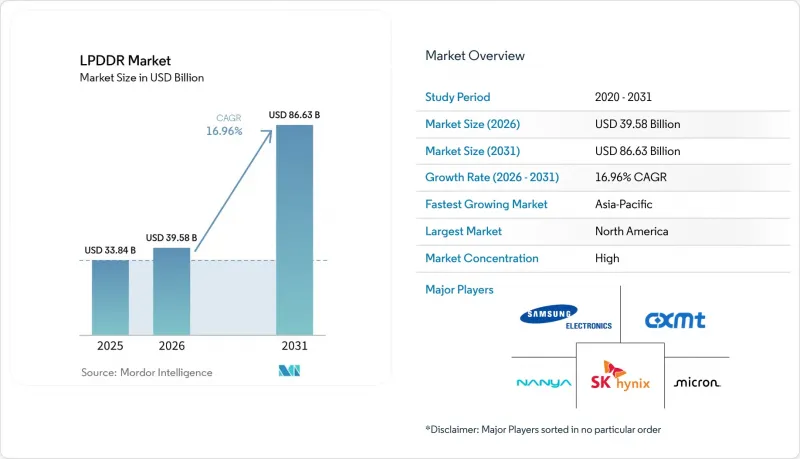
에 의하면, LPDDR 시장 규모는 2025년 338억 4,000만 달러로 평가되었고, 2026년에는 395억 8,000만 달러로 확대될 것으로 추정되고, 2031년까지 866억 3,000만 달러에 이를 것으로 예상되며, 2026-2031년 CAGR 17%로 성장할 전망입니다.
본 보고서는 세대별(LPDDR4/4X, LPDDR5/5X, 기타), 패키지 용량별(4GB 이하, 4GB-8GB, 8GB-16GB, 기타), 패키지 구성별(디스크리트 LPDDR 패키지, 패키지 온 패키지(PoP), 멀티칩 패키지(MCP), 시스템 인 패키지 등), 용도별(소비자용 전자기기, 산업용 및 엣지 AI 디바이스 등), 그리고 지역별로 분류되어 있습니다. 시장 예측은 금액(달러) 기준으로 제시되어 있습니다.
세계의 LPDDR 시장 동향 및 인사이트
AI 탑재 스마트폰이 기기당 LPDDR 탑재량을 늘리고 있습니다.
LPDDR 시장은 기기 내 AI가 프리미엄 스마트폰의 최소 메모리 요구 사항을 변화시키고 있는 데서 혜택을 보고 있습니다. AI 어시스턴트, 로컬 추론, 이미지 생성, 상시 가동형 언어 기능 등 모두 메모리 대역폭과 전력 효율을 더욱 중시하게 되면서, 기기 제조업체들은 더 이상 메모리를 단순한 배경 구성 요소로 취급하지 않습니다. 삼성은 이미 LPDDR6를 고성능 온디바이스 AI에 최적화된 메모리로 포지셔닝하고 있으며, 이는 모바일 AI 수요가 본격적인 상용화가 시작되기 전부터 메모리 로드맵에 영향을 미치고 있음을 보여줍니다. 또한 삼성은 모바일 AI 디바이스용 초슬림형 LPDDR5X 패키지의 양산도 시작했으며, 이를 통해 열적 안정성을 저해하지 않으면서도 콤팩트한 폼 팩터에서 더 많은 메모리를 필요로 하는 수요에 대응하고 있습니다. LPDDR 시장에서 이는 스마트폰 1대당 메모리 탑재량이 단순한 배경적인 비용 항목이 아니라, 제품을 정의하는 사양으로 자리 잡고 있음을 의미합니다.
AI 서버 및 클라이언트 모듈로의 LPDDR 확대
또한, 저전력 DRAM이 AI 서버 및 클라이언트 모듈 설계에 채택되고 있음에 따라 LPDDR 시장도 확대되고 있습니다. Samsung Electronics는 AI 데이터센터용 SOCAMM2 모듈을 발표하고 NVIDIA와의 기술 제휴를 밝혔습니다. 이는 LPDDR이 더 이상 단순한 부수적인 실험이 아니라, 주류 가속기 인프라 계획의 일부가 되었음을 뒷받침합니다. SK하이닉스는 엔비디아의 베라 루빈(Vera Rubin) 플랫폼용 192GB SOCAMM2 모듈을 양산 중이며, 회사에 따르면 이 모듈은 기존 RDIMM에 비해 대역폭이 2배 이상, 전력 효율이 75% 이상 향상되었다고 합니다. 또한 마이크론도 256GB SOCAMM2의 고객용 샘플을 출하하고 있으며, 이 설계를 통해 롱 컨텍스트 추론에서의 ‘타임 투 퍼스트 토큰(TTO)’이 개선되는 동시에 와트당 성능도 향상된다고 밝혔습니다. LPDDR 시장에서 서버로의 채택이 중요시되는 이유는 휴대전화 출하 주기에 좌우되지 않는 지속적인 인프라 수요 흐름을 가져오기 때문입니다.
3-4개 업체에 의한 집중이 가격 변동 확대
LPDDR 시장은 공급이 소수의 제조업체에 집중되어 있어 여전히 가격 변동의 영향을 받기 쉬운 상황입니다. 이러한 구조는 주요 벤더가 이익률을 지키는 데 도움이 되지만, 한편으로는 하류 디바이스 제조업체 입장에서는 할당량이나 계약 조건의 급격한 변화에 더 민감해질 수밖에 없는 상황을 초래하고 있습니다. CXMT의 부상은 일정한 균형을 가져왔으며, 이 회사는 2025년에 여러 중국계 디바이스 제조업체를 대상으로 LPDDR5X 메모리 칩의 양산을 시작했습니다. 그러나 수출 규제로 인해 첨단 노드에서의 신규 생산 능력이 공급 부족을 메우는 속도는 여전히 제한받고 있어, LPDDR 시장은 소수의 기존 공급업체에 의존할 수밖에 없는 상황입니다. 이 때문에 LPDDR 시장은 비용에 민감한 스마트폰 및 기타 저가형 단말기에서 가격에 기인한 수요 부족의 영향을 받기 쉬운 상황에 놓여 있습니다.
부문 분석
2025년 시점에서 LPDDR5/5X는 LPDDR 시장 점유율의 57.6%를 차지했으며, LPDDR6는 2031년까지 연평균 성장률(CAGR) 18.9%로 확대될 것으로 예측됩니다. LPDDR5/5X가 주도적인 위치를 차지하고 있는 것은 플래그십 스마트폰, 상위 미드레인지 단말기, AI PC, 그리고 1세대 서버용 SOCAMM2 모듈 등 폭넓은 분야에서 채택되고 있기 때문입니다. LPDDR 시장에서 이러한 폭넓은 적용 범위가 중요한 이유는 하나의 메모리 인터페이스가 현재 모바일, 클라이언트, 인프라스트럭처의 각 이용 사례를 동시에 아우르고 있기 때문입니다. AMD는 LPDDR5X가 서버의 에너지 효율 향상을 위한 자사의 노력을 뒷받침할 것이라고 밝혔으며, 이는 해당 규격이 휴대전화를 훨씬 뛰어넘는 분야에서 그 유효성이 인정받고 있음을 보여줍니다.
LPDDR6는 AI를 많이 사용하는 기기에서 대역폭과 전력 효율을 모두 향상시키기 때문에 LPDDR 시장의 다음 성장 동력이 될 것입니다. SK하이닉스는 자사의 1c LPDDR6가 LPDDR5X에 비해 전력 효율을 20% 이상 향상시켰으며, 2026년 하반기에 AI 지원 스마트폰 및 태블릿을 타겟으로 하고 있다고 밝혔습니다. 삼성 역시 LPDDR6를 기기 내 AI 성능 향상의 핵심으로 자리매김하고 있으며, 이러한 전환은 우선 프리미엄 부문에서 시작되어 이후 더 폭넓은 대중 시장으로 확대될 것으로 시사되고 있습니다. 기존의 LPDDR4 및 LPDDR4X는 공급업체들이 구세대 노드에 대한 투자를 축소함에 따라 구조적인 감소 추세가 지속되고 있습니다. 또한, JEDEC가 발표한 LPDDR6 아키텍처는 LPDDR 업계의 향후 규정 준수, 전력 관리, 신뢰성에 대해 더 높은 기준을 설정하고 있습니다.
2025년에는 8GB-16GB 대역이 LPDDR 시장 규모의 40.7%를 차지했으나, 16GB를 초과하는 대역은 2031년까지 연평균 성장률(CAGR) 18.6%로 성장할 것으로 전망됩니다. 이 중위 대역은 최고 사양 구성이 초래하는 열적·비용적 부담을 전혀 발생시키지 않으면서도 프리미엄 스마트폰이나 초슬림 노트북의 메모리 수요를 충족시키기 때문에 LPDDR 시장의 중심에 위치하고 있습니다. 실용적인 관점에서 볼 때, 로컬 AI 기능, 더욱 강력한 멀티태스킹 처리, 그리고 더 긴 소프트웨어 지원 기간이 필요한 기기에서 12GB 및 16GB 구성이 표준 최저 사양으로 자리 잡고 있습니다. 한편, LPDDR 시장은 훨씬 더 대용량의 메모리가 필요한 프리미엄 스마트폰이나 AI 서버 모듈과 같은 별도의 제품군에 의해 주도되고 있습니다.
이 두 번째 그룹 덕분에 LPDDR 시장에서 16GB를 초과하는 계층은 탁월한 강인성을 보여주고 있습니다. SK하이닉스는 192GB SOCAMM2 모듈의 양산을 시작했으며, 마이크론은 256GB 설계의 샘플을 제공합니다. 이는 초대용량 LPDDR이 이미 서버 아키텍처에 도입되고 있음을 보여줍니다. 저용량 대역은 여전히 엔트리 레벨 기기나 비용 효율을 중시하는 지역을 대상으로 공급되고 있지만, 공급업체들의 주력 분야는 더 높은 밀도와 높은 수익성을 지닌 제품으로 이동하고 있습니다. LPDDR 시장에서 이러한 공급 추세는 저가형 기기 수요가 불안정한 상황에서도 대용량 대역의 장기적인 성장 가능성을 뒷받침하고 있습니다. 이러한 전환은 LPDDR 업계가 단순한 수량 확대에서 기기당 메모리 용량 증가를 통한 부가가치 확대 쪽으로 이동하고 있음을 반영하고 있습니다.
지역별 분석
아시아태평양은 2025년에 LPDDR 시장 점유율의 51.8%를 차지할 것으로 예상되며, 2031년까지 연평균 성장률(CAGR) 17.9%를 기록해 지역별 가장 높은 성장률을 보일 것으로 전망됩니다. 이 지역이 LPDDR 시장을 주도하고 있는 것은 한국의 생산 능력, 대만의 패키징 기술, 그리고 중국의 최종 사용자 수요가 긴밀하게 연계된 공급망 속에서 융합되고 있기 때문입니다. 한국은 여전히 주요 공급 거점이며, 삼성과 SK하이닉스가 LPDDR6 및 서버급 SOCAMM2 제품으로의 전환을 주도하고 있습니다. 중국은 주요 구매국이자 신흥 생산국으로서 중요한 위치를 차지하고 있으며, CXMT는 설비 관련 제약에 여전히 직면해 있음에도 불구하고 첨단 모바일 DRAM 분야로의 진출을 더욱 확대되고 있습니다. 아시아태평양의 LPDDR 시장은 또한 프리미엄 제품에 대한 활발한 수요와 메모리 비용이 급등했을 때 저가 시장에서 발생하는 압박이라는 양극화 현상도 반영하고 있습니다.
북미는 AI 인프라를 대량으로 구매하는 기업들이 많이 집중되어 있어 LPDDR 시장에서 전략적으로 중요한 역할을 담당하고 있습니다. 하이퍼스케일러 및 플랫폼 개발자들 수요가 현재 LPDDR을 서버 아키텍처로 전환하는 데 일조하고 있으며, 이로 인해 해당 지역은 직접적인 웨이퍼 생산 능력 점유율을 뛰어넘는 영향력을 행사하고 있습니다. 마이크론은 여전히 북미에서 유일한 대규모 DRAM 제조업체이며, 이 회사에 따르면 1-gamma 노드는 2026년 중반까지 DRAM 비트 생산량의 대부분을 차지할 전망입니다. 또한 AMD가 향후 서버 플랫폼에서 LPDDR5X를 지원할 방침이라는 점도 북미가 LPDDR 시장 전체에 파급되는 시스템 아키텍처 선택을 주도하고 있음을 보여줍니다.
유럽은 LPDDR 시장에서 생산 거점이라기보다는 수요의 중심지이며, 그 전략적 중요성의 대부분은 자동차 및 산업용 전자기기에 의해 주도되고 있습니다. 독일, 프랑스, 영국이 중심적인 역할을 하고 있는 것은 자동차 플랫폼 및 산업용 제어 시스템에서 인증을 받은 저전력 메모리에 대한 수요가 점점 더 높아지고 있기 때문입니다. 삼성의 자동차용 LPDDR5X는 ASIL D 인증을 획득하여, ADAS 탑재율 향상 및 차량 컴퓨팅의 중앙 집중화라는 유럽의 흐름을 뒷받침하고 있습니다. 세계 기타 지역 시장은 여전히 소비자용 전자기기 수요에 의존하고 있으며, LPDDR 시장의 경우 메모리가 기기 총비용에서 차지하는 비중이 높아짐에 따라 그 성장이 가격 경쟁 압력에 노출되기 쉬워지고 있습니다.
기타 혜택 :
- 엑셀 형식 시장 예측(ME) 시트
- 3개월간의 애널리스트 지원
자주 묻는 질문
목차
제1장 서론
제2장 조사 방법
제3장 주요 요약
제4장 시장 구도
제5장 시장 규모 및 성장 예측
제6장 경쟁 구도
제7장 시장 기회 및 향후 전망
AJY 26.08.07According to Mordor Intelligence, the LPDDR market size is expected to increase from USD 33.84 billion in 2025 to USD 39.58 billion in 2026 and reach USD 86.63 billion by 2031, growing at a CAGR of 17% over 2026-2031.
This report is Segmented by Generation (LPDDR4/4X, LPDDR5/5X, and More), Package Capacity (Up To 4 GB, 4GB To 8 GB, 8 GB To 16 GB, and More), Package Configuration (Discrete LPDDR Packages, Package-On-Package (PoP), Multichip Packages (MCP), System-In-Package, and More), Application (Consumer Electronics, Industrial and Edge AI Devices, and More), and Geography. The Market Forecasts are Provided in Terms of Value (USD).
Global LPDDR Market Trends and Insights
AI Smartphones Raising LPDDR Content Per Device
The LPDDR market is benefiting from the way on-device AI is changing the minimum memory requirement for premium smartphones. Device makers are no longer treating memory as a background component because AI assistants, local inference, image generation, and always-on language features all place more weight on memory bandwidth and power efficiency. Samsung is already positioning LPDDR6 as memory optimized for high-performing on-device AI, which shows that mobile AI demand is influencing memory road maps before the broad commercial rollout begins. Samsung also began mass production of thinner LPDDR5X packages for mobile AI devices, which supports the need for more memory in compact form factors without giving up thermal stability. In the LPDDR market, this means memory content per phone is becoming a product-defining specification rather than a background cost line.
LPDDR Expansion Into Ai Server And Client Modules
The LPDDR market is also expanding because low-power DRAM is now moving into AI server and client module designs. Samsung introduced its SOCAMM2 module for AI data centers and disclosed technical collaboration with NVIDIA, which confirms that LPDDR is now part of mainstream accelerator infrastructure planning rather than a side experiment. SK Hynix is in mass production of a 192 GB SOCAMM2 module for NVIDIA's Vera Rubin platform, and the company said the module offers more than double the bandwidth and over 75% better power efficiency than conventional RDIMM. Micron has also shipped customer samples of a 256 GB SOCAMM2 and said the design improves time-to-first-token for long-context inference while delivering stronger performance per watt. In the LPDDR market, server adoption matters because it adds a durable infrastructure demand stream that is not tied to handset shipment cycles.
Three-To-Four-Vendor Concentration Amplifying Pricing Swings
The LPDDR market remains exposed to pricing swings because supply is concentrated in a small number of producers. That structure helps leading vendors protect margins, but it also makes downstream device makers more sensitive to abrupt changes in allocation and contract terms. The rise of CXMT offers some counterweight, and the company began mass production of LPDDR5X memory chips in 2025 for several Chinese device makers. Even so, export controls continue to limit how quickly new capacity can close the gap at advanced nodes, which keeps the LPDDR market dependent on a narrow set of established suppliers. This leaves the LPDDR market vulnerable to price-driven demand stress in cost-sensitive smartphones and other lower-end devices.
Other drivers and restraints analyzed in the detailed report include:
- 5g Premium-To-Mid-Tier Migration Into Lpddr5/5x
- Sdv And Adas Memory Demand Scaling In Vehicles
- Advanced-Node Yield Pressure Delaying Lpddr6 Cost Curves
For complete list of drivers and restraints, kindly check the Table Of Contents.
Segment Analysis
LPDDR5/5X held 57.6% of the LPDDR market share in 2025, and LPDDR6 is projected to expand at an 18.9% CAGR through 2031. The leading position of LPDDR5/5X comes from its wide use across flagship phones, upper mid-range devices, AI PCs, and the first wave of server SOCAMM2 modules. In the LPDDR market, that breadth matters because one memory interface is now serving mobile, client, and infrastructure use cases at the same time. AMD said LPDDR5X will support its push for server energy efficiency, which shows that the standard is being validated well beyond handsets.
LPDDR6 is the next growth point in the LPDDR market because it raises both bandwidth and power efficiency for AI-heavy devices. SK Hynix said its 1c LPDDR6 improves power efficiency by more than 20% over LPDDR5X and targets AI-enabled smartphones and tablets in the second half of 2026. Samsung is also framing LPDDR6 around on-device AI performance, which suggests the transition will start at the premium end before moving into broader volume bands. Legacy LPDDR4 and LPDDR4X remain in structural decline as suppliers reduce commitment to older nodes, and JEDEC's published LPDDR6 architecture sets a higher baseline for future compliance, power management, and reliability in the LPDDR industry.
The 8 GB to 16 GB band captured 40.7% of the LPDDR market size in 2025, while the above-16 GB tier is set to grow at an 18.6% CAGR through 2031. This middle tier sits at the center of the LPDDR market because it matches the memory needs of premium smartphones and thin notebooks without creating the full thermal and cost burden of the highest configurations. In practical terms, 12 GB and 16 GB configurations are becoming the working floor for devices that need local AI features, stronger multitasking, and longer software support windows. The LPDDR market is then pulled upward by a different group of products, namely, premium phones and AI server modules that require much larger memory footprints.
That second group gives the above-16 GB tier unusual resilience inside the LPDDR market. SK Hynix is in mass production of a 192 GB SOCAMM2 module, and Micron has sampled a 256 GB design, which shows that very high-capacity LPDDR is already moving into deployed server architectures. Lower capacity bands still serve entry devices and cost-sensitive regions, but supplier focus is shifting toward denser, higher-margin products. In the LPDDR market, that supply preference strengthens the long-term case for high-capacity tiers even when low-end device demand remains uneven. The transition also reflects how the LPDDR industry is moving from pure volume growth to value growth driven by more memory per device.
Complete Report Scope:
- By Generation
- LPDDR3
- LPDDR4/4X
- LPDDR5/5X
- LPDDR6
- By Package Capacity
- Up to 4 GB
- 4 GB to 8 GB
- 8 GB to 16 GB
- Above 16 GB
- By Package Configuration
- Discrete LPDDR Packages
- Package-on-Package (PoP)
- Multichip Packages (MCP)
- System-in-Package (SiP)
- By Application
- Consumer Electronics
- Smartphones and Tablets
- Laptops
- Other Consumer Electronics
- Automotive Electronics
- Industrial and Edge AI Devices
- Networking and Embedded Systems
- Server and Data Center Modules
- Other Applications
- Consumer Electronics
- By Geography
- North America
- United States
- Canada
- Mexico
- Europe
- Germany
- United Kingdom
- France
- Italy
- Rest of Europe
- Asia-Pacific
- China
- Japan
- South Korea
- Taiwan
- India
- Rest of Asia-Pacific
- Rest of the World
- North America
Geography Analysis
Asia-Pacific held 51.8% of the LPDDR market share in 2025, and it is projected to record the fastest regional CAGR at 17.9% through 2031. The region leads the LPDDR market because it combines South Korean production strength, Taiwanese packaging depth, and Chinese end demand in one closely linked supply chain. South Korea remains the main supply anchor, with Samsung and SK Hynix driving the transition into LPDDR6 and server-class SOCAMM2 products. China is important both as a major buyer and as an emerging producer, with CXMT pushing deeper into advanced mobile DRAM while still facing equipment-related constraints. The LPDDR market in Asia-Pacific also reflects a split between strong premium demand and pressure at the lower end when memory costs rise too quickly.
North America holds a strategically important role in the LPDDR market because it concentrates many of the largest AI infrastructure buyers. Demand from hyperscalers and platform developers is now helping shift LPDDR into server architectures, and that gives the region influence beyond its share of direct wafer capacity. Micron remains the only large-scale North American DRAM producer, and the company said its 1-gamma node was on track to become the majority of its DRAM bit production by mid-2026. AMD's support for LPDDR5X in future server platforms also shows that North America is shaping system architecture choices that ripple across the LPDDR market.
Europe is more of a demand center than a production base in the LPDDR market, with automotive and industrial electronics driving most of its strategic importance. Germany, France, and the United Kingdom are central because vehicle platforms and industrial controls increasingly need qualified low-power memory. Samsung's automotive LPDDR5X reached ASIL D certification, which supports use in the European shift toward higher-content ADAS and centralized vehicle computing. Rest-of-the-World markets remain more dependent on consumer electronics demand, and in the LPDDR market their growth is more exposed to affordability pressure when memory becomes a larger part of total device cost.
- Samsung Electronics Co., Ltd.
- SK hynix Inc.
- Micron Technology, Inc.
- ChangXin Memory Technologies, Inc.
- Nanya Technology Corporation
- Winbond Electronics Corporation
- Integrated Silicon Solution, Inc.
- Elite Semiconductor Microelectronics Technology Inc.
- Alliance Memory, Inc.
- AP Memory Technology Corporation
- Etron Technology, Inc.
- Kingston Technology Company, Inc.
- ADATA Technology Co., Ltd.
- Longsys Electronics Co., Ltd.
- BIWIN Storage Technology Co., Ltd.
- Dosilicon Co., Ltd.
- Qualcomm Technologies, Inc.
- MediaTek Inc.
Additional Benefits:
- The market estimate (ME) sheet in Excel format
- 3 months of analyst support
TABLE OF CONTENTS
1 INTRODUCTION
- 1.1 Study Assumptions and Market Definition
- 1.2 Scope of the Study
2 RESEARCH METHODOLOGY
3 EXECUTIVE SUMMARY
4 MARKET LANDSCAPE
- 4.1 Market Overview
- 4.2 Market Drivers
- 4.2.1 AI Smartphones Raising LPDDR Content per Device
- 4.2.2 5G Premium-to-Mid-Tier Migration into LPDDR5/5X
- 4.2.3 SDV and ADAS Memory Demand Scaling in Vehicles
- 4.2.4 AI PCs and Ultra-Thin Notebooks Preferring Soldered LPDDR
- 4.2.5 LPDDR Expansion into AI Server and Client Modules
- 4.2.6 LPDDR4X Scarcity Accelerating Forced Refresh Cycles
- 4.3 Market Restraints
- 4.3.1 Three-to-Four-Vendor Concentration Amplifying Pricing Swings
- 4.3.2 Advanced-Node Yield Pressure Delaying LPDDR6 Cost Curves
- 4.3.3 HBM and DDR5 Allocation Crowding Out Mobile LPDDR Supply
- 4.3.4 Automotive Safety and Thermal Qualification Lengthening Design-Ins
- 4.4 Industry Value Chain Analysis
- 4.5 Technological Outlook
- 4.6 Regulatory Landscape
- 4.7 Porter's Five Forces Analysis
- 4.7.1 Bargaining Power of Suppliers
- 4.7.2 Bargaining Power of Buyers
- 4.7.3 Threat of New Entrants
- 4.7.4 Threat of Substitute Products
- 4.7.5 Intensity of Competitive Rivalry
- 4.8 Impact of Macroeconomic Factors on the Market
5 MARKET SIZE AND GROWTH FORECASTS (VALUE)
- 5.1 By Generation
- 5.1.1 LPDDR3
- 5.1.2 LPDDR4/4X
- 5.1.3 LPDDR5/5X
- 5.1.4 LPDDR6
- 5.2 By Package Capacity
- 5.2.1 Up to 4 GB
- 5.2.2 4 GB to 8 GB
- 5.2.3 8 GB to 16 GB
- 5.2.4 Above 16 GB
- 5.3 By Package Configuration
- 5.3.1 Discrete LPDDR Packages
- 5.3.2 Package-on-Package (PoP)
- 5.3.3 Multichip Packages (MCP)
- 5.3.4 System-in-Package (SiP)
- 5.4 By Application
- 5.4.1 Consumer Electronics
- 5.4.1.1 Smartphones and Tablets
- 5.4.1.2 Laptops
- 5.4.1.3 Other Consumer Electronics
- 5.4.2 Automotive Electronics
- 5.4.3 Industrial and Edge AI Devices
- 5.4.4 Networking and Embedded Systems
- 5.4.5 Server and Data Center Modules
- 5.4.6 Other Applications
- 5.4.1 Consumer Electronics
- 5.5 By Geography
- 5.5.1 North America
- 5.5.1.1 United States
- 5.5.1.2 Canada
- 5.5.1.3 Mexico
- 5.5.2 Europe
- 5.5.2.1 Germany
- 5.5.2.2 United Kingdom
- 5.5.2.3 France
- 5.5.2.4 Italy
- 5.5.2.5 Rest of Europe
- 5.5.3 Asia-Pacific
- 5.5.3.1 China
- 5.5.3.2 Japan
- 5.5.3.3 South Korea
- 5.5.3.4 Taiwan
- 5.5.3.5 India
- 5.5.3.6 Rest of Asia-Pacific
- 5.5.4 Rest of the World
- 5.5.1 North America
6 COMPETITIVE LANDSCAPE
- 6.1 Market Concentration
- 6.2 Strategic Moves
- 6.3 Market Share Analysis
- 6.4 Company Profiles (includes Global level Overview, Market level overview, Core Segments, Financials as available, Strategic Information, Market Rank/Share for key companies, Products and Services, and Recent Developments)
- 6.4.1 Samsung Electronics Co., Ltd.
- 6.4.2 SK hynix Inc.
- 6.4.3 Micron Technology, Inc.
- 6.4.4 ChangXin Memory Technologies, Inc.
- 6.4.5 Nanya Technology Corporation
- 6.4.6 Winbond Electronics Corporation
- 6.4.7 Integrated Silicon Solution, Inc.
- 6.4.8 Elite Semiconductor Microelectronics Technology Inc.
- 6.4.9 Alliance Memory, Inc.
- 6.4.10 AP Memory Technology Corporation
- 6.4.11 Etron Technology, Inc.
- 6.4.12 Kingston Technology Company, Inc.
- 6.4.13 ADATA Technology Co., Ltd.
- 6.4.14 Longsys Electronics Co., Ltd.
- 6.4.15 BIWIN Storage Technology Co., Ltd.
- 6.4.16 Dosilicon Co., Ltd.
- 6.4.17 Qualcomm Technologies, Inc.
- 6.4.18 MediaTek Inc.
7 MARKET OPPORTUNITIES AND FUTURE OUTLOOK
- 7.1 White-space and unmet-need assessment


