
|
시장보고서
상품코드
2098485
아프리카의 사료용 미네랄 시장 : 시장 점유율 분석, 업계 동향 및 통계, 성장 예측(2026-2031년)Africa Feed Minerals - Market Share Analysis, Industry Trends & Statistics, Growth Forecasts (2026 - 2031) |
||||||
 Mordor Intelligence
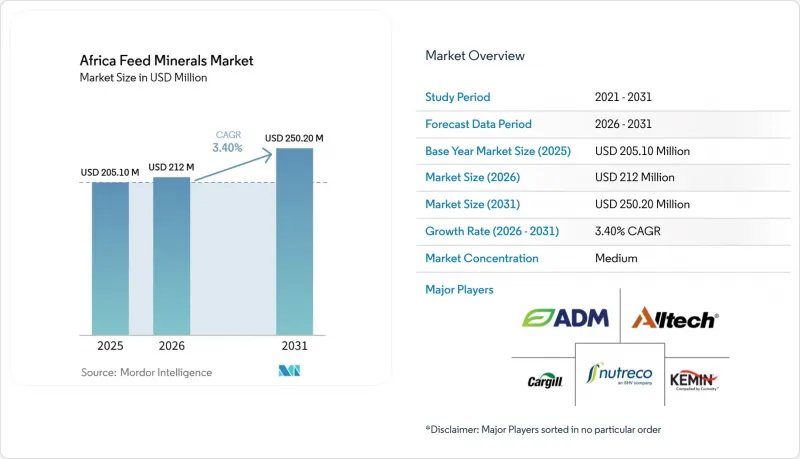
Mordor Intelligence에 의하면, 아프리카의 사료용 미네랄 시장 규모는 2025년 2억 510만 달러로 평가되었고, 2026년 2억 1,200만 달러에서 2031년까지 2억 5,020만 달러로 확대될 것으로 예측되며, 2026-2031년 연평균 복합 성장률(CAGR)은 3.40%를 나타낼 전망입니다.
본 보고서는 첨가제 유형별(주요 미네랄 및 미량 미네랄), 대상 동물별(수산물 양식, 가금류, 반추동물, 돼지, 기타 동물), 지역별(남아프리카, 이집트, 나이지리아, 케냐 및 기타 아프리카 국가)로 분류되어 있습니다. 시장 전망은 금액(달러) 및 수량(미터톤) 단위로 제시되어 있습니다.
아프리카 사료용 미네랄 시장 동향 및 인사이트
아프리카 전역에서 상업용 가금류 및 반추동물사료 수요 증가
『Alltech Agri-Food Outlook 2025』에 따르면, 아프리카에서는 2024년에 40곳의 새로운 사료 공장이 신설되어 시설 총수가 2,228곳에 달했으며, 이는 아프리카 사료용 미네랄 시장의 지속적인 미네랄 조달 기반을 확대했습니다. 동 보고서에 따르면, 2024년 아프리카의 육우용 사료 생산량은 32.2% 증가했으며, 젖소용 사료 출하량은 25.7% 증가했습니다. 이는 반추동물 생산 시스템에서 상업용 사료의 도입이 더욱 진전되고 있음을 보여줍니다. 『OECD-FAO 농업 전망 2025-2034』에서도 향후 10년 동안 가축의 생산성과 생산량이 지속적으로 향상될 것으로 전망되며, 더 높은 효율과 가축 생산성을 추구하는 상업 생산자들에게 있어 균형 잡힌 미네랄 영양의 중요성이 커지고 있습니다. 그 결과, 아프리카의 사료용 미네랄 시장은 가금류 수요에만 의존하는 것이 아니라, 가금류 부문과 반추동물 부문 모두로부터 지지를 얻고 있습니다. 이를 통해 미네랄 공급업체의 고객 기반이 확대되고, 성장이 단일 가축 범주에 집중될 위험이 완화됩니다.
고생산성 농장에서의 정밀 미네랄 영양 확대
아프리카 각지의 상업용 육계 및 젖소 농장에서는 품종별 생산성 목표를 뒷받침하는 영양 프로그램이 점점 더 중요시되고 있으며, 아프리카 사료용 미네랄 시장에서 생체 이용률이 보장된 미네랄 제품에 대한 수요 기회가 창출되고 있습니다. 학술지 『Animals』에 게재된 2025년 메타분석에 따르면, 무기 미량 미네랄을 단백산염계 미량 미네랄로 50%-80% 대체했을 경우, 1마리당 사료 섭취량이 7g 감소하고, 일일 평균 증체량이 1.67g 향상되었으며, 사료 전환율이 4.5% 낮아지고, 구리, 철, 망간, 아연의 배설량이 14%-21% 감소한 것으로 밝혀졌습니다. 이러한 생산성 향상은 특히 상업적 생산 시스템에서 중요한 의미를 지닙니다. 사료용 곡물 가격이 급등하고 있는 상황에서 사료 효율을 높임으로써 킬레이트화 및 프로테인산염화 미네랄 형태의 높은 비용을 상쇄하는 데 도움이 됩니다. 통합형 생산자들이 생산성, 안정성 및 영양소 이용 효율에 주력함에 따라, 아프리카의 사료용 미네랄 시장은 고품질 미량 미네랄 형태에 대해 점점 더 수용적인 태도를 보이고 있으며, 단순한 판매량 증가를 넘어서는 가치 있는 비즈니스 기회가 시사되고 있습니다.
소규모 농가가 주류를 이루는 시장에서 상업용 사료 제조의 보급률이 낮음
아프리카 가축의 상당수는 여전히 상업용 사료 시스템의 범위를 벗어나 사육되고 있으며, 이로 인해 미네랄 기반 영양소에 대한 직접적인 접근이 제한되어 아프리카 사료용 미네랄 시장 규모 확대가 제약을 받고 있습니다. Hatchery FM이 인용한 말라보-몽펠리에 패널의 2025년 수산 양식 및 축산 보고서에 따르면, 사료의 낮은 품질과 상업용 투입재에 대한 물리적 접근 제한이 소규모 농가의 생산성을 저해하는 주요 요인으로 남아 있습니다. Science Africa가 보도한 케냐의 2025년 사료 부문 개혁 발표에서도 사료가 가축 생산 비용의 60%에서 70%를 차지하는 반면, 주요 상업 지역 외부의 생산자들은 제품 품질이 불안정하고 공급 경로가 단절되어 있다는 과제에 여전히 직면해 있다고 지적되었습니다. 소규모 농장에서는 고품질 미네랄 사료를 정기적으로 사용하는 데 필요한 규모나 구매력이 부족한 경우가 많아, 그 결과 대규모 상업 생산 시스템에 대한 수요가 더욱 강해지고 있습니다. 집약화 메커니즘, 협동조합형 사료 모델 및 정책 지원을 통해 더 광범위한 농촌 시장에서 상업용 사료에 대한 접근성이 확대되기 전까지는 아프리카의 사료용 미네랄 시장 성장이 국가 및 축산 부문별로 불균일한 상태를 지속할 가능성이 높습니다.
부문 분석
2025년, 아프리카 사료용 미네랄 시장에서 다량 원소는 58%의 점유율을 차지했으며, 가금류, 반추동물, 수산 양식용 사료의 전체 첨가제 카테고리 중 가장 큰 점유율을 기록했습니다. 칼슘, 인, 마그네슘은 상업용 배합 사료에서 여전히 필수적인 영양 성분이며, 이러한 제품에 대한 수요는 단순한 성능 향상을 위한 선택 사항이라기보다는 사료 생산 전반과 밀접하게 연관되어 있습니다. 남아프리카공화국의 사료 규제 체계에서는 상업용 사료 제품이 표시 및 성분 요건을 준수할 것을 의무화하고 있어, 품질이 검증 가능한 인증된 다량 미네랄 원료에 대한 수요를 뒷받침하고 있습니다. 또한, 솔레보 그룹이 2024년에 포스피아(Phosphia)사와 제휴하여 아프리카 전역에서 인산일칼슘, 인산일이칼슘, 인산이칼슘을 판매하려는 이니셔티브는 아프리카 사료용 미네랄 산업 내 상업적 공급 채널을 강화하기 위한 지속적인 노력을 잘 보여줍니다. 그 결과, 거대 미네랄은 대부분의 시판 사료 배합의 기초가 되는 성분이기 때문에 판매량 증가에 있어 여전히 중심적인 역할을 하고 있습니다.
아프리카 사료용 미네랄 시장에서 2026-2031년 미량 미네랄은 6.8%라는 가장 높은 연평균 성장률(CAGR)을 나타낼 전망입니다. 이는 정규 사료 유통 경로에서 성능 중심의 영양으로의 전환이 점진적으로 진행되고 있음을 반영합니다. 『Animals』지에 게재된 2025년 메타분석에 따르면, 무기 미량 미네랄을 단백산염계 미량 미네랄로 부분적으로 대체한 결과, 구리, 철, 망간, 아연의 배설량이 14%에서 21% 감소하는 동시에 가금류의 생산성이 향상되어, 첨단 미량 미네랄 제품의 가치 제안이 입증되었습니다. 아연, 구리, 망간, 셀레늄은 여전히 주요 상업용 미량 미네랄 범주에 속하며, 특히 토양의 미네랄 결핍이 가축의 건강에 영향을 미치는 지역에서는 셀레늄이 매우 중요합니다. 아프리카 전역에서 수산 양식 생산이 확대되고 상업용 사료 배합이 점점 더 표준화됨에 따라, 일관된 미량 미네랄 조성에 대한 수요는 증가할 것으로 예측됩니다. 이에 따라 기존의 무기염이 저비용 사료 시스템에서 계속해서 주류를 차지하더라도, 미량 미네랄은 아프리카 사료용 미네랄 시장에서 가장 빠르게 성장하는 부문으로 남을 것으로 기대됩니다.
기타 혜택 :
- 엑셀 형식 시장 예측(ME) 시트
- 3개월간의 애널리스트 지원
자주 묻는 질문
목차
제1장 서론
제2장 조사 방법
제3장 주요 요약
제4장 시장 구도
제5장 시장 규모 및 성장 예측
제6장 경쟁 구도
제7장 시장 기회 및 향후 전망
AJYAccording to Mordor Intelligence, the Africa feed minerals market size is projected to expand from USD 205.10 million in 2025 and USD 212 million in 2026 to USD 250.20 million by 2031, registering a CAGR of 3.40% between 2026 and 2031.
This report is Segmented by Sub Additive (Macrominerals and Microminerals), by Animal (Aquaculture, Poultry, Ruminants, Swine, and Other Animals), and by Geography (South Africa, Egypt, Nigeria, Kenya, and the Rest of Africa). The Market Forecasts are Provided in Terms of Value (USD) and Volume (Metric Tons).
Africa Feed Minerals Market Trends and Insights
Rising Commercial Poultry and Ruminant Feed Demand Across Africa
According to the Alltech Agri-Food Outlook 2025, Africa added 40 new feed mills in 2024, bringing the total number of facilities to 2,228 and expanding the recurring procurement base for mineral in the Africa feed minerals market. The same report showed that cattle feed production in Africa increased by 32.2% in 2024, while dairy feed volumes grew by 25.7%, indicating stronger adoption of commercial feed practices within ruminant production systems. The OECD-FAO Agricultural Outlook 2025-2034 also projects continued gains in livestock productivity and output over the coming decade, increasing the importance of balanced mineral nutrition for commercial producers seeking higher efficiency and animal performance. As a result, the Africa feed minerals market is gaining support from both poultry and ruminant sectors rather than depending solely on poultry demand. This broadens the customer base for mineral suppliers and reduces the risk of growth being concentrated in a single livestock category.
Expansion of Precision Mineral Nutrition in High-Performing Farms
Commercial broiler and dairy operations across parts of Africa are increasingly emphasizing nutrition programs that support breed performance targets, creating opportunities for bioavailability-assured mineral products in the Africa feed minerals market. A 2025 meta-analysis published in Animals found that replacing inorganic trace minerals with proteinate trace minerals at 50% to 80% substitution reduced feed intake by 7 g per bird, improved average daily gain by 1.67 g, reduced feed conversion ratio by 4.5%, and lowered copper, iron, manganese, and zinc excretion by 14% to 21%. These performance improvements are particularly relevant in commercial production systems, where better feed efficiency can help offset the higher cost of chelated and proteinate mineral forms when feed grain prices are elevated. As more integrated producers focus on productivity, consistency, and nutrient utilization, the Africa feed minerals market is becoming increasingly receptive to premium trace mineral formats, suggesting a value opportunity beyond simple volume growth.
Limited Penetration of Commercial Feed Milling in Smallholder-Dominated Markets
A large share of Africa's livestock population still operates outside the commercial feed system, limiting direct access to minerals-based nutrition and constraining volume growth in the Africa feed minerals market. According to the Malabo Montpellier Panel's 2025 report on aquaculture and livestock, as cited by Hatchery FM, poor feed quality and limited physical access to commercial inputs remain major constraints on smallholder productivity. Kenya's 2025 feed sector reform announcement, reported by Science Africa, also noted that feed accounts for 60% to 70% of livestock production costs, while producers outside major commercial zones continue to face inconsistent product quality and fragmented supply channels. Smaller farms often lack the scale and purchasing power needed to justify regular use of premium mineral, resulting in stronger demand from larger commercial production systems. Until aggregation mechanisms, cooperative feed models, and policy support expand commercial feed access to wider rural markets, growth in the Africa feed minerals market is likely to remain uneven across countries and livestock sectors.
Other drivers and restraints analyzed in the detailed report include:
- Wider Shift from Bulk Raw Materials to Formulated Feed Inputs
- Rising Demand for Chelated and Organic Trace Minerals in Hot Climate Production Systems
- High Cost Premium of Chelated and Specialty Mineral Products
For complete list of drivers and restraints, kindly check the Table Of Contents.
Segment Analysis
Macrominerals held 58% of the Africa feed minerals market share in 2025, making them the largest sub-additive category across poultry, ruminant, and aquaculture feed. Calcium, phosphorus, and magnesium remain essential nutritional inputs in commercial formulations, and demand for these products is closely linked to overall feed production rather than optional performance enhancements. South Africa's feed regulatory framework requires commercial feed products to comply with labeling and composition requirements, supporting demand for certified macromineral inputs with verifiable quality. In addition, Solevo Group's 2024 partnership with Phosphea to distribute monocalcium phosphate, monodicalcium phosphate, and dicalcium phosphate across Africa highlights ongoing efforts to strengthen commercial supply channels within the Africa feed minerals industry. As a result, macrominerals remain central to volume growth because they constitute a fundamental component of most commercial feed formulations.
Microminerals are projected to register the fastest CAGR of 6.8% during 2026-2031 in the Africa feed minerals market, reflecting the gradual shift toward performance-oriented nutrition in formal feed channels. According to a 2025 meta-analysis published in Animals, partial substitution of inorganic trace minerals with proteinate trace minerals reduced the excretion of copper, iron, manganese, and zinc by 14% to 21% while improving bird performance, supporting the value proposition of advanced trace mineral products. Zinc, copper, manganese, and selenium remain the principal commercial trace mineral categories, with selenium being particularly important in regions where soil mineral deficiencies affect livestock health. As aquaculture production expands and commercial feed formulations become increasingly standardized across Africa, demand for consistent trace mineral profiles is projected to increase. This should enable microminerals to remain the fastest-growing segment of the Africa feed minerals market, even as conventional inorganic salts continue to dominate lower-cost feed systems.
Complete Report Scope:
- By Sub Additive
- Macrominerals
- Microminerals
- By Animal
- Aquaculture
- Fish
- Shrimp
- Other Aquaculture Species
- Poultry
- Broiler
- Layer
- Other Poultry Birds
- Ruminants
- Beef Cattle
- Dairy Cattle
- Other Ruminants
- Swine
- Other Animals
- Aquaculture
- By Country
- South Africa
- Egypt
- Nigeria
- Kenya
- Rest of Africa
List of Companies Covered in this Report:
- Archer Daniels Midland Company
- Alltech, Inc.
- Agri-Vet
- BASF SE
- Bluestone Metals and Chemicals
- Biochem Zusatzstoffe Handels- und Produktionsgesellschaft mbH
- Cargill, Incorporated
- De Heus
- Elanco Animal Health Incorporated
- Kemin Industries, Inc.
- Kimleigh Chemicals SA
- Novus International, Inc.
- SHV Holdings N.V.
- Phibro Animal Health Corporation
- U-MIX
Additional Benefits:
- The market estimate (ME) sheet in Excel format
- 3 months of analyst support
TABLE OF CONTENTS
1 INTRODUCTION
- 1.1 Study Assumptions and Market Definition
- 1.2 Scope of the Study
2 RESEARCH METHODOLOGY
3 EXECUTIVE SUMMARY
4 MARKET LANDSCAPE
- 4.1 Market Overview
- 4.2 Market Drivers
- 4.2.1 Rising Commercial Poultry and Ruminant Feed Demand Across Africa
- 4.2.2 Rapid Expansion of Commercial Feed Mill Infrastructure Across Africa
- 4.2.3 Expansion of Precision Mineral Nutrition in High-Performing Farms
- 4.2.4 Wider Shift from Bulk Raw Materials to Formulated Feed Inputs
- 4.2.5 Rising Demand for Chelated and Organic Trace Minerals in Hot Climate Production Systems
- 4.2.6 Increasing Need for Feed Efficiency Under Volatile Ingredient Costs
- 4.3 Market Restraints
- 4.3.1 Limited Penetration of Commercial Feed Milling in Smallholder-Dominated Markets
- 4.3.2 High Cost Premium of Chelated and Specialty Mineral Products
- 4.3.3 Inconsistent Quality Control and Counterfeit Product Risk in Fragmented Trade Channels
- 4.3.4 Weak Cold Chain and Distribution Infrastructure in Several Inland Markets
- 4.4 Technological Outlook
- 4.5 Regulatory Landscape
- 4.6 Porter's Five Forces Analysis
- 4.6.1 Bargaining Power of Suppliers
- 4.6.2 Bargaining Power of Buyers
- 4.6.3 Threat of New Entrants
- 4.6.4 Threat of Substitutes
- 4.6.5 Intensity of Competitive Rivalry
5 MARKET SIZE AND GROWTH FORECASTS (VALUE AND VOLUME)
- 5.1 By Sub Additive
- 5.1.1 Macrominerals
- 5.1.2 Microminerals
- 5.2 By Animal
- 5.2.1 Aquaculture
- 5.2.1.1 Fish
- 5.2.1.2 Shrimp
- 5.2.1.3 Other Aquaculture Species
- 5.2.2 Poultry
- 5.2.2.1 Broiler
- 5.2.2.2 Layer
- 5.2.2.3 Other Poultry Birds
- 5.2.3 Ruminants
- 5.2.3.1 Beef Cattle
- 5.2.3.2 Dairy Cattle
- 5.2.3.3 Other Ruminants
- 5.2.4 Swine
- 5.2.5 Other Animals
- 5.2.1 Aquaculture
- 5.3 By Country
- 5.3.1 South Africa
- 5.3.2 Egypt
- 5.3.3 Nigeria
- 5.3.4 Kenya
- 5.3.5 Rest of Africa
6 COMPETITIVE LANDSCAPE
- 6.1 Market Concentration
- 6.2 Strategic Moves
- 6.3 Market Share Analysis
- 6.4 Company Profiles (Includes Global Level Overview, Market Level Overview, Core Segments, Financials as Available, Strategic Information, Market Rank/Share, Products and Services, Recent Developments)
- 6.4.1 Archer Daniels Midland Company
- 6.4.2 Alltech, Inc.
- 6.4.3 Agri-Vet
- 6.4.4 BASF SE
- 6.4.5 Bluestone Metals and Chemicals
- 6.4.6 Biochem Zusatzstoffe Handels- und Produktionsgesellschaft mbH
- 6.4.7 Cargill, Incorporated
- 6.4.8 De Heus
- 6.4.9 Elanco Animal Health Incorporated
- 6.4.10 Kemin Industries, Inc.
- 6.4.11 Kimleigh Chemicals SA
- 6.4.12 Novus International, Inc.
- 6.4.13 SHV Holdings N.V.
- 6.4.14 Phibro Animal Health Corporation
- 6.4.15 U-MIX
7 MARKET OPPORTUNITIES AND FUTURE OUTLOOK

(주말 및 공휴일 제외)


