

|
시장보고서
상품코드
2098494
과학 계산용 GPU : 시장 점유율 분석, 업계 동향과 통계, 성장 예측(2026-2031년)Scientific Computing GPU - Market Share Analysis, Industry Trends & Statistics, Growth Forecasts (2026 - 2031) |
||||||
 Mordor Intelligence
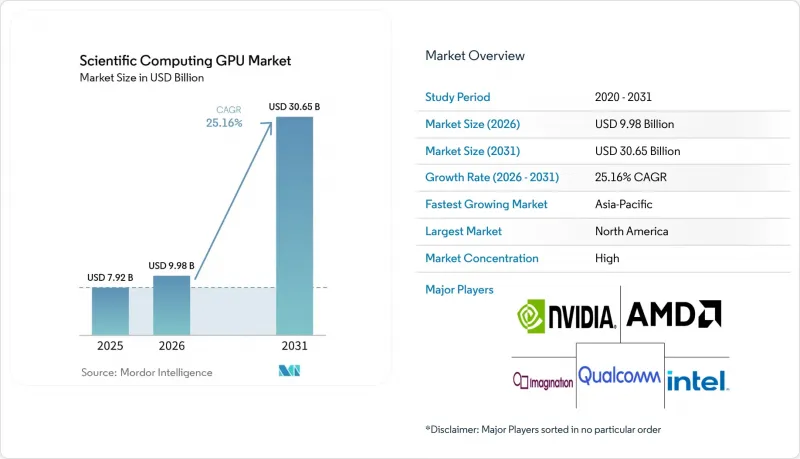
Mordor Intelligence에 의하면, 과학 계산용 GPU 시장 규모는 2025년에 79억 2,000만 달러로 평가되었고, 2026년 99억 8,000만 달러에서 2031년까지 306억 5,000만 달러에 이를 것으로 예측되며, 예측 기간(2026-2031년) CAGR은 25.16%를 나타낼 전망입니다.
본 보고서는 GPU 아키텍처/폼 팩터(디스크리트형 데이터센터 및 HPC용 GPU 등), 도입 형태(On-Premise형 HPC 및 연구 인프라, 퍼블릭 클라우드 등), 용도(양자 시뮬레이션 및 첨단 물리학 연구 등), 최종 사용자(연구 기관 및 학술 기관 등), 지역별로 분류되어 있습니다. 시장 예측은 금액(달러) 기준으로 제시되어 있습니다.
전 세계 과학 계산용 GPU 시장 동향 및 인사이트
GPU 가속을 통한 과학 시뮬레이션 수요 증가
대규모 연구 프로그램은 핵융합, 재료, 에너지, 양자 분야에서 여전히 고정밀 모델링에 의존하고 있기 때문에 GPU 가속 시뮬레이션은 과학 계산용 GPU 시장 수요의 주요 원동력으로 자리 잡고 있습니다. 미국 에너지부는 오크리지 국립연구소의 'Lux' 및 'Discovery' 시스템에 대해 10억 달러가 넘는 민관 공동 투자를 실시할 것이라고 발표했으며, 이는 국가 차원의 프로그램이 어떻게 대규모 구매 주기를 뒷받침하고 있는지를 여실히 보여주고 있습니다. 로렌스 리버모어 국립연구소와 공동 연구진이 실시한 조사에 따르면, GB200 및 GH200 GPU가 주요 유한 요소 커널에서 최대 59%의 성능 향상을 달성하고 에너지 소비를 최대 83%까지 줄인 것으로 나타났습니다. 이로 인해 과학 계산용 GPU 시장에서 보다 신속한 업그레이드의 필요성이 더욱 대두되고 있습니다. 실행 시간 단축을 통해 각 기관은 GPU를 최대 규모의 작업 전용으로 확보하는 대신 더 많은 모델을 실제 운영 환경으로 전환할 수 있게 되므로, 이러한 성능 향상은 매우 중요합니다. 따라서 구매자들은 배정밀도 시뮬레이션과 AI 기반 모델링을 모두 지원할 수 있는 단일 시스템을 원하고 있으며, 이는 과학 계산용 GPU 시장의 신규 조달 시 사양 수립 방식을 변화시키고 있습니다.
AI 주도형 연구 워크로드의 확대
과학 계산용 GPU 시장에서 AI를 많이 사용하는 연구 워크로드는 시뮬레이션 전용 작업보다 빠르게 증가하고 있으므로, 구매자들은 현재 FP64 성능에 더해 AI 처리량도 평가 기준으로 중시하고 있습니다. 리켄(RIKEN)은 신약 개발, 재료 과학, 기후 모델링에 이르는 ‘AI for Science’ 용도를 위해 1,600대의 NVIDIA Blackwell GPU를 도입했습니다. 이는 국립 연구소가 AI와 HPC의 통합 역량을 어떻게 구축하고 있는지를 보여줍니다. 2025년 9월 『Nature Methods』지에 게재된 연구에 따르면, GPU를 활용한 단백질 상동성 검색 가속화를 통해 기존 벤치마크와의 일치도를 유지하면서도 CPU 시스템에 비해 처리 시간을 6분의 1로 단축할 수 있었던 것으로 밝혀졌습니다. NVIDIA는 2026년에 ‘BioNeMo Agent Toolkit’을 출시했으며, 이 플랫폼은 신약 개발 분야에서 다쏘 시스템즈, 캐드런스, 슈뢰딩거 각사의 워크플로우에 통합되어 있습니다. AI가 단순한 분석 단계에 그치지 않고 조사 과정 자체에 통합됨에 따라, 과학 계산용 그래픽 처리 장치(GPU) 시장은 동일한 패브릭 상에서 시뮬레이션, 훈련, 추론을 실행할 수 있는 플랫폼으로 전환되고 있습니다.
과학 계산용 GPU 인프라의 높은 초기 비용
높은 초기 비용은 여전히 과학 계산용 GPU 시장의 도입을 제한하고 있으며, 특히 국립 연구소, 대형 제약 기업 및 최대 규모의 연구 대학 이외의 기관에서는 이러한 경향이 두드러집니다. Supermicro사에 따르면, Vera Rubin NVL4 랙 스케일 유닛은 1,152개의 GPU를 사용하며, 정격 소비 전력은 362 kW에 달할 전망입니다. 이를 통해 전력 공급 및 냉각 시스템의 업그레이드가 칩 자체만큼이나 중요하다는 것을 알 수 있습니다. 남미, 중동 및 아프리카 및 유럽 일부 지역의 소규모 기관들은 이 수준의 밀도를 구현할 예산이나 시설 여유가 부족한 경우가 많아, 이로 인해 과학 계산용 GPU 시장으로의 직접적인 진입이 지연되고 있습니다. 미국 에너지부의 ‘Lux’나 ‘Discovery’ 프로젝트와 같은 민관 협력 프로그램을 통해 일부 구매자에게는 이러한 장벽이 완화되고 있지만, 이러한 모델은 여전히 제한된 국가들에 집중되어 있습니다. 이와 유사한 자금 조달 구조가 더 널리 보급되기 전까지는 계산용 하드웨어와 이를 뒷받침하는 시설의 재구축 모두에 자금을 투입할 수 있는 기관들이 계속해서 성장의 혜택을 누리게 될 것입니다.
부문 분석
2025년, 과학 계산용 GPU 시장에서 디스크리트형 데이터센터 및 HPC용 GPU가 87.32%의 점유율을 차지했으며, 이 카테고리는 생산 및 연구 분야 도입에서 계속해서 중심적인 위치를 차지했습니다. 이러한 위상은 NVIDIA의 H100, GH200, GB200 시스템과 AMD의 MI300X 및 MI355X 플랫폼이 이미 전 세계 HPC 사이트에 도입된 대규모 도입 실적을 반영한 것입니다. 과학 계산용 GPU 시장이 여전히 이 등급을 선호하는 이유는 수년 동안 대부분의 시뮬레이션 코드가 디스크리트 가속기 환경에 최적화되어 왔기 때문이며, 풍부한 소프트웨어 포트폴리오를 보유한 기관의 경우 전환에 시간이 걸리고 비용도 많이 들기 때문입니다. 이러한 도입 기반의 효과는 성숙한 프로그래밍 스택에 의해 더욱 강화되고 있으며, 벤더의 소프트웨어 환경은 주요 연구 사용자에게 워크플로우의 안정성을 뒷받침하는 기반으로서 계속해서 역할을 하고 있습니다.
GPU 기반 이종 가속기는 2031년까지 연평균 성장률(CAGR) 25.96%를 나타낼 것으로 예측되며, 과학 계산용 GPU 시장에서 가장 역동적인 아키텍처 부문으로 자리매김하고 있습니다. 2025년 11월에 계약이 체결된 EuroHPC의 'Alice Recoque' 시스템에서는 코히런트 메모리 설계에 AMD MI430X GPU, AMD Venice 프로세서, SiPearl Rhea2 프로세서가 채택되어, 혼합 아키텍처가 플래그십 시스템의 기본 요건으로 자리 잡고 있음을 보여줍니다. 소형 통합형 특수 가속기 분야는 엣지 기기, 저지연 추론, 혹은 일반적인 데이터 흐름 패턴과 달라 표준 랙의 효율이 저하되는 경우에 여전히 중요하며, 샌디아(Sandia)가 지원한 Cerebras의 ‘Wafer-Scale Engine’에 대한 연구에서는 대상 워크로드에서 Frontier 플랫폼에 비해 초당 분자 역학 타임스텝 수가 179배 향상된 것으로 나타났습니다. 이에 따라 과학 계산용 GPU 시장은 단일 아키텍처 구매 결정에서 벗어나, 시설이 특정 작업을 위해 디스크리트 GPU와 틈새 시장용 가속기를 조합하는 포트폴리오형 접근 방식으로 확대되고 있습니다.
2025년에는 On-Premise형 HPC 및 연구 인프라의 점유율이 46.89%를 차지할 것으로 예상되며, 이는 과학 계산용 GPU 시장에서 시스템, 데이터 및 상호 연결 설계에 대한 직접적인 제어권이 여전히 중요함을 보여줍니다. 국립 연구소, 정부 산하 연구센터 및 주요 대학은 예측 가능한 워크로드를 실행하고, 많은 경우 제한적이거나 기밀성이 높은 데이터를 다루기 때문에 전용 하드웨어를 계속 선호하고 있습니다. 과학 계산용 GPU 시장은 여전히 표준 클라우드 템플릿을 넘어 맞춤형 네트워크, 보안 규칙 및 워크로드 튜닝이 가능한 온사이트 시스템 쪽으로 기울고 있습니다. 반면, 차세대 랙 밀도 증가로 인해 구형 대학 시설에서는 최신 플랫폼을 도입하기 어려워지고 있으며, 이로 인해 호스팅형 및 코로케이션형 모델에 대한 관심이 높아지고 있습니다.
퍼블릭 클라우드는 2031년까지 연평균 성장률(CAGR) 26.13%로 확대될 것으로 예측되며, 이는 과학 계산용 GPU 시장의 도입 형태 중 가장 빠른 성장 속도입니다. AWS는 2026년 6월, P6e-GB200 및 P6e-GB300 UltraServer 모델에 대한 지원을 추가하여, 연구 사용자들이 매니지드 서비스를 통해 단일 NVLink 도메인 내에서 최대 72개의 NVIDIA Blackwell GPU를 활용할 수 있게 되었습니다. 또한 NVIDIA는 주요 클라우드 제공업체들이 2026년 하반기에 Vera Rubin 기반 인스턴스를 가장 먼저 도입할 예정이라고 밝혔습니다. 이를 통해 최신 시스템을 직접 구매할 수 없는 기관에도 고도의 처리 능력이 제공될 것입니다. 따라서 하이브리드 및 멀티 클라우드 활용은 실용적인 리스크 관리 모델로 자리 잡고 있으며, 구매자는 워크로드를 내부 클러스터와 외부 리소스로 분산함으로써 지연을 줄이고 프로젝트를 원활하게 진행할 수 있게 되었습니다.
지역별 분석
2025년, 북미는 과학 계산용 GPU 시장 점유율의 48.23%를 차지하며 해당 지역의 압도적인 선두 위치를 유지했습니다. 미국 에너지부의 아르곤 및 오크리지 조달을 통해 Solstice, Lux, Discovery를 통해 공공 부문의 대규모 수요 기반이 형성되었습니다. 제약 업계의 투자도 두 번째 수요원이 되었으며, 일라이 릴리(Eli Lilly)와 로슈(Roche)는 모두 2026년 초에 대규모 GPU 프로그램을 확대했습니다. 연방 정부의 과학 관련 지출, 대학의 연구 역량, 그리고 상업적 의약품 개발이 결합되어 북미는 과학 계산용 GPU 시장의 중심적 지위를 유지하고 있습니다.
유럽은 2025년에도 2위 지역을 유지할 전망이며, 이 지역의 과학 계산용 GPU 시장은 EuroHPC 공동 사업(EuroHPC Joint Undertaking)을 통한 협력적 조달로 형성되고 있습니다. 약 2만 4,000개의 NVIDIA GH200 Grace Hopper 슈퍼칩을 탑재한 ‘JUPITER’는 2025년 6월 TOP500 목록에서 4위를 차지하며 유럽 최초의 엑사스케일급 시스템이 되었습니다. 'Alice Recoque' 계약은 AMD製 GPU와 SiPearl 프로세서를 결합함으로써 두 번째 중요한 발걸음을 내디뎠습니다. 이는 강력한 현지 시스템 참여를 유지하면서 공급 옵션을 확대하려는 유럽의 노력을 반영한 것입니다. 영국의 국가 슈퍼컴퓨터에 대한 7억 5,000만 파운드(9억 4,500만 달러) 투자 및 'SEANERGYS' 프로그램과 같은 자금 조달 약속은 지역 계획에서 성능과 에너지 효율이 모두 발전하고 있음을 보여줍니다.
아시아태평양은 2031년까지 연평균 성장률(CAGR) 26.09%로 확대될 것으로 예측되며, 과학 계산용 GPU 시장에서 가장 빠르게 성장하는 지역 블록이 될 전망입니다. 일본에서는 리켄(RIKEN)이 새로운 ‘AI for Science’ 및 양자 시스템에 2,140대의 NVIDIA Blackwell GPU를 도입함으로써 이러한 성장을 주도하고 있는 반면, ‘후가쿠 NEXT’는 향후 성능의 비약적인 향상을 위해 현재도 공동 설계가 진행 중입니다. 중국은 수출 규제 하에서 다른 길을 걷고 있으며, 선전에 위치한 국가 슈퍼컴퓨팅 센터는 GPU 가속기를 사용하지 않고, 국내 화웨이(Huawei) LX2 프로세서를 기반으로 한 2 엑사플롭스급 ‘LineShine’ 시스템을 발표했습니다. 이러한 접근 방식은 아시아태평양의 과학 계산용 그래픽 처리 장치(GPU) 시장이 일본에서 볼 수 있는 개방적인 세계 조달과 중국에서 볼 수 있는 국산 대체 프로그램 사이에서 양극화되고 있음을 보여줍니다. 남미, 중동 및 아프리카 및 아시아태평양의 소규모 시장에서는 현지 엑사스케일 인프라보다 클라우드 접근에 대한 의존도가 더 높으며, 도입은 진행되고 있으나 주요 지역과는 다른 규모로 진행되고 있습니다.
기타 혜택:
- 엑셀 형식 시장 예측(ME) 시트
- 3개월간의 애널리스트 지원
자주 묻는 질문
목차
제1장 서론
제2장 조사 방법
제3장 주요 요약
제4장 시장 구도
제5장 시장 규모와 성장 예측
제6장 경쟁 구도
제7장 시장 기회와 향후 전망
KTH 26.08.06According to Mordor Intelligence, the scientific computing GPU market size was valued at USD 7.92 billion in 2025 and estimated to grow from USD 9.98 billion in 2026 to reach USD 30.65 billion by 2031, at a CAGR of 25.16% during the forecast period (2026-2031).
This report is Segmented by GPU Architecture/Form Factor (Discrete Data Center and HPC GPUs, and More), Deployment Mode (On-Premises HPC and Research Infrastructure, Public Cloud, and More), Application (Quantum Simulation and Advanced Physics Research, and More), End-User (Research Institutions and Academia, and More), and Geography. The Market Forecasts are Provided in Terms of Value (USD).
Global Scientific Computing GPU Market Trends and Insights
Rising Demand for GPU-Accelerated Scientific Simulation
GPU-accelerated simulation remains the main engine of demand in the scientific computing GPU market because large research programs still depend on high-precision modeling in fusion, materials, energy, and quantum work. The US Department of Energy announced more than USD 1 billion in public-private investment for the Lux and Discovery systems at Oak Ridge National Laboratory, underscoring how national programs are anchoring large purchase cycles. Research from Lawrence Livermore National Laboratory and collaborators showed that GB200 and GH200 GPUs delivered up to 59% performance gains on key finite element kernels and reduced energy use by up to 83%, strengthening the case for faster upgrades in the scientific computing GPU market. These gains matter because shorter run times let institutions move more models into production use instead of reserving GPUs for only the largest jobs. Buyers, therefore, want a single system that can support both double-precision simulation and AI-assisted modeling, which is changing how the scientific computing GPU market is specified in new procurements.
Growth in AI-Driven Research Workloads
AI-heavy research workloads are growing faster than simulation-only jobs inside the scientific computing GPU market, so buyers are now weighing AI throughput alongside FP64 performance. RIKEN deployed 1,600 NVIDIA Blackwell GPUs for AI-for-science applications spanning drug discovery, materials science, and climate modeling, which shows how national labs are building combined AI and HPC capacity. A September 2025 study in Nature Methods found that GPU-accelerated protein homology search reduced processing time by 6x compared to CPU systems while maintaining agreement with established benchmarks. NVIDIA launched the BioNeMo Agent Toolkit in 2026, and the platform is integrated into the workflows of Dassault Systemes, Cadence, and Schrodinger for drug discovery. As AI moves into the research loop rather than remaining at the analysis stage, the scientific computing graphics processing unit (GPU) market is shifting toward platforms that can run simulation, training, and inference on the same fabric.
High Upfront Cost of Scientific Computing GPU Infrastructure
High upfront cost still limits adoption in the scientific computing GPU market, especially outside national labs, top pharmaceutical companies, and the largest research universities. Supermicro said a Vera Rubin NVL4 rack-scale unit uses 1,152 GPUs and is rated at 362 kW, which shows that power and cooling upgrades are often as important as the chips themselves. Smaller institutions in South America, the Middle East, Africa, and parts of Europe often lack the budget or facility headroom for this level of density, which slows direct participation in the scientific computing GPU market. Public-private programs such as the US Department of Energy's Lux and Discovery projects are easing this barrier for some buyers, but these models remain concentrated in a limited number of countries. Until similar financing structures spread more widely, growth will continue to favor institutions that can fund both compute hardware and the supporting facility rebuild.
Other drivers and restraints analyzed in the detailed report include:
- Expanding Use of Cloud-Based GPU Access for Research Institutions
- Increasing Adoption of Multi-GPU and Heterogeneous Compute Clusters
- Advanced Packaging and HBM Supply Concentration
For complete list of drivers and restraints, kindly check the Table Of Contents.
Segment Analysis
Discrete Data Center and HPC GPUs held 87.32% of the scientific computing GPU market share in 2025, which kept this category at the center of production research deployments. This position reflects the large installed base of NVIDIA H100, GH200, and GB200 systems, as well as AMD MI300X and MI355X platforms already embedded in global HPC sites. The scientific computing GPU market still favors this class because most simulation codes have been tuned for discrete-accelerator environments for many years, making migration slow and expensive for institutions with deep software portfolios. That installed base effect is reinforced by mature programming stacks, where vendor software environments continue to anchor workflow stability for major research users.
GPU-Based Heterogeneous Accelerators are projected to grow at a 25.96% CAGR through 2031, which makes them the most dynamic architecture segment in the scientific computing GPU market. EuroHPC's Alice Recoque system, contracted in November 2025, specified AMD MI430X GPUs, AMD Venice processors, and SiPearl Rhea2 processors in a coherent-memory design, demonstrating that mixed architectures are becoming a baseline requirement in flagship systems. The smaller, integrated, and specialized accelerator segments remain relevant when edge instruments, low-latency inference, or unusual dataflow patterns make standard racks less efficient, and Sandia-backed research on the Cerebras Wafer-Scale Engine showed a 179-fold improvement in molecular dynamics timesteps per second compared with the Frontier platform for a targeted workload. This is widening the scientific computing GPU market from a single-architecture purchase decision into a portfolio approach, where facilities combine discrete GPUs with niche accelerators for specific tasks.
On-Premises HPC and Research Infrastructure held a 46.89% share in 2025, indicating that direct control over systems, data, and interconnect design still matters in the scientific computing GPU market. National laboratories, government research centers, and major universities continue to prefer dedicated hardware because they run predictable workloads and often handle restricted or sensitive data. The scientific computing GPU market still leans toward on-site systems where customized networking, security rules, and workload tuning go beyond standard cloud templates. At the same time, next-generation rack densities are making it harder for older university facilities to host the newest platforms, which is raising interest in hosted and colocation models.
Public Cloud is projected to expand at a 26.13% CAGR through 2031, the fastest pace across deployment modes in the scientific computing GPU market. AWS added support for P6e-GB200 and P6e-GB300 UltraServer models in June 2026, giving research users access to up to 72 NVIDIA Blackwell GPUs in a single NVLink domain via a managed service. NVIDIA also said major cloud providers will be among the first to deploy Vera Rubin-based instances in the second half of 2026, which extends advanced capacity to institutions that cannot buy the newest systems outright. Hybrid and multi-cloud use is therefore becoming a practical risk-control model, with buyers splitting workloads between internal clusters and outside capacity to reduce delays and keep projects moving.
Complete Report Scope:
- By GPU Architecture / Form Factor
- Discrete Data Center and HPC GPUs
- Integrated and SoC GPUs
- GPU-Based Heterogeneous Accelerators
- Other Specialized Scientific Computing GPUs
- By Deployment Mode
- On-Premises HPC and Research Infrastructure
- Public Cloud
- Hosted / Colocation HPC Infrastructure
- Edge and On-Instrument Deployment
- Hybrid and Multi-Cloud Deployment
- By Application
- Numerical Simulation and Computational Modeling
- AI and Machine Learning for Scientific Discovery
- High-Performance Data Analytics and Scientific Visualization
- Life Sciences and Bioinformatics Computing
- Quantum Simulation and Advanced Physics Research
- Other Scientific Computing Applications
- By End-User
- Research Institutions and Academia
- Government Laboratories and National Research Centers
- Defense, Aerospace, and Space Organizations
- Healthcare, Pharmaceutical, and Life Sciences
- Manufacturing and Industrial R&D
- Information Technology, Cloud Service Providers, and Telecommunications
- Financial Services and Quantitative Research
- Other End-Users
- By Geography
- North America
- United States
- Canada
- Mexico
- Europe
- Germany
- United Kingdom
- France
- Italy
- Rest of Europe
- Asia-Pacific
- China
- Japan
- South Korea
- India
- Southeast Asia
- Rest of Asia-Pacific
- South America
- Middle East and Africa
- North America
Geography Analysis
North America held 48.23% of the scientific computing GPU market share in 2025, maintaining the region's clear lead. US Department of Energy procurements at Argonne and Oak Ridge created a large public-sector demand anchor through Solstice, Lux, and Discovery. Pharmaceutical investment added a second stream, with Eli Lilly and Roche both scaling sizable GPU programs in early 2026. This combination of federal science spending, university research capacity, and commercial drug development keeps North America at the center of the scientific computing GPU market.
Europe remained the second-largest region in 2025, and the scientific computing GPU market there is being shaped by coordinated procurement under the EuroHPC Joint Undertaking. JUPITER, equipped with around 24,000 NVIDIA GH200 Grace Hopper Superchips, ranked 4th on the June 2025 TOP500 list and became Europe's first exascale-class system. The Alice Recoque contract added a second major step by combining AMD GPUs with SiPearl processors, reflecting Europe's effort to broaden supply options while maintaining strong local system participation. Funding commitments, such as the UK's GBP 750 million (USD 945 million) investment in a national supercomputer and the SEANERGYS program, show that performance and energy efficiency are advancing together in regional planning.
Asia-Pacific is projected to expand at a 26.09% CAGR through 2031, making it the fastest-growing regional block in the scientific computing GPU market. Japan is driving this growth through RIKEN's deployment of 2,140 NVIDIA Blackwell GPUs across new AI-for-science and quantum systems, while FugakuNEXT remains under joint design for a later step-change in performance. China is following a different path under export controls, and the National Supercomputing Center in Shenzhen announced the 2 exaflops LineShine system built on domestic Huawei LX2 processors without GPU accelerators. These approaches show that the scientific computing graphics processing unit (GPU) market in Asia-Pacific is splitting between open global procurement, as seen in Japan, and sovereign substitution programs, as seen in China. South America, the Middle East, and Africa, and smaller Asia-Pacific markets, remain more dependent on cloud access than on local exascale infrastructure, which keeps adoption moving but at a different scale than in the leading regions.
- NVIDIA Corporation
- Advanced Micro Devices, Inc.
- Intel Corporation
- Qualcomm Incorporated
- Imagination Technologies Limited
- Arm Limited
- Matrox Electronic Systems Ltd.
- ASPEED Technology Inc.
- Biren Technology (Hong Kong) Co., Limited
- Moore Threads Intelligent Technology (Beijing) Co., Ltd.
- Shanghai Jingjia Microelectronics Co., Ltd.
- Innosilicon Technology (Shenzhen) Co., Ltd.
- VeriSilicon Microelectronics (Shanghai) Co., Ltd.
- Graphcore Limited
- Tenstorrent Inc.
- Cerebras Systems, Inc.
- SambaNova Systems, Inc.
- d-Matrix, Inc.
- SiPearl SAS
- Peak Energy, Inc.
Additional Benefits:
- The market estimate (ME) sheet in Excel format
- 3 months of analyst support
TABLE OF CONTENTS
1 INTRODUCTION
- 1.1 Study Assumptions and Market Definition
- 1.2 Scope of the Study
2 RESEARCH METHODOLOGY
3 EXECUTIVE SUMMARY
4 MARKET LANDSCAPE
- 4.1 Market Overview
- 4.2 Market Drivers
- 4.2.1 Rising Demand for GPU-Accelerated Scientific Simulation
- 4.2.2 Growth in AI-Driven Research Workloads
- 4.2.3 Expanding Use of Cloud-Based GPU Access for Research Institutions
- 4.2.4 Increasing Adoption of Multi-GPU and Heterogeneous Compute Clusters
- 4.2.5 Export-Control-Led Reconfiguration of High-End Compute Supply Chains
- 4.2.6 Power-Efficiency Pressure in National Supercomputing Programs
- 4.3 Market Restraints
- 4.3.1 High Upfront Cost of Scientific Computing GPU Infrastructure
- 4.3.2 Advanced Packaging and HBM Supply Concentration
- 4.3.3 Cooling, Power Delivery, and Rack Density Constraints
- 4.3.4 Software Portability and Kernel Optimization Friction Across GPU Architectures
- 4.4 Impact of Macroeconomic Factors on the Market
- 4.5 Industry Value Chain Analysis
- 4.6 Regulatory Landscape
- 4.7 Technological Outlook
- 4.8 Porter's Five Forces Analysis
- 4.8.1 Threat of New Entrants
- 4.8.2 Bargaining Power of Suppliers
- 4.8.3 Bargaining Power of Buyers
- 4.8.4 Threat of Substitutes
- 4.8.5 Intensity of Competitive Rivalry
5 MARKET SIZE AND GROWTH FORECASTS (VALUE)
- 5.1 By GPU Architecture / Form Factor
- 5.1.1 Discrete Data Center and HPC GPUs
- 5.1.2 Integrated and SoC GPUs
- 5.1.3 GPU-Based Heterogeneous Accelerators
- 5.1.4 Other Specialized Scientific Computing GPUs
- 5.2 By Deployment Mode
- 5.2.1 On-Premises HPC and Research Infrastructure
- 5.2.2 Public Cloud
- 5.2.3 Hosted / Colocation HPC Infrastructure
- 5.2.4 Edge and On-Instrument Deployment
- 5.2.5 Hybrid and Multi-Cloud Deployment
- 5.3 By Application
- 5.3.1 Numerical Simulation and Computational Modeling
- 5.3.2 AI and Machine Learning for Scientific Discovery
- 5.3.3 High-Performance Data Analytics and Scientific Visualization
- 5.3.4 Life Sciences and Bioinformatics Computing
- 5.3.5 Quantum Simulation and Advanced Physics Research
- 5.3.6 Other Scientific Computing Applications
- 5.4 By End-User
- 5.4.1 Research Institutions and Academia
- 5.4.2 Government Laboratories and National Research Centers
- 5.4.3 Defense, Aerospace, and Space Organizations
- 5.4.4 Healthcare, Pharmaceutical, and Life Sciences
- 5.4.5 Manufacturing and Industrial R&D
- 5.4.6 Information Technology, Cloud Service Providers, and Telecommunications
- 5.4.7 Financial Services and Quantitative Research
- 5.4.8 Other End-Users
- 5.5 By Geography
- 5.5.1 North America
- 5.5.1.1 United States
- 5.5.1.2 Canada
- 5.5.1.3 Mexico
- 5.5.2 Europe
- 5.5.2.1 Germany
- 5.5.2.2 United Kingdom
- 5.5.2.3 France
- 5.5.2.4 Italy
- 5.5.2.5 Rest of Europe
- 5.5.3 Asia-Pacific
- 5.5.3.1 China
- 5.5.3.2 Japan
- 5.5.3.3 South Korea
- 5.5.3.4 India
- 5.5.3.5 Southeast Asia
- 5.5.3.6 Rest of Asia-Pacific
- 5.5.4 South America
- 5.5.5 Middle East and Africa
- 5.5.1 North America
6 COMPETITIVE LANDSCAPE
- 6.1 Market Concentration
- 6.2 Strategic Moves
- 6.3 Market Positioning Analysis
- 6.4 Company Profiles (includes Global Level Overview, Market Level Overview, Core Segments, Financials as available, Strategic Information, Market Rank/Share, Products and Services, Recent Developments)
- 6.4.1 NVIDIA Corporation
- 6.4.2 Advanced Micro Devices, Inc.
- 6.4.3 Intel Corporation
- 6.4.4 Qualcomm Incorporated
- 6.4.5 Imagination Technologies Limited
- 6.4.6 Arm Limited
- 6.4.7 Matrox Electronic Systems Ltd.
- 6.4.8 ASPEED Technology Inc.
- 6.4.9 Biren Technology (Hong Kong) Co., Limited
- 6.4.10 Moore Threads Intelligent Technology (Beijing) Co., Ltd.
- 6.4.11 Shanghai Jingjia Microelectronics Co., Ltd.
- 6.4.12 Innosilicon Technology (Shenzhen) Co., Ltd.
- 6.4.13 VeriSilicon Microelectronics (Shanghai) Co., Ltd.
- 6.4.14 Graphcore Limited
- 6.4.15 Tenstorrent Inc.
- 6.4.16 Cerebras Systems, Inc.
- 6.4.17 SambaNova Systems, Inc.
- 6.4.18 d-Matrix, Inc.
- 6.4.19 SiPearl SAS
- 6.4.20 Peak Energy, Inc.
7 MARKET OPPORTUNITIES AND FUTURE OUTLOOK
- 7.1 White-Space and Unmet-Need Assessment


