

|
시장보고서
상품코드
2098505
LLM 및 기반 모델 보안 시장 : 점유율 분석, 업계 동향 및 통계, 성장 예측(2026-2031년)LLM and Foundation Model Security - Market Share Analysis, Industry Trends & Statistics, Growth Forecasts (2026 - 2031) |
||||||
 Mordor Intelligence
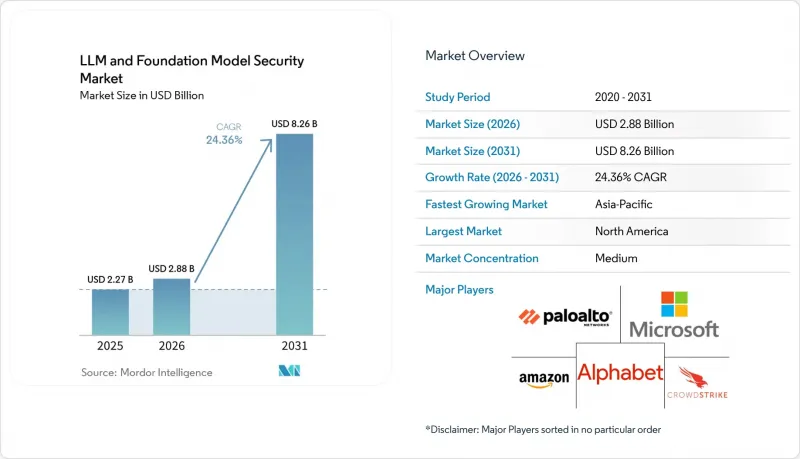
Mordor Intelligence에 의하면, LLM 및 기반 모델 보안 시장 규모는 2025년 22억 7,000만 달러에서 2026년에는 28억 8,000만 달러로 확대되어 2031년까지 82억 6,000만 달러에 이를 것으로 예상되고 있어 2026년부터 2031년까지 CAGR 23.5%로 성장할 전망입니다.
본 보고서는 구성 요소(솔루션 및 서비스), 보안 유형(모델 보안, 데이터 보안, 용도 보안 등), 배포 방식(클라우드, On-Premise, 하이브리드), 기업 규모(대기업 및 중소기업), 최종 사용 산업(BFSI 등), 지역별로 분류되어 있습니다. 시장 전망은 금액(달러) 기준으로 제시됩니다.
세계 LLM 및 기반 모델 보안 시장 동향과 인사이트
프롬프트 주입 및 데이터 유출에 대한 기업의 위험 증가
LLM 및 기반 모델 보안 시장은 프롬프트 주입이 더 이상 이론상의 문제가 아니게 됨에 따라 급속히 확대되고 있습니다. OWASP는 간접적인 프롬프트 주입을 'LLM01:2025'로 분류하며, 프로덕션 시스템에서 그 중요성이 점점 더 커지고 있음을 시사하고 있습니다. 마이크로소프트는 Microsoft 365 Copilot에 대한 제로클릭 공격 경로로 ‘EchoLeak’을 보고하며, 공격자가 사용자의 직접적인 조작 없이도 기업용 어시스턴트를 표적으로 삼을 수 있음을 입증했습니다. 또한, 클라우드 보안 연합(CSA)의 조사에 따르면, 많은 프롬프트웨어 관련 사고는 여러 공격 단계에 걸쳐 발생하며, 모델 악용은 더 이상 고립된 프롬프트가 아니라 보다 광범위한 다단계 보안 캠페인과 유사하다는 것이 밝혀졌습니다. 그 결과, LLM 및 기반 모델 보안 시장에서는 모델 및 용도 계층과 긴밀하게 연동될 수 있는 프롬프트 검사, 런타임 가드레일, 출력 검증에 대한 수요가 증가하고 있습니다.
모델 거버넌스 및 AI 위험 관리에 대한 규제 당국의 감시가 가속화되고 있습니다.
LLM 및 기반 모델 보안 시장은 임의적인 AI 거버넌스에서 공식적인 관리 프레임워크로의 광범위한 전환에 의해서도 뒷받침되고 있습니다. NIST의 AI 지침은 운영 환경에서 AI 위험을 매핑, 측정, 관리 및 거버넌스하기 위한 실용적인 프레임워크를 기업에 제공합니다. 의료 분야에서는 적응형 AI 기기에 대한 FDA 지침과 HHS의 HIPAA 보안 규정 변경으로 인해, AI 특유의 모니터링 및 제어 요구 사항이 적극적인 규정 준수 업무 흐름에 통합되었습니다. 이에 따라 조달 동향도 변화하고 있습니다. 구매자들은 단순한 경보뿐만 아니라 기록, 정책 준수 증거, 워크플로우 제어 및 감사 추적을 생성할 수 있는 보안 도구를 요구하게 되었기 때문입니다. 따라서 조직이 정기 감사나 공급업체 심사 프로세스에 AI 모니터링 기능을 통합함에 따라, LLM 및 기반 모델 보안 시장은 GRC 주도형 도입에서 지속적인 수요를 확보해 나가고 있습니다.
LLM 보안 엔지니어링 인력 부족
LLM 및 기반 모델 보안 시장에서는 여전히 뚜렷한 인력 부족에 직면해 있으며, 이로 인해 도입의 품질과 속도가 저하되고 있습니다. AI 보안 업무에는 모델 이해, 레드팀 기법, 용도 보안, 프롬프트 행동 분석과 같은 다양한 기술이 요구되지만, 2026년이 되어도 이러한 복합적인 기술을 갖춘 인재를 찾는 것은 여전히 어렵습니다. 금융 서비스 업계를 대상으로 한 IIF-EY의 조사에 따르면, 많은 금융 기관에게 AI 모니터링과 거버넌스는 여전히 어려운 과제이며, 벤더의 주장을 검증하거나 철저한 보증 프로그램을 시행하기 위한 사내 자원이 제한적임을 시사하고 있습니다. 이 때문에 많은 구매자는 벤더 주도의 도입이나 관리형 지원을 선택할 수밖에 없으며, 그 결과 배포 일정이 장기화되고 사내에서 구축할 수 있는 관리 체제가 약화될 가능성이 있습니다. 따라서 LLM 및 기반 모델 보안 시장은 수요와 함께 성장하고 있지만, 모든 구매자가 동일한 속도로 도구를 운영에 적용할 수 있는 것은 아닙니다.
부문 분석
2025년에는 솔루션이 매출의 61.3%를 차지하며, LLM 및 기반 모델 보안 시장에서 가장 큰 구성 요소가 되었습니다. 구매 기업들은 대체로 플랫폼을 선호하는데, 이는 구독형 소프트웨어가 컨설팅을 많이 활용하는 계약보다 모델 팀 간 표준화를 더 쉽게 할 수 있기 때문입니다. 실제 가동 중인 AI의 경우 입력, 출력 및 모델의 동작에 대한 적극적인 점검이 필요하기 때문에 프롬프트 보안 도구와 모델 모니터링이 도입 계획의 최우선 과제가 되고 있습니다. 또한, 많은 엔터프라이즈 어시스턴트가 사내 컨텐츠 저장소, 문서, 커뮤니케이션 도구에 접근하기 때문에 데이터 유출 방지 및 거버넌스 측면도 중요합니다. 이로 인해 대규모 고객의 LLM 및 기반 모델 보안 시장 구현에서 소프트웨어 플랫폼은 여전히 중심적인 역할을 수행하고 있습니다.
서비스 분야는 2031년까지 연평균 성장률(CAGR) 24.6%를 나타낼 것으로 예측되며, LLM 및 기반 모델 보안 시장에서 가장 빠르게 확대될 구성 요소가 될 전망입니다. 많은 조직이 사내에서 레드팀 활동, 적대적 테스트, AI 사고 대응 역량을 신속하게 구축할 수 없기 때문에 인력 부족이 직접적인 요인으로 작용하고 있습니다. 또한 구매자들이 진화하는 프롬프트, 새로운 에이전트, 그리고 도입 후 정책 조정의 필요성에 대응하기 위해 노력함에 따라, 관리형 모니터링도 탄력을 받고 있습니다. 따라서 이 서비스는 일회성 도입의 부가 기능이라기보다는 소프트웨어 도입의 실질적인 연장선상에 있는 것으로 자리 잡고 있습니다. 이로 인해, 특히 도입 초기부터 운영 지원이 필요한 구매자를 대상으로 LLM 및 기반 모델 보안 업계의 잠재 시장이 확대되고 있습니다.
2025년에는 모델 보안이 28.1%라는 최대 점유율을 차지하며, LLM 및 기반 모델 보안 시장의 중심에 자리 잡았습니다. 미세 조정된 모델, 가중치, 추론 경로는 이제 직접적인 비즈니스 가치를 지니며, 정보 추출이나 변조의 표적이 될 수 있기 때문에 기업들은 이를 최우선 과제로 삼고 있습니다. 데이터 보안과 용도 보안은 컨텍스트 파이프라인 및 프롬프트 인터페이스가 기밀 정보 유출이나 안전하지 않은 상호작용이 빈번히 발생하는 침입 경로가 되고 있기 때문에 여전히 근소한 차이로 그 뒤를 따르고 있습니다. 또한 에이전트형 시스템이 권한, 토큰, 나아가 사용자를 대신해 작업을 수행할 수 있는 능력을 점점 더 부여받고 있기 때문에 ID 및 액세스 보안도 증가 추세를 보이고 있습니다. 이는 LLM 및 기반 모델 보안 시장이 순수한 모델 방어에서 이를 둘러싼 더 광범위한 제어 스택으로 확대되고 있음을 의미합니다.
GRC는 2031년까지 연평균 성장률(CAGR) 24.7%로 확대될 것으로 예측되며, LLM 및 기반 모델 보안 시장에서 가장 빠르게 성장하는 보안 분야가 될 전망입니다. 이러한 성장은 AI 위험 문서화, 통제 조치 할당, 증거 보존, 그리고 내부 검토 및 외부 감사 지원에 대한 수요에 의해 주도되고 있습니다. 2026년에는 의료 관련 규정 및 기업의 AI 거버넌스 프로그램으로 인해 이러한 문서화 수요가 더욱 시급해질 것입니다. 또한 구매자들은 눈에 보이는 사고에 의존하는 순전히 사후 대응적인 범주에 비해 GRC에 대한 지출이 예산 근거가 더 명확하다는 점을 높이 평가했습니다. 이에 따라 AI 활용이 관리된 비즈니스 프로세스로 전환됨에 따라 거버넌스 소프트웨어는 LLM 및 기반 모델 보안 시장에서 지속적인 성장 동력이 될 것입니다.
지역별 분석
2025년, 북미는 LLM 및 기반 모델 보안 시장 점유율의 32.2%를 차지하며 최대 지역 시장이 되었습니다. 이 지역은 규제 대상 금융 기관, 클라우드 AI 인프라, 그리고 성숙한 기업의 보안 예산이 고도로 집중되어 있다는 이점을 가지고 있습니다. 또한, 신제품 및 통합 기능을 통해 이 분야를 적극적으로 주도하고 있는 벤더들의 기반도 견고합니다. NIST의 AI 지침은 해당 지역의 AI 거버넌스 프로그램, 특히 모델 모니터링 및 운영 관리를 위한 체계적인 프레임워크를 필요로 하는 기업들에게 중요한 지침이 되고 있습니다. 마이크로소프트와 CrowdStrike의 제품 출시 동향 또한 LLM 및 기반 모델 보안 시장에서 중앙 집중식 에이전트 및 게이트웨이 제어의 주요 거점이 여전히 북미임을 보여줍니다.
2025년, 유럽은 LLM 및 기반 모델 보안 시장에서 지역별 2위 규모를 자랑하는 시장이 되었습니다. 수요를 견인하고 있는 것은 AI 거버넌스를 단순한 선택적 요소가 아닌 필수적인 운영 규율로 인식하는 조직이 늘어나고 있다는 점입니다. 금융 서비스, 공공 기관 및 기타 규제 대상 부문에서는 정책 제어, 문서화, 공급업체 보증에 초점을 맞춘 구매 활동이 계속해서 활발합니다. 또한, 유럽이 여전히 중요한 시장으로 남아 있는 이유는 해당 지역의 구매자들이 추적 가능성, 거버넌스의 심도, 그리고 보안 통제가 공식적인 심사를 견딜 수 있다는 증거를 중시하는 경향이 있기 때문입니다. 이러한 추세로 인해 LLM 및 기반 모델 보안 시장 전반에서 모델 보호와 거버넌스 워크플로를 연계할 수 있는 플랫폼에 대한 안정적인 수요가 뒷받침되고 있습니다.
아시아태평양은 연평균 성장률(CAGR) 25.2%로 확대될 것으로 예측되며, 2031년까지 LLM 및 기반 모델 보안 시장에서 가장 두드러진 성장을 보일 지역 부문이 될 전망입니다. 이 지역에서는 대규모 기업용 AI 도입에 더해, 중국, 인도, 일본, 한국 등 각국별로 다양한 도입 경로가 나타나고 있습니다. 또한, 공공 부문 및 기업 내 거버넌스 활동도 점차 체계화되고 있으며, 이는 모델, 데이터 및 용도 통제에 대한 수요를 뒷받침하고 있습니다. 아시아태평양의 많은 도입 사례에서 전용 AI 보안 도구의 보급률은 여전히 북미보다 낮기 때문에 LLM 및 기반 모델 보안 시장은 낮은 도입 기반에서 더욱 확대될 여지가 있습니다.
기타 혜택:
- 엑셀 형식 시장 예측(ME) 시트
- 3개월간의 애널리스트 지원
자주 묻는 질문
목차
제1장 서론
제2장 조사 방법
제3장 주요 요약
제4장 시장 구도
제5장 시장 규모와 성장 예측
제6장 경쟁 구도
제7장 시장 기회와 향후 전망
JHS 26.08.07According to Mordor Intelligence, the LLM and Foundation Model Security Market size is expected to increase from USD 2.27 billion in 2025 to USD 2.88 billion in 2026 and reach USD 8.26 billion by 2031, growing at a CAGR of 23.5% over 2026-2031.
This report is Segmented by Component (Solutions, and Services), Security Type (Model Security, Data Security, Application Security, and More), Deployment (Cloud, On-Premises, and Hybrid), Enterprise Size (Large Enterprises, and Small and Medium Enterprises), End-User Industry (BFSI, and More), and Geography. The Market Forecasts are Provided in Terms of Value (USD).
Global LLM and Foundation Model Security Market Trends and Insights
Rising Enterprise Exposure to Prompt Injection and Data Exfiltration
The LLM and Foundation Model Security Market is moving faster because prompt injection is no longer a theoretical issue. OWASP ranked indirect prompt injection as LLM01:2025, indicating its growing centrality in production systems. Microsoft documented EchoLeak as a zero-click attack path against Microsoft 365 Copilot, demonstrating that attackers can target enterprise assistants without requiring direct user action. Cloud Security Alliance research also showed that many promptware incidents span multiple attack stages, indicating that model abuse now resembles broader multi-step security campaigns rather than isolated prompts. As a result, the LLM and Foundation Model Security Market is seeing stronger demand for prompt inspection, runtime guardrails, and output validation that can sit close to the model and the application layer.
Accelerating Regulatory Scrutiny on Model Governance and AI Risk Controls
The LLM and Foundation Model Security Market is also supported by a broader shift away from optional AI governance toward formal control frameworks. NIST AI guidance provides enterprises with a practical framework for mapping, measuring, managing, and governing AI risk in operational settings. In healthcare, the FDA guidance for adaptive AI devices and the HHS HIPAA Security Rule changes have pushed AI-specific monitoring and control needs into active compliance workstreams. This is changing procurement because buyers now want security tools that can produce records, policy evidence, workflow controls, and audit trails, rather than just alerts. The LLM and Foundation Model Security Market is therefore gaining recurring demand from GRC-led deployments as organizations build AI oversight into normal audit and supplier review processes.
Limited Availability of LLM Security Engineering Talent
The LLM and Foundation Model Security Market still faces a clear talent gap that slows deployment quality and speed. AI security work needs a mix of model understanding, red teaming discipline, application security, and prompt behavior analysis, and that mix remains hard to find in 2026. The IIF-EY survey in financial services found that AI oversight and governance remain difficult for many institutions, suggesting limited internal capacity to test vendor claims or run deep assurance programs. This pushes many buyers toward vendor-led implementation and managed support, which can stretch rollout timelines and reduce the amount of control they build internally. The LLM and Foundation Model Security Market therefore grows alongside demand, but not every buyer can operationalize tools at the same pace.
Other drivers and restraints analyzed in the detailed report include:
- Expansion of Multi-Model Enterprise AI Stacks Requiring Centralized Security
- Mainstream Commercialization of Customer-Facing LLM Applications
- Fragmented Threat Taxonomy Slows Standardized Buying Decisions
For complete list of drivers and restraints, kindly check the Table Of Contents.
Segment Analysis
Solutions accounted for 61.3% of revenue in 2025, making them the largest component of the LLM and Foundation Model Security Market. Buyers have generally preferred platforms because subscription software is easier to standardize across model teams than consulting-heavy engagements. Prompt security tools and model monitoring have moved to the front of deployment plans because production AI now needs active checks on inputs, outputs, and model behavior. Data leakage prevention and governance layers also matter because many enterprise assistants touch internal content repositories, documents, and communication tools. This keeps software platforms central to how the LLM and Foundation Model Security Market is being implemented in large accounts.
Services are projected to grow at a 24.6% CAGR through 2031, making them the fastest-expanding component of the LLM and Foundation Model Security Market. The talent shortage is a direct reason, as many organizations cannot build in-house red teaming, adversarial testing, and AI incident response capabilities quickly enough. Managed monitoring is also gaining ground as buyers try to keep pace with evolving prompts, new agents, and post-deployment policy tuning needs. Services are therefore becoming a practical extension of software adoption rather than a one-time implementation add-on. This is expanding the addressable market for the LLM and Foundation Model Security industries, especially among buyers who need operational support from the start.
Model Security held the largest share at 28.1% in 2025, which placed it at the center of the LLM and Foundation Model Security Market. Enterprises are prioritizing it because fine-tuned models, weights, and inference pathways now hold direct business value and can become targets for extraction or manipulation. Data Security and Application Security remain close behind because the context pipeline and the prompt interface are frequent entry points for sensitive information exposure and unsafe interactions. Identity and Access Security is also rising because agentic systems increasingly receive permissions, tokens, and the ability to take actions on behalf of users. This means the LLM and Foundation Model Security Market is broadening from pure model defense into a wider stack of surrounding controls.
GRC is projected to expand at a 24.7% CAGR through 2031, making it the fastest-growing security type in the LLM and Foundation Model Security Market. The growth is being driven by the need to document AI risks, assign controls, preserve evidence, and support internal reviews or external audits. Healthcare rules and enterprise AI governance programs are making those documentation needs more immediate in 2026. Buyers also value GRC spending because it gives a clearer budget case than purely reactive categories that depend on visible incidents. That makes governance software a durable growth layer within the LLM and Foundation Model Security Market as AI use moves into controlled business processes.
Complete Report Scope:
- By Component
- Solutions
- Prompt Security Solutions
- Output Security and Content Moderation
- Model Monitoring and Runtime Protection
- Data Leakage Prevention and Data Governance
- AI Red Teaming and Validation Platforms
- Other Solutions
- Services
- Solutions
- By Security Type
- Model Security
- Data Security
- Application Security
- Identity and Access Security
- Governance, Risk and Compliance (GRC)
- By Deployment
- Cloud
- On-Premises
- Hybrid
- By Enterprise Size
- Large Enterprises
- Small and Medium Enterprises
- By End-user Industry
- BFSI
- Healthcare and Life Sciences
- Information Technology and Telecom
- Retail and E-commerce
- Industrial Manufacturing
- Government and Public Sector
- Other End-user Industries
- By Geography
- North America
- United States
- Canada
- Mexico
- South America
- Brazil
- Argentina
- Rest of South America
- Europe
- Germany
- United Kingdom
- France
- Italy
- Spain
- Russia
- Rest of Europe
- Asia-Pacific
- China
- India
- Japan
- South Korea
- Australia
- Rest of Asia-Pacific
- Middle East and Africa
- Middle East
- Saudi Arabia
- United Arab Emirates
- Rest of Middle East
- Africa
- South Africa
- Nigeria
- Rest of Africa
- Middle East
- North America
Geography Analysis
North America held 32.2% of the LLM and Foundation Model Security Market share in 2025, which made it the largest regional market. The region benefits from a high concentration of regulated financial institutions, cloud AI infrastructure, and mature enterprise security budgets. It also has a strong base of vendors that are actively shaping the category with new products and integrations. NIST AI guidance has become an important anchor for AI governance programs in the region, especially for enterprises that want a structured framework for model oversight and operational controls. Product moves from Microsoft and CrowdStrike also show that North America remains the main launch ground for centralized agent and gateway controls in the LLM and Foundation Model Security Market.
Europe was the second-largest regional market in 2025 within the LLM and Foundation Model Security Market. Demand is being shaped by organizations that increasingly treat AI governance as a required operating discipline rather than a discretionary layer. Financial services, public institutions, and other regulated sectors continue to support buying activity focused on policy controls, documentation, and supplier assurance. Europe also remains important because buyers there tend to place heavy weight on traceability, depth of governance, and evidence that security controls can withstand formal review. That preference supports steady demand for platforms that can connect model protection with governance workflows across the LLM and Foundation Model Security Market.
Asia-Pacific is projected to expand at a 25.2% CAGR, making it the fastest-growing regional segment of the LLM and Foundation Model Security Market through 2031. The region combines large-scale enterprise AI adoption with a wide range of domestic implementation paths across China, India, Japan, and South Korea. Public sector and enterprise governance activity is also becoming more structured, which supports demand for model, data, and application controls. Since dedicated AI security tooling still has lower penetration in many Asia-Pacific deployments than in North America, the LLM and Foundation Model Security Market has more room to expand from a lower installed base.
- Palo Alto Networks, Inc.
- Microsoft Corporation
- Alphabet Inc.
- Amazon.com, Inc.
- IBM Corporation
- Cisco Systems, Inc.
- CrowdStrike Holdings, Inc.
- Check Point Software Technologies Ltd.
- Fortinet, Inc.
- Zscaler, Inc.
- SentinelOne, Inc.
- HiddenLayer
- Darktrace plc
- Trend Micro Incorporated
- Elastic N.V.
- Securonix, Inc.
- Nightfall AI
- Protect AI, Inc.
- Lakera AG
- SplxAI Inc.
Additional Benefits:
- The market estimate (ME) sheet in Excel format
- 3 months of analyst support
TABLE OF CONTENTS
1 INTRODUCTION
- 1.1 Study Assumptions and Market Definition
- 1.2 Scope of the Study
2 RESEARCH METHODOLOGY
3 EXECUTIVE SUMMARY
4 MARKET LANDSCAPE
- 4.1 Market Overview
- 4.2 Market Drivers
- 4.2.1 Rising Enterprise Exposure to Prompt Injection and Data Exfiltration
- 4.2.2 Accelerating Regulatory Scrutiny on Model Governance and AI Risk Controls
- 4.2.3 Expansion of Multi-Model Enterprise AI Stacks Requiring Centralized Security
- 4.2.4 Mainstream Commercialization of Customer-Facing LLM Applications
- 4.2.5 Shift Toward Secure AI Development Lifecycles in Regulated Industries
- 4.2.6 Growing Demand for Runtime Monitoring of Hallucinations and Unsafe Outputs
- 4.3 Market Restraints
- 4.3.1 Limited Availability of LLM Security Engineering Talent
- 4.3.2 Fragmented Threat Taxonomy Slows Standardized Buying Decisions
- 4.3.3 Difficulty Proving ROI Before a Material Security Incident
- 4.3.4 Model Access Constraints and Vendor Black-Box Limitations
- 4.4 Impact of Macroeconomic Factors on the Market
- 4.5 Industry Value-Chain Analysis
- 4.6 Regulatory Landscape
- 4.7 Technological Outlook
- 4.8 Porter's Five Forces Analysis
- 4.8.1 Bargaining Power of Buyers
- 4.8.2 Bargaining Power of Suppliers
- 4.8.3 Threat of New Entrants
- 4.8.4 Threat of Substitutes
- 4.8.5 Intensity of Competitive Rivalry
5 MARKET SIZE AND GROWTH FORECASTS (VALUE)
- 5.1 By Component
- 5.1.1 Solutions
- 5.1.1.1 Prompt Security Solutions
- 5.1.1.2 Output Security and Content Moderation
- 5.1.1.3 Model Monitoring and Runtime Protection
- 5.1.1.4 Data Leakage Prevention and Data Governance
- 5.1.1.5 AI Red Teaming and Validation Platforms
- 5.1.1.6 Other Solutions
- 5.1.2 Services
- 5.1.1 Solutions
- 5.2 By Security Type
- 5.2.1 Model Security
- 5.2.2 Data Security
- 5.2.3 Application Security
- 5.2.4 Identity and Access Security
- 5.2.5 Governance, Risk and Compliance (GRC)
- 5.3 By Deployment
- 5.3.1 Cloud
- 5.3.2 On-Premises
- 5.3.3 Hybrid
- 5.4 By Enterprise Size
- 5.4.1 Large Enterprises
- 5.4.2 Small and Medium Enterprises
- 5.5 By End-user Industry
- 5.5.1 BFSI
- 5.5.2 Healthcare and Life Sciences
- 5.5.3 Information Technology and Telecom
- 5.5.4 Retail and E-commerce
- 5.5.5 Industrial Manufacturing
- 5.5.6 Government and Public Sector
- 5.5.7 Other End-user Industries
- 5.6 By Geography
- 5.6.1 North America
- 5.6.1.1 United States
- 5.6.1.2 Canada
- 5.6.1.3 Mexico
- 5.6.2 South America
- 5.6.2.1 Brazil
- 5.6.2.2 Argentina
- 5.6.2.3 Rest of South America
- 5.6.3 Europe
- 5.6.3.1 Germany
- 5.6.3.2 United Kingdom
- 5.6.3.3 France
- 5.6.3.4 Italy
- 5.6.3.5 Spain
- 5.6.3.6 Russia
- 5.6.3.7 Rest of Europe
- 5.6.4 Asia-Pacific
- 5.6.4.1 China
- 5.6.4.2 India
- 5.6.4.3 Japan
- 5.6.4.4 South Korea
- 5.6.4.5 Australia
- 5.6.4.6 Rest of Asia-Pacific
- 5.6.5 Middle East and Africa
- 5.6.5.1 Middle East
- 5.6.5.1.1 Saudi Arabia
- 5.6.5.1.2 United Arab Emirates
- 5.6.5.1.3 Rest of Middle East
- 5.6.5.2 Africa
- 5.6.5.2.1 South Africa
- 5.6.5.2.2 Nigeria
- 5.6.5.2.3 Rest of Africa
- 5.6.5.1 Middle East
- 5.6.1 North America
6 COMPETITIVE LANDSCAPE
- 6.1 Market Concentration
- 6.2 Strategic Moves
- 6.3 Market Share Analysis
- 6.4 Company Profiles (includes Global Level Overview, Market Level Overview, Core Segments, Financials as available, Strategic Information, Market Rank/Share, Products and Services, Recent Developments)
- 6.4.1 Palo Alto Networks, Inc.
- 6.4.2 Microsoft Corporation
- 6.4.3 Alphabet Inc.
- 6.4.4 Amazon.com, Inc.
- 6.4.5 IBM Corporation
- 6.4.6 Cisco Systems, Inc.
- 6.4.7 CrowdStrike Holdings, Inc.
- 6.4.8 Check Point Software Technologies Ltd.
- 6.4.9 Fortinet, Inc.
- 6.4.10 Zscaler, Inc.
- 6.4.11 SentinelOne, Inc.
- 6.4.12 HiddenLayer
- 6.4.13 Darktrace plc
- 6.4.14 Trend Micro Incorporated
- 6.4.15 Elastic N.V.
- 6.4.16 Securonix, Inc.
- 6.4.17 Nightfall AI
- 6.4.18 Protect AI, Inc.
- 6.4.19 Lakera AG
- 6.4.20 SplxAI Inc.
7 MARKET OPPORTUNITIES AND FUTURE OUTLOOK
- 7.1 White-Space and Unmet-Need Assessment


