

|
시장보고서
상품코드
2098506
IT-OT 컨버전스 보안 시장 : 점유율 분석, 업계 동향 및 통계, 성장 예측(2026-2031년)IT-OT Convergence Security - Market Share Analysis, Industry Trends & Statistics, Growth Forecasts (2026 - 2031) |
||||||
 Mordor Intelligence
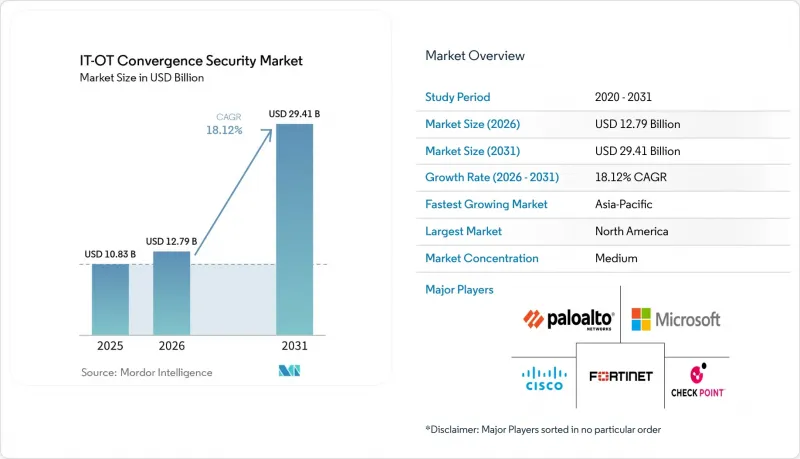
Mordor Intelligence에 의하면, IT-OT 컨버전스 보안 시장 규모는 2025년에 108억 3,000만 달러, 2026년에는 127억 9,000만 달러에 이르고, 2031년까지 294억 1,000만 달러에 이를 것으로 예측되며, 2026년부터 2031년까지 CAGR 18.12%로 성장할 전망입니다.
본 보고서는 제공 방식(솔루션 및 서비스), 배포 모드(클라우드, On-Premise, 하이브리드), 조직 규모(대기업 및 중소기업), 최종 사용 산업(에너지·유틸리티, 산업 제조, 석유 및 가스, 운송 및 물류, 화학, 의료 등) 및 지역별로 분류되어 있습니다. 시장 전망은 금액(달러) 기준으로 제시되어 있습니다.
전 세계 IT-OT 컨버전스 보안 시장 동향 및 인사이트
산업용 제어 환경을 표적으로 하는 랜섬웨어 증가
산업 분야의 랜섬웨어는 단순한 기회주의적 방해 행위에서 물리적 운영 및 생산의 연속성을 표적으로 한 방해 행위로 전환되고 있습니다. 하네웰(Honeywell)의 보고서에 따르면, 산업 운영자를 표적으로 한 랜섬웨어 공격은 2025년 1분기에 46% 급증했으며, 이는 공격자들이 제어 환경의 가동 중단으로 인한 압박을 얼마나 중요하게 여기는지를 보여줍니다. 드라고스(Dragos)는 2026년 1분기에 엔지니어링 기업, 시스템 통합사업자, 장비 제조업체 등 ICS 관련 조직에서 139건의 랜섬웨어 사고를 기록했습니다. 이는 OT 환경에 대한 공급망을 통한 접근 경로에 대한 압박이 커지고 있음을 시사합니다. 이러한 추세로 인해 IT-OT 컨버전스 보안 시장에서는 더욱 강력한 세분화, 조기 이상 감지, 그리고 사무실 네트워크가 아닌 생산 현장을 위해 구축된 사고 대응 계획에 대한 수요가 증가하고 있습니다. 또한, IT 부서는 데이터 유출만 발생하는 경우보다 가동 중단이 경제적 손실을 더 크게 초래하는 산업 프로세스를 보호하기 위한 도구의 지속적인 구매를 추진하고 있습니다. 공격자들이 침입 경로를 넓히고 타이밍의 정확도를 높이는 가운데, IT-OT 컨버전스 보안 시장에서는 공장 현장의 시스템뿐만 아니라 업스트림 벤더 및 관련 서비스 파트너를 보호해야 할 시급성이 커지고 있습니다.
IT-OT 융합으로 공격 대상 영역 확대
IT-OT 네트워크의 융합으로 인해 기존 산업용 보안 모델로는 대처할 수 없었던 새로운 공격 경로가 생겨나고 있습니다. 인프라 공유, 인증 정보 공유, 그리고 원격 액세스의 확대에 따라 공격자가 엔터프라이즈 시스템에서 운영 환경으로 쉽게 침투할 수 있게 되었습니다. 2026년 4월, CISA는 Volt Typhoon이 공유된 Active Directory 인증 정보를 악용하여 감지 가능한 악성코드를 배포하지 않고, 침해된 IT 부문에서 OT 환경으로 횡방향 이동을 통해 미국 중요 인프라 내부에 사전에 잠복해 있었음을 확인했습니다. 이 사건의 양상은 현재 가장 심각한 위협이 산업용 프로토콜에 대한 직접적인 공격에만 의존하는 것이 아니라, 융합의 피팅 자체를 악용하고 있음을 보여줍니다. 따라서 IT-OT 컨버전스 보안 시장은 신원 기반 제어, 더욱 엄격한 세분화, 그리고 운영상의 혼란을 단순한 IT 문제가 아닌 사업 연속성상의 과제로 다루는 거버넌스 체제로 전환되고 있습니다. 이러한 변화로 인해 경영진의 책임도 더 높은 수준으로 확대되고 있습니다. 왜냐하면 플랜트의 가동률, 안전성 및 회복력은 이제 기업 환경과 운영 환경이 하나로 통합되어 얼마나 적절하게 보호되고 있는지에 달려 있기 때문입니다.
레거시 OT 자산과 독자 프로토콜의 제약
레거시 산업용 자산은 여전히 주요 제약 요인으로 남아 있습니다. 많은 PLC, DCS 시스템, SCADA 서버가 당초 보안 설계의 가정을 훨씬 뛰어넘는 상태에서 계속 가동되고 있기 때문입니다. 이러한 시스템은 대부분의 경우 가동을 중단하지 않고는 업데이트할 수 없어, 그 결과 시정 조치가 지연되고 보안 개선에 드는 운영 비용이 증가하고 있습니다. Modbus, DNP3, BACnet 등의 산업용 프로토콜은 네이티브 인증이나 암호화 기능을 갖추도록 설계되지 않았기 때문에 운영자가 프로토콜에 대응하는 보안 계층을 추가하지 않는 한 스푸핑, 리플레이 공격, 중간자 공격의 위험에 계속 노출됩니다. 많은 자산 소유자는 여전히 운영 환경에 대한 완전한 현황을 파악하지 못하고 있어, 이에 따라 대책의 우선순위 설정이나 공격 대상 영역의 완전한 정의조차 어려워지고 있습니다. 이 문제는 특히 오래된 에너지, 화학, 인프라 시설에서 뿌리 깊게 남아 있으며, 설비의 맞춤화, 공정의 기밀성, 그리고 교체 비용 등의 이유로 현대화 속도가 당초 예산 계획보다 더뎌지고 있습니다. IT-OT 컨버전스 보안 시장은 계속 확대되고 있지만, 이러한 기존 설비의 실정 때문에 도입 일정이 장기화되고, 브라운필드 인프라의 대부분이 부분적인 보호 수준에 그치는 상황이 지속되고 있습니다.
부문 분석
2025년, 솔루션은 IT-OT 컨버전스 보안 시장의 62.34%를 차지했으며, 사업자들이 융합된 산업 환경 전반에 걸친 가시성, 위협 감지 및 위험 관리를 우선시함에 따라 이 부문은 계속해서 주도적인 위치를 유지했습니다. 네트워크 보안, 취약점 관리 및 SIEM은 연결된 사이트 전반에 걸친 모니터링 및 대응이라는 시급한 과제를 해결하기 위해 하위 부문 중 가장 높은 투자액을 기록했습니다. 자산 감지 및 인벤토리 관리는 어떤 자산이 존재하고 어떤 자산이 노출되어 있는지 파악하지 못하면 사업자가 보호를 효과적으로 우선시할 수 없기 때문에 구매의 기반이 되는 계층입니다. 또한, 연결된 산업 아키텍처에서 인증 정보의 악용 및 횡방향 이동이 더욱 중요한 문제가 됨에 따라, ID 및 액세스 관리, 데이터 보안의 전략적 중요성도 높아지고 있습니다. 팔로알토 네트웍스는 2024년 10월, AI를 활용한 가상 패치 적용 기능과 내환경성 방화벽을 도입하여 OT 보안 포트폴리오를 확충했습니다. 이는 일반적인 패치 적용 주기가 느린 상황에서 대체 통제 조치에 대한 수요가 높아지고 있음을 반영한 것입니다.
서비스 시장은 2026년부터 2031년까지 연평균 성장률(CAGR) 21.32%를 나타낼 것으로 예측되며, IT-OT 컨버전스 보안 시장에서 가장 빠르게 확대되고 있는 분야입니다. 많은 사업자가 여러 거점이나 운영 환경에 걸쳐 완전한 사내 OT 팀을 구축할 수 없기 때문에 매니지드 보안 서비스 및 사고 대응에 대한 수요가 급속히 확대되고 있습니다. 전문 서비스, 교육, 컨설팅 분야도 마찬가지로 혜택을 보고 있습니다. 이는 산업 분야의 구매자들이 성숙한 프로그램을 독자적으로 운영할 수 있게 되기 전에 아키텍처, 평가, 규정 준수 준비, 운영 모델 설계에 대한 지원이 필요한 경우가 많기 때문입니다. OT 사고에는 물리적 안전성이나 생산 안정성을 훼손하지 않는 기술적 대응이 요구되기 때문에 기업의 사이버 보안과 현장 대응 간의 기술 격차로 인해 서비스 수요는 높은 수준을 유지하고 있습니다. 이 섹션에서는 ‘솔루션’의 62.34%라는 점유율이 2025년 IT-OT 컨버전스 보안 시장에서 주도적인 위치를 반영하는 한편, ‘서비스’의 21.32%라는 연평균 성장률(CAGR)은 예측 기간 동안 새로운 지출이 가장 빠르게 집중되고 있는 분야를 나타냅니다.
2025년 IT-OT 컨버전스 보안 시장에서 클라우드 도입은 58.42%를 차지하며, 도입 모델 중 가장 큰 점유율을 기록했습니다. 특히, 로컬 인프라의 부담을 경감하고 여러 거점에 걸친 운영 전반의 가시성을 향상시키는 클라우드 호스팅형 SIEM, 자산 관리, 위협 인텔리전스 도구의 도입이 가장 활발히 진행되고 있습니다. OT 환경의 표준화가 진행되고 있는 대기업들이 이러한 전환을 주도하고 있는데, 이는 각 거점을 처음부터 재설계하지 않고도 분석과 모니터링을 일원화할 수 있기 때문입니다. 또한, 규정 준수 해석의 업데이트로 인해 과거 산업용 보안 기능의 클라우드 도입을 지연시켰던 조달상의 주저함도 일부 해소되었습니다. 그 결과, IT-OT 컨버전스 보안 시장에서는 초저지연 로컬 강제 실행에 의존하지 않는 워크로드에서 클라우드의 수용이 더욱 확산되고 있습니다.
On-Premise 배포는 2026년부터 2031년까지 연평균 성장률(CAGR) 20.86%를 나타낼 것으로 예측되며, 현재 시장 점유율에서는 클라우드가 주도적인 입지를 차지하고 있음에도 불구하고 가장 빠르게 성장하는 배포 형태가 될 전망입니다. 이러한 경향은 주권, 분리, 저지연 요건으로 인해 여전히 클라우드 연결이 제한되고 있는 에너지, 국방, 정부 관련 환경에서 특히 두드러집니다. 보안 수준이 높은 기존 시설(브라운필드)의 운영 사업자는 생산 시스템 근처에 배치해야 하는 모니터링, 접근 제어 및 집행 기능에 대해 계속해서 On-Premise 배포를 선호하고 있습니다. 또한, 석유 및 가스 및 화학 업계에서도 하이브리드 모델이 부상하고 있습니다. 이는 사업자가 기밀성이 높은 OT 워크로드를 현장에 유지하면서, 보고서나 선별된 인텔리전스를 외부 플랫폼과 동기화할 수 있기 때문입니다. 수치적으로 보면, 2025년 IT-OT 컨버전스 보안 시장 규모에서 도입 형태별 점유율이 58.42%로 가장 큰 비중을 차지하며, 연평균 성장률(CAGR)은 엄격하게 관리되는 산업 환경에서 On-Premise에 대한 수요가 얼마나 빠르게 회복되고 있는지를 보여줍니다.
지역별 분석
2025년, 북미는 IT-OT 컨버전스 보안 시장의 38.15%를 차지하며, 현재 매출 측면에서 가장 큰 기여를 한 지역이 되었습니다. 이 지역은 중요 인프라가 밀집해 있고, 업계 고유의 규칙에 기반한 성숙한 규제 집행 체계, 그리고 첨단 감지 및 대응 도구의 조기 도입과 같은 이점을 갖추고 있습니다. 미국은 여전히 이 지역 내에서 지배적인 위치를 유지하고 있는 반면, 캐나다와 멕시코는 국경을 초월한 에너지 및 제조업 협력이 심화됨에 따라 공통된 보안 요구 사항에 대한 노출이 증가하며 그 중요성이 계속해서 높아지고 있습니다. OT-ISAC은 2026년 4월 ‘에너지 부문 위협 자문’ 보고서에서 분산형 재생에너지 시설, 배터리 저장 시스템, 원격 변전소가 위험 노출 면적을 확대하고 있음에도 불구하고 중앙 발전 시설에 비해 보안상 주목도가 낮다고 지적했습니다. 이러한 격차는 성숙한 구매자조차도 운영 환경 보호가 미흡한 상태가 지속되고 있기 때문에 단순한 규정 준수 대응 비용을 넘어 IT-OT 컨버전스 보안 시장에서 지속적인 수요를 뒷받침하고 있습니다.
유럽은 NIS2의 시행과 레거시 OT 자산을 보유한 에너지 집약적 산업의 광범위한 기반에 힘입어 여전히 2위 지역 시장을 유지했습니다. 독일, 프랑스, 영국이 지역 내 도입을 주도하는 한편, 남유럽 및 동유럽의 사업자들은 여전히 기초 자산의 가시화 및 모니터링 역량 확충을 추진하고 있었습니다. NIS2 프레임워크 하에서는 최대 1,000만 유로(1,130만 달러) 또는 전 세계 연간 매출의 2%에 해당하는 벌금이 부과될 수 있으며, 이는 많은 유럽 사업자들이 규정 준수를 중심으로 한 구매 주기를 강화하는 요인이 되고 있습니다. 남미는 여전히 신흥 IT-OT 컨버전스 보안 시장이며, 브라질과 아르헨티나가 석유 및 가스 및 농업 관련 산업에서의 도입을 주도했지만, 지출은 고급 감지 기능보다는 기본적인 가시화에 중점을 둔 채로 남아 있었습니다. 중동 및 아프리카에서도 활동이 가속화되고 있으며, 걸프협력회의(GCC) 회원국들은 에너지 인프라 보호에 투자하고 있는 반면, 아프리카 전역에서의 도입은 특정 광업 및 유틸리티 이용 사례를 제외하고는 여전히 제한적인 수준에 머물러 있습니다.
아시아태평양은 2026년부터 2031년까지 연평균 성장률(CAGR) 23.37%로 확대될 것으로 예측되며, 지역별로는 가장 빠르게 성장하는 IT-OT 컨버전스 보안 시장이 될 전망입니다. 이러한 성장은 대규모 스마트 제조에 대한 투자, 인프라 확장, 그리고 주요 산업국에서의 국가 사이버 보안 요건 단계적 강화에 의해 주도되고 있습니다. 중국에서는 중요 인프라 보호 요건으로 인해 시장 규모가 확대되고 있는 반면, 인도에서는 스마트 시티, 전력망 현대화, 그리고 산업 위험에 대한 인식 제고가 조달 확대를 뒷받침하여, 이 지역에서 가장 빠르게 성장하는 국가별 시장이 될 전망입니다. 또한 일본과 싱가포르도 아시아태평양의 선진 시장에서 규제 측면에서의 영향력을 높이고 있으며, 한국에서는 반도체 및 자동차 산업에 대한 집중이 진행됨에 따라 위험 노출도와 보안 지출 수요가 모두 지속적으로 증가하고 있습니다. OT-ISAC은 2026년 4월, 휴대형 공격 기법에 의한 아시아태평양의 중요 인프라 위험을 ‘높음’으로 평가했습니다. 이에 따라 해당 지역의 위협 상황은 미국이나 유럽에서 이미 관찰되고 있는 패턴과 더욱 밀접하게 일치하게 되었습니다.
기타 혜택:
- 엑셀 형식 시장 예측(ME) 시트
- 3개월간의 애널리스트 지원
자주 묻는 질문
목차
제1장 서론
제2장 조사 방법
제3장 주요 요약
제4장 시장 구도
제5장 시장 규모와 성장 예측
제6장 경쟁 구도
제7장 시장 기회와 향후 전망
JHS 26.08.07According to Mordor Intelligence, the IT-OT convergence security market size stood at USD 10.83 billion in 2025, reached USD 12.79 billion in 2026, and is projected to reach USD 29.41 billion by 2031, expanding at a CAGR of 18.12% over 2026-2031.
This report is Segmented by Offering (Solutions, and Services), Deployment Mode (Cloud, On-Premises, and Hybrid), Organization Size (Large Enterprises, and Small and Medium Enterprises), End User Industry (Energy and Utilities, Industrial Manufacturing, Oil and Gas, Transportation and Logistics, Chemicals, Healthcare, and More), and Geography. The Market Forecasts are Provided in Terms of Value (USD).
Global IT-OT Convergence Security Market Trends and Insights
Rising Ransomware Targeting Industrial Control Environments
Ransomware in industrial settings has moved from opportunistic disruption to targeted interference with physical operations and production continuity. Honeywell reported that ransomware attacks targeting industrial operators jumped 46% in Q1 2025, which shows how strongly adversaries now value downtime pressure in control environments. Dragos recorded 139 ransomware incidents in Q1 2026 across ICS-adjacent organizations such as engineering firms, system integrators, and equipment manufacturers, which points to growing pressure on supply chain access routes into OT environments. That pattern raises demand in the IT-OT convergence security market for stronger segmentation, earlier anomaly detection, and incident response plans built for production sites rather than office networks. IT also supports sustained buying of tools that protect industrial processes where operational interruption carries a higher financial penalty than isolated data loss. As attackers broaden their entry paths and timing precision, the IT-OT convergence security market is seeing more urgency around protecting upstream vendors and adjacent service partners along with plant-floor systems.
IT and OT Convergence Expanding the Attack Surface
The convergence of IT and OT networks has created new attack paths that older industrial security models were not built to manage. Shared infrastructure, shared credentials, and wider remote access have made it easier for attackers to pivot from enterprise systems into operational environments. In April 2026, CISA confirmed that Volt Typhoon had been prepositioning inside U.S. critical infrastructure by exploiting shared Active Directory credentials and moving laterally from compromised IT segments into OT environments without deploying detectable malware. That incident pattern shows that the most severe threats now exploit the convergence seam itself rather than relying only on direct attacks against industrial protocols. The IT-OT convergence security market is therefore moving toward identity-aware controls, tighter segmentation, and governance structures that treat operational disruption as a business continuity issue instead of a narrow IT problem. This shift is also pushing leadership responsibility upward because plant uptime, safety, and resilience now depend on how well enterprise and operational environments are secured together.
Legacy OT Assets and Proprietary Protocol Constraints
Legacy industrial assets remain a core restraint because many PLCs, DCS systems, and SCADA servers still operate far beyond their original security design assumptions. These systems often cannot be updated without shutdowns, which slows remediation and raises the operational cost of security improvement. Industrial protocols such as Modbus, DNP3, and BACnet were not designed with native authentication or encryption, which leaves them exposed to spoofing, replay attacks, and man-in-the-middle activity unless operators add protocol-aware security layers. Many asset owners still lack full inventories of their operational environments, which makes it difficult to prioritize controls or even define the complete attack surface. This issue is especially persistent in older energy, chemicals, and infrastructure sites where equipment customization, process sensitivity, and replacement cost make modernization slower than spending intentions suggest. The IT-OT convergence security market continues to expand, but this installed-base reality stretches deployment timelines and keeps a large share of brownfield infrastructure only partially protected.
Other drivers and restraints analyzed in the detailed report include:
- Regulatory Push for Critical Infrastructure Cybersecurity
- Rising Adoption of IIoT, Edge Computing, and Remote Operations
- Limited OT-Specific Cybersecurity Talent Availability
For complete list of drivers and restraints, kindly check the Table Of Contents.
Segment Analysis
Solutions held 62.34% of the IT-OT convergence security market in 2025, which kept this category in the leading position as operators prioritized visibility, threat detection, and risk control across converged industrial environments. Network security, vulnerability management, and SIEM attracted the highest sub-segment spending because they address immediate monitoring and response gaps across connected sites. Asset discovery and inventory management have become the foundational purchase layer because operators cannot prioritize protection effectively if they do not know which assets are present or exposed. Identity and access management and data security are also moving higher in strategic importance as credential misuse and lateral movement become more relevant in connected industrial architectures. Palo Alto Networks expanded its OT security portfolio in October 2024 with AI-powered virtual patching and ruggedized firewalls, which reflected the growing need for compensating controls where normal patch cycles remain slow.
Services are projected to grow at a 21.32% CAGR from 2026 to 2031, which makes them the faster-moving offering within the IT-OT convergence security market. Managed security services and incident response are scaling quickly because many operators cannot build full internal OT teams across multiple sites and operating environments. Professional services, training, and consulting are also benefiting because industrial buyers often need help with architecture, assessment, compliance preparation, and operating model design before they can run mature programs on their own. The skill mismatch between enterprise cybersecurity and plant-floor response keeps service demand elevated because OT incidents require technical action that does not compromise physical safety or production stability. In this section, the 62.34% share for Solutions reflects IT-OT convergence security market share leadership in 2025, while the 21.32% CAGR for Services shows where new spending is concentrating most quickly over the forecast period.
Cloud deployment captured 58.42% of the IT-OT convergence security market in 2025, which gave it the largest position among deployment models. Adoption has been strongest for cloud-hosted SIEM, asset management, and threat intelligence tools that reduce local infrastructure burden and improve visibility across multi-site operations. Large enterprises with more standardized OT environments have led this shift because they can centralize analytics and monitoring without redesigning every site from the ground up. Updated compliance interpretation has also reduced some of the procurement hesitation that once slowed cloud adoption for industrial security functions. As a result, the IT-OT convergence security market has seen cloud become more acceptable for workloads that do not depend on ultra-low-latency local enforcement.
On-premises deployment is projected to grow at a 20.86% CAGR from 2026 to 2031, which makes it the fastest-growing mode despite cloud leadership in current share. That pattern is strongest in energy, defense, and government-linked environments where sovereignty, separation, and low-latency requirements still limit cloud connectivity. Operators in high-security brownfield sites continue to favor local deployment for monitoring, access control, and enforcement functions that must stay close to production systems. Hybrid models are also gaining ground in oil and gas and chemicals because they let operators keep sensitive OT workloads on site while syncing reporting and selected intelligence to external platforms. In numeric terms, the 58.42% share marked the largest portion of IT-OT convergence security market size by deployment in 2025, while the 20.86% CAGR shows how fast on-premises demand is now rebuilding in tightly controlled industrial settings.
Complete Report Scope:
- By Offering
- Solutions
- Asset Discovery and Inventory Management
- Network Security
- Endpoint Security
- Vulnerability Management
- Security Information and Event Management
- Identity and Access Management
- Data Security
- Other Solutions
- Services
- Professional Services
- Managed Security Services
- Incident Response and Forensics
- Training and Consulting Services
- Solutions
- By Deployment Mode
- Cloud
- On-Premises
- Hybrid
- By Organization Size
- Large Enterprises
- Small and Medium Enterprises
- By End User Industry
- Energy and Utilities
- Industrial Manufacturing
- Oil and Gas
- Transportation and Logistics
- Chemicals
- Healthcare and Life Sciences
- Water and Wastewater
- Government and Defense
- Other End User Industries
- By Geography
- North America
- United States
- Canada
- Mexico
- South America
- Brazil
- Argentina
- Rest of South America
- Europe
- Germany
- United Kingdom
- France
- Italy
- Spain
- Russia
- Rest of Europe
- Asia-Pacific
- China
- Japan
- India
- South Korea
- Australia
- Singapore
- Rest of Asia-Pacific
- Middle East and Africa
- Middle East
- Saudi Arabia
- United Arab Emirates
- Turkey
- Israel
- Rest of Middle East
- Africa
- South Africa
- Nigeria
- Rest of Africa
- Middle East
- North America
Geography Analysis
North America held 38.15% of the IT-OT convergence security market in 2025, which made it the largest regional contributor to current revenue. The region benefits from dense critical infrastructure concentration, mature enforcement under sector-specific rules, and earlier adoption of advanced detection and response tools. The United States remained the dominant country within the region, while Canada and Mexico continued to gain relevance as cross-border energy and manufacturing links deepened exposure to common security expectations. OT-ISAC noted in its April 2026 Energy Sector Threat Advisory that distributed renewable sites, battery energy storage systems, and remote substations were receiving less security attention than central generation facilities, even though they represented growing risk surfaces. That gap supports continued demand in the IT-OT convergence security market beyond pure compliance spending because even mature buyers still have underprotected operating environments.
Europe remained the second-largest regional market, supported by NIS2 enforcement and a broad base of energy-intensive industries with legacy OT assets. Germany, France, and the United Kingdom led regional adoption, while Southern and Eastern European operators were still expanding foundational asset visibility and monitoring capabilities. The NIS2 framework allows penalties of up to EUR 10 million (USD 11.3 million) or 2% of global annual turnover, which has reinforced a compliance-led purchasing cycle across many European operators. South America remained an emerging IT-OT convergence security market where Brazil and Argentina led adoption in oil and gas and agri-industrial applications, while spending stayed more focused on foundational visibility than advanced detection. Middle East and Africa also showed accelerating activity, with Gulf Cooperation Council states investing in energy infrastructure protection while broader African adoption remained limited outside selected mining and utilities use cases.
Asia-Pacific is projected to expand at a 23.37% CAGR from 2026 to 2031, which makes it the fastest-growing regional IT-OT convergence security market. Growth is being driven by large-scale smart manufacturing investment, infrastructure expansion, and the gradual tightening of national cybersecurity requirements across major industrial economies. China is adding scale through critical infrastructure protection requirements, while India is on track to be the fastest-growing country-level market in the region as smart cities, grid modernization, and industrial risk awareness support procurement growth. Japan and Singapore are also adding regulatory weight in developed APAC markets, while South Korea's semiconductor and automotive concentration continues to rise both exposure and security spending needs. OT-ISAC assessed APAC critical infrastructure risk from portable attacker tradecraft as elevated in April 2026, which aligned the region's threat posture more closely with the patterns already observed in the United States and Europe.
- Cisco Systems, Inc.
- Fortinet, Inc.
- Palo Alto Networks, Inc.
- Check Point Software Technologies Ltd.
- Microsoft Corporation
- Honeywell International Inc.
- Schneider Electric SE
- Siemens AG
- Rockwell Automation, Inc.
- Claroty Ltd.
- Dragos, Inc.
- Nozomi Networks Inc.
- Forescout Technologies, Inc.
- Tenable Holdings, Inc.
- Armis, Inc.
- Darktrace plc
- Trend Micro Incorporated
- IBM Corporation
- Broadcom Inc.
- TXOne Networks Inc.
Additional Benefits:
- The market estimate (ME) sheet in Excel format
- 3 months of analyst support
TABLE OF CONTENTS
1 INTRODUCTION
- 1.1 Study Assumptions and Market Definition
- 1.2 Scope of the Study
2 RESEARCH METHODOLOGY
3 EXECUTIVE SUMMARY
4 MARKET LANDSCAPE
- 4.1 Market Overview
- 4.2 Market Drivers
- 4.2.1 Rising Ransomware Targeting Industrial Control Environments
- 4.2.2 IT and OT Convergence Expanding the Attack Surface
- 4.2.3 Regulatory Push for Critical Infrastructure Cybersecurity
- 4.2.4 Rising Adoption of IIoT, Edge Computing, and Remote Operations
- 4.2.5 Board-Level Focus on Operational Resilience and Uptime Protection
- 4.2.6 Increased Security Budget Allocation for Industrial Cyber Defense
- 4.3 Market Restraints
- 4.3.1 Legacy OT Assets and Proprietary Protocol Constraints
- 4.3.2 Limited OT-Specific Cybersecurity Talent Availability
- 4.3.3 High Retrofit Complexity in Brownfield Industrial Sites
- 4.3.4 Unclear Return on Investment for Mid-Market Operators
- 4.4 Industry Value-Chain Analysis
- 4.5 Technology Outlook
- 4.6 Regulatory Landscape
- 4.7 Pricing Analysis
- 4.8 Porter's Five Forces Analysis
- 4.8.1 Bargaining Power of Suppliers
- 4.8.2 Bargaining Power of Buyers
- 4.8.3 Threat of New Entrants
- 4.8.4 Threat of Substitutes
- 4.8.5 Intensity of Competitive Rivalry
- 4.9 Impact of Macroeconomic Factors on the Market
5 MARKET SIZE AND GROWTH FORECASTS (VALUE)
- 5.1 By Offering
- 5.1.1 Solutions
- 5.1.1.1 Asset Discovery and Inventory Management
- 5.1.1.2 Network Security
- 5.1.1.3 Endpoint Security
- 5.1.1.4 Vulnerability Management
- 5.1.1.5 Security Information and Event Management
- 5.1.1.6 Identity and Access Management
- 5.1.1.7 Data Security
- 5.1.1.8 Other Solutions
- 5.1.2 Services
- 5.1.2.1 Professional Services
- 5.1.2.2 Managed Security Services
- 5.1.2.3 Incident Response and Forensics
- 5.1.2.4 Training and Consulting Services
- 5.1.1 Solutions
- 5.2 By Deployment Mode
- 5.2.1 Cloud
- 5.2.2 On-Premises
- 5.2.3 Hybrid
- 5.3 By Organization Size
- 5.3.1 Large Enterprises
- 5.3.2 Small and Medium Enterprises
- 5.4 By End User Industry
- 5.4.1 Energy and Utilities
- 5.4.2 Industrial Manufacturing
- 5.4.3 Oil and Gas
- 5.4.4 Transportation and Logistics
- 5.4.5 Chemicals
- 5.4.6 Healthcare and Life Sciences
- 5.4.7 Water and Wastewater
- 5.4.8 Government and Defense
- 5.4.9 Other End User Industries
- 5.5 By Geography
- 5.5.1 North America
- 5.5.1.1 United States
- 5.5.1.2 Canada
- 5.5.1.3 Mexico
- 5.5.2 South America
- 5.5.2.1 Brazil
- 5.5.2.2 Argentina
- 5.5.2.3 Rest of South America
- 5.5.3 Europe
- 5.5.3.1 Germany
- 5.5.3.2 United Kingdom
- 5.5.3.3 France
- 5.5.3.4 Italy
- 5.5.3.5 Spain
- 5.5.3.6 Russia
- 5.5.3.7 Rest of Europe
- 5.5.4 Asia-Pacific
- 5.5.4.1 China
- 5.5.4.2 Japan
- 5.5.4.3 India
- 5.5.4.4 South Korea
- 5.5.4.5 Australia
- 5.5.4.6 Singapore
- 5.5.4.7 Rest of Asia-Pacific
- 5.5.5 Middle East and Africa
- 5.5.5.1 Middle East
- 5.5.5.1.1 Saudi Arabia
- 5.5.5.1.2 United Arab Emirates
- 5.5.5.1.3 Turkey
- 5.5.5.1.4 Israel
- 5.5.5.1.5 Rest of Middle East
- 5.5.5.2 Africa
- 5.5.5.2.1 South Africa
- 5.5.5.2.2 Nigeria
- 5.5.5.2.3 Rest of Africa
- 5.5.5.1 Middle East
- 5.5.1 North America
6 COMPETITIVE LANDSCAPE
- 6.1 Market Concentration
- 6.2 Strategic Moves
- 6.3 Market Share Analysis
- 6.4 Company Profiles (includes Global Level Overview, Market Level Overview, Core Segments, Financials as available, Strategic Information, Market Rank/Share, Products and Services, Recent Developments)
- 6.4.1 Cisco Systems, Inc.
- 6.4.2 Fortinet, Inc.
- 6.4.3 Palo Alto Networks, Inc.
- 6.4.4 Check Point Software Technologies Ltd.
- 6.4.5 Microsoft Corporation
- 6.4.6 Honeywell International Inc.
- 6.4.7 Schneider Electric SE
- 6.4.8 Siemens AG
- 6.4.9 Rockwell Automation, Inc.
- 6.4.10 Claroty Ltd.
- 6.4.11 Dragos, Inc.
- 6.4.12 Nozomi Networks Inc.
- 6.4.13 Forescout Technologies, Inc.
- 6.4.14 Tenable Holdings, Inc.
- 6.4.15 Armis, Inc.
- 6.4.16 Darktrace plc
- 6.4.17 Trend Micro Incorporated
- 6.4.18 IBM Corporation
- 6.4.19 Broadcom Inc.
- 6.4.20 TXOne Networks Inc.
7 MARKET OPPORTUNITIES AND FUTURE OUTLOOK
- 7.1 White-Space and Unmet-Need Assessment


