

|
시장보고서
상품코드
2098513
상업용 바닥재 : 시장 점유율 분석, 업계 동향과 통계, 성장 예측(2026-2031년)Commercial Flooring - Market Share Analysis, Industry Trends & Statistics, Growth Forecasts (2026 - 2031) |
||||||
 Mordor Intelligence
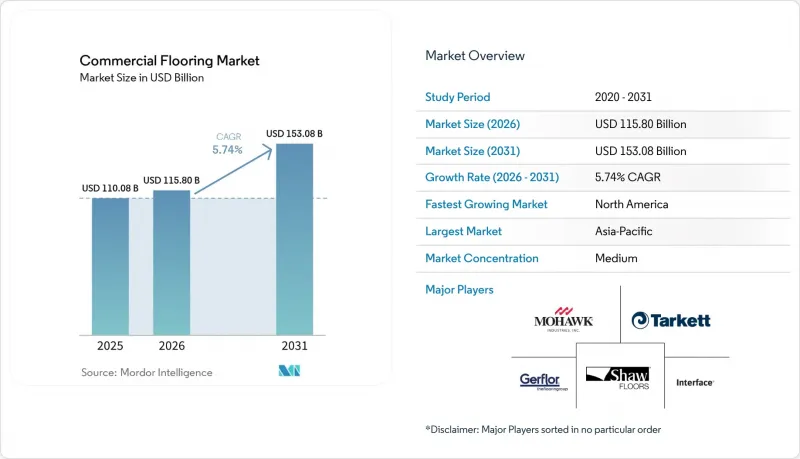
Mordor Intelligence에 의하면, 상업용 바닥재 시장 규모는 2025년 1,100억 8,000만 달러에서 2026년에는 1,158억 달러로 확대되고, 2026-2031년 CAGR 5.74%로 성장을 지속하여 2031년에는 1,530억 8,000만 달러에 이를 것으로 예측됩니다.
본 보고서는 제품 유형(러그 및 카펫, 탄성 바닥재, 비탄성 바닥재), 최종 사용자(사무실·기업, 소매, 의료, 교육, 호텔·관광, 공공·기관, 기타 상업용 최종 사용자), 유통 채널(직접 판매 및 간접 판매), 그리고 지역별로 분류되어 있습니다. 시장 전망은 금액(달러) 기준으로 제시됩니다.
세계 상업용 바닥재 시장 동향 및 인사이트
다이아몬드 하드 코팅과 EPD의 투명성 덕분에 상업용 사양에서 탄성 바닥재/LVT로의 전환이 가속화되고 있습니다.
소유주가 수명 주기 비용, 시공 속도, 모듈식 설계의 균형을 맞추는 가운데, LVT는 사무실, 교육 시설, 소매점 및 기타 유동 인구가 많은 환경에서 주류 사양으로 자리 잡고 있습니다. 이 카테고리의 성장세는 표면 보호 기술에 의해 더욱 강화되고 있으며, 의료시설이나 직장 복도의 내구성 요구 사항을 충족하는 높은 내흠집성, 내오염성, 내마모성을 갖춘 새로운 컬렉션이 등장하고 있습니다. FloorScore 인증 및 오르토프탈산 에스테르 미사용 표시는 현재 후보 목록 선정의 일반적인 기준이 되었으며, 이러한 문서는 그린빌딩 신청 시 실내 공기질 관련 평가 항목 획득에도 기여하고 있습니다. 사양 결정자들은 LEED 점수 획득에 기여하고, 배출량 및 건강과 관련된 기업의 조달 방침을 충족하는 데 도움이 되기 때문에 제품별 EPD 및 재료 공개 문서를 우선적으로 검토하고 있습니다. LVT의 모듈식 구조 덕분에 시설이 가동 중인 상태에서 리모델링 공사 시 다운타임을 단축할 수 있습니다. 이는 리모델링 기간 동안 시설을 완전히 비울 수 없는 병원, 학교, 그리고 여러 임차인이 입주해 있는 사무실의 경우 큰 이점이 됩니다. 기존에는 다른 마감재가 선호되던 상업시설에서도 경질 바닥재의 점유율이 확대되는 가운데, 주요 브랜드들은 LVT의 생산 능력과 제품 라인업을 지속적으로 확충하고 있습니다.
노후화된 건물과 팬데믹 이후의 공간 재구성이 겹치면서, 개보수 및 갱신 주기가 가속화되고 있습니다.
북미 및 유럽에서는 소유주들이 팬데믹 초기에 유지보수를 미뤄두었던 만큼, 현재 협업, 음향, 실내 공기질 개선을 목적으로 한 인테리어 재구성이 진행되며 활발한 개보수 주기에 접어들고 있습니다. 인력 확보는 여전히 과제로 남아 있어 리드타임이 장기화되는 한편, 단계별 프로젝트에서 신속하고 확실하게 시공할 수 있는 제품의 가치가 높아지고 있습니다. 소프트 표면재와 하드 표면재 모두에 걸친 종합적인 EPD(환경 제품 선언)를 제공하는 제조업체는 소유주가 프로젝트의 추진력을 유지하면서 그린 빌딩 목표 달성에 필요한 문서를 축적할 수 있도록 지원하고 있습니다. 흡음성 비닐, 고무, 하이브리드 구조의 저탄소 옵션은 성능을 향상시키는 동시에 지구온난화지수(GWP)를 저감하여, 임차인 리모델링 및 공공시설 리프레시 프로그램에 대한 적합성을 높이고 있습니다. 2025년 후반의 금융 정책 전환으로 자금 조달 환경이 소폭 개선되어, 2026년 리모델링 의향이 완만하게 상승하는 데 기여했습니다. 기업 임차인들이 하이브리드 근무 방식에 대응하여 사무실 구역을 재검토하는 가운데, 설계 요건으로는 생물 친화적인 시각 효과, 소음 전달 저감, 그리고 청결성과 쾌적성의 균형을 갖춘 마감 시스템이 요구되는 경우가 많아지고 있습니다.
프탈레이트 및 PFAS에 대한 화학물질 규제로 인해 규정 준수 비용이 증가하고, 자재 대체가 가속화되고 있습니다.
주 차원의 규제 제정 및 전국적인 제안에 따라, 바닥재 및 관련 자재에 포함된 퍼플루오로알킬 물질(PFAS) 및 프탈레이트에 대한 규정 준수 환경이 재편되고 있습니다. 뉴멕시코주는 2026년 3월, PFAS 규제를 최종 확정했습니다. 이에 따라 2028년 1월부터 카펫에 PFAS를 의도적으로 첨가하는 것이 금지되며, 보고, 표시 및 집행에 관한 규정이 마련됩니다. 규제의 진전에 따라 이러한 조치는 관련 카테고리에도 영향을 미치게 될 것입니다. 다른 주들의 조치에 더해, 불필요한 PFAS 사용을 억제하기 위한 2026년 연방 의회 제안까지 더해지면서, 향후 지역별 규제의 불일치를 완화할 수 있는 보다 광범위한 규제 체계의 구축이 시사되고 있습니다. 각 제조업체는 의도적으로 첨가된 PFAS를 제거하기 위해 제품의 재조성을 시작했으며, 일부 기업은 화학 성분의 변경을 확인하기 위한 공약이나 업데이트된 기술 데이터 시트를 공개하고 있습니다. 더 엄격해진 오르토프탈산 에스테르 시험 방법과 업데이트된 기준에 따라 검출 및 보고가 개선되었으며, 탄성 바닥재에 관한 제품 주장 및 적합성 선언에 대한 기준이 높아졌습니다. 이러한 변화로 인해 시험 및 연구 개발 비용은 증가하겠지만, 동시에 배출량 및 규제 물질에 대한 진화하는 기준을 충족하는 대체 화학 물질 및 제품군의 도입이 가속화될 것입니다. 그 결과, 해당 첨가제를 사용하지 않고도 성능을 유지하면서 배출량이 적고 충분한 문서가 갖춰진 바닥재 포트폴리오를 구축하기 위해 신중한 사양 재검토가 진행되고 있습니다.
부문 분석
2025년, 비탄성 바닥재는 상업용 바닥재 수요의 54%를 차지했습니다. 이는 공공시설, 호텔 및 레스토랑, 기업 로비 등에서 여전히 널리 사용되고 있는 세라믹 타일과 포셀린 타일에 힘입은 결과입니다. 이러한 소재는 긴 수명, 위생성, 그리고 일관된 외관을 중시하는 구매자들에게 여전히 매력적인 선택지로 남아 있습니다. 또한, 개발업자들이 피팅를 줄인 깔끔한 레이아웃을 추구하는 가운데, 대형 포셀린 타일도 고급 복합 시설이나 사무실 인테리어에서 주목을 받고 있습니다. 석재나 목재, 또는 엔지니어드 플랭크는 자연스러운 마감이 중시되는 고급 호스피탈리티 시설이나 본사 빌딩 프로젝트에서 여전히 일정한 위치를 차지하고 있지만, 내습성이 뛰어난 LVT(리지드 비닐 타일)가 유사한 외관을 유지하면서도 유지 관리 비용이 낮다는 장점으로 인해 이 두 카테고리에 압박을 가하고 있습니다. 비탄성 바닥재가 주도적인 위치를 차지하고 있는 배경에는 공공기관 및 공공시설의 조달 동향 변화가 완만하다는 점도 반영되어 있으며, 이러한 분야에서는 구매자들이 내구성과 수명 주기 가치 측면에서 오랜 실적을 가진 소재를 계속해서 선호하기 때문입니다.
LVT가 사무실, 소매, 교육, 의료 각 분야에서 널리 받아들여짐에 따라, 탄성 바닥재는 2031년까지 연평균 성장률(CAGR) 7.20%로 가장 빠르게 성장할 것으로 예측됩니다. 이러한 변화는 방수 성능, 신속한 시공, 그리고 많은 프로젝트에서 총비용 측면에서의 우위에 의해 주도되고 있습니다. 또한, 사양 결정자들 사이에서는 구조적 안정성을 유지하면서도 발밑의 쾌적성을 향상시키는 더 두꺼운 구조에 대한 관심이 다시 높아지고 있습니다. 비닐 시트나 고무 바닥재는 의료·교육 분야에서 여전히 중요한 위치를 차지하고 있습니다. 이러한 분야에서는 디자인의 다양성보다 이음매 없는 시공이나 감염 방지 요건이 중시되는 경우가 많기 때문입니다. 사무실 프로젝트에서 경질 바닥재의 점유율이 확대됨에 따라 카펫이나 러그 등 연질 바닥재에는 일정한 압박이 가해지고 있지만, 방음 대책이 필요한 오픈 플랜 공간에서는 모듈형 카펫 타일이 여전히 중요한 역할을 수행하고 있습니다.
지역별 분석
북미는 가장 성장세가 두드러진 지역 시장으로, 2031년까지 연평균 성장률(CAGR) 7.50%로 확대될 것으로 예측됩니다. 이 지역은 이전의 금리 관련 침체기에서 회복세를 보이고 있으며, 사무실, 의료, 교육 분야의 전반적인 리모델링 활동으로 수요가 개선되고 있습니다. 국내 제조업체들도 국산 마루재에 대한 관심 증가와 무역 환경의 변화를 배경으로 더욱 유리한 입장에 있습니다. 동시에 PFAS에 대한 규제 환경이 엄격해지고 있어 규정 준수 비용은 상승하고 있는 반면, 제조업체 입장에서는 환경 성능을 강화한 신제품 라인을 전개할 여지도 생기고 있습니다. 캐나다와 멕시코에서는 니어쇼어링에 따른 물류 및 산업 개발의 성장이 이 지역의 전망을 더욱 뒷받침하고 있습니다.
아시아태평양은 인도, 중국, 인도네시아, 베트남의 비주거용 건설 활동에 힘입어 2025년에는 38%라는 최대 지역 점유율을 차지했습니다. 사무실 공급 증가, 인프라 투자, 대규모 도시 개발 프로젝트가 계속해서 이 지역 전체의 바닥재 수요를 뒷받침하고 있습니다. 일본과 호주에서는 다른 경향이 나타나고 있으며, 리모델링, 이전 활동, ESG 주도형 업그레이드가 더 높은 사양의 바닥재 솔루션에 대한 기회를 창출하고 있습니다. 지역 전체적으로 상업용 수요가 품질 중심으로 전환됨에 따라, 각 제조업체들도 더 고급스럽고 방음 성능이 뛰어난 바닥재를 적극적으로 출시하고 있습니다. 신흥 아시아태평양 시장에서는 비용이 여전히 주요 요인으로 작용하고 있지만, 주요 대도시권의 그린 빌딩 기준에 따라 EPD(환경 제품 선언) 도입이 점차 진행되면서 환경 성능에 대한 문서화 요구가 높아지고 있습니다.
유럽에서는 거시경제적 압박과 비주거용 건설의 둔화로 인해 단기적인 성장이 제한되고 있지만, 완만한 속도로 확장을 이어가고 있습니다. 그럼에도 불구하고 이 지역은 지속가능성 규제로 인해 변화하고 있으며, 환경 보고 기준이 강화되면서 시장 진입 시 제품의 문서화가 점점 더 중요해지고 있습니다. 이러한 변화는 카펫 및 소프트 커버링 업계에 특히 중요하며, 2030년까지 생산자 책임의 확대와 순환형 경제 요건이 더욱 엄격해질 전망입니다. 중동 및 아프리카에서는 상황에 따라 차이가 보이지만, UAE와 사우디아라비아에서는 호텔·관광 산업과 복합 애플리케이션 개발이 수요를 뒷받침하고 있습니다. 남미는 낮은 수준에서 회복세를 보이고 있으며, 소매, 호텔·관광, 경공업 분야의 활동에 힘입어 수요가 점차 뒷받침되고 있습니다. 이 지역 전체적으로 성장 속도는 제각각이지만, 수요는 분명히 보다 상세한 문서화가 이루어지고, 더 지속 가능한 바닥재 솔루션으로 전환되고 있습니다.
기타 혜택:
- 엑셀 형식 시장 예측(ME) 시트
- 3개월간의 애널리스트 지원
자주 묻는 질문
목차
제1장 서론
제2장 조사 방법
제3장 주요 요약
제4장 시장 구도
제5장 시장 규모와 성장 예측
제6장 경쟁 구도
제7장 시장 기회와 향후 전망
KTH 26.08.06According to Mordor Intelligence, the commercial flooring market size is expected to grow from USD 110.08 billion in 2025 to USD 115.80 billion in 2026 and is forecast to reach USD 153.08 billion by 2031 at 5.74% CAGR over 2026-2031.
This report is Segmented by Product Type (Rugs and Carpets, Resilient, and Non-Resilient), End-User (Offices & Corporate, Retail, Healthcare, Education, Hospitality, Institutional/Public, and Other Commercial End-Users), Distribution Channel (Direct Sales and Indirect Sales), and Geography. Market Forecasts are Provided in Terms of Value (USD).
Global Commercial Flooring Market Trends and Insights
Resilient/LVT Shift in Commercial Specifications Gains Momentum Through Diamond Hard Coatings and EPD Transparency
LVT has become a mainstream specification in offices, education, retail, and other high-traffic settings as owners balance lifecycle cost, installation speed, and modular design. The category's traction has been reinforced by protective surface chemistries, with new collections offering high scratch, stain, and scuff resistance that meet the durability needs of healthcare and workplace corridors. FloorScore certification and ortho-phthalate-free claims are now common qualifiers for shortlists, and these documentation elements also support indoor air quality credits in green building submissions. Specifiers are prioritizing product-specific EPDs and material disclosure documents because they count toward LEED points and help satisfy corporate procurement policies around emissions and health. The modular nature of LVT reduces downtime during occupied renovations, which is valuable for hospitals, schools, and multi-tenant offices that cannot fully vacate during upgrades. Leading brands continue to expand LVT capacity and assortments as hard surfaces gain share in commercial settings that historically favored other finishes.
Renovation and Replacement Cycles Intensify as Aging Stock Meets Post Pandemic Space Reconfigurations
North America and Europe are in an active renovation cycle as owners deferred maintenance from the early pandemic period and reconfigure interiors for collaboration, acoustics, and indoor air quality. Labor availability remains a pinch point, prolonging lead times and increasing the value of products that install quickly and predictably in phased projects. Manufacturers that provide comprehensive EPD coverage across soft and hard surfaces enable owners to maintain project momentum while accumulating the documentation needed for green building targets. Low-carbon options in acoustic vinyl, rubber, and hybrid constructions have improved performance while reducing Global Warming Potential, strengthening their fit for tenant improvements and institutional refresh programs. Monetary policy shifts in late 2025 marginally improved financing conditions, supporting a measured uptick in remodeling intentions for 2026. As corporate occupiers rezone offices for hybrid work, design briefs often call for biophilic visuals, reduced noise transmission, and finish systems that balance cleanability and comfort.
Chemicals Regulation on Phthalates and PFAS Raises Compliance Costs and Accelerates Material Substitution
State-level rulemaking and national proposals are reshaping the compliance landscape for per- and polyfluoroalkyl substances and phthalates in floor coverings and related materials. New Mexico finalized PFAS regulations in March 2026 that ban intentionally added PFAS in carpets starting January 2028 and establish reporting, labeling, and enforcement provisions, which will affect adjacent categories as rules evolve. Additional state actions, along with a 2026 congressional proposal aimed at curbing non-essential PFAS uses, point to a broader regulatory framework that could reduce patchwork variability over time. Manufacturers have begun reformulating products to remove intentionally added PFAS, with some publishing public commitments and updated technical data sheets to confirm changes in chemistry. Stricter ortho-phthalate testing methods and updated standards improve detection and reporting, raising the bar on product claims and compliance declarations for resilient formats. These shifts increase testing and R&D costs, but they also push faster adoption of alternative chemistries and product families that meet evolving thresholds for emissions and restricted substances. The net effect is a measured remix of specifications toward low-emitting, well-documented flooring portfolios that maintain performance without the use of targeted additives.
Other drivers and restraints analyzed in the detailed report include:
- Asia-Pacific Non Residential Construction Pipeline Expands on Infrastructure Spending and Grade An Office Absorption
- LEED/WELL Driven Low Emitting Materials and EPD Adoption Reshape Specification Gatekeeping
- Skilled Installer Shortage Prolongs Lead Times, Raises Costs, and Stalls Project Completions
For complete list of drivers and restraints, kindly check the Table Of Contents.
Segment Analysis
Non-resilient flooring held 54% of commercial flooring demand in 2025, supported by ceramic and porcelain tile formats that remain widely used in institutional buildings, hospitality spaces, and corporate lobbies. These materials continue to appeal to buyers who value long service life, hygiene, and a consistent visual finish. Large-format porcelain is also gaining attention in premium mixed-use and office interiors, as developers seek cleaner layouts with fewer grout lines. Stone and wood, or engineered planks, still hold a place in upscale hospitality and headquarters projects where natural finishes matter, though moisture-resistant LVT alternatives are putting pressure on both categories because they offer a similar look with lower upkeep . The leading position of non-resilient flooring also reflects slower change in public and institutional procurement, where buyers continue to favor materials with a long record of durability and lifecycle value.
Resilient flooring is forecast to grow the fastest at a 7.20% CAGR through 2031 as LVT gains wider acceptance in offices, retail, education, and healthcare. The shift is driven by waterproof performance, faster installation, and a better total cost profile for many projects. Specifiers are also showing renewed interest in thicker constructions that improve comfort underfoot while maintaining structural stability. Vinyl sheet and rubber flooring remain important in healthcare and education, where seamless installation and infection-control requirements often matter more than design variety. Soft coverings such as carpets and rugs have seen some pressure as hard surfaces gain share in office projects, but modular carpet tile still holds an important role in open-plan spaces where acoustic control is needed.
Complete Report Scope:
- By Product Type
- Rugs and Carpets
- Resilient Flooring
- Luxury Vinyl Tiles
- Vinyl sheets
- Rubber
- Linoleum
- Others
- Non-Resilient Flooring
- Wood Flooring
- Laminate Flooring
- Stone/Marble Flooring
- Ceramic Flooring
- Others
- By End-user
- Offices & Corporate
- Retail
- Healthcare
- Education
- Hospitality
- Institutional/Public
- Other Commercial End-Users
- By Distribution Channel
- Direct Sales
- Indirect Sales
- By Geography
- North America
- Canada
- United States
- Mexico
- South America
- Brazil
- Peru
- Chile
- Argentina
- Rest of South America
- Europe
- United Kingdom
- Germany
- France
- Spain
- Italy
- BENELUX (Belgium, Netherlands, Luxembourg)
- NORDICS (Denmark, Finland, Iceland, Norway, Sweden)
- Rest of Europe
- Asia-Pacific
- India
- China
- Japan
- Australia
- South Korea
- South-East Asia
- Rest of Asia-Pacific
- Middle East & Africa
- United Arab Emirates
- Saudi Arabia
- South Africa
- Nigeria
- Rest of Middle East & Africa
- North America
Geography Analysis
North America is the fastest-growing regional market, forecast to expand at a 7.50% CAGR through 2031. The region is recovering from an earlier period of interest-rate-related softness, and demand is improving across office, healthcare, and education renovation activity. Domestic manufacturers are also in a stronger position to benefit from interest in locally produced flooring and shifting trade conditions. At the same time, the regulatory environment around PFAS is becoming stricter, raising compliance costs but also creating room for manufacturers to offer reformulated product lines with stronger environmental positioning. Canada and Mexico add to the regional outlook through nearshoring-related growth in logistics and industrial development.
Asia-Pacific held the largest regional share at 38% in 2025, supported by non-residential construction activity in India, China, Indonesia, and Vietnam. Office supply growth, infrastructure spending, and large urban development projects continue to support flooring demand across the region. Japan and Australia present a different pattern, where refurbishment, relocation activity, and ESG-led upgrades are creating opportunities for higher-specification flooring solutions. Across the region, manufacturers are also pushing more premium and acoustically enhanced surfaces as commercial demand becomes more quality-driven. While cost remains a major factor in emerging APAC markets, green building codes in key urban centers are gradually pushing EPD adoption and raising expectations for documented environmental performance.
Europe is expanding at a moderate pace as macroeconomic pressure and slower non-residential construction limit short-term growth. Even so, the region is being reshaped by sustainability regulations, which are raising the bar for environmental reporting and making product documentation increasingly important for market access. These changes are especially relevant for carpet and soft coverings, where extended producer responsibility and circularity requirements are likely to tighten further through 2030. The Middle East and Africa present a mixed picture, with hospitality and mixed-use development supporting demand in the UAE and Saudi Arabia. South America is recovering from a lower base and is seeing gradual support from retail, hospitality, and light industrial activity. Across these regions, growth remains uneven, but demand is clearly moving toward better-documented, more sustainable flooring solutions.
- Mohawk Industries
- Shaw Industries Group
- Tarkett
- Interface
- Gerflor
- Forbo Flooring Systems
- Mannington Commercial
- Milliken
- Armstrong Flooring (commercial brand under AHF Products)
- Altro
- RAK Ceramics
- Polyflor (James Halstead)
- Karndean Designflooring
- NOX Corporation
- LX Hausys (HFLOR)
- Ecore International
- Roppe Holding Company
- J+J Flooring
- Crossville
- Florim
Additional Benefits:
- The market estimate (ME) sheet in Excel format
- 3 months of analyst support
TABLE OF CONTENTS
1 Introduction
- 1.1 Study Assumptions & Market Definition
- 1.2 Scope of the Study
2 Research Methodology
3 Executive Summary
4 Market Landscape
- 4.1 Market Overview
- 4.2 Market Drivers
- 4.2.1 Resilient/LVT shift in commercial specifications
- 4.2.2 Renovation and replacement cycles intensify in mature markets
- 4.2.3 Asia-Pacific non-residential construction pipeline expands
- 4.2.4 LEED/WELL-driven low-emitting materials and EPD adoption
- 4.2.5 Public procurement and EPR policies push circularity (European Union-first)
- 4.2.6 Healthcare/cleanroom performance (ICRA, ESD) boosts specialty floors
- 4.3 Market Restraints
- 4.3.1 Chemicals regulation (phthalates/PFAS) raises compliance costs
- 4.3.2 Skilled installer shortage prolongs lead times and raises costs
- 4.3.3 Embodied-carbon/EPD scoring penalizes non-documented products
- 4.3.4 Competing finishes (polished concrete/resin) displace coverings
- 4.4 Industry Value Chain Analysis
- 4.5 Porter's Five Forces
- 4.5.1 Threat of New Entrants
- 4.5.2 Bargaining Power of Suppliers
- 4.5.3 Bargaining Power of Buyers
- 4.5.4 Threat of Substitutes
- 4.5.5 Competitive Rivalry
- 4.6 Insights into the Latest Trends and Innovations in the Industry
- 4.7 Insights on Recent Developments (New Product Launches, Strategic Initiatives, Investments, Partnerships, JVs, Expansion, M&As, etc.) in the Industry
5 Market Size & Growth Forecasts (value in USD Billion)
- 5.1 By Product Type
- 5.1.1 Rugs and Carpets
- 5.1.2 Resilient Flooring
- 5.1.2.1 Luxury Vinyl Tiles
- 5.1.2.2 Vinyl sheets
- 5.1.2.3 Rubber
- 5.1.2.4 Linoleum
- 5.1.2.5 Others
- 5.1.3 Non-Resilient Flooring
- 5.1.3.1 Wood Flooring
- 5.1.3.2 Laminate Flooring
- 5.1.3.3 Stone/Marble Flooring
- 5.1.3.4 Ceramic Flooring
- 5.1.3.5 Others
- 5.2 By End-user
- 5.2.1 Offices & Corporate
- 5.2.2 Retail
- 5.2.3 Healthcare
- 5.2.4 Education
- 5.2.5 Hospitality
- 5.2.6 Institutional/Public
- 5.2.7 Other Commercial End-Users
- 5.3 By Distribution Channel
- 5.3.1 Direct Sales
- 5.3.2 Indirect Sales
- 5.4 By Geography
- 5.4.1 North America
- 5.4.1.1 Canada
- 5.4.1.2 United States
- 5.4.1.3 Mexico
- 5.4.2 South America
- 5.4.2.1 Brazil
- 5.4.2.2 Peru
- 5.4.2.3 Chile
- 5.4.2.4 Argentina
- 5.4.2.5 Rest of South America
- 5.4.3 Europe
- 5.4.3.1 United Kingdom
- 5.4.3.2 Germany
- 5.4.3.3 France
- 5.4.3.4 Spain
- 5.4.3.5 Italy
- 5.4.3.6 BENELUX (Belgium, Netherlands, Luxembourg)
- 5.4.3.7 NORDICS (Denmark, Finland, Iceland, Norway, Sweden)
- 5.4.3.8 Rest of Europe
- 5.4.4 Asia-Pacific
- 5.4.4.1 India
- 5.4.4.2 China
- 5.4.4.3 Japan
- 5.4.4.4 Australia
- 5.4.4.5 South Korea
- 5.4.4.6 South-East Asia
- 5.4.4.7 Rest of Asia-Pacific
- 5.4.5 Middle East & Africa
- 5.4.5.1 United Arab Emirates
- 5.4.5.2 Saudi Arabia
- 5.4.5.3 South Africa
- 5.4.5.4 Nigeria
- 5.4.5.5 Rest of Middle East & Africa
- 5.4.1 North America
6 Competitive Landscape
- 6.1 Market Concentration
- 6.2 Strategic Moves
- 6.3 Market Share Analysis
- 6.4 Company Profiles (includes Global level Overview, Market level overview, Core Segments, Financials as available, Strategic Information, Market Rank/Share for key companies, Products & Services, and Recent Developments)
- 6.4.1 Mohawk Industries
- 6.4.2 Shaw Industries Group
- 6.4.3 Tarkett
- 6.4.4 Interface
- 6.4.5 Gerflor
- 6.4.6 Forbo Flooring Systems
- 6.4.7 Mannington Commercial
- 6.4.8 Milliken
- 6.4.9 Armstrong Flooring (commercial brand under AHF Products)
- 6.4.10 Altro
- 6.4.11 RAK Ceramics
- 6.4.12 Polyflor (James Halstead)
- 6.4.13 Karndean Designflooring
- 6.4.14 NOX Corporation
- 6.4.15 LX Hausys (HFLOR)
- 6.4.16 Ecore International
- 6.4.17 Roppe Holding Company
- 6.4.18 J+J Flooring
- 6.4.19 Crossville
- 6.4.20 Florim
7 Market Opportunities & Future Outlook
- 7.1 Win EPD-first public tenders with low-embodied-carbon lines
- 7.2 Healthcare/cleanroom-ready resilient and resinous systems


