

|
시장보고서
상품코드
2098515
인사 및 재무 통합 데이터 플랫폼 시장 : 점유율 분석, 업계 동향 및 통계, 성장 예측(2026-2031년)HR and Finance Unified Data Platform - Market Share Analysis, Industry Trends & Statistics, Growth Forecasts (2026 - 2031) |
||||||
 Mordor Intelligence
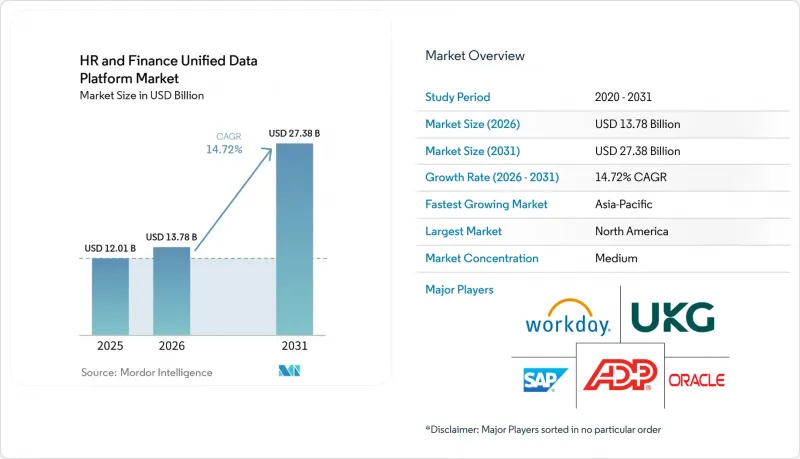
Mordor Intelligence에 의하면, 인사 및 재무 통합 데이터 플랫폼 시장 규모는 2025년 120억 1,000만 달러에서 2026년에는 137억 8,000만 달러로 확대되어 2031년까지 273억 8,000만 달러에 이를 것으로 예상되고 있어 2026년부터 2031년까지 CAGR 14.72%로 성장할 전망입니다.
본 보고서는 구성 요소(소프트웨어 및 서비스), 도입 형태(클라우드, On-Premise, 하이브리드), 기업 규모(대기업 및 중소기업), 최종 사용 산업(은행 및 금융 서비스·보험, 헬스케어 및 생명과학, 기타) 및 지역별로 분류되어 있습니다. 시장 전망은 금액(달러) 기준으로 제시되어 있습니다.
세계 인사 및 재무 통합 데이터 플랫폼 시장 동향 및 인사이트
CFO 및 CHRO 부서에서 통합된 인사 및 재무 정보에 대한 수요 증가
인사 및 재무 통합 데이터 플랫폼 시장은 기업의 설명 책임에 대한 구조적 변화에 힘입어 성장하고 있습니다. CFO와 CHRO가 동일한 경영 성과에 기반하여 평가받는 경우가 점점 늘어나고 있기 때문입니다. 단위당 인건비, 인력 효율성, 인재 유지율, 기술 준비 상태는 이전의 소프트웨어 주기에 비해 현재 재무 계획과 더욱 밀접하게 연관되어 있습니다. 이들 리더가 서로 다른 시스템에서 업무를 수행할 경우, 동일한 의사결정을 내리기 위해 직원, 급여, 비용 센터 기록을 대조해야 하므로 일상적인 계획 수립조차 지연됩니다. 따라서 수요의 원동력은 단순히 최신 소프트웨어에 대한 선호가 아니라, 인재 데이터와 재무 데이터를 아우르는 신뢰할 수 있는 단일 업무 기록에 대한 필요성에 있습니다. 또한, 인사 부서와 재무 부서가 동일한 조달 주기에서 공급업체를 평가하는 경향이 강해지고 있어, 인사 및 재무 통합 데이터 플랫폼 시장은 공동 구매 결정으로부터도 혜택을 받고 있습니다. 이를 통해 전략, 예산 편성, 실행 간의 간격이 좁혀지며, 이사회 차원에서 플랫폼 통합을 정당화하기가 쉬워집니다.
사일로화된 인사·재무 시스템에서 클라우드로의 전환 가속화
인사 및 재무 통합 데이터 플랫폼 시장은 노후화된 On-Premise HRIS 및 ERP 환경을 클라우드 기반 플랫폼으로 대체하는 움직임에 의해서도 견인되고 있습니다. 2025년 7월 기준으로 여전히 기업의 약 40%가 구식 On-Premise형 인사·ERP 환경에 의존하고 있으며, 이는 기존 도입 기반에서 얼마나 많은 마이그레이션 작업이 남아 있는지를 보여줍니다. SAP의 주력 제품인 ECC의 지원 종료 시한이 다가옴에 따라, 이러한 마이그레이션 계획에는 더욱 시급성이 대두되고 있습니다. 많은 조직이 이미 더 광범위한 ERP 업데이트 프로그램으로 내몰리고 있기 때문입니다. 이 전환은 중요한 의미를 지닙니다. 인사 및 재무 데이터 모델은 일반적으로 동시에 재검토되기 때문에 통합 플랫폼 아키텍처를 제공하는 벤더에게는 자연스러운 진입 기회가 생기기 때문입니다. 예산 제약, 통합의 복잡성, 사내의 저항으로 인해, 특히 많은 로컬 시스템을 보유한 성숙한 기업에서는 대규모 프로젝트의 진전이 여전히 더딘 상황입니다. 그럼에도 불구하고, HR 및 재무 통합 데이터 플랫폼 시장은 이 사이클로부터 계속해서 혜택을 받고 있습니다. 이는 클라우드 전환이 더 이상 단순한 인프라 교체가 아니라, 규정 준수 가시화, 거버넌스, 실시간 접근 제어와 밀접하게 연결되어 있기 때문입니다.
레거시 HRIS, ERP, 급여 계산 시스템 간의 데이터 대조 및 마이그레이션의 복잡성
인사 및 재무 통합 데이터 플랫폼 시장의 주요 제약 요인은 레거시 HRIS, ERP 및 급여 계산 시스템 간에 데이터를 정리, 매핑 및 대조하는 데 필요한 노력입니다. Strada의 보고서에 따르면, 2025년 7월 기준으로 기업의 40% 가까이가 여전히 노후화된 On-Premise 인사·ERP 플랫폼에 의존하고 있으며, 해당 조사에서는 예산 제약, 통합의 복잡성, 변화에 대한 저항이 주요 장벽으로 지적되었습니다. 실제로 많은 기업에서 직원 기록의 중복, 비용 센터 구조의 불일치, 시스템 간 일관성이 없는 로컬 직무 코드 등이 여전히 존재합니다. 이러한 문제로 인해 기반이 되는 비즈니스 규칙이 표준화될 때까지 공급업체가 마이그레이션을 자동화할 수 없어 프로젝트 기간이 장기화되고 있습니다. 이로 인해 장기적인 비즈니스 타당성이 탄탄한 경우에도 대규모 마이그레이션이 지연되고, 성숙한 기업 환경에서 업무를 수행하는 공급업체의 서비스 부담이 증가하고 있습니다. 따라서 인사 및 재무 통합 데이터 플랫폼 시장은 성장을 지속하고 있지만, 기술적 부채가 가장 심각한 분야에서는 마이그레이션 속도가 여전히 더딘 상태입니다.
부문 분석
2025년에는 매출의 68.24%를 소프트웨어가 차지했으나, 서비스 부문은 2026년부터 2031년까지 연평균 성장률(CAGR) 15.58%를 나타낼 것으로 예측됩니다. 이러한 구성 비율은 복잡한 도입 환경을 둘러싸고 서비스 부문의 확장이 가속화되고 있음에도 불구하고, 인사 및 재무 통합 데이터 플랫폼 시장이 여전히 소프트웨어를 수익 기반으로 의존하고 있는 이유를 보여줍니다. 소프트웨어가 여전히 중심적인 위치를 차지하고 있는 것은 구매자들이 단일 운영 모델에서 작동하는 통합 데이터 인프라, 오케스트레이션 도구, 분석 기능, 그리고 의사결정 지원 용도를 여전히 필요로 하기 때문입니다. 동시에, 기업이 사업체나 관할 구역을 넘나들며 여러 HRIS, 급여 계산, 재무 환경을 연동해야 할 필요가 생길 때마다 도입 수요가 높아집니다. 이는 마이그레이션 시 데이터 정제, 프로세스 재설계, 역할 매핑 및 변경 관리가 동시에 필요한 경우가 많은 인사 및 재무 통합 데이터 플랫폼 시장에서 특히 두드러집니다.
서비스 분야의 확대 속도가 빠른 이유는 통합이 단순한 도입 프로젝트가 아니라, 많은 조직이 가동 후에도 보고서, 워크플로우 및 통제를 안정화하기 위해 지속적인 지원이 필요하기 때문입니다. 2025년 9월 ADP와 SAP가 체결한 세계 급여 계산 클라우드 파트너십은 최초 50개 다국적 기업을 12개월 이내에 SAP Cloud ERP로 전환시킨 사례로, 지속적인 전환 및 지원 활동이 현재 소프트웨어 계층과 병행하여 진행되고 있음을 보여줍니다. 이러한 상황에서는 기업이 기존 프로세스를 새로운 시스템으로 이관하는 것을 피하려 하기 때문에 기술적 통합과 마찬가지로 자문 및 최적화 업무도 매우 중요해지고 있습니다. 소프트웨어 계층은 여전히 인사 및 재무 통합 데이터 플랫폼 시장 규모의 기반을 이루고 있지만, 서비스 분야의 급속한 성장은 통합된 기록을 일상 업무에 활용하기 위해 필요한 변화의 깊이를 반영하고 있습니다. 정기적인 구독 수익과 정기적인 서비스 계약 간의 이러한 균형은 2031년까지 구성 요소 조합을 특징짓는 요소로 남아 있을 것입니다.
2025년에는 클라우드가 매출의 72.83%를 차지하며 도입 형태 중 가장 큰 점유율을 기록하고 있지만, On-Premise는 2031년까지 연평균 성장률(CAGR) 14.97%로 확대될 것으로 예측됩니다. 이러한 점유율 추세는 인사 및 재무 통합 데이터 플랫폼 시장에서 신규 수요의 상당 부분이 이미 SaaS형 제공 방식으로 확실히 전환되고 있음을 보여줍니다. 클라우드는 조직이 정기적인 규정 준수 업데이트, 더 빠른 릴리스 주기, 분석 및 AI 서비스에 대한 손쉬운 접근을 필요로 하는 상황에서 가장 뚜렷한 우위를 발휘합니다. 또한 단일 클라우드 환경이라면 여러 사업체에 걸친 세계 템플릿, 공유 제어 기능, 그리고 통합된 직원 보고서 관리도 용이해집니다. 인사 및 재무 통합 데이터 플랫폼 시장의 많은 구매자에게 있어 이러한 이점은 기존의 On-Premise 배포가 가진 유연성을 능가합니다.
그렇지만 모든 조직이 인사 및 재무 기록을 동일한 속도로 퍼블릭 클라우드 환경으로 이전할 수 있는 것은 아니기 때문에 On-Premise나 하이브리드 모델도 여전히 중요한 선택지로 남아 있습니다. Strada사의 2025년 조사에 따르면, 노후화된 On-Premise 시스템의 도입 기반이 여전히 많이 가동되고 있으며, 많은 기업이 플랫폼의 전면적인 교체 대신 단계적인 이전을 선택하고 있는 것으로 나타났습니다. 금융 서비스, 정부 기관, 대규모 의료 시스템 등 규제 대상 부문에서는 데이터 보관 요건, 보안 분류 또는 급여 계산 검증 요건 등의 이유로 특정 기록을 사내에 보관하는 경우가 많습니다. 따라서, 특히 수년 단위의 현대화 프로그램에서 클라우드 기반 인사 시스템과 레거시 ERP를 병행하여 사용하는 경우, 하이브리드 배포는 가교 역할을 수행합니다. 이로 인해 인사 및 재무 통합 데이터 플랫폼 시장은 클라우드를 명확한 중심축으로 삼고 있지만, 모든 구매자 그룹에 공통된 단일 전환 경로가 있는 것은 아닙니다.
지역별 분석
2025년, 북미는 전 세계 매출의 41.76%를 차지하며, 인사 및 재무 통합 데이터 플랫폼 시장 규모에서 가장 큰 점유율을 기록했습니다. 미국은 기업 소프트웨어의 높은 보급률, 급여 계산의 복잡성, 인사·재무 기능 간 연계 계획에 대한 강력한 수요가 맞물려 여전히 최대의 국내 시장을 형성하고 있습니다. 또한, 이 지역은 주요 플랫폼 공급업체의 존재와 SaaS 기반 ERP 및 HCM 도입에 이미 익숙한 구매자층의 존재라는 이점도 누리고 있습니다. 캐나다는 기술 부문의 확대와 개별 관리 도구가 아닌 단일 업무 기록을 추구하는 중견 기업에서의 도입 증가에 힘입어 두 번째로 성장하는 지역으로 부상하고 있습니다. 멕시코에서는 니어쇼어 제조의 확대에 따라 급여 계산의 현대화와 국경을 초월한 사업 운영에서 여러 사업체에 걸친 직원 보고에 대한 관심이 높아지면서 추가적인 수요를 창출하고 있습니다.
유럽은 규제의 복잡성, 오랫동안 정착된 기업 소프트웨어 환경, 그리고 국가별로 다른 급여 계산 모델이 특징입니다. 독일은 여전히 이 지역 수요 중심지이며, IAB 보고서에 따르면 2026년에 독일 노동 시장의 전문 인력 수가 약 4만 명이나 감소할 것으로 예측됩니다. 이로 인해 고용주에게 있어 인력 계획의 효율화는 점점 더 중요해지고 있습니다. 또한 SAP는 SuccessFactors가 100개국 이상에서 현지화되어 있음을 지적하며, 이를 통해 광범위한 국가를 포괄해야 하는 유럽 기업 도입 과정에서 해당 기업이 견고한 구조적 우위를 확보하고 있다고 밝혔습니다. EU의 임금 투명성 지침은 회원국이 2026년 6월 7일까지 해당 규정을 국내법에 반영해야 하므로, 지역 전체에 걸쳐 단기적인 규정 준수 촉진요인이 되고 있습니다. 또한 사우디아라비아와 아랍에미리트(UAE)를 필두로 한 중동도 중요성이 커지고 있으며, 이들 국가에서는 노동력 현지화 프로그램이 진행되고 있어 노동 구성 및 고용 정책의 성과에 관한 상세한 인사 및 재무 보고서에 대한 수요가 증가하고 있습니다.
아시아태평양은 가장 빠르게 성장하는 지역이며, 인사 및 재무 통합 데이터 플랫폼 시장은 2031년까지 연평균 성장률(CAGR) 15.22%로 확대될 것으로 예측됩니다. 인도는 주요 견인차 역할을 하고 있는데, 이는 급여 계산의 디지털화와 데이터 거버넌스 요건으로 인해 구매자와 공급업체 모두 현지 호스팅, 관리, 규정 준수에 대해 더욱 신중하게 검토할 수밖에 없기 때문입니다. 중국에서는 Kingdee나 Yonyou와 같은 국내 기업 소프트웨어 공급업체들이 시장을 주도하고 있습니다. 두 기업 모두 기업 고객을 대상으로 재무, 인사, 업무를 종합적인 통합 플랫폼 모델에 배치하고 있습니다. 아프리카는 현재 매출 기준으로는 여전히 규모가 작지만, 남아프리카공화국과 나이지리아에서는 업무 표준화에 대한 필요성과 모바일 우선 급여 계산 시스템의 도입이 더 광범위한 플랫폼 수요의 기반을 공고히 함에 따라 초기 성장세를 보이고 있습니다.
기타 혜택:
- 엑셀 형식 시장 예측(ME) 시트
- 3개월간의 애널리스트 지원
자주 묻는 질문
목차
제1장 서론
제2장 조사 방법
제3장 주요 요약
제4장 시장 구도
제5장 시장 규모와 성장 예측
제6장 경쟁 구도
제7장 시장 기회와 향후 전망
JHS 26.08.07According to Mordor Intelligence, the HR and Finance Unified Data Platform market size is expected to increase from USD 12.01 billion in 2025 to USD 13.78 billion in 2026 and reach USD 27.38 billion by 2031, growing at a CAGR of 14.72% over 2026-2031.
This report is Segmented by Component (Software, and Services), Deployment Mode (Cloud, On-Premises, and Hybrid), Enterprise Size (Large Enterprises, and Small and Medium Enterprises), End-User Industry Vertical (Banking, Financial Services, and Insurance, Healthcare and Life Sciences, and More), and Geography. The Market Forecasts are Provided in Terms of Value (USD).
Global HR and Finance Unified Data Platform Market Trends and Insights
Rising Demand for Unified Workforce and Financial Truth Across the CFO and CHRO Office
The HR and Finance Unified Data Platform market is being supported by a structural change in enterprise accountability, as CFOs and CHROs are increasingly judged on the same operating outcomes. Workforce cost per unit, headcount efficiency, retention quality, and skills readiness now sit closer to financial planning than they did in earlier software cycles. When those leaders work from separate systems, even routine planning becomes slower because the same decision needs to match employee, payroll, and cost-center records. That is why the demand driver is not simply a preference for modern software, but a need for one trusted operating record across people and money data. The HR and Finance Unified Data Platform market also benefits from joint buying decisions, because HR and finance teams are now more likely to evaluate vendors in the same procurement cycle. This shortens the distance between strategy, budgeting, and execution, and it makes platform unification easier to justify at the board level.
Accelerating Cloud Migration Away from Siloed HR and Finance Systems
The HR and Finance Unified Data Platform market is also being driven by the replacement of aging on-premises HRIS and ERP estates with cloud-based platforms. Nearly 40% of enterprises still relied on older on-premises HR and ERP environments in July 2025, indicating how much migration work remains in the installed base. SAP's mainstream ECC support deadline has added urgency to those transition plans, because many organizations are already being pushed toward broader ERP renewal programs. The migration event matters because HR and finance data models are usually reviewed at the same time, creating a natural opening for vendors that offer unified platform architectures. Budget constraints, integration complexity, and internal resistance still slow large projects, especially in mature enterprises with many local systems. Even so, the HR and Finance Unified Data Platform market continues to benefit from this cycle, as cloud migration is now tied to compliance visibility, governance, and real-time access controls rather than simple infrastructure replacement.
High Data Reconciliation and Migration Complexity Between Legacy HRIS, ERP, and Payroll Stacks
The main restraint on the HR and Finance Unified Data Platform market is the effort required to clean, map, and reconcile data across legacy HRIS, ERP, and payroll stacks. Strada reported that nearly 40% of enterprises still relied on aging on-premises HR and ERP platforms in July 2025, and the same research identified budget limits, integration complexity, and resistance to change as major blockers. In practical terms, many enterprises still hold duplicate employee records, inconsistent cost-center structures, and local job codes that do not align across systems. Those issues extend project timelines because vendors cannot automate migration until the underlying business rules are standardized. This slows large conversions even when the long-term business case remains strong, and it raises the service burden for providers working in mature enterprise environments. The HR and Finance Unified Data Platform market, therefore, keeps growing, but conversion speed remains lower where technical debt is deepest.
Other drivers and restraints analyzed in the detailed report include:
- AI-Enabled Planning, Forecasting, and Decision Support Across People and Money Data
- Compliance Pressure from Multi-Jurisdiction Payroll, Labor, and Disclosure Rules
- Integration Risk from Fragmented Identity, Security, and Master Data Architectures
For complete list of drivers and restraints, kindly check the Table Of Contents.
Segment Analysis
Software represented 68.24% of revenue in 2025, while services are projected to grow at a 15.58% CAGR from 2026 to 2031. That mix shows why the HR and Finance Unified Data Platform market still depends on software as its revenue base, even as services expand faster around complex deployments. Software remains central because buyers still need a unified data foundation, orchestration tools, analytics, and decision support applications that can sit on one operating model. At the same time, implementation demand rises whenever enterprises need to connect multiple HRIS, payroll, and finance environments across entities and jurisdictions. This is especially true in the HR and Finance Unified Data Platform market, where migrations often involve data cleansing, process redesign, role mapping, and change management at the same time.
The services category is expanding faster because unification is not a simple installation project, and many organizations need ongoing support after go-live to stabilize reporting, workflows, and controls. The September 2025 global payroll cloud partnership between ADP and SAP, which moved an initial wave of 50 multinational clients to SAP Cloud ERP in under 12 months, shows how recurring migration and support activity now sits alongside the software layer. In this setting, advisory and optimization work matters almost as much as technical integration because enterprises are trying to avoid carrying old processes into new systems. The software layer still anchors the HR and Finance Unified Data Platform market size, but the faster rise of services reflects the depth of transformation needed to make unified records useful in daily operations. This balance between recurring subscription revenue and recurring service engagement is likely to remain a defining trait of the component mix through 2031.
Cloud held 72.83% of revenue in 2025, giving it the largest position in the deployment mix, while on-premises is projected to expand at a 14.97% CAGR through 2031. That share pattern shows that the HR and Finance Unified Data Platform market has already moved firmly toward SaaS delivery for most new demand. Cloud has the clearest advantage where organizations need regular compliance updates, faster release cycles, and easier access to analytics and AI services. A single cloud environment also makes it easier to manage global templates, shared controls, and centralized workforce reporting across multiple entities. For many buyers in the HR and Finance Unified Data Platform market, those benefits outweigh the flexibility of older local deployments.
Still, on-premises and hybrid models remain relevant because not every organization can move all people and finance records into a public cloud environment at the same pace. Strada's 2025 research shows that a large installed base of aging on-premises systems remains active, which means many enterprises are still making gradual migration choices rather than full platform replacements. Regulated sectors such as financial services, government, and large healthcare systems often keep certain records closer to home because of data residency, security classification, or payroll validation requirements. Hybrid deployment therefore serves as a bridge, especially when cloud HR is paired with legacy ERP during a multi-year modernization program. This leaves the HR and Finance Unified Data Platform market with a clear cloud center of gravity, but not with a uniform migration path across all buyer groups.
Complete Report Scope:
- By Component
- Software
- HR and Finance Unified Data Foundation Layer
- Data Integration and Orchestration Layer
- Workforce, Financial and Talent Analytics Layer
- Decision Intelligence Applications
- Services
- Implementation and Integration Services
- Data Architecture and Migration Services
- Managed Data Platform Services
- Advisory and Optimization Services
- Software
- By Deployment Mode
- Cloud
- On-Premises
- Hybrid
- By Enterprise Size
- Large Enterprises
- Small and Medium Enterprises (SMEs)
- By End-User Industry Vertical
- Banking, Financial Services, and Insurance
- Healthcare and Life Sciences
- Information Technology and Telecommunications
- Manufacturing
- Retail and E-Commerce
- Government and Public Sector
- Professional Services
- Energy and Utilities
- Other End-User Industry Verticals
- By Geography
- North America
- United States
- Canada
- Mexico
- South America
- Brazil
- Argentina
- Rest of South America
- Europe
- Germany
- United Kingdom
- France
- Italy
- Spain
- Russia
- Rest of Europe
- Asia-Pacific
- China
- Japan
- India
- South Korea
- Australia and New Zealand
- Rest of Asia-Pacific
- Middle East
- Saudi Arabia
- United Arab Emirates
- Turkey
- Rest of Middle East
- Africa
- South Africa
- Nigeria
- Rest of Africa
- North America
Geography Analysis
North America held 41.76% of global revenue in 2025, giving the region the largest share of the HR and Finance Unified Data Platform market size. The United States remains the largest national market because it combines deep enterprise software penetration, heavy payroll complexity, and strong demand for connected planning across people and finance functions. The region also benefits from the presence of major platform vendors and a buyer base that is already familiar with SaaS-based ERP and HCM rollouts. Canada is building as a secondary growth area, supported by technology-sector expansion and rising adoption among mid-sized firms that want one operating record instead of separate administrative tools. Mexico adds another layer of demand because nearshore manufacturing expansion is increasing interest in payroll modernization and multi-entity workforce reporting across cross-border operations.
Europe is shaped by regulatory complexity, long-established enterprise software estates, and varied country-level payroll models. Germany remains central to regional demand, and IAB reported that the German labor market professional pool declined by around 40,000 people in 2026, which raises the importance of workforce planning efficiency for employers. SAP also notes that SuccessFactors is localized for more than 100 countries, which gives the company a strong structural position in European enterprise deployments that need broad country coverage. The EU Pay Transparency Directive created a near-term compliance catalyst across the region because member states must transpose the rules by June 7, 2026. The Middle East is also becoming more relevant, led by Saudi Arabia and the United Arab Emirates, where workforce nationalization programs are increasing demand for detailed HR-finance reporting on labor composition and employment policy outcomes.
Asia-Pacific is the fastest-growing region, with the HR and Finance Unified Data Platform market projected to advance at a 15.22% CAGR through 2031. India is a major driver because digital payroll modernization and data governance requirements are forcing both buyers and vendors to think more carefully about local hosting, control, and compliance. China is supported by domestic enterprise software suppliers, including Kingdee and Yonyou, both of which position finance, HR, and operations on broader unified platform models for business customers. Africa remains smaller in current revenue terms, but South Africa and Nigeria are showing early momentum as formalization needs and mobile-first payroll adoption create a stronger base for broader platform demand.
- Workday, Inc.
- Oracle Corporation
- SAP SE
- Automatic Data Processing, Inc.
- UKG Inc.
- Dayforce, Inc.
- Paychex, Inc.
- Paycom Software, Inc.
- Paylocity Holding Corporation
- Ceridian HCM Holding Inc.
- Microsoft Corporation
- IBM Corporation
- Rippling People Center Inc.
- Bamboo HR LLC
- Gusto, Inc.
- Oracle NetSuite
- SAP SuccessFactors
- Cornerstone OnDemand, Inc.
- HiBob Ltd.
- Ramco Systems Limited
Additional Benefits:
- The market estimate (ME) sheet in Excel format
- 3 months of analyst support
TABLE OF CONTENTS
1 INTRODUCTION
- 1.1 Study Assumptions and Market Definition
- 1.2 Scope of the Study
2 RESEARCH METHODOLOGY
3 EXECUTIVE SUMMARY
4 MARKET LANDSCAPE
- 4.1 Market Overview
- 4.2 Impact of Macroeconomic Factors on the Market
- 4.3 Market Drivers
- 4.3.1 Rising Demand for Unified Workforce and Financial Truth Across the CFO and CHRO Office
- 4.3.2 Accelerating Cloud Migration Away From Siloed HR and Finance Systems
- 4.3.3 AI-Enabled Planning, Forecasting, and Decision Support Across People and Money Data
- 4.3.4 Compliance Pressure From Multi-Jurisdiction Payroll, Labor, and Disclosure Rules
- 4.3.5 Employee Experience Expectations for Consumer-Grade Self-Service and Mobile Workflows
- 4.3.6 Expansion of Skills-Based Workforce Planning and Internal Talent Mobility
- 4.4 Market Restraints
- 4.4.1 High Data Reconciliation and Migration Complexity Between Legacy HRIS, ERP, and Payroll Stacks
- 4.4.2 Integration Risk From Fragmented Identity, Security, and Master Data Architectures
- 4.4.3 Elevated Total Cost of Ownership for Global, Multi-Entity Deployments
- 4.4.4 Resistance to Process Standardization in Mature Enterprises With Country-Specific Workflows
- 4.5 Industry Value-Chain Analysis
- 4.6 Pricing Analysis
- 4.7 Regulatory Landscape
- 4.8 Technological Outlook
- 4.9 Porter's Five Forces Analysis
- 4.9.1 Bargaining Power of Suppliers
- 4.9.2 Bargaining Power of Buyers
- 4.9.3 Threat of New Entrants
- 4.9.4 Threat of Substitutes
- 4.9.5 Intensity of Competitive Rivalry
5 MARKET SIZE AND GROWTH FORECASTS
- 5.1 By Component
- 5.1.1 Software
- 5.1.1.1 HR and Finance Unified Data Foundation Layer
- 5.1.1.2 Data Integration and Orchestration Layer
- 5.1.1.3 Workforce, Financial and Talent Analytics Layer
- 5.1.1.4 Decision Intelligence Applications
- 5.1.2 Services
- 5.1.2.1 Implementation and Integration Services
- 5.1.2.2 Data Architecture and Migration Services
- 5.1.2.3 Managed Data Platform Services
- 5.1.2.4 Advisory and Optimization Services
- 5.1.1 Software
- 5.2 By Deployment Mode
- 5.2.1 Cloud
- 5.2.2 On-Premises
- 5.2.3 Hybrid
- 5.3 By Enterprise Size
- 5.3.1 Large Enterprises
- 5.3.2 Small and Medium Enterprises (SMEs)
- 5.4 By End-User Industry Vertical
- 5.4.1 Banking, Financial Services, and Insurance
- 5.4.2 Healthcare and Life Sciences
- 5.4.3 Information Technology and Telecommunications
- 5.4.4 Manufacturing
- 5.4.5 Retail and E-Commerce
- 5.4.6 Government and Public Sector
- 5.4.7 Professional Services
- 5.4.8 Energy and Utilities
- 5.4.9 Other End-User Industry Verticals
- 5.5 By Geography
- 5.5.1 North America
- 5.5.1.1 United States
- 5.5.1.2 Canada
- 5.5.1.3 Mexico
- 5.5.2 South America
- 5.5.2.1 Brazil
- 5.5.2.2 Argentina
- 5.5.2.3 Rest of South America
- 5.5.3 Europe
- 5.5.3.1 Germany
- 5.5.3.2 United Kingdom
- 5.5.3.3 France
- 5.5.3.4 Italy
- 5.5.3.5 Spain
- 5.5.3.6 Russia
- 5.5.3.7 Rest of Europe
- 5.5.4 Asia-Pacific
- 5.5.4.1 China
- 5.5.4.2 Japan
- 5.5.4.3 India
- 5.5.4.4 South Korea
- 5.5.4.5 Australia and New Zealand
- 5.5.4.6 Rest of Asia-Pacific
- 5.5.5 Middle East
- 5.5.5.1 Saudi Arabia
- 5.5.5.2 United Arab Emirates
- 5.5.5.3 Turkey
- 5.5.5.4 Rest of Middle East
- 5.5.6 Africa
- 5.5.6.1 South Africa
- 5.5.6.2 Nigeria
- 5.5.6.3 Rest of Africa
- 5.5.1 North America
6 COMPETITIVE LANDSCAPE
- 6.1 Market Concentration
- 6.2 Strategic Moves
- 6.3 Market Share Analysis
- 6.4 Company Profiles (includes Global Level Overview, Market Level Overview, Core Segments, Financials as available, Strategic Information, Market Rank/Share, Products and Services, Recent Developments)
- 6.4.1 Workday, Inc.
- 6.4.2 Oracle Corporation
- 6.4.3 SAP SE
- 6.4.4 Automatic Data Processing, Inc.
- 6.4.5 UKG Inc.
- 6.4.6 Dayforce, Inc.
- 6.4.7 Paychex, Inc.
- 6.4.8 Paycom Software, Inc.
- 6.4.9 Paylocity Holding Corporation
- 6.4.10 Ceridian HCM Holding Inc.
- 6.4.11 Microsoft Corporation
- 6.4.12 IBM Corporation
- 6.4.13 Rippling People Center Inc.
- 6.4.14 Bamboo HR LLC
- 6.4.15 Gusto, Inc.
- 6.4.16 Oracle NetSuite
- 6.4.17 SAP SuccessFactors
- 6.4.18 Cornerstone OnDemand, Inc.
- 6.4.19 HiBob Ltd.
- 6.4.20 Ramco Systems Limited
7 MARKET OPPORTUNITIES AND FUTURE OUTLOOK
- 7.1 White-Space and Unmet-Need Assessment


