

|
시장보고서
상품코드
2098546
신원 위협 감지 및 대응(ITDR) 시장 : 점유율 분석, 업계 동향 및 통계, 성장 예측(2026-2031년)Identity Threat Detection and Response (ITDR) - Market Share Analysis, Industry Trends & Statistics, Growth Forecasts (2026 - 2031) |
||||||
 Mordor Intelligence
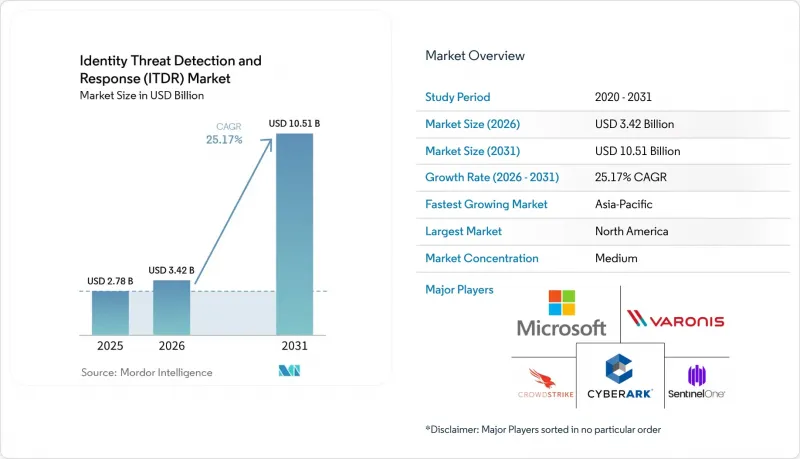
Mordor Intelligence에 의하면, 신원 위협 감지 및 대응(ITDR) 시장 규모는 2025년 27억 8,000만 달러에서 2026년에는 34억 2,000만 달러로 확대되어 2031년까지 105억 1,000만 달러에 이를 것으로 예상되고 있어 2026년부터 2031년까지 CAGR 25.17%로 성장할 전망입니다.
본 보고서는 구성 요소(솔루션 및 서비스), 보안 유형(신원 위협 감지, ID 위험 평가 등), 배포 방식(클라우드, 하이브리드 등), 기업 규모(대기업, 중소기업), 최종 사용 산업(소매 및 전자상거래, BFSI 등) 및 지역별로 분류되어 있습니다. 시장 전망은 금액(달러) 기준으로 제시되어 있습니다.
세계 신원 위협 감지 및 대응(ITDR) 시장 동향 및 인사이트
신원을 표적으로 한 공격 및 인증 정보 악용 증가
공격자들이 유효한 계정을 이용하여 기업 시스템 내부로 계속 침투함에 따라, 인증 정보 악용은 신원 위협 감지 및 대응(ITDR) 시장의 가장 직접적인 성장 요인으로 자리 잡고 있습니다. 버라이즌의 보고서에 따르면, 2026년에는 공격 체인 전반에 걸친 정보 유출 사례의 39%에서 도난당한 인증 정보가 확인되었으며, 신원이 많은 경우 최초의 침입 지점이자 이후의 공격 경로가 되고 있음을 보여줍니다. 소포스는 2026년 1분기 조사에서 71%의 조직이 지난 12개월 동안 적어도 한 건의 ID 관련 침해 사고를 경험했으며, 사고 1건당 평균 복구 비용이 164만 달러에 달했다고 밝혔습니다. 이 조사에 따르면 랜섬웨어 사고의 67%에서 ID 침해가 주요 침입 경로였던 반면, ID 침해의 41%는 API 키, 서비스 계정 및 방치된 인증 정보로 인한 것으로 밝혀졌습니다. 자동화된 공격이 계속 가속화되고 비인간 ID가 지속적으로 증가하는 가운데, ID 위협 감지 및 대응(ITDR) 시장의 구매자들은 인간 분석가가 모든 경보를 확인하기 전에 작동하는 지속적인 모니터링, 신속한 검증 및 자동화된 대응 조치를 더욱 중요하게 여기고 있습니다.
원격 및 하이브리드 근무 확대에 따른 ID의 확산
원격 근무 및 하이브리드 근무의 보급으로 인해, ID 위협 감지 및 대응(ITDR) 시장에서는 모니터링 대상인 사용자 계정, 기기, 일시적 권한, 파트너 연결의 범위가 대폭 확대되고 있습니다. 많은 기업에서 온보딩 시마다 토큰, 쿠키, 단기 접근 권한이 생성되는데, 이들이 의도된 기간보다 더 오래 유효한 상태로 남아 있기 때문에 보안 담당자가 선별해야 하는 ‘ID 노이즈’의 양이 증가하고 있습니다. Netwrix의 보고서에 따르면, 2025년에는 46%의 조직이 클라우드 계정 침해 사고를 경험할 것으로 예상되며, 이는 2020년의 16%에서 증가한 수치입니다. 이러한 추세는 더욱 분산화된 업무 방식과 클라우드 의존도가 높아진 액세스 패턴으로의 전환과 밀접한 관련이 있습니다. 이러한 변화가 중요한 이유는 원격 근무로 인해 직원들이 사무실 밖에서 일하게 된 것뿐만 아니라, ID 점검 대상이 더 많은 디렉터리, 용도 및 관리 대상 외 세션으로 확대되었기 때문입니다. 따라서 ID 위협 감지 및 대응(ITDR) 시장에서는
IAM, PAM, SIEM, XDR 스택 간의 통합 복잡성
대부분의 기업이 이미 서로 다른 팀이 관리하는 여러 ID 및 보안 시스템을 운영하고 있기 때문에 통합 작업은 여전히 신원 위협 감지 및 대응(ITDR) 시장에서 가장 뚜렷한 도입 장벽으로 남아 있습니다. 플랫폼이 완전한 감지 범위를 실현하기 전에, 싱글 사인온(SSO), 특권 액세스, 엔드포인트 텔레메트리, 사고 대응 워크플로를 통합해야 하는 경우, 도입은 더욱 어려워집니다. 부분적인 통합은 또 다른 문제도 야기합니다. 도구는 자체적으로 인식하는 데이터 내에서는 효과적으로 보일 수 있지만, 다른 ID 저장소나 관리 대상 외 용도의 접근 경로에 대해서는 파악하지 못할 가능성이 있기 때문입니다. 보안 책임자는 도입을 시작하기 전에 보안 운영 팀과 IT 팀 양측으로부터 예산과 승인을 받아야 하는 경우가 많아, 이로 인해 구매 결정이 지연되고 있습니다. 보다 광범위한 커넥터 라이브러리를 제공하는 벤더는 이러한 마찰을 완화할 수 있지만, 기업들이 구식 IAM 환경이나 여러 벤더가 혼재된 아키텍처를 유지하고 있기 때문에 ITDR 시장의 도입은 여전히 더딘 상태입니다.
부문 분석
2025년, 솔루션은 신원 위협 감지 및 대응(ITDR) 시장 점유율의 61.23%를 차지했습니다. 이는 기업들이 핵심적인 감지, 분석 및 디렉터리 보호 계층에 대한 직접적인 제어를 우선시했기 때문에 제품 매출이 서비스 매출을 상회했음을 보여줍니다. 신원 위협 감지 및 대응(ITDR) 시장의 이 부문에 대한 수요는 계속해서 신원 위협 감지 플랫폼, Active Directory 보안 도구, 클라우드 ID 제어, 그리고 팀이 부정 사용을 조기에 파악하는 데 도움이 되는 위협 인텔리전스 기능에 집중되었습니다. 또한, 보안 책임자들이 복잡한 환경 전반에 걸쳐 액세스 제어가 효과적으로 작동하고 있는지 보여주는 대시보드와 증거를 점점 더 요구함에 따라, 구매자들은 단순한 경보 알림 단계를 넘어섰습니다. 이로 인해 솔루션에 대한 지출을 정당화하기가 더 쉬워졌습니다. 제품이 더 이상 좁은 범위의 침해 이용 사례에 국한되지 않고, 일상적인 모니터링, 정책 검증 및 감사 지원과 연계되어 있기 때문입니다.
서비스 부문은 2031년까지 연평균 성장률(CAGR) 26.28%를 나타낼 것으로 예측되며, 규모는 작지만 구성 요소 중 가장 빠르게 성장하는 분야입니다. 이러한 성장은 신원 위협 감지 및 대응 업계의 현실적인 추세를 반영한 것입니다. 많은 조직에서는 감지 설정의 미세 조정, 텔레메트리 매핑, 그리고 ID 신호의 대규모 조사를 수행할 수 있는 사내 전문가가 여전히 부족하기 때문입니다. 따라서 관리형 감지, 도입 지원 및 자문 서비스는 제품 도입과 경쟁하기보다는 그 보급에 따라 확대될 것입니다. 여기서 중견 기업의 구매자가 특히 중요합니다. 왜냐하면 이들은 전담 ID 보안 팀을 구축하지 않은 채 더 강력한 ID 모니터링을 원하는 경우가 많기 때문입니다. 장기적으로 볼 때, 구성 요소의 동향을 고려할 때, 신원 위협 감지 및 대응 시장에서는 특히 도입이 여러 신원 제공업체나 대응 도구에 걸쳐 있는 경우, 사용하기 쉬운 플랫폼과 충실한 서비스를 결합할 수 있는 벤더가 계속해서 우위를 점할 것으로 시사됩니다.
2025년, 신원 위협 감지 시장 점유율은 27.19%를 차지하고 있으며, 이는 신원 위협 감지 및 대응(ITDR) 시장에 진입하는 많은 구매자에게 있어 직접적인 감지가 여전히 출발점이 되고 있음을 보여줍니다. 대부분의 조직은 보다 예방적인 ID 프로그램으로 확대하기 전에, 먼저 의심스러운 로그인, 특권 남용 및 비정상적인 인증 경로를 확인해야 합니다. 이를 통해 위협 감지는 즉각적인 가시성을 제공하고 보안 팀에 투자에 대한 명확한 운영적 근거를 제시하므로 그 중요성이 유지되고 있습니다. 또한, 엔드포인트 및 네트워크 감지를 이미 이해하고 있으며 ID 계층에서도 동등한 커버리지를 원하는 기업에게 위협 감지는 여전히 가장 쉬운 진입점입니다.
ID 보안 태세 관리는 2031년까지 연평균 성장률(CAGR) 26.39%로 확대될 것으로 예측되며, 이는 신원 위협 감지 및 대응(ITDR) 시장의 지출이 다음 단계로 진입할 것임을 시사합니다. 구매자들은 부정 사용이 시작된 후에야 이를 발견하는 것만으로는 더 이상 만족하지 않으며, 권한이 과도하게 부여된 계정, 방치된 인증 정보, 취약한 정책 설정을 해당 취약점이 악용되기 전에 식별하기를 점점 더 요구하고 있습니다. 이러한 변화에 따라 가치 제안도 변화하고 있습니다. 보안 태세 관리는 단편적인 대응이 아닌 지속적인 재검토를 지원하기 때문입니다. 또한, 보안 태세 조사 결과가 실제 활동이나 접근 행동과 연계되면 우선순위 설정이 용이해지므로, ID 위험 평가 및 사고 대응도 이러한 추세의 혜택을 받고 있습니다. 이러한 동향은 ITDR 시장이 단순한 감지 범주를 넘어 거버넌스, 감사 대응, 운영 관리를 지원하는 보다 광범위한 ID 위험 관리 영역으로 확대되고 있음을 시사합니다.
지역별 분석
2025년, 북미는 신원 위협 감지 및 대응(ITDR) 시장 점유율의 32.18%를 차지하며, 지역별로는 가장 큰 기여를 한 지역이 되었습니다. 이 지역은 규제 대상 기업의 기반이 탄탄하고, 벤더의 입지가 성숙하며, 보다 광범위한 사이버 보안 프로그램의 일환으로 신원 제어에 투자하려는 의지가 높다는 점 등의 혜택을 받고 있습니다. CISA의 '제로 트러스트 성숙도 모델'에서는 신원 관리에 가장 큰 영향력을 미치는 초기 역할이 할당되어 있으며, 이는 많은 대기업 및 연방 정부 공급업체에게 신원 가시화를 실질적인 요구 사항으로 전환하는 데 기여하고 있습니다. 또한, 북미의 신원 위협 감지 및 대응(ITDR) 시장은 인증 정보의 악용, 신원 침해를 통한 랜섬웨어 유포, 그리고 복잡한 기업 환경 전반에 걸친 특권 액세스 감시의 강화로 인해 발생하는 꾸준한 압박으로부터도 혜택을 받고 있습니다. 따라서 이 지역의 구매자들은 ITDR을 단기적인 조달 주기가 아닌, 보안 운영의 영구적인 계층으로 취급하는 경향이 강해지고 있습니다.
유럽에서는 신원 위협 감지 및 대응(ITDR) 시장이 규정 준수를 주도하는 더욱 강력한 단계로 접어들고 있습니다. 독일의 NIS2(네트워크 및 정보 보안 지침 2)가 2025년 12월에 발효되면서, 더 광범위한 조직에 대해 신원 관리 및 인증과 관련된 더 엄격한 의무가 도입되었습니다. 이는 현재 지출이 침해 방지뿐만 아니라 감사에 대한 대비 및 법적 구속력이 있는 운영 요건과도 연결되어 있기 때문에 중요한 의미를 지닙니다. HID Global은 2026년 보고서에서 신원 관리가 물리적 보안과 사이버 보안의 중요한 접점이 되고 있다고 지적했으며, 이는 통합된 관리 프레임워크를 향한 유럽 전역의 움직임과 일치합니다. 남미는 도입 주기의 초기 단계에 머물러 있지만, 디지털 금융의 성장과 데이터 보호에 대한 기대감 고조가 해당 지역에서 ID 모니터링 도입의 근거를 명확히 하는 데 기여하고 있습니다.
아시아태평양은 2031년까지 연평균 성장률(CAGR) 26.83%를 나타낼 것으로 예측되며, ITDR 시장에서 가장 빠르게 성장하는 지역입니다. 이 지역에서는 디지털 서비스의 급속한 확대, 클라우드의 광범위한 활용, 모바일 주도 인증 활동 증가가 관찰되며, 이 모든 요인이 모니터링이 필요한 ID 및 세션의 수를 증가시키고 있습니다. 인도, 일본, 한국, 호주 등 여러 국가에서 진행 중인 정부 주도의 디지털 ID 프로그램 또한 공공 및 민간 시스템 전반에 걸친 보다 광범위한 신원 관리 노력을 뒷받침하고 있습니다. 다만, 각국의 규정 준수 요건, 조달 성숙도, 인력 규모에는 여전히 큰 편차가 존재하기 때문에 도입 현황이 균일한 것은 아닙니다. 중동 및 아프리카(MEA) 지역은 여전히 초기 단계에 있지만, 국가 주도의 디지털 인프라 계획과 공공 부문의 ID 프로그램으로 인해 보다 체계적인 수요가 발생하기 시작하고 있습니다. 아시아태평양과 MEA 지역 모두에서 신원 위협 감지 및 대응(ITDR) 시장은 클라우드 도입, 규제 당국의 관심, 그리고 머신 ID 증가가 동일한 구매자 환경 내에서 중첩되는 지역에서 가장 빠르게 성장할 것으로 예측됩니다.
기타 혜택:
- 엑셀 형식 시장 예측(ME) 시트
- 3개월간의 애널리스트 지원
자주 묻는 질문
목차
제1장 서론
제2장 조사 방법
제3장 주요 요약
제4장 시장 구도
제5장 시장 규모와 성장 예측
제6장 경쟁 구도
제7장 시장 기회와 향후 전망
JHS 26.08.07According to Mordor Intelligence, the identity threat detection and response (ITDR) market size is expected to increase from USD 2.78 billion in 2025 to USD 3.42 billion in 2026 and reach USD 10.51 billion by 2031, growing at a CAGR of 25.17% over 2026-2031.
This report is Segmented by Component (Solution and Services), Security Type (Identity Threat Detection, Identity Risk Assessment, and More), Deployment (Cloud, Hybrid, and More), Enterprise Size (Large Enterprises, and Small and Medium Enterprises), End-User Industry (Retail and E-Commerce, BFSI, and More), and Geography. The Market Forecasts are Provided in Terms of Value (USD).
Global Identity Threat Detection and Response (ITDR) Market Trends and Insights
Rise in Identity-Based Attacks and Credential Abuse
Credential abuse remains the most direct growth driver for the identity threat detection and response (ITDR) market, as attackers continue to use valid accounts to move through enterprise systems. Verizon reports that stolen credentials appear in 39% of breaches across the full attack chain in 2026, indicating that identity is often the initial entry point and the subsequent path of attack. Sophos found in Q1 2026 that 71% of organizations experienced at least 1 identity-related breach in the prior 12 months, and the mean recovery cost per incident reached USD 1.64 million. The same study found that identity compromise was the primary delivery path in 67% of ransomware incidents, while API keys, service accounts, and orphaned credentials accounted for 41% of identity breaches. As automated attacks keep accelerating and non-human identities keep growing, buyers in the identity threat detection and response market are placing greater value on continuous monitoring, rapid validation, and automated response actions that act before a human analyst can review every alert.
Expansion of Remote and Hybrid Work Identity Sprawl
Remote and hybrid work have left the identity threat detection and response (ITDR) market with a much broader set of user accounts, devices, temporary permissions, and partner connections to monitor. In many enterprises, each onboarding cycle now creates tokens, cookies, and short-term access grants that remain active longer than intended, increasing the amount of identity noise defenders must sort through. Netwrix reported that 46% of organizations experienced cloud account compromise in 2025, up from 16% in 2020, which closely tracks the shift toward more distributed work and more cloud-dependent access patterns. This change matters because remote work not only moved employees outside the office but also pushed identity checks across more directories, applications, and unmanaged sessions. That is why the identity threat detection and response (ITDR) market is seeing stronger demand for
Integration Complexity Across IAM, PAM, SIEM, and XDR Stacks
Integration work remains the clearest adoption barrier in the identity threat detection and response (ITDR) market, as most enterprises already run multiple identity and security systems owned by different teams. Deployment becomes more difficult when organizations must integrate single sign-on, privileged access, endpoint telemetry, and incident workflows before the platform can deliver complete detection coverage. Partial integration creates another problem because the tool may appear effective within the data it sees, while remaining blind to access paths in other identity stores or unmanaged applications. That slows buying decisions because security leaders often need budget and approval from both security operations and IT teams before rollout can begin. Vendors that offer broader connector libraries can reduce this friction, but the ITDR market still faces slower adoption, as enterprises maintain older IAM estates and mixed-vendor architectures.
Other drivers and restraints analyzed in the detailed report include:
- Cloud Identity Fragmentation Across SaaS and IaaS Environments
- Zero Trust Program Expansion Across Large Enterprises
- Identity Telemetry Privacy Concerns and Data Minimization Constraints
For complete list of drivers and restraints, kindly check the Table Of Contents.
Segment Analysis
Solutions held 61.23% of the identity threat detection and response (ITDR) market share in 2025, which kept product revenue ahead of services as enterprises prioritized direct control over core detection, analytics, and directory protection layers. Demand for this part of the identity threat detection and response (ITDR) market remained centered on identity threat detection platforms, Active Directory security tools, cloud identity controls, and risk intelligence features that help teams see misuse earlier. Buyers have also moved beyond simple alerting, as security leaders increasingly want dashboards and evidence to show whether access controls are effective across complex environments. That makes solution spending easier to justify because the product is now tied to daily monitoring, policy validation, and audit support rather than a narrow breach response use case.
Services are projected to grow at a 26.28% CAGR through 2031, which makes them the faster-moving part of the component mix even though they start from a smaller base. This growth follows a practical pattern in the identity threat detection and response industry, as many organizations still lack internal specialists who can tune detections, map telemetry, and investigate identity signals at scale. Managed detection, implementation support, and advisory services therefore rise with product adoption instead of competing against it. Mid-market buyers are especially important here because they often want stronger identity monitoring without building a dedicated identity security team. Over time, the component mix suggests that the identity threat detection and response market will continue to reward vendors that can pair a usable platform with service depth, especially when deployments span multiple identity providers and response tools.
Identity threat detection held a 27.19% share in 2025, indicating that direct detection remains the starting point for many buyers entering the identity threat detection and response (ITDR) market. Most organizations first need to see suspicious logins, privilege misuse, and unusual authentication paths before they expand into more preventive identity programs. This keeps threat detection important because it delivers immediate visibility and gives security teams a clear operational case for investment. It also remains the easiest entry point for enterprises that already understand endpoint or network detection and now want equivalent coverage at the identity layer.
Identity security posture management is forecast to expand at a 26.39% CAGR through 2031, signaling the next phase of spending in the identity threat detection and response (ITDR) market. Buyers are no longer satisfied with finding misuse after it starts, and they increasingly want to identify over-permissioned accounts, orphaned credentials, and weak policy settings before those gaps are exploited. That shift changes the value story because posture management supports continuous review rather than isolated responses. Identity risk assessment and incident response also benefit from this pattern, as posture findings are easier to prioritize when they connect to live activity and access behavior. The direction of travel suggests that the ITDR market is broadening from a detection category into a broader identity risk management layer that supports governance, audit readiness, and operational control.
Complete Report Scope:
- By Component
- Solutions
- Identity Threat Detection Platforms
- Identity Security Posture Management
- Identity Analytics and Risk Intelligence
- Active Directory Security
- Cloud Identity Security
- Services
- Solutions
- By Security Type
- Identity Threat Detection
- Identity Risk Assessment
- Identity Security Posture Management
- Identity Incident Response
- Governance and Compliance
- By Deployment
- Cloud
- On-Premises
- Hybrid
- By Enterprise Size
- Large Enterprises
- Small and Medium Enterprises
- By End-user Industry
- BFSI
- Healthcare and Life Sciences
- Information Technology and Telecom
- Retail and E-commerce
- Industrial Manufacturing
- Government and Public Sector
- Other End-user Industries
- By Geography
- North America
- United States
- Canada
- Mexico
- South America
- Brazil
- Argentina
- Rest of South America
- Europe
- Germany
- United Kingdom
- France
- Italy
- Spain
- Russia
- Rest of Europe
- Asia-Pacific
- China
- India
- Japan
- South Korea
- Australia
- Rest of Asia-Pacific
- Middle East and Africa
- Middle East
- Saudi Arabia
- United Arab Emirates
- Rest of Middle East
- Africa
- South Africa
- Nigeria
- Rest of Africa
- Middle East
- North America
Geography Analysis
North America held 32.18% of the identity threat detection and response (ITDR) market share in 2025, making it the largest regional contributor. The region benefits from a dense base of regulated enterprises, mature vendor presence, and a stronger willingness to fund identity controls as part of broader cyber programs. CISA's Zero Trust Maturity Model gives identity the highest-leverage starting role, and that has helped turn identity visibility into a practical requirement for many large organizations and federal-facing suppliers. The identity threat detection and response market in North America also benefits from steady pressure created by credential abuse, ransomware delivery through identity compromise, and rising scrutiny of privileged access across complex enterprise estates. Buyers in the region are therefore more likely to treat ITDR as a permanent layer inside security operations rather than as a short-term procurement cycle.
Europe is entering a stronger, compliance-led phase of the identity threat detection and response (ITDR) market. Germany's NIS2 implementation took effect in December 2025 and introduced stricter obligations on identity controls and authentication across a wider set of entities. This matters because spending is now linked not only to breach prevention but also to audit readiness and enforceable operating requirements. HID Global reported in 2026 that identity has become a key meeting point between physical security and cybersecurity, which fits the broader European push toward integrated control frameworks. South America remains earlier in the adoption cycle, but digital financial growth and tighter data protection expectations are helping the region build a clearer case for identity monitoring.
Asia-Pacific is projected to grow at a 26.83% CAGR through 2031, which makes it the fastest-growing region in the ITDR market. The region is seeing rapid expansion of digital services, heavy cloud use, and rising volumes of mobile-led authentication activity, all of which increase the number of identities and sessions that must be monitored. Government-backed digital identity programs in countries such as India, Japan, South Korea, and Australia also support a wider identity control agenda across public and private systems. That does not mean adoption is uniform, because local compliance demands, purchasing maturity, and staffing depth still vary widely by country. The Middle East and Africa remain at an earlier stage, yet sovereign digital infrastructure plans and public-sector identity programs are starting to create more structured demand. Across both Asia-Pacific and MEA, the identity threat detection and response (ITDR) market is likely to grow fastest where cloud adoption, regulatory attention, and machine-identity growth converge within the same buyer environment.
- CrowdStrike, Inc.
- Microsoft Corporation
- CyberArk Software Ltd.
- Varonis Systems, Inc.
- SentinelOne, Inc.
- Proofpoint, Inc.
- BeyondTrust Corporation
- SailPoint Technologies Holdings, Inc.
- Okta, Inc.
- Ping Identity Holding Corp.
- Semperis, Inc.
- Silverfort Ltd.
- Delinea, Inc.
- Quest Software Inc.
- Vectra AI, Inc.
- Acalvio Technologies, Inc.
- Gurucul, Inc.
- Saviynt
- ZeroFox Holdings, Inc.
- Netwrix Corporation
Additional Benefits:
- The market estimate (ME) sheet in Excel format
- 3 months of analyst support
TABLE OF CONTENTS
1 INTRODUCTION
- 1.1 Study Assumptions and Market Definition
- 1.2 Scope of the Study
2 RESEARCH METHODOLOGY
3 EXECUTIVE SUMMARY
4 MARKET LANDSCAPE
- 4.1 Market Overview
- 4.2 Market Drivers
- 4.2.1 Rise in Identity-Based Attacks and Credential Abuse
- 4.2.2 Expansion of Remote and Hybrid Work Identity Sprawl
- 4.2.3 Cloud Identity Fragmentation Across SaaS and IaaS Environments
- 4.2.4 Zero Trust Program Expansion Across Large Enterprises
- 4.2.5 Board-Level Pressure for Identity Telemetry and Measurable Control Coverage
- 4.2.6 AI-Augmented Attack Simulation and Exposure Prioritization
- 4.3 Market Restraints
- 4.3.1 Integration Complexity Across IAM, PAM, SIEM, and XDR Stacks
- 4.3.2 Identity Telemetry Privacy Concerns and Data Minimization Constraints
- 4.3.3 False Positive Fatigue in Identity Signal Correlation
- 4.3.4 High Operational Skill Requirement for Tuning and Investigation
- 4.4 Impact of Macroeconomic Factors on the Market
- 4.5 Industry Value-Chain Analysis
- 4.6 Regulatory Landscape
- 4.7 Technological Outlook
- 4.8 Porter's Five Forces Analysis
- 4.8.1 Bargaining Power of Buyers
- 4.8.2 Bargaining Power of Suppliers
- 4.8.3 Threat of New Entrants
- 4.8.4 Threat of Substitutes
- 4.8.5 Intensity of Competitive Rivalry
5 MARKET SIZE AND GROWTH FORECASTS (VALUE)
- 5.1 By Component
- 5.1.1 Solutions
- 5.1.1.1 Identity Threat Detection Platforms
- 5.1.1.2 Identity Security Posture Management
- 5.1.1.3 Identity Analytics and Risk Intelligence
- 5.1.1.4 Active Directory Security
- 5.1.1.5 Cloud Identity Security
- 5.1.2 Services
- 5.1.1 Solutions
- 5.2 By Security Type
- 5.2.1 Identity Threat Detection
- 5.2.2 Identity Risk Assessment
- 5.2.3 Identity Security Posture Management
- 5.2.4 Identity Incident Response
- 5.2.5 Governance and Compliance
- 5.3 By Deployment
- 5.3.1 Cloud
- 5.3.2 On-Premises
- 5.3.3 Hybrid
- 5.4 By Enterprise Size
- 5.4.1 Large Enterprises
- 5.4.2 Small and Medium Enterprises
- 5.5 By End-user Industry
- 5.5.1 BFSI
- 5.5.2 Healthcare and Life Sciences
- 5.5.3 Information Technology and Telecom
- 5.5.4 Retail and E-commerce
- 5.5.5 Industrial Manufacturing
- 5.5.6 Government and Public Sector
- 5.5.7 Other End-user Industries
- 5.6 By Geography
- 5.6.1 North America
- 5.6.1.1 United States
- 5.6.1.2 Canada
- 5.6.1.3 Mexico
- 5.6.2 South America
- 5.6.2.1 Brazil
- 5.6.2.2 Argentina
- 5.6.2.3 Rest of South America
- 5.6.3 Europe
- 5.6.3.1 Germany
- 5.6.3.2 United Kingdom
- 5.6.3.3 France
- 5.6.3.4 Italy
- 5.6.3.5 Spain
- 5.6.3.6 Russia
- 5.6.3.7 Rest of Europe
- 5.6.4 Asia-Pacific
- 5.6.4.1 China
- 5.6.4.2 India
- 5.6.4.3 Japan
- 5.6.4.4 South Korea
- 5.6.4.5 Australia
- 5.6.4.6 Rest of Asia-Pacific
- 5.6.5 Middle East and Africa
- 5.6.5.1 Middle East
- 5.6.5.1.1 Saudi Arabia
- 5.6.5.1.2 United Arab Emirates
- 5.6.5.1.3 Rest of Middle East
- 5.6.5.2 Africa
- 5.6.5.2.1 South Africa
- 5.6.5.2.2 Nigeria
- 5.6.5.2.3 Rest of Africa
- 5.6.5.1 Middle East
- 5.6.1 North America
6 COMPETITIVE LANDSCAPE
- 6.1 Market Concentration
- 6.2 Strategic Moves
- 6.3 Market Share Analysis
- 6.4 Company Profiles (includes Global Level Overview, Market Level Overview, Core Segments, Financials as available, Strategic Information, Market Rank/Share, Products and Services, Recent Developments)
- 6.4.1 CrowdStrike, Inc.
- 6.4.2 Microsoft Corporation
- 6.4.3 CyberArk Software Ltd.
- 6.4.4 Varonis Systems, Inc.
- 6.4.5 SentinelOne, Inc.
- 6.4.6 Proofpoint, Inc.
- 6.4.7 BeyondTrust Corporation
- 6.4.8 SailPoint Technologies Holdings, Inc.
- 6.4.9 Okta, Inc.
- 6.4.10 Ping Identity Holding Corp.
- 6.4.11 Semperis, Inc.
- 6.4.12 Silverfort Ltd.
- 6.4.13 Delinea, Inc.
- 6.4.14 Quest Software Inc.
- 6.4.15 Vectra AI, Inc.
- 6.4.16 Acalvio Technologies, Inc.
- 6.4.17 Gurucul, Inc.
- 6.4.18 Saviynt
- 6.4.19 ZeroFox Holdings, Inc.
- 6.4.20 Netwrix Corporation
7 MARKET OPPORTUNITIES AND FUTURE OUTLOOK
- 7.1 White-Space and Unmet-Need Assessment


