

|
시장보고서
상품코드
2098593
유약 유리화 타일(GVT) : 시장 점유율 분석, 업계 동향 및 통계, 성장 예측(2026-2031년)Glazed Vitrified Tiles (GVT) - Market Share Analysis, Industry Trends & Statistics, Growth Forecasts (2026 - 2031) |
||||||
 Mordor Intelligence
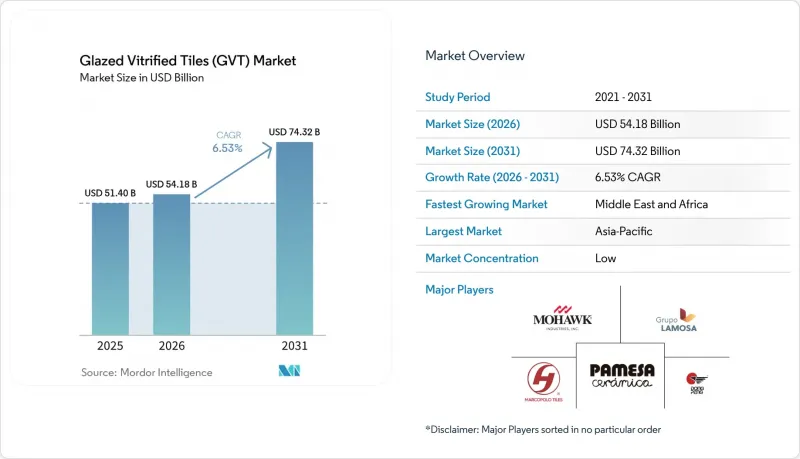
Mordor Intelligence에 의하면, 유약 유리화 타일(GVT) 시장 규모는 2025년 514억 달러로 평가되었습니다. 2026년에는 542억 달러로 확대되어 2031년까지 743억 달러에 이를 것으로 예상되고 2026년부터 2031년에 걸쳐 CAGR 6.5%로 성장할 전망입니다.
본 보고서는 제품 유형(연마 유약 유리화 타일(PGVT), 기타), 두께(8 mm 이하, 9-12 mm, 20 mm 포장용), 크기(표준 600 mm 이하, 기타), 건설 유형(신축, 리모델링), 용도(바닥, 기타), 최종 사용자(주택, 상업시설), 유통 채널(B2C, B2B), 지역별로 분류되어 있습니다. 시장 전망은 금액(달러) 기준으로 제시되어 있습니다.
세계의 유약 유리화 타일(GVT) 시장 동향 및 인사이트
리모델링을 계기로, 기존의 세라믹 타일이나 라미네이트 자재에서 내구성이 높고 유지보수 부담이 적은 GVT로 교체
성숙한 경제권에서 주택 재고의 노후화에 따라 주방 및 욕실 관련 지출이 지속적으로 증가하고 있으며, 주택 소유자들은 GVT의 유지보수 용이성과 치수 안정성을 선호하고 있습니다. 습기가 많은 장소나 현관에서는 DIN 51130에 기반한 R10-R11의 미끄럼 저항 등급을 가진 무광 마감이나 텍스처 마감 타일이 지정되어, 연마된 천연석에 비해 안전성을 높이고 미끄러짐 사고를 줄이도록 하고 있습니다. 온라인 비주얼라이저 및 소매 플랫폼을 통한 안내는 소비자가 대형 타일의 배치를 계획하는 데 도움을 주며, 리모델링 프로젝트의 시공 복잡성에 대한 인식을 완화하고 있습니다. 리모델링 수요가 활발한 시기에는 프로젝트 기반 주문이 소매 재고 보충보다 신속하게 처리되기 때문에 공급망의 자금 사정이 어려워지고, 분산된 클러스터에 속한 소규모 가공업체에 대해 지급 기한 단축을 요구하는 압박이 가해질 가능성이 있습니다. 대규모 통합 제조업체는 안정적인 타일 판매량과 설비 가동률에 주력하는 동시에, 수요가 부진한 계절적 기간에는 판촉 활동과 판매점에 대한 인센티브를 조정하고 있습니다. ISO 9001 시스템이나 ANSI A137.1의 허용 오차와 같은 품질·성능 기준으로 인해 소규모 생산자의 규정 준수 비용이 증가하고 있으며, 이는 사내 시험 체계와 확립된 보증 체계를 갖춘 상장 대기업에게 유리하게 작용하고 있습니다.
소매, 호텔·리조트, 사무실, 의료시설 등 상업시설의 리뉴얼에서는 오염 저항성 및 내마모성이 중시되고 있습니다.
의료 및 호텔·리조트 분야의 리모델링 공사에서는 표면의 위생성, 내화학성, 미끄럼 방지 성능이 중시되고 있으며, 이는 ISO 22196에 따라 시험된 GVT의 항균 유약 옵션과 부합합니다. 공공 공간에서 요구되는 펜듈럼 시험 PTV 36 이상이나 DCOF의 습윤 임계값과 같은 기술 사양은 복도, 로비, 환자 대응 구역 프로젝트 입찰에 영향을 미치고 있습니다. 시설 소유주는 항균 유약 및 CIP(정지 세척) 대응성을 장기적인 비용 관리의 일환으로 간주하고 있으며, 이로 인해 해당 부문에서 GVT의 고가 제품군에도 가격 책정 여지가 생기고 있습니다. 각 공급업체는 현장 미끄럼 시험, 내화학성 검증, 그리고 의료 및 공공시설의 그린 빌딩 인증 취득에 필요한 화재 안전 기준 및 저VOC 요건을 준수하는 제출 서류를 통해 컨설팅 지원을 강화하고 있습니다. RAK Ceramics의 보고에 따르면, UAE 내 해당사의 타일 제품 포트폴리오 중 대형 도자기 타일에 대한 수요는 슬래브 생산에 대한 투자와 프로젝트 기반 업무 구조의 강화에 힘입어 지속적으로 확대되고 있습니다. 이러한 변화로 인해 초기 비용 기준보다 성능과 유지보수의 예측 가능성이 선정의 결정적 요인이 되는 고사양 GVT 포맷에 대한 수용도가 높아지고 있습니다.
에너지 집약적인 소성 및 연료·탄소 가격 변동에 대한 노출
타일의 소성 온도와 연속 생산 일정에 따라 에너지 소비량은 일정 수준으로 고정되어 있어, 가스 가격의 급등이나 탄소 배출료로 인해 이익률이 압박받을 가능성이 있습니다. 연료 연소에 따른 배출량, 공정에서 발생하는 직접 배출량, 그리고 간접적인 전력 사용에 따른 배출량은 유럽에서 엄격하게 추적되고 있으며, 정책 메커니즘을 통해 에너지 집약적인 세라믹 제조에 대한 비용 압박이 강화되고 있습니다. 수소 대응 가마나 하이브리드 건조기는 요금 및 공급 상황의 변화에 따라 연료 혼합 비율과 전기 가열을 전환함으로써 가격 변동 위험을 헤지할 수 있습니다. 최신 슬래브 제조 시설에 도입된 첨단 열 회수 시스템은 소성에 필요한 1제곱미터당 에너지량을 줄여, 내재 탄소를 감축하기 위한 노력을 뒷받침하는 동시에 생산자가 저탄소 조달 기준을 충족하도록 돕고 있습니다. 전기화 및 수소화로의 개조에는 막대한 설비 투자가 필요하기 때문에 도입은 단계적으로 진행되며, 파일럿 라인에서의 시험 운영을 거친 후 공장 전체의 전환이 이루어집니다. 에너지 유연성과 열효율 향상을 우선시하는 생산자는 지정학적 요인이나 계절적인 가스 공급 제한에 따른 급격한 비용 급등의 영향을 완화할 수 있습니다.
부문 분석
2025년, 디지털 유약 유리화 타일은 유약 유리화 타일 시장 점유율의 62.03%를 차지했으며, 잉크젯 장식이 주거용 및 상업용 수요에서 이미 주류를 이루고 있음이 확인되었습니다. 이러한 주도적 지위는 제조의 유연성과 관련이 있습니다. 디지털 시스템은 기존 인쇄 방식과 같은 재고 부담 없이 더 신속한 디자인 변경과 폭넓은 카탈로그 전개를 가능하게 하기 때문입니다. 가장 큰 장점은 시각적 다양성뿐만 아니라, 소매업체, 시공업체, 사양 결정자가 더 짧은 주기로 최신 디자인을 요구할 때 이에 대응할 수 있는 높은 유연성에 있습니다. 그 결과, 유약 유리화 타일 시장에서 디지털 인쇄 제품은 틈새 프리미엄 시장이 아닌 표준 상품으로 자리 잡아가고 있습니다.
연마 GVT는 2031년까지 연평균 성장률(CAGR) 7.21%를 나타낼 것으로 예측되며, 유약 유리화 타일 업계에서 가장 빠르게 성장하는 제품 하위 유형이 될 전망입니다. 수요를 견인하고 있는 것은 더 높은 품질의 주거 환경을 추구하는 주택 리노베이션과, 대리석과 같은 마감 효과를 유지하면서도 유지 관리의 번거로움을 줄이고자 하는 호스피탈리티 업계의 프로젝트입니다. 한편, 광택보다는 미끄럼 방지 성능이나 저눈부심성이 중시되는 상황에서는 매트, 새틴, 텍스처 가공 제품이 여전히 중요한 위치를 차지하고 있습니다. 프리미엄 제품 조달에 있어 항균성, 저VOC, 내마모성 등의 성능이 점점 더 중요해지고 있으므로, 우수한 유약 기술과 시험 능력을 갖춘 제조업체는 이 시장에서 유리한 입지를 점하고 있습니다.
2025년, 9-12mm 두께 대는 유약 유리화 타일 시장의 46.73%를 차지하며, 대부분의 실내 주거 및 소규모 상업 용도에서 표준 사양으로서의 역할을 입증했습니다. 이 두께 범위는 구조적 성능, 취급 용이성, 운송 효율, 시공 시 익숙해지기 쉬움의 균형이 잘 잡혀 있어 적합합니다. 따라서 더 특수한 형태로 전환하지 않고도 신뢰할 수 있는 성능을 추구하는 구매자가 많은 유약 유리화 타일 시장에서 이 두께 대는 여전히 중심적인 위치를 차지하고 있습니다. 표준 두께의 제품은 시공업체와 주택 소유자가 실적이 입증되고 널리 구할 수 있는 제품을 선호하는 광범위한 리모델링 프로젝트에도 적합합니다.
20mm 포장용 타일 부문은 실외 하드스케이프가 도자기 타일 대체재로 전환됨에 따라 2031년까지 연평균 성장률(CAGR) 6.83%를 나타낼 것으로 예측됩니다. 이러한 제품은 테라스, 수영장 데크, 광장, 옥상 공간 등에서 그 중요성이 커지고 있으며, 이러한 공간에서는 기존의 석재 외관뿐만 아니라 강도, 낮은 수분 흡수율, 그리고 교체가 용이하다는 점이 더욱 중시되는 추세입니다. 또한, 이러한 제품의 매력은 유지보수를 간소화하고 개별 타일을 교체할 때의 불편함을 줄여주는 드라이 레이 공법 및 페데스탈 시스템에서도 기인합니다. 이를 통해 유약 유리화 타일 시장은 기존에 콘크리트나 천연석에 크게 의존하던 광범위한 실외 사양 기반과 연계된 상태를 유지하고 있습니다.
2025년에는 600mm 이하 타일이 부문 매출의 47.62%를 차지했으며, 이는 표준 크기가 여전히 유약 유리화 타일 시장의 가장 광범위한 설치 기반을 뒷받침하고 있음을 보여줍니다. 이러한 제품은 운반 및 절단이 용이하고, 바탕 상태가 이상적이지 않은 리모델링 공사에서도 시공이 쉬워 그 입지는 여전히 견고합니다. 또한 표준 크기는 기존의 방 배치나 일반적인 줄눈 간격 관행에도 부합하므로, 일상적인 주택 공사에서 시공의 복잡성을 줄여줍니다. 이러한 실용적인 적합성 덕분에 디자인 주도형 프로젝트에서 대형 슬래브나 리파인 타일이 주목을 받는 상황에서도 표준 크기는 여전히 중심적인 위치를 차지하고 있습니다.
대형 타일은 2031년까지 연평균 성장률(CAGR) 7.34%로 확대될 것으로 예측되며, 유약 유리화 타일 업계에서 가장 빠르게 성장하는 부문이 될 전망입니다. 이러한 성장을 주도하고 있는 것은 로비, 파사드, 오픈 플랜 인테리어에서 줄눈 수를 줄이고, 더 연속적인 표면을 구현하며, 시각적 임팩트를 높이려는 프로젝트들입니다. 또한 제조업체의 투자도 분명히 이 분야로 이동하고 있으며, 주요 제조업체들은 대형 타일 생산 라인과 슬래브 생산 능력에 대해 보다 전략적인 자본을 투입하고 있습니다. 장거리 운송의 경우, 물류 및 파손이 여전히 제약 요인으로 작용하고 있지만, 메쉬 뒷면 보강, 포장 개선 및 자동화된 취급을 통해 이러한 제품을 대규모로 상용화하는 것이 점차 용이해지고 있습니다.
지역별 분석
2025년, 아시아태평양은 전 세계 매출의 58.9%를 차지하며 유약 유리화 타일 시장에서 가장 큰 점유율을 기록했습니다. 이 지역은 광범위한 제조거점, 밀집된 도시 건설 프로젝트, 그리고 생산과 소비 양면에서 중국과 인도가 수행하는 중심적인 역할의 혜택을 받고 있습니다. 인도가 여전히 중요한 위치를 차지하고 있는 것은 체계적인 제조업체들이 생산 능력 확대, 브랜드력 강화, 그리고 프리미엄 및 프로젝트용 규격 시장으로의 추가 진출을 지속하고 있기 때문입니다. 중국 역시 중요한 시장입니다. 중국의 대규모 제조거점이 디자인의 폭넓은 다양성, 수출 공급, 그리고 고부가가치 도자기 타일 부문에서의 지속적인 제품 개발을 뒷받침하고 있기 때문입니다. 이러한 조건들이 결합되어 아시아태평양은 생산량, 제품의 다양성, 비용 경쟁력 어느 측면에서나 유약 유리화 타일 시장의 중심적인 위치를 계속 차지하고 있습니다.
중동 및 아프리카는 2031년까지 연평균 성장률(CAGR) 7.5%를 나타낼 것으로 예측되며, 이는 유약 유리화 타일 시장에서 지역별 가장 빠른 성장 속도입니다. GCC(걸프협력회의) 국가들 수요는 호텔·리조트, 공공시설, 의료, 복합 용도 건설에 의해 뒷받침되고 있으며, 이러한 분야에서는 대형 포세린 타일 및 사양 등급 타일에 대한 수요가 증가하고 있습니다. 북아프리카 및 사하라 이남 아프리카 시장도 도시화와 현지 제조 투자로 인해 공급 기반이 확대됨에 따라 장기적인 성장 여지가 예상됩니다. 이러한 성장세에도 불구하고, 가격 압박과 에너지 제약이 해당 지역의 신규 생산 능력 흡수 속도에 영향을 미칠 가능성이 있습니다.
북미 및 유럽은 아시아태평양에 비해 유약 유리화 타일 시장 점유율은 작지만, 프리미엄 사양의 동향이나 리모델링 주도형 수요에 영향을 미치기 때문에 여전히 전략적으로 중요한 시장입니다. 북미 시장은 리모델링이나 바닥재 교체가 주류를 이루고 있어, 제품 차별화, 항균 성능, 미끄럼 저항 성능의 기준 적합성이 구매 결정에 있어 중요한 요소로 작용하고 있습니다. 유럽은 에너지 환경이 더욱 엄격한 상황인 만큼, 대형 고급 타일 생산 라인이나 보다 효율적인 공정 기술에 투자하는 제조업체일수록 이익률을 유지하기 쉬운 입장에 있습니다. 남미는 현지 생산과 주택 관련 수요를 통해 안정적인 기반을 제공하고 있으며, 멕시코와 브라질은 지역 내 공급 및 투자 의사 결정에서 계속해서 중요한 역할을 수행하고 있습니다.
기타 혜택 :
- 엑셀 형식 시장 예측(ME) 시트
- 3개월간의 애널리스트 지원
자주 묻는 질문
목차
제1장 서론
제2장 조사 방법
제3장 주요 요약
제4장 시장 구도
제5장 시장 규모 및 성장 예측
제6장 경쟁 구도
제7장 시장 기회 및 향후 전망
KTH 26.08.10According to Mordor Intelligence, the glazed vitrified tiles market size is expected to increase from USD 51.4 billion in 2025 to USD 54.2 billion in 2026 and reach USD 74.3 billion by 2031, growing at a CAGR of 6.5% over 2026-2031.
This report is Segmented by Product Type (Polished Glazed Vitrified Tiles (PGVT) and Others), Thickness (<=8 Mm, 9-12 Mm, and 20 Mm), Format (Standard <=600 Mm and Others), Construction Type (New and Renovation), Application (Floor and Others), End-User (Residential and Commercial), Distribution Channel (B2C and B2B), and Geography. The Market Forecasts are Provided in Terms of Value (USD).
Global Glazed Vitrified Tiles (GVT) Market Trends and Insights
Renovation-led replacement of legacy ceramic/laminate with durable low-maintenance GVT
Aging housing stock across mature economies continues to direct spending into kitchens and bathrooms, where homeowners favor GVT's low maintenance and dimensional stability. In wet areas and entryways, matte and structured tiles with R10 to R11 slip ratings per DIN 51130 are specified to improve safety and reduce slip incidents compared with polished natural stone. Online visualizers and guidance from retail platforms help consumers plan large-format layouts, which lowers perceived installation complexity for remodeling projects. Supply-chain financing tightens during strong remodeling cycles because project-based orders turn faster than retail replenishment, which can pressure smaller fabricators in fragmented clusters to shorten payment terms. Larger integrated manufacturers focus on stable tile volumes and capacity utilization while adjusting promotion and dealer incentives across soft seasonal periods. Quality and performance standards, such as ISO 9001 systems and ANSI A137.1 tolerances, increase compliance costs for small-scale producers, which benefits listed leaders with in-house testing and established warranty frameworks .
Commercial upgrades in retail, hospitality, offices, and healthcare favoring stain/wear resistance
Healthcare and hospitality refurbishments emphasize surface hygiene, chemical resistance, and slip control, which aligns with GVT's antibacterial glaze options tested per ISO 22196. Technical specifications, such as wet-pendulum targets of at least PTV 36 and DCOF wet thresholds for public spaces, influence project tenders for corridors, lobbies, and patient-facing areas. Facility owners view antimicrobial glazes and clean-in-place compatibility as part of long-run cost control, which adds headroom for premium GVT pricing in these categories. Vendors strengthen consultative support through on-site slip testing, chemical-resistance verification, and submittals that align with fire-safety and low-VOC requirements for green building credits in healthcare and institutional settings. RAK Ceramics reports that large-format porcelain demand in the UAE continues to grow within its tiles portfolio, supported by investment in slab production and a stronger mix in project-based work. These shifts elevate acceptance of higher-spec GVT formats where performance and maintenance predictability drive selection over first-cost criteria.
Energy-intensive firing and exposure to fuel/carbon price volatility
Tile firing temperatures and continuous production schedules anchor energy consumption at a level where gas price spikes and carbon charges can compress margins. Emissions footprints from fuel combustion, direct process emissions, and indirect electricity use are tracked closely in Europe, where policy mechanisms increase cost pressure on energy-intensive ceramics manufacturing. Hydrogen-ready kilns and hybrid dryers can hedge against volatility by switching between fuel blends and electric heating as tariffs and supply conditions change . Advanced heat-recovery systems in modern slab facilities reduce the energy per square meter required for firing, supporting embodied-carbon reduction efforts, and helping producers qualify for low-carbon procurement criteria. The capital-intensive nature of electrification and hydrogen retrofits means adoption is gradual and staged across pilot lines before full-plant conversion. Producers that prioritize energy flexibility and thermal-efficiency upgrades reduce exposure to sudden cost surges tied to geopolitical or seasonal curtailments in gas supply.
Other drivers and restraints analyzed in the detailed report include:
- Shift from natural stone/wood to cost-stable, lightweight porcelain alternatives
- Digital Inkjet Printing Enables Hyper-Realistic Designs and Mass Customization
- Share Loss to Resilient LVT/SPC and Engineered Wood in Select Residential Use Cases
For complete list of drivers and restraints, kindly check the Table Of Contents.
Segment Analysis
Digital glazed vitrified tiles held 62.03% of the glazed vitrified tiles market share in 2025, which confirmed that inkjet decoration had already moved into the mainstream across residential and commercial demand. This leadership is tied to manufacturing flexibility because digital systems support faster design changes and broader catalogs without the same inventory burden as older printing methods. The largest benefit is not only visual variety, but also better responsiveness when retailers, contractors, and specifiers want updated designs in shorter cycles. That is why the glazed vitrified tiles market has seen digitally printed products become the standard offer rather than a niche premium layer.
Polished GVT is projected to grow at a 7.21% CAGR through 2031, making it the fastest-growing product subtype in the glazed vitrified tiles industry. Demand is being pulled by aspirational residential upgrades and hospitality projects seeking a marble-like finish without the same maintenance requirements. At the same time, matte, satin, and structured products remain important where slip resistance and lower-glare surfaces matter more than gloss. Producers with stronger glaze chemistry and testing capability are better positioned in this mix because antibacterial, low-VOC, and wear-resistant performance is becoming more important in premium procurement.
The 8-12 mm band accounted for 46.73% of the glazed vitrified tiles market in 2025, underscoring its role as the default specification for most indoor residential and light commercial applications. This thickness range works well because it balances structural performance, ease of handling, shipping efficiency, and familiarity during installation. It therefore remains central to the glazed vitrified tiles market, where buyers want dependable performance without moving into more specialized formats. Standard profiles also fit a broad set of renovation projects where installers and homeowners prefer proven, widely available products.
The 20 mm paver segment is forecast to grow at 6.83% CAGR through 2031 as outdoor hardscaping shifts toward porcelain alternatives. These products are gaining relevance in terraces, pool decks, plazas, and rooftop spaces where strength, low water absorption, and easier replacement can matter more than the traditional stone look alone. Their appeal is also tied to dry-lay and pedestal systems that simplify maintenance and reduce disruption when individual units need to be replaced. This keeps the glazed vitrified tiles market linked to a wider outdoor specification base that had historically leaned more heavily on concrete and natural stone.
Tiles up to 600 mm held 47.62% of segment revenue in 2025, which shows that standard formats still underpin the broadest installed base of the glazed vitrified tiles market. Their position remains strong because they are easier to transport, cut, and install in renovations where substrate conditions are not ideal. Standard sizes also fit legacy room layouts and common grout spacing practices, which lowers installation complexity for everyday residential jobs. That practical fit keeps them central, even as design-led projects draw attention to larger slabs and rectified tiles.
Large-format tiles are projected to expand at a 7.34% CAGR through 2031, making them the fastest-growing segment of the glazed vitrified tiles industry. Their growth is driven by projects seeking fewer grout lines, more continuous surfaces, and stronger visual impact in lobbies, facades, and open-plan interiors. This is also where producer investment is clearly moving, with large-format lines and slab capacity receiving more strategic capital from major manufacturers. Logistics and breakage remain a constraint for long-haul movement, but mesh backing, improved packing, and automated handling are gradually making these products easier to commercialize at scale.
Complete Report Scope:
- By Product Type
- Polished Glazed Vitrified Tiles (PGVT)
- Double Charge Glazed Vitrified Tiles
- Digital Glazed Vitrified Tiles
- Full Body Glazed Vitrified Tiles
- Nano Polished Glazed Vitrified Tiles
- By Thickness
- <=8 mm
- 8-12 mm
- 20 mm Pavers
- By Format/Size
- Standard <=600 mm (e.g., 300X600, 600X600)
- Large 601-1200 mm (e.g., 800X800, 600X1200)
- Customized
- By Construction Type
- New Construction
- Renovation/Retrofit
- By Application
- Flooring
- Wall
- Other Application (Facade and Cladding, countertops, Outdoor and Pavers, etc.)
- By End-User
- Residential
- Commercial
- By Distribution Channel
- B2C/Retail
- Home Centers
- Specialty Flooring Stores
- Online
- Local Hardware Shops (unorganized market)
- Other Distribution Channels
- B2B/Contractors/Builders
- B2C/Retail
- By Geography
- North America
- Canada
- United States
- Mexico
- South America
- Brazil
- Peru
- Chile
- Argentina
- Rest of South America
- Europe
- United Kingdom
- Germany
- France
- Spain
- Italy
- BENELUX (Belgium, Netherlands, Luxembourg)
- NORDICS (Denmark, Finland, Iceland, Norway, Sweden)
- Rest of Europe
- Asia-Pacific
- India
- China
- Japan
- Australia
- South Korea
- South-East Asia
- Rest of Asia-Pacific
- Middle East & Africa
- United Arab Emirates
- Saudi Arabia
- South Africa
- Nigeria
- Rest of Middle East & Africa
- North America
Geography Analysis
Asia-Pacific accounted for 58.9% of global revenue in 2025, making it the largest share of the glazed vitrified tiles market. The region benefits from its broad manufacturing base, dense urban construction pipelines, and the central role of China and India in both production and consumption. India remains important because organized producers continue to scale capacity, strengthen branding, and move further into premium and project-grade formats. China also matters because its large installed manufacturing base supports design breadth, export supply, and continued product development in higher-value porcelain categories. Together, these conditions keep Asia-Pacific at the center of the glazed vitrified tiles market across volume, product variety, and cost competitiveness.
The Middle East and Africa are projected to grow at a 7.5% CAGR through 2031, the fastest regional pace in the glazed vitrified tiles market. GCC demand is being supported by hospitality, civic, healthcare, and mixed-use construction, where large-format porcelain and specification-grade tiles are in greater demand. North African and sub-Saharan markets also present longer-run room for expansion as urbanization and local manufacturing investment build a broader supply base. Even with this growth, pricing pressure and energy constraints can still affect the pace at which new regional capacity is absorbed.
North America and Europe account for a smaller share of the glazed vitrified tiles market than the Asia-Pacific. Still, both remain strategically important because they influence premium specifications and renovation-led demand. North America is shaped by remodeling and replacement, which keeps product differentiation, antimicrobial credentials, and slip-performance compliance high on the buying agenda. Europe faces a tighter energy environment, so producers that invest in large-format premium lines and more efficient process technology are better placed to protect margins. South America provides a steady base through local production and housing-linked demand, with Mexico and Brazil remaining relevant to regional supply and investment decisions .
- Kajaria Ceramics Ltd.
- RAK Ceramics PJSC
- Mohawk Industries
- Somany Ceramics Ltd.
- Asian Granito India Ltd. (AGL)
- Grupo Lamosa
- Porcelanosa Grupo
- Florim Ceramiche
- Panariagroup Industrie Ceramiche
- Pamesa Grupo
- SCG Ceramics
- Grupo STN Ceramica
- Dongpeng Holdings
- Newpearl Ceramic Group
- Monalisa Group
- Marco Polo (Wonderful Group)
- Simpolo Ceramics
- Varmora Granito
- Orient Bell Limited
- Nitco Limited
Additional Benefits:
- The market estimate (ME) sheet in Excel format
- 3 months of analyst support
TABLE OF CONTENTS
1 Introduction
- 1.1 Study Assumptions & Market Definition
- 1.2 Scope of the Study
2 Research Methodology
3 Executive Summary
4 Market Landscape
- 4.1 Market Overview
- 4.2 Market Drivers
- 4.2.1 Renovation-led replacement of legacy ceramic/laminate with durable low-maintenance GVT
- 4.2.2 Commercial upgrades in retail, hospitality, offices, and healthcare favoring stain/wear resistance
- 4.2.3 Shift from natural stone/wood to cost-stable, lightweight porcelain alternatives
- 4.2.4 Digital inkjet printing enabling hyper-realistic designs and short-run customization
- 4.2.5 Adoption of large-format thin slabs for countertops, wall cladding, and facades
- 4.2.6 Tightening hygiene and safety specs (antibacterial, low-VOC, R10+ slip ratings) lifting premium GVT
- 4.3 Market Restraints
- 4.3.1 Energy-intensive firing and exposure to fuel/carbon price volatility
- 4.3.2 Share loss to resilient LVT/SPC and engineered wood in select residential use-cases
- 4.3.3 Dealer-channel credit cycles and working-capital stress in fragmented markets
- 4.3.4 Logistics and breakage constraints for >1200 mm slabs limiting penetration in long-haul routes
- 4.4 Industry Value Chain Analysis
- 4.5 Porter's Five Forces Analysis
- 4.5.1 Threat of New Entrants
- 4.5.2 Bargaining Power of Suppliers
- 4.5.3 Bargaining Power of Buyers
- 4.5.4 Threat of Substitutes
- 4.5.5 Competitive Rivalry
- 4.6 Insights into the Latest Trends and Innovations in the Industry
- 4.7 Insights into the Recent Developments (New Product Launches, Strategic Initiatives, Investments, Partnerships, JVs, Expansion, M&As, etc.) in the Industry
5 Market Size & Growth Forecasts
- 5.1 By Product Type
- 5.1.1 Polished Glazed Vitrified Tiles (PGVT)
- 5.1.2 Double Charge Glazed Vitrified Tiles
- 5.1.3 Digital Glazed Vitrified Tiles
- 5.1.4 Full Body Glazed Vitrified Tiles
- 5.1.5 Nano Polished Glazed Vitrified Tiles
- 5.2 By Thickness
- 5.2.1 <=8 mm
- 5.2.2 8-12 mm
- 5.2.3 20 mm Pavers
- 5.3 By Format/Size
- 5.3.1 Standard <=600 mm (e.g., 300X600, 600X600)
- 5.3.2 Large 601-1200 mm (e.g., 800X800, 600X1200)
- 5.3.3 Customized
- 5.4 By Construction Type
- 5.4.1 New Construction
- 5.4.2 Renovation/Retrofit
- 5.5 By Application
- 5.5.1 Flooring
- 5.5.2 Wall
- 5.5.3 Other Application (Facade and Cladding, countertops, Outdoor and Pavers, etc.)
- 5.6 By End-User
- 5.6.1 Residential
- 5.6.2 Commercial
- 5.7 By Distribution Channel
- 5.7.1 B2C/Retail
- 5.7.1.1 Home Centers
- 5.7.1.2 Specialty Flooring Stores
- 5.7.1.3 Online
- 5.7.1.4 Local Hardware Shops (unorganized market)
- 5.7.1.5 Other Distribution Channels
- 5.7.2 B2B/Contractors/Builders
- 5.7.1 B2C/Retail
- 5.8 By Geography
- 5.8.1 North America
- 5.8.1.1 Canada
- 5.8.1.2 United States
- 5.8.1.3 Mexico
- 5.8.2 South America
- 5.8.2.1 Brazil
- 5.8.2.2 Peru
- 5.8.2.3 Chile
- 5.8.2.4 Argentina
- 5.8.2.5 Rest of South America
- 5.8.3 Europe
- 5.8.3.1 United Kingdom
- 5.8.3.2 Germany
- 5.8.3.3 France
- 5.8.3.4 Spain
- 5.8.3.5 Italy
- 5.8.3.6 BENELUX (Belgium, Netherlands, Luxembourg)
- 5.8.3.7 NORDICS (Denmark, Finland, Iceland, Norway, Sweden)
- 5.8.3.8 Rest of Europe
- 5.8.4 Asia-Pacific
- 5.8.4.1 India
- 5.8.4.2 China
- 5.8.4.3 Japan
- 5.8.4.4 Australia
- 5.8.4.5 South Korea
- 5.8.4.6 South-East Asia
- 5.8.4.7 Rest of Asia-Pacific
- 5.8.5 Middle East & Africa
- 5.8.5.1 United Arab Emirates
- 5.8.5.2 Saudi Arabia
- 5.8.5.3 South Africa
- 5.8.5.4 Nigeria
- 5.8.5.5 Rest of Middle East & Africa
- 5.8.1 North America
6 Competitive Landscape
- 6.1 Market Concentration
- 6.2 Strategic Moves
- 6.3 Market Share Analysis
- 6.4 Company Profiles (includes Global level Overview, Market level overview, Core Segments, Financials as available, Strategic Information, Market Rank/Share for key companies, Products & Services, and Recent Developments)
- 6.4.1 Kajaria Ceramics Ltd.
- 6.4.2 RAK Ceramics PJSC
- 6.4.3 Mohawk Industries
- 6.4.4 Somany Ceramics Ltd.
- 6.4.5 Asian Granito India Ltd. (AGL)
- 6.4.6 Grupo Lamosa
- 6.4.7 Porcelanosa Grupo
- 6.4.8 Florim Ceramiche
- 6.4.9 Panariagroup Industrie Ceramiche
- 6.4.10 Pamesa Grupo
- 6.4.11 SCG Ceramics
- 6.4.12 Grupo STN Ceramica
- 6.4.13 Dongpeng Holdings
- 6.4.14 Newpearl Ceramic Group
- 6.4.15 Monalisa Group
- 6.4.16 Marco Polo (Wonderful Group)
- 6.4.17 Simpolo Ceramics
- 6.4.18 Varmora Granito
- 6.4.19 Orient Bell Limited
- 6.4.20 Nitco Limited
7 Market Opportunities & Future Outlook
- 7.1 20-mm outdoor porcelain pavers for climate-resilient urban hardscapes and landscaping
- 7.2 Digital design-to-manufacture mass customization for architect-led project specifications


