

|
시장보고서
상품코드
2099055
스테이블코인 시장 : 시장 점유율 분석, 업계 동향 및 통계, 성장 예측(2026-2031년)Stablecoin - Market Share Analysis, Industry Trends & Statistics, Growth Forecasts (2026 - 2031) |
||||||
 Mordor Intelligence
Mordor Intelligence에 의하면, 스테이블코인 시장 규모는 2025년 3,000억 달러로 평가되었고, 2026년에는 3,300억 달러로 확대될 것으로 추정되고, 2026-2031년 CAGR 28.77%로 성장을 지속할 전망이며, 2031년에는 1조 1,600억 달러에 이를 것으로 예측됩니다.
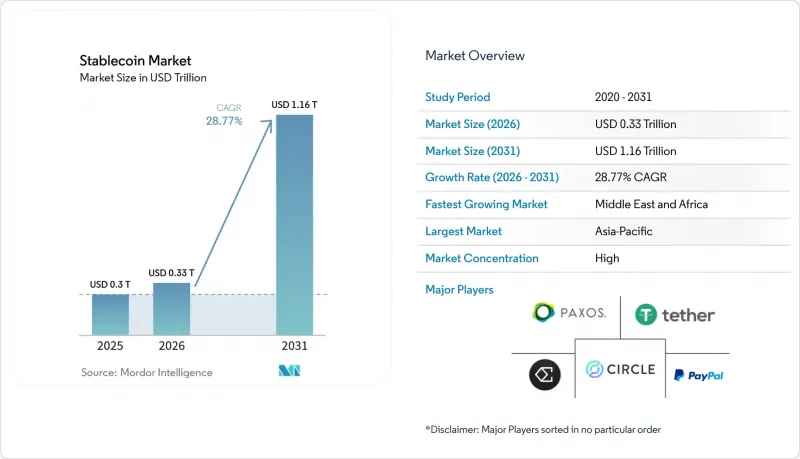
본 보고서는 담보 유형별(법정화폐 담보형 스테이블코인 등), 블록체인 플랫폼별(이더리움 등), 용도별(암호자산 거래 및 유동성 관리 등), 최종 사용자별(일반 소비자 등), 유통 채널별(중앙집권형 거래소 등), 지역별(북미, 남미 등)로 분류되어 있습니다. 시장 예측은 금액(달러) 기준으로 제시되어 있습니다.
세계의 스테이블코인 시장 동향 및 인사이트
실시간 국경 간 결제에 대한 수요 증가
국경을 넘는 결제 과정에서 발생하는 마찰은 계속해서 스테이블코인 시장을 뒷받침하고 있습니다. 이는 스테이블코인 결제 네트워크가 언제든지 결제를 수행할 수 있으며, 처리에 시간이 걸리는 무통장 은행망에 대한 의존도를 줄일 수 있기 때문입니다. 이 점은 송금 수수료, 결제 지연, 외환 접근 제한으로 인해 개인과 기업 모두에게 기존 시스템이 여전히 비용이 많이 드는 결제 경로에서 특히 중요합니다. 또한 스테이블코인 시장은 초기 도입 단계에서 특히 사용자가 제품의 복잡성보다 속도와 비용을 우선시할 때 결제 경로의 경제성이 공식적인 규제 수립보다 더 중요하게 여겨지는 경향이라는 사실로부터도 혜택을 받고 있습니다. 서클(Circle)의 결제 네트워크는 브라질과 나이지리아를 포함한 새로운 송금 경로를 통해 법정화폐 인출 연결을 확대한 결과, 2026년 3월 31일 기준 연율 환산 거래량이 83억 달러에 달했다고 보고했습니다. 이로 인해 송금량이 많은 송금 경로나 B2B 결제 경로에서 저비용 블록체인 경로와 신뢰성 높은 현지 현금 인출 인프라를 결합할 수 있는 발행사 및 파트너에게 경쟁 우위가 생기고 있습니다.
준비금 담보형 스테이블코인에 대한 규제 명확화
규제의 명확화는 스테이블코인 시장에 큰 힘이 될 것입니다. 이는 기관 투자자들이 준비금, 증명, 보관 및 발행사에 대한 감독과 관련하여 보다 명확한 지침을 기다려 왔기 때문입니다. 미국의 ‘GENIUS 법’과 유럽의 ‘MiCA’는 결제용 스테이블코인을 위한 최초의 대규모 규정 준수 체계를 확립해 가고 있으며, 거래소, 은행, 결제 기업이 유통 파트너를 평가하는 방식에 변화를 가져오고 있습니다. 현재 스테이블코인 시장에서는 공식적인 운영 기준을 충족하는 발행사와 여전히 규제의 회색지대에 의존하고 있는 발행사 간의 구분이 더욱 명확해지고 있습니다. 이러한 구분은 플랫폼 상장, 기업 간 제휴, 그리고 대형 금융기관이 스테이블코인을 고객 대상 상품에 임베디드하려는 의지에 영향을 미치고 있습니다. 그 결과, 컴플라이언스는 단순한 법적 요건이 아니라 유통상의 우위로 자리 잡고 있으며, 스테이블코인 시장 전체경쟁 구도를 재편하고 있습니다.
준비금의 투명성과 상환에 대한 신뢰의 격차
기관 투자자들은 여전히 명확한 상환 메커니즘, 검증된 준비금, 일관된 보고 기준을 중시하고 있으므로, 준비금의 투명성은 계속해서 스테이블코인 시장에 직접적인 제약 요인으로 작용하고 있습니다. 새로운 규제가 도입되었음에도 불구하고, 모든 주요 시장에서 그 이행이 아직 완료된 것은 아니며, 많은 투자자와 운영 파트너는 여전히 자발적인 증명이나 불균일한 공시 관행에 의존하고 있습니다. 그 결과, 스테이블코인 시장에서는 보다 엄격한 공시 기준을 준수하는 대형 발행사와 준비금의 건전성을 일관되게 입증하는 데 어려움을 겪는 중소 발행사 간에 품질 격차가 발생하고 있습니다. 또한 온체인 준비금 검증 도구가 보급됨에 따라 DeFi 프로토콜도 담보 수용 기준을 더욱 엄격히 하고 있어, 높아지는 투명성에 대한 기대에 부응하지 못하는 발행사의 경우 대상 시장이 축소될 가능성이 있습니다. 유럽중앙은행(ECB)도 2025년 7월, 미국과 유럽의 규제 차이로 인해 감독이 미흡한 발행사가 규제가 더 엄격한 시장에 간접적으로 진입할 경우, 규제 차익 거래가 발생해 시스템적 우려를 초래할 우려가 있다고 경고했습니다.
부문 분석
2025년, 법정화폐 담보형 스테이블코인은 시장의 92.3%를 차지했으며, 준비금으로 뒷받침되는 달러 표시 금융 상품이 여전히 스테이블코인 시장의 기준이 되고 있음을 보여줍니다. USDT와 USDC를 합치면 총 공급량의 약 83%를 차지했으나, USDP와 USDG를 발행하는 Paxos, PYUSD를 발행하는 PayPal, FDUSD를 발행하는 First Digital Trust, RLUSD를 발행하는 Ripple 등, 기타 법정화폐 담보형 스테이블코인 발행사들은 여전히 특정 규정 준수 요건이나 기관 투자자 대상의 틈새 시장에 중점을 두고 있었습니다. 이러한 경향은 스테이블코인 시장의 대부분에서 제품의 다양성보다 신뢰성, 유동성의 깊이, 거래소에서의 수용 여부가 여전히 중요함을 보여줍니다. MakerDAO의 DAI와 같은 암호화폐 담보형 스테이블코인은 DeFi 대출 및 거래 시스템에서 핵심 담보로서의 역할을 계속 수행하고 있기 때문에 구조적으로 중요한 위치를 차지하고 있습니다. Tether Gold와 Paxos Gold를 포함한 상품 담보형 토큰도 2025년 금 가격 상승의 혜택을 받았습니다. 또한, 테더가 2026년 2월 Gold.com 지분 12%를 1억 5,000만 달러에 인수함에 따라, 토큰화된 금의 유통은 귀금속 수요와 더욱 직접적으로 연계되게 되었습니다.
하이브리드형 및 알고리즘형 스테이블코인은 2031년까지 연평균 성장률(CAGR) 44.8%로 확대될 것으로 예측되며, 스테이블코인 시장에서 가장 빠르게 성장하는 담보 부문이 될 전망입니다. 이러한 성장을 주도하는 것은 제로 수익률의 준비금 담보형 모델을 대체할 수 있는 수익 창출 메커니즘에 대한 수요이며, 특히 디지털 달러에 대한 노출을 통해 더 높은 자본 효율성을 추구하는 기관 투자자들 수요가 원동력이 되고 있습니다. Ethena의 USDe는 단순한 준비금 보유가 아닌, 델타 중립적인 영구 파생상품 포지션을 기반으로 한 합성 달러 구조를 채택하고 있다는 점에서 그 대표적인 예라고 할 수 있습니다. 현재 세대의 합성 상품은 2022년에 실패했던 순수한 알고리즘형과는 본질적으로 다릅니다. 새로운 설계는 위험이 더 세분화되어 있으며, 구조화 신용 상품에 가까운 형태를 띠고 있기 때문입니다. 그렇지만 스테이블코인 시장은 이 점에서 여전히 규제상의 공백에 직면해 있습니다. 이러한 새로운 구조를 어떻게 감독해야 할지에 대한 규제가 완전히 법제화되지 않았기 때문에 성장 여지가 있는 반면, 감독이 급격히 강화될 경우 명백한 하방 리스크도 남아 있습니다.
2025년, 트론(Tron)은 34.9%의 점유율을 차지하며 스테이블코인 시장에서 가장 큰 블록체인 플랫폼 부문이 되었습니다. 이러한 위상은 매우 낮은 거래 수수료와 동남아시아, 사하라 이남 아프리카, 라틴아메리카와 같은 신흥 시장에서 USDT가 소액 송금 수단으로 선호되는 역할을 반영한 것입니다. 트론상의 스테이블코인 시장은 많은 사용자가 일상적인 국경 간 송금에서 가장 저렴한 대안으로 트론을 의존하고 있기 때문에 단순한 투기가 아닌 결제 기능과 밀접하게 연결된 상태를 유지하고 있습니다. 이더리움은 기관용 DeFi, 고액 결제, 그리고 광범위한 용도 지원에서의 역할 덕분에 여전히 큰 점유율을 유지하고 있습니다. 바이낸스 스마트 체인(BSC)과 솔라나 역시 각각 서로 다른 사용자층에 서비스를 제공하고 있으며, 솔라나상의 PYUSD는 1센트 미만의 수수료와 기관 결제 처리업체들의 관심 증가라는 혜택을 누리고 있습니다.
레이어 2 네트워크는 2031년까지 연평균 성장률(CAGR) 39.5%를 나타낼 것으로 예측되며, 스테이블코인 시장에서 가장 빠르게 성장하는 부문이 될 전망입니다. 초안에 따르면, 이러한 네트워크는 2025년에 하루 190만 건 이상의 거래를 처리할 것이며, 스테이블코인이 레이어 2 거래량의 70% 이상을 차지해 확장성 확산과 스테이블코인 이용 간의 밀접한 연관성이 부각되고 있습니다. 또한 2025년 말까지 레이어 2 채택이 이더리움 거래 처리량의 85%에 달하는 한편, Base는 견조한 USDC 거래량을 바탕으로 미국 스테이블코인 거래의 30% 이상을 처리한 것으로 나타났습니다. 주요 운영상의 전환점으로는 주요 레이어 2 네트워크에서 브리지 계약을 통한 방식에서 네이티브 스테이블코인 발행으로의 전환을 꼽을 수 있습니다. 2025년 말까지 Arbitrum이 USDC.e에서 네이티브 USDC로 전환한 것은 이러한 변화를 반영한 것입니다. 이는 스테이블코인 시장에 중요한 의미를 지닙니다. 확장 가능한 체인상에서 조기에 네이티브 유동성을 확립한 발행사는 브리지에 의존한 유통에 의존하는 후발 주자보다 시장에서 입지를 더 효과적으로 지킬 수 있기 때문입니다.
지역별 분석
2025년, 아시아태평양은 스테이블코인 시장의 39.6%를 차지하며 최대 지역 시장이 되었습니다. 이 지역의 주도적 지위는 활발한 송금 활동, 거래소에 대한 적극적인 참여, 모바일 우선의 금융 행동, 그리고 싱가포르, 홍콩, 한국, 일본 등 시장에서 이루어진 조기 규제 정비가 결합되어 형성된 것입니다. 트론(Tron)상의 개인용 USDT 흐름은 동남아시아의 각 경로에서 특히 중요한 위치를 계속 차지하고 있습니다. 이는 낮은 거래 수수료와 쉬운 접근성이 가격에 민감한 사용자 및 국경을 넘는 송금자들의 요구에 부합하기 때문입니다. 한국의 ‘디지털자산기본법’은 2026년 중반까지 정체된 상태였습니다. 이는 어떤 발행자 범주를 허용해야 하는지에 대해 정책 입안자들 간의 의견 차이가 지속되었기 때문이며, 그 결과 현지 통화 기반 스테이블코인의 발행이 지연되면서 당분간은 달러 기반 세계 스테이블코인이 더 두드러진 존재가 되었습니다. 인도, 인도네시아, 태국, 베트남, 말레이시아 역시 스테이블코인 시장에 있어 중요한 성장 시장으로 남아 있습니다. 이는 은행 서비스를 이용할 수 없는 계층의 존재, 스마트폰을 활용한 금융 활동, 그리고 상당한 규모의 송금 유입이 계속해서 스테이블코인의 보급을 뒷받침하고 있기 때문입니다.
북미와 유럽은 스테이블코인 시장의 규제 준수(컴플라이언스) 최전선을 정의하고 있습니다. 이는 두 지역이 기관 투자자들이 따를 가능성이 높은 규칙을 제정하고 있기 때문입니다. 미국에서는 GENIUS법에 근거한 최종 규정이 2026년 7월 18일까지 마련되어야 하며, 동 법은 그로부터 120일 후에 발효될 예정입니다. 이에 따라 초안에 따르면, 공식적인 기관 투자자 대상 시장의 활성화는 2026년 하반기부터 2027년 초까지의 일정이 될 전망입니다. 테더는 2026년 1월, 앵커리지 디지털 뱅크를 통해 USAT를 출시하고 칸터 피츠제럴드에 준비금을 예치한 바 있으며, 주요 발행사가 미국의 규제 환경에 맞추어 제품 구조를 구체적으로 정비하고 있는 것으로 보입니다. 유럽에서는 MiCA의 이행 기간이 2026년 7월 1일에 종료되었으며, 초안에 따르면 10개 발행사가 정식 인가를 받은 반면, USDT는 2025년 1분기까지 규제 대상인 EU 플랫폼에서 이미 삭제되었습니다. 또한, 유럽 집행위원회는 2026년 5월 20일, MiCA가 여전히 그 목적에 부합하는지 여부를 검토하기 위한 의견 수렴을 시작했습니다. 해당 초안에 따르면, 유로화 기반 스테이블코인의 규모는 7억 7,400만 유로(8억 3,590만 달러)인 반면, 달러화 기반 스테이블코인은 3,200억 달러에 달하고 있어, 유로화 및 달러화 기반 스테이블코인의 활동 규모 간에는 현재 큰 격차가 있음을 여실히 드러내고 있습니다.
중동 및 아프리카는 2031년까지 연평균 성장률(CAGR) 35.6%를 나타낼 것으로 예측되며, 이는 스테이블코인 시장에서 가장 성장세가 두드러진 지역 부문이 될 것입니다. 송금에 대한 높은 의존도, 외환 접근성 제약, 그리고 송금 경로의 인프라 확충이 이러한 성장을 뒷받침하고 있습니다. 특히 두바이의 규제 환경과 더 광범위한 해외 거주자들의 송금 흐름과 관련된 시장에서 이러한 경향이 두드러집니다. 또한 UAE에서도 기업들이 혼란스러운 코레스 은행 채널에 대한 의존도를 줄이기 위한 결제 경로를 모색하는 가운데, 스테이블코인 시장이 탄력을 받고 있습니다. 한편, 남미, 특히 브라질과 아르헨티나는 외환 제약이 있는 환경에서 달러 연동형 스테이블코인이 실용적인 도구로 기능하고 있어 여전히 중요한 시장으로 남아 있습니다. 초안에 따르면, 아르헨티나는 국내 스테이블코인 거래량의 약 46%를 차지하는 것으로 나타났으며, 한편 브라질 중앙은행과 핀테크 생태계는 USDC 및 즉시 결제 시스템 ‘PIX’와의 연동을 모색하고 있어, 이를 통해 예측 기간 동안 대규모 기관용 결제 경로가 열릴 가능성이 있습니다.
기타 혜택 :
- 엑셀 형식 시장 예측(ME) 시트
- 3개월간의 애널리스트 지원
자주 묻는 질문
목차
제1장 서론
제2장 조사 방법
제3장 주요 요약
제4장 시장 구도
제5장 시장 규모 및 성장 예측
제6장 경쟁 구도
제7장 시장 기회 및 향후 전망
AJY 26.08.07According to Mordor Intelligence, the stablecoin market size is expected to grow from USD 0.3 trillion in 2025 to USD 0.33 trillion in 2026 and is forecast to reach USD 1.16 trillion by 2031 at 28.77% CAGR over 2026-2031.
This report is Segmented by Collateral Type (Fiat-Backed Stablecoins, and More), by Blockchain (Ethereum, and More), by Application (Cryptocurrency Trading and Liquidity Management, and More), by End User (Retail Consumers, and More), by Distribution (Centralized Exchanges, and More), and by Geography (North America, South America, and More). The Market Forecasts are Provided in Terms of Value (USD).
Global Stablecoin Market Trends and Insights
Rising Demand for Real-Time Cross-Border Settlement
Cross-border payment friction continues to support the stablecoin market because stablecoin rails can settle at any time and reduce reliance on slower correspondent banking chains. This matters most in corridors where transfer fees, settlement delays, and limited foreign exchange access still make traditional systems costly for both individuals and businesses. The stablecoin market is also benefiting from the fact that corridor economics often matter more than formal rulemaking in early adoption environments, especially where users prioritize speed and cost over product complexity. Circle's Payments Network reported USD 8.3 billion in annualized transaction volume as of March 31, 2026, after expanding fiat payout connectivity through new corridors, including Brazil and Nigeria. This creates an advantage for issuers and partners that can combine low-cost blockchain routes with dependable local cash-out infrastructure in high-volume remittance and B2B payment corridors.
Regulatory Clarity for Reserve-Backed Stablecoins
Regulatory clarity is a major support for the stablecoin market because institutional users have been waiting for clearer expectations on reserves, attestations, custody, and issuer oversight. The GENIUS Act in the United States and MiCA in Europe are setting the first large-scale compliance framework for payment stablecoins, changing how exchanges, banks, and payment firms evaluate distribution partners. The stablecoin market is now separating more clearly between issuers that meet formal operating standards and those that still rely on regulatory gray areas. That split affects platform listings, enterprise partnerships, and the willingness of large financial institutions to integrate stablecoins into customer-facing products. The practical result is that compliance is becoming a distribution advantage rather than merely a legal requirement, reshaping competitive positioning across the stablecoin market.
Reserve Transparency and Redemption Confidence Gaps
Reserve transparency remains a direct limit on the stablecoin market because institutional users still place a high value on clear redemption mechanics, verified reserves, and consistent reporting standards. Even with new regulations, implementation is not yet complete across all major markets, meaning many investors and operating partners still rely on voluntary attestations and uneven disclosure practices. The stablecoin market is therefore developing a quality gap between the largest issuers, which adhere to stronger disclosure standards, and smaller issuers that struggle to consistently demonstrate reserve strength. DeFi protocols are also becoming more selective in their collateral acceptance as on-chain reserve verification tools gain traction, potentially reducing the addressable market for issuers that fail to meet rising transparency expectations. The European Central Bank also warned in July 2025 that differences between United States and European rules could create regulatory arbitrage and raise systemic concerns if under-supervised issuers find indirect access into stricter markets.
Other drivers and restraints analyzed in the detailed report include:
- On-Chain Treasury and Cash Management for Enterprises
- Liquidity Bridge For Crypto Trading And DeFi
- Fragmented Global Licensing and Compliance Burden
For complete list of drivers and restraints, kindly check the Table Of Contents.
Segment Analysis
Fiat-backed stablecoins held 92.3% of the market in 2025, indicating that reserve-backed dollar instruments still set the baseline for the stablecoin market. USDT and USDC together accounted for approximately 83% of total supply, while other fiat-backed issuers, such as Paxos with USDP and USDG, PayPal with PYUSD, First Digital Trust with FDUSD, and Ripple with RLUSD, remained more focused on targeted compliance and institutional niches. This pattern shows that trust, liquidity depth, and exchange acceptance still matter more than product variety in the largest part of the stablecoin market. Crypto-collateralized stablecoins such as MakerDAO's DAI remain structurally important because they continue to serve as core collateral in DeFi lending and trading systems. Commodity-backed tokens, including Tether Gold and Paxos Gold, also benefited from stronger gold prices in 2025, and Tether's February 2026 USD 150 million purchase of a 12% stake in Gold.com linked tokenized gold distribution more directly to precious metals demand.
Hybrid and algorithmic stablecoins are projected to expand at a 44.8% CAGR through 2031, making them the fastest-growing collateral segment in the stablecoin market. Growth is being driven by demand for yield-bearing structures that offer an alternative to zero-yield reserve-backed models, especially among institutional allocators seeking greater capital efficiency from digital dollar exposure. Ethena's USDe is a clear example because it uses a synthetic dollar structure built on delta-neutral perpetual derivative positions rather than simple reserve storage. The current generation of synthetic products is materially different from the purely algorithmic formats that failed in 2022, because the newer designs are more risk-segmented and closer in form to structured credit products. Even so, the stablecoin market still faces a policy gap here because regulation has not fully codified how these newer structures should be supervised, leaving room for growth and a clear downside risk if oversight tightens abruptly.
Tron held a 34.9% share in 2025, making it the largest blockchain platform segment in the stablecoin market. That position reflects its very low transaction fees and its role as the preferred route for retail USDT transfers in emerging market corridors across Southeast Asia, Sub-Saharan Africa, and Latin America. The stablecoin market on Tron remains closely tied to payment utility rather than solely to speculation, as many users rely on it as the cheapest available option for routine cross-border transfers. Ethereum still maintained a large position because of its role in institutional DeFi, high-value settlement, and broader application support. Binance Smart Chain and Solana also served distinct user groups, and PYUSD on Solana benefited from sub-cent fees and growing interest from institutional payment processors.
Layer-2 networks are projected to grow at a 39.5% CAGR through 2031, making them the fastest-growing segment of the stablecoin market. The source draft stated that these networks processed more than 1.9 million daily transactions in 2025 and that stablecoins accounted for more than 70% of Layer-2 transaction volume, underscoring the close link between scaling adoption and stablecoin usage. It also stated that Layer-2 adoption reached 85% of Ethereum transaction throughput by late 2025, while Base processed more than 30% of the United States stablecoin transactions through strong USDC volumes. A major operating shift is the move from bridged contracts to native stablecoin issuance on leading Layer-2 networks, and Arbitrum's migration from USDC.e to native USDC by late 2025 reflected that change. This matters for the stablecoin market because issuers that establish native liquidity early on scalable chains can defend market position more effectively than late entrants that rely on bridge-dependent distribution.
Complete Report Scope:
- By Collateral Type
- Fiat-Backed Stablecoins
- Crypto-Collateralized Stablecoins
- Algorithmic Stablecoins
- Commodity-Backed Stablecoins
- Other Stablecoins
- By Blockchain Platform
- Ethereum
- Tron
- Binance Smart Chain
- Solana
- Layer-2 Networks
- Other Blockchain Platforms
- By Application
- Cryptocurrency Trading and Liquidity Management
- Cross-Border Payments and Remittances
- Decentralized Finance
- E-Commerce and Merchant Payments
- Treasury and Cash Management
- Other Applications
- By End User
- Retail Consumers
- Crypto Exchanges and Trading Platforms
- Financial Institutions and Payment Service Providers
- Enterprises and Merchants
- Developers and Web3 Platforms
- Government and Public Sector Entities
- By Distribution Channel
- Centralized Exchanges
- Decentralized Exchanges
- Wallet Providers
- Payment Gateways and Fintech Platforms
- OTC Desks and Institutional Brokers
- By Geography
- North America
- United States
- Canada
- Mexico
- South America
- Brazil
- Argentina
- Rest of South America
- Europe
- United Kingdom
- Germany
- France
- Italy
- Spain
- Rest of Europe
- Asia-Pacific
- India
- China
- Japan
- Australia
- South Korea
- South East Asia (Singapore, Malaysia, Thailand, Indonesia, Vietnam, and Philippines)
- Rest of Asia-Pacific
- Middle East and Africa
- Saudi Arabia
- United Arab Emirates
- Turkey
- South Africa
- Egypt
- Rest of Middle East and Africa
- North America
Geography Analysis
Asia-Pacific accounted for 39.6% of the stablecoin market in 2025, making it the largest regional market. The region's leadership reflects a combination of high remittance activity, active participation in exchanges, mobile-first financial behavior, and early regulatory development across markets such as Singapore, Hong Kong, South Korea, and Japan. Retail USDT flows on Tron remained especially important across Southeast Asian corridors because low transaction fees and easy availability fit the needs of price-sensitive users and cross-border senders. South Korea's Digital Asset Basic Law remained stalled through mid-2026 because policymakers continued to disagree over which issuer categories should be allowed, delaying local-currency stablecoin issuance and keeping global-dollar stablecoins more prominent in the interim. India, Indonesia, Thailand, Vietnam, and Malaysia also remain important growth markets for the stablecoin market because underbanked populations, smartphone-based finance, and meaningful remittance inflows continue to support adoption.
North America and Europe define the compliance frontier for the stablecoin market because both regions are shaping the rules that institutional users are likely to follow. In the United States, final rules under the GENIUS Act are required by July 18, 2026, with the law taking effect within 120 days after that, which places formal institutional market activation on a late 2026 to early 2027 timeline in the source draft. Tether launched USAT in January 2026 through Anchorage Digital Bank, with reserves held at Cantor Fitzgerald, demonstrating how major issuers are preparing product structures specifically for the United States compliance environment. In Europe, the full MiCA transition period ends on July 1, 2026, and the source draft noted that 10 issuers received formal authorization, while USDT had already been removed from regulated EU platforms by the first quarter of 2025. The European Commission also opened a consultation on May 20, 2026, to review whether MiCA remains fit for purpose, and the source draft noted that euro stablecoins represented EUR 774 million, or USD 835.9 million, versus USD 320 billion for dollar-denominated instruments, highlighting the wide current gap between euro and dollar stablecoin activity.
The Middle East and Africa are projected to grow at a 35.6% CAGR through 2031, which makes it the fastest-growing regional segment in the stablecoin market. High remittance dependence, foreign exchange access constraints, and expanding corridor infrastructure are supporting this rise, especially in markets linked to Dubai's regulatory environment and broader expatriate payment flows. The stablecoin market is also gaining traction in the UAE as firms seek payment routes that reduce reliance on disrupted correspondent banking channels. At the same time, South America, especially Brazil and Argentina, remains important because dollar-linked stablecoins serve as practical tools in foreign-exchange-constrained settings. Argentina was cited in the source draft as accounting for approximately 46% of local stablecoin volumes, while Brazil's central bank and fintech ecosystem are exploring links with USDC and the PIX instant payment system, which could open a large institutional corridor during the forecast period.
- Tether Limited
- Circle Internet Financial, Inc.
- PayPal Holdings, Inc.
- Paxos Trust Company, LLC
- MakerDAO
- Ethena Labs
- First Digital Trust
- Ripple Labs, Inc.
- Binance Holdings Limited
- Coinbase Global, Inc.
- Anchorage Digital Bank, N.A.
- BitGo, Inc.
- Fireblocks Ltd.
- Gemini Trust Company, LLC
- Societe Generale - FORGE
- Visa Inc.
- Mastercard Incorporated
- Stripe, Inc.
- Fiserv, Inc.
- Kraken
Additional Benefits:
- The market estimate (ME) sheet in Excel format
- 3 months of analyst support
TABLE OF CONTENTS
1 INTRODUCTION
- 1.1 Study Assumptions and Market Definition
- 1.2 Scope of the Study
2 RESEARCH METHODOLOGY
3 EXECUTIVE SUMMARY
4 MARKET LANDSCAPE
- 4.1 Market Overview
- 4.2 Market Drivers
- 4.2.1 Rising Demand for Real-Time Cross-Border Settlement
- 4.2.2 Liquidity Bridge For Crypto Trading And DeFi
- 4.2.3 Regulatory Clarity For Reserve-Backed Stablecoins
- 4.2.4 Treasury Yield Economics Supporting Issuer Scale
- 4.2.5 On-Chain Treasury And Cash Management For Enterprises
- 4.2.6 Synthetic Stablecoin Risk Segmentation And Yield Demand
- 4.3 Market Restraints
- 4.3.1 Reserve Transparency And Redemption Confidence Gaps
- 4.3.2 Fragmented Global Licensing And Compliance Burden
- 4.3.3 Limited Payments Penetration Beyond Crypto-Native Use
- 4.3.4 Market Concentration Limits New Issuer Network Effects
- 4.4 Value Chain Analysis
- 4.5 Regulatory Landscape
- 4.6 Technological Outlook
- 4.7 Porter's Five Forces Analysis
- 4.7.1 Threat of New Entrants
- 4.7.2 Bargaining Power of Suppliers
- 4.7.3 Bargaining Power of Buyers
- 4.7.4 Threat of Substitutes
- 4.7.5 Competitive Rivalry
5 MARKET SIZE AND GROWTH FORECASTS
- 5.1 By Collateral Type
- 5.1.1 Fiat-Backed Stablecoins
- 5.1.2 Crypto-Collateralized Stablecoins
- 5.1.3 Algorithmic Stablecoins
- 5.1.4 Commodity-Backed Stablecoins
- 5.1.5 Other Stablecoins
- 5.2 By Blockchain Platform
- 5.2.1 Ethereum
- 5.2.2 Tron
- 5.2.3 Binance Smart Chain
- 5.2.4 Solana
- 5.2.5 Layer-2 Networks
- 5.2.6 Other Blockchain Platforms
- 5.3 By Application
- 5.3.1 Cryptocurrency Trading and Liquidity Management
- 5.3.2 Cross-Border Payments and Remittances
- 5.3.3 Decentralized Finance
- 5.3.4 E-Commerce and Merchant Payments
- 5.3.5 Treasury and Cash Management
- 5.3.6 Other Applications
- 5.4 By End User
- 5.4.1 Retail Consumers
- 5.4.2 Crypto Exchanges and Trading Platforms
- 5.4.3 Financial Institutions and Payment Service Providers
- 5.4.4 Enterprises and Merchants
- 5.4.5 Developers and Web3 Platforms
- 5.4.6 Government and Public Sector Entities
- 5.5 By Distribution Channel
- 5.5.1 Centralized Exchanges
- 5.5.2 Decentralized Exchanges
- 5.5.3 Wallet Providers
- 5.5.4 Payment Gateways and Fintech Platforms
- 5.5.5 OTC Desks and Institutional Brokers
- 5.6 By Geography
- 5.6.1 North America
- 5.6.1.1 United States
- 5.6.1.2 Canada
- 5.6.1.3 Mexico
- 5.6.2 South America
- 5.6.2.1 Brazil
- 5.6.2.2 Argentina
- 5.6.2.3 Rest of South America
- 5.6.3 Europe
- 5.6.3.1 United Kingdom
- 5.6.3.2 Germany
- 5.6.3.3 France
- 5.6.3.4 Italy
- 5.6.3.5 Spain
- 5.6.3.6 Rest of Europe
- 5.6.4 Asia-Pacific
- 5.6.4.1 India
- 5.6.4.2 China
- 5.6.4.3 Japan
- 5.6.4.4 Australia
- 5.6.4.5 South Korea
- 5.6.4.6 South East Asia (Singapore, Malaysia, Thailand, Indonesia, Vietnam, and Philippines)
- 5.6.4.7 Rest of Asia-Pacific
- 5.6.5 Middle East and Africa
- 5.6.5.1 Saudi Arabia
- 5.6.5.2 United Arab Emirates
- 5.6.5.3 Turkey
- 5.6.5.4 South Africa
- 5.6.5.5 Egypt
- 5.6.5.6 Rest of Middle East and Africa
- 5.6.1 North America
6 COMPETITIVE LANDSCAPE
- 6.1 Market Concentration
- 6.2 Strategic Moves
- 6.3 Market Share Analysis
- 6.4 Company Profiles (includes Global Level Overview, Market Level Overview, Core Segments, Financials as available, Strategic Information, Market Rank/Share, Products and Services, Recent Developments)
- 6.4.1 Tether Limited
- 6.4.2 Circle Internet Financial, Inc.
- 6.4.3 PayPal Holdings, Inc.
- 6.4.4 Paxos Trust Company, LLC
- 6.4.5 MakerDAO
- 6.4.6 Ethena Labs
- 6.4.7 First Digital Trust
- 6.4.8 Ripple Labs, Inc.
- 6.4.9 Binance Holdings Limited
- 6.4.10 Coinbase Global, Inc.
- 6.4.11 Anchorage Digital Bank, N.A.
- 6.4.12 BitGo, Inc.
- 6.4.13 Fireblocks Ltd.
- 6.4.14 Gemini Trust Company, LLC
- 6.4.15 Societe Generale - FORGE
- 6.4.16 Visa Inc.
- 6.4.17 Mastercard Incorporated
- 6.4.18 Stripe, Inc.
- 6.4.19 Fiserv, Inc.
- 6.4.20 Kraken
7 MARKET OPPORTUNITIES AND FUTURE OUTLOOK
- 7.1 White-Space and Unmet-Need Assessment


