

|
시장보고서
상품코드
2099058
사이버 보안 메시 아키텍처(CSMA) 시장 : 점유율 분석, 업계 동향 및 통계, 성장 예측(2026-2031년)Cybersecurity Mesh Architecture (CSMA) - Market Share Analysis, Industry Trends & Statistics, Growth Forecasts (2026 - 2031) |
||||||
 Mordor Intelligence
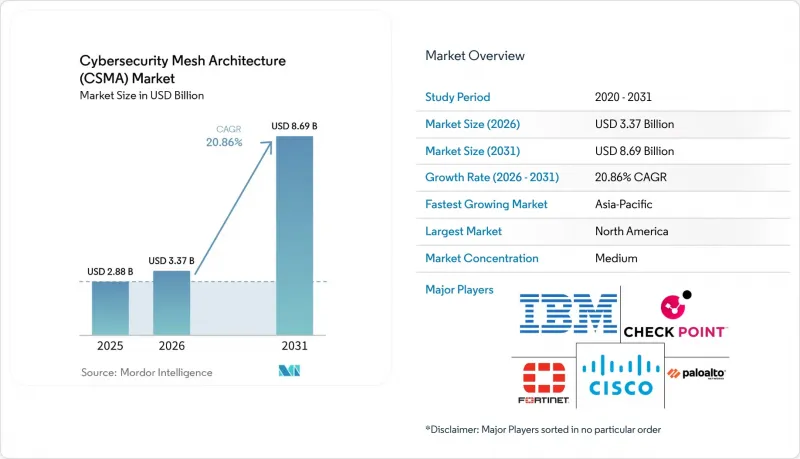
Mordor Intelligence에 의하면, 사이버 보안 메시 아키텍처(CSMA) 시장 규모는 2025년에 28억 8,000만 달러, 2026년에 33억 7,000만 달러가 되어, 2031년까지 86억 9,000만 달러에 이를 것으로 예측되며, 2026년부터 2031년까지 CAGR 20.86%로 성장할 전망입니다.
본 보고서는 구성 요소(소프트웨어 및 서비스), 도입 형태(클라우드, On-Premise, 하이브리드), 기업 규모(대기업 및 중소기업), 최종 사용자 산업(은행, 금융서비스 및 보험(BFSI), 헬스케어 및 생명과학, 정보기술·통신, 산업 제조 등), 그리고 지역별로 분류되어 있습니다. 시장 전망은 금액(달러) 기준으로 제시되어 있습니다.
세계 사이버 보안 메시 아키텍처(CSMA) 시장 동향 및 인사이트
분산형 및 하이브리드 IT 환경으로의 급속한 전환
분산형 및 하이브리드 IT로의 전환은 사이버 보안 메시 아키텍처(CSMA) 시장 수요를 견인하는 가장 큰 요인으로 계속 작용하고 있습니다. 기업들은 현재 On-Premise 거점, 퍼블릭 클라우드, 프라이빗 클라우드, 엣지 위치에 걸쳐 워크로드를 동시에 실행하고 있어, 단일 경계선에 기반한 방어 모델의 유효성이 떨어지고 있습니다. NIST 특별 간행물 800-207에서는 현대 기업 네트워크에 더 이상 명확하게 정의된 경계가 존재하지 않는다고 밝히고 있으며, 이는 분산형 보안 제어의 필요성을 뒷받침합니다. 이 운영 모델은 많은 조직에게 더 이상 일시적인 것이 아닙니다. 특히 금융 서비스 및 제조업 분야에서는 업무 부서와 IT 부서의 협력이 그 어느 때보다 긴밀해지고 있습니다. 시스코의 ‘2025 AI Workforce Consortium’ 보고서에서도 서비스 메시와 제로 트러스트 아키텍처가 G7 국가 전반에 걸쳐 심각한 기술 격차로 대두되고 있다고 지적하고 있으며, 이는 이용 가능한 전문 지식에 비해 하이브리드 IT가 얼마나 빠르게 발전하고 있는지를 여실히 보여주고 있습니다.
기업 전반에 걸친 제로 트러스트 프로그램의 확대
제로 트러스트 프로그램은 파일럿 프로젝트에서 보다 광범위한 본 운영 단계로 전환되고 있으며, 이것이 사이버 보안 메시 아키텍처(CSMA) 시장의 성장을 뒷받침하고 있습니다. ID, 엔드포인트, 네트워크 각 도구를 개별적으로 사용하여 제로 트러스트를 도입한 조직에서는 이러한 제어 수단이 분산 환경 전반에 걸쳐 단편적으로 적용되는 경우가 종종 있었습니다. 메시 기반 설계는 이러한 제어 수단을 연계함으로써 검증, 세분화 및 정책 결정이 보다 일관되게 작동하도록 합니다. NIST의 ‘사이버 보안 프레임워크 2.0’ 발표는 거버넌스와 보호 성과를 조합 가능한 보안 제어와 잘 조화되는 형태로 연결함으로써 이러한 방향성을 더욱 강화하고 있습니다. 이로 인해 사이버 보안 메시 아키텍처(CSMA) 시장은 순전히 재량적인 보안 지출보다 더 탄력적인 특성을 갖게 됩니다. 이러한 프로그램들이 공식적인 운영 요건 및 규정 준수 요건과 점점 더 밀접하게 연계되고 있기 때문입니다.
레거시 및 최신 보안 스택에 걸친 통합의 복잡성
많은 레거시 보안 도구는 메시 아키텍처에 필요한 API, 텔레메트리 형식 또는 정책 구조를 공개하지 않기 때문에 통합은 여전히 주요 제약 요인으로 남아 있습니다. 환경의 분산이 가장 심한 구매 기업일수록 CSMA 도입에 대한 비즈니스 타당성은 높아지지만, 동시에 구현까지의 과정도 가장 길어집니다. 따라서 정책 오케스트레이션을 대규모로 가동하기 전에 미들웨어나 외부 서비스를 추가하거나 단계적 전환이 필요한 조직의 경우, 사이버 보안 메시 아키텍처(CSMA) 시장의 성장은 완만해질 것입니다. 2025년 2월 IBM이 HashiCorp를 인수한 사례는 시크릿 관리, 인프라 프로비저닝, 하이브리드 클라우드 보안을 단일 스택으로 통합하기 위해 대형 벤더라 할지라도 얼마나 많은 투자가 필요한지를 보여줍니다. 이것이 전략적 필요성이 명확함에도 불구하고, 많은 중규모 프로젝트가 계획보다 더 오랫동안 시범 단계에 머무르는 이유입니다.
부문 분석
2025년, 소프트웨어는 구성 요소별 매출의 60.91%를 차지하며 사이버 보안 메시 아키텍처(CSMA) 시장에서 가장 큰 구성 요소가 되었습니다. 구매자들은 당초 정책 관리, 보안 분석 및 신원 오케스트레이션에 지출을 할당했습니다. 이는 이러한 계층들이 메시 모델의 기반을 형성하기 때문입니다. 이러한 경향은 많은 초기 도입 사례에서 보다 광범위한 운영 지원으로 전환하기 전에 아키텍처 및 가시성 확보부터 시작됨을 보여줍니다. 또한, 이미 체계적인 보안 로드맵을 수립해 두고 있으며, 우선 정책 로직을 통합하고자 하는 대기업의 구매 행동도 반영하고 있습니다.
서비스 부문은 2026년부터 2031년까지 연평균 성장률(CAGR) 22.94%를 나타낼 것으로 예측되며, 이는 구성 요소 카테고리 중 가장 빠르게 성장하는 분야가 될 것입니다. 이러한 성장 속도는 소프트웨어만으로는 기존 보안 스택과 새로운 오케스트레이션 계층 간의 통합 작업을 해결할 수 없음을 보여줍니다. 구매자가 파일럿 프로그램에서 대규모 도입으로 전환함에 따라, 자문 지원, 관리형 감지 및 대응(MDR), 그리고 도입 서비스의 역할이 더욱 중요해지고 있습니다. 또한, 많은 벤더들이 플랫폼 구독에 온보딩, 정책 조정, 관리형 운영을 묶어 제공하기 시작함에 따라 소프트웨어 및 서비스의 경계도 모호해지고 있습니다. 이로 인해 사이버 보안 메시 아키텍처(CSMA) 시장에서 소프트웨어가 여전히 수익의 주축을 이루고 있는 반면, 서비스의 성장 속도는 더욱 가속화되고 있습니다.
2025년에는 클라우드 도입이 매출의 53.87%를 차지하며, 도입 모델별 사이버 보안 메시 아키텍처(CSMA) 시장 점유율에서 1위를 차지하고 있습니다. 클라우드가 조기에 보급된 배경으로는 프로비저닝의 신속화, 인프라 오버헤드 절감, 그리고 벤더 관리 보안 서비스에 대한 손쉬운 접근이 가능하다는 점을 들 수 있습니다. 이 모델은 플랫폼 관리의 상당 부분이 공급자에게 이관되므로, 사내 아키텍처 운영 역량이 제한적인 조직에 특히 유용합니다. 또한, 막대한 초기 투자 없이 엔터프라이즈급 제어 기능을 도입하고자 하는 중소기업에게도 신속한 도입을 가능하게 했습니다.
하이브리드 배포는 2031년까지 연평균 성장률(CAGR) 23.05%로 확대될 것으로 예측되며, 가장 빠르게 성장하는 배포 옵션이 될 것입니다. 대규모 조직의 경우, 주권, 지연, 규제상의 이유로 여전히 중요한 On-Premise 시스템을 운영하고 있기 때문에 보안을 클라우드만으로 완전히 이전하는 것은 대부분의 경우 현실적이지 않습니다. 하이브리드 모델을 통해 이러한 조직은 새로운 워크로드가 이동할 때마다 보안을 재설계할 필요 없이, 기존 인프라와 새로운 디지털 환경 모두에 단일 정책을 적용할 수 있습니다. 또한, 기밀 정보를 다루는 환경, 산업용 환경, 에어 갭 환경에서도 On-Premise 환경은 여전히 중요하며, 이는 하이브리드 아키텍처의 장기적인 필요성을 뒷받침합니다. 이로 인해 사이버 보안 메시 아키텍처(CSMA) 시장에서 하이브리드 모델은 더욱 견고한 성장 궤도를 유지할 것입니다.
지역별 분석
2025년, 북미는 전 세계 매출의 32.12%를 차지하며 사이버 보안 메시 아키텍처(CSMA) 시장에서 가장 규모가 큰 지역 시장이 되었습니다. 이 지역의 강점은 금융 서비스 인프라가 밀집해 있고, 전문 벤더가 집중되어 있으며, 많은 공공 부문에서 제로 트러스트를 기본 요건으로 취급하는 정책 환경이 조성되어 있다는 점입니다. 연방 정부의 지침과 업계 고유의 보안 의무로 인해 미국의 대규모 조직에게 지속적인 검증과 ID 중심 통제의 중요성이 더욱 높아지고 있으며, 그 결과 규제 및 벤더 생태계가 아직 성숙하지 않은 지역에 비해 의사결정 주기가 단축되고 있습니다. 캐나다와 멕시코에서는 디지털 인프라의 성장과 협력적 제어 모델에 대한 의존도가 높아지고 있는 국경을 초월한 보안 요건을 통해 시장이 활성화되고 있습니다.
유럽은 단기간 내에 몇 가지 규제 변경이 시행되어 조직들이 보다 체계적인 보안 아키텍처를 채택하도록 촉진됨에 따라 계속해서 주요 수요 거점으로 자리매김했습니다. 이러한 압력은 접근, 제3자 노출 및 운영 복원력에 대한 보다 강력한 모니터링을 요구하는 규제 대상 산업에서 특히 두드러지게 나타났습니다. 또한, 유럽의 구매자들은 다른 여러 지역에 비해 하이브리드형 및 소버린형 도입 패턴을 더 선호하는 경향을 보였습니다. 도이치 텔레콤과 팔로알토 네트웍스는 ‘Sovereign Cortex with T Security’를 통해 이러한 요구에 대응했습니다. 이 솔루션은 고급 관리형 보안 기능을 활용하면서도 텔레메트리 데이터를 유럽 내에 유지할 수 있게 해줍니다. 남미에서는 금융의 디지털화와 공공 부문의 현대화로 인해 CSMA의 시범 도입 및 단계적 확장에 더 유리한 환경이 조성되어 꾸준한 진전이 나타났습니다.
아시아태평양은 2031년까지 연평균 성장률(CAGR) 23.38%를 나타낼 것으로 예측되며, 사이버 보안 메시 아키텍처(CSMA) 시장에서 가장 빠르게 성장하는 지역이 될 전망입니다. 이 지역은 급속한 디지털화, 5G 인프라 확대, 그리고 각국의 강화된 사이버 보안 프레임워크에 힘입고 있습니다. 인도, 일본, 한국, 호주는 각각 다른 방식으로 기여하고 있지만, 어느 나라에서나 최신 인프라 전반에 걸친 분산형 ID 및 접근 제어에 대한 수요가 증가하고 있습니다. 또한, 이 지역에는 대규모 클라우드 네이티브 시스템을 구축하고 있는 조직이 많이 존재하며, 이는 메시 지향 보안 설계와 잘 부합합니다. 중국에서는 클라우드 환경과 On-Premise 환경을 아우르는 ID 및 접근 관리에 대한 국가적 노력이 협업형 보안 모델의 중요성을 더욱 높이고 있습니다. 중동 및 아프리카는 도입 성숙도가 아직 낮은 단계에 있지만, 사우디아라비아와 아랍에미리트(UAE)는 디지털 정부 및 핵심 인프라 프로그램을 통해 도입을 추진하고 있습니다. 앞으로 이러한 지역별 상황의 조합에 따라, 아시아태평양 및 특정 중동 시장은 사이버 보안 메시 아키텍처(CSMA) 시장에 있어 중요한 성장 동력으로 계속 자리매김할 것입니다.
기타 혜택:
- 엑셀 형식 시장 예측(ME) 시트
- 3개월간의 애널리스트 지원
자주 묻는 질문
목차
제1장 서론
제2장 조사 방법
제3장 주요 요약
제4장 시장 구도
제5장 시장 규모와 성장 예측
제6장 경쟁 구도
제7장 시장 기회와 향후 전망
JHS 26.08.05According to Mordor Intelligence, the cybersecurity mesh architecture (CSMA) market size is projected to be USD 2.88 billion in 2025, USD 3.37 billion in 2026, and reach USD 8.69 billion by 2031, growing at a CAGR of 20.86% from 2026 to 2031.
This report is Segmented by Component (Software, and Services), Deployment (Cloud, On-Premises, and Hybrid), Enterprise Size (Large Enterprises, and Small and Medium Enterprises), End-User Industry (BFSI, Healthcare and Life Sciences, Information Technology and Telecom, Industrial Manufacturing, and More), and Geography. The Market Forecasts are Provided in Terms of Value (USD).
Global Cybersecurity Mesh Architecture (CSMA) Market Trends and Insights
Rapid Shift to Distributed And Hybrid IT Environments
The move to distributed and hybrid IT remains the strongest driver of demand for the Cybersecurity mesh architecture (CSMA) market. Enterprises now run workloads across on-premises sites, public clouds, private clouds, and edge locations simultaneously, weakening single-perimeter defense models. NIST Special Publication 800-207 states that modern enterprise networks no longer have a clearly defined perimeter, which supports the need for distributed security controls. This operating model is no longer temporary for most organizations, especially in financial services and manufacturing, where operational and information technology are now more closely connected. Cisco's 2025 AI Workforce Consortium report also identified service mesh and zero-trust architecture as high-severity skill gaps across G7 economies, underscoring how quickly hybrid IT is advancing relative to available expertise.
Zero Trust Program Expansion Across Enterprises
Zero-trust programs are moving from pilot projects into broader production use, which is supporting the Cybersecurity mesh architecture (CSMA) market. Organizations that adopted zero trust with separate identity, endpoint, and network tools often found that these controls led to fragmented enforcement across distributed environments. A mesh-based design helps connect those controls so that verification, segmentation, and policy decisions work together more consistently. NIST's Cybersecurity Framework 2.0 release reinforces this direction by linking governance and protection outcomes in a way that aligns well with composable security controls. This makes the Cybersecurity mesh architecture (CSMA) market more resilient than purely discretionary security spending because these programs are increasingly tied to formal operating and compliance requirements.
Integration Complexity Across Legacy and Modern Security Stacks
Integration remains the main restraint because many legacy security tools do not expose the APIs, telemetry formats, or policy structures that mesh architectures need. Buyers with the most fragmented estates often have the strongest business case for CSMA, but they also face the longest implementation path. The Cybersecurity mesh architecture (CSMA) market, therefore, grows more slowly in organizations that must add middleware, external services, or staged migrations before policy orchestration can work at scale. IBM's February 2025 acquisition of HashiCorp shows how much investment is required, even for a major vendor, to integrate secrets management, infrastructure provisioning, and hybrid cloud security into a single stack. This is why many mid-sized projects stay in pilot mode longer than planned, even when the strategic need is clear.
Other drivers and restraints analyzed in the detailed report include:
- Rising Identity-Centric Security Orchestration Needs
- Tool Sprawl Forcing Cross-Platform Security Coordination
- Shortage of Mesh-Literate Security Talent
For complete list of drivers and restraints, kindly check the Table Of Contents.
Segment Analysis
Software accounted for 60.91% of component revenue in 2025, making it the largest component of the Cybersecurity mesh architecture (CSMA) market. Buyers initially allocated their spending to policy management, security analytics, and identity orchestration because those layers form the foundation for a mesh model. This pattern shows that many early deployments start with architecture and visibility before moving into broader operating support. It also reflects the buying behavior of large enterprises that already have structured security roadmaps and want to consolidate policy logic first.
Services are projected to grow at a 22.94% CAGR from 2026 to 2031, which makes them the fastest-growing component category. That pace shows that software alone cannot resolve the integration work between older security stacks and newer orchestration layers. Advisory support, managed detection and response, and implementation services are taking a larger role as buyers move from pilot programs into scaled deployments. The line between software and services is also becoming less clear because many vendors now bundle platform subscriptions with onboarding, policy tuning, and managed operations. This keeps services on a faster path, even while software remains the revenue anchor in the Cybersecurity mesh architecture (CSMA) market.
Cloud deployment accounted for 53.87% of revenue in 2025, giving it the leading position in the Cybersecurity mesh architecture (CSMA) market share by deployment model. Cloud gained early traction because it allows faster provisioning, lower infrastructure overhead, and easier access to vendor-managed security services. This model has been especially useful for organizations with limited in-house architecture capacity because much of the platform management shifts to the provider. It also supported faster entry for smaller firms that wanted enterprise-grade controls without large upfront investments.
Hybrid deployment is projected to expand at a 23.05% CAGR through 2031, which makes it the fastest-growing deployment option. Large organizations still operate critical on-premises systems for sovereignty, latency, and regulatory reasons, so a full migration to cloud-only security is often impractical. The hybrid model lets these organizations apply a single policy across older infrastructure and newer digital environments without redesigning security each time a new workload moves. On-premises environments also remain relevant in classified, industrial, and air-gapped settings, which strengthens the long-term case for hybrid architectures. This keeps hybrid on a stronger growth path inside the Cybersecurity mesh architecture (CSMA) market.
Complete Report Scope:
- By Component
- Software
- Services
- By Deployment
- Cloud
- On-Premises
- Hybrid
- By Enterprise Size
- Large Enterprises
- Small and Medium Enterprises
- By End-user Industry
- BFSI
- Healthcare and Life Sciences
- Information Technology and Telecom
- Retail and E-commerce
- Industrial Manufacturing
- Government and Public Sector
- Other End-user Industries
- By Geography
- North America
- United States
- Canada
- Mexico
- South America
- Brazil
- Argentina
- Rest of South America
- Europe
- Germany
- United Kingdom
- France
- Italy
- Spain
- Russia
- Rest of Europe
- Asia-Pacific
- China
- India
- Japan
- South Korea
- Australia
- Rest of Asia-Pacific
- Middle East and Africa
- Middle East
- Saudi Arabia
- United Arab Emirates
- Rest of Middle East
- Africa
- South Africa
- Nigeria
- Rest of Africa
- Middle East
- North America
Geography Analysis
North America accounted for 32.12% of global revenue in 2025, making it the leading regional market for Cybersecurity mesh architecture (CSMA). The region benefits from dense financial services infrastructure, a strong concentration of specialist vendors, and a policy environment that treats zero trust as a baseline requirement in many public sector settings. Federal guidance and sector-specific security obligations have made continuous verification and identity-centric controls more urgent for large U.S. organizations, thereby shortening decision cycles compared with regions where the regulatory and vendor ecosystems are still less mature. Canada and Mexico added support through digital infrastructure growth and cross-border security requirements that increasingly depend on coordinated control models.
Europe remained a major demand center because several regulatory changes took effect within a short period, prompting organizations to adopt more structured security architectures. That pressure has been especially visible in regulated industries that need stronger oversight of access, third-party exposure, and operational resilience. European buyers have also shown a stronger preference for hybrid and sovereign deployment patterns than in some other regions. Deutsche Telekom and Palo Alto Networks addressed that need through Sovereign Cortex with T Security, which keeps telemetry within European borders while still using advanced managed security capabilities. South America saw steady progress as financial digitization and public-sector modernization created a more favorable environment for CSMA pilots and phased deployments.
Asia-Pacific is projected to grow at a 23.38% CAGR through 2031, making it the fastest-growing region in the Cybersecurity mesh architecture (CSMA) market. The region is being supported by high digitization speed, expanding 5G infrastructure, and stronger national cybersecurity frameworks. India, Japan, South Korea, and Australia are all contributing through different paths, but each shows a rising need for distributed identity and access controls across modern infrastructure. The region also contains many organizations building cloud-native systems at scale, which aligns well with a mesh-oriented security design. In China, national approaches to identity and access management across cloud and on-premises environments add another layer of relevance for coordinated security models. The Middle East and Africa remain earlier in deployment maturity, but Saudi Arabia and the UAE are pushing adoption through digital government and critical infrastructure programs. Over time, that regional mix should keep Asia-Pacific and selected Middle East markets important growth engines for the Cybersecurity mesh architecture (CSMA) market.
- IBM Corporation
- Palo Alto Networks, Inc.
- Cisco Systems, Inc.
- Fortinet, Inc.
- Check Point Software Technologies Ltd.
- Microsoft Corporation
- CrowdStrike Holdings, Inc.
- Zscaler, Inc.
- Cloudflare, Inc.
- Akamai Technologies, Inc.
- Trend Micro Incorporated
- Forcepoint LLC
- F5, Inc.
- Ivanti, Inc.
- SonicWall Inc.
- Cato Networks Ltd.
- Appgate, Inc.
- SailPoint Technologies Holdings, Inc.
- CyberArk Software Ltd.
- Okta, Inc.
Additional Benefits:
- The market estimate (ME) sheet in Excel format
- 3 months of analyst support
TABLE OF CONTENTS
1 INTRODUCTION
- 1.1 Study Assumptions and Market Definition
- 1.2 Scope of the Study
2 RESEARCH METHODOLOGY
3 EXECUTIVE SUMMARY
4 MARKET LANDSCAPE
- 4.1 Market Overview
- 4.2 Market Drivers
- 4.2.1 Rapid Shift to Distributed and Hybrid IT Environments
- 4.2.2 Zero Trust Program Expansion Across Enterprises
- 4.2.3 Rising Identity-Centric Security Orchestration Needs
- 4.2.4 Tool Sprawl Is Forcing Cross-Platform Security Coordination
- 4.2.5 Compliance Pressure Around Continuous Access Verification
- 4.2.6 Security Teams Seeking Lower Mean Time to Contain Incidents
- 4.3 Market Restraints
- 4.3.1 Integration Complexity Across Legacy and Modern Security Stacks
- 4.3.2 Shortage of Mesh-Literate Security Talent
- 4.3.3 Vendor Lock-In Concerns in Multi-Vendor Security Meshes
- 4.3.4 Limited Budget Prioritization Versus Immediate Compliance Spend
- 4.4 Industry Value-Chain Analysis
- 4.5 Regulatory Landscape
- 4.6 Technological Outlook
- 4.7 Porter's Five Forces Analysis
- 4.7.1 Bargaining Power of Buyers
- 4.7.2 Bargaining Power of Suppliers
- 4.7.3 Threat of New Entrants
- 4.7.4 Threat of Substitutes
- 4.7.5 Intensity of Competitive Rivalry
5 MARKET SIZE AND GROWTH FORECASTS (VALUE)
- 5.1 By Component
- 5.1.1 Software
- 5.1.2 Services
- 5.2 By Deployment
- 5.2.1 Cloud
- 5.2.2 On-Premises
- 5.2.3 Hybrid
- 5.3 By Enterprise Size
- 5.3.1 Large Enterprises
- 5.3.2 Small and Medium Enterprises
- 5.4 By End-user Industry
- 5.4.1 BFSI
- 5.4.2 Healthcare and Life Sciences
- 5.4.3 Information Technology and Telecom
- 5.4.4 Retail and E-commerce
- 5.4.5 Industrial Manufacturing
- 5.4.6 Government and Public Sector
- 5.4.7 Other End-user Industries
- 5.5 By Geography
- 5.5.1 North America
- 5.5.1.1 United States
- 5.5.1.2 Canada
- 5.5.1.3 Mexico
- 5.5.2 South America
- 5.5.2.1 Brazil
- 5.5.2.2 Argentina
- 5.5.2.3 Rest of South America
- 5.5.3 Europe
- 5.5.3.1 Germany
- 5.5.3.2 United Kingdom
- 5.5.3.3 France
- 5.5.3.4 Italy
- 5.5.3.5 Spain
- 5.5.3.6 Russia
- 5.5.3.7 Rest of Europe
- 5.5.4 Asia-Pacific
- 5.5.4.1 China
- 5.5.4.2 India
- 5.5.4.3 Japan
- 5.5.4.4 South Korea
- 5.5.4.5 Australia
- 5.5.4.6 Rest of Asia-Pacific
- 5.5.5 Middle East and Africa
- 5.5.5.1 Middle East
- 5.5.5.1.1 Saudi Arabia
- 5.5.5.1.2 United Arab Emirates
- 5.5.5.1.3 Rest of Middle East
- 5.5.5.2 Africa
- 5.5.5.2.1 South Africa
- 5.5.5.2.2 Nigeria
- 5.5.5.2.3 Rest of Africa
- 5.5.5.1 Middle East
- 5.5.1 North America
6 COMPETITIVE LANDSCAPE
- 6.1 Market Concentration
- 6.2 Strategic Moves
- 6.3 Market Share Analysis
- 6.4 Company Profiles (includes Global Level Overview, Market Level Overview, Core Segments, Financials as available, Strategic Information, Market Rank/Share, Products and Services, Recent Developments)
- 6.4.1 IBM Corporation
- 6.4.2 Palo Alto Networks, Inc.
- 6.4.3 Cisco Systems, Inc.
- 6.4.4 Fortinet, Inc.
- 6.4.5 Check Point Software Technologies Ltd.
- 6.4.6 Microsoft Corporation
- 6.4.7 CrowdStrike Holdings, Inc.
- 6.4.8 Zscaler, Inc.
- 6.4.9 Cloudflare, Inc.
- 6.4.10 Akamai Technologies, Inc.
- 6.4.11 Trend Micro Incorporated
- 6.4.12 Forcepoint LLC
- 6.4.13 F5, Inc.
- 6.4.14 Ivanti, Inc.
- 6.4.15 SonicWall Inc.
- 6.4.16 Cato Networks Ltd.
- 6.4.17 Appgate, Inc.
- 6.4.18 SailPoint Technologies Holdings, Inc.
- 6.4.19 CyberArk Software Ltd.
- 6.4.20 Okta, Inc.
7 MARKET OPPORTUNITIES AND FUTURE OUTLOOK
- 7.1 White-Space and Unmet-Need Assessment


