

|
시장보고서
상품코드
2099067
암호화폐 거래소 시장 : 시장 점유율 분석, 업계 동향 및 통계, 성장 예측(2026-2031년)Crypto Exchange - Market Share Analysis, Industry Trends & Statistics, Growth Forecasts (2026 - 2031) |
||||||
 Mordor Intelligence
Mordor Intelligence에 의하면, 암호화폐 거래소 시장 규모는 2025년 81조 2,700억 달러로 평가되었고, 2026년에는 95조 200억 달러로 확대될 것으로 추정되고, 2031년까지 204조 9,700억 달러에 이를 것으로 예상되며, 2026-2031년 CAGR 16.62%로 성장할 전망입니다.
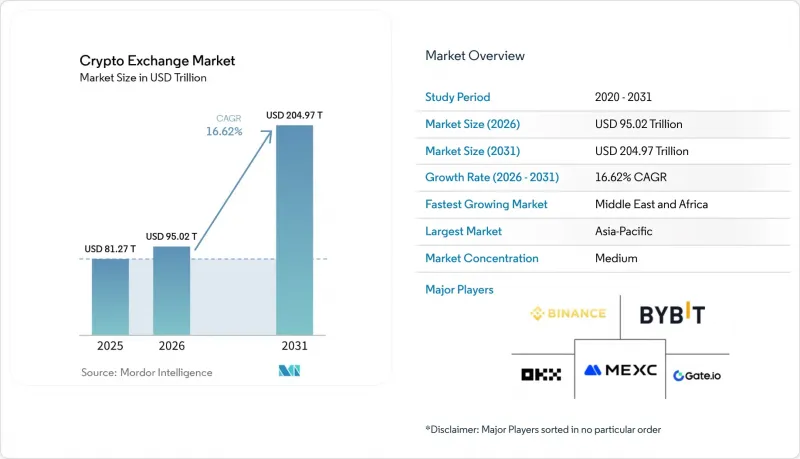
본 보고서는 거래 모델별(중앙 집중형 거래소 및 탈중앙화 거래소), 거래 유형별(현물 거래 및 파생상품 거래), 지역별(북미, 남미, 유럽, 아시아태평양, 중동 및 아프리카)로 분류되어 있습니다. 시장 전망은 금액(달러) 기준으로 제시되어 있습니다.
세계의 암호화폐 거래소 시장 동향 및 인사이트
디지털 자산에 대한 기관 투자자의 비중 확대
암호화폐 거래소 시장에 대한 기관 투자자의 진출은 단순한 시도 단계를 넘어, 현재는 거래량 분포를 보다 영구적으로 형성하고 있습니다. 2026년 1월, 351개 기관 투자자를 대상으로 한 설문조사에 따르면, 73%가 2026년에 디지털 자산에 대한 배분을 늘릴 계획인 것으로 나타났으며, 운용 자산 총액(AUM)의 5% 이상을 목표로 하는 비율은 연내 18%에서 29%로 상승할 것으로 예측됩니다. 이러한 변화가 암호화폐 거래소 시장에 중요한 이유는 투자 배분 규모가 커질수록 기관 투자자의 기준을 충족하는 감사 가능성, 보고 체계 및 운영상의 회복력을 갖춘 거래소가 선택되기 쉬워지는 경향이 있기 때문입니다. 또한, 기존 헤지펀드의 디지털 자산 노출 비중도 2024년 47%에서 2025년에는 55%를 나타낼 것으로 예측되며, 이는 시험적인 포지션 구축에서 지속적인 자본 투입으로의 전환을 뒷받침하는 결과입니다. 수탁자 선정 기준도 극적으로 변화하여, 보안 및 키 서명 프로토콜이 수탁자 선정의 주요 요인으로 8%에서 66%로 상승했습니다. 이에 따라 보다 견고한 자체 보관 또는 다자간 관리 프레임워크를 제공하는 암호화폐 거래소 사업자가 직접적으로 우대받게 되었습니다.
규제 대상 현물 및 파생상품 거래소의 확대
주요 관할권에서 규제 대상 현물 및 파생상품 거래 플랫폼의 급속한 확충 또한 암호화폐 거래소 시장을 재편하고 있습니다. OKX는 2026년 미국에서 현물 거래를 시작했으며, 45개 주에 걸친 자금 이체업자 라이선스 적용 범위 내에서 약 75종의 디지털 자산에 대한 접근을 제공했습니다. 이로 인해 오랫동안 국내 시장을 독점해 온 기존 사업자에 대한 경쟁 압력이 강화되었습니다. 코인베이스의 Deribit 29억 달러 인수 거래는 2025년 8월에 완료되었으며, 이를 통해 코인베이스는 주요 현물 거래소에서 옵션 및 퍼페추얼 계약 분야로 즉시 규모를 확장할 수 있는 보다 광범위한 파생상품 플랫폼으로 입지를 확대했습니다. 인수 당시 Deribit의 미결제 포지션 잔고는 600억 달러에 육박했으며, 2025년 7월 거래량은 1,850억 달러를 넘어섰습니다. 이는 암호화폐 거래소 시장에서 상품의 유동성이 이제 얼마나 중요한지를 보여줍니다. 그 결과, 거래소는 더 이상 ‘현물 전용’ 또는 ‘파생상품 전용’ 플랫폼으로서 경쟁하지 않게 되었습니다. 왜냐하면 현재의 암호화폐 거래소 시장에서는 단일 운영 체제 하에서 현물, 퍼페추얼, 옵션 모두에 대해 규제를 준수하는 접근을 제공할 수 있는 플랫폼이 높이 평가받고 있기 때문입니다.
라이선스 제도에 따른 규제의 파편화
암호화폐 거래소 시장은 국가 및 지역별로 상이한 라이선스 제도로 인해 여전히 큰 제약을 받고 있습니다. EU에서는 ‘암호자산 시장 규제(MiCA)’가 2026년에 전면 시행되며, 유럽증권시장감독청(ESMA)은 유효한 인가를 보유하지 않은 플랫폼은 이행 기간 종료 후 EU 고객에게 서비스 제공을 중단해야 한다고 밝혔습니다. 이로 인해 현재 심사 중인 사업자들에게는 규정 준수(컴플라이언스)의 문턱이 크게 높아졌습니다. 아랍에미리트(UAE)에서도 CMA, VARA, DFSA, FSRA, CBUAE에 걸친 여러 디지털 자산 규제 체제가 운영되고 있으며, 각각 다른 사업 범위와 자본 요건이 설정되어 있어 지역 진출 비용과 복잡성이 증가하고 있습니다. 이러한 부담이 가장 크게 가중되는 곳은 중견 거래소들입니다. 대규모 세계 사업자들은 법적 비용이나 보고 비용을 더 광범위한 수익원으로 분산시킬 수 있지만, 소규모 기업들은 그렇게 할 수 없기 때문입니다. 그 결과, 규제 당국이 투명성 제고와 투자자 보호에 힘쓰고 있음에도 불구하고, 암호화폐 거래소 시장은 상위 기업으로의 집중이 더욱 심화될 가능성이 있습니다.
부문 분석
2025년, 중앙 집중형 거래소는 시장 총 거래량의 86.1%를 차지했으며, 온체인 대안 수단과의 경쟁이 격화되는 상황에서도 그 우위를 유지했습니다. 이러한 우위는 더 강력한 법정화폐 온램프 기능, 더 빠른 매칭 인프라, 그리고 더 광범위한 라이선싱에 기인하며, 이 모든 요소는 프로토콜의 개방성만으로는 설명할 수 없는 기관 투자자들에게 여전히 중요한 요소로 남아 있습니다. 바이낸스는 2025년 8월부터 2026년 1월까지 현물 거래 누적 거래량으로 3조 5,400억 달러를 처리했으며, 이는 동 기간 동안 추적된 현물 거래량의 39.6%를 차지했습니다. CEX의 영구 선물 미결제 포지션 잔고는 2025년 10월에 2135억 달러로 정점을 찍었으며, 이는 2024년 1월 대비 291% 증가한 수치입니다. 이는 암호화폐 거래소 시장에서 레버리지 거래를 위한 유동성의 깊이가 여전히 중앙 집중형 플랫폼에 크게 의존하고 있음을 보여줍니다. 한편, 2025년 후반 MEXC와 Gate.io의 급부상은 수수료 인하와 기능의 신속한 도입이 기존 시장 지위의 안정성을 잠식하고 있음을 보여주며, 암호화폐 거래소 시장이 하위 계층에 고정되어 있는 것은 아님을 시사합니다.
분산형 거래소(DEX)는 암호화폐 거래소 시장 내에서 가장 빠르게 성장하고 있는 부문으로, 시장 규모는 2031년까지 연평균 성장률(CAGR) 22.8%로 확대될 것으로 예측됩니다. DEX의 현물 거래 점유율은 2024년 1월 6.9%에서 2026년 1월 13.6%로 두 배로 증가했으며, 같은 기간 DEX의 영구 선물 미결제 포지션 잔고는 12배 증가해 150억 달러에 달했습니다. PancakeSwap과 Uniswap은 2025년 8월부터 2026년 1월까지의 누적 거래량 기준, 전 세계 현물 거래소 상위 10위권에 진입했습니다. 이는 과거 대형 CEX가 지배하던 부문에서도 암호화폐 거래소 시장에 신뢰할 수 있는 온체인 경쟁자가 등장했음을 보여줍니다. Hyperliquid의 금, 은 S&P 500 영구 선물 상장은 과거 주로 중앙집권형 거래소와 연관되었던 상품 유형으로 DEX의 경쟁을 확대하며, 암호화폐 거래 업계 경쟁 구도를 한층 더 넓혔습니다. 기관 투자자 수요도 유사한 추세를 보이고 있으며, 조사 대상 투자자의 56%가 2028년까지 주로 대출 및 파생상품을 목적으로 DeFi 프로토콜을 이용할 것으로 예상하고 있습니다. 이는 컴플라이언스 관리가 성숙해짐에 따라, 암호화폐 거래소 시장에서 허가 없이도 참여할 수 있는 기관 투자자의 자금 유입이 더욱 증가할 가능성을 시사합니다.
지역별 분석
2025년, 아시아태평양은 암호화폐 거래소 시장 점유율의 42.9%를 차지했으며 거래 활동의 최대 지역 거점이 되었습니다. 이러한 위상은 대규모 개인 사용자 기반, 높은 온체인 이용률, 그리고 선진국과 신흥국에 걸친 다양한 규제 접근 방식의 조합에 의해 뒷받침되고 있습니다. 2025년 6월까지의 12개월 동안, 해당 지역의 암호화폐 거래량은 1조 4,000억 달러에서 2조 4,000억 달러로 증가하여 전년 대비 69%의 성장률을 기록했습니다. 이러한 성장의 주요 견인차는 인도, 베트남, 파키스탄 등이었습니다. 인도는 2024년과 2025년 모두 Chainalysis의 ‘세계 채택 지수’에서 1위를 차지했습니다. 또한, 2026년 6월 코인베이스(Coinbase)가 루피(INR) 기반 결제 시스템을 현지에서 시작한 것은 전 세계 거래소들이 법정화폐와의 직접 연동을 통해 암호화폐 거래소 시장에서 사용자 활성화의 다음 단계를 목표로 하고 있음을 보여줍니다. 한국의 실명제 계좌 시스템, 일본 금융청이 주도하는 모델, 중국 관련 역외 활동, 그리고 인도네시아와 베트남의 모바일 우선 거래 패턴이 어우러져 아시아태평양의 암호화폐 거래소 시장에 깊이와 다양성을 더하고 있습니다.
북미는 2025년에도 여전히 2위 규모를 유지했으며, 이는 라이선스 발급 절차가 명확해졌고 기관 투자자의 자금 유입이 증가하고 있는 것이 배경입니다. 2024년 1월 비트코인 현물 ETF의 승인은 지속적인 기관 투자자의 매수 수요를 창출하는 요인이 되었으며, 2025년에는 전 세계 암호화폐 ETP가 400억 달러 이상의 순유입을 기록했고, 운용 자산 잔고는 일시적으로 2,000억 달러를 돌파했습니다. OKX의 2026년 미국 시장 진출과 코인베이스(Coinbase)와 데리빗(Deribit)의 통합은 모두 암호화폐 거래소 시장에서 기관 투자자 및 고액 개인 투자자의 주문 흐름을 둘러싼 경쟁이 격화되고 있음을 시사했습니다. 캐나다에서는 CSA(캐나다 증권 감독 당국)의 감독 하에 있는 체계를 통해 규제 대상 거래소의 규모가 확대되었으며, 멕시코에서는 모바일 중심의 개인 투자자들의 참여를 통해 시장이 지속적으로 성장했습니다.
중동 및 아프리카는 암호화폐 거래소 시장에서 가장 빠르게 성장하는 지역으로, 이 지역 시장 규모는 2031년까지 연평균 성장률(CAGR) 23.5%로 확대될 것으로 예측됩니다. 이러한 성장은 아랍에미리트(UAE)의 활발한 라이선스 발급, 튀르키예, 이집트, 남아프리카공화국에서의 풀뿌리 수준 확산, 그리고 걸프 국가 시장 전반에 걸친 암호화폐 감독 체계 구축을 위한 광범위한 노력에 힘입은 것입니다. 유럽에서는 MiCA(암호자산 시장 규제)에 따라 독자적인 통합 단계가 진행 중이며, 자본력이 풍부한 거래소들은 승인을 받는 즉시 27개 회원국 모두에서 사업을 확장할 수 있는 명확한 로드맵이 제시되어 있습니다. 남미 역시 암호화폐 거래소 시장에서 여전히 중요한 위치를 차지하고 있으며, 아르헨티나의 스테이블코인 수요와 브라질의 보다 체계적인 규제가 달러 페그 자산에 대한 P2P 거래 및 거래소 주도 활동을 모두 뒷받침하고 있습니다.
기타 혜택 :
- 엑셀 형식 시장 예측(ME) 시트
- 3개월간의 애널리스트 지원
자주 묻는 질문
목차
제1장 서론
제2장 조사 방법
제3장 주요 요약
제4장 시장 구도
제5장 시장 규모 및 성장 예측
제6장 경쟁 구도
제7장 시장 기회 및 향후 전망
AJY 26.08.07According to Mordor Intelligence, the crypto exchange market size is expected to increase from USD 81.27 trillion in 2025 to USD 95.02 trillion in 2026 and reach USD 204.97 trillion by 2031, growing at a CAGR of 16.62% over 2026-2031.
This report is Segmented by Exchange Model (Centralized Exchanges and Decentralized Exchanges), by Trading Type (Spot Trading and Derivatives Trading), and by Geography (North America, South America, Europe, Asia-Pacific, and the Middle East and Africa). The Market Forecasts are Provided in Terms of Value (USD).
Global Crypto Exchange Market Trends and Insights
Rising Institutional Allocation to Digital Assets
Institutional participation in the crypto exchange market has moved beyond trial activity and is now shaping volume distribution more permanently. In January 2026, a survey of 351 institutional investors found that 73% planned to increase digital asset allocations in 2026, and the share targeting more than 5% of AUM was expected to rise from 18% to 29% within the year. That change matters for the crypto exchange market because larger allocation sizes tend to favor venues that can support auditability, reporting, and operational resilience at institutional standards. Traditional hedge fund exposure to digital assets also reached 55% in 2025, up from 47% in 2024, which reinforced the shift from exploratory positioning to repeat capital deployment. Custody selection criteria also changed sharply, with security and key-signing protocols rising from 8% to 66% as the leading factor in custodian selection, directly favoring crypto exchange market operators that offer stronger self-custody or multi-party control frameworks.
Expansion of Regulated Spot and Derivatives Venues
The faster buildout of regulated spot and derivatives platforms across major jurisdictions is also reshaping the crypto exchange market. OKX opened United States spot trading in 2026 with access to nearly 75 digital assets under Money Transmitter License coverage across 45 states, which raised the competitive pressure on incumbents that had long dominated the domestic market. Coinbase's USD 2.9 billion acquisition of Deribit closed in August 2025, expanding its position from a major spot venue into a broader derivatives platform with immediate scale in options and perpetuals. At the time of the deal, Deribit held close to USD 60 billion in open interest and processed more than USD 185 billion in trading volume in July 2025, which showed how much product depth now matters in the crypto exchange market. The practical result is that exchanges are no longer competing as spot-only or derivatives-only venues, because the crypto exchange market now rewards platforms that can offer regulated access across spot, perpetuals, and options within one operating structure.
Regulatory Fragmentation Across Licensing Regimes
The crypto exchange market still faces a material drag from uneven licensing systems across countries and regions. In the EU, Markets in Crypto-Assets (MiCA) entered full enforcement in 2026, and the European Securities and Markets Authority (ESMA) stated that platforms without valid authorization must stop serving EU clients after the transition period ends, sharply raising the compliance threshold for any operator still under review. The United Arab Emirates also operates multiple digital asset regimes across the CMA, VARA, DFSA, FSRA, and CBUAE, each with distinct activity scopes and capital requirements, which increases the cost and complexity of regional expansion. That burden falls hardest on mid-tier exchanges, because large global operators can spread legal and reporting costs across broader revenue pools while smaller firms cannot. The result is that the crypto exchange market can become even more concentrated at the top, even as regulators try to improve transparency and investor protection.
Other drivers and restraints analyzed in the detailed report include:
- Mobile First Trading and Embedded Finance Access
- Tokenized Treasury and Stablecoin Settlement Flows
- Counterparty Risk from Hacks, Insolvencies, and Custody Failures
For complete list of drivers and restraints, kindly check the Table Of Contents.
Segment Analysis
Centralized exchanges accounted for 86.1% of total market volume in 2025, maintaining their dominance despite rising competition from on-chain alternatives. That lead came from stronger fiat on-ramp capability, faster matching infrastructure, and broader regulatory licensing, all of which still matter more to institutions than protocol openness alone. Binance processed USD 3.54 trillion in spot cumulative volume between August 2025 and January 2026, accounting for 39.6% of tracked spot exchange volume during that period. CEX perpetual open interest peaked at USD 213.5 billion in October 2025, up 291% from January 2024, which showed how much of the crypto exchange market still depends on centralized liquidity depth for leveraged trading. At the same time, late 2025 gains by MEXC and Gate.io showed that the crypto exchange market is not locked in at the bottom tier, as fee cuts and faster feature rollouts are eroding the stability of inherited market positions.
Decentralized exchanges are the fastest-growing segment of the crypto exchange market, with the market size projected to grow at a 22.8% CAGR through 2031. Their spot share doubled from 6.9% in January 2024 to 13.6% in January 2026, and DEX perpetual open interest rose 12-fold to USD 15 billion over the same period. PancakeSwap and Uniswap entered the top 10 global spot exchanges by cumulative volume between August 2025 and January 2026, which showed that the crypto exchange market now has credible on-chain challengers in categories once dominated by major CEXs. Hyperliquid's launch of gold, silver, and S&P 500 perpetuals widened the competitive landscape of the crypto exchange industry by pushing DEX competition into instrument types that were once largely tied to centralized venues. Institutional appetite also points in that direction, with 56% of surveyed investors expecting to engage with DeFi protocols by 2028, mainly for lending and derivatives, suggesting that the crypto exchange market could see more permissionless institutional flows as compliance controls mature.
Complete Report Scope:
- By Exchange Model
- Centralized Exchanges
- Decentralized Exchanges
- By Trading Type
- Spot Trading
- Derivatives Trading
- By Geography
- North America
- United States
- Canada
- Mexico
- South America
- Brazil
- Argentina
- Rest of South America
- Europe
- Germany
- United Kingdom
- France
- Italy
- Spain
- Rest of Europe
- Asia-Pacific
- China
- India
- Japan
- South Korea
- Australia
- Indonesia
- Rest of Asia-Pacific
- Middle East and Africa
- Turkey
- Israel
- Saudi Arabia
- United Arab Emirates
- South Africa
- Egypt
- Rest of Middle East and Africa
- North America
Geography Analysis
Asia-Pacific held 42.9% of the crypto exchange market share in 2025, making it the largest regional center for trading activity. That position rests on a combination of large retail user bases, high on-chain engagement, and a wide mix of regulatory approaches across developed and emerging countries. Regional crypto transaction volume rose from USD 1.4 trillion to USD 2.4 trillion over the 12 months to June 2025, representing 69% year-on-year growth, with India, Vietnam, and Pakistan among the main contributors. India ranked first in the Chainalysis Global Adoption Index in both 2024 and 2025, and Coinbase's local INR rails launch in June 2026 showed how global exchanges are targeting the next stage of user activation in the crypto exchange market through direct fiat access. South Korea's real-name account system, Japan's FSA-led model, offshore China-linked activity, and Indonesia's and Vietnam's mobile-first trading patterns together give the Asia-Pacific crypto exchange market both depth and diversification.
North America remained the second-largest region in 2025, supported by clearer exchange licensing pathways and the growing presence of institutional capital. Spot Bitcoin ETF approvals in January 2024 helped create a sustained institutional bid, and global crypto ETPs attracted more than USD 40 billion in net inflows in 2025 while assets under management briefly moved above USD 200 billion. OKX's 2026 United States market entry and the Coinbase-Deribit combination both pointed to stronger competition for institutional and advanced retail order flow in the crypto exchange market. Canada added regulated exchange capacity through CSA-supervised structures, while Mexico continued to expand through mobile-led retail participation.
The Middle East and Africa are the fastest-growing regions in the crypto exchange market, with the region's market size forecast to grow at a 23.5% CAGR through 2031. Growth there is being supported by United Arab Emirates licensing momentum, rising grassroots adoption in Turkey, Egypt, and South Africa, and a broader push to formalize virtual asset oversight across Gulf markets. Europe is moving through a separate consolidation phase under MiCA, where better-capitalized exchanges have a clearer path to scale across all 27 member states once approvals are secured. South America also remains relevant for the crypto exchange market, because stablecoin demand in Argentina and more structured regulation in Brazil are supporting both peer-to-peer and exchange-led activity in USD-pegged assets.
- Binance
- Coinbase Global, Inc.
- Bybit
- OKX
- Gate.io
- MEXC
- Kraken
- Bitget
- Crypto.com
- KuCoin
- HTX
- Upbit
- Bitfinex
- Gemini
- Bitstamp
- Robinhood Markets, Inc.
- eToro Group Ltd.
- BitMEX
- Coincheck, Inc.
- Luno
- CEX.IO
Additional Benefits:
- The market estimate (ME) sheet in Excel format
- 3 months of analyst support
TABLE OF CONTENTS
1 INTRODUCTION
- 1.1 Study Assumptions and Market Definition
- 1.2 Scope of the Study
2 RESEARCH METHODOLOGY
3 EXECUTIVE SUMMARY
4 MARKET LANDSCAPE
- 4.1 Market Overview
- 4.2 Market Drivers
- 4.2.1 Rising Institutional Allocation to Digital Assets
- 4.2.2 Expansion of Regulated Spot and Derivatives Venues
- 4.2.3 Mobile First Trading and Embedded Finance Access
- 4.2.4 Tokenized Treasury and Stablecoin Settlement Flows
- 4.2.5 Fee Compression and Zero Fee Acquisition Models
- 4.2.6 Exchange Proof of Reserve and Auditability Demand
- 4.3 Market Restraints
- 4.3.1 Regulatory Fragmentation Across Licensing Regimes
- 4.3.2 Counterparty Risk From Hacks, Insolvencies, and Custody Failures
- 4.3.3 Liquidity Migration to Off-Exchange and Onchain Venues
- 4.3.4 Banking Access and Fiat On-Ramp Disruption Risk
- 4.4 Value Chain Analysis
- 4.5 Regulatory Landscape
- 4.6 Technological Outlook
- 4.7 Porter's Five Forces Analysis
- 4.7.1 Threat of New Entrants
- 4.7.2 Bargaining Power of Buyers
- 4.7.3 Bargaining Power of Suppliers
- 4.7.4 Threat of Substitutes
- 4.7.5 Intensity of Competitive Rivalry
5 MARKET SIZE AND GROWTH FORECASTS
- 5.1 By Exchange Model
- 5.1.1 Centralized Exchanges
- 5.1.2 Decentralized Exchanges
- 5.2 By Trading Type
- 5.2.1 Spot Trading
- 5.2.2 Derivatives Trading
- 5.3 By Geography
- 5.3.1 North America
- 5.3.1.1 United States
- 5.3.1.2 Canada
- 5.3.1.3 Mexico
- 5.3.2 South America
- 5.3.2.1 Brazil
- 5.3.2.2 Argentina
- 5.3.2.3 Rest of South America
- 5.3.3 Europe
- 5.3.3.1 Germany
- 5.3.3.2 United Kingdom
- 5.3.3.3 France
- 5.3.3.4 Italy
- 5.3.3.5 Spain
- 5.3.3.6 Rest of Europe
- 5.3.4 Asia-Pacific
- 5.3.4.1 China
- 5.3.4.2 India
- 5.3.4.3 Japan
- 5.3.4.4 South Korea
- 5.3.4.5 Australia
- 5.3.4.6 Indonesia
- 5.3.4.7 Rest of Asia-Pacific
- 5.3.5 Middle East and Africa
- 5.3.5.1 Turkey
- 5.3.5.2 Israel
- 5.3.5.3 Saudi Arabia
- 5.3.5.4 United Arab Emirates
- 5.3.5.5 South Africa
- 5.3.5.6 Egypt
- 5.3.5.7 Rest of Middle East and Africa
- 5.3.1 North America
6 COMPETITIVE LANDSCAPE
- 6.1 Market Concentration
- 6.2 Strategic Moves
- 6.3 Market Share Analysis
- 6.4 Company Profiles (includes Global Level Overview, Market Level Overview, Core Segments, Financials as available, Strategic Information, Market Rank/Share, Products and Services, Recent Developments)
- 6.4.1 Binance
- 6.4.2 Coinbase Global, Inc.
- 6.4.3 Bybit
- 6.4.4 OKX
- 6.4.5 Gate.io
- 6.4.6 MEXC
- 6.4.7 Kraken
- 6.4.8 Bitget
- 6.4.9 Crypto.com
- 6.4.10 KuCoin
- 6.4.11 HTX
- 6.4.12 Upbit
- 6.4.13 Bitfinex
- 6.4.14 Gemini
- 6.4.15 Bitstamp
- 6.4.16 Robinhood Markets, Inc.
- 6.4.17 eToro Group Ltd.
- 6.4.18 BitMEX
- 6.4.19 Coincheck, Inc.
- 6.4.20 Luno
- 6.4.21 CEX.IO
7 MARKET OPPORTUNITIES AND FUTURE OUTLOOK
- 7.1 White-space and Unmet-Need Assessment


