

|
시장보고서
상품코드
2099124
바이오인포매틱스 분야 AI 시장 : 점유율 분석, 업계 동향 및 통계, 성장 예측(2026-2031년)AI In Bioinformatics - Market Share Analysis, Industry Trends & Statistics, Growth Forecasts (2026 - 2031) |
||||||
 Mordor Intelligence
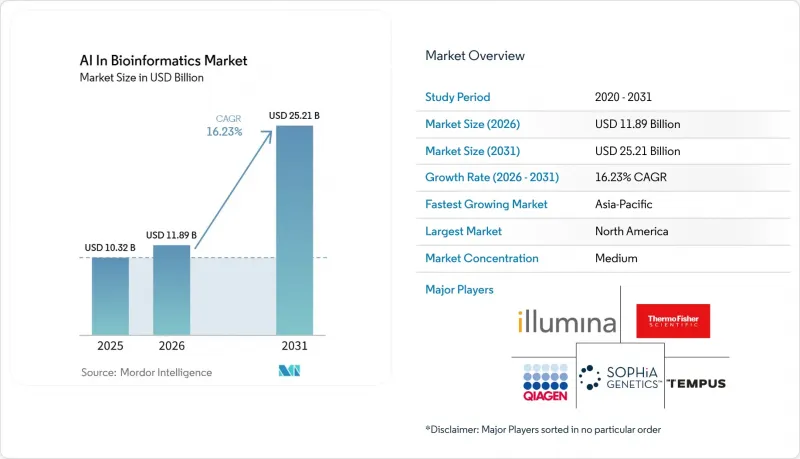
Mordor Intelligence에 의하면, 바이오인포매틱스 분야 AI시장은 2025년 103억 2,000만 달러에서 2026년에는 118억 9,000만 달러로 확대되어 2026년부터 2031년까지 CAGR 16.23%로 성장을 지속하여, 2031년에는 252억 1,000만 달러에 이를 것으로 예측됩니다.
본 보고서는 제공 분야(소프트웨어, 서비스), 기술(머신러닝, 딥러닝, 기타), 용도(신약·의약품 개발, 기타), 최종 사용자(제약·바이오기술 기업, 기타), 지역(북미, 유럽, 아시아태평양, 중동 및 아프리카, 남미)별로 분류되어 있습니다. 시장 전망은 금액(달러) 기준으로 제시되어 있습니다.
전 세계 바이오인포매틱스 분야 AI 시장 동향 및 인사이트
AI를 활용한 대규모 멀티오믹스 데이터 분석
바이오인포매틱스 분야 AI 시장은 유전체학, 전사체학, 단백질체학, 대사체학이 통합된 AI 워크플로우로의 통합에 의해 주도되고 있습니다. 기존에는 멀티오믹스 분석이 모델이 데이터 유형 간의 서로 다른 통계적 특성과 배치 효과를 조정하는 데 어려움을 겪었기 때문에 그 범위가 제한적이었습니다. 2026년 『Cell Metabolism』지에 게재된 연구에서는 42만 5,258명의 피험자를 대상으로 한 통합적인 멀티오믹스 모델링이 제시되었으며, 단일 모달리티 접근법으로는 도달할 수 없었던 규모로 노화 과정, 대사 건강, 그리고 중재에 대한 반응을 예측하는 데 있어 뛰어난 성능을 발휘했습니다. 이를 통해 제약 기업들은 표적 검증 과정에서 AI 통합형 멀티오믹스를 보다 일상적인 단계로 채택하게 되었으며, 시간이 많이 소요되는 체외(in vitro) 스크리닝에 대한 의존도를 점차 낮추고 있습니다. 또한, 2025년에 발표된 Flexynesis 툴킷은 대량 멀티오믹스 데이터가 정밀 종양학에서의 계층화를 어떻게 지원할 수 있는지를 보여주며, 이는 암 적응증 선정에 있어 임상적 적용이 조기에 이루어질 것임을 시사합니다. 남은 과제는 데이터 생성에서 의미론적 조화로의 전환입니다. 이는 벤더들이 현재 대규모 코호트 데이터셋 전반에 걸쳐 일관성이 없는 임상 표현형 및 메타데이터 기준을 조화시켜야 할 필요성에 직면해 있기 때문입니다.
임상시험의 계층화 및 코호트 매칭
바이오인포매틱스 분야 AI는 의약품 개발 과정에서 환자 하위 집단을 선정하는 방식을 개선해야 할 필요성에서도 지지를 얻고 있습니다. 기존의 역학 도구로는 이질적인 시험 대상 집단 중에서 약리유전체학을 기반으로 정의된 반응자 집단을 식별하지 못하는 경우가 많았으며, 이러한 약점이 2상 임상시험 실패의 한 원인이 되어 왔습니다. FDA가 2026년 4월에 시작한 임상시험 AI 시범 프로그램은 용량 선정, 안전성 모니터링, 그리고 조기 지속·중단 판단에 직접적으로 초점을 맞추고 있으며, 이를 통해 임상시험 설계 및 수행에 사용되는 AI 바이오인포매틱스 도구에 대한 규제적 지원이 더욱 명확해졌습니다. 상용 플랫폼은 이에 대응하여 유전체, 전사체, 영상 및 임상 데이터를 결합하여 코호트 정의를 생성하고 있으며, 기존 워크플로우보다 훨씬 신속하게 활용할 수 있게 되었습니다. 이로 인해 설명 가능한 소프트웨어에 대한 수요가 증가하고 있습니다. 규제 당국에 제출되는 AI로 정의된 코호트에는 고정된 모델 매개변수, 감사 가능한 논리, 그리고 명확한 데이터 계보 기록이 필요하기 때문입니다.
국경을 초월한 유전체 공동 연구에서 데이터 주권을 둘러싼 마찰
바이오인포매틱스 분야 AI 시장은 개인정보 보호, 재식별 위험, 2차 데이터 이용에 관한 서로 다른 전제에 기반하여 구축된 국경을 초월한 유전체 데이터 규제로 인해 큰 제약에 직면해 있습니다. EU의 GDPR(EU 개인정보보호규정), 중국의 ‘개인정보보호법’ 및 ‘인간 유전자원 관리 규정’, 그리고 미국 NIH의 유전체 데이터 공유 프레임워크는 실제로 충분히 조화를 이루지 못하고 있어, 다국적 모델 학습 및 검증 프로그램의 거버넌스 일정을 장기화시키고 있습니다. 중국의 유전 자원 관련 규제는 관련 데이터 흐름에 대해 수출 규제 및 국내 현지화 요건을 부과하고 있어, 외국이 참여하는 연구에 대해 특히 제한이 엄격합니다. 그 결과, 바이오인포매틱스 분야 AI 시장은 단순한 세계 라이선싱 계약이 아닌, 국가별 데이터 파트너십 체제로 전환되고 있습니다. 이로 인해 전 세계적으로 유용한 훈련 데이터 세트를 필요로 하는 벤더들의 경우, 개발 비용이 증가하고 시장 출시까지의 기간이 길어지고 있습니다.
부문 분석
2025년, 바이오인포매틱스 분야 AI 시장에서 소프트웨어는 59.73%의 점유율을 차지했습니다. 이는 SaaS형 유전체 분석 플랫폼, 클라우드 네이티브 변이 주석 도구, 그리고 도입 후 효율적으로 확장되는 AI 기반 시퀀싱 분석 파이프라인에 힘입은 결과입니다. 또한, 대규모 유전체 데이터베이스와 소프트웨어 플랫폼에 내장된 독자적인 모델 가중치로 인해 발생하는 전환 비용 역시 이러한 입지를 공고히 하고 있습니다. 이러한 요인들로 인해 소프트웨어는 현재 바이오인포매틱스 분야 AI 시장에서 가장 확고하게 자리 잡은 제품이 되었습니다. 이러한 가치 제안은 고객이 재현 가능한 분석, 처리 속도 향상, 그리고 여러 연구 프로그램에 걸친 통합된 모델 업데이트를 필요로 하는 상황에서 가장 강력하게 발휘됩니다.
서비스 부문은 2026년부터 2031년까지 연평균 성장률(CAGR) 16.58%를 기록하며 가장 빠르게 성장하는 하위 부문이 될 것으로 예측됩니다. 이는 복잡한 모델의 도입으로 인해 구매자들이 외부 지원을 필요로 하고 있음을 보여줍니다. 바이오인포매틱스 분야 AI 업계는 플랫폼과 서비스를 묶은 번들 계약으로 전환되고 있습니다. 이는 모델 맞춤화, 파이프라인 통합 및 관리형 분석이 소프트웨어 단독보다 표준화하기 어렵기 때문입니다. 바이오인포매틱스 분야 AI 시장에서는 수익원이 소프트웨어 단독 모델에서 지속적인 서비스 기반 계약 형태로 전환되고 있습니다.
2025년에는 머신러닝이 44.38%의 점유율을 차지하며, 시퀀싱 파이프라인, 변이 분류, 바이오마커 관련성 연구, 표현형 예측 각 분야에서 여전히 가장 확고한 기술 기반으로 자리매김했습니다. 임상 유전체학 워크플로우에서는 해석 가능성이나 보정이 중시되는 경우가 많기 때문에 그라디언트 부스팅 트리나 랜덤 포레스트와 같은 지도 학습 모델은 여전히 중요한 역할을 수행하고 있습니다. 딥러닝은 단백질 구조 예측, 전체 슬라이드 이미지 분석 및 단일 세포 작업에서 상대적으로 우수한 성능을 발휘하고 있으며, 전체 점유율에서 1위를 차지하지는 않더라도 그 중요성은 여전히 유지되고 있습니다. 이러한 구성은 바이오인포매틱스 분야 AI 시장이 하나의 지배적인 모델 클래스로 수렴하기보다는 여전히 여러 기술적 접근 방식을 채택하고 있음을 보여줍니다.
자연어 처리는 2031년까지 연평균 성장률(CAGR)이 16.82%에 달하고, 가장 빠르게 성장하는 기술 분야가 될 것으로 예측됩니다. 이는 생의학 문헌, 임상 기록, 지식 그래프가 연구 워크플로우에서 활발히 활용되는 데이터 계층으로 자리 잡고 있기 때문입니다. 컴퓨터 비전은 여전히 소규모 부문이지만, 임상 워크플로우에서 AI를 활용한 디지털 병리학 및 전체 슬라이드 이미징과 병행하여 성장하고 있습니다. 따라서 바이오인포매틱스 분야 AI는 단순한 서열 분석에 그치지 않고, 조사 및 진단 과정을 보다 폭넓게 지원하는 텍스트, 이미지, 그래프 추론 작업으로 그 범위를 확대해 나가고 있습니다.
지역별 분석
2025년, 북미는 바이오인포매틱스 분야 AI 시장 규모에서 48.55%를 차지하며 지역별 최대 점유율을 기록했습니다. 이 지역은 활발한 제약 업계의 연구개발 활동, 풍부한 벤처 자금, 그리고 NIH(미국 국립보건원)가 지원하는 견고한 유전체학 인프라의 혜택을 받고 있습니다. 미국은 계속해서 이 지역의 바이오인포매틱스 분야 AI 시장의 중심적인 존재이며, 캐나다는 ‘Genome Canada’ 및 관련 정밀의료 활동을 통해 시장을 뒷받침하고 있습니다. 주요 클라우드 제공업체를 통한 하이엔드 GPU 인프라 접근성도 대규모 오믹스 워크로드에서 북미의 비용 및 속도 면에서의 우위를 강화하고 있으며, EuroHPC의 MeluXina 프로젝트에서는 3개의 GPU 노드에서 Parabricks를 사용함으로써, GPU 가속을 통한 전체 유전체 분석의 실행 시간을 14.6시간에서 4.7시간으로 단축할 수 있음이 입증되었습니다.
유럽은 바이오인포매틱스 분야 AI 시장에서 2위 규모를 자랑하는 지역 블록으로, 독일, 영국, 프랑스가 주도적인 역할을 하고 있습니다. 영국에서는 NHS 잉글랜드의 ‘혈액 검사 우선 암 프로그램’과 SOPHiA GENETICS가 2026년 5월 Synnovis와 체결한 제휴가, 공공 의료 제도가 어떻게 AI를 활용한 유전체 진단에 대한 대규모 직접 수요를 창출할 수 있는지를 보여주고 있습니다. 독일은 독일 바이오뱅크 얼라이언스(German Biobank Alliance) 및 유전체 데이터 인프라 프로젝트를 통해 연합 유전체학(Federated Genomics) 분야에서 주도적인 역할을 수행하고 있으며, 2026년에는 여러 국내 노드에 걸쳐 개인정보 보호형 연합 GWAS(유전체 연관 분석) 실증 실험을 완료했습니다.
아시아태평양은 2026년부터 2031년까지 연평균 성장률(CAGR) 18.43%를 기록하며 가장 빠르게 성장할 지역으로 예측되며, 바이오인포매틱스 분야 AI 시장에서 가장 급성장하는 지역이 될 전망입니다. 이러한 성장은 중국, 일본, 인도, 한국의 정부 주도 유전체학 프로그램과 각국의 건강 데이터 인프라에 대한 지속적인 투자에 의해 주도되고 있습니다. 2025년 『Nature』지에 게재된 한족의 조상에 관한 연구에서는 집단 특이적 다유전자 위험도 평가가 비유럽계 모델의 대규모 개발을 어떻게 지원할 수 있는지가 제시되었습니다. 이는 지역 특이적 정밀의료 도구에 있어 중요한 의미를 지닙니다. 중국의 대규모 코호트 프로그램과 다민족 간 연구는 지역 특화형 모델의 학습 데이터 기반을 확대되고 있습니다. 한편, 남미, 중동 및 아프리카에서는 병원과의 제휴 및 정밀의료 인프라에 대한 투자를 통해 초기 단계 수요가 나타나고 있습니다. 여기에는 PathAI가 2026년에 브라질에서 진행할 공동 프로젝트도 포함됩니다.
기타 혜택:
- 엑셀 형식 시장 예측(ME) 시트
- 3개월간의 애널리스트 지원
자주 묻는 질문
목차
제1장 서론
제2장 조사 방법
제3장 주요 요약
제4장 시장 구도
제5장 시장 규모와 성장 예측
제6장 경쟁 구도
제7장 시장 기회와 향후 전망
JHS 26.08.07According to Mordor Intelligence, the AI in bioinformatics market is expected to grow from USD 10.32 billion in 2025 to USD 11.89 billion in 2026 and is forecasted to reach USD 25.21 billion by 2031 at 16.23% CAGR over 2026-2031.
This report is Segmented by Offering (Software, Services), Technology (Machine Learning, Deep Learning, and Others), Application (Drug Discovery and Development, and Others), End-User (Pharmaceutical and Biotechnology Companies, and Others), and Geography (North America, Europe, Asia-Pacific, Middle East and Africa, South America). The Market Forecasts are Provided in Terms of Value (USD).
Global AI In Bioinformatics Market Trends and Insights
AI-Led Interpretation of Multi-Omics Data at Scale
The AI in bioinformatics market is being pushed forward by the merging of genomics, transcriptomics, proteomics, and metabolomics into unified AI workflows. Multi-omics analysis was previously limited because models struggled to reconcile different statistical properties and batch effects across data types. A 2026 study in Cell Metabolism showed unified multi-omics modeling across 425,258 individuals, with strong performance in predicting aging trajectories, metabolic health, and intervention response at a scale that single-modality approaches could not reach.This is moving pharmaceutical companies toward AI-integrated multi-omics as a more routine step in target validation and reducing dependence on slower in vitro screening paths. The 2025 Flexynesis toolkit also showed how bulk multi-omics data can support precision oncology stratification, which points to earlier clinical use in cancer indication selection.The remaining challenge has shifted from data generation to semantic harmonization, because vendors now need to align inconsistent clinical phenotyping and metadata standards across large cohort datasets.
Clinical Trial Stratification and Cohort Matching
The AI in bioinformatics market is also gaining support from the need to improve patient subgroup selection in drug development. Conventional epidemiological tools often fail to isolate pharmacogenomically defined responder populations inside heterogeneous trial pools, and that weakness has contributed to Phase II failures. The FDA's April 2026 pilot program on AI in clinical trials directly addressed dose selection, safety monitoring, and early go or no-go decisions, which gives clearer regulatory support for AI bioinformatics tools used in trial design and execution.Commercial platforms are responding by combining genomic, transcriptomic, imaging, and clinical data into cohort definitions that can be used much faster than traditional workflows. This raises demand for explainable software, because AI-defined cohorts that enter regulatory submissions will need fixed model parameters, auditable logic, and clear lineage records.
Data Sovereignty Friction in Cross-Border Genomic Collaboration
The AI in bioinformatics market faces a major constraint from cross-border genomic data rules that were built on different assumptions about privacy, re-identification risk, and secondary data use. The EU's GDPR, China's Personal Information Protection Law and Human Genetic Resources Administration rules, and the U.S. NIH genomic data sharing framework do not align well in practice, which stretches governance timelines for multinational model training and validation programs. China's genetic resources rules are especially restrictive for foreign-involved research because they impose export controls and domestic localization requirements on relevant data flows. As a result, the AI in bioinformatics market is moving toward country-specific data partnership structures rather than simple global licensing arrangements. This raises development costs and extends time to market for vendors that want globally relevant training datasets.
Other drivers and restraints analyzed in the detailed report include:
- Foundation Models for Biological Sequence and Structure Prediction
- Federated Learning Across Hospital and Biobank Data Silos
- Model Validation Burden Across Clinical, Research, and GxP Use Cases
For complete list of drivers and restraints, kindly check the Table Of Contents.
Segment Analysis
Software held 59.73% of the AI in bioinformatics market share in 2025, supported by SaaS genomic interpretation platforms, cloud-native variant annotation tools, and AI-powered sequencing analysis pipelines that scale efficiently after deployment. Its position is also reinforced by switching costs created by large genomic databases and by proprietary model weights embedded within software platforms. These factors make software the most entrenched offering in the AI in bioinformatics market at present. The value proposition has been strongest where customers need repeatable analysis, faster throughput, and centralized model updates across multiple research programs.
Services are expected to be the fastest-growing sub-segment at 16.58% CAGR from 2026 to 2031, which shows that complex model deployment is pushing buyers toward external support. The AI in bioinformatics industry is moving toward bundled platform and service contracts because model customization, pipeline integration, and managed analysis are harder to standardize than software alone. Revenue is moving away from software-only models and toward recurring service-based engagement structures in the AI in bioinformatics market.
Machine learning held 44.38% share in 2025 and remained the most established technology base across sequencing pipelines, variant classification, biomarker association studies, and phenotype prediction. Supervised models such as gradient-boosted trees and random forests still matter because clinical genomics workflows often favor interpretability and calibration. Deep learning has delivered stronger relative performance in protein structure prediction, whole-slide image analysis, and single-cell tasks, which keeps it important even when not leading overall share. This mix shows that the AI in bioinformatics market still uses multiple technical approaches rather than converging on one dominant model class.
Natural language processing is expected to be the fastest-growing technology segment at 16.82% CAGR through 2031 because biomedical literature, clinical notes, and knowledge graphs are becoming active data layers in research workflows. Computer vision remains a smaller segment, but it is growing alongside AI-powered digital pathology and whole-slide imaging in clinical workflows. The AI in bioinformatics industry is therefore broadening from sequence analysis alone into text, image, and graph reasoning tasks that support more of the research and diagnostic process.
Complete Report Scope:
- By Offering
- Software
- Services
- By Technology
- Machine Learning
- Deep Learning
- Natural Language Processing
- Computer Vision
- Other Technologies
- By Application
- Drug Discovery and Development
- Clinical Diagnostics and Precision Medicine
- Biomarker Discovery and Validation
- Multi-Omics Data Integration and Interpretation
- Biological Network and Systems Biology Modeling
- Laboratory Informatics and Workflow Automation
- Other Applications
- By End-User
- Pharmaceutical and Biotechnology Companies
- Academic and Research Institutes
- Hospitals and Diagnostic Laboratories
- Other End-Users
- By Geography
- North America
- United States
- Canada
- Mexico
- Europe
- Germany
- United Kingdom
- France
- Italy
- Spain
- Rest of Europe
- Asia-Pacific
- China
- Japan
- India
- Australia
- South Korea
- Rest of Asia-Pacific
- Middle East and Africa
- GCC
- South Africa
- Rest of Middle East and Africa
- South America
- Brazil
- Argentina
- Rest of South America
- North America
Geography Analysis
North America accounted for 48.55% of the AI in bioinformatics market size in 2025, giving it the largest regional position. The region benefits from dense pharmaceutical R&D activity, deep venture funding, and strong NIH-backed genomics infrastructure. The United States remains the anchor of the regional AI in bioinformatics market, while Canada adds support through Genome Canada and related precision medicine activity. Access to high-end GPU infrastructure at major cloud providers also strengthens North America's cost and speed advantage for large omics workloads, and the EuroHPC MeluXina project showed that GPU-accelerated whole-genome analysis can reduce runtime from 14.6 hours to 4.7 hours with Parabricks on 3 GPU nodes.
Europe is the second-largest regional block in the AI in bioinformatics market, led by Germany, the UK, and France. In the UK, NHS England's blood-test-first cancer program and SOPHiA GENETICS' May 2026 partnership with Synnovis show how public health systems can create direct demand for AI-enabled genomic diagnostics at scale. Germany has taken a leading role in federated genomics through the German Biobank Alliance and the Genomic Data Infrastructure project, which completed a 2026 demonstration of privacy-preserving federated GWAS across multiple national nodes.
Asia-Pacific is projected to be the fastest-growing region at 18.43% CAGR from 2026 to 2031, making it the fastest-rising part of the AI in bioinformatics market. Growth is being driven by government-backed genomics programs in China, Japan, India, and South Korea and by continued investment in national health data infrastructure. A 2025 Nature study on Han Chinese ancestry showed how population-specific polygenic risk scoring can support non-European model development at large scale, which is important for region-specific precision medicine tools. China's large cohort programs and cross-ancestry research are expanding the training base for local models, while South America and the Middle East and Africa are showing earlier-stage demand through hospital partnerships and precision medicine infrastructure investment, including PathAI's 2026 Brazil collaboration.
- Benevolent AI
- Congenica Ltd.
- Deep Genomics Inc.
- DNAnexus, Inc.
- Fabric Genomics, Inc.
- GeneDx, Inc.
- Genialis, Inc.
- Genoox Ltd.
- IBM
- Illumina
- Insilico Medicine
- NVIDIA
- Owkin, Inc.
- Oxford Nanopore Technologies plc
- PathAI, Inc.
- QIAGEN
- SOPHiA GENETICS SA
- Tempus AI, Inc.
- Thermo Fisher Scientific
- Velsera, Inc.
Additional Benefits:
- The market estimate (ME) sheet in Excel format
- 3 months of analyst support
TABLE OF CONTENTS
1 Introduction
- 1.1 Study Assumptions and Market Definition
- 1.2 Scope of the Study
2 Research Methodology
3 Executive Summary
4 Market Landscape
- 4.1 Market Overview
- 4.2 Market Drivers
- 4.2.1 AI-Led Interpretation of Multi-Omics Data at Scale
- 4.2.2 Clinical Trial Stratification and Cohort Matching
- 4.2.3 Foundation Models for Biological Sequence and Structure Prediction
- 4.2.4 Federated Learning Across Hospital and Biobank Data Silos
- 4.2.5 Closed-Loop Wet Lab and In Silico Workflow Automation
- 4.2.6 Cross-Ancestry Model Expansion for Population-Scale Genomics
- 4.3 Market Restraints
- 4.3.1 Data Sovereignty Friction in Cross-Border Genomic Collaboration
- 4.3.2 Model Validation Burden Across Clinical, Research, and GxP Use Cases
- 4.3.3 GPU and High-Performance Compute Constraints for Large Omics Pipelines
- 4.3.4 Limited Labeled Biological Datasets for Rare Variant and Rare Disease Use Cases
- 4.4 Supply/Value Chain Analysis
- 4.5 Regulatory Landscape
- 4.6 Technological Outlook
- 4.7 Porter's Five Forces
- 4.7.1 Threat of New Entrants
- 4.7.2 Bargaining Power of Suppliers
- 4.7.3 Bargaining Power of Buyers
- 4.7.4 Threat of Substitutes
- 4.7.5 Competitive Rivalry
5 Market Size & Growth Forecasts (Value)
- 5.1 By Offering
- 5.1.1 Software
- 5.1.2 Services
- 5.2 By Technology
- 5.2.1 Machine Learning
- 5.2.2 Deep Learning
- 5.2.3 Natural Language Processing
- 5.2.4 Computer Vision
- 5.2.5 Other Technologies
- 5.3 By Application
- 5.3.1 Drug Discovery and Development
- 5.3.2 Clinical Diagnostics and Precision Medicine
- 5.3.3 Biomarker Discovery and Validation
- 5.3.4 Multi-Omics Data Integration and Interpretation
- 5.3.5 Biological Network and Systems Biology Modeling
- 5.3.6 Laboratory Informatics and Workflow Automation
- 5.3.7 Other Applications
- 5.4 By End-User
- 5.4.1 Pharmaceutical and Biotechnology Companies
- 5.4.2 Academic and Research Institutes
- 5.4.3 Hospitals and Diagnostic Laboratories
- 5.4.4 Other End-Users
- 5.5 By Geography
- 5.5.1 North America
- 5.5.1.1 United States
- 5.5.1.2 Canada
- 5.5.1.3 Mexico
- 5.5.2 Europe
- 5.5.2.1 Germany
- 5.5.2.2 United Kingdom
- 5.5.2.3 France
- 5.5.2.4 Italy
- 5.5.2.5 Spain
- 5.5.2.6 Rest of Europe
- 5.5.3 Asia-Pacific
- 5.5.3.1 China
- 5.5.3.2 Japan
- 5.5.3.3 India
- 5.5.3.4 Australia
- 5.5.3.5 South Korea
- 5.5.3.6 Rest of Asia-Pacific
- 5.5.4 Middle East and Africa
- 5.5.4.1 GCC
- 5.5.4.2 South Africa
- 5.5.4.3 Rest of Middle East and Africa
- 5.5.5 South America
- 5.5.5.1 Brazil
- 5.5.5.2 Argentina
- 5.5.5.3 Rest of South America
- 5.5.1 North America
6 Competitive Landscape
- 6.1 Market Concentration
- 6.2 Market Share Analysis
- 6.3 Company Profiles {(includes Global level Overview, Market level overview, Core Segments, Financials as available, Strategic Information, Market Rank/Share for key companies, Products & Services, and Recent Developments)}
- 6.3.1 BenevolentAI
- 6.3.2 Congenica Ltd.
- 6.3.3 Deep Genomics Inc.
- 6.3.4 DNAnexus, Inc.
- 6.3.5 Fabric Genomics, Inc.
- 6.3.6 GeneDx, Inc.
- 6.3.7 Genialis, Inc.
- 6.3.8 Genoox Ltd.
- 6.3.9 IBM Corporation
- 6.3.10 Illumina, Inc.
- 6.3.11 Insilico Medicine, Inc.
- 6.3.12 NVIDIA Corporation
- 6.3.13 Owkin, Inc.
- 6.3.14 Oxford Nanopore Technologies plc
- 6.3.15 PathAI, Inc.
- 6.3.16 QIAGEN N.V.
- 6.3.17 SOPHiA GENETICS SA
- 6.3.18 Tempus AI, Inc.
- 6.3.19 Thermo Fisher Scientific Inc.
- 6.3.20 Velsera, Inc.
7 Market Opportunities & Future Outlook
- 7.1 White-space & unmet-need assessment


