

|
시장보고서
상품코드
2099126
AI 간호 보조 시장 : 점유율 분석, 업계 동향 및 통계, 성장 예측(2026-2031년)AI-Based Nursing Assistant - Market Share Analysis, Industry Trends & Statistics, Growth Forecasts (2026 - 2031) |
||||||
 Mordor Intelligence
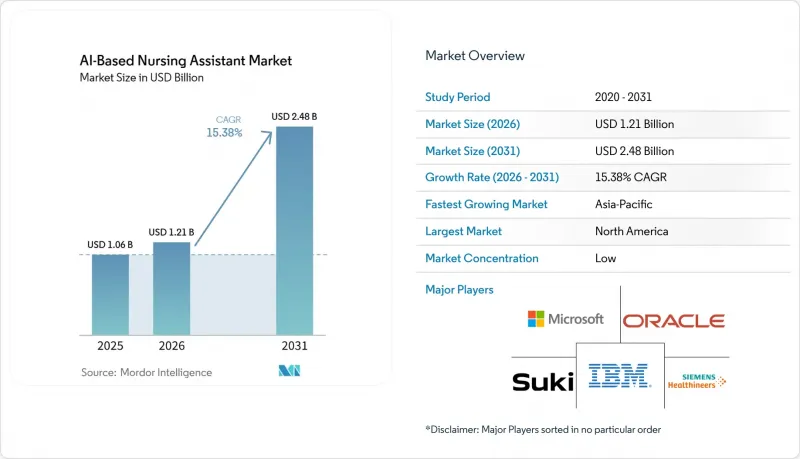
Mordor Intelligence에 의하면, AI 간호 보조 시장은 2025년 10억 6,000만 달러에서 2026년에는 12억 1,000만 달러로 확대되어 2026년부터 2031년까지 CAGR 15.38%로 성장을 지속하여, 2031년에는 24억 8,000만 달러에 이를 것으로 예측됩니다.
본 보고서는 구성 요소(소프트웨어, 서비스), 배포 방식(클라우드 기반, On-Premise형, 하이브리드형), AI 기능(자연어 처리, 기타), 용도(투약 지원, 에스컬레이션, 기타), 최종 사용자(병원 및 진료소, 기타), 지역(북미, 유럽, 아시아태평양, 기타)별로 분류되어 있습니다. 시장 예측은 금액(달러) 기준으로 제시되어 있습니다.
전 세계 AI 간호 보조 시장 동향 및 인사이트
심화되는 간호 인력 부족과 간호 서비스 제공의 병목 현상
AI 간호 보조 시장은 선진국 및 신흥국의 의료 시스템 모두에서 구조적으로 해소하기 어려운 인력 부족 상황으로 인해 계속해서 가장 큰 추진력을 얻고 있습니다. 세계보건기구(WHO) 보고서에 따르면, 2023년 전 세계 간호사 부족 규모는 580만 명에 달했으며, 2030년까지 410만 명으로 부분적인 개선이 예상되지만, 그 부담은 여전히 의료 접근성 확대와 병원 수용 능력 강화를 도모하고 있는 지역에 집중되어 있습니다. 전 미주 간호위원회 협의회(NCSBN)의 조사에 따르면, 2022년 이후 13만 8,000명 이상의 간호사가 이직했으며, 남아 있는 간호사의 40% 가까이가 2029년까지 이직할 의향이 있는 것으로 밝혀졌습니다. 이로 인해 인력 공급이 정상화되기를 기다리지 않고, 직원의 대응 능력을 확대할 수 있는 대안을 모색해야 한다는 병원에 대한 압박이 더욱 커지고 있습니다. 이러한 상황에서 AI 간호 보조 시장은 단순한 편의성 향상이라는 측면보다, 각 근무 교대 시간 내에 활용할 수 있는 간호 시간을 확보하는 수단으로 평가받고 있습니다. 따라서 의료 제공업체들은 병상 옆에서 근무하는 직원이 반드시 직접 수작업으로 반복할 필요가 없는 교육, 퇴원 절차, 신규 환자 접수와 같은 업무를 대행할 수 있는 도구에 큰 관심을 보이고 있습니다.
워크플로우 자동화 및 시간 단축에 대한 병원의 관심
AI 간호 보조 시장은 진료 기록 작성, 업무 인계, 반복적인 사무 업무에 소요되는 시간을 되찾고자 하는 병원 측 수요에 힘입어 성장하고 있습니다. 마이크로소프트는 2025년 10월, 간호사가 근무 시간의 25%에서 41%를 기록 작성이나 사무 업무에 소비하고 있다는 견해를 밝혔습니다. 이에 따라 워크플로우 개선은 단순한 부가적인 이점이 아니라 구매 결정의 핵심 요소가 되었습니다. 이러한 압력으로 인해 AI 간호 보조 시장의 조달 동향은 고립된 시범 도입에서 더 광범위한 전자건강기록(EHR) 환경과 연동된 플랫폼 도입으로 변화하고 있습니다. Epic Rover와의 통합을 통해 출시된 간호사용 ‘Dragon Copilot’은 앰비언트 AI가 단순한 용도 범주에 머무르지 않고 임상 시스템의 핵심 부분으로 침투하고 있음을 보여주었습니다. 2026년 대만의 3개 병원을 대상으로 진행된 JMIR 연구에 따르면, LLM(대규모 언어 모델) 기반의 업무 인계 문서 작성 시스템을 통해 매월 474-981시간의 간호 시간이 절감된 것으로 나타났습니다. 이를 통해 재무 및 운영 팀은 AI 도입 비용과 파견 직원의 인건비 및 초과 근무 수당을 직접 비교할 수 있게 되었습니다. 이러한 이점이 실제 병원 현장에서 입증됨에 따라, AI 간호 보조 시장에서는 단순한 제한적인 기능 개선에 그치지 않고, 기업 규모에서 측정 가능한 시간 절감 효과를 보여줄 수 있는 벤더가 우위를 점할 것으로 보입니다.
데이터 개인정보 보호 및 임상 거버넌스에 대한 우려
AI 간호 보조 시장에서는 주변 대화 청취, 진료 기록 요약, 또는 환자와의 음성 대화를 통해 보호 대상인 의료 정보를 다루는 솔루션의 경우, 도입 속도가 둔화되는 경향이 있습니다. 이러한 도구는 실제 임상 기록이나 환자와의 소통과 밀접하게 관련되어 있기 때문에 조달 과정에서의 감사 가능성, 거버넌스, 설명 책임 기준이 더욱 엄격해지기 때문입니다. 미국간호사협회(ANA)는 2025년, 간호 분야에서 AI를 윤리적으로 활용하기 위해서는 투명성, 감독, 그리고 지속적인 거버넌스 노력이 필요하다고 밝혔습니다. 이는 불투명한 시스템은 실무에서 평가나 감독이 어렵기 때문입니다. 병원 측에는 데이터 취급, 인간에 의한 검토, 임상적 설명 책임에 관한 명확한 방침도 요구되므로, 제품의 가치만으로는 불충분하며, 이것이 AI 간호 보조 시장 확대를 지연시키고 있습니다. 또한, 규정 준수를 제품 설계의 핵심 원칙으로 삼는 벤더와 도입 후에야 거버넌스 대응을 시도하는 벤더 사이에는 더 큰 격차가 발생하고 있습니다. 임상 AI에 관한 규제가 더욱 명확해짐에 따라, 구매자들은 AI 간호 보조 프로그램을 확대하기 전에 문서 관리, 감사 지원 및 추적 가능성을 더욱 중시하게 될 것입니다.
부문 분석
2025년 기준, AI 간호 보조 시장에서 소프트웨어의 점유율은 57.47%를 차지하고 있는 반면, 서비스 부문은 2031년까지 연평균 성장률(CAGR) 15.59%를 나타낼 것으로 예측됩니다. 문서 관리 플랫폼, 예측 분석 엔진, 의사결정 지원 모듈과 같은 제품이 일상적인 간호 업무와 가장 밀접하게 연관되어 있기 때문에 소프트웨어가 AI 간호 보조 시장을 주도하고 있습니다. 이러한 우위는 많은 의료 기관이 직원이 관리하기 위한 독립적인 운영 계층을 추가하는 대신, 기존 EHR 워크플로우에 통합할 수 있는 기능을 원하고 있다는 사실도 반영하고 있습니다. 따라서 AI를 활용한 간호 지원 시장은 여전히 소프트웨어를 통한 가치 창출에 힘입고 있으며, 특히 병원이 진료 기록 작성 시간, 업무 인계, 임상 조정에 즉각적인 효과를 기대하는 상황에서 두드러집니다.
의료 기관들은 일회성 소프트웨어 조달에서 벗어나, 본 가동 후에도 지속되는 도입 지원, 변경 관리, 직원 교육, 워크플로우 재설계, 모델 조정으로 전환하고 있습니다. 이는 타당한 움직임입니다. 왜냐하면 AI 간호 보조는 일반적으로 단순히 새로운 디지털 기능을 추가하는 데 그치지 않고, 일상 업무, 기록 작성 습관, 감독 체계 그 자체를 변화시키기 때문입니다. 그 결과, 서비스 수익이 증가하고 있는 것은 소프트웨어의 중요성이 떨어졌기 때문이 아니라, AI 간호 보조 시장이 시범 운영 단계에서 지속적인 지원이 필요한 운영 단계로 전환되고 있기 때문입니다.
2025년에는 클라우드 도입이 매출의 48.38%를 차지하며, AI 간호 보조 시장의 중심적인 위치를 계속 유지할 전망입니다. 이는 클라우드 시스템이 지속적인 모델 업데이트를 지원하고, 초기 인프라 요구 사항을 줄이며, 여러 거점에 걸친 의료 기관 네트워크 전체에서의 확장을 용이하게 하기 때문입니다. 또한 클라우드는 이미 임상 데이터 스택의 대부분을 최신 호스팅 환경으로 이전한 의료 시스템에도 적합합니다. 이 때문에 AI 간호 보조 시장에서 경쟁하는 많은 벤더들에게 클라우드는 기본적인 출발점이 되고 있습니다. 반면, 데이터 상주 요건이 더 엄격하거나 내부 통제 기준이 더 까다로운 시스템의 경우, On-Premise 배포도 여전히 중요합니다. 이러한 지속적인 중요성 때문에 시장이 단일 인프라 모델로 고정되는 것을 막고 있습니다.
하이브리드 배포는 2031년까지 연평균 성장률(CAGR) 15.76%를 나타낼 것으로 예측되며, 이는 속도와 보안에 대한 요구가 AI 간호 보조 시장을 순수한 클라우드 의존이 아닌 하이브리드 아키텍처로 이끌고 있음을 보여줍니다. 그 이유는 실용적인 데 있습니다. 지연으로 인해 임상적으로 중요한 대응이 늦어질 경우, 주변 음성 모니터링, 낙상 감지, 생체 신호 경보 기능의 가치가 상실되기 때문입니다. 따라서 시간적 제약과 데이터 보호를 동시에 고려해야 하는 워크플로우에서 엣지 처리와 로컬 추론이 더 큰 역할을 하게 될 것입니다. 이것이 바로 AI 간호 보조 시장에서 클라우드가 주도적인 지위를 유지하면서도, 임상적 대응 능력과 개인정보 보호를 양립시켜야 하는 상황에서는 하이브리드 모델이 더욱 빠르게 보급될 것으로 예상되는 이유입니다.
지역별 분석
2025년 시점에서 북미는 AI 간호 보조 시장 점유율의 43.41%를 차지하고 있는 반면, 아시아태평양은 2031년까지 연평균 성장률(CAGR) 18.43%를 나타낼 것으로 예측됩니다. 북미가 AI 간호 보조 시장을 주도하고 있는 것은 급성기 간호 분야의 인력 부족이 심각할 뿐만 아니라, 성숙한 전자건강기록(EHR) 생태계와 표준 워크플로우 내에서 AI를 실용화하려는 의료 제공업체의 기반이 결합되어 있기 때문입니다. 미국은 이미 입증된 인력 부족과 평가 단계에서 실제 운영으로의 신속한 전환에 힘입어 이 지역 내 중심적인 지위를 유지하고 있습니다. 마이크로소프트가 머시 병원과 ‘Dragon Copilot’을 통해 진행 중인 협력 사례나, 2025년 10월 Suki가 Epic, MEDITECH, Oracle 헬스를 이용하는 의료 시스템과 결성한 간호 컨소시엄은 북미의 AI 간호 보조 시장이 고립된 시범 운영이 아닌, 기업 차원의 본격적인 도입으로 나아가고 있음을 보여줍니다. 캐나다와 멕시코도 AI 간호 보조 시장으로 진입하고 있지만, 거버넌스 및 전자건강기록(EHR)의 파편화로 인해 규모 확대의 진전이 더딘 탓에 도입은 여전히 신중한 단계에 머물러 있습니다.
유럽은 AI 간호 보조 시장에서 여전히 2위 규모의 지역 클러스터이며, 그 활동은 독일, 영국, 프랑스 등 시장에 집중되어 있습니다. 이 지역의 발전은 디지털 인프라 개선 및 실험 단계에서 체계적인 임상 AI 전략으로의 단계적 전환과 밀접하게 관련되어 있습니다. 2025년 NHS 그램피언이 Corti사와 제휴한 사실 또한, 기존에 상용 AI 도구 도입에 신중한 태도를 보여왔던 공공 의료 기관에서도 AI 간호 보조 시장이 탄력을 받고 있음을 보여줍니다.
아시아태평양은 중국, 일본, 한국, 인도에서 병원의 디지털화가 가속화되고 있어 AI 간호 보조 도구 시장에서 가장 빠르게 성장하고 있는 지역입니다. 이 지역이 매력적인 이유는 의료 제공업체들이 디지털 인프라를 확충하고 있는 한편, 인력 부족, 고령화, 임상 처리 능력 향상에 대한 압박에도 직면하고 있기 때문입니다. 중동 및 아프리카는 여전히 발전의 초기 단계에 있으며, 걸프 국가 시장의 경우 조직적인 예산 지원이 가장 뚜렷하게 나타나는 반면, 기타 지역에서는 여전히 인프라 격차에 직면해 있습니다. 남미 역시 AI 간호 보조 시장에서는 아직 발전 초기 단계에 있으며, 전자건강기록(EHR)의 현대화가 진행됨에 따라 보다 광범위한 도입의 기반이 서서히 마련되고 있어, 수요는 주요 도시의 의료기관 및 민간 병원 그룹에 집중되어 있습니다.
기타 혜택:
- 엑셀 형식 시장 예측(ME) 시트
- 3개월간의 애널리스트 지원
자주 묻는 질문
목차
제1장 서론
제2장 조사 방법
제3장 주요 요약
제4장 시장 구도
제5장 시장 규모와 성장 예측
제6장 경쟁 구도
제7장 시장 기회와 향후 전망
JHS 26.08.07According to Mordor Intelligence, the AI-based nursing assistant market is expected to grow from USD 1.06 billion in 2025 to USD 1.21 billion in 2026 and is forecasted to reach USD 2.48 billion by 2031 at 15.38% CAGR over 2026-2031.
This report is Segmented by Component (Software, Services), Deployment Mode (Cloud-Based, On-Premises, Hybrid), AI Capability (Natural Language Processing, and Others), Application (Medication Support, and Escalation, and Others), End-User (Hospitals and Clinics, and Others) and Geography (North America, Europe, Asia-Pacific, and Others). The Market Forecasts are Provided in Terms of Value (USD).
Global AI-Based Nursing Assistant Market Trends and Insights
Rising Nursing Shortages and Care Delivery Bottlenecks
The AI-based nursing assistant market continues to draw its strongest support from a labor gap that remains structurally difficult to close across both advanced and emerging healthcare systems. The World Health Organization reported a global nursing shortage of 5.8 million in 2023 and projected only a partial improvement to 4.1 million by 2030, with the burden still concentrated in regions that are also trying to expand care access and hospital capacity. The National Council of State Boards of Nursing also found that more than 138,000 nurses left the workforce since 2022 and that nearly 40% of the remaining workforce intend to leave by 2029, which reinforces the pressure on hospitals to find alternatives that extend staff capacity without waiting for labor supply to normalize. In this setting, the AI-based nursing assistant market is being evaluated less as a convenience layer and more as a source of usable nursing time inside each shift. That is why providers are paying close attention to tools that can absorb education, discharge, and intake tasks that do not always need direct manual repetition from bedside staff.
Hospital Interest in Workflow Automation and Time Savings
The AI-based nursing assistant market is also being pushed forward by hospital demand to recover time now lost to charting, handovers, and repetitive administrative work. Microsoft stated in October 2025 that nurses can spend 25% to 41% of their shift on documentation and administrative tasks, which has made workflow improvement central to purchasing decisions rather than a side benefit. This pressure is changing procurement in the AI-based nursing assistant market from isolated pilots toward platform decisions tied to the broader EHR environment. Dragon Copilot for nurses, launched with Epic Rover integration, showed how ambient AI is moving into the core clinical stack rather than staying in a standalone application category. A 2026 JMIR study across three hospitals in Taiwan found that an LLM-based handover documentation system saved 474 to 981 nursing hours per month, which gave finance and operations teams a direct way to compare AI deployment with agency staffing and overtime costs. As more of these gains are proven inside live hospital settings, the AI-based nursing assistant market is likely to favor vendors that can show measurable time recovery at enterprise scale instead of only offering narrow feature improvements.
Data Privacy and Clinical Governance Concerns
The AI-based nursing assistant market faces a slower rollout path when solutions handle protected health information through ambient listening, chart summarization, or patient-facing voice interaction. These tools sit close to real clinical documentation and real patient communication, which raises the standard for auditability, governance, and accountability inside the procurement process. The American Nurses Association stated in 2025 that the ethical use of AI in nursing requires transparency, oversight, and an ongoing approach to governance because opaque systems are difficult to evaluate and supervise in practice. This slows the AI-based nursing assistant market because product value alone is not enough when hospitals also need clear policies for data handling, human review, and clinical accountability. It also creates a wider separation between vendors that treat compliance as a core product design principle and those that try to address governance after deployment. As regulation of clinical AI becomes more defined, buyers are likely to place greater weight on documentation controls, audit support, and traceability before scaling any nursing AI program.
Other drivers and restraints analyzed in the detailed report include:
- Need for Continuous Patient Monitoring and Escalation
- Expansion of Home-Based and Remote Care Models
- Integration Friction with EHR and Nursing Workflows
For complete list of drivers and restraints, kindly check the Table Of Contents.
Segment Analysis
Software held 57.47% of AI-based nursing assistant market share in 2025, while services are projected to grow at a 15.59% CAGR through 2031. Software leads the AI-based nursing assistant market because documentation platforms, predictive analytics engines, and decision-support modules are the products that sit closest to daily nursing work. This lead also reflects the fact that many providers want capabilities that can plug into existing EHR workflows instead of adding a separate operating layer for staff to manage. The AI-based nursing assistant market is, therefore, still anchored by software value capture, especially where hospitals want immediate impact on charting time, handovers, and clinical coordination.
Providers are moving from one-time software procurement toward implementation support, change management, staff training, workflow redesign, and model tuning that stay active after go-live. This makes sense because nursing AI usually changes routines, documentation habits, and supervision structures rather than simply adding a new digital feature. As a result, service revenue is rising not because software is weakening, but because the AI-based nursing assistant market is moving from pilot activity into operational deployment that needs ongoing support.
Cloud deployment held 48.38% of revenue in 2025, which keeps it at the center of the AI-based nursing assistant market because cloud systems support continuous model updates, lower upfront infrastructure demands, and easier scaling across multi-site provider networks. Cloud also fits well with health systems that have already moved large portions of their clinical data stack into modern hosted environments. This has made cloud the default starting point for many vendors competing in the AI-based nursing assistant market. At the same time, on-premises deployment still matters in systems with tighter data residency expectations or stricter internal control preferences. That ongoing relevance prevents the market from settling into a single infrastructure model.
Hybrid deployment is forecasted to grow at a 15.76% CAGR through 2031, which shows that speed and security needs are pushing the AI-based nursing assistant market toward blended architecture rather than pure cloud dependence. The reason is practical, because ambient listening, fall detection, and vital-sign alerting lose value if latency delays a clinically meaningful response. That gives edge processing and local inference a larger role in workflows that are time-sensitive and data-sensitive at the same time. That is why the AI-based nursing assistant market is likely to keep cloud in the lead while allowing hybrid models to gain faster traction where clinical responsiveness and privacy controls must be managed together.
Complete Report Scope:
- By Component
- Software
- Services
- By Deployment Mode
- Cloud-Based
- On-Premises
- Hybrid
- By AI Capability
- Natural Language Processing
- Predictive Analytics
- Computer Vision
- Speech Recognition
- Other AI Capabilities
- By Application
- Medication Support
- Patient Monitoring and Escalation
- Virtual Patient Interaction
- Falls and Safety Management
- Documentation Assistance
- By End-User
- Hospitals and Clinics
- Long-Term Care Facilities
- Home Healthcare Providers
- Ambulatory Care Centers
- Rehabilitation Centers
- By Geography
- North America
- United States
- Canada
- Mexico
- Europe
- Germany
- United Kingdom
- France
- Italy
- Spain
- Rest of Europe
- Asia-Pacific
- China
- Japan
- India
- Australia
- South Korea
- Rest of Asia-Pacific
- Middle East and Africa
- GCC
- South Africa
- Rest of Middle East and Africa
- South America
- Brazil
- Argentina
- Rest of South America
- North America
Geography Analysis
North America held 43.41% of AI-based nursing assistant market share in 2025, while Asia-Pacific is forecasted to grow at an 18.43% CAGR through 2031. North America leads the AI-based nursing assistant market because it combines acute nurse staffing pressure with mature EHR ecosystems and a provider base willing to operationalize AI inside standard workflows. The United States remains the center of this regional position, supported by documented workforce strain and faster movement from evaluation into active deployment. Microsoft's work with Mercy hospitals on Dragon Copilot and Suki's October 2025 nursing consortium with health systems on Epic, MEDITECH, and Oracle Health showed that the AI-based nursing assistant market in North America is moving toward enterprise commitment rather than isolated trials. Canada and Mexico are also participating in the AI-based nursing assistant market, though adoption remains more measured because governance and EHR fragmentation create a slower path to scale.
Europe remains the second-largest regional cluster in the AI-based nursing assistant market, with activity concentrated in markets such as Germany, the United Kingdom, and France. The region's progress is tied to digital infrastructure improvement and a gradual move from experimentation toward structured clinical AI strategy. NHS Grampian's partnership with Corti in 2025 also showed that the AI-based nursing assistant market is gaining traction in public health settings that have traditionally moved more cautiously on commercial AI tools.
Asia-Pacific is the fastest-growing region in the AI-based nursing assistant market because hospital digitization is accelerating across China, Japan, South Korea, and India. The region is attractive because providers are expanding digital infrastructure while also facing staffing strain, aging populations, and pressure to improve clinical throughput. The Middle East and Africa remain earlier in development, with Gulf markets showing the clearest institutional budget support while other areas still face infrastructure gaps. South America is also earlier in the AI-based nursing assistant market, with demand centered in major urban providers and private hospital groups as EHR modernization gradually improves the base for wider deployment.
- Abridge AI, Inc.
- Amelia US LLC
- Baxter
- Cerner
- DeepScribe Inc.
- Epic Systems
- GE Healthcare
- HealthTap, Inc.
- Hippocratic AI, Inc.
- IBM
- Infermedica Sp. z o.o.
- Koninklijke Philips
- Microsoft
- Moving Analytics GmbH
- Oracle
- Sensely, Inc.
- Siemens Healthineers
- Suki AI, Inc.
- Teladoc Health
Additional Benefits:
- The market estimate (ME) sheet in Excel format
- 3 months of analyst support
TABLE OF CONTENTS
1 Introduction
- 1.1 Study Assumptions and Market Definition
- 1.2 Scope of the Study
2 Research Methodology
3 Executive Summary
4 Market Landscape
- 4.1 Market Overview
- 4.2 Market Drivers
- 4.2.1 Rising Nursing Shortages and Care Delivery Bottlenecks
- 4.2.2 Need for Continuous Patient Monitoring and Escalation
- 4.2.3 Hospital Interest in Workflow Automation and Time Savings
- 4.2.4 Expansion of Home-Based and Remote Care Models
- 4.2.5 Liability-Reduction Through Standardized Digital Triage
- 4.2.6 Under-Documented Demand from Night-Shift Coverage Gaps
- 4.3 Market Restraints
- 4.3.1 Data Privacy and Clinical Governance Concerns
- 4.3.2 Integration Friction with EHR and Nursing Workflows
- 4.3.3 Reimbursement Uncertainty for AI-Augmented Nursing Services
- 4.3.4 Limited Acceptance in High-Acuity and Safety-Critical Use Cases
- 4.4 Supply/Value Chain Analysis
- 4.5 Regulatory Landscape
- 4.6 Technological Outlook
- 4.7 Porter's Five Forces Analysis
- 4.7.1 Threat of New Entrants
- 4.7.2 Bargaining Power of Suppliers
- 4.7.3 Bargaining Power of Buyers
- 4.7.4 Threat of Substitutes
- 4.7.5 Competitive Rivalry
5 Market Size & Growth Forecasts (Value, USD)
- 5.1 By Component
- 5.1.1 Software
- 5.1.2 Services
- 5.2 By Deployment Mode
- 5.2.1 Cloud-Based
- 5.2.2 On-Premises
- 5.2.3 Hybrid
- 5.3 By AI Capability
- 5.3.1 Natural Language Processing
- 5.3.2 Predictive Analytics
- 5.3.3 Computer Vision
- 5.3.4 Speech Recognition
- 5.3.5 Other AI Capabilities
- 5.4 By Application
- 5.4.1 Medication Support
- 5.4.2 Patient Monitoring and Escalation
- 5.4.3 Virtual Patient Interaction
- 5.4.4 Falls and Safety Management
- 5.4.5 Documentation Assistance
- 5.5 By End-User
- 5.5.1 Hospitals and Clinics
- 5.5.2 Long-Term Care Facilities
- 5.5.3 Home Healthcare Providers
- 5.5.4 Ambulatory Care Centers
- 5.5.5 Rehabilitation Centers
- 5.6 By Geography
- 5.6.1 North America
- 5.6.1.1 United States
- 5.6.1.2 Canada
- 5.6.1.3 Mexico
- 5.6.2 Europe
- 5.6.2.1 Germany
- 5.6.2.2 United Kingdom
- 5.6.2.3 France
- 5.6.2.4 Italy
- 5.6.2.5 Spain
- 5.6.2.6 Rest of Europe
- 5.6.3 Asia-Pacific
- 5.6.3.1 China
- 5.6.3.2 Japan
- 5.6.3.3 India
- 5.6.3.4 Australia
- 5.6.3.5 South Korea
- 5.6.3.6 Rest of Asia-Pacific
- 5.6.4 Middle East and Africa
- 5.6.4.1 GCC
- 5.6.4.2 South Africa
- 5.6.4.3 Rest of Middle East and Africa
- 5.6.5 South America
- 5.6.5.1 Brazil
- 5.6.5.2 Argentina
- 5.6.5.3 Rest of South America
- 5.6.1 North America
6 Competitive Landscape
- 6.1 Market Concentration
- 6.2 Market Share Analysis
- 6.3 Company Profiles (includes Global level Overview, Market level overview, Core Segments, Financials as available, Strategic Information, Market Rank/Share for key companies, Products & Services, Recent Developments)
- 6.3.1 Abridge AI, Inc.
- 6.3.2 Amelia US LLC
- 6.3.3 Baxter International Inc.
- 6.3.4 Cerner Corporation
- 6.3.5 DeepScribe Inc.
- 6.3.6 Epic Systems Corporation
- 6.3.7 GE HealthCare
- 6.3.8 HealthTap, Inc.
- 6.3.9 Hippocratic AI, Inc.
- 6.3.10 IBM
- 6.3.11 Infermedica Sp. z o.o.
- 6.3.12 Koninklijke Philips N.V.
- 6.3.13 Microsoft Corporation
- 6.3.14 Moving Analytics GmbH
- 6.3.15 Oracle
- 6.3.16 Sensely, Inc.
- 6.3.17 Siemens Healthineers AG
- 6.3.18 Suki AI, Inc.
- 6.3.19 Teladoc Health, Inc.
7 Market Opportunities & Future Outlook
- 7.1 White-space & Unmet-need Assessment


