

|
시장보고서
상품코드
2099149
영화 및 TV 제작 시장 : 점유율 분석, 업계 동향 및 통계, 성장 예측(2026-2031년)Film and TV Production - Market Share Analysis, Industry Trends & Statistics, Growth Forecasts (2026 - 2031) |
||||||
 Mordor Intelligence
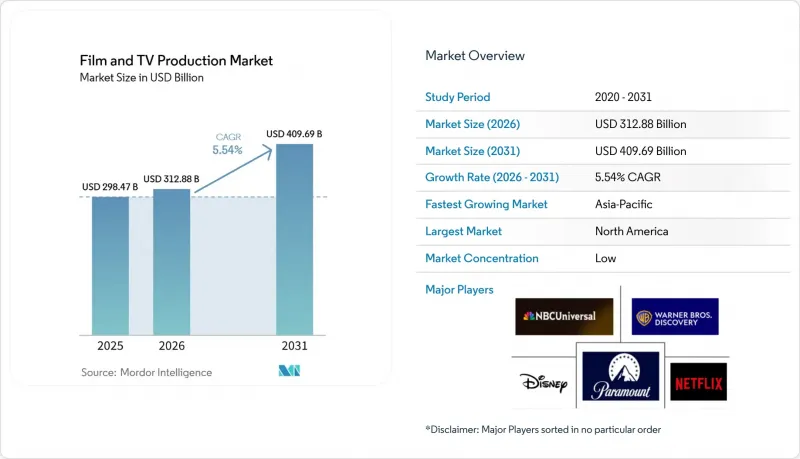
Mordor Intelligence에 의하면, 영화 및 TV 제작 시장 규모는 2025년 2,984억 7,000만 달러에서 2026년에는 3,128억 8,000만 달러로 확대되어 2031년까지 4,096억 9,000만 달러에 이를 것으로 예상되고 있어 2026년부터 2031년까지 CAGR 5.54%로 성장할 전망입니다.
본 보고서는 컨텐츠 유형(장편 영화, TV 시리즈, 다큐멘터리 및 논픽션, 광고, 뮤직비디오 등), 제작 단계(프리프로덕션, 프로덕션, 포스트프로덕션), 클라이언트 유형(스튜디오 및 방송사 등), 지역(북미, 남미, 유럽, 아시아태평양, 중동 및 아프리카)별로 분류되어 있습니다. 시장 전망은 금액(달러) 기준으로 제시되어 있습니다.
전 세계 영화 및 TV 제작 시장 동향과 인사이트
‘스트리밍 우선’ 제작 발주 확대
‘방송 우선’에서 ‘스트리밍 우선’으로의 발주 형태 전환에 따라, 2020년 이전과 비교하여 영화 및 TV 제작 시장 수요 기반이 더욱 안정화되었습니다. 주요 플랫폼들은 초기 단계부터 전 세계 권리를 포함한 작품을 발주하는 사례가 증가하고 있으며, 이로 인해 제작자에게는 판매 시장의 불확실성이 감소하는 반면, 구매자는 가격 책정 및 소유권에 대해 더 강력한 통제권을 갖게 됩니다. 이 모델은 예산 결정의 조기화를 가능하게 하며, 보다 장기적인 계획 주기를 통해 스태프, 시설, 포스트 프로덕션 회사에 대한 지속적인 참여를 보장합니다. 또한, 여러 지역이나 연속되는 시즌, 혹은 관련 시리즈 작품에 걸쳐 일관된 제작 능력을 발휘할 수 있는 프로듀서에게도 유리하게 작용하고 있습니다. 독립 제작사는 여전히 자금 조달의 가시성이 높아지는 혜택을 누리고 있지만, 현재는 롱테일의 가치 대부분이 제작을 위탁하는 플랫폼 측에 귀속되는 시스템 하에서 사업을 전개하고 있습니다. 영화 및 TV 제작 시장에서 이러한 제작 위탁 구조는 개별 플랫폼이 매년 제작 편수를 조정하는 경우라 하더라도 지속 가능한 성장을 뒷받침하는 기반이 되고 있습니다.
고부가가치 현지화 컨텐츠에 대한 수요 증가
언어, 문화, 지역의 맥락을 반영한 이야기는 시청자가 더 오랫동안 관심을 유지하기 때문에 현지화된 작품에 대한 수요가 높아지고 있습니다. 이러한 변화로 인해 영화 및 TV 제작 시장의 타겟층은 기존의 영어권 제작 거점에서 지역 위탁 거점으로 확대되고 있습니다. 2024년, 한국의 영상 산업은 TV, 영화, VOD를 합쳐 23조 800억 원(168억 달러) 시장 규모를 기록했습니다. 이는 현지 IP가 국내 시장 확대와 수출 확대 모두를 뒷받침할 수 있음을 보여줍니다. 이러한 추세에 따라, 문화적으로 특화된 컨텐츠를 최고 수준으로 제공할 수 있는 지역 공급업체의 경우, 공동 제작, 권리 제휴 및 지속적인 수주가 강화되고 있습니다. 현지화된 제작은 더 이상 배급사 시장 진입 수단에 그치지 않습니다. 왜냐하면 이는 장기적으로 볼 때 가입자 유지율 향상과 컨텐츠 카탈로그 확충을 뒷받침하는 요소가 되고 있기 때문입니다. 이러한 변화가 진행됨에 따라 영화 및 TV 업계는 더욱 광범위하고 탄탄한 위탁 컨텐츠 공급원을 확보하게 될 것입니다.
연예인, 노조, 촬영지 비용의 급등
영화 및 TV 제작 시장에서 인건비 급등은 단기적인 혼란이라기보다는 구조적인 비용 문제로 자리 잡고 있습니다. SAG-AFTRA 조합원들은 2026년 TV·극장용 계약을 91.42%의 찬성률로 승인했습니다. 이 계약에는 2030년 6월 30일까지 최저임금을 매년 3% 인상하는 내용이 명시되어 있습니다. 이러한 인상으로 인해 시나리오가 있는 프로젝트의 기본 예산 수요가 증가하여, 기존 제작 거점에서는 소규모 제작 일정을 유지하기가 어려워지고 있습니다. 또한 로스앤젤레스, 뉴욕, 런던에서는 촬영지, 법무, 규정 준수 관련 경비도 여전히 높은 수준을 유지하고 있어, 이로 인해 더 많은 제작자들이 인센티브 제도가 있는 제2 시장으로 눈을 돌리고 있습니다. AI 및 디지털 레플리카 사용과 관련된 새로운 의무는 출연자의 초상을 재현하는 도구에 의존하는 제작사에게 추가적인 행정 업무 부담을 주고 있습니다. 그 결과, 영상 엔터테인먼트에 대한 최종 수요는 견조함에도 불구하고, 중규모 예산 작품의 경우 이익률이 더욱 압박받는 상황이 되고 있습니다.
부문 분석
2025년, TV 시리즈는 영화 및 TV 제작 시장 규모의 39.62%를 차지하고 있으며, 이는 가입자 유지 및 지속적인 제작 발주에서 이 포맷이 중심적인 역할을 하고 있음을 반영합니다. 스튜디오와 플랫폼이 여러 시즌에 걸친 패키지 계약을 체결하는 것은 더 긴 주기에 걸쳐 각본가, 출연진, 세트, 포스트 프로덕션 팀을 안정적으로 활용할 수 있도록 하기 위함입니다. 이러한 지속성 덕분에 시리즈 작품은 개발, 주요 촬영, 마무리 각 단계에서 영화 및 TV 제작 시장 내에서 가장 신뢰할 수 있는 물량 기반이 되고 있습니다. 또한, 지속적으로 제작되는 작품에는 대개 정평이 난 크리에이티브 팀, 반복적으로 사용되는 촬영지, 이미 알려진 납품 요건이 수반되므로, 벤더 입장에서는 계획 수립의 가시성이 높아집니다. 장편 영화는 여전히 독자적인 가치 원천이며, 시청 시간이 디지털 플랫폼으로 계속 이동하고 있음에도 불구하고 2025년 전 세계 극장 흥행 수입은 328억 달러에 달했습니다.
다큐멘터리 및 논픽션 분야는 2031년까지 연평균 성장률(CAGR) 9.87%로 확대될 것으로 예측되며, 영화 및 TV 제작 업계에서 가장 빠르게 성장하는 컨텐츠 카테고리가 될 전망입니다. 구매자에게 있어 그 매력은 분명합니다. 다큐멘터리는 일반적으로 프리미엄 각본 드라마에 비해 시간당 제작비를 낮게 유지할 수 있는 반면, 시청자의 강한 몰입을 이끌어낼 수 있기 때문입니다. 또한 이 카테고리는 고급 픽션 작품과 같은 완벽한 비용 구조를 필요로 하지 않으면서도 범죄, 스포츠, 음악, 유명인, 시사 문제 등을 다룰 수 있어 현재의 플랫폼 전략에도 잘 부합합니다. 유럽의 카탈로그 요건에 따라 시장용 라이브러리에서 지역 작품의 최소 비율을 확보해야 하는 서비스의 경우, 다큐멘터리 제작 의뢰는 여전히 중요한 위치를 차지하고 있습니다. 광고, 브랜드 컨텐츠, 뮤직비디오 및 기타 포맷은 광고주, 음반사, 소규모 컨텐츠 소유자의 안정적인 단편 컨텐츠 수요를 충족시킴으로써 영화 및 TV 제작 시장을 보완하고 있습니다.
지역별 분석
2025년, 북미는 영화 및 TV 제작 시장 규모의 37.21%를 차지했으며, 미국 스튜디오의 탄탄한 기반과 캐나다의 인센티브 지원 덕분에 금액 기준으로 최대 지역 시장으로서의 지위를 유지했습니다. 엔터테인먼트 파트너스(Entertainment Partners)의 보고서에 따르면, 2026년 미국 내 티켓 매출액은 2025년 대비 20% 이상 증가했으며, 같은 해 국내 흥행 수입은 99억 달러에 달할 것으로 전망됩니다. 캘리포니아주, 뉴욕주, 뉴저지주는 연중 막대한 세액 공제 한도를 배정함으로써 제작 계획의 기반이 되고 있으며, 이를 통해 해당 지역은 스튜디오 및 촬영지 지출에 있어 견고한 뒷받침을 확보하고 있습니다. 또한, 이 지역은 소규모 생태계에서는 단기간에 재현하기 어려운 금융, 에이전시, 노동조합, 포스트 프로덕션의 긴밀한 네트워크로부터도 혜택을 받고 있습니다. 남미에서는 더욱 다각화된 제작 기반이 구축되고 있으며, 2026년 멕시코에서 EFICA가 출범하는 것은 이 지역이 재정 정책을 활용하여 국내 제작 및 공동 제작 파이프라인을 강화하고 있음을 보여줍니다.
유럽은 긴밀한 제작 생태계와 공식적인 규제 체계에 힘입어, 영화 및 TV 제작 시장에서 여전히 가장 크고 체계적인 지역 중 하나입니다. 유럽 시청각 관측소(European Audiovisual Observatory)의 보고서에 따르면, 2024년에는 36개 시장에서 역대 최다인 2,523편의 장편 영화가 제작되어 이 지역의 활발한 제작 활동의 깊이를 입증하고 있습니다. 동 보고서에 따르면, 유럽 시청각 시장 규모는 1,420억 유로(1,600억 달러)로 평가되며, 이를 통해 유럽은 자금 조달, 제작 위탁, 권리 거래의 중심적 위치를 계속 차지하고 있습니다. 영국의 ‘독립 영화 세액 공제(Independent Film Tax Credit)’ 제도는 런던 및 인근 스튜디오 인프라를 미국 자본이 투입된 공동 제작의 유망한 촬영지로 강화해 왔습니다. 중동에서는 사우디아라비아와 아랍에미리트(UAE)가 인프라와 우대 조치를 확충함에 따라 단순한 서비스 제작의 틀을 넘어 발전하고 있습니다. 아프리카는 여전히 발전의 초기 단계에 있지만, 나이지리아, 남아프리카공화국, 이집트는 계속해서 활발한 거점으로 자리 잡고 있으며, 2024년에 63편의 영화 타이틀로 우간다가 WIPO 데이터셋에 포함된 것은 해당 지역의 측정 체계와 제도화가 진전되고 있음을 보여줍니다.
아시아태평양은 2031년까지 연평균 성장률(CAGR) 10.12%를 나타낼 것으로 예측되며, 영화 및 TV 제작 시장에서 가장 빠르게 성장하는 지역이 될 전망입니다. 한국의 시청각 산업은 2024년에 TV, 영화, VOD를 통해 23조 800억 원(168억 달러)의 수익을 창출하며, 현지 지적재산권(IP)의 강점과 수출 대응이 가능한 제작 체계의 충실함을 부각시키고 있습니다. AVIA는 2031년까지 아시아태평양의 SVOD 가입자 수가 유료 TV의 5배를 넘어설 것으로 예측하고 있으며, 이는 제작 발주의 주도권이 장기적으로 디지털 바이어 쪽으로 이동하고 있음을 뒷받침합니다. 이를 종합해 보면, 인도, 한국, 중국 및 인근 핵심 지역들이 더 많은 제작 자본을 동아시아로 끌어들이며, 영화 및 TV 제작 시장의 지리적 비중을 꾸준히 확대하고 있음을 알 수 있습니다.
기타 혜택:
- 엑셀 형식 시장 예측(ME) 시트
- 3개월간의 애널리스트 지원
자주 묻는 질문
목차
제1장 서론
제2장 조사 방법
제3장 주요 요약
제4장 시장 구도
제5장 시장 규모와 성장 예측
제6장 경쟁 구도
제7장 시장 기회와 향후 전망
JHS 26.08.07According to Mordor Intelligence, the film and TV Production Market size is expected to increase from USD 298.47 billion in 2025 to USD 312.88 billion in 2026 and reach USD 409.69 billion by 2031, growing at a CAGR of 5.54% over 2026-2031.
This report is Segmented by Content Type (Feature Films, TV Series, Documentary and Non-Fiction, Commercials, Music Videos, and More), Production Stage (Pre-Production, Production, and Post-Production), Client Type (Studios and Broadcasters, and More), and Geography (North America, South America, Europe, Asia-Pacific, Middle East, and Africa). The Market Forecasts are Provided in Terms of Value (USD).
Global Film and TV Production Market Trends and Insights
Expansion of Streaming-First Commissioning
The shift from broadcast-first to streaming-first ordering has created a steadier base of demand for the film and TV production market than existed before 2020. Large platforms increasingly commission titles with global rights from the outset, which lowers sales-market uncertainty for producers but gives buyers stronger control over pricing and ownership. That model supports earlier budgeting decisions and keeps crews, facilities, and post houses engaged across longer planning cycles. It also favors producers that can deliver consistent execution across several territories and across repeat seasons or linked franchises. Independent production companies still benefit from clearer funding visibility, but they now operate in a system where more of the long-tail value sits with the commissioning platform. In the film and Television production market, this commissioning structure has become a durable growth support even when individual platforms adjust title counts from one year to the next.
Rising Demand for High-Value Localized Content
Demand for localized titles is rising because audiences stay engaged longer with stories that reflect language, culture, and regional context. That shift has widened the addressable base of the film and TV production market beyond legacy English-language production centers and into regional commissioning hubs. South Korea's audiovisual sector generated KRW 23,080 billion (USD 16.8 billion), across television, film, and VOD in 2024, which shows how local IP can support both domestic scale and export reach. The same pattern strengthens co-productions, rights partnerships, and repeat work for regional suppliers that can deliver culturally specific content at a premium standard. Localized production is no longer only a market-entry tool for distributors because it now supports subscriber retention and catalog depth over time. As that shift continues, the film and TV industry gains a broader and more resilient pipeline of commissioned content.
Escalating Talent, Union, And Location Costs
Labor inflation is becoming a structural cost issue rather than a short-term disruption in the film and TV production market. SAG-AFTRA members ratified the 2026 TV/Theatrical Agreement with 91.42% approval, and the agreement set 3% annual minimum wage increases through June 30, 2030. These increases raise base budgeting needs for scripted projects and make established production hubs harder to justify smaller slates. Location, legal, and compliance expenses also remain elevated in Los Angeles, New York, and London, which pushes more producers toward incentive-backed secondary markets. New obligations tied to AI and digital replica usage add another layer of administrative work for productions that rely on performer-likeness tools. The result is that mid-budget titles face tighter margins even when end demand for filmed entertainment remains healthy.
Other drivers and restraints analyzed in the detailed report include:
- Virtual Production Adoption in Studio Workflows
- Growth Of Premium Post-Production and VFX Outsourcing
- Financing Volatility for Mid-Budget Projects
For complete list of drivers and restraints, kindly check the Table Of Contents.
Segment Analysis
Television Series held 39.62% of the film and TV production market size in 2025, reflecting the format's central role in subscriber retention and repeat commissioning. Studios and platforms commit multi-season packages because they support steadier use of writers, cast, sets, and post-production teams over longer cycles. That continuity makes series work the most dependable volume anchor within the film and TV production market across development, principal photography, and finishing. It also gives service vendors better planning visibility because returning titles typically carry established creative teams, recurring locations, and known delivery requirements. Feature Films remain a separate value pool, and global theatrical revenue reached USD 32.8 billion in 2025 even as viewing time continued to shift toward digital platforms.
Documentary and non-fiction segment is projected to expand at a 9.87% CAGR through 2031, making it the fastest-moving content category in the film and TV production industry. For buyers, the appeal is clear because documentaries usually require lower spend per hour than premium scripted drama while still supporting strong audience engagement. The category also fits well with current platform strategies because it can address crime, sports, music, celebrity, and current affairs without the full cost structure of high-end fiction. European catalog requirements keep documentary commissioning relevant for services that need a minimum share of regional works in market-facing libraries. Commercial and branded content, music videos, and other formats round out the film and TV production market by supplying steady short form demand from advertisers, labels, and smaller content owners.
Complete Report Scope:
- By Content Type
- Feature Films
- Television Series
- Documentary and Non-Fiction
- Commercials and Branded Content
- Music Videos
- Other Content Types
- By Production Stage
- Pre-Production
- Production
- Post-Production
- By Client Type
- Studios and Broadcasters
- Streaming Platforms
- Independent Producers
- Advertising Agencies
- By Geography
- North America
- United States
- Canada
- Mexico
- South America
- Brazil
- Argentina
- Chile
- Rest of South America
- Europe
- Germany
- United Kingdom
- France
- Italy
- Spain
- Rest of Europe
- Asia-Pacific
- China
- Japan
- India
- South Korea
- Australia
- Rest of Asia-Pacific
- Middle East
- Saudi Arabia
- United Arab Emirates
- Qatar
- Rest of Middle East
- Africa
- South Africa
- Egypt
- Nigeria
- Rest of Africa
- North America
Geography Analysis
North America accounted for 37.21% of the film and TV production market size in 2025, which kept it the largest regional base by value because of studio depth in the United States and incentive support in Canada. Entertainment Partners reported that U.S. domestic ticket sales in 2026 were running more than 20% ahead of 2025, and it projected domestic box office could reach USD 9.9 billion for the year. California, New York, and New Jersey continue to underpin production planning with large annual tax credit allocations, which gives the region a durable floor for studio and location spending. The region also benefits from dense finance, agency, union, and post-production networks that are difficult for smaller ecosystems to replicate quickly. South America is building a more diversified production base, and Mexico's 2026 EFICA launch shows how the region is using fiscal policy to strengthen domestic and co-production pipelines.
Europe remains one of the largest and most structured regions in the film and TV production market, supported by dense production ecosystems and formal regulatory frameworks. The European Audiovisual Observatory reported a record 2,523 feature films across 36 markets in 2024, which confirms the region's depth of active production. The same source valued the European audiovisual market at EUR 142 billion (USD 160 billion), which keeps Europe central to financing, commissioning, and rights activity. The UK's Independent Film Tax Credit has reinforced London and nearby studio infrastructure as a preferred setting for U.S.-funded co-productions. The Middle East is moving beyond service production as Saudi Arabia and the UAE expand infrastructure and incentives. Africa is still earlier in its development curve, yet Nigeria, South Africa, and Egypt remain active hubs, and Uganda's entry into the WIPO dataset with 63 film titles in 2024 shows that regional measurement and formalization are improving.
Asia-Pacific is projected to grow at a 10.12% CAGR through 2031, making it the fastest-growing geography in the film and TV production market. South Korea's audiovisual sector generated KRW 23,080 billion, USD 16.8 billion, across television, film, and VOD in 2024, highlighting the strength of local IP and export-ready production systems. AVIA expects SVOD subscriptions in Asia-Pacific to exceed pay-TV by more than 5 to 1 by 2031, which supports a longer shift of commissioning power toward digital buyers. Taken together, India, South Korea, China, and adjacent hubs are pulling more production capital eastward and steadily expanding the geographic weight of the film and TV production market.
- The Walt Disney Company
- Warner Bros. Discovery, Inc.
- Comcast Corporation
- Netflix, Inc.
- Paramount Global
- Sony Group Corporation
- NBCUniversal Media, LLC
- Amazon.com, Inc.
- Apple Inc.
- Lions Gate Entertainment Corp.
- BBC Studios Limited
- ITV Studios Limited
- Fremantle Limited
- Banijay Group
- Hasbro, Inc.
- A24, Inc.
- Pinewood Group Limited
- Deluxe Media Inc.
- DNEG Group
- Framestore Holdings Ltd.
Additional Benefits:
- The market estimate (ME) sheet in Excel format
- 3 months of analyst support
TABLE OF CONTENTS
1 INTRODUCTION
- 1.1 Study Assumptions and Market Definition
- 1.2 Scope of the Study
2 RESEARCH METHODOLOGY
3 EXECUTIVE SUMMARY
4 MARKET LANDSCAPE
- 4.1 Market Overview
- 4.2 Market Drivers
- 4.2.1 Expansion of Streaming-First Commissioning
- 4.2.2 Rising Demand for High-Value Localized Content
- 4.2.3 Virtual Production Adoption in Studio Workflows
- 4.2.4 Growth of Premium Post-Production and VFX Outsourcing
- 4.2.5 Faster Greenlight Cycles Enabled by Data-Driven Development
- 4.2.6 Demand for Cross-Platform Content Packages
- 4.3 Market Restraints
- 4.3.1 Escalating Talent, Union, and Location Costs
- 4.3.2 Financing Volatility for Mid-Budget Projects
- 4.3.3 Regulatory Fragmentation Across Rights, Labor, and Content Rules
- 4.3.4 Schedule Risk From Weather, Permits, and Production Interruptions
- 4.4 Industry Value Chain Analysis
- 4.5 Regulatory Landscape
- 4.6 Technological Outlook
- 4.7 Porter's Five Forces Analysis
- 4.7.1 Bargaining Power of Buyers
- 4.7.2 Bargaining Power of Suppliers
- 4.7.3 Threat of New Entrants
- 4.7.4 Threat of Substitutes
- 4.7.5 Competitive Rivalry
5 MARKET SIZE AND GROWTH FORECASTS (VALUE)
- 5.1 By Content Type
- 5.1.1 Feature Films
- 5.1.2 Television Series
- 5.1.3 Documentary and Non-Fiction
- 5.1.4 Commercials and Branded Content
- 5.1.5 Music Videos
- 5.1.6 Other Content Types
- 5.2 By Production Stage
- 5.2.1 Pre-Production
- 5.2.2 Production
- 5.2.3 Post-Production
- 5.3 By Client Type
- 5.3.1 Studios and Broadcasters
- 5.3.2 Streaming Platforms
- 5.3.3 Independent Producers
- 5.3.4 Advertising Agencies
- 5.4 By Geography
- 5.4.1 North America
- 5.4.1.1 United States
- 5.4.1.2 Canada
- 5.4.1.3 Mexico
- 5.4.2 South America
- 5.4.2.1 Brazil
- 5.4.2.2 Argentina
- 5.4.2.3 Chile
- 5.4.2.4 Rest of South America
- 5.4.3 Europe
- 5.4.3.1 Germany
- 5.4.3.2 United Kingdom
- 5.4.3.3 France
- 5.4.3.4 Italy
- 5.4.3.5 Spain
- 5.4.3.6 Rest of Europe
- 5.4.4 Asia-Pacific
- 5.4.4.1 China
- 5.4.4.2 Japan
- 5.4.4.3 India
- 5.4.4.4 South Korea
- 5.4.4.5 Australia
- 5.4.4.6 Rest of Asia-Pacific
- 5.4.5 Middle East
- 5.4.5.1 Saudi Arabia
- 5.4.5.2 United Arab Emirates
- 5.4.5.3 Qatar
- 5.4.5.4 Rest of Middle East
- 5.4.6 Africa
- 5.4.6.1 South Africa
- 5.4.6.2 Egypt
- 5.4.6.3 Nigeria
- 5.4.6.4 Rest of Africa
- 5.4.1 North America
6 COMPETITIVE LANDSCAPE
- 6.1 Market Concentration
- 6.2 Strategic Moves
- 6.3 Vendor Positioning Analysis
- 6.4 Company Profiles (includes Global Level Overview, Market Level Overview, Core Segments, Financials as available, Strategic Information, Products and Services, Recent Developments)
- 6.4.1 The Walt Disney Company
- 6.4.2 Warner Bros. Discovery, Inc.
- 6.4.3 Comcast Corporation
- 6.4.4 Netflix, Inc.
- 6.4.5 Paramount Global
- 6.4.6 Sony Group Corporation
- 6.4.7 NBCUniversal Media, LLC
- 6.4.8 Amazon.com, Inc.
- 6.4.9 Apple Inc.
- 6.4.10 Lions Gate Entertainment Corp.
- 6.4.11 BBC Studios Limited
- 6.4.12 ITV Studios Limited
- 6.4.13 Fremantle Limited
- 6.4.14 Banijay Group
- 6.4.15 Hasbro, Inc.
- 6.4.16 A24, Inc.
- 6.4.17 Pinewood Group Limited
- 6.4.18 Deluxe Media Inc.
- 6.4.19 DNEG Group
- 6.4.20 Framestore Holdings Ltd.
7 MARKET OPPORTUNITIES AND FUTURE OUTLOOK
- 7.1 White-Space and Unmet-Need Assessment


