

|
시장보고서
상품코드
2099157
ECG 패치 홀터 모니터 시장 : 점유율 분석, 업계 동향 및 통계, 성장 예측(2026-2031년)ECG Patch Holter Monitor - Market Share Analysis, Industry Trends & Statistics, Growth Forecasts (2026 - 2031) |
||||||
 Mordor Intelligence
Mordor Intelligence에 의하면, ECG 패치 홀터 모니터 시장 규모는 2025년 20억 4,000만 달러에서 2026년에는 24억 4,000만 달러로 확대되어 2026년부터 2031년까지 CAGR 19.67%로 성장을 지속하여, 2031년에는 59억 9,000만 달러에 이를 것으로 예측됩니다.
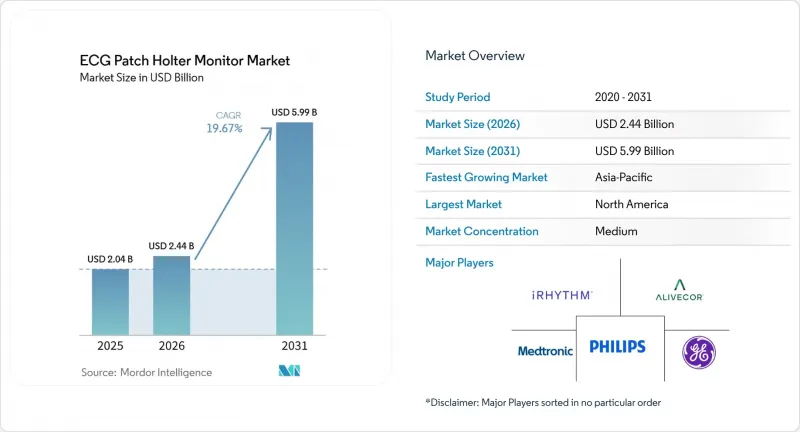
본 보고서는 제품 유형(ECG 패치, 홀터 모니터), 리드 유형(싱글 리드, 3리드 등), 용도(부정맥 감지 등), 최종 사용자(병원 등), 기술(무선, 블루투스 지원 등), 유통 채널(직접 판매 등), 지역(북미, 유럽 등)별로 분류되어 있습니다. 시장 전망은 금액(달러) 기준으로 제시되어 있습니다.
전 세계 ECG 패치 홀터 모니터 시장 동향 및 인사이트
심방세동(AF) 감지 부담 증가로 인해 환자 선정 기준이 재구성되고 있습니다.
심방세동은 전 세계적으로 약 3,350만 명에게 영향을 미치고 있으며, 80세 이상 성인의 유병률이 15%에서 20%에 달하는 만큼, ECG 패치 홀터 모니터 시장은 선별 검사 대상 확대라는 혜택을 받고 있습니다. 2026년 3월에 개최될 ACC.26에서 발표될 예정인 후향적 분석은 14일간 Zio 연속 휴대형 심전도로 모니터링된 미국 환자 65만 7,147명을 대상으로 하며, 만성 신장병 환자의 48%에서 임상적 조치가 필요한 부정맥이 확인되었습니다. 이러한 연구 결과를 통해 잠재적 환자층은 기존의 심혈관내과에서 의뢰된 환자를 넘어 확대되었으며, 신장내과 및 대사질환 진료 현장도 ECG 패치 홀터 모니터 시장에 포함되고 있습니다. 임상의들이 당뇨병, 비만, 만성 신장병을 독립적인 부정맥 위험 요인으로 다루는 경향이 강해짐에 따라, 뚜렷한 심장 증상이 없는 환자에 대한 모니터링 수요도 확대되고 있습니다.
보험 적용 범위 확대가 단기적인 수요 증가를 뒷받침
CMS가 2026년 6월 28일부터 발효되는 일시적인 비치료용 휴대형 심장 모니터링 기기에 관한 LCD L40257을 최종 확정하면, ECG 패치 홀터 모니터 시장은 단기적으로 성장세를 보일 것으로 예측됩니다. 이 방침에 따라 메디케어의 적용 범위가 TAVR(경카테터 대동맥판막 치환술) 후 부정맥 감시 및 원인 불명의 뇌졸중 모니터링까지 확대됩니다. 또한, CMS는 2025년 1월에 CPT 코드 93241부터 93248까지를 개정하고, 장기 모니터링에 대한 설명을 업데이트함으로써 7일 이상 지속되는 검사의 청구 기준을 명확히 할 예정입니다. 이러한 규정은 적용 범위와 관련된 기술 사양을 충족할 수 있는 FDA 승인 클래스 II 의료기기를 보유한 기업을 지원하기 위한 것입니다. 유럽에서는 의료기기 규정(MDR)에 따라 AI 기능이 강화된 패치에 대해 더욱 강력한 임상 성능 증거가 요구되고 있어, 시장 진입 장벽이 높아지면서 자금력이 있는 기업이 유리한 입장에 서 있습니다.
접착력 부족으로 인해 수 주간에 걸친 착용 준수가 저해됨
ECG 패치 홀터 모니터 시장은 접촉성 피부염, 발한으로 인한 박리, 움직임으로 인한 스트레스 등이 원인으로 지정된 기간이 끝나기 전에 모니터링이 중단될 가능성이 있어, 여전히 착용 시간의 제한에 직면해 있습니다. 2025년 9월 신청이 예정된 Vivalink사의 재설계된 웨어러블 심전도용 접착제는 P파 감지에 최적화되어 있으며, 방수 기능을 갖추고 7일간의 착용이 검증되었습니다. 이는 제조업체가 착용 순응도 향상에 주력하고 있음을 보여줍니다. 그러나 고령자나 피부가 민감한 환자, 땀 분비량이 다른 사람들은 동일한 접착제 조성에 대해서도 서로 다른 반응을 보일 가능성이 있습니다. 이러한 편차는 진단의 정확성을 저하시키고 성과 연동형 보상 모델을 복잡하게 만들 우려가 있지만, 모듈식 센서 및 접착제 설계는 순응도 향상과 환자 1인당 소모품 비용 절감에 도움이 될 수 있습니다.
부문 분석
ECG 패치는 2025년에 제품 유형 부문의 57.60%를 차지할 것으로 예측되며, ECG 패치 홀터 모니터 시장에서 가장 큰 점유율을 차지할 전망입니다. 이러한 선도적 지위는 착용 시 편안함의 향상, 케이블이 없는 설계, 그리고 보험사 및 의사가 채택하는 장기 모니터링 프로토콜과의 높은 호환성을 반영합니다. 패치형 시스템은 7일에서 30일간의 모니터링 기간에 대한 지원이 점점 확대되고 있으며, 24시간에서 48시간과 같은 단기간 기록에서는 간과되기 쉬운 발작성 부정맥을 감지하는 데 적합합니다. 2025년 11월, iRhythm사는 자사의 30일 ‘Zio’ 서비스가 14일 프로토콜에 비해 부정맥 검출률이 18% 더 높았다고 보고하여, 더 장기간에 걸친 패치형 연구의 임상적 근거를 공고히 했습니다.
심전도 패치 시장은 2031년까지 연평균 성장률(CAGR) 23.73%를 나타낼 것으로 예측되며, ECG 패치 홀터 모니터 시장에서 가장 빠르게 성장하는 제품 형태가 될 전망입니다. 이러한 성장은 보험 청구 기준 개정, 외래 진료에서의 이용 확대, 환자 수용도 향상, 그리고 장기 리듬 모니터링에 대한 신뢰도 상승을 반영한 것입니다.
3채널 구성은 2025년에 채널 유형 부문의 55.55%를 차지할 것으로 예측되며, ECG 패치 홀터 모니터 시장에서 가장 확고하게 자리 잡은 형태가 될 전망입니다. 이러한 위상은 일상적인 휴대용 심전도 사용에서 허혈 검사보다 부정맥 감지에 계속해서 중점을 두고 있음을 반영합니다. 12-리드 부문은 2031년까지 연평균 성장률(CAGR) 21.76%를 나타낼 것으로 예측되며, 이는 휴대용 심전도의 임상적 역할이 확대되고 있음을 보여줍니다.
HeartBeam사는 2025년 하반기에 장기 착용형 12-리드 휴대용 심전도 패치의 첫 번째 작동 가능한 시제품을 완성했으며, 2026년 6월에는 베오그라드의 두 병원에서 파일럿 연구를 시작했습니다. 이러한 개발은 진료소 밖에서 패치를 활용한 허혈 감지를 향한 중요한 한 걸음이 될 것입니다. 2026년 『npj Digital Medicine』지에 게재된 연구에 따르면, 웨어러블 기기에서 얻은 AI 심전도 점수는 심방세동의 부하와 상관관계가 있는 것으로 밝혀졌으며, 보다 상세한 신호 획득이 표준 심박 리듬 분류를 넘어서는 바이오마커 식별에 기여할 가능성이 시사되고 있습니다. 단일 유도 및 6유도 기기는 일반 소비자 대상 선별 검사 및 전문의에 의한 휴대형 모니터링 분야에서 각각 뚜렷한 틈새 시장을 유지할 것으로 예상되지만, 가장 두드러진 전략적 전환은 다유도 패치 시스템을 통한 임상적 유용성 확대로 향하고 있습니다.
지역별 분석
북미는 2025년에 전 세계 ECG 패치 홀터 모니터 시장 점유율의 42.95%를 차지할 것으로 예상되며, 최대 지역 시장으로서의 지위를 유지할 전망입니다. 이 지역은 휴대용 심장 모니터링에 대한 확립된 보험 환급 체계와, 1차 진료 및 전문 심장내과 현장에서 iRhythm사의 Zio 플랫폼이 광범위하게 도입된 점의 혜택을 받고 있습니다. CMS는 2026년 6월 28일부터 발효되는 LCD L40257을 통해 TAVR 수술 후 및 색전성 뇌졸중 관련 모니터링을 추가함으로써 보험 적용 대상 적응증을 확대할 예정입니다. 이에 따라 이미 성숙한 시장에서 검사 건수 증가가 예상됩니다. 또한 미국에서는 클래스 II 휴대용 심전도 기기에 대해 명확한 FDA 510(k) 승인 절차가 마련되어 있어, 승인된 혁신적인 기술이 상업적 불확실성을 최소화하면서 임상 현장에 도입될 수 있도록 지원하고 있습니다.
아시아태평양은 2031년까지 연평균 성장률(CAGR) 22.34%로 확대될 것으로 예측되며, ECG 패치 홀터 모니터 시장에서 가장 빠르게 성장하는 지역이 될 전망입니다. 일본, 한국, 호주가 조기 도입을 주도하는 한편, 중국, 인도, 동남아시아에서는 병원 인프라 확충 및 디지털 헬스 투자로 인해 대상 시장 규모가 확대되고 있습니다. 일본은 2025년에 진료보수 기준을 개정하여 7일 이상의 홀터 심전도 검사 보수 점수를 2,050점으로 인상했습니다(24시간 검사는 1,750점). 이에 따라 패치형 기기의 가치 제안이 향상되었습니다. 이후 후쿠다전자는 2025년 8월 PMDA 승인을 거쳐 2026년 4월에 일회용 패치형 홀터 심전도 ‘Liz’를 출시할 전망이며, 이는 해당 지역에서 유력한 현지 제품의 한 사례를 제시하게 될 것입니다. 또한, AliveCor가 2025년 7월 인도에서 ‘Kardia 12L’을 출시한 것도, 전 세계 기업들이 해당 지역을 대상으로 더욱 집중된 시장 진출 전략을 전개하고 있음을 보여줍니다.
유럽은 고령화와 심혈관 질환의 큰 부담에 힘입어 ECG 패치 홀터 모니터 시장에서 꾸준한 수요의 중심지로 자리 잡고 있습니다. 유로스타트(Eurostat)의 예측에 따르면, 2030년까지 65세 이상 인구가 EU 인구의 24.8%를 차지하게 될 것이며, 이로 인해 휴대용 심박 리듬 모니터링에 대한 지속적인 수요가 촉진될 전망입니다. 2024년, 유럽에서는 심혈관 질환으로 인한 사망자 수가 170만 명에 달하고,, 이는 해당 지역 전체 사망자의 42.5%를 차지하며, 심장 진단은 공중보건상의 중요한 과제로 자리 잡고 있습니다. 또한, AI 기능을 탑재한 패치에 대한 EU의 MDR(의료기기 규정) 요건으로 인해 임상 성능에 대한 증거의 중요성이 높아지고 있으며, 이는 규제 대응 자원이 충실한 대형 기존 기업들에게 유리하게 작용하는 경향이 있습니다. 중동 및 아프리카 및 남미는 여전히 발전 초기 단계에 있는 지역이지만, 의료 투자 프로그램과 진단 대상 범위의 확대로 인해 향후 환자층이 확대되기 시작하고 있습니다.
기타 혜택:
- 엑셀 형식 시장 예측(ME) 시트
- 3개월간의 애널리스트 지원
자주 묻는 질문
목차
제1장 서론
제2장 조사 방법
제3장 주요 요약
제4장 시장 구도
제5장 시장 규모와 성장 예측
제6장 경쟁 구도
제7장 시장 기회와 향후 전망
JHS 26.08.07According to Mordor Intelligence, the ECG patch holter monitor market size is expected to grow from USD 2.04 billion in 2025 to USD 2.44 billion in 2026 and is forecast to reach USD 5.99 billion by 2031 at 19.67% CAGR over 2026-2031.
This report is Segmented by Product Type (ECG Patch, Holter Monitor), Lead Type (Single-Lead, 3-Lead, and More), Application (Arrhythmia Detection, and More), End User (Hospitals, and More), Technology (Wireless, Bluetooth-Enabled, and More), Distribution Channel (Direct Sales, and More), and Geography (North America, Europe, and More). The Market Forecasts are Provided in Terms of Value (USD).
Global ECG Patch Holter Monitor Market Trends and Insights
Rising AF Detection Burden Reshapes Patient Selection Criteria
The ECG patch Holter monitor market is benefiting from a broader screening base, as atrial fibrillation affects an estimated 33.5 million people globally, with prevalence rising to 15% to 20% among adults older than 80 years. A retrospective analysis to be presented at ACC.26 in March 2026 covers 657,147 U.S. patients monitored with 14-day Zio continuous ambulatory ECG and identifies clinically actionable arrhythmias in 48% of patients with chronic kidney disease. This finding expands the addressable candidate pool beyond traditional cardiology referrals and brings nephrology and metabolic care settings into the ECG patch Holter monitor market. As clinicians increasingly treat diabetes, obesity, and chronic kidney disease as independent arrhythmia risk factors, monitoring demand is extending to patients without clear cardiac symptoms.
Expanded Reimbursement Framework Unlocks Near-Term Volume
The ECG patch Holter monitor market is expected to gain near-term momentum when CMS finalizes LCD L40257 for temporary nontherapeutic ambulatory cardiac monitoring devices, effective June 28, 2026. The policy expands Medicare coverage to post-TAVR arrhythmia surveillance and cryptogenic stroke monitoring. CMS is also set to revise CPT codes 93241 to 93248 in January 2025 to update extended-monitoring descriptors, improving billing clarity for studies lasting 7 days or longer. These rules support companies with FDA-cleared Class II devices that can meet coverage-related technical specifications. In Europe, the Medical Device Regulation is pushing AI-enhanced patches toward stronger clinical performance evidence, raising the entry bar and favoring better-funded companies.
Adhesive Performance Gaps Limit Multi-Week Wear Compliance
The ECG patch Holter monitor market continues to face wear-time limitations, as contact dermatitis, sweat-related loosening, and motion stress can shorten monitoring before the prescribed period ends. Vivalink's redesigned wearable ECG adhesive, cited for September 2025, is optimized for p-wave detection and validated for 7-day wear with water resistance, highlighting manufacturer focus on improving wear compliance. However, older adults, patients with fragile skin, and individuals with varying sweat rates may respond differently to the same adhesive formulation. This variability can reduce diagnostic completeness and complicate outcome-based payment models, while modular sensor-adhesive designs may help improve compliance and control per-patient consumable costs.
Other drivers and restraints analyzed in the detailed report include:
- AI Signal Analytics Reduce Interpretation Bottlenecks at Scale
- Ambulatory-First Care Models Accelerate Device Adoption
- Cybersecurity Risks in Cloud-Dependent ECG Platforms Demand Systemic Attention
For complete list of drivers and restraints, kindly check the Table Of Contents.
Segment Analysis
ECG patches are projected to hold 57.60% of the product type segment in 2025, giving them the largest share of the ECG patch Holter monitor market. Their leadership reflects better wear comfort, cable-free design, and stronger alignment with extended monitoring protocols used by payers and physicians. Patch-based systems increasingly support 7-day to 30-day monitoring pathways, making them better suited to detect paroxysmal arrhythmias that shorter 24-hour to 48-hour recordings may miss. In November 2025, iRhythm reported that its 30-day Zio service delivered 18% higher arrhythmia detection than 14-day protocols, strengthening the clinical case for longer patch-based studies.
ECG patches are forecast to grow at a CAGR of 23.73% through 2031, making them the fastest-growing product format in the ECG patch Holter monitor market. This growth reflects billing updates, wider ambulatory use, stronger patient acceptance, and increasing confidence in extended rhythm surveillance.
The 3-lead configuration is projected to hold 55.55% of the lead type segment in 2025, making it the most established format in the ECG patch Holter monitor market. Its position reflects the continued focus of routine ambulatory ECG use on rhythm detection rather than ischemia workup. The 12-lead segment is forecast to grow at a CAGR of 21.76% through 2031, indicating that the clinical role of ambulatory ECG is widening.
HeartBeam completed the first working prototype of an extended-wear 12-lead ECG ambulatory patch in late 2025 and started a pilot study at two hospitals in Belgrade in June 2026. This development marks an important step toward patch-based ischemia detection outside the clinic. Research published in npj Digital Medicine in 2026 found that wearable device-derived AI ECG age correlated with atrial fibrillation burden, suggesting that richer signal capture may support biomarkers beyond standard rhythm classification. Single-lead and 6-lead devices are expected to maintain defined niches in consumer-facing screening and specialist ambulatory settings, while the strongest strategic shift is toward broader clinical utility from multi-lead patch systems.
Complete Report Scope:
- By Product Type
- ECG Patch
- Holter Monitor
- By Lead Type
- Single-Lead
- 3-Lead
- 6-Lead
- 12-Lead
- Other Multi-Lead Configurations
- By Application
- Arrhythmia Detection
- Atrial Fibrillation Screening
- Syncope Evaluation
- Palpitation Workup
- Post-Ablation and Post-Procedure Monitoring
- Other Cardiac Monitoring Applications
- By End User
- Hospitals
- Cardiology Clinics
- Ambulatory Surgical Centers
- Home Care Settings
- Diagnostic Laboratories
- By Technology
- Wireless ECG Monitoring
- Bluetooth-Enabled Monitoring
- Cellular-Connected Monitoring
- AI-Assisted Signal Analytics
- By Distribution Channel
- Direct Sales
- Online Sales
- Distributors and Dealers
- By Geography
- North America
- United States
- Canada
- Mexico
- Europe
- Germany
- United Kingdom
- France
- Italy
- Spain
- Rest of Europe
- Asia-Pacific
- China
- India
- Japan
- Australia
- South Korea
- Rest of Asia-Pacific
- Middle East and Africa
- GCC
- South Africa
- Rest of Middle East and Africa
- South America
- Brazil
- Argentina
- Rest of South America
- North America
Geography Analysis
North America is expected to hold 42.95% of the global ECG patch Holter monitor market share in 2025, maintaining its position as the largest regional contributor. The region benefits from a well-established reimbursement framework for ambulatory cardiac monitoring and the broad adoption of iRhythm's Zio platform across primary care and specialist cardiology settings. CMS is set to expand reimbursable indications through LCD L40257, effective June 28, 2026, by adding post-TAVR and embolic stroke-related monitoring, which is expected to increase procedure volume in an already developed market. The United States also provides a defined FDA 510(k) pathway for Class II ambulatory ECG devices, helping cleared innovations move into clinical use with fewer commercial uncertainties.
Asia-Pacific is forecast to expand at a CAGR of 22.34% through 2031, making it the fastest-growing region in the ECG patch Holter monitor market. Japan, South Korea, and Australia are leading early adoption, while China, India, and Southeast Asia are expanding the addressable base through hospital development and digital health investments. Japan revised its medical fee schedule in 2025 and increased reimbursement for Holter recordings of seven days or longer to 2,050 points, compared to 1,750 points for 24-hour studies, improving the value proposition for patch-based formats. Fukuda Denshi is then expected to launch the single-use patch-type Holter ECG "Liz" in April 2026, following PMDA approval in August 2025, providing the region with a strong local product example. AliveCor's July 2025 launch of Kardia 12L in India also indicates that global companies are developing more targeted market entry strategies for the region.
Europe remains a stable demand center in the ECG patch Holter monitor market, supported by its aging population and substantial cardiovascular disease burden. Eurostat projects that people aged 65 years and older will account for 24.8% of the EU population by 2030, supporting sustained demand for ambulatory rhythm monitoring. Cardiovascular disease caused 1.7 million deaths in Europe in 2024, representing 42.5% of all regional deaths and keeping cardiac diagnostics high on public health agendas. EU MDR requirements for AI-enhanced patches also increase the importance of clinical performance evidence, which tends to favor larger incumbents with stronger regulatory resources. The Middle East and Africa and South America remain earlier-stage regions, but healthcare investment programs and broader diagnostic coverage are beginning to expand the future patient pool.
- AliveCor
- Bardy Diagnostics, Inc.
- Baxter
- Bittium Oyj
- Cardiac Insight Inc.
- Fukuda Denshi Co., Ltd.
- GE HealthCare Technologies Inc.
- HeartBeam, Inc.
- Hill-Rom
- iRhythm Technologies
- Koninklijke Philips
- Medtronic
- Nihon Kohden
- OSI Systems, Inc.
- QIAGEN
- Shimmer Research Ltd.
- SmartCardia AG
- Spacelabs Healthcare, LLC
- VitalConnect, Inc.
- Vivalink, Inc.
Additional Benefits:
- The market estimate (ME) sheet in Excel format
- 3 months of analyst support
TABLE OF CONTENTS
1 INTRODUCTION
- 1.1 Study Assumptions and Market Definition
- 1.2 Scope of the Study
2 RESEARCH METHODOLOGY
3 EXECUTIVE SUMMARY
4 MARKET LANDSCAPE
- 4.1 Market Overview
- 4.2 Market Drivers
- 4.2.1 Expanding Ambulatory Arrhythmia Screening Programs
- 4.2.2 Shift From In-Clinic Holter Use to At-Home Continuous Monitoring
- 4.2.3 Higher Reimbursement Support for Extended ECG Monitoring
- 4.2.4 Rising Atrial Fibrillation Detection Burden in Aging Populations
- 4.2.5 AI-Driven Signal Review Reducing Clinical Reading Time
- 4.2.6 Reusable Workflow Integration With Remote Patient Monitoring Platforms
- 4.3 Market Restraints
- 4.3.1 Skin Adhesive Intolerance and Wear-Time Drop-Off
- 4.3.2 Fragmented Reimbursement Across Countries and Payers
- 4.3.3 Data Privacy and Cybersecurity Constraints on Cloud ECG Transmission
- 4.3.4 Under-Reported, False Positive Fatigue From High-Volume Algorithmic Alerts
- 4.4 Supply/Value Chain Analysis
- 4.5 Regulatory Landscape
- 4.6 Technological Outlook
- 4.7 Porter's Five Forces Analysis
- 4.7.1 Bargaining Power of Suppliers
- 4.7.2 Bargaining Power of Buyers
- 4.7.3 Threat of New Entrants
- 4.7.4 Threat of Substitutes
- 4.7.5 Industry Rivalry
5 MARKET SIZE AND GROWTH FORECASTS (VALUE, USD)
- 5.1 By Product Type
- 5.1.1 ECG Patch
- 5.1.2 Holter Monitor
- 5.2 By Lead Type
- 5.2.1 Single-Lead
- 5.2.2 3-Lead
- 5.2.3 6-Lead
- 5.2.4 12-Lead
- 5.2.5 Other Multi-Lead Configurations
- 5.3 By Application
- 5.3.1 Arrhythmia Detection
- 5.3.2 Atrial Fibrillation Screening
- 5.3.3 Syncope Evaluation
- 5.3.4 Palpitation Workup
- 5.3.5 Post-Ablation and Post-Procedure Monitoring
- 5.3.6 Other Cardiac Monitoring Applications
- 5.4 By End User
- 5.4.1 Hospitals
- 5.4.2 Cardiology Clinics
- 5.4.3 Ambulatory Surgical Centers
- 5.4.4 Home Care Settings
- 5.4.5 Diagnostic Laboratories
- 5.5 By Technology
- 5.5.1 Wireless ECG Monitoring
- 5.5.2 Bluetooth-Enabled Monitoring
- 5.5.3 Cellular-Connected Monitoring
- 5.5.4 AI-Assisted Signal Analytics
- 5.6 By Distribution Channel
- 5.6.1 Direct Sales
- 5.6.2 Online Sales
- 5.6.3 Distributors and Dealers
- 5.7 By Geography
- 5.7.1 North America
- 5.7.1.1 United States
- 5.7.1.2 Canada
- 5.7.1.3 Mexico
- 5.7.2 Europe
- 5.7.2.1 Germany
- 5.7.2.2 United Kingdom
- 5.7.2.3 France
- 5.7.2.4 Italy
- 5.7.2.5 Spain
- 5.7.2.6 Rest of Europe
- 5.7.3 Asia-Pacific
- 5.7.3.1 China
- 5.7.3.2 India
- 5.7.3.3 Japan
- 5.7.3.4 Australia
- 5.7.3.5 South Korea
- 5.7.3.6 Rest of Asia-Pacific
- 5.7.4 Middle East and Africa
- 5.7.4.1 GCC
- 5.7.4.2 South Africa
- 5.7.4.3 Rest of Middle East and Africa
- 5.7.5 South America
- 5.7.5.1 Brazil
- 5.7.5.2 Argentina
- 5.7.5.3 Rest of South America
- 5.7.1 North America
6 COMPETITIVE LANDSCAPE
- 6.1 Market Concentration
- 6.2 Market Share Analysis
- 6.3 Company Profiles (includes Global Level Overview, Market Level Overview, Core Segments, Financials as available, Strategic Information, Market Rank/Share, Products and Services, Recent Developments)
- 6.3.1 AliveCor, Inc.
- 6.3.2 Bardy Diagnostics, Inc.
- 6.3.3 Baxter International Inc.
- 6.3.4 Bittium Oyj
- 6.3.5 Cardiac Insight Inc.
- 6.3.6 Fukuda Denshi Co., Ltd.
- 6.3.7 GE HealthCare Technologies Inc.
- 6.3.8 HeartBeam, Inc.
- 6.3.9 Hill-Rom Holdings, Inc.
- 6.3.10 iRhythm Technologies, Inc.
- 6.3.11 Koninklijke Philips N.V.
- 6.3.12 Medtronic plc
- 6.3.13 Nihon Kohden Corporation
- 6.3.14 OSI Systems, Inc.
- 6.3.15 Qardio, Inc.
- 6.3.16 Shimmer Research Ltd.
- 6.3.17 SmartCardia AG
- 6.3.18 Spacelabs Healthcare, LLC
- 6.3.19 VitalConnect, Inc.
- 6.3.20 Vivalink, Inc.
7 MARKET OPPORTUNITIES AND FUTURE OUTLOOK
- 7.1 White-Space and Unmet-Need Assessment


