

|
시장보고서
상품코드
2099181
GPU 인터포저 시장 : 점유율 분석, 업계 동향 및 통계, 성장 예측(2026-2031년)GPU Interposer - Market Share Analysis, Industry Trends & Statistics, Growth Forecasts (2026 - 2031) |
||||||
 Mordor Intelligence
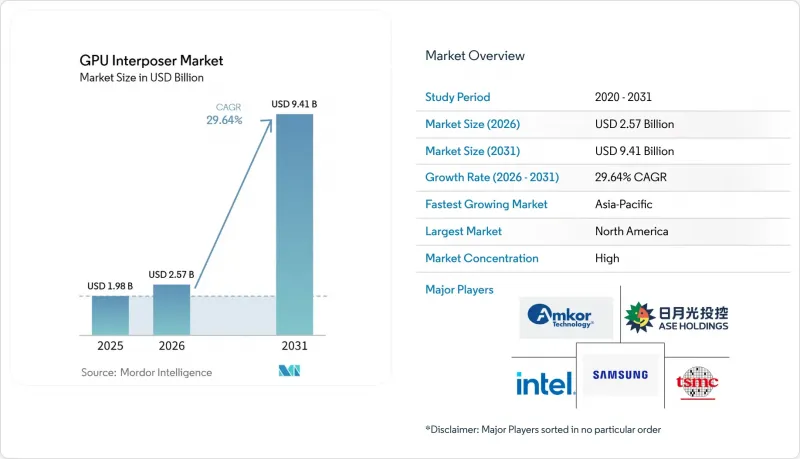
Mordor Intelligence에 의하면, GPU 인터포저 시장 규모는 2025년 19억 8,000만 달러에서 2026년에는 25억 7,000만 달러로 확대되어 2031년까지 94억 1,000만 달러에 이를 것으로 예상되고 있어 2026년부터 2031년까지 CAGR 29.64%로 성장할 전망입니다.
본 보고서는 인터포저의 아키텍처(RDL 기반/하이브리드 인터포저, 3D 액티브 베이스 다이/인터포저 통합 등), 용도(AI 훈련 가속기, HPC 및 과학 계산 등), 도입처인 최종 사용자(GPU 클라우드, 코로케이션 및 매니지드 서비스 제공업체, 엔터프라이즈 데이터센터 등), 그리고 지역별로 분류되어 있습니다. 시장 전망은 금액(달러) 기준으로 제시되어 있습니다.
세계 GPU 인터포저 시장 동향과 인사이트
생성형 AI용 GPU 클러스터의 급속한 보급
각 고급 가속기 패키지에는 연산 다이와 메모리 스택을 연결하기 위한 고밀도 인터포저 층이 필요하기 때문에 GPU 인터포저 시장은 생성형 AI 클러스터 구축에 발맞추어 확대되고 있습니다. NVIDIA의 'Vera Rubin' 플랫폼은 긴밀하게 통합된 GPU 패키지를 핵심으로 하는 랙스케일 시스템으로 도입됨에 따라, 수요는 단순한 조립이 아닌 고급 패키지 형식에 집중되고 있습니다. AMD 역시 대규모 가속기 도입을 중심으로 차세대 AI 시스템 로드맵을 수립하고 있으며, 이는 GPU 인터포저 시장에서 유사한 패키징 방향성을 뒷받침하고 있습니다. TSMC는 2026년 4월, CoWoS 생산 능력이 2027년까지 완전 가동될 것이라고 발표했습니다. 이는 새로운 생산 라인이 추가되더라도 패키징 수요가 단기적인 공급을 계속해서 상회하고 있음을 보여줍니다. 이는 중요한 점입니다. 왜냐하면 GPU 인터포저 시장은 현재 개별 칩의 출시뿐만 아니라 시스템 수준의 조달에 의해 형성되고 있기 때문입니다. 클러스터 단위의 수주가 확정되면 이에 따라 패키징 수요가 직접 발생하므로, 현재 사이클을 통해 가동률은 높은 수준을 유지하고 있습니다.
GPU 패키지당 HBM 스택 수 증가
HBM 탑재량 증가에 따라, GPU 인터포저 시장에서 각 패키지에 요구되는 물리적 조건이 더욱 까다로워지고 있습니다. NVIDIA는 Vera Rubin이 8개의 HBM4 스택, 288 GB의 메모리, 그리고 22 TB/s의 총 대역폭을 채택하고 있음을 밝혔습니다. 이는 이전 설계에 비해 인터포저의 실적가 더 커지고 요구 사항도 더 엄격해졌음을 시사합니다. AMD는 자사의 Instinct MI455X가 12개의 HBM4 스택, 432 GB의 메모리 용량, 그리고 19.6 TB/s의 대역폭을 채택하고 있다고 밝혔으며, 이로 인해 배선 밀도와 패키지의 복잡성이 더욱 높아졌습니다. 실용적인 관점에서 볼 때, 메모리 스택 증가에 따라 인터포저 면적 확대, 배선 층수 증가, 그리고 더욱 엄격한 조립 관리가 필요해집니다. 2026년 3월에 발표된 삼성과 AMD의 제휴에 관한 최신 정보에서도 메모리 공급업체가 패키지 로드맵과 더욱 밀접하게 연계되어 있음을 보여주고 있으며, 이는 HBM과 GPU 인터포저 시장 간의 상호 의존성을 더욱 강화하고 있습니다. HBM 로드맵이 진전됨에 따라 패키지 설계는 제품 차별화의 핵심 요소가 될 것이며, 이에 따라 첨단 인터포저에 대한 수요는 계속해서 높은 수준을 유지할 전망입니다.
대면적 인터포저용 파운드리 생산 능력의 제약
생산 능력은 여전히 GPU 인터포저 시장에서 가장 두드러진 단기적 제약 요인입니다. TSMC는 2026년 4월, CoWoS 라인이 2027년까지 풀 가동 상태를 유지할 것이라고 확인했습니다. 이는 확장이 진행되고 있음에도 불구하고, 수요가 인증된 공급량을 여전히 상회하고 있음을 의미합니다. 해당 업데이트에서는 CoPoS가 여전히 시범 단계에 있으며, 양산 개시까지 아직 수년이 소요될 것임이 밝혀졌는데, 이로 인해 더 크고 고밀도인 패키지 형식을 위한 주요 대안 경로가 지연될 것입니다. 차세대 GPU는 여전히 현재 이용 가능한 패키징 기법에 의존하고 있기 때문에 실리콘 인터포저 생산 라인에는 계속해서 압박이 가해지고 있습니다. 따라서 GPU 인터포저 시장은 생산 라인 증설은 현실화되고 있지만, 인증 및 양산 확대가 고객 수요 예상보다 더 많은 시간이 소요된다는 시기의 불일치에 직면해 있습니다. 이러한 불일치로 인해 최종 수요가 존재하더라도 2차 칩 설계 기업이 첨단 패키징 용량을 얼마나 신속하게 확보할 수 있는지가 제한되고 있습니다.
부문 분석
2.5D 실리콘 인터포저 부문은 2025년 매출의 76.28%를 차지하며, GPU 인터포저 시장 전체에서 선두 자리를 유지했습니다. 이러한 위상은 현재의 대량 생산형 가속기 패키지와 높은 호환성을 반영한 것으로, 미세한 배선 피치, 치수 안정성 및 공정 성숙도 측면에서 대규모 양산에서 여전히 이에 필적할 만한 기술은 존재하지 않습니다. 2.5D 실리콘 인터포저 부문은 2025년 GPU 인터포저 시장 규모에서도 가장 큰 점유율을 차지했습니다. 이는 플래그십 GPU 프로그램에서 여전히 기본 선택지로 남아 있었기 때문입니다. 고밀도 재배선 층에는 일관된 공차가 요구되므로, 특히 대형 컴퓨팅 다이가 여러 개의 HBM 스택과 결합되는 경우 실리콘의 공정 호환성이 중요해집니다. 현재의 주요 패키지 라인은 이미 이 아키텍처에 맞추어 최적화되어 있기 때문에 GPU 인터포저 시장은 계속해서 이 아키텍처에 의존하고 있습니다.
TSMC의 2026년 4월 최신 정보에 따르면, CoWoS는 2027년까지 풀 가동 상태가 지속될 것으로 보이며, 이는 실리콘 인터포저 사용을 뒷받침하는 견고한 도입 기반을 입증하는 것입니다. 한편, GPU 인터포저 업계가 정체되어 있는 것은 아닙니다. RDL 기반 및 하이브리드형 인터포저 시장 규모는 2031년까지 연평균 29.99% 성장할 것으로 예측되기 때문입니다. 인텔은 유기 기판 기반의 대형 패키지 대응을 위한 로드맵으로 EMIB-T를 추진하고 있으며, 이를 통해 풀 실리콘 인터포저의 성능이 필수적이지 않은 경우 고객에게 비용 및 확장성 측면에서 대안을 제공합니다. 삼성 역시 RDL 인터포저와 적층 로직을 활용한 3.3D 패키징 방향을 제시하고 있으며, 이는 주요 공급업체들이 순수 실리콘 기반 접근 방식에 대한 의존도를 낮추고자 한다는 것을 보여줍니다. 따라서 GPU 인터포저 업계는 현재도 실리콘이 주도적인 위치를 차지하고 있지만, 향후 성장은 비용 절감, 패키지 면적 확대, 혹은 보다 광범위한 가속기 제품군에서의 확장성 향상을 도모하는 설계를 통해 형성될 가능성이 높습니다.
지역별 분석
2025년, 북미는 매출의 56.71%를 차지하며 GPU 인터포저 시장에서 가장 큰 기여를 한 지역이 되었습니다. 이러한 우위는 미국 및 캐나다에 클라우드 플랫폼, AI 시스템 구매자, 그리고 첨단 반도체 고객이 집중되어 있기 때문입니다. 또한, 미국은 2025년 1월, AI 인프라 개발 및 입지 활동 가속화를 지원하는 대통령령 제14179호를 통해 정책적 지원을 강화했습니다. 캐나다는 국가 차원의 AI 컴퓨팅 자금 지원 정책을 통해 추가적인 뒷받침을 제공함으로써, 첨단 패키지형 가속기 시스템에 대한 국내 수요를 강화했습니다. 또한 북미는 2025년 GPU 인터포저 시장 규모에서도 최대 점유율을 차지하고 있는데, 이는 해당 지역의 주요 구매자들이 조기에 움직여 대규모 구매를 진행했기 때문입니다.
아시아태평양은 2031년까지 연평균 성장률(CAGR) 30.56%로 확대될 것으로 예측되며, GPU 인터포저 시장에서 가장 빠르게 성장하는 지역이 될 것입니다. 이 지역의 중요성은 수요뿐만 아니라 실행력에서도 기인합니다. 대만, 한국, 일본, 중국이 핵심인 패키징, 기판, 메모리 공급망과 인접해 있기 때문입니다. TSMC는 자사의 CoWoS 및 관련 패키징 생태계가 현재 AI 가속기 조립의 대부분을 뒷받침하고 있어, 이 구조에서 여전히 중심적인 존재입니다. 일본의 이비덴(Ibiden)과 대만의 유니마이크론(Unimicron)도 기판 생산 능력을 확대하고 있으며, 이는 다음 성장 단계에서 GPU 인터포저 시장에 대한 공급을 유지하는 이 지역의 역할을 뒷받침하고 있습니다. 따라서 아시아태평양은 GPU 인터포저 시장에서 가장 빠른 성장이 예상되는 전망과 가장 강력한 제조 측면의 우위를 모두 갖추고 있습니다.
유럽은 GPU 인터포저 시장에서 지역 내 AI 투자와 패키징 관련 공급망 활동이 모두 증가하고 있어 여전히 중요한 수요 거점으로 자리 잡고 있습니다. 유럽 수요는 클라우드 인프라의 확대와 지역 내 반도체 생산 능력 강화를 위한 광범위한 노력에 힘입어 뒷받침되고 있습니다. 남미, 중동 및 아프리카는 GPU 인터포저 시장에 대한 기여도는 여전히 미미하지만, 각국의 컴퓨팅 프로그램이 계획 단계에서 조달 단계로 전환됨에 따라 그 중요성이 높아지고 있습니다. 따라서 지역별 동향은 고르지 않으며, 현재는 북미가 주도하고 아시아태평양이 가장 빠르게 성장하고 있는 반면, 유럽은 패키징과 인프라 두 분야 모두에서 보다 전략적인 역할을 구축해 나가고 있습니다. 이러한 구성을 통해 지역 성장이 단일 최종 시장에만 의존하는 것을 방지하고 있으며, 이는 GPU 인터포저 시장의 장기적인 수요 회복력에 유리한 상황입니다.
기타 혜택:
- 엑셀 형식 시장 예측(ME) 시트
- 3개월간의 애널리스트 지원
자주 묻는 질문
목차
제1장 서론
제2장 조사 방법
제3장 주요 요약
제4장 시장 구도
제5장 시장 규모와 성장 예측
제6장 경쟁 구도
제7장 시장 기회와 향후 전망
JHS 26.08.07According to Mordor Intelligence, the GPU interposer market size is expected to increase from USD 1.98 billion in 2025 to USD 2.57 billion in 2026 and reach USD 9.41 billion by 2031, growing at a CAGR of 29.64% over 2026-2031.
This report is Segmented by Interposer Architecture (RDL-Based/Hybrid Interposer, and 3D Active Base-Die / Interposer Integration, and More), Application (AI Training Accelerators, HPC and Scientific Computing, and More), Deployment End User (GPU Cloud, Colocation, and Managed-Service Providers, Enterprise Data Centers, and More), and Geography. The Market Forecasts are Provided in Terms of Value (USD).
Global GPU Interposer Market Trends and Insights
Rapid Proliferation Of Generative AI GPU Clusters
The GPU interposer market is moving in line with the build-out of generative AI clusters because each advanced accelerator package needs a dense interposer layer to connect compute dies and memory stacks. NVIDIA's Vera Rubin platform was introduced as a rack-scale system built around tightly integrated GPU packages, which keeps demand focused on advanced package formats rather than simpler assemblies. AMD also positioned its next AI system roadmap around large accelerator deployments, which supports the same packaging direction in the GPU interposer market. TSMC stated in April 2026 that CoWoS capacity is fully utilized through 2027, which shows that package demand is staying ahead of near-term supply even as new lines are added. This matters because the GPU interposer market is now shaped by system-level procurement, not just by individual chip launches. Once a cluster order is placed, the packaging requirement follows directly, and that keeps utilization high across the current cycle.
Escalating HBM Stack Counts Per GPU Package
Higher HBM content is raising the physical demands placed on each package in the GPU interposer market. NVIDIA disclosed that Vera Rubin uses 8 HBM4 stacks, 288 GB of memory, and 22 TB/s of aggregate bandwidth, which points to a larger and more demanding interposer footprint than earlier designs. AMD stated that its Instinct MI455X adopts 12 HBM4 stacks, 432 GB of memory capacity, and 19.6 TB/s of bandwidth, which increases routing density and package complexity further. In practical terms, more memory stacks require more interposer area, more wiring layers, and tighter assembly control. Samsung's March 2026 collaboration update with AMD also showed how memory suppliers are now more closely tied to the package roadmap, which reinforces the interdependence between HBM and the GPU interposer market. As HBM roadmaps advance, package design becomes a larger part of product differentiation, which keeps advanced interposer demand elevated.
Limited Foundry Capacity For Large-Area Interposers
Capacity remains the clearest near-term constraint on the GPU interposer market. TSMC confirmed in April 2026 that CoWoS lines are fully utilized through 2027, which means demand is still ahead of qualified supply despite ongoing expansion. The same update also showed that CoPoS is still in pilot mode and commercial production remains a couple of years away, which delays a major alternative path for larger and denser package formats. This keeps silicon interposer lines under pressure because new GPU generations continue to rely on currently available package methods. The GPU interposer market, therefore, faces a timing mismatch, where line additions are real but qualification and volume ramp take longer than customer demand expects. That mismatch limits how quickly second-tier chip designers can secure advanced packaging slots, even when end demand is present.
Other drivers and restraints analyzed in the detailed report include:
- Transition Toward Chiplet-Based GPU Architectures
- Sovereign AI Build-Outs And Local Packaging Localization
- High Build-Up Substrate Costs Offsetting Interposer Gains
For complete list of drivers and restraints, kindly check the Table Of Contents.
Segment Analysis
The 2.5D silicon interposer segment held 76.28% of revenue in 2025, which kept it in the lead across the GPU interposer market. That position reflects strong alignment with current high-volume accelerator packages, where fine routing pitch, dimensional stability, and process maturity remain hard to match at scale. The 2.5D silicon interposer segment also represented the largest share of GPU interposer market size in 2025 because it remained the default choice for flagship GPU programs. Silicon's process compatibility matters because high-density redistribution layers need consistent tolerances, especially when large compute dies are paired with multiple HBM stacks. The GPU interposer market continues to rely on this architecture because today's leading package lines are already optimized around it.
TSMC's April 2026 update showed that CoWoS remains fully utilized through 2027, which reinforces the installed-base strength behind silicon interposer use. At the same time, the GPU interposer industry is not standing still because RDL-based and hybrid interposer formats are projected to grow at 29.99% through 2031. Intel promoted EMIB-T as a route toward larger package support on an organic substrate base, which gives customers a cost and scale alternative where full silicon interposer performance is not essential. Samsung also outlined a 3.3D packaging direction that uses an RDL interposer and stacked logic, which shows that major suppliers want to reduce dependence on pure silicon-based approaches. The GPU interposer industry therefore remains led by silicon today, but future gains are likely to be shaped by designs that lower cost, increase package area, or improve scalability across broader accelerator portfolios.
Complete Report Scope:
- By Interposer Architecture
- 2.5D Silicon Interposer
- RDL-Based / Hybrid Interposer
- 3D Active Base-Die / Interposer Integration
- By Application
- AI Training Accelerators
- AI Inference Accelerators
- HPC and Scientific Computing
- Professional Visualization and Technical Computing
- Other Specialized GPU Compute Applications
- By Deployment End User
- Hyperscale Cloud Service Providers
- GPU Cloud, Colocation, and Managed-Service Providers
- Enterprise Data Centers
- Research, Academic, and Government HPC Centers
- Defense and Sovereign AI Programs
- By Geography
- North America
- United States
- Canada
- Mexico
- Europe
- Germany
- United Kingdom
- France
- Italy
- Rest of Europe
- Asia-Pacific
- China
- Japan
- South Korea
- India
- Southeast Asia
- Rest of Asia-Pacific
- South America
- Middle East and Africa
- North America
Geography Analysis
North America held 56.71% of revenue in 2025, which made it the largest regional contributor to the GPU interposer market. This lead came from the concentration of cloud platforms, AI system buyers, and advanced semiconductor customers in the United States and Canada. The United States also strengthened the policy backdrop in January 2025 through Executive Order 14179, which supported AI infrastructure development and faster siting activity. Canada added another layer of support through its national AI compute funding push, which reinforced sovereign demand for advanced packaged accelerator systems. North America also accounted for the largest share of the GPU interposer market size in 2025 because leading buyers there moved first and purchased at scale.
Asia-Pacific is projected to expand at a 30.56% CAGR through 2031, which makes it the fastest-growing region in the GPU interposer market. The region's importance is tied not only to demand but also to execution, because Taiwan, South Korea, Japan, and China sit close to core packaging, substrate, and memory supply chains. TSMC remains central to this structure because its CoWoS and related packaging ecosystem anchors a large part of the current AI accelerator assembly. Japan's Ibiden and Taiwan's Unimicron are also expanding substrate capacity, which supports the region's role in keeping the GPU interposer market supplied during the next phase of growth. Asia-Pacific therefore combines the fastest expansion outlook with the strongest manufacturing leverage in the GPU interposer market.
Europe remains a meaningful demand center because regional AI investment and packaging-related supply chain activity are both rising in the GPU interposer market. Demand in Europe is supported by cloud infrastructure expansion and a wider push for more locally resilient semiconductor capability. South America and the Middle East and Africa remain smaller contributors to the GPU interposer market, but they are becoming more relevant as sovereign compute programs move from planning to procurement. The geographic pattern is therefore uneven, with North America leading today, Asia-Pacific scaling the fastest, and Europe building a more strategic role across packaging and infrastructure. This mix keeps regional growth from depending on only one end market, which is favorable for long-term demand resilience in the GPU interposer market.
- Taiwan Semiconductor Manufacturing Company Limited
- Samsung Electronics Co., Ltd.
- ASE Technology Holding Co., Ltd.
- Amkor Technology, Inc.
- Intel Corporation
- NVIDIA Corporation
- Advanced Micro Devices, Inc.
- Broadcom Inc.
- Marvell Technology, Inc.
- Siliconware Precision Industries Co., Ltd.
- JCET Group Co., Ltd.
- Unimicron Technology Corp.
- Shinko Electric Industries Co., Ltd.
- AT&S Austria Technologie & Systemtechnik AG
- UMC (United Microelectronics Corporation)
- Powertech Technology Inc.
- Murata Manufacturing Co., Ltd.
- Toppan Inc.
- NGK Insulators, Ltd.
Additional Benefits:
- The market estimate (ME) sheet in Excel format
- 3 months of analyst support
TABLE OF CONTENTS
1 INTRODUCTION
- 1.1 Study Assumptions and Market Definition
- 1.2 Scope of the Study
2 RESEARCH METHODOLOGY
3 EXECUTIVE SUMMARY
4 MARKET LANDSCAPE
- 4.1 Market Overview
- 4.2 Market Drivers
- 4.2.1 Rapid Proliferation of Generative AI GPU Clusters
- 4.2.2 Escalating HBM Stack Counts Per GPU Package
- 4.2.3 Transition Toward Chiplet-Based GPU Architectures
- 4.2.4 Sovereign AI Build-Outs and Local Packaging Localization
- 4.2.5 Co-Packaged Memory Roadmaps Requiring Fine-Pitch Interconnects
- 4.2.6 Design Rule Convergence Around Open Die-to-Die Standards
- 4.3 Market Restraints
- 4.3.1 Limited Foundry Capacity for Large-Area Interposers
- 4.3.2 High Build-Up Substrate Costs Offsetting Interposer Gains
- 4.3.3 Thermal and Warpage Limits in Dense Multi-Die Packages
- 4.3.4 Qualification Risk in Cross-Vendor Chiplet Ecosystems
- 4.4 Industry Value Chain Analysis
- 4.5 Industry Supply Chain Analysis
- 4.6 Impact of Macroeconomic Factors on the Market
- 4.7 Regulatory Landscape
- 4.8 Technological Outlook
- 4.9 Porter's Five Forces Analysis
- 4.9.1 Bargaining Power of Suppliers
- 4.9.2 Bargaining Power of Buyers
- 4.9.3 Threat of New Entrants
- 4.9.4 Threat of Substitutes
- 4.9.5 Competitive Rivalry
5 MARKET SIZE AND GROWTH FORECASTS (VALUE)
- 5.1 By Interposer Architecture
- 5.1.1 2.5D Silicon Interposer
- 5.1.2 RDL-Based / Hybrid Interposer
- 5.1.3 3D Active Base-Die / Interposer Integration
- 5.2 By Application
- 5.2.1 AI Training Accelerators
- 5.2.2 AI Inference Accelerators
- 5.2.3 HPC and Scientific Computing
- 5.2.4 Professional Visualization and Technical Computing
- 5.2.5 Other Specialized GPU Compute Applications
- 5.3 By Deployment End User
- 5.3.1 Hyperscale Cloud Service Providers
- 5.3.2 GPU Cloud, Colocation, and Managed-Service Providers
- 5.3.3 Enterprise Data Centers
- 5.3.4 Research, Academic, and Government HPC Centers
- 5.3.5 Defense and Sovereign AI Programs
- 5.4 By Geography
- 5.4.1 North America
- 5.4.1.1 United States
- 5.4.1.2 Canada
- 5.4.1.3 Mexico
- 5.4.2 Europe
- 5.4.2.1 Germany
- 5.4.2.2 United Kingdom
- 5.4.2.3 France
- 5.4.2.4 Italy
- 5.4.2.5 Rest of Europe
- 5.4.3 Asia-Pacific
- 5.4.3.1 China
- 5.4.3.2 Japan
- 5.4.3.3 South Korea
- 5.4.3.4 India
- 5.4.3.5 Southeast Asia
- 5.4.3.6 Rest of Asia-Pacific
- 5.4.4 South America
- 5.4.5 Middle East and Africa
- 5.4.1 North America
6 COMPETITIVE LANDSCAPE
- 6.1 Market Concentration
- 6.2 Strategic Moves
- 6.3 Market Positioning Analysis
- 6.4 Company Profiles (includes Global Level Overview, Market Level Overview, Core Segments, Financials as available, Strategic Information, Market Rank/Share, Products and Services, Recent Developments)
- 6.4.1 Taiwan Semiconductor Manufacturing Company Limited
- 6.4.2 Samsung Electronics Co., Ltd.
- 6.4.3 ASE Technology Holding Co., Ltd.
- 6.4.4 Amkor Technology, Inc.
- 6.4.5 Intel Corporation
- 6.4.6 NVIDIA Corporation
- 6.4.7 Advanced Micro Devices, Inc.
- 6.4.8 Broadcom Inc.
- 6.4.9 Marvell Technology, Inc.
- 6.4.10 Siliconware Precision Industries Co., Ltd.
- 6.4.11 JCET Group Co., Ltd.
- 6.4.12 Unimicron Technology Corp.
- 6.4.13 Shinko Electric Industries Co., Ltd.
- 6.4.14 AT&S Austria Technologie & Systemtechnik AG
- 6.4.15 UMC (United Microelectronics Corporation)
- 6.4.16 Powertech Technology Inc.
- 6.4.17 Murata Manufacturing Co., Ltd.
- 6.4.18 Toppan Inc.
- 6.4.19 NGK Insulators, Ltd.
7 MARKET OPPORTUNITIES AND FUTURE OUTLOOK
- 7.1 White-space and Unmet-Need Assessment


