|
시장보고서
상품코드
2099184
국경 간 광섬유 백본 연결 시장 : 점유율 분석, 업계 동향 및 통계, 성장 예측(2026-2031년)Cross-Border Fiber Backbone Connectivity - Market Share Analysis, Industry Trends & Statistics, Growth Forecasts (2026 - 2031) |
||||||
 Mordor Intelligence
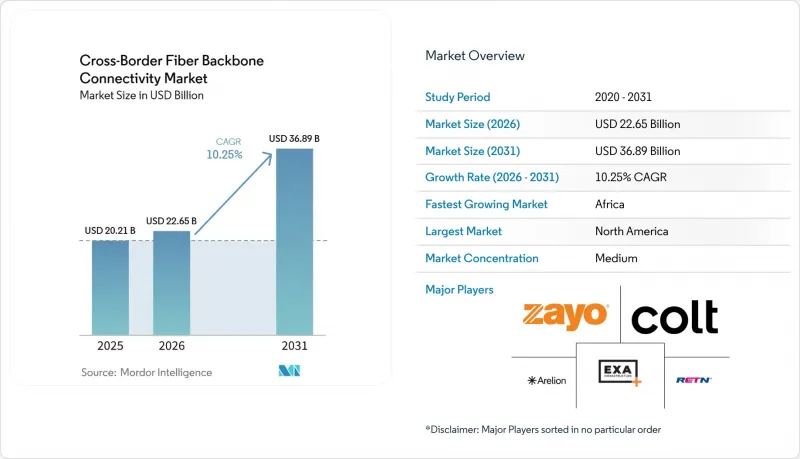
Mordor Intelligence에 의하면, 국경 간 광섬유 백본 연결 시장 규모는 2025년에 202억 1,000만 달러로 평가되었고 2026년 226억 5,000만 달러에서 2031년까지 368억 9,000만 달러에 이를 것으로 추정되고 있어 예측 기간(2026-2031년) CAGR은 10.25%를 나타낼 전망입니다.
본 보고서는 네트워크 유형(육상 국경을 넘는 광섬유 백본, 해저 광섬유 백본 등), 소유 형태(단독 소유 등), 용도(하이퍼스케일러 및 클라우드 상호 연결, 통신 사업자의 트랜짓 등), 그리고 지역별로 분류되어 있습니다. 시장 전망은 금액(달러)으로 표시됩니다.
전 세계 국경 간 광섬유 백본 연결 시장 동향 및 인사이트
하이퍼스케일러의 경로 소유권 및 직접적인 용량 조달
국경 간 광섬유 백본 연결 시장은 더 이상 도매 통신사공급에만 의존하지 않고, 경로 설계, 케이블 용량 및 상륙 전략을 직접 관리하고자 하는 구매자들에 의해 재편되고 있습니다. 이러한 변화는 통신 사업자가 주도하는 대규모 백본 프로젝트나, 처음부터 트래픽 확보를 전제로 구축된 민간 또는 앵커 기업 지원형 시스템에서 확인할 수 있습니다. Meta는 2025년 11월 ‘2Africa’ 시스템의 핵심 부분을 완성하여, 아프리카, 유럽, 아시아 전역에 걸친 국제 백본 용량을 대폭 확대하는 33개국을 아우르는 오픈 액세스 경로를 구축했습니다. 또한 Colt도 2026년에 ‘Juno’ 및 ‘Marea’ 해저 케이블 용량과 새로운 육상 링크를 결합하여 경로 내 입지를 확대했습니다. 이는 민간 경로에 대한 접근권 및 장기적인 용량 이용권이 현재 회랑 전략에 어떤 영향을 미치고 있는지를 보여줍니다. 이러한 추세가 확산됨에 따라, 국경 간 광섬유 백본 연결 시장에서는 단기적인 용량 구매에서 장기적인 인프라 투자로 점진적인 전환이 나타나고 있습니다. 이러한 변화로 인해 경로 소유권이 상업적 우위로 강화되었으며, 밀도가 가장 높은 회랑에서는 통신 사업자와의 관계 구축이 더욱 선택적으로 이루어지고 있습니다.
AI, 클라우드 및 데이터센터 간의 상호 연결 밀도
국경 간 광섬유 백본 연결 시장은 클라우드 리전, AI 클러스터, 캐리어 호텔, 케이블 상륙국을 더 빠르고 지연 시간이 짧은 방식으로 연결해야 하는 수요가 증가함에 따라 혜택을 보고 있습니다. 루멘(Lumen)은 2026년 2월, ‘프라이빗 커넥티비티 패브릭(Private Connectivity Fabric)’ 전략과 관련된 계약 총액이 약 130억 달러에 달했다고 발표했습니다. 이는 AI 관련 수요가 장거리 회선에서의 새로운 백본 구축을 어떻게 뒷받침하고 있는지를 보여줍니다. Zayo사도 주요 AI 회랑에서 핵심 고객을 확보한 후, 회사 역사상 최대 규모의 노선 마일 확장 프로그램을 시작했습니다. 이는 대규모 데이터 트래픽 흐름을 뒷받침하기 위한 도시 간 및 국경을 넘는 용량에 대한 수요가 지속되고 있음을 보여줍니다. NTT 도코모 비즈니스와 NTT Com Asia는 2025년 10월 홍콩에 'APN InterLink'를 추가하고, 도쿄와 홍콩을 연결하는 ASE 케이블 상에서 지연에 민감한 트래픽을 위해 올포토닉 네트워크 기술을 도입했습니다. 또한 Arelion은 2026년 4월, 새로운 상륙 거점 및 AI 워크로드를 지원하기 위해 덴마크의 네트워크를 확장하고, 백본 계획과 데이터센터의 성장 패턴을 더욱 긴밀하게 연계했습니다. 이러한 움직임은 국경 간 광섬유 백본 연결 시장이 더 이상 일반적인 인터넷 성장에 의해서만 주도되고 있지 않음을 보여줍니다. 왜냐하면 현재 경로에 대한 수요는 컴퓨팅, 스토리지 및 클라우드 교환 지점의 물리적 집중을 따르고 있기 때문입니다.
장거리 토목 공사 및 상륙 시설 통합에 수반되는 막대한 설비 투자
국경 간 광섬유 백본 연결 시장에는 여전히 높은 진입 장벽이 존재합니다. 이는 백본 건설에 해양 공사, 상륙 스테이션, 육상 백홀, 국경을 넘는 통합에 대한 막대한 선행 투자가 필요하기 때문입니다. 소규모 사업자는 용량 재판매에는 진입할 수 있지만, 새로운 국제 경로에서 시스템 전체에 대한 소유권을 확보하기 위한 자금 조달에는 종종 어려움을 겪습니다. 이러한 비용 구조가 투자가 이미 명확한 트래픽 수요와 수익화 경로가 보이는 회랑 주변에 계속 집중되는 이유 중 하나입니다. 또한, 이로 인해 국경 간 광섬유 백본 연결 시장은 소규모 지역 사업자보다 인프라 펀드, 대형 통신 사업자, 클라우드 기업이 지원하는 프로젝트를 더 많이 유치하고 있습니다. 공공 지원이 있는 경우, 보조금 조건에 따라 자금 조달 부담이 일부 경감되기도 하지만, 그 반면 접근, 규정 준수, 보고 의무와 같은 부담도 발생합니다. 그 결과, 경로의 다각화는 전략적으로 중요한 회랑에서 먼저 진행되고, 그 후에야 트래픽이 적은 국경을 넘는 경로로 비로소 확대되는 시장 상황이 조성되고 있습니다.
부문 분석
2025년, 해저 백본은 국경 간 광섬유 백본 연결 시장 점유율의 42.89%를 차지하고 있으며, 이는 장거리에 걸친 대륙 간 대용량 트래픽을 전송하는 데 있어 해저 경로가 수행하는 역할을 반영합니다. 주요 클라우드 사업자, 통신 사업자, 인프라 사업자는 여전히 최대 수요 중심지를 연결하기 위해 심해 시스템에 의존하고 있으므로, 이 부문은 국경 간 광섬유 백본 연결 시장에서 계속해서 중심적인 위치를 차지하고 있습니다. 2025년 11월 Meta가 핵심이 되는 ‘2Africa’ 시스템의 건설을 완료한 것은 대규모 해저 케이블 확장의 최근 가장 중요한 사례 중 하나로 꼽힙니다. 이 시스템은 아프리카, 유럽, 아시아를 횡단하며 33개국을 아우르는 설계와 개방형 접근 방식을 채택하고 있습니다. 또한 해저 케이블 건설 주기는 점점 더 기술 주도형으로 변모하고 있으며, 이는 핵심 백본 경로의 수명 연장 및 용량 효율 향상에 기여하고 있습니다. NTT는 2026년 3월, 192코어의 멀티코어 광섬유 해저 케이블 시스템을 개발했습니다. 이 설계는 기존의 단일 광섬유 케이블 시스템에 비해 전송 용량을 4배로 늘리는 것을 목표로 하고 있습니다. 이는 국경을 넘는 광섬유 백본 시장에게 중요한 의미를 지닙니다. 왜냐하면 현재 용량 확대는 클라우드 트래픽의 고밀도화, 데이터센터 간의 보다 직접적인 상호 연결, 그리고 경로의 다양화에 대한 수요 증가에 대응해야 하기 때문입니다. 육상 백본은 단거리 국제 트래픽에서 낮은 지연 시간과 용이한 물리적 접근이 요구되는 내륙 지역이나 국경 인근 회랑에서 여전히 중요한 보조적 역할을 수행하고 있습니다. 또한, 육상 백본은 내륙 데이터센터와 해안 상륙국 사이에서 통신 사업자에게 더 큰 유연성을 제공합니다. 하지만 육상 전용 경로는 통행권 문제, 국경 절차, 그리고 지역별 허가 요건의 차이에 여전히 취약합니다. 따라서 보조적인 육상 구간의 가치가 높아지고 있음에도 불구하고, 장거리 경로 계획에서는 해저 시스템이 여전히 중심적인 위치를 차지하고 있습니다.
육상·해저 하이브리드 백본은 2026년부터 2031년까지 연평균 성장률(CAGR) 14.87%를 나타낼 것으로 예측되며, 통신 사업자들이 시스템 설계 초기 단계부터 중복성을 반영하기를 요구함에 따라, 이 네트워크 유형을 대상으로 하는 국경 간 광섬유 백본 연결 시장도 확대되고 있습니다. 하이브리드 아키텍처를 통해 통신 사업자와 인프라 소유자는 심해까지의 도달 범위와, 위험이 높은 회랑이나 혼잡한 회랑을 우회하는 육상 경로를 결합할 수 있게 됩니다. EXA Infrastructure와 Socar Fiber는 튀르키예, 그리스, 조지아를 횡단할 예정인 케이블을 통해 이러한 방향으로 나아갔습니다. 이 케이블은 유럽에서 아시아로 향하는 트래픽을 위한 새로운 육상 대체 경로로 자리매김하고 있습니다. Colt사의 2026년 경로 확장도 이와 같은 논리에 기반하여, Juno나 Marea와 같은 해저 자산과 육상 착륙국 간 새로운 육상 광섬유 건설을 결합한 것입니다. 국경 간 광섬유 백본 연결 시장에서 이 모델은 단일 경로 유형에 대한 의존도를 낮추고, 보다 유연한 복구 계획을 가능하게 한다는 점에서 매력적입니다. 또한 사업자가 경로 설계를 트래픽 등급, 고객 계약, 규제상의 제약에 맞추어 조정할 수 있는 여지도 넓어집니다. 따라서 하이브리드 시스템은 단순한 내결함성 추가 기능에서 주류 도입 옵션으로 전환되고 있습니다. 이러한 변화는 유럽-아시아, 아프리카, 그리고 태평양 횡단 회랑 확장을 위한 새로운 투자를 촉진할 것으로 보입니다. 또한 중립적인 인프라 소유자에게는 단일 물리적 경로가 아닌, 여러 경로 옵션에 걸쳐 용량을 판매할 수 있는 보다 광범위한 플랫폼을 제공하게 됩니다. 국경을 넘는 광섬유 백본 연결 시장에서 보다 폭넓은 경로 전략은 고객에 대한 매력과 자산의 장기적인 중요성 모두를 높여줍니다.
지역별 분석
2025년, 북미는 국경 간 광섬유 백본 연결 시장 점유율의 34.65%를 차지했으며, 이 지역은 많은 클라우드 주도형 백본 투자의 주요 출발점이자 종착지로서의 위치를 유지하고 있어 그 선두 자리를 지켰습니다. 이 지역의 건설 사이클은 여전히 활발하며, Lumen사는 2028년까지 3,400만 마일의 신규 도시 간 광섬유 회선을 추가하고, AI 및 클라우드 연결과 관련된 계약을 통해 2031년까지 네트워크 규모를 더욱 확대할 계획입니다. Zayo 역시 주요 AI 회랑에서 주요 고객들의 확약을 확보한 후, 회사 역사상 최대 규모의 노선 마일 확장 프로그램을 추진했습니다. 이러한 투자는 노선 계획이 현재 AI 및 클라우드 수요가 물리적으로 집중된 지역과 밀접하게 연결되어 있다는 점에서 북미 국경 간 광섬유 백본 연결 시장이 단순한 트래픽 증가 이상의 요인에 의해 형성되고 있음을 보여줍니다. 또한, 2025년 8월 FCC(연방통신위원회)의 라이선싱 제도 개혁으로 인해 미국에 상륙하는 케이블 시스템에 대한 국가 안보 심사가 강화됨에 따라, 이 지역은 정책적 측면에서도 그 중요성이 더욱 커지고 있습니다. 이로 인해 북미는 국경 간 광섬유 백본 연결 시장에서 가장 활발하고 주목받는 지역 중 하나가 되었습니다. 북미는 규모, 자금 조달 접근성, 상륙 인프라, 그리고 규제 당국의 감시를 다른 지역에서는 유례를 찾아볼 수 없는 형태로 모두 갖추고 있습니다.
유럽과 아시아태평양은 성숙한 백본 수요와 활발한 경로 재설계를 모두 갖추고 있어, 국경 간 광섬유 백본 연결 시장에서 여전히 중심적인 위치를 차지하고 있습니다. EXA Infrastructure는 2025년 9월, 중부 유럽의 주요 도시들을 자사의 광역 하이퍼스케일 백본에 연결하는 ‘프로젝트 비셰그라드’를 시작했으며, 2026년 중반에 첫 번째 경로가 서비스를 개시했습니다. RETN은 2026년 2월 탈린-체시스 노선을 추가하여, 북유럽·발트 회랑에 40Tbps 용량을 갖춘 물리적으로 독립된 새로운 경로를 제공했습니다. 아시아태평양에서는 Colt가 2026년에 NTT의 태평양 횡단 시스템 ‘Juno’의 용량을 확보하여 도쿄와 로스앤젤레스 간 새로운 경로를 추가하는 한편, 주요 무역 경로를 아우르는 백본의 도달 범위를 확대했습니다. 정책 면에서도 움직임이 보였는데, 핀란드가 2025년에 EU의 ‘기가비트 인프라 법’에 따라 취한 조치는 초대용량 네트워크 구축에 대한 장벽을 낮추기 위한 지속적인 노력을 보여줍니다. 이러한 발전들이 맞물리면서, 국경 간 광섬유 백본 연결 시장에서 유럽과 아시아태평양은 회랑의 다양화, 경로의 내결함성, 그리고 고밀도 상호 연결 계획의 중심적인 위치를 계속 차지하고 있습니다.
아프리카는 2026년부터 2031년까지 연평균 성장률(CAGR) 17.43%를 나타낼 것으로 예측되며, 국경 간 광섬유 백본 연결 시장에서 가장 빠르게 성장하는 지역 클러스터가 될 전망입니다. 이러한 성장 모멘텀의 상당 부분은 대륙 전체에 걸친 경로 접근성, 국제적 도달 범위 및 상륙 지점의 다양성을 향상시키는 대규모 백본 회선 확충에 기인합니다. 메타(Meta)는 2025년 11월 ‘2Africa’ 시스템의 핵심 부분을 완공하여 33개국을 연결하는 동시에, 아프리카, 유럽, 아시아 전역에 걸친 개방형 국제 통신 용량을 확대했습니다. 또한, ‘Medusa’ 시스템도 2025년 12월 나도르에 상륙하여 지중해 지역의 연결성에서 모로코의 역할을 뒷받침하는 동시에, 남유럽과 북아프리카를 연결하는 링크를 강화하고 있습니다. 중동도 사업자들이 취약한 회랑에 대한 의존도를 낮추기 위해 우회 경로나 대체 상륙 지점을 모색함에 따라 그 중요성이 높아지고 있습니다. 남미는 상대적으로 여전히 규모가 작지만, 이 지역의 국경 간 광섬유 백본 연결 시장은 국제 경로에 대한 관심이 높아지고 있으며, 다양화된 대륙 간 연결에 대한 관심이 확산됨에 따라 혜택을 보고 있습니다. 중립 사업자 및 통신 사업자가 주도하는 백본 시스템이 이 지역으로 확대됨에 따라, 이 시장은 단순히 트래픽에 인접하는 데 그치지 않고 허브 연결에서 더 큰 역할을 수행하게 될 것입니다. 이를 통해 중동 및 아프리카, 남미를 아우르는 지역 전체가 장기적인 경로 균형 조정에서 더욱 견고한 입지를 구축하게 될 것입니다. 또한, 국경 간 광섬유 백본 연결 시장의 성장이 기존의 북미 핵심 지역에만 집중되지 않게 될 것임을 의미합니다.
기타 혜택:
- 엑셀 형식 시장 예측(ME) 시트
- 3개월간의 애널리스트 지원
자주 묻는 질문
목차
제1장 서론
제2장 조사 방법
제3장 주요 요약
제4장 시장 구도
제5장 시장 규모와 성장 예측
제6장 경쟁 구도
제7장 시장 기회와 향후 전망
JHS 26.08.07According to Mordor Intelligence, the cross-Border fiber backbone connectivity market size was valued at USD 20.21 billion in 2025 and is estimated to grow from USD 22.65 billion in 2026 to reach USD 36.89 billion by 2031, at a CAGR of 10.25% during the forecast period (2026-2031).
This report is Segmented by Network Type (Terrestrial Cross-Border Fiber Backbone, Submarine Fiber Backbone, and More), Ownership Type (Single Ownership, and More), Application (Hyperscaler and Cloud Interconnect, Telecom Carrier Transit, and More), and Geography. The Market Forecasts are Provided in Value (USD).
Global Cross-Border Fiber Backbone Connectivity Market Trends and Insights
Hyperscaler Route Ownership And Direct Capacity Procurement
The cross-border fiber backbone connectivity market is being reshaped by buyers who now want direct control over route design, cable capacity, and landing strategy, rather than relying solely on wholesale carrier supply. That shift is visible in large, operator-led backbone projects and in private or anchor-backed systems that are built around traffic assurance from the start. Meta completed the core 2Africa system in November 2025, creating a 33-country open-access route that materially expands international backbone capacity across Africa, Europe, and Asia. Colt also expanded its route position in 2026 by combining subsea capacity on Juno and Marea with new terrestrial links, which shows how private route access and long-term capacity rights now influence corridor strategy. As this pattern spreads, the cross-border fiber backbone connectivity market is seeing a steady shift from short-term capacity purchases toward long-term infrastructure commitments. That change is strengthening route ownership as a commercial advantage and making carrier relationships more selective across the highest-density corridors.
AI, Cloud, And Data Center Interconnection Density
The cross-border fiber backbone connectivity market is also benefiting from the growing need to connect cloud regions, AI clusters, carrier hotels, and cable landing stations with higher speed and lower latency. Lumen said in February 2026 that it had nearly USD 13 billion in contracted deals tied to its Private Connectivity Fabric strategy, which shows how AI-related demand is supporting new backbone builds across long-haul corridors. Zayo also launched its largest route-mile expansion program after securing an anchor customer for critical AI corridors, indicating continued demand for intercity and cross-border capacity to support large data traffic flows. NTT DOCOMO BUSINESS and NTT Com Asia added APN InterLink in Hong Kong in October 2025, using All-Photonic Network technology on the ASE cable between Tokyo and Hong Kong for latency-sensitive traffic. Arelion also expanded its Danish network in April 2026 to support new landings and AI workloads, linking backbone planning more closely to data center growth patterns. These moves show that the cross-border fiber backbone connectivity market is no longer driven only by general internet growth, because route demand now follows the physical concentration of compute, storage, and cloud exchange points.
High Capex For Long-Haul Civil Works And Landing Integration
The cross-border fiber backbone connectivity market still has a high entry barrier because backbone construction requires significant upfront investment in marine works, landing stations, terrestrial backhaul, and cross-border integration. Smaller operators can participate in capacity resale, but they often struggle to fund full system ownership on new international routes. This cost structure is one reason investment continues to cluster around corridors with already visible traffic demand and clearer monetization paths. It also explains why the cross-border fiber backbone connectivity market is attracting more infrastructure funds, larger carriers, and cloud-backed projects than smaller regional builders. Where public support exists, grant conditions can ease some of the financing burden, but they also add access, compliance, and reporting obligations. The result is a market where route diversification often advances first on strategically important corridors and only later reaches thinner cross-border paths.
Other drivers and restraints analyzed in the detailed report include:
- Cross-Border Data Sovereignty And Sovereign Connectivity Mandates
- Terrestrial Diversification Away From Geopolitical Chokepoints
- Permitting Delays Across Multiple Jurisdictions
For complete list of drivers and restraints, kindly check the Table Of Contents.
Segment Analysis
Submarine backbone held 42.89% of the cross-border fiber backbone connectivity market share in 2025, reflecting the role of subsea routes in carrying large volumes of intercontinental traffic over long distances. The segment remains central to the cross-border fiber backbone connectivity market because major cloud, carrier, and infrastructure operators still depend on deepwater systems to connect the largest demand centers. Meta's completion of the core 2Africa system in November 2025 added to the list of the most important recent examples of large-scale subsea expansion, with a 33-country design and open-access positioning across Africa, Europe, and Asia. The subsea build cycle is also becoming increasingly technology-driven, helping extend the useful life and improve capacity efficiency of core backbone routes. NTT developed a 192-core multicore optical fiber submarine cable system in March 2026, with a design aimed at a 4x increase in transmission capacity over conventional single-fiber cable systems. That matters for the cross-border fiber backbone connectivity market because capacity growth now has to align with denser cloud traffic, more direct data center interconnection, and rising demand for route diversity. The terrestrial backbone still plays an important supporting role in landlocked and near-border corridors where short-haul international traffic needs lower latency and easier physical access. It also gives operators more flexibility between inland data centers and coastal landing stations. Even so, terrestrial-only routes remain more exposed to rights-of-way issues, border procedures, and variations in local permitting. That keeps submarine systems at the center of long-haul route planning even as supporting land segments become more valuable.
The hybrid terrestrial-submarine backbone is projected to grow at a 14.87% CAGR from 2026 to 2031, and the cross-border fiber backbone connectivity market for this network type is growing as operators now seek redundancy built into system design from the start. Hybrid architecture helps carriers and infrastructure owners combine deepwater reach with land-based bypass options across exposed or congested corridors. EXA Infrastructure and Socar Fiber moved in that direction with their planned cable across Turkey, Greece, and Georgia, which was positioned as a new terrestrial alternative for Europe-to-Asia traffic. Colt's 2026 route expansion followed a similar logic by combining subsea assets such as Juno and Marea with new terrestrial fiber builds between landing stations. In the cross-border fiber backbone connectivity market, this model is attractive because it reduces reliance on a single route type and supports more flexible restoration planning. It also gives operators more room to match route design with traffic class, customer contracts, and regulatory constraints. Hybrid systems are therefore moving from a resilience add-on to a mainstream deployment choice. That shift is likely to support new investment across Europe-to-Asia, Africa-facing, and transpacific corridor extensions. It also gives neutral infrastructure owners a broader platform to sell capacity across multiple path options rather than a single physical alignment. For the cross-border fiber backbone connectivity market, a wider route logic improves both customer appeal and long-term asset relevance.
Complete Report Scope:
- By Network Type
- Terrestrial Cross-Border Fiber Backbone
- Submarine Fiber Backbone
- Hybrid Terrestrial-Submarine Backbone
- By Ownership Type
- Single Ownership
- Consortium Ownership
- Wholesale Neutral Host Ownership
- By Application
- Hyperscaler and Cloud Interconnect
- Telecom Carrier Transit
- Data Center Interconnect
- Government and Defense Connectivity
- Financial Services and Low-Latency Trading Connectivity
- Other Applications
- By Geography
- North America
- United States
- Canada
- Mexico
- South America
- Brazil
- Argentina
- Rest of South America
- Europe
- Germany
- United Kingdom
- France
- Rest of Europe
- Asia-Pacific
- China
- Japan
- India
- South Korea
- Rest of Asia-Pacific
- Middle East
- Saudi Arabia
- United Arab Emirates
- Rest of the Middle East
- Africa
- South Africa
- Nigeria
- Rest of Africa
- North America
Geography Analysis
North America held 34.65% of the cross-border fiber backbone connectivity market share in 2025, and the region kept that lead because it remains the main origin and destination point for many cloud-led backbone investments. The regional build cycle is still active, with Lumen adding 34 million new intercity fiber miles by 2028 and targeting a larger footprint by 2031 through contracts linked to AI and cloud connectivity. Zayo also moved ahead with the largest route-mile expansion program in its history after winning an anchor customer commitment for critical AI corridors. These investments show that the cross-border fiber backbone connectivity market in North America is being shaped by more than simple traffic growth, as route planning is now closely tied to where AI and cloud demand are physically concentrated. The region also carries added policy weight because the FCC's August 2025 licensing reforms tightened national security review on U.S.-landing cable systems. That makes North America one of the most active and closely watched parts of the cross-border fiber backbone connectivity market. It combines scale, access to funding, landing infrastructure, and regulatory scrutiny in a way few other regions match.
Europe and Asia-Pacific remain central to the cross-border fiber backbone connectivity market because both regions combine mature backbone demand with active route redesign. EXA Infrastructure launched Project Visegrad in September 2025 to connect major Central European cities into its wider hyperscale backbone, and the first routes entered service in mid-2026. RETN added the Tallinn-Cesis route in February 2026, giving the Nordic and Baltic corridor a new physically independent path with 40Tbps of capacity. In the Asia-Pacific region, Colt secured capacity on NTT's Juno trans-Pacific system in 2026, adding a new route between Tokyo and Los Angeles and expanding its backbone reach across major trade lanes. The policy backdrop is also moving, with Finland's 2025 action on the EU Gigabit Infrastructure Act showing continued effort to reduce deployment friction for very high-capacity networks. Together, these developments keep Europe and the Asia-Pacific at the center of corridor diversification, route resilience, and high-density interconnection planning in the cross-border fiber backbone connectivity market.
Africa is projected to grow at a 17.43% CAGR from 2026 to 2031, making it the fastest-growing regional cluster in the cross-border fiber backbone connectivity market. Much of that momentum comes from large backbone additions that improve route access, international reach, and landing diversity across the continent. Meta completed the core 2Africa system in November 2025, connecting 33 countries and extending open-access international capacity across Africa, Europe, and Asia. The Medusa system also landed in Nador in December 2025, supporting Morocco's role in Mediterranean connectivity and strengthening links across Southern Europe and North Africa. The Middle East is also becoming more important as operators pursue bypass routes and alternative landings to reduce dependence on exposed corridors. South America is still smaller in relative terms, but the cross-border fiber backbone connectivity market there is benefiting from stronger international route attention and broader interest in diversified intercontinental links. As more neutral and carrier-led backbone systems expand into the region, the market is likely to play a greater role in hub connectivity rather than remain mostly traffic-adjacent. That gives the broader Middle East, Africa, and South America group a stronger position in long-term route balancing. It also means growth in the cross-border fiber backbone connectivity market is becoming less concentrated in only the historic North Atlantic core.
- Arelion AB
- Colt Technology Services Group Limited
- Zayo Group Holdings, Inc.
- EXA Infrastructure Services UK Limited
- RETN Limited
- Tata Communications Limited
- NTT DOCOMO BUSINESS, Inc.
- Orange Wholesale (Orange S.A.)
- Telecom Italia Sparkle S.p.A.
- PCCW Global Limited
- Lumen Technologies, Inc.
- GTT Communications, Inc.
- GlobalConnect A/S
- Cogent Communications Holdings, Inc.
- Deutsche Telekom AG
- Telefonica Global Solutions, S.L.U.
- Singapore Telecommunications Limited
- SubCom, LLC
- NEC Corporation
- Alcatel Submarine Networks SAS
- Infinera Corporation
- Prysmian S.p.A.
- Seaborn Networks
- HMN Technologies Co., Ltd.
- Ciena Corporation
- Nokia Corporation
Additional Benefits:
- The market estimate (ME) sheet in Excel format
- 3 months of analyst support
TABLE OF CONTENTS
1 INTRODUCTION
- 1.1 Study Assumptions and Market Definition
- 1.2 Scope of the Study
2 RESEARCH METHODOLOGY
3 EXECUTIVE SUMMARY
4 MARKET LANDSCAPE
- 4.1 Market Overview
- 4.2 Market Drivers
- 4.2.1 Hyperscaler Route Ownership and Direct Capacity Procurement
- 4.2.2 Cross-Border Data Sovereignty and Sovereign Connectivity Mandates
- 4.2.3 AI, Cloud, and Data Center Interconnection Density
- 4.2.4 Terrestrial Diversification Away From Geopolitical Chokepoints
- 4.2.5 Government-Backed Digital Corridor Programs
- 4.2.6 Multi-Homed Resilience for Financial and Critical Infrastructure Traffic
- 4.3 Market Restraints
- 4.3.1 Permitting Delays Across Multiple Jurisdictions
- 4.3.2 High Capex for Long-Haul Civil Works and Landing Integration
- 4.3.3 Cross-Border Regulatory Fragmentation and Licensing Complexity
- 4.3.4 Security Risks, Sabotage Exposure, and Route Repair Bottlenecks
- 4.4 Industry Value Chain Analysis
- 4.5 Regulatory Landscape
- 4.6 Technological Outlook
- 4.7 Porter's Five Forces Analysis
- 4.7.1 Bargaining Power of Suppliers
- 4.7.2 Bargaining Power of Buyers
- 4.7.3 Threat of New Entrants
- 4.7.4 Threat of Substitutes
- 4.7.5 Industry Rivalry
5 MARKET SIZE AND GROWTH FORECASTS (VALUE)
- 5.1 By Network Type
- 5.1.1 Terrestrial Cross-Border Fiber Backbone
- 5.1.2 Submarine Fiber Backbone
- 5.1.3 Hybrid Terrestrial-Submarine Backbone
- 5.2 By Ownership Type
- 5.2.1 Single Ownership
- 5.2.2 Consortium Ownership
- 5.2.3 Wholesale Neutral Host Ownership
- 5.3 By Application
- 5.3.1 Hyperscaler and Cloud Interconnect
- 5.3.2 Telecom Carrier Transit
- 5.3.3 Data Center Interconnect
- 5.3.4 Government and Defense Connectivity
- 5.3.5 Financial Services and Low-Latency Trading Connectivity
- 5.3.6 Other Applications
- 5.4 By Geography
- 5.4.1 North America
- 5.4.1.1 United States
- 5.4.1.2 Canada
- 5.4.1.3 Mexico
- 5.4.2 South America
- 5.4.2.1 Brazil
- 5.4.2.2 Argentina
- 5.4.2.3 Rest of South America
- 5.4.3 Europe
- 5.4.3.1 Germany
- 5.4.3.2 United Kingdom
- 5.4.3.3 France
- 5.4.3.4 Rest of Europe
- 5.4.4 Asia-Pacific
- 5.4.4.1 China
- 5.4.4.2 Japan
- 5.4.4.3 India
- 5.4.4.4 South Korea
- 5.4.4.5 Rest of Asia-Pacific
- 5.4.5 Middle East
- 5.4.5.1 Saudi Arabia
- 5.4.5.2 United Arab Emirates
- 5.4.5.3 Rest of the Middle East
- 5.4.6 Africa
- 5.4.6.1 South Africa
- 5.4.6.2 Nigeria
- 5.4.6.3 Rest of Africa
- 5.4.1 North America
6 COMPETITIVE LANDSCAPE
- 6.1 Market Concentration
- 6.2 Strategic Moves
- 6.3 Market Share Analysis
- 6.4 Company Profiles (includes Global Level Overview, Market Level Overview, Core Segments, Financials as available, Strategic Information, Market Rank/Share, Products and Services, Recent Developments)
- 6.4.1 Arelion AB
- 6.4.2 Colt Technology Services Group Limited
- 6.4.3 Zayo Group Holdings, Inc.
- 6.4.4 EXA Infrastructure Services UK Limited
- 6.4.5 RETN Limited
- 6.4.6 Tata Communications Limited
- 6.4.7 NTT DOCOMO BUSINESS, Inc.
- 6.4.8 Orange Wholesale (Orange S.A.)
- 6.4.9 Telecom Italia Sparkle S.p.A.
- 6.4.10 PCCW Global Limited
- 6.4.11 Lumen Technologies, Inc.
- 6.4.12 GTT Communications, Inc.
- 6.4.13 GlobalConnect A/S
- 6.4.14 Cogent Communications Holdings, Inc.
- 6.4.15 Deutsche Telekom AG
- 6.4.16 Telefonica Global Solutions, S.L.U.
- 6.4.17 Singapore Telecommunications Limited
- 6.4.18 SubCom, LLC
- 6.4.19 NEC Corporation
- 6.4.20 Alcatel Submarine Networks SAS
- 6.4.21 Infinera Corporation
- 6.4.22 Prysmian S.p.A.
- 6.4.23 Seaborn Networks
- 6.4.24 HMN Technologies Co., Ltd.
- 6.4.25 Ciena Corporation
- 6.4.26 Nokia Corporation
7 MARKET OPPORTUNITIES AND FUTURE OUTLOOK
- 7.1 White-Space and Unmet-Need Assessment