

|
시장보고서
상품코드
2099185
데이터센터 메모리 시장 : 점유율 분석, 업계 동향 및 통계, 성장 예측(2026-2031년)Data Center Memory - Market Share Analysis, Industry Trends & Statistics, Growth Forecasts (2026 - 2031) |
||||||
 Mordor Intelligence
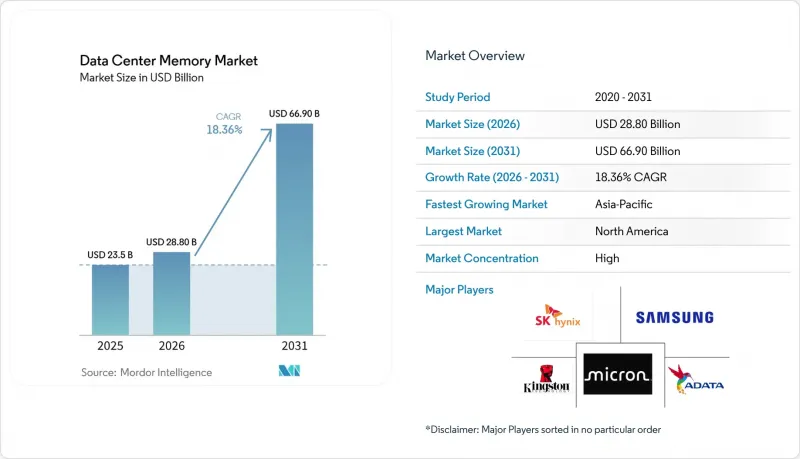
Mordor Intelligence에 의하면, 데이터센터 메모리 시장 규모는 2025년에 235억 달러, 2026년에 288억 달러가 되어, 2031년까지 669억 달러에 이를 것으로 예측되며, 2026년부터 2031년까지 CAGR 18.36%로 성장할 전망입니다.
본 보고서는 메모리 유형(DRAM, 고대역폭 메모리 등), 모듈 및 폼 팩터(RDIMM, LRDIMM, MRDIMM 등), 용량(32 GB 이하, 32 GB-64GB 등), 데이터 전송 속도(5600 MT/s 이하 등), 최종 용도(클라우드 서비스 제공업체, 엔터프라이즈 데이터센터 등), 지역(북미 등)별로 분류되어 있습니다. 시장 전망은 금액(달러) 기준으로 제시되어 있습니다.
전 세계 데이터센터 메모리 시장 동향 및 인사이트
AI 서버의 메모리 밀도 확대가 구조적 수요를 견인
데이터센터 메모리 시장이 확대되고 있는 이유는 AI 시스템에서 가속기 1대당 메모리 용량이나 호스트 서버 1대당 메모리 용량이 증가하고 있을 뿐만 아니라, 훈련 시뿐만 아니라 추론 시에도 지속적인 대역폭이 요구되게 되었기 때문입니다. 메모리는 추론 처리가 중심이 되는 도입 환경에서 병목 현상을 일으키고 있으며, 구매자의 관심은 단순한 용량 수치에서 실제 워크로드 하에서 각 서버가 유지할 수 있는 실용적인 대역폭과 효율성으로 이동하고 있습니다. 공급업체들은 스택 밀도, 입출력 포트 수, 전력 효율 향상을 통해 이에 대응하고 있으며, 이는 제품 로드맵이 짧은 업데이트 주기가 아닌 AI에 의한 구조적인 수요를 바탕으로 수립되고 있음을 보여줍니다. 또한, 삼성이 2026년에 최초의 상용 HBM4를 출하할 예정이라는 점은 성능 향상이 AI 클러스터의 경제성을 뒷받침할 경우 구매자들이 더 신속한 제품 전환을 수용하고 있음을 보여주며, 그 결과 데이터센터 메모리 시장에서 세대 간 전환 기간이 단축되고 있습니다. 모델의 컨텍스트 길이가 증가하고 추론이 지속적인 프로덕션 환경으로 전환됨에 따라 수요의 기준선은 계속해서 상향 조정되고 있습니다. 이것이 바로 데이터센터 메모리 시장이 기존의 부품 시장이라기보다는 전략적인 용량 시장과 같은 움직임을 보이고 있는 이유입니다.
DDR5 전용 서버 CPU로의 전환이 플랫폼 갱신을 가속화
또한, 데이터센터 메모리 시장은 서버 CPU가 DDR5 전용 플랫폼으로 전환되고 있는 점에 힘입어 성장하고 있습니다. 이는 새로운 서버를 구매할 때 모듈 수준만의 업그레이드가 아닌, 시스템 수준의 메모리 업그레이드가 필요하기 때문입니다. 2026년 6월 인텔의 서버 발표에서는 AI 및 네트워킹 워크로드를 위해 고채널 DDR5 서버 메모리 구성을 핵심으로 한 Xeon 6+ 지원이 발표되며, 이러한 방향성이 더욱 강화되었습니다. 이러한 변화는 AI 클러스터에 그치지 않고, 노후화된 DDR4 인프라를 교체하는 기업 고객들이 더 높은 대역폭과 더 높은 기본 용량을 표준으로 하는 플랫폼 세대로 전환함에 따라, 범용 서버 전반에 걸친 데이터센터 메모리 시장의 가치 구성을 높이고 있습니다. JEDEC의 MRDIMM 로드맵은 추가적인 업그레이드 계층을 더해 DDR5의 성능을 향상시키는 동시에, 더욱 정교한 모듈 아키텍처를 통해 동일한 플랫폼 제품군의 상용 수명 주기를 연장합니다. 이로 인해 데이터센터 메모리 시장은 서버의 설비 투자 주기, 마더보드 교체, 전원 공급 장치 변경과 더욱 밀접하게 연계되며, 메모리의 성장은 일회성 모듈 교체가 아닌 인프라 전반의 현대화와 연동된 형태로 이루어지게 됩니다.
HBM의 용량 수요가 기존 DDR5 공급을 제약하여 보급을 제한하고 있습니다.
데이터센터 메모리 시장에서 단기적으로 가장 큰 제약 요인은 HBM으로의 생산 자원 전환입니다. 주요 제조업체들은 전략적 및 재무적 수익성이 더 높은 프리미엄 AI 메모리 제품 라인을 우선시하고 있기 때문입니다. 이들 제조업체는 첨단 DRAM 공급의 핵심을 담당하고 있기도 하므로, HBM 생산으로의 전환이 진행될 때마다 일반 시장을 겨냥한 기존 서버용 DDR5공급이 부족해질 수밖에 없습니다. 고객들의 동향은 이러한 제약이 얼마나 심각해지고 있는지를 보여주고 있으며, 대형 기술 기업들은 일반적인 조달에 그치지 않고 미래의 팹 설비 및 생산 라인에 직접 자금을 지원하기 시작했습니다. 이로 인해 동등한 구매력을 갖추지 못한 엔터프라이즈 데이터센터나 코로케이션 제공업체의 경우, 리드타임이 길어지고 비용 압박이 가중되어 자사의 워크로드 수요가 증가하고 있음에도 불구하고 용량 확충이 지연될 가능성이 있습니다. 그 결과, 데이터센터 메모리 시장은 하이엔드 분야에서 강력하게 확대되는 반면, 보다 광범위한 서버 시장의 일부는 공급 부족과 예산 급등에 계속 노출될 가능성이 있습니다.
부문 분석
2025년, DRAM은 데이터센터 메모리 시장 점유율의 74.87%를 차지하고 있으며, 이러한 주도적 지위는 하이퍼스케일, 엔터프라이즈, 코로케이션, 연구 용도에 걸친 CPU 탑재 서버 메모리에서 수행하는 범용적인 역할에 기인합니다. 이 부문은 DDR5 서버 플랫폼으로의 광범위한 전환의 혜택을 받았습니다. 이는 주요 OEM 업체들의 신형 시스템이 AI와 범용 워크로드를 모두 지원하는 더 높은 대역폭과 더 큰 기본 용량을 표준 사양으로 채택하고 있기 때문입니다. 퍼시스턴트 메모리 및 스토리지 클래스 메모리는 여전히 가장 작은 부문에 머물러 있으며, 그 활용은 주류 DRAM 모듈에 비해 비트당 비용이 높고 인증 절차가 장기간 소요된다는 점으로 인해 제한받고 있습니다. 따라서 특히 프리미엄 가속기급 대역폭보다 예측 가능한 공급량과 폭넓은 플랫폼 지원이 중시되는 환경에서 DRAM은 데이터센터 메모리 시장의 중심적인 위치를 계속 차지하고 있습니다.
고대역폭 메모리(HBM)는 2026년부터 2031년까지 연평균 성장률(CAGR) 18.97%로 확대될 것으로 예측되며, 이러한 부상은 AI 가속기 구매자들이 단순한 용량 비교보다 제공되는 대역폭과 전력 효율을 점점 더 중시하고 있다는 사실을 반영합니다. SK하이닉스는 세계 최초로 HBM4개발을 완료하고 양산 체제를 구축했습니다. 한편, 삼성은 2026년에 HBM4의 상용 출하를 시작했으며, 메모리 스택의 최상위 계층에서 인증 및 출시 주기가 가속화되고 있음이 확인되었습니다. 또한 HBM은 가격과 성능 면에서 독자적인 계층을 형성하고 있으며, 기존 DRAM이 여전히 대규모 서버 도입 기반을 지탱하고 있음에도 불구하고 매출에서 차지하는 중요성은 높아지고 있습니다. 이러한 균형으로 인해 데이터센터 메모리 시장은 규모 면에서는 계속해서 DRAM에 의존하는 한편, AI 가속기 플랫폼에서의 가치 성장 측면에서는 HBM이 압도적인 점유율을 차지하게 될 것입니다.
RDIMM은 2025년에 매출 점유율의 62.39%를 차지하고, 이는 대부분의 엔터프라이즈 및 클라우드 플랫폼에서 기본 서버 메모리 모듈로 자리 잡았음을 반영합니다. 이러한 우위는 성숙한 인증 기반, 폭넓은 OEM 지원, 그리고 DDR5 서버 도입의 첫 번째 대규모 물결과 강력한 호환성 덕분이며, 이를 통해 2025년 내내 데이터센터 메모리 시장의 중심적인 위치를 유지했습니다. LRDIMM은 특정 대용량 시스템에 계속해서 채택되었지만, RDIMM의 밀도가 향상되고 범용 서버 설계가 특수한 형식으로 전환되지 않고도 더 많은 용량을 수용하게 되면서 그 적용 범위는 좁아졌습니다. 새로운 저전력형 및 CXL 연결형을 포함한 기타 서버 메모리 모듈은 시장 규모가 여전히 작음에도 불구하고, 추론에 특화된 시스템 설계가 표준 DIMM의 틀을 넘어 검토되기 시작하면서 그 존재감이 커졌습니다.
MRDIMM은 2026년부터 2031년까지 연평균 성장률(CAGR) 19.18%를 나타낼 것으로 예측되며, 이러한 전망은 DDR5 세대의 서버 성능이 다음 단계로 도약하는 것과 밀접하게 연관되어 있습니다. JEDEC이 2026년 4월에 발표한 MRDIMM 관련 업데이트 정보와 인텔의 'Diamond Rapids' 대응 방침은 이 포맷이 좁은 실험적 틈새 시장에 머무르지 않고 보다 명확한 상용화 도입 주기로 전환되고 있음을 보여줍니다. 양산형 MRDIMM 서버에 대한 학술적 테스트에서도 대폭적인 대역폭 향상과 에너지 절약 효과가 확인되었으며, 플랫폼 전체를 교체할 필요가 아직 없는 경우에도 운영자에게 모듈 수준의 업그레이드를 진행할 근거를 제공합니다. 이를 통해 MRDIMM은 DDR5 인프라의 가치를 확장하는 동시에 메모리 제약이 있는 서버 워크로드에 새로운 성능 수준을 제공할 수 있어, 데이터센터 메모리 시장에서 중요한 위치를 차지하고 있습니다.
지역별 분석
2025년, 북미는 데이터센터 메모리 시장 점유율의 46.28%를 차지했으며, 하이퍼스케일 캠퍼스, 코로케이션 허브 및 엔터프라이즈 인프라가 혼재된 구성을 통해 지역별 매출에서 가장 큰 기여를 했습니다. 미국은 여전히 그 지위의 핵심을 차지하고 있습니다. 이는 Amazon, Microsoft, Google, Meta가 고도의 데이터센터량을 갖춘 매우 고밀도 도입 기반을 지속적으로 뒷받침하고 있으며, 이러한 집중이 직접적으로 대규모 서버 메모리 구매 프로그램으로 이어지고 있기 때문입니다. 계획된 ‘스타게이트’ 관련 미국 인프라 구축의 물결은 장기적인 컴퓨팅 수요에 또 다른 차원을 더할 것이며, 향후 도입 시 서버 대수 증가와 더욱 강화된 메모리 구성을 모두 뒷받침하게 될 것입니다. 또한 마이크론이 미국 내 대규모 확장 계획을 확정하고, 현지 생산 능력에 대한 공공 자금 지원이 이루어짐에 따라 국내 메모리 제조의 전략적 중요성도 커지고 있으며, 이를 통해 지역 내 수요 증가와 공급망의 회복력 간의 연계가 더욱 강화되고 있습니다. 캐나다는 국가 차원의 AI 계획을 통해 지역 전체에 새로운 요소를 더한 반면, 멕시코는 북미 전역으로의 확장 옵션을 모색하는 기업들의 니어쇼어링 관련 관심이 높아짐에 따라 그 역할을 강화했습니다.
아시아태평양은 2026년부터 2031년까지 연평균 성장률(CAGR) 19.28%를 나타낼 것으로 예측되며, 데이터센터 메모리 시장에서 가장 두드러진 성장을 보일 것으로 전망됩니다. 이는 수요 측면의 AI 인프라 구축과 공급 측면의 메모리 투자가 모두 이 지역에 집중되어 있기 때문입니다. 삼성과 SK하이닉스가 첨단 메모리 생산의 핵심을 계속 담당하는 동시에, 미래의 AI 수요를 대비한 투자 프로그램을 확대하고 있어 한국은 이 전망에서 여전히 중심적인 위치를 차지하고 있습니다. 중국은 국가가 뒷받침하는 AI 데이터센터 확장을 통해 독자적인 국내 수요층을 형성하고 있지만, 최상위급 HBM 분야에서의 경쟁력은 한국의 주요 공급업체에 비해 여전히 제한적입니다. 인도, 싱가포르, 태국, 대만도 새로운 수요 거점이나 자본 유입, 혹은 데이터센터 메모리 시장 전체를 뒷받침하는 패키징 및 반도체 생태계에서의 역할을 통해 이 지역의 성장을 견인하고 있습니다.
유럽은 각국 정부의 AI 추진 노력, 전력 효율을 고려한 인프라 설계, 그리고 효율적인 서버 메모리 아키텍처의 단계적 도입을 통해 수요가 형성되고 있으며, 보다 안정적인 성장 패턴을 보이고 있습니다. 소프트뱅크의 프랑스 캠퍼스 프로젝트는 유럽에서 대규모 AI 데이터센터 구축 노력이 향후 메모리 조달에 막대한 영향을 미칠 만큼 중요한 요소가 되고 있음을 보여줍니다. 남미는 여전히 규모는 작지만, 브라질이나 칠레와 같은 주요 경제국이 주도하는 코로케이션 및 클라우드 확장을 통해 지역 시장이 지속적으로 발전하고 있습니다. 중동 및 아프리카는 중요한 수요 촉진제 역할을 하고 있습니다. 사우디아라비아나 UAE 등 국가 주도의 AI 프로그램이 기존의 북미나 동북아시아 핵심 지역 이외의 곳에서 고밀도 메모리 배치를 필요로 하는 새로운 클러스터를 창출하고 있기 때문입니다.
기타 혜택:
- 엑셀 형식 시장 예측(ME) 시트
- 3개월간의 애널리스트 지원
자주 묻는 질문
목차
제1장 서론
제2장 조사 방법
제3장 주요 요약
제4장 시장 구도
제5장 시장 규모와 성장 예측
제6장 경쟁 구도
제7장 시장 기회와 향후 전망
JHS 26.08.05According to Mordor Intelligence, the data center memory market size is projected to be USD 23.50 billion in 2025, USD 28.80 billion in 2026, and reach USD 66.90 billion by 2031, growing at a CAGR of 18.36% from 2026 to 2031.
This report is Segmented by Memory Type (DRAM, High Bandwidth Memory, and More), Module and Form Factor (RDIMM, LRDIMM, MRDIMM, and More), Capacity (Up To 32 GB, 32 GB To 64 GB, and More), Data Rate (Up To 5600 MT/S, and More), End-Use Application (Cloud Service Providers, Enterprise Data Centers, and More), and Geography (North America, and More). The Market Forecasts are Provided in Terms of Value (USD).
Global Data Center Memory Market Trends and Insights
AI Server Memory Density Scaling Drives Structural Demand
The data center memory market is moving higher because AI systems now need more memory per accelerator, more memory per host server, and more sustained bandwidth during inference rather than only during training. Memory has become a limiting factor in inference-heavy deployments, shifting buyer attention away from simple capacity counts toward usable bandwidth and efficiency each server can sustain under live workloads. Suppliers are responding by raising stack density, input and output counts, and power efficiency, indicating that product roadmaps are being built around structural AI demand rather than short replacement cycles. Samsung's first commercial HBM4 shipments in 2026 also indicate that buyers are accepting faster product transitions when the performance gain supports AI cluster economics, thereby shortening the time between one generation and the next in the data center memory market. As model context lengths increase and inference moves into continuous production settings, the demand baseline keeps resetting upward, which is why the data center memory market is behaving more like a strategic capacity market than a traditional component market.
DDR5-Only Server CPU Transition Accelerates Platform Refresh
The data center memory market is also being boosted by the server CPU transition to DDR5-only platforms, as new server purchases now require a system-level memory upgrade rather than a module-level upgrade alone. Intel's June 2026 server announcements reinforced this direction with Xeon 6+ support built around high-channel DDR5 server memory configurations for AI and networking workloads. The shift matters beyond AI clusters because enterprise buyers replacing aging DDR4 infrastructure are moving to a platform generation that standardizes higher bandwidth and higher baseline capacity, which raises the value mix of the data center memory market across general-purpose servers. JEDEC's MRDIMM roadmap adds another upgrade layer, pushing DDR5 performance higher and extending the commercial runway of the same platform family through more advanced module architectures. This makes the data center memory market more closely tied to server capital spending cycles, motherboard refreshes, and power-delivery changes, keeping memory growth linked to full infrastructure modernization rather than isolated module replacement.
HBM Capacity Pull Constraining Conventional DDR5 Supply Limits Broad Access
The strongest near-term restraint in the data center memory market is the capacity pull from HBM, as leading manufacturers prioritize premium AI memory lines that offer stronger strategic and financial returns. The same manufacturers also sit at the core of advanced DRAM supply, so every shift toward HBM production tightens the availability of conventional server DDR5 for the broader market. Customer behavior shows how serious that constraint has become, with large technology buyers moving beyond standard procurement and providing direct funding for future fab equipment and production lines. That raises lead times and cost pressures for enterprise data centers and colocation providers that lack the same purchasing leverage, and it can delay capacity additions even as their own workload demand rises. The result is that the data center memory market can expand strongly at the high end while still leaving parts of the wider server market exposed to tight supply and elevated budgets.
Other drivers and restraints analyzed in the detailed report include:
- CXL-Attached Memory Expansion Unlocks A New Addressable Surface
- Bandwidth-Per-Watt Gains Redefine Purchase Priorities
- EUV Yield And Ramp Challenges Slow Practical Capacity Expansion
For complete list of drivers and restraints, kindly check the Table Of Contents.
Segment Analysis
DRAM held 74.87% of the data center memory market share in 2025, and that leadership came from its universal role in CPU-attached server memory across hyperscale, enterprise, colocation, and research deployments. The category benefited from the broad move toward DDR5 server platforms, because new systems from major OEMs are aligning around higher bandwidth and larger baseline capacities that support both AI and general-purpose workloads. Persistent and storage-class memory remained the smallest segment, with its use limited by higher per-bit costs and longer qualification paths in comparison with mainstream DRAM modules. This kept DRAM at the center of the data center memory market, especially in environments where predictable volume availability and broad platform support mattered more than premium accelerator-tier bandwidth.
High Bandwidth Memory is projected to expand at an 18.97% CAGR from 2026 to 2031, and its rise reflects the fact that AI accelerator buyers increasingly value delivered bandwidth and power efficiency over simple capacity comparisons. SK hynix completed the world-first HBM4 development and positioned the product for mass production, while Samsung began commercial HBM4 shipments in 2026, confirming that the top end of the memory stack is moving toward faster qualification and launch cycles. HBM also sits in a separate pricing and performance tier, which lifts its revenue importance even though conventional DRAM still serves the larger installed server base. That balance means the data center memory market will continue to rely on DRAM for scale, while HBM captures an outsized share of value growth in AI accelerator platforms.
RDIMMs held a 62.39% revenue share in 2025, reflecting their entrenched use as the default server memory module across most enterprise and cloud platforms. Their advantage came from a mature qualification base, wide OEM support, and strong compatibility with the first large wave of DDR5 server deployments, which kept them central to the data center memory market through 2025. LRDIMMs continued to serve selected high-capacity systems, yet their addressable role narrowed as RDIMM densities improved and broader server designs absorbed more capacity without moving into specialized formats. Other server memory modules, including newer low-power and CXL-linked options, remained small but became more visible as inference-focused system designs started to look beyond standard DIMM assumptions.
MRDIMMs are projected to record a 19.18% CAGR from 2026 to 2031, and that outlook is closely tied to the next step in server performance within the DDR5 generation. JEDEC's April 2026 MRDIMM updates and Intel's Diamond Rapids support path show that this format is moving into a clearer commercial adoption cycle rather than staying in a narrow experimental niche. Academic testing on production MRDIMM servers also showed meaningful bandwidth gains and energy savings, providing operators with a case for module-level upgrades where full platform replacement is not yet necessary. This makes MRDIMMs important to the data center memory market because they can extend the value of DDR5 infrastructure while still delivering a new performance tier for memory-bound server workloads.
Complete Report Scope:
- By Memory Type
- DRAM
- High Bandwidth Memory
- Persistent and Storage-Class Memory
- By Module and Form Factor
- Registered DIMM (RDIMM)
- Load-Reduced DIMM (LRDIMM)
- Multiplexed Rank DIMM (MRDIMM)
- Other Server Memory Modules
- By Capacity
- Up to 32 GB
- 32 GB to 64 GB
- 64 GB to 128 GB
- Above 128 GB
- By Data Rate
- Up to 5600 MT/s
- 6400 MT/s
- 7200 MT/s and Above
- By End-Use Application
- Cloud Service Providers
- Enterprise Data Centers
- Colocation Providers
- Government and Research Data Centers
- Edge Data Centers
- By Geography
- North America
- United States
- Canada
- Mexico
- Europe
- Germany
- United Kingdom
- France
- Italy
- Rest of Europe
- Asia-Pacific
- China
- Japan
- South Korea
- Taiwan
- India
- Rest of Asia-Pacific
- South America
- Middle East and Africa
- North America
Geography Analysis
North America held 46.28% of the data center memory market share in 2025, making it the largest regional revenue contributor through its mix of hyperscale campuses, colocation hubs, and enterprise infrastructure. The United States remained the core of that position because Amazon, Microsoft, Google, and Meta continue to anchor a very dense installed base of advanced data center capacity, and that concentration translates directly into large server memory purchasing programs. The planned Stargate-related wave of U.S. infrastructure activity adds another layer of long-term compute demand, which supports both higher server unit counts and richer memory configurations in future deployments. Domestic memory manufacturing also gained strategic weight, with Micron confirming major U.S. expansion plans and public funding support for local capacity, which ties regional demand growth more closely to supply-chain resilience. Canada added to the regional picture through sovereign AI planning, while Mexico's role improved through nearshoring-related interest from operators seeking wider North American deployment options.
Asia-Pacific is projected to grow at a 19.28% CAGR from 2026 to 2031, making it the fastest-growing region in the data center memory market, as demand-side AI buildout and supply-side memory investment are both concentrated there. South Korea remains central to that outlook, since Samsung and SK hynix continue to anchor advanced memory production while also expanding investment programs aimed at future AI demand. China adds a separate domestic demand layer through state-backed AI data center expansion, even though its ability to compete in the highest-end HBM tier remains more limited than that of South Korea's leading suppliers. India, Singapore, Thailand, and Taiwan also strengthen the regional case, because they add new demand locations, capital flows, or packaging and semiconductor ecosystem roles that support the wider data center memory market.
Europe contributes a steadier growth pattern, with demand shaped by sovereign AI commitments, power-aware infrastructure design, and gradual adoption of efficient server memory architectures. SoftBank's France campus project shows that large AI data center commitments are now material enough in Europe to influence future memory procurement at scale. South America remains smaller, but the regional market continues to develop through colocation and cloud expansion led by larger economies such as Brazil and Chile. Middle East and Africa adds an important demand catalyst, because sovereign AI programs in countries such as Saudi Arabia and the UAE are creating new clusters that require dense memory provisioning outside the traditional North American and Northeast Asian core.
- Samsung Electronics Co., Ltd.
- SK hynix Inc.
- Micron Technology, Inc.
- Kingston Technology Company, Inc.
- ADATA Technology Co., Ltd.
- SMART Modular Technologies, Inc.
- Transcend Information, Inc.
- Innodisk Corporation
- Corsair Gaming, Inc.
- G.SKILL International Enterprise Co., Ltd.
- Team Group Inc.
- Apacer Technology Inc.
- Patriot Memory, LLC
- Netlist, Inc.
- Super Micro Computer, Inc.
- Dell Technologies Inc.
- Hewlett Packard Enterprise Company
- Lenovo Group Limited
- NVIDIA Corporation
- Advanced Micro Devices, Inc.
- Intel Corporation
- Marvell Technology, Inc.
- Rambus Inc.
- Astera Labs, Inc.
- JEDEC Solid State Technology Association
Additional Benefits:
- The market estimate (ME) sheet in Excel format
- 3 months of analyst support
TABLE OF CONTENTS
1 INTRODUCTION
- 1.1 Study Assumptions and Market Definition
- 1.2 Scope of the Study
2 RESEARCH METHODOLOGY
3 EXECUTIVE SUMMARY
4 MARKET LANDSCAPE
- 4.1 Market Overview
- 4.2 Market Drivers
- 4.2.1 AI Server Memory Density Scaling
- 4.2.2 DDR5-Only Server CPU Transition
- 4.2.3 CXL-Attached Memory Expansion
- 4.2.4 Bandwidth-Per-Watt Gains For Power-Constrained Data Centers
- 4.2.5 Sovereign AI And Hyperscale Buildout
- 4.2.6 Memory Refresh Cycles Driven By High-Capacity Server Platforms
- 4.3 Market Restraints
- 4.3.1 HBM Capacity Pull Constraining Conventional DDR5 Supply
- 4.3.2 EUV Yield And Ramp Challenges On High-Density Dies
- 4.3.3 Export-Control And China-Localization Bifurcation
- 4.3.4 Qualification Complexity Across Emerging Module Standards
- 4.4 Industry Supply Chain Analysis
- 4.5 Impact of Macroeconomic Factors on the Market
- 4.6 Regulatory Landscape
- 4.7 Technological Outlook
- 4.8 Porter's Five Forces Analysis
- 4.8.1 Bargaining Power of Suppliers
- 4.8.2 Bargaining Power of Buyers
- 4.8.3 Threat of New Entrants
- 4.8.4 Threat of Substitutes
- 4.8.5 Intensity of Competitive Rivalry
5 MARKET SIZE AND GROWTH FORECASTS (VALUE)
- 5.1 By Memory Type
- 5.1.1 DRAM
- 5.1.2 High Bandwidth Memory
- 5.1.3 Persistent and Storage-Class Memory
- 5.2 By Module and Form Factor
- 5.2.1 Registered DIMM (RDIMM)
- 5.2.2 Load-Reduced DIMM (LRDIMM)
- 5.2.3 Multiplexed Rank DIMM (MRDIMM)
- 5.2.4 Other Server Memory Modules
- 5.3 By Capacity
- 5.3.1 Up to 32 GB
- 5.3.2 32 GB to 64 GB
- 5.3.3 64 GB to 128 GB
- 5.3.4 Above 128 GB
- 5.4 By Data Rate
- 5.4.1 Up to 5600 MT/s
- 5.4.2 6400 MT/s
- 5.4.3 7200 MT/s and Above
- 5.5 By End-Use Application
- 5.5.1 Cloud Service Providers
- 5.5.2 Enterprise Data Centers
- 5.5.3 Colocation Providers
- 5.5.4 Government and Research Data Centers
- 5.5.5 Edge Data Centers
- 5.6 By Geography
- 5.6.1 North America
- 5.6.1.1 United States
- 5.6.1.2 Canada
- 5.6.1.3 Mexico
- 5.6.2 Europe
- 5.6.2.1 Germany
- 5.6.2.2 United Kingdom
- 5.6.2.3 France
- 5.6.2.4 Italy
- 5.6.2.5 Rest of Europe
- 5.6.3 Asia-Pacific
- 5.6.3.1 China
- 5.6.3.2 Japan
- 5.6.3.3 South Korea
- 5.6.3.4 Taiwan
- 5.6.3.5 India
- 5.6.3.6 Rest of Asia-Pacific
- 5.6.4 South America
- 5.6.5 Middle East and Africa
- 5.6.1 North America
6 COMPETITIVE LANDSCAPE
- 6.1 Market Concentration
- 6.2 Strategic Moves
- 6.3 Market Share Analysis
- 6.4 Company Profiles (includes Global Level Overview, Market Level Overview, Core Segments, Financials as available, Strategic Information, Products and Services, Recent Developments)
- 6.4.1 Samsung Electronics Co., Ltd.
- 6.4.2 SK hynix Inc.
- 6.4.3 Micron Technology, Inc.
- 6.4.4 Kingston Technology Company, Inc.
- 6.4.5 ADATA Technology Co., Ltd.
- 6.4.6 SMART Modular Technologies, Inc.
- 6.4.7 Transcend Information, Inc.
- 6.4.8 Innodisk Corporation
- 6.4.9 Corsair Gaming, Inc.
- 6.4.10 G.SKILL International Enterprise Co., Ltd.
- 6.4.11 Team Group Inc.
- 6.4.12 Apacer Technology Inc.
- 6.4.13 Patriot Memory, LLC
- 6.4.14 Netlist, Inc.
- 6.4.15 Super Micro Computer, Inc.
- 6.4.16 Dell Technologies Inc.
- 6.4.17 Hewlett Packard Enterprise Company
- 6.4.18 Lenovo Group Limited
- 6.4.19 NVIDIA Corporation
- 6.4.20 Advanced Micro Devices, Inc.
- 6.4.21 Intel Corporation
- 6.4.22 Marvell Technology, Inc.
- 6.4.23 Rambus Inc.
- 6.4.24 Astera Labs, Inc.
- 6.4.25 JEDEC Solid State Technology Association
7 MARKET OPPORTUNITIES AND FUTURE OUTLOOK
- 7.1 White-Space and Unmet-Need Assessment


