

|
시장보고서
상품코드
2099241
터닝 센터 시장 : 점유율 분석, 업계 동향 및 통계, 성장 예측(2026-2031년)Turning Centers - Market Share Analysis, Industry Trends & Statistics, Growth Forecasts (2026 - 2031) |
||||||
 Mordor Intelligence
Mordor Intelligence에 의하면, 터닝 센터 시장 규모는 2025년에 208억 달러, 2026년에 219억 달러가 되고, 2031년까지 284억 달러에 이를 것으로 예측되며, 2026년부터 2031년까지 CAGR 5.34%로 성장할 전망입니다.
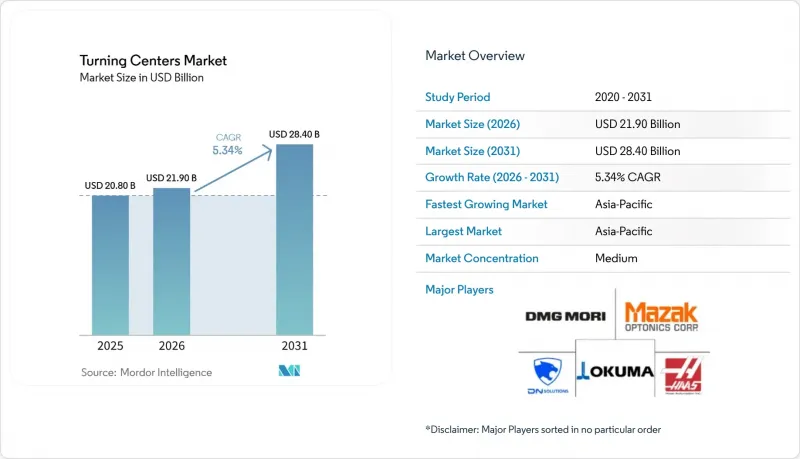
본 보고서는 제품 유형(수평형 터닝 센터, 수직형 터닝 센터 등), 축 구성(3축, 4축 등), 자동화 유형(수동, 반자동 등), 최종 사용 산업(자동차 및 상용차 등), 지역(북미, 남미 등)별로 분류되어 있습니다. 시장 전망은 금액(달러) 및 수량(대)으로 제시되어 있습니다.
세계 터닝 센터 시장 동향 및 인사이트
멀티태스크 터닝 센터로의 전환: 셋업 시간 단축 및 설치 공간 절감
터닝 센터 시장은 단일 생산 흐름 내에서 여러 셋업 공정을 제거하는 기계로의 전환으로 인해 혜택을 보고 있습니다. 각 제조업체는 선삭, 밀링, 드릴링, 보링 및 기타 기계 가공을 단일 플랫폼에서 통합하기 위해 멀티태스크 터닝 센터의 도입을 확대하고 있으며, 이를 통해 공정 연속성이 향상되고 수작업 개입이 감소하고 있습니다. 기존의 가공 방식에서는 서로 다른 기계 간 재클램핑, 재측정 및 공작물 이송으로 인해 여전히 시간 손실이 발생할 뿐만 아니라, 치수 편차 및 위치 정렬 오차의 위험도 높아지고 있습니다. WFL사의 보고에 따르면, 항공우주 분야에 이를 도입함으로써 연속적인 셋업 횟수가 평균 10회 이상에서 3-5회로 감소했으며, 동일한 부품군의 생산성은 200%-300% 향상되었습니다. 이러한 개선은 엄격한 공차와 재현성이 높은 가공 품질이 요구되는 복잡하고 고부가가치 부품에서 특히 중요합니다. 또한, 이러한 전환을 통해 공정 경로에 관여하는 기계 수가 줄어들고, 각 공정 간 대기하는 배치 수가 감소하므로 재공품 재고도 절감됩니다. 이를 통해 공장은 리드 타임을 단축하고 현장 수준의 효율을 향상시킬 수 있습니다. 니덱 타키사와는 기존 기종에 비해 설치 면적을 30% 줄인 콤팩트한 멀티태스크 모델도 도입했습니다. 이는 생산 공간을 확대하지 않고도 높은 생산량을 필요로 하는 공간 제약이 있는 공장의 터닝 센터 시장을 지원하기 위한 것입니다.
미국, 멕시코, 인도에서의 투자를 주도하는 ‘리쇼어링’과 ‘프렌드쇼어링’의 동향
터닝 센터 시장은 정밀 가공을 최종 수요지 근처로 이동시키는 생산 프로그램에 의해서도 뒷받침되고 있습니다. '리쇼어링 이니셔티브' 보고서에 따르면, 2024년에는 리쇼어링 및 외국인 직접 투자를 통해 미국에서 24만 4,000건의 제조업 일자리가 발표되었으며, 이는 생산 거점 결정이 새로운 설비 수요를 창출하고 있음을 보여줍니다. 이는 국내 신규 공장이나 공급업체의 확장 과정에서 신속하게 설치할 수 있고, 세팅 횟수를 줄여 가동할 수 있는 가공 능력이 요구되기 때문에 중요한 의미를 지닙니다. 인도에서는 ‘생산 연계 인센티브(PLI)’ 제도를 통해 2026년 3월까지 14개 부문에서 누적 2.4락 크롤(267억 달러)의 투자가 유치되었으며, 자동차 및 자동차 부품 프로그램만으로도 44,326 카롤 루피(49억 달러)를 유치했으며, 이는 정밀 가공 설비 수요를 직접 뒷받침하고 있습니다. 또한, AMT의 2025년 조사에 따르면, 추가적인 리쇼어링 과정에서 인력 확보가 여전히 핵심 과제로 드러났으며, 이는 터닝 센터 시장에서 자동화 셀 도입을 촉진하는 요인이 되고 있습니다.
높은 단가와 ROI 회수까지의 장기화가 중소기업의 도입을 저해
터닝 센터 시장은 여전히 구조적인 제약에 직면해 있습니다. 소규모 수탁 가공 업체의 경우 막대한 초기 설비 비용을 감당할 수 없습니다. 완전한 사양의 다축 공작기계는 기계 본체만 해도 25만-80만 달러가 들 수 있습니다. 동시에 자동화, 공구, 공작물 고정 장치, 소프트웨어를 완비한 생산 셀의 총 비용은 100만 달러를 초과하기도 합니다. 표준적인 1교대 가동을 전제로 할 경우, 투자 회수 기간은 대개 3-5년이 되지만, 이는 많은 중소 제조업체가 채택하고 있는 자본 계획 기간보다 긴 것입니다. 이 때문에 터닝 센터 시장의 교체 수요는 둔화되고 있습니다. 생산성 향상이 가장 두드러지는 곳은 이미 수주 전망이 서 있고, 설비 가동률이 높으며, 사내 프로그래밍 역량도 뛰어난 기업에 집중되어 있기 때문입니다. 동남아시아와 남미에서는 자금 조달 비용이 여전히 높고 지원책도 충분히 마련되어 있지 않아, 이러한 격차는 더욱 벌어지고 있습니다.
부문 분석
2025년 시점에서 수평형 터닝 센터는 시장의 48.5%를 차지하며, 터닝 센터 시장에서 가장 큰 제품 카테고리가 되고 있습니다. 이러한 확고한 위상은 대량의 회전 부품을 가공하는 자동차, 일반 산업 및 수탁 가공 분야에서 오랫동안 사용되어 온 데 기인합니다. 공작물의 고정 방식이 간편하고, 칩의 흐름도 충분히 파악되며, 유지보수 방법 또한 광범위한 도입 기반에서 친숙한 방식입니다. 이러한 요인들로 인해 공정 통합보다는 처리량, 표준화 및 단위 비용이 중시되는 경우, 수평형 시스템이 기본 선택지로 계속해서 채택되고 있습니다.
한편, 수직형 선반은 대구경·중량급·원반형 공작물에 적합하기 때문에 선반 시장에서 다양한 공작물 형상에 대응하고 있습니다. 이러한 특징 덕분에 중력을 이용한 로딩이 운영상의 이점이 되는 에너지, 풍력 발전, 대형 산업기계 등의 분야에서 활용이 확대되고 있습니다. 반면, 멀티태스크 터닝 센터는 가장 빠르게 성장하고 있는 제품 유형으로, 2031년까지 연평균 성장률(CAGR) 7.2%로 확대될 것으로 예측됩니다. WFL의 조사에 따르면, 세팅 시간 단축과 공정 통합을 통해 생산성을 대폭 향상시킬 수 있는 것으로 나타났으며, 이것이 멀티태스크 플랫폼이 터닝 센터 시장에서 점유율을 확대하고 있는 이유입니다.
2025년에는 3축 터닝 센터가 시장의 52%를 차지하고 있어, 터닝 센터 시장이 여전히 기존의 선삭, 평삭, 중공 가공에 크게 의존하고 있음을 여실히 보여주고 있습니다. 이러한 도입 기반은 일반적인 산업 생산 전반과 부품 형상이 비교적 단순한 자동차 부품의 대량 생산에서 여전히 중요한 역할을 하고 있습니다. 4축 가공기는 라이브 툴링 및 C축 기능을 통해 가공 능력을 확대하고, 중심에서 벗어난 형상을 가진 부품에 대한 두 번째 세팅의 필요성을 줄여줍니다. 따라서 기본적인 터닝 센터와 보다 고도화된 밀-터닝 플랫폼 사이를 실용적인 가교 역할로 기능하고 있습니다.
터닝 센터 시장에서 가장 급속한 확장을 보이고 있는 것은 5축 이상의 시스템으로, 2031년까지 연평균 성장률(CAGR) 8.1%를 나타낼 것으로 예측됩니다. 이러한 기계가 인기를 끌고 있는 이유는 항공우주, 전기차(EV), 석유 및 가스 관련 부품에서 B축 이동, 윤곽 가공의 유연성, 그리고 동기화된 동작이 빈번하게 요구되기 때문이며, 이는 더 단순한 구성의 기계로는 실현할 수 없기 때문입니다. 모놀리식 브리스크 가공에 관한 MDPI의 동료 심사 연구에 따르면, 5축 동시 윤곽 가공은 3축의 다중 셋업 방식에 비해 스택업 오차를 72% 감소시키는 것으로 밝혀졌습니다. 고부가가치 프로그램의 인증 요건이 엄격해짐에 따라, 터닝 센터 시장의 구매자들은 기계 성능에 대해 타협할 여지가 점점 줄어들고 있습니다.
지역별 분석
아시아태평양은 2025년 터닝 센터 시장 점유율의 58.2%를 차지하며, 2031년까지 연평균 성장률(CAGR)이 5.9%를 나타낼 것으로 예측되는 가장 빠르게 성장하는 지역 부문이기도 합니다. 중국은 자동차, 전자, 일반 산업 생산 분야의 규모가 크기 때문에 해당 지역 내에서도 가장 큰 기여를 하는 국가로 자리매김하고 있습니다. 또한, 일본은 공작기계 제조의 탄탄한 기반과 수출 역량을 바탕으로 터닝 센터 시장에서 여전히 중심적인 역할을 수행하고 있습니다. JMTBA 보고서에 따르면, 2025년 일본의 공작기계 수주 총액은 1조 6,043억 2,000만 엔(103억 달러)에 달했으며, 해외 수주는 11.5% 증가했습니다. 인도 역시 제조업에 대한 우대 조치가 새로운 정밀 가공 능력의 확대로 이어지고 있어, 수요 증가의 중요한 원천이 되고 있습니다.
북미는 아시아태평양 이외에서 터닝 센터 시장의 가장 뚜렷한 성장 동력이 되고 있습니다. 미국의 금속 가공 기계 수주액은 2025년에 57억 4,000만 달러에 달했으며, 2026년 1분기 수주액은 16억 1,000만 달러를 기록하여 자본재에 대한 지출이 계속해서 가속화되고 있음을 보여줍니다. 이 지역의 항공우주 업계 구매자들도 2025년 기계 설비 지출을 2024년 대비 45.1% 끌어올렸습니다. 이는 첨단 5축 가공 시스템 및 선반·밀링 복합 시스템에 대한 수요 증가와 일치합니다. 멕시코는 공급업체들이 자동차 조립 공장 근처에 선반 생산 능력을 배치하거나 국경을 넘는 생산 프로그램에 참여하고 있어 계속해서 혜택을 보고 있습니다.
유럽은 독일, 이탈리아, 스위스에 정밀 공작기계 집적지가 밀집해 있어 터닝 센터 시장에서 여전히 중요한 위치를 차지하고 있습니다. DMG MORI사는 2025년 수주액이 23억 4,020만 유로(27억 5,280만 달러)에 달했으며, 해외 수주가 10% 증가했다고 보고했는데, 이는 납품상의 어려움이 있었음에도 불구하고 고급 장비에 대한 수요가 견조하게 유지되었음을 보여줍니다. 중동 및 아프리카은 여전히 비교적 소규모 수요 기반을 가지고 있지만, 석유 및 가스 관련 서비스, 방위 산업, 하류 가공 분야에서 새로운 설비 도입 기회가 생겨나고 있습니다. 남미는 브라질과 광업 관련 유지보수 활동이 중심을 이루고 있으나, 자금 조달 제약으로 인해 터닝 센터 시장의 광범위한 보급은 여전히 주춤한 상태입니다.
기타 혜택:
- 엑셀 형식 시장 예측(ME) 시트
- 3개월간의 애널리스트 지원
자주 묻는 질문
목차
제1장 서론
제2장 조사 방법
제3장 주요 요약
제4장 시장 구도
제5장 시장 규모와 성장 예측
제6장 경쟁 구도
제7장 시장 기회와 향후 전망
JHS 26.08.07According to Mordor Intelligence, the turning centers market size is projected to be USD 20.80 billion in 2025, USD 21.90 billion in 2026, and reach USD 28.40 billion by 2031, growing at a CAGR of 5.34% from 2026 to 2031.
This report is Segmented by Product Type (Horizontal Turning Centers, Vertical Turning Centers, and More), by Axis Configuration (3-Axis, 4-Axis, and More), by Automation Type (Manual, Semi-Automatic, and More), by End-User Industry (Automotive and Commercial Vehicles, and More), and by Geography (North America, South America, and More). The Market Forecasts are Provided in Terms of Value (USD) and Volume (Units).
Global Turning Centers Market Trends and Insights
Shift to Multi-Tasking Turning Centers: Reduced Setup Times and Floor Space
The turning centers market benefits from the shift toward machines that eliminate multiple setup steps within a single production flow. Manufacturers are increasingly adopting multitasking turning centers to combine turning, milling, drilling, boring, and other machining operations on a single platform, thereby improving process continuity and reducing manual intervention. Conventional processing still causes time losses due to re-clamping, re-indicating, and part transfers between separate machines, while also increasing the risk of dimensional variation and alignment errors. WFL reported that aerospace deployments reduced the number of sequential setups from more than 10 to 3-5 on average, while productivity for the same part families improved by 200%-300%. This improvement is particularly relevant for complex, high-value components that require tight tolerances and repeatable machining quality. This shift also reduces work-in-process inventory, as fewer machines are involved in the route and fewer batches wait between steps, allowing plants to shorten lead times and improve floor-level efficiency. Nidec Takisawa also introduced a compact multitasking model with a 30% smaller footprint than conventional alternatives, supporting the turning centers market in space-constrained plants where manufacturers need higher output without expanding production space.
Reshoring and Friendshoring Trends Driving Investments in the United States, Mexico, and India
The turning centers market is also being supported by production programs that move precision machining closer to end-use demand. The Reshoring Initiative reported 244,000 United States manufacturing jobs announced in 2024 through reshoring and foreign direct investment, showing that production location decisions are feeding new equipment demand. This matters because new domestic plants and supplier expansions need machining capacity that can be installed quickly and run with fewer setups. In India, the Production Linked Incentive scheme had attracted INR 2.4 lakh crore (USD 26.7 billion) in cumulative investment across 14 sectors by March 2026, and the automobile and auto-components program alone drew INR 44,326 crore (USD 4.9 billion), which directly supports demand for precision-machining equipment. AMT also found in its 2025 survey that workforce availability remained central to further reshoring, which strengthens the case for more automated cells in the turning centers market.
High Unit Price and Long ROI Horizon Limiting SME Adoption
The turning centers market still faces a structural limit: smaller contract shops cannot absorb the large upfront equipment costs. A fully configured multi-axis machine can cost USD 250,000 to USD 800,000 at the machine level. At the same time, a fully equipped production cell with automation, tooling, workholding, and software can cost more than USD 1 million. Under standard single-shift assumptions, the payback period is often 3 to 5 years, which is longer than the capital planning horizon used by many small and medium-sized manufacturers. This slows replacement demand in the turning centers market because the largest productivity gains are concentrated in companies that already have stronger order visibility, better utilization, and in-house programming depth. The gap is wider in Southeast Asia and South America, where financing costs remain higher, and incentive support is less developed.
Other drivers and restraints analyzed in the detailed report include:
- EV Powertrain Complexity Driving Y-Axis and B-Axis Turning Center Adoption for Motor Shaft and Housing Families
- Aerospace Single-Piece-Flow Requirements Driving 5-Axis Turn-Mill Adoption
- Export Controls Restricting Access to Advanced 5-Axis Turning Center Technology
For complete list of drivers and restraints, kindly check the Table Of Contents.
Segment Analysis
Horizontal turning centers held 48.5% of the market in 2025, making them the largest product category in the turning centers market. Their strong position stems from long-standing use in automotive, general industrial, and contract-machining lines that process large volumes of rotational parts. Workholding remains simple, chip flow is well understood, and maintenance practices are familiar to a wide installed base. Those factors keep horizontal systems as the default choice when throughput, standardization, and unit cost matter more than process consolidation.
Vertical turning centers serve a different part profile in the turning centers market because they are better suited to large-diameter, heavy, and disc-shaped workpieces. That fit has supported use in energy, wind power, and large industrial machinery applications where gravity-assisted loading is an operational advantage. Multi-tasking turning centers, however, are the fastest-growing product type and are projected to rise at a 7.2% CAGR through 2031. WFL showed that setup reduction and process consolidation can produce major productivity gains, which explains why multi-tasking platforms are taking share in the turning centers market.
3-axis turning centers accounted for 52% of the market in 2025, underscoring that the turning centers market still relies heavily on conventional turning, facing, and boring work. This installed base remains important across general industrial output and in large volumes of automotive parts, where part geometry remains relatively straightforward. The 4-axis machines broaden capability through live tooling or C-axis functionality, reducing the need for a second setup on parts with off-center features. That makes them a practical bridge between basic lathes and more advanced mill-turn platforms.
The fastest expansion in the turning centers market is occurring in 5-axis and above systems, which are forecast to grow at a 8.1% CAGR through 2031. These machines are gaining popularity because aerospace, EV, and oil and gas parts often require B-axis motion, contouring flexibility, and synchronized operations that simpler layouts cannot match. A peer-reviewed MDPI study on monolithic blisk machining found that 5-axis simultaneous contouring reduced stack-up errors by 72% compared with 3-axis multi-setup methods. As qualification requirements become stricter in high-value programs, buyers in the turning centers market have less room to compromise on machine capability.
Complete Report Scope:
- By Product Type
- Horizontal Turning Centers
- Vertical Turning Centers
- Multi-Tasking Turning Centers
- Others
- By Axis Configuration
- 3-Axis
- 4-Axis
- 5-Axis and Above
- By Automation Type
- Manual
- Semi-Automatic
- Fully Automatic CNC
- By End-User Industry
- Automotive and Commercial Vehicles
- Aerospace & Defense
- Medical Devices and Surgical Instruments
- Oil, Gas, and Energy
- Electrical, Electronics and Semiconductor Equipment
- General Industrial Machinery
- Others
- By Geography
- North America
- United States
- Canada
- Mexico
- South America
- Brazil
- Argentina
- Chile
- Peru
- Rest of South America
- Europe
- Germany
- United Kingdom
- France
- Italy
- Spain
- Benelux (Belgium, Netherlands, and Luxembourg)
- NORDICS (Denmark, Finland, Iceland, Norway, and Sweden)
- Rest of Europe
- Asia-Pacific
- China
- India
- Japan
- South Korea
- Australia
- Southeast Asia (Indonesia, Vietnam, Thailand, Malaysia, Philippines)
- Rest of Asia-Pacific
- Middle East & Africa
- United Arab Emirates
- Saudi Arabia
- South Africa
- Nigeria
- Rest of Middle East & Africa
- North America
Geography Analysis
Asia-Pacific held 58.2% of the turning centers market share in 2025 and is also the fastest-growing regional segment with a projected 5.9% CAGR through 2031. China remains the largest contributor within the regional base due to its scale in automotive, electronics, and general industrial production. Japan also remains central to the turning centers market through its depth in machine tool manufacturing and export strength. JMTBA reported total Japanese machine tool orders of JPY 1,604.32 billion (USD 10.3 billion) in 2025, with foreign orders increasing by 11.5%. India is also becoming a stronger source of incremental demand as manufacturing incentives translate into new precision machining capacity.
North America is the clearest growth engine outside Asia-Pacific in the turning centers market. United States metalworking machinery orders reached USD 5.74 billion in 2025, and Q1 2026 orders stood at USD 1.61 billion, indicating continued acceleration in capital equipment spending. Aerospace buyers in the region also lifted machinery spending by 45.1% in 2025 versus 2024, which aligns with expanding demand for advanced 5-axis and turn-mill systems. Mexico continues to benefit as suppliers place turning capacity near vehicle assembly and in cross-border production programs.
Europe remains important to the turning centers market because Germany, Italy, and Switzerland hold a dense base of precision machine tool capability. DMG MORI reported 2025 order intake of EUR 2,340.2 million (USD 2,752.8 million), with international orders up 10%, which shows that premium equipment demand remained resilient despite delivery friction. The Middle East & Africa remains a relatively small demand base, but oil and gas services, defense manufacturing, and downstream processing are creating new installed-base opportunities. South America remains anchored by Brazil and mining-related maintenance activity, although financing limits continue to slow broader adoption in the turning centers market.
- DMG MORI
- Mazak Corporation
- Okuma Corporation
- DN Solutions
- Haas Automation
- INDEX-Werke GmbH
- Hyundai WIA Corporation
- Murata Machinery
- Hwacheon Machinery Co., Ltd.
- Goodway Machine Corporation
- Shenyang Machine Tool Co., Ltd.
- Victor Taichung Machinery
- Nakamura-Tome Precision Industry Co., Ltd
- Hanwha Semitech
- Spinner AG
- WFL Millturn Technologies GmbH & Co. KG
- EMAG GmbH & Co. KG
- Tsugami Corporation
- Biglia S.p.A.
- CMZ Machine Tool Manufacturer
Additional Benefits:
- The market estimate (ME) sheet in Excel format
- 3 months of analyst support
TABLE OF CONTENTS
1 Introduction
- 1.1 Study Assumptions & Market Definition
- 1.2 Scope of the Study
2 Research Methodology
3 Executive Summary
4 Market Landscape
- 4.1 Market Overview
- 4.2 Market Drivers
- 4.2.1 Shift to Multi-Tasking Turning Centers: Reduced Setup Times and Floor Space
- 4.2.2 Reshoring and Friendshoring Trends Driving Investments in the United States, Mexico, and India
- 4.2.3 EV Powertrain Complexity Driving Y-Axis and B-Axis Turning Center Adoption for Motor Shaft and Housing Families
- 4.2.4 Aerospace Single-Piece-Flow Requirements Driving 5-Axis Turn-Mill Adoption
- 4.2.5 Growing Complexity of Oil and Gas Valve and Wellhead Components Requiring Multi-Axis Turning Centers
- 4.2.6 Labor Cost Pressures in North America and Europe Driving Lights-Out Turning Center Cell Investments
- 4.3 Market Restraints
- 4.3.1 High Unit Price and Long ROI Horizon Limiting SME Adoption
- 4.3.2 Export Controls Restricting Access to Advanced 5-Axis Turning Center Technology
- 4.3.3 Programming Complexity in Multi-Axis Turning Centers
- 4.3.4 Toolholder and Fixturing Ecosystem Fragmentation (BMT, VDI, Capto)
- 4.4 Value / Supply-Chain Analysis
- 4.4.1 Raw Material & Critical Component Ecosystem
- 4.4.2 Manufacturing & Assembly Value Chain
- 4.4.3 Distribution & Go-to-Market Channels
- 4.4.4 Aftermarket Services & Lifecycle Support
- 4.5 Regulatory Landscape
- 4.6 Technological Outlook & Innovation Investment Landscape
- 4.6.1 AI-Driven Adaptive Control and Chatter Suppression
- 4.6.2 High-Speed Spindle and HSK-T Interface Evolution
- 4.7 Pricing Analysis
- 4.7.1 Average Selling Price (ASP) Benchmarking of Key Market Participants
- 4.7.2 Average Selling Price (ASP) Analysis, by Product Type
- 4.7.3 Average Selling Price (ASP) Analysis, by Axis Configuration
- 4.7.4 Average Selling Price (ASP) Analysis, by Automation
- 4.8 Buying Criteria & Procurement Analysis
- 4.9 Porter's Five Forces Analysis - Industry Attractiveness Scoring
- 4.9.1 Threat of New Entrants
- 4.9.2 Bargaining Power of Suppliers
- 4.9.3 Bargaining Power of Buyers
- 4.9.4 Threat of Substitutes
- 4.9.5 Industry Rivalry
- 4.10 Impact of Geopolitical Events on the Market
5 Market Size & Growth Forecasts
- 5.1 By Product Type
- 5.1.1 Horizontal Turning Centers
- 5.1.2 Vertical Turning Centers
- 5.1.3 Multi-Tasking Turning Centers
- 5.1.4 Others
- 5.2 By Axis Configuration
- 5.2.1 3-Axis
- 5.2.2 4-Axis
- 5.2.3 5-Axis and Above
- 5.3 By Automation Type
- 5.3.1 Manual
- 5.3.2 Semi-Automatic
- 5.3.3 Fully Automatic CNC
- 5.4 By End-User Industry
- 5.4.1 Automotive and Commercial Vehicles
- 5.4.2 Aerospace & Defense
- 5.4.3 Medical Devices and Surgical Instruments
- 5.4.4 Oil, Gas, and Energy
- 5.4.5 Electrical, Electronics and Semiconductor Equipment
- 5.4.6 General Industrial Machinery
- 5.4.7 Others
- 5.5 By Geography
- 5.5.1 North America
- 5.5.1.1 United States
- 5.5.1.2 Canada
- 5.5.1.3 Mexico
- 5.5.2 South America
- 5.5.2.1 Brazil
- 5.5.2.2 Argentina
- 5.5.2.3 Chile
- 5.5.2.4 Peru
- 5.5.2.5 Rest of South America
- 5.5.3 Europe
- 5.5.3.1 Germany
- 5.5.3.2 United Kingdom
- 5.5.3.3 France
- 5.5.3.4 Italy
- 5.5.3.5 Spain
- 5.5.3.6 Benelux (Belgium, Netherlands, and Luxembourg)
- 5.5.3.7 NORDICS (Denmark, Finland, Iceland, Norway, and Sweden)
- 5.5.3.8 Rest of Europe
- 5.5.4 Asia-Pacific
- 5.5.4.1 China
- 5.5.4.2 India
- 5.5.4.3 Japan
- 5.5.4.4 South Korea
- 5.5.4.5 Australia
- 5.5.4.6 Southeast Asia (Indonesia, Vietnam, Thailand, Malaysia, Philippines)
- 5.5.4.7 Rest of Asia-Pacific
- 5.5.5 Middle East & Africa
- 5.5.5.1 United Arab Emirates
- 5.5.5.2 Saudi Arabia
- 5.5.5.3 South Africa
- 5.5.5.4 Nigeria
- 5.5.5.5 Rest of Middle East & Africa
- 5.5.1 North America
6 Competitive Landscape
- 6.1 Market Concentration
- 6.2 Strategic Moves
- 6.3 Market Share Analysis
- 6.4 Competitive Benchmarking Analysis
- 6.5 Company Profiles (Includes Global Level Overview, Market Level Overview, Core Segments, Financials as Available, Strategic Information, Products & Services, and Recent Developments)
- 6.5.1 DMG MORI
- 6.5.2 Mazak Corporation
- 6.5.3 Okuma Corporation
- 6.5.4 DN Solutions
- 6.5.5 Haas Automation
- 6.5.6 INDEX-Werke GmbH
- 6.5.7 Hyundai WIA Corporation
- 6.5.8 Murata Machinery
- 6.5.9 Hwacheon Machinery Co., Ltd.
- 6.5.10 Goodway Machine Corporation
- 6.5.11 Shenyang Machine Tool Co., Ltd.
- 6.5.12 Victor Taichung Machinery
- 6.5.13 Nakamura-Tome Precision Industry Co., Ltd
- 6.5.14 Hanwha Semitech
- 6.5.15 Spinner AG
- 6.5.16 WFL Millturn Technologies GmbH & Co. KG
- 6.5.17 EMAG GmbH & Co. KG
- 6.5.18 Tsugami Corporation
- 6.5.19 Biglia S.p.A.
- 6.5.20 CMZ Machine Tool Manufacturer
7 Market Opportunities & Future Outlook
- 7.1 White-Space & Unmet-Need Assessment
- 7.2 Emerging Growth Hotspots for Turning Centers


