|
시장보고서
상품코드
2099257
GPU 렌탈 시장 : 점유율 분석, 업계 동향 및 통계, 성장 예측(2026-2031년)GPU Rental - Market Share Analysis, Industry Trends & Statistics, Growth Forecasts (2026 - 2031) |
||||||
 Mordor Intelligence
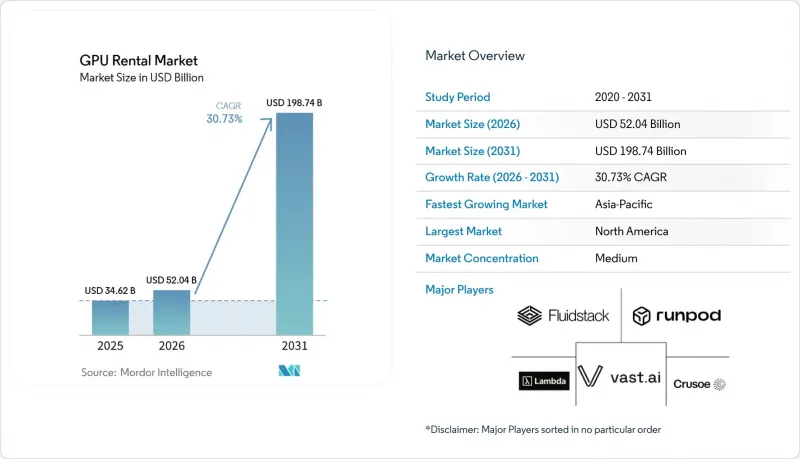
Mordor Intelligence에 의하면, GPU 렌탈 시장 규모는 2025년 346억 2,000만 달러에서 2026년에는 520억 4,000만 달러로 확대되어 2031년까지 1,987억 4,000만 달러에 이를 것으로 예상되고 있어 2026년부터 2031년까지 CAGR 30.73%로 성장할 전망입니다.
본 보고서는 도입 형태(공유형 퍼블릭 GPU 클라우드 등), 서비스 모델(GPU 인프라스트럭처-어-서비스 등), 용도(고성능 컴퓨팅 및 과학 계산 등), 기업 규모(스타트업 및 중소기업 등), 최종 사용자(헬스케어 및 생명과학, BFSI 등), 지역별로 분류되어 있습니다. 시장 전망은 금액(달러) 기준으로 제시되어 있습니다.
전 세계 GPU 렌탈 시장 동향 및 인사이트
생성형 AI 및 LLM 훈련 수요 증가
생성형 AI가 시범 단계에서 더 많은 팀과 제품의 일반 생산 환경으로 전환됨에 따라, GPU 렌탈 시장의 기반 수요가 더욱 강화되고 있습니다. RunPod는 2026년 6월, 자사 플랫폼을 이용하는 개발자 수가 100만 명에 달했다고 발표했으며, 이는 렌탈 GPU에 접근하는 컴퓨팅 사용자 기반이 얼마나 광범위해졌는지를 보여줍니다. KDDI는 2026년 4월 NVIDIA GB200 NVL72 시스템에 대한 온디맨드 액세스를 시작했으며, 소프트뱅크도 2026년 3월 NVIDIA GB200 NVL72의 베타 버전 렌탈 서비스를 추가했습니다. 이는 각 제공업체들이 현재의 AI 개발 수요에 맞추어 새로운 용량을 확충하고 있음을 보여줍니다. 또한 NVIDIA는 2026년 3월 Nebius에 20억 달러를 투자했으며, 이 제휴를 통해 2030년까지 5GW 이상의 NVIDIA 컴퓨팅 리소스를 제공하겠다고 약속했습니다. 이는 하류 인프라 수요가 지속될 것이라는 자신감을 보여줍니다. 이러한 동향이 중요한 이유는 추론, 미세 조정, 모델 배포의 모든 과정에서 일시적인 집중 수요가 아닌 지속적인 접근이 필요할 때, GPU 임대 시장이 혜택을 볼 수 있기 때문입니다. 따라서 조기에 공급 관계를 확보한 제공업체는 생성형 AI의 채택이 더욱 확대되는 가운데 가동률을 유지하는 데 있어 더 유리한 입장에 있습니다.
설비 투자(CapEx)에서 종량제 GPU 액세스로의 전환
GPU 임대 시장은 막대한 초기 하드웨어 투자 없이 컴퓨팅 리소스를 이용하고자 하는 사용자들로부터 계속해서 혜택을 받고 있습니다. KDDI는 자사의 GPU 클라우드가 초기 투자 없이 시작되었다고 밝혔으며, 이는 많은 워크로드에서 자사 소유 인프라보다 온디맨드 접근이 더 적합하다는 주장을 직접 뒷받침하는 것입니다. 이 모델은 출시 후 트래픽, 모델 크기, 상용화 시기가 급격히 변할 가능성이 있는 프로젝트에 적합합니다. 또한 사용자에게는 자사 자산을 완전히 활용하거나 폐기될 때까지 기다릴 필요 없이 새로운 시스템으로 전환할 수 있는 실용적인 수단이 됩니다. RunPod가 개발자 수 100만 명이라는 이정표를 달성한 것은 GPU 렌탈 시장의 상당 부분을 고정적인 조달 주기보다 유연한 접근 방식을 선호하는 팀들이 차지하고 있음을 뒷받침합니다. 대기업이 나중에 전용 환경을 구축하더라도, 테스트, 수요 급증, 새로운 용도 배포와 같은 상황에서는 렌탈이 운영 모델의 일부로 남아 있는 경우가 많습니다.
HBM 및 첨단 패키징 공급 제약
GPU 렌탈 시장은 여전히 최신 시스템이 서비스에 도입되는 속도에 의존하고 있습니다. KDDI는 2026년 4월에 NVIDIA GB200 NVL72 제공을 시작했으며, 소프트뱅크는 2026년 3월에 GB200 NVL72 베타 버전 렌탈을 추가했습니다. 또한 Nebius는 향후 컴퓨팅 플랫폼에 대해 NVIDIA와 다년간의 확장 계획을 수립하고 있으며, 이는 시장 성장이 하드웨어의 적시 공급과 밀접하게 연결되어 있음을 보여줍니다. 여러 사업자가 동시에 동세대 시스템을 목표로 할 경우, 조달 능력이 경쟁상의 차별화 요인이 됩니다. 이에 따라 공급업체와의 유대가 깊고, 자금력이 탄탄하거나, 조기 예약 물량을 확보한 제공업체가 유리한 경향을 보입니다. 소규모 플랫폼이라도 경쟁은 가능하지만, 현행 하드웨어에 대한 접근이 어려워지면 확장 속도는 둔화될 가능성이 있습니다. GPU 렌탈 시장에서 이는 수요를 멈추게 하지는 않겠지만, 용량 확충을 지연시키고 최대 규모 제공업체와 기타 사업자 간의 격차를 확대하는 요인이 될 수 있습니다.
부문 분석
2025년, 공유형 퍼블릭 GPU 클라우드는 GPU 렌탈 시장 점유율의 48.13%를 차지하며, 광범위한 도달 범위, 풀링된 용량, 그리고 버스트 수요에 대한 대응 용이성 덕분에 가장 큰 도입 형태가 되었습니다. 프라이빗 또는 소버린 호스팅형 GPU 클라우드는 2031년까지 연평균 성장률(CAGR) 31.58%로 확대될 것으로 예상되며, 이는 전용 리소스와 데이터 위치에 대한 보다 엄격한 관리를 요구하는 구매자들 수요 증가를 반영합니다. GPU 임대 시장에서 공유 환경은 여전히 표준으로 자리 잡고 있습니다. 이는 인프라를 많은 사용자에게 분산시켜 내부 용량 계획의 부담을 줄이기 위함입니다. 이러한 이점은 신속한 프로비저닝과 모델 테스트 및 배포 과정에서 이용 규모를 유연하게 확장·축소할 수 있어야 하는 개발 팀에게 여전히 중요합니다.
그러나 소버린 모델이나 프라이빗 모델의 운영이 더욱 현실화됨에 따라 성장 양상은 변화하고 있습니다. 2026년, Canonical에 따르면 NVIDIA는 GPU DRA 드라이버를 CNCF에 기증했습니다. 이를 통해 프라이빗 쿠버네티스 클러스터에서 더욱 표준화된 GPU 스케줄링 및 할당 기법을 활용할 수 있게 되었습니다. 또한, IBM Research도 멀티테넌트형 클라우드 서비스를 위한 투명하고 탄력적인 프로비저닝에 대한 연구를 지속하고 있으며, 운영 효율성을 지나치게 희생하지 않으면서 전용 환경을 보다 효과적으로 활용할 수 있도록 지원하고 있습니다. 일본에서 KDDI의 서비스 개시나 독일에서 도이체 텔레콤의 산업용 AI 클라우드는 국내 통신 사업자들이 현지 기업 및 공공 부문의 요구 사항에 맞추어 관리형 GPU 환경을 구축하고 있음을 보여줍니다. 이는 GPU 임대 시장이 더 이상 퍼블릭 클라우드의 규모만으로 정의되는 것이 아니라, 현지에서 설명 책임을 다하면서 관리형 액세스를 제공할 수 있는 사업자들이 시장을 형성하고 있음을 의미합니다.
2025년에는 GPU 인프라스트럭처-어즈-어-서비스(IaaS)가 서비스 모델 수익의 58.32%를 차지하고, 많은 엔지니어링 팀에게 컴퓨팅 리소스에 대한 직접 접근이 여전히 선호되는 선택지임을 보여주었습니다. 서버리스 및 컨테이너형 GPU 서비스는 2031년까지 연평균 성장률(CAGR) 32.17%를 나타낼 것으로 예측되며, 이는 더 간단한 도입 경로와 인프라 관리 부담을 줄이고자 하는 수요를 반영합니다. 이러한 변화가 중요한 이유는 현재 더 많은 사용자가 클러스터 설정보다는 용도 로직, 모델 서빙, 워크플로우의 성능에 집중하기를 원하기 때문입니다. GPU 렌탈 시장에서 이로 인해 기술적 진입 장벽이 낮아져, 대상 고객층이 소규모 개발 팀이나 제품 그룹까지 확대됩니다.
서비스 모델 스택 또한 과거의 클라우드 주기에 비해 급속히 통합되고 있습니다. RunPod가 개발자 100만 명이라는 이정표를 달성한 것은 개발자용 플랫폼이 이미 GPU 렌탈 시장 내에서 의미 있는 규모로 운영되고 있음을 시사합니다. Vast.ai가 2026년 6월에 실시한 제품 업데이트에서는 NVIDIA B200 및 B300 Blackwell Ultra GPU가 추가되었습니다. 이는 플랫폼 사업자들이 첨단 시스템을 대규모 계약에만 국한하지 않고, 더 이용하기 쉬운 액세스 모델과 최신 세대 하드웨어를 결합해 나가고 있음을 보여줍니다. 관리형 환경은 여전히 보다 철저한 지원이 필요한 사용자에게 제공되고 있지만, 그 방향성은 분명합니다. 서비스의 추상화가 진행됨에 따라 GPU 임대 업계의 더 많은 기업들이 단순한 하드웨어 접근뿐만 아니라 개발자 경험 및 프로덕션 환경으로의 신속한 전환 측면에서 경쟁할 수 있게 되고 있습니다.
지역별 분석
2025년, 북미는 GPU 렌탈 시장 점유율의 51.25%를 차지하며, 수요 및 공급 양면에서 가장 규모가 큰 지역 거점이 되고 있습니다. 이 지역은 상용 AI 분야에서 이미 상당한 규모로 운영되고 있는 하이퍼스케일러, AI 연구소, 개발자 플랫폼이 집중되어 있다는 이점을 누리고 있습니다. 2026년 6월 기준 개발자 수가 100만 명을 돌파한 RunPod의 존재는 북미 GPU 렌탈 시장이 활발한 제품 개발 및 도입 커뮤니티와 깊이 연결되어 있다는 관점을 뒷받침합니다. 캐나다는 ‘Sovereign AI Compute Strategy’를 통해 컴퓨팅 접근성과 공공 인프라에 최대 17억 달러를 투자하겠다고 약속하며, 지역 수요에 새로운 차원을 더했습니다.
유럽은 북미에 이어 2위를 차지하고 있지만, 조달 결정에서 규정 준수 및 데이터 소재지의 중요성이 점점 더 커짐에 따라 GPU 임대 시장에서 유럽의 역할은 더욱 전략적인 방향으로 변화하고 있습니다. EU AI법에 따라 특정 AI 활용에 있어 문서화된 거버넌스 및 현지 감독의 필요성이 높아지면서, 지역 관리형 인프라에 대한 수요를 뒷받침하고 있습니다. 도이치 텔레콤은 2026년 초 뮌헨에서 독일 최초의 산업용 AI 클라우드를 출시했습니다. 이 클라우드에는 약 1만 대의 NVIDIA Blackwell GPU와 최대 0.5 엑사플롭스의 연산 능력이 탑재되어 있어, 유럽이 외부 공급업체에만 의존하는 것이 아니라 의미 있는 국내 역량을 구축하고 있음을 보여줍니다. 이를 통해 유럽의 GPU 임대 시장은 특히 현지에서의 설명 책임과 지역적 서비스 범위를 요구하는 사용자에게 주권 측면 및 기업 규정 준수 측면에서 강점을 더욱 강화하고 있습니다.
아시아태평양은 2031년까지 연평균 성장률(CAGR) 32.54%를 나타낼 것으로 예측되며, GPU 임대 시장 규모 측면에서 가장 빠르게 성장하는 지역이 될 것입니다. 일본에서는 이미 직접 서비스 제공 개시를 통해 이러한 성장세가 나타나고 있습니다. KDDI는 2026년 4월 NVIDIA GB200 NVL72에 대한 액세스를 갖춘 GPU 클라우드 용량 제공을 시작했으며, 소프트뱅크는 2026년 3월 NVIDIA GB200 NVL72의 베타 버전 렌탈 서비스를 추가했습니다. 두 서비스 모두 일본 국내에 호스팅된 인프라를 통해 제공되고 있습니다. 이러한 움직임은 국내 이용 가능성, 현지 지원, 규제 대상 부문에 대한 적합성이 이 지역 전체에서 주요 구매 요인으로 자리 잡고 있음을 시사합니다. 따라서 아시아태평양은 상용 AI 수요와 지역 내 컴퓨팅 통제에 대한 각국의 관심이 높아지는 것이 맞물려 더욱 급속한 성장이 예상됩니다. 남미, 중동 및 아프리카는 GPU 렌탈 시장에서 여전히 초기 단계에 있지만, 이와 유사한 주권 및 현지화라는 주제가 이들 지역의 다음 단계 용량 확충을 뒷받침할 가능성이 있습니다.
기타 혜택:
- 엑셀 형식 시장 예측(ME) 시트
- 3개월간의 애널리스트 지원
자주 묻는 질문
목차
제1장 서론
제2장 조사 방법
제3장 주요 요약
제4장 시장 구도
제5장 시장 규모와 성장 예측
제6장 경쟁 구도
제7장 시장 기회와 향후 전망
JHS 26.08.05According to Mordor Intelligence, the GPU rental market size is expected to increase from USD 34.62 billion in 2025 to USD 52.04 billion in 2026 and reach USD 198.74 billion by 2031, growing at a CAGR of 30.73% over 2026-2031.
This report is Segmented by Deployment Type (Shared Public GPU Cloud, More), Service Model (GPU Infrastructure As A Service, and More), Application (High-Performance Computing and Scientific Computing, and More), Enterprise Size (Start-Ups and Small and Medium Enterprises, and More), End-User (Healthcare and Life Sciences, BFSI, and More), and Geography. The Market Forecasts are Provided in Terms of Value (USD).
Global GPU Rental Market Trends and Insights
Rising Generative AI And LLM Training Demand
The GPU rental market is seeing stronger baseline demand as generative AI moves from pilot work into regular production use across more teams and products. RunPod said in June 2026 that its platform had reached 1 million developers, indicating how broad the base of compute users has become for rented GPU access. KDDI launched on-demand access to NVIDIA GB200 NVL72 systems in April 2026, and SoftBank added NVIDIA GB200 NVL72 beta rental in March 2026, which shows that providers are adding new capacity around current AI development needs. NVIDIA also invested USD 2 billion in Nebius in March 2026 and tied that partnership to more than 5 GW of NVIDIA computing by 2030, which signals confidence in sustained downstream infrastructure demand. These developments matter because the GPU rental market benefits when inference, fine-tuning, and model deployment all require ongoing access instead of one-time bursts. Providers that secured supply relationships early are therefore in a stronger position to hold utilization as generative AI adoption scales further.
Shift From CapEx to Pay-Per-Use GPU Access
The GPU rental market continues to benefit from users who want compute without a large upfront hardware commitment. KDDI stated that its GPU cloud launched with no upfront investment requirement, which directly supports the case for on-demand access over owned infrastructure for many workloads. This model suits projects where traffic, model size, and commercial timing can change quickly after launch. It also gives users a practical way to move to newer systems without waiting for owned assets to be fully utilized or retired. RunPod's 1 million developer milestone reinforces that a large share of the GPU rental market now includes teams that prefer flexible access over fixed procurement cycles. Even when larger firms later build dedicated environments, rental often remains part of the operating model for testing, overflow demand, and new application rollout.
HBM and Advanced Packaging Supply Constraints
The GPU rental market still depends on the pace at which the newest systems can be brought into service. KDDI launched NVIDIA GB200 NVL72 access in April 2026, SoftBank added GB200 NVL72 beta rental in March 2026, and Nebius mapped a multi-year buildout with NVIDIA across future computing platforms, which shows how growth is tied to timely hardware availability. When several operators target the same generation of systems simultaneously, procurement strength becomes a competitive filter. That tends to favor providers with deeper supplier ties, stronger financing, or earlier reservation windows. Smaller platforms can still compete, but they may expand more slowly when access to current hardware tightens. In the GPU rental market, this does not stop demand, but it can delay capacity additions and widen the gap between the largest providers and the rest of the field.
Other drivers and restraints analyzed in the detailed report include:
- Fractional GPU Orchestration and Multi-Tenant Scheduling
- Sovereign AI And Regulated Workload Adoption
- Data Sovereignty and Cross-Border Compliance Risk
For complete list of drivers and restraints, kindly check the Table Of Contents.
Segment Analysis
Shared public GPU cloud held 48.13% of the GPU rental market share in 2025, making it the largest deployment mode because it offers broad reach, pooled capacity, and easier handling of burst demand. Private or sovereign-hosted GPU cloud is projected to expand at a 31.58% CAGR through 2031, reflecting stronger demand from buyers that want dedicated resources and tighter control over data location. In the GPU rental market, shared environments still set the baseline because they spread infrastructure across many users and reduce the burden of internal capacity planning. That advantage remains important for development teams that need quick provisioning and the flexibility to scale usage up or down as models move through testing and deployment.
The growth pattern is shifting, though, because sovereign and private models are becoming more practical to operate. In 2026, Canonical said NVIDIA donated the GPU DRA driver to CNCF, which helps private Kubernetes clusters use more standardized GPU scheduling and allocation methods. IBM Research also continued work on transparent, elastic provisioning for multi-tenant cloud services, which supports better use of dedicated environments without sacrificing as much operational efficiency. KDDI's launch in Japan and Deutsche Telekom's industrial AI cloud in Germany show that domestic operators are building controlled GPU environments around local enterprise and public requirements. This means the GPU rental market is no longer defined only by public cloud scale, it is also being shaped by who can provide controlled access with local accountability.
GPU Infrastructure as a Service accounted for 58.32% of service model revenue in 2025, indicating that direct access to compute remained the preferred route for many engineering teams. Serverless and container GPU services are projected to grow at a 32.17% CAGR through 2031, which reflects demand for simpler deployment paths and less hands-on infrastructure work. This shift matters because more users now want to focus on application logic, model serving, and workflow performance rather than cluster setup. In the GPU rental market, this lowers the skills barrier and broadens the addressable customer base to smaller development teams and product groups.
The service model stack is also tightening faster than it did in earlier cloud cycles. RunPod's 1 million developer milestone suggests that developer-focused platforms are already operating at meaningful scale inside the GPU rental market. Vast.ai's June 2026 product update added NVIDIA B200 and B300 Blackwell Ultra GPUs, indicating that platform operators are pairing easier access models with newer hardware generations rather than limiting advanced systems to larger contracts. Managed environments still serve users who need more support, but the direction of travel is clear. As service abstraction improves, more of the GPU rental industry can compete on developer experience and speed to production rather than solely on raw hardware access.
Complete Report Scope:
- By Deployment Type
- Shared Public GPU Cloud
- Dedicated / Bare-Metal GPU Cloud
- Private or Sovereign Hosted GPU Cloud
- By Service Model
- GPU Infrastructure as a Service
- Managed GPU Platform as a Service
- Serverless / Container GPU Services
- By Application
- Artificial Intelligence and Machine Learning
- High-Performance Computing and Scientific Computing
- Rendering, VFX, Cloud Gaming, and 3D Visualization
- Other Applications
- By Enterprise Size
- Start-ups and Small and Medium Enterprises
- Large Enterprises
- Government, Academic, and Research Institutions
- By End-User Industry
- IT, Cloud, and Communications
- BFSI
- Automotive and Mobility
- Healthcare and Life Sciences
- Media and Entertainment
- Government, Defense, Education, and Research
- Other End-User Industries
- By Geography
- North America
- United States
- Canada
- Mexico
- Europe
- Germany
- United Kingdom
- France
- Italy
- Rest of Europe
- Asia-Pacific
- China
- Japan
- South Korea
- India
- Southeast Asia
- Rest of Asia-Pacific
- South America
- Middle East and Africa
- North America
Geography Analysis
North America held 51.25% of the GPU rental market share in 2025, making it the largest regional base for both demand and supply. The region benefits from the concentration of hyperscalers, AI labs, and developer platforms that already operate at meaningful scale in commercial AI. RunPod in June 2026, which had passed 1 million developers, supports the view that the North American GPU rental market remains deeply tied to active product development and deployment communities. Canada added a second layer of regional demand through its Sovereign AI Compute Strategy, which committed up to USD 1.7 billion across compute access and public infrastructure.
Europe is ranked behind North America, but its role in the GPU rental market is becoming more strategic as compliance and data residency carry greater weight in procurement decisions. The EU AI Act increased the need for documented governance and local oversight in certain AI uses, which supports demand for regionally controlled infrastructure. Deutsche Telekom launched Germany's first industrial AI cloud in Munich in early 2026, featuring nearly 10,000 NVIDIA Blackwell GPUs and up to 0.5 ExaFLOPS of compute, demonstrating that Europe is building meaningful domestic capacity rather than relying solely on external providers. This gives the European GPU rental market a stronger sovereign and enterprise compliance profile, especially for users that want local accountability and regional service coverage.
Asia-Pacific is projected to grow at a 32.54% CAGR through 2031, which makes it the fastest-growing region in the GPU rental market size. Japan is already showing that momentum through direct service launches. KDDI launched GPU cloud capacity in April 2026 with NVIDIA GB200 NVL72 access, and SoftBank added NVIDIA GB200 NVL72 beta rental in March 2026, both on Japan-hosted infrastructure. These moves suggest that domestic availability, local support, and regulated sector alignment are becoming central buying factors across the region. Asia-Pacific therefore appears positioned for faster expansion because it combines commercial AI demand with rising national interest in local compute control. South America and the Middle East and Africa remain earlier-stage parts of the GPU rental market, but the same sovereign and localization themes could support their next phase of capacity buildout.
- Lambda, Inc.
- Runpod Inc.
- Vast.ai, Inc.
- Crusoe Energy Systems LLC
- Fluidstack Ltd.
- Nebius B.V.
- Scaleway SAS
- OVH Groupe SA
- Akamai Technologies, Inc.
- DigitalOcean, LLC
- Oracle Corporation
- Alibaba Cloud Computing Co., Ltd.
- Google LLC
- Microsoft Corporation
- Amazon Web Services, Inc.
- IBM Corporation
Additional Benefits:
- The market estimate (ME) sheet in Excel format
- 3 months of analyst support
TABLE OF CONTENTS
1 INTRODUCTION
- 1.1 Study Assumptions and Market Definition
- 1.2 Scope of the Study
2 RESEARCH METHODOLOGY
3 EXECUTIVE SUMMARY
4 MARKET LANDSCAPE
- 4.1 Market Overview
- 4.2 Market Drivers
- 4.2.1 Rising Generative AI and LLM Training Demand
- 4.2.2 Shift From CapEx to Pay-Per-Use GPU Access
- 4.2.3 Fractional GPU Orchestration and Multi-Tenant Scheduling
- 4.2.4 Sovereign AI and Regulated Workload Adoption
- 4.2.5 Cloud Gaming and Real-Time Rendering Expansion
- 4.2.6 Liquid-Cooled High-Density GPU Pod Deployment
- 4.3 Market Restraints
- 4.3.1 HBM and Advanced Packaging Supply Constraints
- 4.3.2 Data Sovereignty and Cross-Border Compliance Risk
- 4.3.3 Power Tariff Pressure and Carbon Reporting Burden
- 4.3.4 GPU Spot Capacity Volatility and Margin Compression
- 4.4 Industry Value Chain Analysis
- 4.5 Technological Outlook
- 4.6 Impact of Macroeconomic Factors on the Market
- 4.7 Porter's Five Forces Analysis
- 4.7.1 Bargaining Power of Suppliers
- 4.7.2 Bargaining Power of Buyers
- 4.7.3 Threat of New Entrants
- 4.7.4 Threat of Substitutes
- 4.7.5 Industry Rivalry
5 MARKET SIZE AND GROWTH FORECASTS (VALUE)
- 5.1 By Deployment Type
- 5.1.1 Shared Public GPU Cloud
- 5.1.2 Dedicated / Bare-Metal GPU Cloud
- 5.1.3 Private or Sovereign Hosted GPU Cloud
- 5.2 By Service Model
- 5.2.1 GPU Infrastructure as a Service
- 5.2.2 Managed GPU Platform as a Service
- 5.2.3 Serverless / Container GPU Services
- 5.3 By Application
- 5.3.1 Artificial Intelligence and Machine Learning
- 5.3.2 High-Performance Computing and Scientific Computing
- 5.3.3 Rendering, VFX, Cloud Gaming, and 3D Visualization
- 5.3.4 Other Applications
- 5.4 By Enterprise Size
- 5.4.1 Start-ups and Small and Medium Enterprises
- 5.4.2 Large Enterprises
- 5.4.3 Government, Academic, and Research Institutions
- 5.5 By End-User Industry
- 5.5.1 IT, Cloud, and Communications
- 5.5.2 BFSI
- 5.5.3 Automotive and Mobility
- 5.5.4 Healthcare and Life Sciences
- 5.5.5 Media and Entertainment
- 5.5.6 Government, Defense, Education, and Research
- 5.5.7 Other End-User Industries
- 5.6 By Geography
- 5.6.1 North America
- 5.6.1.1 United States
- 5.6.1.2 Canada
- 5.6.1.3 Mexico
- 5.6.2 Europe
- 5.6.2.1 Germany
- 5.6.2.2 United Kingdom
- 5.6.2.3 France
- 5.6.2.4 Italy
- 5.6.2.5 Rest of Europe
- 5.6.3 Asia-Pacific
- 5.6.3.1 China
- 5.6.3.2 Japan
- 5.6.3.3 South Korea
- 5.6.3.4 India
- 5.6.3.5 Southeast Asia
- 5.6.3.6 Rest of Asia-Pacific
- 5.6.4 South America
- 5.6.5 Middle East and Africa
- 5.6.1 North America
6 COMPETITIVE LANDSCAPE
- 6.1 Market Concentration
- 6.2 Strategic Moves
- 6.3 Vendor Positioning Analysis
- 6.4 Company Profiles (includes Global Level Overview, Market Level Overview, Core Segments, Financials as available, Strategic Information, Market Rank/Share, Products and Services, Recent Developments)
- 6.4.1 Lambda, Inc.
- 6.4.2 Runpod Inc.
- 6.4.3 Vast.ai, Inc.
- 6.4.4 Crusoe Energy Systems LLC
- 6.4.5 Fluidstack Ltd.
- 6.4.6 Nebius B.V.
- 6.4.7 Scaleway SAS
- 6.4.8 OVH Groupe SA
- 6.4.9 Akamai Technologies, Inc.
- 6.4.10 DigitalOcean, LLC
- 6.4.11 Oracle Corporation
- 6.4.12 Alibaba Cloud Computing Co., Ltd.
- 6.4.13 Google LLC
- 6.4.14 Microsoft Corporation
- 6.4.15 Amazon Web Services, Inc.
- 6.4.16 IBM Corporation
7 MARKET OPPORTUNITIES AND FUTURE OUTLOOK
- 7.1 White-Space and Unmet-Need Assessment