

|
시장보고서
상품코드
2099265
GPU 전력 인프라 시장 : 점유율 분석, 업계 동향 및 통계, 성장 예측(2026-2031년)GPU Power Infrastructure - Market Share Analysis, Industry Trends & Statistics, Growth Forecasts (2026 - 2031) |
||||||
 Mordor Intelligence
Mordor Intelligence에 의하면, GPU 전력 인프라 시장 규모는 2025년 129억 4,000만 달러에서 2026년에는 153억 1,000만 달러로 확대되어 2031년까지 379억 2,000만 달러에 이를 것으로 예상되고 있어 2026년부터 2031년까지 CAGR 19.89%로 성장할 전망입니다.
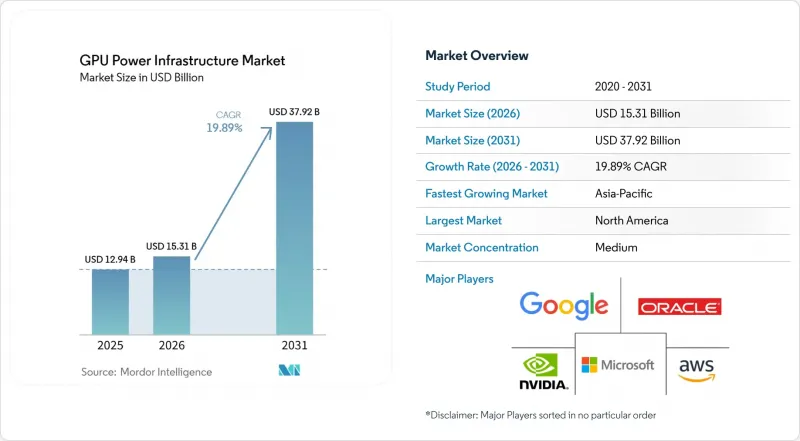
본 보고서는 구성 요소(솔루션 및 서비스), 전력 아키텍처(랙 레벨 전력, 열/포드 레벨 전력, 인프라 레벨 전력), 배전 토폴로지(집중형 등), 데이터센터 유형(하이퍼스케일 데이터센터, 코로케이션 데이터센터, 엔터프라이즈 데이터센터, 엣지 데이터센터), 지역별로 분류되어 있습니다. 시장 전망은 금액(달러) 기준으로 제시되어 있습니다.
세계 GPU 전력 인프라 시장 동향 및 인사이트
AI 클러스터의 전력 밀도 상승이 인프라 재설계를 촉진
GPU 전력 인프라 시장은 최근 GPU 세대 간 랙당 전력 밀도가 급증함에 따라 성장세를 보이고 있습니다. 이는 시스템 수준에서 증가가 칩의 열설계전력(TDP)의 단독 상승보다 훨씬 더 급격했기 때문입니다. NVIDIA는 자사의 Vera Rubin VR200 NVL72 랙 스케일 시스템이 랙당 190-230 kW를 소비한다고 밝혔습니다. 이는 Hopper 세대에서 보였던 수준을 훨씬 상회하며, 구형 데이터센터 전기실의 설계 기준을 크게 초과하는 수치입니다. 이러한 변화로 인해 GPU 전력 인프라 시장은 단순한 조달 범주에서 프로젝트 일정을 좌우하는 결정 요인으로 변모했습니다. 현재 전력 공급이 대규모 AI 클러스터를 예정대로 가동할 수 있는지 여부를 결정짓게 되었기 때문입니다. 다음 플랫폼 주기에서도 이러한 압박은 높은 수준을 유지할 전망입니다. Rubin Ultra Kyber는 랙당 600kW로 사양이 정해져 있으며, 이후 플랫폼에서는 1MW급 랙 설계로 전환되고 있기 때문입니다. 기존의 54VDC 배전 방식으로는 구리선 사용량, 케이블의 부피 증가, 저항 손실 측면에서 심각한 문제를 수반하지 않고는 이러한 고밀도화에 대응할 수 없습니다. 즉, 새로운 시설이라 하더라도 기존 레이아웃을 확장하는 것이 아니라 전력 아키텍처를 재설계해야 합니다. 따라서 GPU 전력 인프라 시장은 서버 대수 증가뿐만 아니라, 가동을 시작하는 고밀도 랙 1대당 전력 인프라에 대한 지출이 구조적으로 증가한다는 점에서도 혜택을 받고 있습니다.
고전압 랙 레벨 전력 아키텍처로의 전환
또한, GPU 전력 인프라 시장은 800 VDC 고전압 직류 설계로의 전환에 의해서도 뒷받침되고 있습니다. 이를 통해 기존에는 종단 간 효율을 제한하던 여러 변환 단계가 제거됩니다. NVIDIA에 따르면, 800 VDC 전선의 게이지(굵기)는 동등한 415 VAC에 비해 157% 더 많은 전력을 전송할 수 있으므로, 고밀도 AI 도입 환경에서 도체의 무게, 케이블 혼잡 및 변환 손실을 줄일 수 있다고 합니다. 이에 따라 중앙 집중형 정류기, 800 VDC 지원 버스웨이, 보호 시스템 및 랙 수준의 DC-DC 변환 장치가 전기 스택 내에서 더 높은 부가가치를 지닌 부품으로 자리 잡으면서, GPU 전력 인프라 시장은 여러 계층에 걸쳐 확대되고 있습니다. Vertiv사는 2025년 10월에 800 VDC 플랫폼을 컨셉 단계에서 엔지니어링 준비 단계로 전환하고, 2026년 하반기 상용 출시를 계획하고 있으며, 벤더의 로드맵을 NVIDIA의 'Rubin Ultra' 주기와 일치시키고 있습니다. 또한 Open Compute Project Foundation도 2025년에 ‘Power Distribution Project’를 출범시켜 800 VDC 시스템을 위한 전압, 커넥터, 안전 기준을 정의했습니다. 이를 통해 광범위한 도입에 따른 불확실성이 완화될 것입니다. 표준 제정과 제품 공급이 병행됨에 따라, GPU 전력 인프라 시장은 초기 도입에서 하이퍼스케일 및 코로케이션 시설 전반에 걸친 대규모 확장에 이르기까지 보다 명확한 로드맵을 확보하게 될 것입니다.
초기 투자 비용이 많이 들기 때문에 하이퍼스케일 이외의 사업자 시장 진입이 제한되고 있습니다.
GPU 전력 인프라 시장은 엔터프라이즈 사업자나 중견 코로케이션 제공업체 사이에서 명확한 도입 한계에 직면해 있습니다. 이는 고밀도 GPU 헐이 기존 서버 환경보다 훨씬 더 많은 전력 투자를 필요로 하기 때문입니다. 800 VDC 아키텍처로의 전환은 대개 새로운 중앙 집중식 정류기, 전용 버스웨이, 이중화된 배터리 시스템 및 보호 장치의 도입을 의미하지만, 이러한 요소들은 기존의 업그레이드 주기에 쉽게 통합될 수 없습니다. NVIDIA는 도입이 현재의 GB200급 시스템에서 Vera Rubin CPX급 시스템으로 전환됨에 따라 AI 서버 랙 1대당 전력 인프라의 가치가 1,000% 이상 상승할 가능성이 있어, 시장 진입을 위한 자본적 장벽이 급격히 높아질 것이라고 지적합니다. 실제로 이는 1MW 규모의 GPU 홀 하나만으로도 이전에는 훨씬 더 대규모의 기존 시설을 지원하던 수준의 전력 관련 비용이 필요함을 의미하며, 이로 인해 상위권 이외의 클라우드 사업자들 시장 진입이 지연되고 있습니다. IEC 61439 및 UL 857과 같은 규격 준수를 위해서는 추가적인 설계 및 시험 작업이 필요하며, 이로 인해 더 탄탄한 기술 팀을 보유한 공급업체와 구매자가 더욱 유리한 입지를 차지하게 됩니다. 따라서 GPU 전력 인프라 시장에는 강력한 수요 모멘텀이 있지만, 많은 잠재적 구매자가 새로운 전력 스택의 초기 도입 비용을 감당할 수 없기 때문에 그 수요의 일부는 집중된 상태로 남아 있습니다.
부문 분석
2025년, GPU 전력 인프라 시장에서 솔루션 부문은 83.19%의 점유율을 차지했습니다. 이는 시설의 건설 및 확장 단계에서 초기 투자의 상당 부분이 여전히 UPS 어레이, 변압기, 개폐 장치, PDU, 중앙 집중형 정류기 및 관련 하드웨어에 할당되고 있음을 반영합니다. GPU 전력 인프라 시장의 이 분야가 여전히 지배적인 위치를 유지하고 있는 이유는 주요 GPU 세대가 업데이트될 때마다 사업자가 기존 시스템에 높은 부하를 추가하는 대신 전력 스택의 대부분을 갱신할 수밖에 없기 때문입니다. 이러한 환경 하에서 특히 여러 홀에 걸친 단계적 확장을 상정하여 전기실이 설계된 하이퍼스케일 캠퍼스에서는 장비 조달이 여전히 최초이자 가장 큰 설비 투자 결정 사항으로 남아 있습니다. 또한, 변환 단계가 중앙 집중화되고 랙 밀도가 높아짐에 따라 시설 수준의 전력 아키텍처가 기술적 복잡성의 더 큰 부분을 차지하게 된 점도 솔루션 시장의 기반을 뒷받침하고 있습니다. 이로 인해 하드웨어 계약은 규모가 크고 다단계에 걸쳐 있으며, 시설의 시운전 일정과 밀접하게 연계되어 있습니다.
서비스 시장은 2026년부터 2031년까지 연평균 성장률(CAGR) 20.57%를 나타낼 것으로 예측되며, 규모는 작지만 GPU 전력 인프라 시장에서 가장 빠르게 성장하는 분야가 될 전망입니다. 많은 사내 팀은 AI를 활용한 운영이 아닌 기존 데이터센터 운영을 전제로 구축되어 있기 때문에 사업자들 사이에서는 시운전, 동적 전력 관리, 디지털 트윈 활용 및 고밀도 부하 분산에 대한 지원 수요가 높아지고 있습니다. Vertiv사는 2026년 3월 Vera Rubin DSX 발표에서 4,000명 이상의 현장 서비스 엔지니어를 보유하고 있음을 강조했는데, 이는 제품의 완성도뿐만 아니라 서비스 체계의 충실함이 직접적인 판매 포인트가 되고 있음을 보여줍니다. 이러한 변화는 GPU 전력 인프라 업계가 라이프사이클 모델로 전환되고 있음을 시사합니다. 이 모델에서 구매자는 장비 자체뿐만 아니라 검증된 도입 지원 및 지속적인 운영 튜닝을 점점 더 중요하게 여기고 있습니다. 또한, 강력한 현장 조직을 갖춘 벤더는 하드웨어 납품 후에도 고객과의 관계를 심화시켜 예측 기간 동안 수익 구조를 확대할 수 있음을 의미합니다.
2025년 GPU 전력 인프라 시장에서 인프라 수준의 전력은 시장의 46.53%를 차지하고 있으며, 현재 도입 사례에서 시설 에지 시스템이 여전히 가치 측면에서 가장 큰 비중을 차지하고 있는 것으로 나타났습니다. 이 계층에는 중전압 개폐 장치, 주배전반, 시설 수준의 UPS 시스템, 발전기, 그리고 전체 전기 설계를 뒷받침하는 핵심 변환 자산이 포함됩니다. GPU 전력 인프라 시장이 이러한 아키텍처를 중시해 온 이유는 AI 지원 데이터센터가 가치를 하위 계층이나 랙 계층으로 더 깊이 이전하기 전에, 신뢰성 높은 업스트림 측 전력 기반을 확립해야 하기 때문입니다. 800 VDC로의 전환은 더 많은 변환 및 제어 책임을 중앙 집중식 정류기나 버스웨이 연결 배전 시스템으로 이관함으로써 이러한 입지를 더욱 공고히 하고 있습니다. 그 결과, 인프라 수준의 전력은 여전히 주요 설계 요소이며, 장애 발생 시 제한된 랙 그룹뿐만 아니라 캠퍼스 전체에 영향을 미치는 핵심 영역이 되었습니다.
랙 레벨 전력 시장은 2026년부터 2031년까지 연평균 성장률(CAGR) 20.78%를 나타낼 것으로 예측되며, 이는 고밀도 GPU 클러스터 내의 소비 지점에서도 가치가 얼마나 빠르게 창출되고 있는지를 보여줍니다. NVIDIA의 Kyber 랙 아키텍처는 높은 비율의 64:1 LLC 컨버터를 통해 각 컴퓨팅 노드에 고전압을 분배함으로써, 랙 인터페이스를 단순한 일상적인 부품 선택이 아닌 핵심 엔지니어링 사양으로 격상시키고 있습니다. 이러한 변화로 인해 지능형 랙 수준의 전력 조정, 랙 내 버퍼링, 그리고 업스트림 전력 시스템과 컴퓨팅 노드 간의 긴밀한 연동을 가능하게 하는 GPU 전력 인프라 시장이 확대되고 있습니다. 2026년 3월에 발표된 이튼(Eaton)의 'Beam Rubin DSX' 플랫폼은 엔드투엔드 그리드-투-칩 전력 생태계로 자리매김하고 있으며, 이는 각 벤더들이 모든 전기적 계층에 걸친 협업 설계의 필요성에 어떻게 대응하고 있는지를 반영합니다. 그 결과, 인프라 수준의 자산이 중요성을 잃는 것은 아니며, 기존 서버 환경에 비해 시설 에지와 랙 에지 모두 더 큰 가치를 창출하는 보다 광범위한 아키텍처 간의 경쟁이 전개될 것입니다.
지역별 분석
2025년, 북미는 GPU 전력 인프라 시장에서 43.91%의 점유율을 차지하며, 현재 매출 측면에서 가장 규모가 큰 지역 거점이 되고 있습니다. 이 지역은 하이퍼스케일 캠퍼스의 밀집, GPU 클라우드 사업자의 강력한 입지, 그리고 AI 인프라를 중심으로 한 대규모 자본 투자 프로그램의 혜택을 받고 있습니다. CoreWeave의 보고서에 따르면, 2026년 1분기에는 가동 전력 1GW 이상, 계약 전력 3.5GW 이상이 확인되어, 해당 지역의 현재 확장 압력 규모를 뒷받침하고 있습니다. 북미에서도 지난 10년간 계통 연계 대기 시간이 급증하고 개혁 조치가 여전히 시행되고 있어, 계량기 뒤편 지원 시스템에 대한 수요를 높이는 것과 동일한 상황에 직면해 있습니다. 이러한 요인들이 복합적으로 작용하여, 캠퍼스 수준의 확장뿐만 아니라 중복화, 전력 조정, 단계적 전력 공급과 같은 사이트 수준의 투자에서도 GPU 전력 인프라 시장은 호황을 누리고 있습니다.
유럽은 AI 지원 데이터센터의 확장이 에너지 정책, 효율화 규제 및 각국의 디지털 전략과 더욱 밀접하게 연계되어 있기 때문에 GPU 전력 인프라 시장에서 여전히 중요한 위치를 차지하고 있습니다. 독일은 이 지역 정세의 중심에 있습니다. 연방 정부는 2026년 3월 데이터센터 전략을 채택하여, 2030년까지 데이터센터의 총 용량을 2배로, AI 전용 용량을 4배로 확대하는 것을 목표로 하고 있습니다. 독일에서는 데이터센터의 전력 소비량이 2024년 20 TWh에서 2025년에는 21.3 TWh로 증가하고 있으며, 이는 다음 AI 프로젝트 물결이 완전히 구축되기도 전에 전력 부하가 증가하고 있음을 시사합니다. 독일에서는 2027년 이후 신규 데이터센터에 대해 재생에너지로부터 전력을 조달할 것을 의무화하고 있어, 이로 인해 인프라 계획에 더욱 복잡성이 가중되고 있습니다. 이는 사업자가 용량 확대를 전력 공급 상황과 규정 준수 요건 모두에 맞추어 조정해야 하기 때문입니다. 이러한 상황은 유럽의 GPU 전력 인프라 시장을 뒷받침하는 한편, 프로젝트의 시기나 설계상의 선택이 다른 지역에 비해 전력 조달 전략에 크게 좌우되는 요인이 되고 있습니다.
아시아태평양은 2031년까지 연평균 성장률(CAGR) 21.46%를 나타낼 것으로 예측되며, GPU 전력 인프라 시장에서 가장 빠르게 성장하는 지역 부문이 될 것입니다. 이 지역의 성장을 주도하는 요인은 각국 정부 주도의 AI 프로그램, 하이퍼스케일러의 확장, 그리고 대규모 데이터센터 시장 전체에서 랙당 전력 밀도의 급격한 상승입니다. NTT는 2026년 4월, 2033 회계연도까지 IT 전력 용량을 300 MW에서 1 GW로 확대할 계획이라고 발표했습니다. 또한, 인자이 및 시라이에 건설 중인 AI 전용 신규 캠퍼스에서는 IT 용량 총 250 MW를 목표로 하고 있습니다. 또한, 에퀴닉스(Equinix)도 2025년 9월, 첸나이에 자사 최초의 AI 대응 데이터센터를 개장했습니다. 초기 투자액은 6,900만 달러이며, 고밀도 GPU 워크로드를 지원하는 수냉식 인프라를 갖추고 있습니다. 남미, 중동 및 아프리카는 GPU 전력 인프라 시장에서 여전히 초기 단계에 있지만, 최근의 기본 협정 및 초기 단계 캠퍼스에 대한 투자는 AI 지원 전력 용량이 이미 확립된 주요 지역을 넘어 확대되기 시작했음을 보여줍니다.
기타 혜택:
- 엑셀 형식 시장 예측(ME) 시트
- 3개월간의 애널리스트 지원
자주 묻는 질문
목차
제1장 서론
제2장 조사 방법
제3장 주요 요약
제4장 시장 구도
제5장 시장 규모와 성장 예측
제6장 경쟁 구도
제7장 시장 기회와 향후 전망
JHS 26.08.05According to Mordor Intelligence, the GPU power infrastructure market size is expected to increase from USD 12.94 billion in 2025 to USD 15.31 billion in 2026 and reach USD 37.92 billion by 2031, growing at a CAGR of 19.89% over 2026-2031.
This report is Segmented by Component (Solution, and Services), Power Architecture (Rack-Level Power, Row/Pod-Level Power, and Infrastructure-Level Power), Power Distribution Topology (Centralized, and More), Data Center Type (Hyperscale Data Centers, Colocation Data Centers, Enterprise Data Centers, and Edge Data Centers), and Geography. The Market Forecasts are Provided in Terms of Value (USD).
Global GPU Power Infrastructure Market Trends and Insights
Rising AI Cluster Power Density Drives Infrastructure Redesign
The GPU power infrastructure market is being pushed upward by the jump in rack power density between recent GPU generations, because the system-level increase has been much sharper than the rise in chip thermal design power alone. NVIDIA stated that its Vera Rubin VR200 NVL72 rack-scale systems draw 190-230 kW per rack, which is far above levels seen in the Hopper generation and well beyond the design point of older data center electrical rooms. That shift has changed the GPU power infrastructure market from a procurement category into a gating factor for project timing, because power delivery now determines whether large AI clusters can be energized on schedule. The next platform cycle keeps this pressure high, since Rubin Ultra Kyber has been specified at 600 kW per rack, and later platforms are moving toward 1 MW-class rack designs. Traditional 54 VDC distribution cannot support these densities without severe penalties in copper volume, cable bulk, and resistive losses, meaning even new facilities must redesign their electrical architecture rather than extend older layouts. The GPU power infrastructure market is therefore benefiting not only from higher server counts, but also from a structural increase in power infrastructure spend for every high-density rack that enters service.
Shift Toward High-Voltage Rack-Level Power Architectures
The GPU power infrastructure market is also being boosted by the shift toward 800 VDC high-voltage direct current designs, which eliminate several conversion stages that previously limited end-to-end efficiency. NVIDIA stated that an 800 VDC wire gauge can carry 157% more power than a 415 VAC equivalent, thereby reducing conductor weight, cable congestion, and conversion losses across dense AI deployments. This is expanding the GPU power infrastructure market across multiple layers, as centralized rectifiers, 800 VDC-rated busways, protection systems, and rack-level DC-DC conversion become higher-value parts of the electrical stack. Vertiv moved its 800 VDC platform from concept to engineering readiness in October 2025 and planned a commercial release in the second half of 2026, aligning vendor roadmaps with NVIDIA's Rubin Ultra cycle. The Open Compute Project Foundation also launched its Power Distribution Project in 2025 to define voltage, connector, and safety standards for 800 VDC systems, which reduces uncertainty around broad deployment. As standards and product availability move forward together, the GPU power infrastructure market gains a clearer path from early adoption to scaled rollouts across hyperscale and colocation facilities.
High Upfront Capital Intensity Limits Participation Among Non-Hyperscale Operators
The GPU power infrastructure market faces a clear adoption limit among enterprise operators and mid-tier colocation providers because high-density GPU halls require a much heavier electrical investment than traditional server environments. The move toward 800 VDC architectures often means new centralized rectifiers, specialized busways, redundant battery systems, and protection equipment that do not fit easily into legacy upgrade cycles. NVIDIA indicated that the value of power infrastructure per AI server rack could rise by more than 1,000% as deployments shift from current GB200-class systems to Vera Rubin CPX-class systems, sharply raising the capital threshold for participation. In practice, that means a single 1 MW GPU hall can demand the kind of electrical spending that previously supported a much larger conventional footprint, which slows entry by non-top-tier cloud operators. Compliance with standards such as IEC 61439 and UL 857 adds more engineering and testing work, which further favors suppliers and buyers with deeper technical teams. The GPU power infrastructure market, therefore, has strong demand momentum, yet part of that demand stays concentrated because many potential buyers cannot absorb the upfront replacement cost of the new power stack.
Other drivers and restraints analyzed in the detailed report include:
- Hyperscale And Colocation Expansion Creates Structural Demand For GPU-Optimized Power
- Modular Rapid-Deploy Power Blocks Address Brownfield Retrofit Constraints
- Electrical Equipment Supply Chain Bottlenecks Constrain Deployment Timelines
For complete list of drivers and restraints, kindly check the Table Of Contents.
Segment Analysis
Solutions held an 83.19% share of the GPU power infrastructure market in 2025, reflecting how much of the initial spending still goes toward UPS arrays, transformers, switchgear, PDUs, centralized rectifiers, and related hardware during facility buildout. This part of the GPU power infrastructure market remains dominant because each major GPU generation forces operators to refresh large sections of the electrical stack rather than bolt on higher loads to older systems. In that environment, equipment procurement remains the first and largest capital decision, especially for hyperscale campuses where the electrical room is designed for staged expansion across multiple halls. The solutions base is also supported by the fact that facility-level power architecture now captures a larger share of technical complexity as conversion stages are centralized and rack densities rise. That keeps hardware contracts large, multi-phase, and closely tied to site commissioning schedules.
Services are projected to grow at a 20.57% CAGR from 2026 to 2031, making them the fastest-growing component of the GPU power infrastructure market, even though they start from a smaller base. Operators increasingly need support with commissioning, dynamic power management, digital twin use, and high-density load balancing, as many internal teams were built for conventional data center operations rather than AI-powered behavior. Vertiv highlighted its 4,000-plus field service engineers in its March 2026 Vera Rubin DSX announcement, which shows how service capacity is becoming a direct selling point beside product depth. This shift suggests that the GPU power infrastructure industry is moving toward a lifecycle model, where buyers increasingly value validated deployment support and ongoing operational tuning along with the equipment itself. It also means vendors with strong field organizations can deepen customer relationships after hardware delivery and widen their revenue mix over the forecast period.
Infrastructure-level power accounted for 46.53% of the GPU power infrastructure market in 2025, indicating that facility-edge systems still account for the largest share of value in current deployments. This layer includes medium-voltage switchgear, main distribution boards, facility-level UPS systems, generators, and the core conversion assets that anchor the entire electrical design. The GPU power infrastructure market has favored this architecture because every AI-ready data center must establish a reliable upstream power foundation before value can shift deeper into row or rack layers. The move toward 800 VDC reinforces that position by transferring more conversion and control responsibility into centralized rectifiers and busway-linked distribution systems. As a result, infrastructure-level power remains the primary design point and the main area where failure would affect the entire campus rather than a limited rack group.
Rack-level power is projected to grow at a 20.78% CAGR from 2026 to 2031, indicating how quickly value is also being built at the point of consumption within dense GPU clusters. NVIDIA's Kyber rack architecture distributes high voltage to each compute node via a high-ratio 64:1 LLC converter, elevating the rack interface to a major engineering specification rather than a routine component choice. That change expands the GPU power infrastructure market for intelligent rack-level conditioning, in-rack buffering, and tightly coordinated control between upstream power systems and compute nodes. Eaton's Beam Rubin DSX platform, introduced in March 2026, was framed as an end-to-end grid-to-chip power ecosystem, which reflects how vendors are responding to the need for coordinated design across all electrical layers. The practical outcome is not a loss of relevance for infrastructure-level assets, but a broader architecture contest in which both the facility edge and the rack edge capture more value than they did in conventional server environments.
Complete Report Scope:
- By Component
- Solution
- Services
- By Power Architecture
- Rack-Level Power
- Row/Pod-Level Power
- Infrastructure-Level Power
- By Power Distribution Topology
- Centralized
- Distributed
- By Data Center Type
- Hyperscale Data Centers
- Colocation Data Centers
- Enterprise Data Centers
- Edge Data Centers
- By Geography
- North America
- United States
- Canada
- Mexico
- Europe
- Germany
- United Kingdom
- France
- Italy
- Rest of Europe
- Asia-Pacific
- China
- Japan
- South Korea
- India
- Southeast Asia
- Rest of Asia-Pacific
- South America
- Middle East and Africa
- North America
Geography Analysis
North America held a 43.91% share of the GPU power infrastructure market in 2025, making it the largest regional base for current revenue. The region benefits from a dense cluster of hyperscale campuses, a strong presence of GPU cloud operators, and very large capital deployment programs centered on AI infrastructure. CoreWeave reported more than 1 GW of active power in the first quarter of 2026 and more than 3.5 GW of contracted power, underscoring the scale of current expansion pressure in the region. North America also faces the same conditions that are increasing demand for behind-the-meter support systems, as interconnection queue wait times have risen sharply over the past decade, and reform measures are still being implemented. That combination keeps the GPU power infrastructure market active across both campus-level buildouts and site-level investments in redundancy, power conditioning, and staged energization.
Europe remains an important part of the GPU power infrastructure market because AI-capable data center expansion is now more closely linked to energy policy, efficiency rules, and national digital strategies. Germany is central to this regional picture, since the federal government adopted its data center strategy in March 2026 with a target to double general data center capacity and quadruple AI-specific capacity by 2030. The same country recorded data center electricity consumption rising from 20 TWh in 2024 to 21.3 TWh in 2025, which points to a growing power burden even before the next wave of AI projects is fully built out. Germany's requirement for new data centers to source energy from renewables from 2027 adds another layer of infrastructure planning, because operators must align capacity growth with both power availability and compliance needs. These conditions support the GPU power infrastructure market in Europe, but they also make project timing and design choices more dependent on power sourcing strategy than in some other regions.
Asia-Pacific is projected to grow at a 21.46% CAGR through 2031, which makes it the fastest-growing regional segment in the GPU power infrastructure market. The region is being driven by sovereign AI programs, hyperscaler expansion, and a fast rise in per-rack power density across large data center markets. NTT stated in April 2026 that it plans to expand IT power capacity from 300 MW to 1 GW by fiscal year 2033, with its new AI-focused campus in Inzai and Shiroi targeting 250 MW of total IT capacity. Equinix also opened its first AI-ready data center in Chennai in September 2025 with an initial investment of USD 69 million and liquid-cooling-ready infrastructure for high-density GPU workloads. South America and the Middle East and Africa remain earlier-stage markets in the GPU power infrastructure market, but recent framework agreements and early campus investments show that AI-ready electrical capacity is beginning to extend beyond the largest established regions.
- NVIDIA Corporation
- Amazon Web Services, Inc.
- Microsoft Corporation
- Google LLC
- Oracle Corporation
- Advanced Micro Devices, Inc.
- Intel Corporation
- Dell Technologies Inc.
- Hewlett Packard Enterprise Development LP
- Super Micro Computer, Inc.
- Lenovo Group Limited
- CoreWeave, Inc.
- Lambda Labs, Inc.
- Alibaba Cloud
- Equinix, Inc.
- Digital Realty Trust, Inc.
- Vertiv Group Corp.
- Schneider Electric SE
Additional Benefits:
- The market estimate (ME) sheet in Excel format
- 3 months of analyst support
TABLE OF CONTENTS
1 INTRODUCTION
- 1.1 Study Assumptions and Market Definition
- 1.2 Scope of the Study
2 RESEARCH METHODOLOGY
3 EXECUTIVE SUMMARY
4 MARKET LANDSCAPE
- 4.1 Market Overview
- 4.2 Market Drivers
- 4.2.1 Rising AI Cluster Power Density in GPU Training Halls
- 4.2.2 Shift Toward High-Voltage Rack-Level Power Architectures
- 4.2.3 Expansion of Hyperscale and Colocation Capacity Built for Accelerated Computing
- 4.2.4 Demand for Modular, Rapid-Deploy Power Blocks in Brownfield Retrofits
- 4.2.5 Grid Interconnection Constraints Accelerating On-Site Power Conditioning Demand
- 4.2.6 Utility Reliability Risk Increasing Multi-Layer Redundancy Investments
- 4.3 Market Restraints
- 4.3.1 High Upfront Cost of High-Density Electrical Rooms and Backup Architecture
- 4.3.2 Long Lead Times for Switchgear, Transformers, and High-Capacity UPS Systems
- 4.3.3 Limited Availability of Skilled Commissioning and Power-Integration Labor
- 4.3.4 Thermal and Spatial Constraints in Existing Facilities Restricting GPU Retrofit Scale-Up
- 4.4 Industry Value Chain Analysis
- 4.5 Technological Outlook
- 4.6 Impact of Macroeconomic Factors on the Market
- 4.7 Porter's Five Forces Analysis
- 4.7.1 Bargaining Power of Suppliers
- 4.7.2 Bargaining Power of Buyers
- 4.7.3 Threat of New Entrants
- 4.7.4 Threat of Substitutes
- 4.7.5 Industry Rivalry
5 MARKET SIZE AND GROWTH FORECASTS (VALUE)
- 5.1 By Component
- 5.1.1 Solution
- 5.1.2 Services
- 5.2 By Power Architecture
- 5.2.1 Rack-Level Power
- 5.2.2 Row/Pod-Level Power
- 5.2.3 Infrastructure-Level Power
- 5.3 By Power Distribution Topology
- 5.3.1 Centralized
- 5.3.2 Distributed
- 5.4 By Data Center Type
- 5.4.1 Hyperscale Data Centers
- 5.4.2 Colocation Data Centers
- 5.4.3 Enterprise Data Centers
- 5.4.4 Edge Data Centers
- 5.5 By Geography
- 5.5.1 North America
- 5.5.1.1 United States
- 5.5.1.2 Canada
- 5.5.1.3 Mexico
- 5.5.2 Europe
- 5.5.2.1 Germany
- 5.5.2.2 United Kingdom
- 5.5.2.3 France
- 5.5.2.4 Italy
- 5.5.2.5 Rest of Europe
- 5.5.3 Asia-Pacific
- 5.5.3.1 China
- 5.5.3.2 Japan
- 5.5.3.3 South Korea
- 5.5.3.4 India
- 5.5.3.5 Southeast Asia
- 5.5.3.6 Rest of Asia-Pacific
- 5.5.4 South America
- 5.5.5 Middle East and Africa
- 5.5.1 North America
6 COMPETITIVE LANDSCAPE
- 6.1 Market Concentration
- 6.2 Strategic Moves
- 6.3 Vendor Positioning Analysis
- 6.4 Company Profiles (includes Global Level Overview, Market Level Overview, Core Segments, Financials as available, Strategic Information, Market Rank/Share, Products and Services, Recent Developments)
- 6.4.1 NVIDIA Corporation
- 6.4.2 Amazon Web Services, Inc.
- 6.4.3 Microsoft Corporation
- 6.4.4 Google LLC
- 6.4.5 Oracle Corporation
- 6.4.6 Advanced Micro Devices, Inc.
- 6.4.7 Intel Corporation
- 6.4.8 Dell Technologies Inc.
- 6.4.9 Hewlett Packard Enterprise Development LP
- 6.4.10 Super Micro Computer, Inc.
- 6.4.11 Lenovo Group Limited
- 6.4.12 CoreWeave, Inc.
- 6.4.13 Lambda Labs, Inc.
- 6.4.14 Alibaba Cloud
- 6.4.15 Equinix, Inc.
- 6.4.16 Digital Realty Trust, Inc.
- 6.4.17 Vertiv Group Corp.
- 6.4.18 Schneider Electric SE
7 MARKET OPPORTUNITIES AND FUTURE OUTLOOK
- 7.1 White-Space and Unmet-Need Assessment


