|
시장보고서
상품코드
2099284
디펩티딜 펩티다제 4(DPP-4) 억제제 시장 : 점유율 분석, 업계 동향 및 통계, 성장 예측(2026-2031년)Dipeptidyl Peptidase-4 (DPP-4) Inhibitors - Market Share Analysis, Industry Trends & Statistics, Growth Forecasts (2026 - 2031) |
||||||
 Mordor Intelligence
Mordor Intelligence에 의하면, 디펩티딜 펩티다제 4(DPP-4) 억제제 시장 규모는 2025년에 119억 1,000만 달러, 2026년에 122억 2,000만 달러가 되어, 2031년까지 139억 1,000만 달러에 이를 것으로 예측되며, 2026년부터 2031년까지 CAGR 2.61%로 성장할 전망입니다.
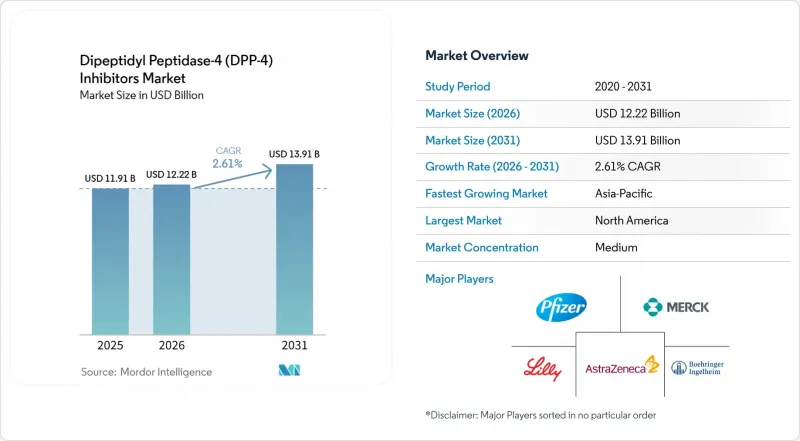
본 보고서는 약제 유형(시타글립틴, 삭사글립틴, 리나글립틴, 알로그리프틴, 빌다글리프틴, 기타 약물), 의약품 유형(브랜드 의약품, 제네릭), 유통 채널(병원, 소매, 온라인 약국), 지역(북미, 유럽, 아시아태평양, 중동 및 아프리카, 남미)별로 분류되어 있습니다. 시장 전망은 금액(달러) 기준으로 제시되어 있습니다.
전 세계 디펩티딜 펩티다제-4(DPP-4) 억제제 시장 동향 및 인사이트
2형 당뇨병 유병률 증가
디펩티딜 펩티다제-4(DPP-4) 억제제 시장은 대부분의 주요 의료 시스템 및 소득 계층에서 여전히 확대되고 있는 당뇨병의 부담에 힘입어 성장하고 있습니다. IDF(국제당뇨병연맹)의 ‘당뇨병 아틀라스’에 따르면, 2024년에는 5억 8,900만 명의 성인이 당뇨병을 앓고 있으며, 이 총 수는 2050년까지 8억 5,300만 명으로 증가할 것으로 예측됩니다. 이로 인해 경구용 혈당 강하제 대상 환자 기반은 구조적으로 대규모로 유지될 것입니다. 같은 데이터 세트에 따르면, 2억 5,170만 명의 성인이 아직 진단을 받지 않은 상태이며, 이는 선별 검진에 대한 접근성이 개선되고 있는 국가들에서 향후 진단 및 치료가 확대됨에 따라 처방량이 지속적으로 증가할 것임을 의미합니다. 도시 지역의 식생활, 앉아 있는 생활 습관, 그리고 평균 수명의 연장으로 인해 이러한 부담의 더 큰 비중이 아시아, 중동 및 아프리카, 라틴아메리카의 인구 밀집 지역으로 이동하고 있습니다. 이러한 지역에서는 주사제에 비해 경구용 치료제의 보급이 여전히 용이합니다. 이러한 광범위한 환자층의 존재로 인해, 가격 압박으로 인해 가치 상승이 억제되는 경우에도 디펩티딜 펩티다제-4(DPP-4) 억제제 시장은 지속적인 판매량 기반을 확보하고 있습니다.
저혈당 위험이 낮은 경구 요법에 대한 선호
디펩티딜 펩티다제-4(DPP-4) 억제제 시장은 중증 저혈당 위험을 증가시키지 않으면서 혈당 수치를 낮추는 경구 요법에 대한 의료진의 안정적인 수요 덕분에 혜택을 보고 있습니다. 2025년 독일 고령자를 대상으로 실시된 보험 청구 데이터 분석에 따르면, DPP-4 억제제는 설포닐우레아계 약물과 비교하여 신규 사용자의 경우 중증 저혈당 위험을 49%, 중증 신장 기능 장애가 있는 환자의 경우 69% 감소시키는 것으로 밝혀졌습니다. 2형 당뇨병 환자의 대부분은 고령이며, 여러 약물을 복용하고 있고, 치료의 편의성이 극히 중요한 1차 진료 현장에서 관리되고 있기 때문에 이러한 이점은 일상 진료에서 중요한 의미를 지닙니다. 따라서 디펩티딜 펩티다제-4(DPP-4) 억제제 시장은 경구 치료가 필요한 환자나, 보다 적극적인 치료법이나 저혈당 위험 증가를 감당할 수 없는 환자들에게 계속해서 실질적인 역할을 수행하고 있습니다. 저혈당 위험이 낮다는 점은 복약 순응도 유지와 처방전 지속에도 기여하며, 주로 만성 질환의 유지 요법에 사용되는 이 치료제군에서 여전히 중요한 요소로 남아 있습니다.
성숙한 브랜드 의약품에 대한 제네릭 의약품의 침식
디펩티딜 펩티다제-4(DPP-4) 억제제 시장에서 가장 명백한 가치 제약 요인은 제네릭 의약품이 널리 시판되기 시작하면 성숙한 브랜드 의약품의 가격이 꾸준히 잠식된다는 점입니다. 이러한 변화로 인해 환자의 접근성과 처방량은 확대되지만, 한편으로는 처방 건당 수익이 감소하여 이 치료제군의 전반적인 가치 성장에 상한선이 생깁니다. 2026년 6월 아포텍스(Apotex)사가 미국에서 출시한 시타글립틴 및 메트포르민 복합제 시타글립틴의 제네릭 의약품은 대형 분자 의약품이 제네릭 단계에 진입하면 브랜드 의약품에 가해지는 압박이 얼마나 급속히 커지는지를 보여주는 직접적인 사례입니다. 캐나다 보건부도 NRA-시타글립틴 정제를 승인했으며, 이는 규제 시장 전체에서 제네릭 의약품이 전국적으로 확산되고 있는 광범위한 추세를 뒷받침합니다. 점점 더 많은 처방약 목록이 저비용 대체품을 우선시함에 따라, 디펩티딜 펩티다제-4(DPP-4) 억제제 시장에서는 판매량이 견조한 추세를 보일 것으로 예상되지만, 브랜드 의약품의 수익 확보 한도는 더욱 엄격해질 것으로 보입니다.
부문 분석
시타글립틴은 디펩티딜 펩티다제-4(DPP-4) 억제제 시장의 주요 분자로, 2031년까지 연평균 성장률(CAGR) 4.38%를 나타낼 것으로 예측되며, 이는 동 계열 전체의 성장 속도를 상회하는 수치입니다. 이러한 추세는 처방에서의 높은 중요성과 브랜드 의약품으로서의 가격 결정력 약화라는 이례적인 조합을 반영하고 있습니다. 이는 성장이 프리미엄 가격 주도형이 아닌 판매량 주도형으로 진행되는 경향이 강해지고 있기 때문입니다. 디펩티딜 펩티다제-4(DPP-4) 억제제 시장은 여전히 시타글립틴을 중심으로 전개되고 있습니다. 이는 해당 분자가 의사들에게 친숙하고, 병용 요법에 대한 적응성이 높으며, 제네릭 의약품의 보급이 진행되더라도 시장 규모 확대가 용이하기 때문입니다. 따라서 시타글립틴은 단독 경구 요법으로서뿐만 아니라, 보다 광범위한 고정 용량 치료 전략의 기반으로서도 중요한 역할을 수행하고 있습니다. 이에 따라 치료 경로의 다른 여러 부분이 급속히 변화하는 가운데, 이 분자는 해당 약물군의 지속성을 지탱하는 핵심 요소가 되고 있습니다.
그 밖의 약물 유형에 대해서는 각 지역의 특허 상황, 보험 적용 현황, 그리고 지역별 처방 관행에 따라 그 상황이 더욱 다양해지고 있습니다. 삭사글립틴, 리나글립틴, 알로글립틴 및 빌다글립틴은 여전히 디펩티딜 펩티다제-4(DPP-4) 억제제 시장에서 특정한 위치를 차지하고 있지만, 각각은 전 세계적인 성장세보다는 국가별 동향에 크게 좌우되고 있습니다. 리나글립틴은 신장 기능에 따라 치료법 선택이 좌우되는 환자들에게 특히 중요한 위치를 계속 차지하고 있는 반면, 빌다글립틴은 유럽 및 아시아 일부 지역에서 이미 확고히 자리 잡은 인지도 덕분에 계속해서 혜택을 보고 있습니다. '기타 약물 유형' 카테고리도 아시아 일부 지역에서 존재감을 키우고 있으며, 현지에서 분자 개발이 진행됨에 따라 선택의 폭이 넓어지고 가격 경쟁도 격화되고 있습니다. 이 부문 전체에서 디펩티딜 펩티다제-4(DPP-4) 억제제 업계는 순수한 분자 수준의 경쟁에서 병용 요법, 보험 급여 적격성, 그리고 지속적인 만성 질환 관리에 대한 접근성을 기반으로 한 포트폴리오 경쟁으로 전환되고 있습니다.
지역별 분석
2025년, 북미는 디펩티딜 펩티다제-4(DPP-4) 억제제 시장 점유율의 39.63%를 차지하며, 이 계열의 매출에 대한 지역별 기여도에서 1위를 유지했습니다. 이 지역은 대규모 보험 가입 환자 기반, 확립된 만성 질환 관리 경로, 그리고 의사가 경구용 당뇨병 치료 순서에 대해 오랫동안 숙지해 온 이점을 가지고 있습니다. 북미의 디펩티딜 펩티다제-4(DPP-4) 억제제 시장은 현재 가격에 민감한 단계에 접어들었습니다. 이는 시타글립틴 제네릭 의약품의 출시로 접근성이 확대되는 한편, 브랜드 의약품의 가격 결정력이 약화되고 있기 때문입니다. 아포텍스(Apotex)는 2026년 6월, 미국에서 시타글립틴 정제 및 시타글립틴·메트포르민 복합제의 제네릭 의약품을 출시하여 이러한 전환 속도를 더욱 가속화하고 있습니다. 이러한 압박이 있음에도 불구하고, 고령 환자나 신장 기능에 주의가 필요한 환자들에 의한 안정적인 처방 수요가 지속되고 있어, 해당 지역은 상업적으로 중요한 위치를 유지할 전망입니다.
유럽은 디펩티딜 펩티다제-4(DPP-4) 억제제 시장에서 브랜드 의약품에서 제네릭으로의 전환이 가장 빠르게 진행되고 있는 지역 중 하나로 자리 잡고 있습니다. 영국에서는 이미 처방 목록에서 시타글립틴 제네릭으로의 명확한 전환이 관찰되고 있으며, 사우스 요크셔 통합 의료 위원회는 2025년 정책 성명에서 적격 환자 및 신규 치료 시작 환자에 대해 시타글립틴 제네릭을 1순위로 권장하는 글리프틴으로 지정했습니다. 독일과 영국은 비용 주도형 도입의 가장 두드러진 사례로 남아 있을 전망이지만, 프랑스, 이탈리아, 스페인에서는 고령 인구 증가와 보험 급여에 뒷받침된 경구 치료 경로를 통한 지원이 여전히 기대되고 있습니다. 중동부 유럽은 현재 시장 규모가 작지만, 접근성 기준의 개선에 따라 디펩티딜 펩티다제-4(DPP-4) 억제제 시장에 있어 여전히 중요한 성장 지역으로 남아 있습니다.
아시아태평양은 2031년까지 연평균 성장률(CAGR) 3.53%로 지역별 가장 높은 성장률을 나타낼 것으로 예측되며, 이에 따라 예측 기간 동안 디펩티딜 펩티다제-4(DPP-4) 억제제 시장에 있어 가장 중요한 성장 지역이 될 것입니다. 지역별 상황은 균일하지 않아, 일본에서는 여전히 브랜드 보호가 강력하고, 중국에서는 국내 개발이 잇따르고 있으며, 인도에서는 병용 요법을 중심으로 한 경구 치료에 대한 수요가 증가하고 있습니다. 인구 규모가 크고, 진단 건수가 증가하며, 보험 환급 제도가 개선됨에 따라 여러 국가에서 동시에 처방 기회가 확대되고 있습니다. 따라서 단가는 여전히 낮은 편이지만, 디펩티딜 펩티다제-4(DPP-4) 억제제 시장은 보다 성숙한 유럽 및 미국 지역에 비해 아시아태평양에서 더 큰 판매량 성장 잠재력을 가지고 있습니다. 중동 및 아프리카 및 남미는 여전히 초기 단계 시장이지만, 진단율, 보험 적용 범위, 약국 접근성이 지속적으로 개선됨에 따라 두 지역 모두 수요가 점차 확대될 가능성이 있습니다.
기타 혜택:
- 엑셀 형식 시장 예측(ME) 시트
- 3개월간의 애널리스트 지원
목차
제1장 서론
제2장 조사 방법
제3장 주요 요약
제4장 시장 구도
제5장 시장 규모와 성장 예측
제6장 경쟁 구도
제7장 시장 기회와 향후 전망
JHSAccording to Mordor Intelligence, the dipeptidyl peptidase-4 inhibitors market size is projected to be USD 11.91 billion in 2025, USD 12.22 billion in 2026, and reach USD 13.91 billion by 2031, growing at a CAGR of 2.61% from 2026 to 2031.
This report is Segmented by Drug Type (Sitagliptin, Saxagliptin, Linagliptin, Alogliptin, Vildagliptin, Other Drug Types), Medication Type (Branded, Generic), Distribution Channel (Hospital, Retail, Online Pharmacies), and Geography (North America, Europe, Asia-Pacific, MEA, South America). The Market Forecasts are Provided in Terms of Value (USD).
Global Dipeptidyl Peptidase-4 (DPP-4) Inhibitors Market Trends and Insights
Rising Type 2 Diabetes Prevalence
The dipeptidyl peptidase-4 (DPP-4) inhibitors market is supported by a diabetes burden that is still widening across most major care systems and income groups. The IDF Diabetes Atlas reported 589 million adults living with diabetes in 2024, and this total is projected to rise to 853 million by 2050, which keeps the addressable treatment base structurally large for oral glucose-lowering drugs. The same dataset showed that 251.7 million adults remained undiagnosed, which means future diagnosis and treatment expansion can continue to lift prescription volume in countries where screening access is improving. Urban diets, sedentary behavior, and longer life expectancy are pushing a larger share of this burden into densely populated parts of Asia, the Middle East, Africa, and Latin America, where oral therapy remains easier to scale than injectables. This broad patient flow gives the Dipeptidyl Peptidase-4 (DPP-4) Inhibitors Market a durable volume base, even when pricing pressure limits faster value growth.
Preference for Low Hypoglycemia Oral Therapies
The dipeptidyl peptidase-4 (DPP-4) inhibitors market benefits from steady physician demand for oral therapies that lower glucose without adding a high-severe hypoglycemia burden. A 2025 German claims analysis in older adults found that DPP-4 inhibitors lowered severe hypoglycemia risk by 49% in new users and by 69% in patients with severe renal insufficiency when compared with sulfonylureas. This advantage matters in routine practice because many patients with type 2 diabetes are elderly, take several drugs, and are managed in primary care settings where treatment simplicity carries real weight. The dipeptidyl peptidase-4 (DPP-4) inhibitors market therefore, keeps a practical role in people who need oral treatment but cannot tolerate more aggressive regimens or greater hypoglycemia exposure. Low hypoglycemia risk also helps preserve adherence and refill continuity, which remains important in a therapy class used mainly for chronic maintenance.
Generic Erosion of Mature Brands
The clearest value restraint on the dipeptidyl peptidase-4 (DPP-4) inhibitors market is the steady erosion of mature brand pricing once generic alternatives reach broad commercial availability. This shift expands patient access and prescription volume, but it also reduces revenue per prescription and caps headline value growth for the class. The June 2026 Apotex launch of generic sitagliptin and generic sitagliptin with metformin in the United States is a direct example of how fast branded pressure can build when large molecules enter the generic phase. Health Canada also authorized NRA-Sitagliptin Tablets, which support the broader pattern of national generic rollout across regulated markets. As more formularies prioritize low-cost substitution, the Dipeptidyl Peptidase-4 (DPP-4) Inhibitors Market will likely see volume resilience but a tighter ceiling on branded value capture.
Other drivers and restraints analyzed in the detailed report include:
- Expansion of Fixed-Dose Combination Therapy Use
- Patent-Lifecycle Defense and Brand Extension Activity
- Competition from SGLT2 Inhibitors and GLP-1 Receptor Agonists
For complete list of drivers and restraints, kindly check the Table Of Contents.
Segment Analysis
Sitagliptin is the leading molecule in the dipeptidyl peptidase-4 (DPP-4) inhibitors market and is projected to grow at a 4.38% CAGR through 2031, which keeps it ahead of the overall class pace. This profile reflects an unusual mix of strong prescription relevance and weaker branded pricing power, because growth is increasingly volume-led rather than premium-led. The dipeptidyl peptidase-4 (DPP-4) inhibitors market continues to revolve around sitagliptin because the molecule remains familiar to physicians, adaptable in combinations, and easier to scale once generic access broadens. That makes sitagliptin important not only as a standalone oral therapy but also as a foundation for broader fixed-dose treatment strategies. The molecule, therefore, anchors class continuity at a time when several other parts of the treatment pathway are changing quickly.
The rest of the drug type landscape is more differentiated by local patent status, formulary access, and regional prescribing habits. Saxagliptin, linagliptin, alogliptin, and vildagliptin still hold specific positions in the dipeptidyl peptidase-4 (DPP-4) inhibitors market, but each one depends more heavily on country-level dynamics than on global growth momentum. Linagliptin remains especially relevant in patients where renal handling shapes treatment choice, while vildagliptin continues to benefit from established familiarity in selected European and Asian settings. The other drug types category is also becoming more visible in parts of Asia, where domestic molecule development is expanding the choice set and widening price-based competition. Across this segment, the dipeptidyl peptidase-4 (DPP-4) inhibitors industry is moving from pure molecule competition toward portfolio competition built on combinations, reimbursement fit, and sustained chronic-care access.
Complete Report Scope:
- By Drug Type
- Sitagliptin
- Saxagliptin
- Linagliptin
- Alogliptin
- Vildagliptin
- Other Drug Types
- By Medication Type
- Branded Medication
- Generic Medication
- By Distribution Channel
- Hospital Pharmacies
- Retail Pharmacies
- Online Pharmacies
- By Geography
- North America
- United States
- Canada
- Mexico
- Europe
- Germany
- United Kingdom
- France
- Italy
- Spain
- Rest of Europe
- Asia-Pacific
- China
- Japan
- India
- Australia
- South Korea
- Rest of Asia-Pacific
- Middle East & Africa
- GCC
- South Africa
- Rest of Middle East & Africa
- South America
- Brazil
- Argentina
- Rest of South America
- North America
Geography Analysis
North America held 39.63% of the dipeptidyl peptidase-4 (DPP-4) inhibitors market share in 2025, which kept it as the leading regional contributor to class revenue. The region benefits from a large insured patient base, established chronic-care pathways, and long-standing physician familiarity with oral diabetes treatment sequencing. The dipeptidyl peptidase-4 (DPP-4) inhibitors market in North America is now entering a more price-sensitive phase because generic sitagliptin launches are widening access while also reducing branded pricing power. Apotex launched generic sitagliptin tablets and sitagliptin with metformin tablets in the United States in June 2026, which reinforces the speed of this transition. Even with that pressure, the region should remain commercially important because older patients and those with renal considerations continue to support steady prescribing.
Europe remains one of the most advanced regions in branded-to-generic migration within the dipeptidyl peptidase-4 (DPP-4) inhibitors market. The United Kingdom has already shown clear formulary movement toward generic sitagliptin, with the South Yorkshire Integrated Care Board designating generic sitagliptin as the first-line preferred gliptin for eligible patients and new starts in its 2025 position statement. Germany and the United Kingdom are likely to remain among the clearest examples of cost-led adoption, while France, Italy, and Spain still offer support from aging populations and reimbursement-backed oral care pathways. Central and Eastern Europe provide a smaller base today, but they still represent a meaningful expansion area for the Dipeptidyl Peptidase-4 (DPP-4) Inhibitors Market as access standards improve.
Asia-Pacific is projected to record the fastest regional growth at 3.53% CAGR through 2031, which makes it the most important expansion geography for the dipeptidyl peptidase-4 (DPP-4) inhibitors market over the forecast period. The regional story is broad rather than uniform, because Japan remains more brand-protected, China is becoming more crowded with domestic development, and India is seeing strong demand for combination-led oral treatment. Population scale, rising diagnoses, and improving reimbursement are lifting prescription opportunities across several countries at once. This gives the dipeptidyl peptidase-4 (DPP-4) inhibitors market a larger volume runway in Asia-Pacific than in the more mature Western regions, even if unit pricing remains lower. The Middle East and Africa, and South America are still earlier-stage contributors, but both regions can add incremental demand as diagnosis rates, reimbursement coverage, and pharmacy access continue to improve.
- AstraZeneca
- Astellas Pharma
- Boehringer Ingelheim
- Bristol-Myers Squibb
- Dr. Reddy's Laboratories Ltd.
- Eli Lilly and Company
- Glenmark Pharmaceuticals
- Handok Inc.
- Jiangsu Hengrui Pharmaceuticals Co., Ltd.
- LG Chem
- Merck
- Mitsubishi Tanabe Pharma
- Novartis
- Pfizer
- Sanofi
- Sanwa Kagaku Kenkyusho Co., Ltd.
- Sun Pharmaceuticals Industries
- Takeda Pharmaceuticals
- Teijin Pharma Ltd.
- Zydus Lifesciences Limited
Additional Benefits:
- The market estimate (ME) sheet in Excel format
- 3 months of analyst support
TABLE OF CONTENTS
1 Introduction
- 1.1 Study Assumptions & Market Definition
- 1.2 Scope of the Study
2 Research Methodology
3 Executive Summary
4 Market Landscape
- 4.1 Market Overview
- 4.2 Market Drivers
- 4.2.1 Rising Type 2 Diabetes Prevalence
- 4.2.2 Preference for Low Hypoglycemia Oral Therapies
- 4.2.3 Expansion of Fixed-Dose Combination Therapy Use
- 4.2.4 Patent-Lifecycle Defense and Brand Extension Activity
- 4.2.5 Under-Served Elderly and Renal-Impaired Patient Pools
- 4.2.6 Prescription Conversion from Injectable to Oral Maintenance Therapy
- 4.3 Market Restraints
- 4.3.1 Generic Erosion of Mature Brands
- 4.3.2 Competition from SGLT2 Inhibitors and GLP-1 Receptor Agonists
- 4.3.3 Pricing Pressure from Payers and Formularies
- 4.3.4 Limited Differentiation Versus Newer Diabetes Classes
- 4.4 Value / Supply-Chain Analysis
- 4.5 Regulatory Landscape
- 4.6 Technological Outlook
- 4.7 Porter's Five Forces Analysis
- 4.7.1 Threat of New Entrants
- 4.7.2 Bargaining Power of Suppliers
- 4.7.3 Bargaining Power of Buyers
- 4.7.4 Threat of Substitutes
- 4.7.5 Industry Rivalry
5 Market Size & Growth Forecasts
- 5.1 By Drug Type
- 5.1.1 Sitagliptin
- 5.1.2 Saxagliptin
- 5.1.3 Linagliptin
- 5.1.4 Alogliptin
- 5.1.5 Vildagliptin
- 5.1.6 Other Drug Types
- 5.2 By Medication Type
- 5.2.1 Branded Medication
- 5.2.2 Generic Medication
- 5.3 By Distribution Channel
- 5.3.1 Hospital Pharmacies
- 5.3.2 Retail Pharmacies
- 5.3.3 Online Pharmacies
- 5.4 By Geography
- 5.4.1 North America
- 5.4.1.1 United States
- 5.4.1.2 Canada
- 5.4.1.3 Mexico
- 5.4.2 Europe
- 5.4.2.1 Germany
- 5.4.2.2 United Kingdom
- 5.4.2.3 France
- 5.4.2.4 Italy
- 5.4.2.5 Spain
- 5.4.2.6 Rest of Europe
- 5.4.3 Asia-Pacific
- 5.4.3.1 China
- 5.4.3.2 Japan
- 5.4.3.3 India
- 5.4.3.4 Australia
- 5.4.3.5 South Korea
- 5.4.3.6 Rest of Asia-Pacific
- 5.4.4 Middle East & Africa
- 5.4.4.1 GCC
- 5.4.4.2 South Africa
- 5.4.4.3 Rest of Middle East & Africa
- 5.4.5 South America
- 5.4.5.1 Brazil
- 5.4.5.2 Argentina
- 5.4.5.3 Rest of South America
- 5.4.1 North America
6 Competitive Landscape
- 6.1 Market Concentration
- 6.2 Market Share Analysis
- 6.3 Company Profiles (includes Global Level Overview, Market-level Overview, Core Segments, Financials, Strategic Information, Market Rank/Share, Products & Services, Recent Developments)
- 6.3.1 AstraZeneca PLC
- 6.3.2 Astellas Pharma Inc.
- 6.3.3 Boehringer Ingelheim International GmbH
- 6.3.4 Bristol Myers Squibb Company
- 6.3.5 Dr. Reddy's Laboratories Ltd.
- 6.3.6 Eli Lilly and Company
- 6.3.7 Glenmark Pharmaceuticals Limited
- 6.3.8 Handok Inc.
- 6.3.9 Jiangsu Hengrui Pharmaceuticals Co., Ltd.
- 6.3.10 LG Chem Ltd.
- 6.3.11 Merck & Co., Inc.
- 6.3.12 Mitsubishi Tanabe Pharma Corporation
- 6.3.13 Novartis AG
- 6.3.14 Pfizer Inc.
- 6.3.15 Sanofi
- 6.3.16 Sanwa Kagaku Kenkyusho Co., Ltd.
- 6.3.17 Sun Pharmaceutical Industries Limited
- 6.3.18 Takeda Pharmaceutical Company Limited
- 6.3.19 Teijin Pharma Ltd.
- 6.3.20 Zydus Lifesciences Limited
7 Market Opportunities & Future Outlook
- 7.1 White-space & Unmet-need Assessment