

|
시장보고서
상품코드
2099299
수술 중 영상 시장 : 점유율 분석, 업계 동향 및 통계, 성장 예측(2026-2031년)Intraoperative Imaging - Market Share Analysis, Industry Trends & Statistics, Growth Forecasts (2026 - 2031) |
||||||
 Mordor Intelligence
에 의하면, 수술 중 영상 진단 시장 규모는 2025년에 34억 9,000만 달러로 평가되었고 2026년 37억 5,000만 달러에서 2031년까지 54억 3,000만 달러에 이를 것으로 예측되며, 예측 기간(2026-2031년) CAGR은 7.65%를 나타낼 전망입니다.
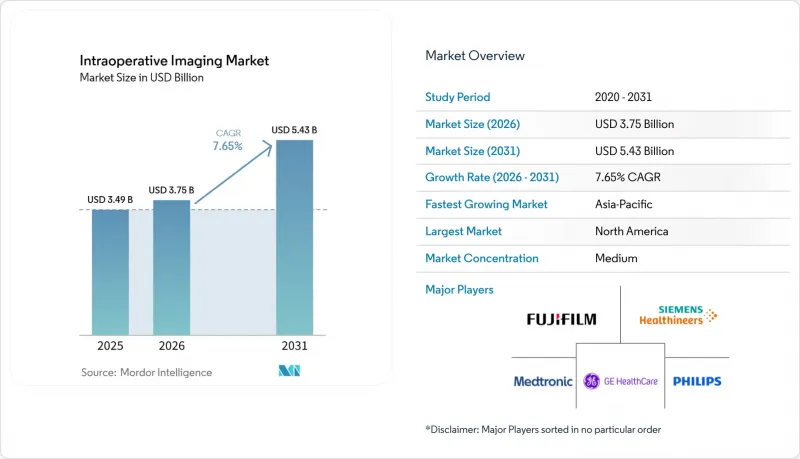
본 보고서는 제품 유형(모바일 C-암, 수술 중 CT, 수술 중 MRI 등), 용도(뇌신경외과, 정형외과·외상외과, 척추외과 등), 최종 사용자(병원, 외래수술센터(ASC) 등), 지역(북미, 유럽, 아시아태평양, 기타)별로 분류되어 있습니다. 시장 전망은 금액(달러) 기준으로 제시되어 있습니다.
전 세계 수술 중 영상 진단 시장 동향 및 인사이트
최소 침습 수술에 대한 수요 증가
개복 수술에서 최소 침습 수술로의 전환은 수술 중 영상 진단 시장에서 가장 뚜렷한 수요 증가 요인으로 계속되고 있습니다. 이는 수술 부위가 좁아 직접적인 시야 확보가 제한되는 상황에서 외과의사가 실시간 영상을 필요로 하기 때문입니다. Intuitive Surgical사는 2025년에 315만 3,000건의 다빈치(da Vinci) 수술이 시행되어 전년 대비 18% 증가했다고 보고했으며, 2026년에는 추가로 13-15% 증가를 예상하고 있습니다. 이러한 성장률은 로봇 수술 및 영상 유도 수술의 도입 속도가 여전히 많은 병원의 장비 교체 주기보다 빠른 속도로 확대되고 있음을 보여줍니다. 『Pakistan Journal of Surgical and Neurological Sciences』 지에 게재된 2024년 연구에 따르면, 기존의 안내 방식과 비교하여 첨단 수술 중 영상 진단을 도입함으로써 신경학적 합병증이 19.1%에서 5.3%로, 출혈성 합병증이 7.4%에서 2.1%로 감소한 것으로 보고되었습니다. 병원들이 측정 가능한 성과와 시술 효율성을 더욱 중시하게 됨에 따라, 수술 중 영상 진단 시장에서는 합병증 감소, 내비게이션 향상, 그리고 기술적으로 어려운 사례에서 외과의사의 자신감 향상을 추구하는 의료 기관들 수요가 계속해서 증가할 것으로 예측됩니다.
AI를 활용한 수술 중 의사결정 지원
AI는 영상 획득부터 외과적 해석에 이르기까지 소요되는 시간을 단축함으로써 수술 중 영상 진단 시장의 실용적 가치를 높이고 있습니다. 2026년 내러티브 리뷰에 따르면, 메드트로닉(Medtronic)사의 FDA 승인을 받은 ‘Spine Smart Dose’ 프로토콜은 내비게이션 정확도를 유지하면서 표준 O-arm 3D 영상 진단과 비교해 방사선 피폭량을 70% 줄일 수 있는 것으로 보고되었습니다. 동 리뷰에서는 수술 중 2D X선 영상 4장을 이용해 4초 만에 3D 요추 모델을 재구성하는 ‘X23D’ 기법에 대해서도 언급되어 있으며, 이를 통해 전용 수술 중 CT실을 갖추지 않은 의료기관에서도 고도의 내비게이션을 쉽게 활용할 수 있게 되었습니다. 또한, 이 리뷰에서 인용된 동료 심사 연구에 따르면, MRI 기반 합성 CT가 기존 CT와 동등한 안전성을 확보하면서 척추궁 나사 삽입을 지원할 수 있음이 밝혀졌으며, 이는 방사선 피폭을 줄이는 미래의 방향을 시사합니다. 2025년 『Journal of Clinical Medicine』 저널의 논문에서는 나아가 AI, 형광 영상, 증강현실(XR)이 단일 안내 계층으로 융합되기 시작하고 있음을 지적하고 있으며, 이를 통해 AI는 수술 중 영상 진단 시장에서 독립적인 부가 기능이 아니라 워크플로우를 강화하는 요소가 되고 있음을 보여주고 있습니다.
높은 초기 투자 및 수명 주기 서비스 비용
높은 도입 비용과 소유 비용은 수술 중 영상 진단 시장에서 여전히 가장 두드러진 장벽으로 남아 있으며, 특히 기능 범위가 상위권에 속하는 모달리티에서 더욱 두드러집니다. 수술 중 MRI 스위트 설치에는 건당 100만-500만 달러가 소요될 수 있으며, O-arm 시스템은 일반적으로 서비스 계약, 소프트웨어 라이선스, 교육 비용을 추가하기 전 단계에서 75만-120만 달러 범위에 속합니다. 구매 결정이 스캐너 본체에만 국한되는 경우는 거의 없으며, 병원 측은 공간 설계, 전문 인력 배치, 유지보수, 가동 중단으로 인한 위험도 고려해야 하므로 이러한 비용 요소는 중요합니다. 그 결과, 대규모 대학 병원 시스템은 중규모 병원, 지방의 구매자, 혹은 소규모 민간 그룹보다 고가 플랫폼의 도입을 더 쉽게 정당화할 수 있는 시장이 되었습니다. 이러한 비용 격차는 더 광범위한 도입 기반에 연구 개발(R&D) 및 서비스 인프라를 분산시킬 수 있는 세계 OEM 업체들에게도 유리하게 작용하며, 그 결과 수술 중 영상 진단 시장은 최첨단 제품 카테고리에서 대규모 업체들에게 유리한 상황이 지속되고 있습니다.
부문 분석
2025년, 이동식 C-암은 수술 중 영상 진단 시장 규모의 42.32%를 차지하며, 매출 기준 최대 제품 카테고리가 되었습니다. 이러한 위상은 정형외과, 외상, 심혈관 외과, 일반외과 등 폭넓은 분야에서 활용되고 있음을 반영하며, 병원 측에서는 많은 수술실과 다양한 증례 유형에 대응할 수 있는 범용성이 높은 시스템을 요구하고 있습니다. 또한, 자본 비용이 낮고 설치 공간도 작기 때문에 특히 전용 CT나 MRI실을 마련할 수 없는 시설에서는 고정식 시스템보다 도입이 용이합니다. 이 때문에 특히 병원이 가동률, 수술실의 유연성, 그리고 갱신 예산의 균형을 고려하고 있는 경우, 이동식 영상 장비는 수술 중 영상 시장의 중심적인 위치를 계속 차지하고 있습니다.
그 밖의 제품군에 대해서는 단순한 하드웨어 업그레이드에 그치지 않고, 소프트웨어 및 내비게이션 기능과의 보다 긴밀한 통합이 진행되고 있습니다. GE 헬스케어가 2026년 4월에 ‘bkActiv iUS’를, 메드트로닉이 ‘Stealth AXiS’ 디지털 링크를 시장에 출시한 것은 두개골 수술 중 수술 전 MRI 및 CT 데이터에 더해 외과의에게 수술 중 실시간 영상을 제공함으로써, 초음파 진단의 중요성이 점점 더 높아지고 있음을 보여줍니다. 수술 중 MRI 시장은 2031년까지 연평균 성장률(CAGR) 7.78%를 나타낼 것으로 예측되며, 이는 제품 라인업 중 가장 빠른 성장 속도입니다. 또한, IMRIS는 2025년 8월 자사의 ‘InVision 3T Recharge Operating Suite’에 대해 FDA 510(k) 승인을 획득했습니다. 이를 통해 병원은 시설 개조 없이 기존 지멘스(Siemens)사의 ‘Magnetom Verio’ 시스템을 AI 통합형 플랫폼 ‘Skyra Fit’으로 업그레이드할 수 있게 되었습니다. 캐논 메디컬이 2025년 11월 ‘Alphenix 4D CT’에 대해 FDA의 510(k) 승인을 획득한 것은 수술 중 CT가 수술 중 영상 진단 시장에서 중견 모달리티로서 계속해서 중요한 역할을 하고 있음을 뒷받침하는 것입니다.
지역별 분석
2025년, 북미는 수술 중 영상 시장 규모의 42.87%를 차지하며 계속해서 최대 지역 기여자로서의 지위를 유지했습니다. 미국은 여전히 주요 견인 역할을 하고 있습니다. 이는 2025년 및 2026년의 FDA 승인 흐름이 뇌신경외과, 척추외과, MRI, CT 및 중재적 시술 안내 각 분야에서 Brainlab, IMRIS, 캐논 메디컬, Philips의 주요 플랫폼을 포괄했기 때문입니다. 이러한 높은 제품 사이클 밀도는 병원에 더 많은 업그레이드 선택지를 제공할 뿐만 아니라, 소프트웨어 기능이 검출기나 스캐너 하드웨어만큼 중요해지고 있는 모달리티에서 보다 신속한 업데이트 결정을 촉진하고 있습니다.
유럽은 2025년에도 2위 지역 시장으로서의 지위를 유지했습니다. 이는 성숙한 병원 체계, 확립된 영상 진단 기준, 그리고 첨단 수술 워크플로우 도구에 대한 수요가 뒷받침한 결과입니다. Philips는 FDA 510(k) 승인과 CE 마킹을 동시에 획득한 후, 2026년 3월에 ‘IntraSight Plus’를 출시했습니다. 이는 프리미엄 가이던스 플랫폼의 첫 번째 상용화 지역으로서 유럽이 계속해서 중요한 역할을 하고 있음을 보여줍니다. 또한, 이 지역은 AI를 활용한 내비게이션 및 선량 관리 측면에서도 여전히 중요하며, 최근 임상 문헌에서는 재구성 속도 향상, 방사선 피폭 감소, 그리고 영상 레이어와 가이드 레이어의 보다 긴밀한 통합이 강조되고 있습니다. 의료기기 규정(MDR) 체계에 기반한 CE 마크는 보다 광범위한 상용화를 촉진하겠지만, 소프트웨어 및 알고리즘 업데이트와 관련된 증거 제시 부담으로 인해 수술 중 영상 시장에서 공급업체의 실행력에 대한 요구는 계속해서 높은 수준을 유지할 것입니다.
아시아태평양은 2031년까지 연평균 성장률(CAGR) 7.73%를 나타낼 것으로 예측되며, 수술 중 영상 진단 시장에서 가장 두드러진 성장을 보일 것으로 전망됩니다. 이러한 성장 추세는 북미보다 더 광범위하게 나타나고 있습니다. 이는 지속적으로 확장되는 외과 센터에서의 초기 도입과, 고도화된 의료 수요를 가진 병원에서의 프리미엄 시스템 선택적 도입이 결합된 결과입니다. 이로 인해 이동식 C-암의 확대와 통합 내비게이션, 수술 중 CT, 수술 중 MRI 플랫폼에 대한 장기적인 수요 모두에 여지가 생기고 있습니다.
기타 혜택:
- 엑셀 형식 시장 예측(ME) 시트
- 3개월간의 애널리스트 지원
자주 묻는 질문
목차
제1장 서론
제2장 조사 방법
제3장 주요 요약
제4장 시장 구도
제5장 시장 규모와 성장 예측
제6장 경쟁 구도
제7장 시장 기회와 향후 전망
JHS 26.08.05According to Mordor Intelligence, the intraoperative imaging market size was valued at USD 3.49 billion in 2025 and is estimated to grow from USD 3.75 billion in 2026 to reach USD 5.43 billion by 2031, at a CAGR of 7.65% during the forecast period (2026-2031).
This report is Segmented by Product Type (Mobile C-Arms, Intraoperative Computed Tomography, Intraoperative Magnetic Resonance Imaging, and More), Application (Neurosurgery, Orthopedic and Trauma Surgery, Spine Surgery, and More), End User (Hospitals, Ambulatory Surgical Centers, and More), and Geography (North America, Europe, Asia-Pacific, and Other). The Market Forecasts are Provided in Value (USD)
Global Intraoperative Imaging Market Trends and Insights
Rising Demand for Minimally Invasive Surgery
The shift from open procedures to minimally invasive surgery remains the clearest volume driver for the intraoperative imaging market because surgeons need live imaging when the operative field is smaller and direct visualization is limited. Intuitive Surgical reported 3,153,000 da Vinci procedures in 2025, up 18% from the prior year, and it expects another 13-15% increase in 2026. That growth rate indicates that robotic and image-guided surgical capacity is still expanding faster than many hospital capital replacement cycles. A 2024 study in the Pakistan Journal of Surgical and Neurological Sciences reported that advanced intraoperative imaging reduced neurological complications to 5.3% from 19.1% and bleeding complications to 2.1% from 7.4% when compared with conventional guidance. As hospitals place more weight on measurable outcomes and procedural efficiency, the intraoperative imaging market is likely to see continued demand from centers that want fewer complications, better navigation, and stronger surgeon confidence during technically constrained cases.
AI-Enabled Intraoperative Decision Support
AI is improving the practical value of the intraoperative imaging market by reducing the time between image acquisition and surgical interpretation. A 2026 narrative review reported that Medtronic's FDA-cleared Spine Smart Dose protocol can reduce radiation dose by 70% versus standard O-arm 3D imaging while maintaining navigation accuracy. The same review described the X23D method, which reconstructs a 3D lumbar vertebra model from 4 intraoperative 2D X-rays in 4 seconds, making advanced navigation more accessible in sites without dedicated intraoperative CT suites. Peer reviewed studies cited in that review also showed that MRI-based synthetic CT can support pedicle screw placement safety comparable to conventional CT, which points to a future pathway with less radiation exposure. A 2025 Journal of Clinical Medicine paper further noted that AI, fluorescence, and extended reality are starting to converge into a single guidance layer, which makes AI a workflow enhancer rather than a separate add-on for the intraoperative imaging market.
High Capital and Lifecycle Service Cost
High acquisition and ownership costs remain the most visible barrier in the intraoperative imaging market, especially for modalities at the top end of the capability range. Intraoperative MRI suites can require USD 1-5 million per installation, while O-arm systems typically sit in the USD 750,000-1.2 million range, before service contracts, software licensing, and training are added. These cost layers matter because the buying decision is rarely limited to the scanner alone, and hospitals must account for room design, specialist staffing, maintenance, and downtime exposure. The result is a market where large academic systems can justify premium platforms more easily than mid-tier hospitals, rural buyers, or smaller private groups. This cost gap also favors global OEMs that can spread R&D and service infrastructure over a wider installed base, which keeps the intraoperative imaging market tilted toward scale players in the most advanced product categories.
Other drivers and restraints analyzed in the detailed report include:
- Hybrid Operating Room Retrofit Cycles in Tertiary Hospitals
- Expansion of Same-Day Complex Procedures in Ambulatory Settings
- Reimbursement Pressure on High-Cost Imaging Procedures
For complete list of drivers and restraints, kindly check the Table Of Contents.
Segment Analysis
Mobile C-arms held 42.32% of the intraoperative imaging market size in 2025, making them the largest product category by revenue. Their position reflects broad use across orthopedic, trauma, cardiovascular, and general surgery, where hospitals want versatile systems that fit many rooms and case types. Lower capital cost and a smaller physical footprint also make them easier to adopt than fixed systems, especially in facilities that cannot support dedicated CT or MRI suites. This keeps mobile imaging at the center of the intraoperative imaging market, particularly where hospitals are balancing utilization, room flexibility, and replacement budgets.
The rest of the product mix is moving toward tighter software and navigation integration rather than simple hardware upgrades alone. GE HealthCare's April 2026 commercial launch of the bkActiv iUS and Medtronic Stealth AXiS digital link shows how ultrasound is gaining relevance by giving surgeons live intraoperative images alongside pre-operative MRI or CT data during cranial procedures. Intraoperative MRI is projected to grow at 7.78% CAGR through 2031, the fastest pace in the product mix, and IMRIS received FDA 510(k) clearance in August 2025 for its InVision 3T Recharge Operating Suite, which lets hospitals upgrade legacy Siemens Magnetom Verio systems to the AI-integrated Skyra Fit platform without reconstructing the facility. Canon Medical's November 2025 FDA 510(k) clearance for Alphenix 4D CT reinforced the continuing role of intraoperative CT as a strong mid-tier modality inside the intraoperative imaging market.
Complete Report Scope:
- By Product Type
- Mobile C-Arms
- Intraoperative Computed Tomography
- Intraoperative Magnetic Resonance Imaging
- Intraoperative Ultrasound
- Others (Intraoperative Endoscopic Imaging Systems and Intraoperative X-ray Systems, among others)
- By Application
- Neurosurgery
- Orthopedic and Trauma Surgery
- Spine Surgery
- Cardiovascular Surgery
- Other Applications (Gastrointestinal Surgery and Pediatric Surgery, among others)
- By End User
- Hospitals
- Ambulatory Surgical Centers
- Clinics
- Others (Academic & Research Institutes and Specialty Surgical Centers, among others)
- By Geography
- North America
- United States
- Canada
- Mexico
- Europe
- Germany
- United Kingdom
- France
- Italy
- Spain
- Rest of Europe
- Asia-Pacific
- China
- India
- Japan
- South Korea
- Australia
- Rest of Asia-Pacific
- Middle East & Africa
- GCC
- South Africa
- Rest of Middle East and Africa
- South America
- Brazil
- Argentina
- Rest of South America
- North America
Geography Analysis
North America held 42.87% of the intraoperative imaging market size in 2025, which kept it as the largest regional contributor. The United States remains the main driver because the FDA clearance flow in 2025 and 2026 covered major platforms from Brainlab, IMRIS, Canon Medical, and Philips across neurosurgery, spine, MRI, CT, and interventional guidance. This product cycle density gives hospitals more upgrade options and supports faster replacement decisions in modalities where software capability is becoming as important as detector or scanner hardware.
Europe remained the second-largest regional base in 2025, supported by mature hospitals, established imaging standards, and demand for advanced surgical workflow tools. Philips launched IntraSight Plus in March 2026 after simultaneous FDA 510(k) clearance and CE marking, which shows that Europe continues to matter as a first-wave commercial region for premium guidance platforms. The region also remains important for AI-enabled navigation and dose management, where recent clinical literature has emphasized better reconstruction speed, lower radiation exposure, and closer integration between imaging and guidance layers. CE marking under the Medical Device Regulation framework supports broader commercialization, but the evidence burden around software and algorithm updates will keep vendor execution discipline high inside the intraoperative imaging market.
Asia-Pacific is projected to grow at 7.73% CAGR through 2031, making it the fastest-growing region in the intraoperative imaging market. The growth profile is broader than in North America because it combines first-time placements in expanding surgical centers with selective uptake of premium systems in high-acuity hospitals. This creates room for both mobile C-arm expansion and longer-term demand for integrated navigation, intraoperative CT, and intraoperative MRI platforms.
- Activ Surgical, Inc.
- Allengers
- Brain Lab
- Canon
- Carl Zeiss
- Esaote S.p.A.
- FUJIFILM
- GE Healthcare
- Hitachi
- IMRIS, Inc.
- Koninklijke Philips
- Medtronic
- NeuroLogica
- Samsung Group
- Shenzhen Anke High-tech Co., Ltd.
- Mindray
- Shimadzu
- Siemens Healthineers
- Stryker
- Ziehm Imaging
Additional Benefits:
- The market estimate (ME) sheet in Excel format
- 3 months of analyst support
TABLE OF CONTENTS
1 INTRODUCTION
- 1.1 Study Assumptions and Market Definition
- 1.2 Scope of the Study
2 RESEARCH METHODOLOGY
3 EXECUTIVE SUMMARY
4 MARKET LANDSCAPE
- 4.1 Market Overview
- 4.2 Market Drivers
- 4.2.1 Rising Demand for Minimally Invasive Surgery
- 4.2.2 Wider Use of Real-Time Surgical Navigation and Image Guidance
- 4.2.3 AI-Enabled Intraoperative Decision Support
- 4.2.4 Hybrid Operating Room Retrofit Cycles in Tertiary Hospitals
- 4.2.5 Expansion of Same-Day Complex Procedures in Ambulatory Settings
- 4.2.6 Increase in the Prevalence of Chronic Diseases
- 4.3 Market Restraints
- 4.3.1 High Capital and Lifecycle Service Cost
- 4.3.2 Reimbursement Pressure on High-Cost Imaging Procedures
- 4.3.3 Sterile Workflow and OR Integration Complexity
- 4.3.4 Safety Concerns & Regulatory Hurdles
- 4.4 Value Chain Analysis
- 4.5 Regulatory Landscape
- 4.6 Technological Outlook
- 4.7 Porter's Five Forces Analysis
- 4.7.1 Threat of New Entrants
- 4.7.2 Bragaining Power of Suppliers
- 4.7.3 Bragaining Power of Buyers
- 4.7.4 Threat of Substitutes
- 4.7.5 Industry Rivalry
5 MARKET SIZE AND GROWTH FORECASTS
- 5.1 By Product Type
- 5.1.1 Mobile C-Arms
- 5.1.2 Intraoperative Computed Tomography
- 5.1.3 Intraoperative Magnetic Resonance Imaging
- 5.1.4 Intraoperative Ultrasound
- 5.1.5 Others (Intraoperative Endoscopic Imaging Systems and Intraoperative X-ray Systems, among others)
- 5.2 By Application
- 5.2.1 Neurosurgery
- 5.2.2 Orthopedic and Trauma Surgery
- 5.2.3 Spine Surgery
- 5.2.4 Cardiovascular Surgery
- 5.2.5 Other Applications (Gastrointestinal Surgery and Pediatric Surgery, among others)
- 5.3 By End User
- 5.3.1 Hospitals
- 5.3.2 Ambulatory Surgical Centers
- 5.3.3 Clinics
- 5.3.4 Others (Academic & Research Institutes and Specialty Surgical Centers, among others)
- 5.4 By Geography
- 5.4.1 North America
- 5.4.1.1 United States
- 5.4.1.2 Canada
- 5.4.1.3 Mexico
- 5.4.2 Europe
- 5.4.2.1 Germany
- 5.4.2.2 United Kingdom
- 5.4.2.3 France
- 5.4.2.4 Italy
- 5.4.2.5 Spain
- 5.4.2.6 Rest of Europe
- 5.4.3 Asia-Pacific
- 5.4.3.1 China
- 5.4.3.2 India
- 5.4.3.3 Japan
- 5.4.3.4 South Korea
- 5.4.3.5 Australia
- 5.4.3.6 Rest of Asia-Pacific
- 5.4.4 Middle East & Africa
- 5.4.4.1 GCC
- 5.4.4.2 South Africa
- 5.4.4.3 Rest of Middle East and Africa
- 5.4.5 South America
- 5.4.5.1 Brazil
- 5.4.5.2 Argentina
- 5.4.5.3 Rest of South America
- 5.4.1 North America
6 COMPETITIVE LANDSCAPE
- 6.1 Market Concentration
- 6.2 Market Share Analysis
- 6.3 Company Profiles (includes Global Level Overview, Market Level Overview, Core Segments, Financials as available, Strategic Information, Market Rank/Share, Products and Services, Recent Developments)
- 6.3.1 Activ Surgical, Inc.
- 6.3.2 Allengers Medical Systems Limited
- 6.3.3 Brainlab AG
- 6.3.4 Canon Medical Systems Corporation
- 6.3.5 Carl Zeiss Meditec AG
- 6.3.6 Esaote S.p.A.
- 6.3.7 FUJIFILM Holdings Corporation
- 6.3.8 GE HealthCare
- 6.3.9 Hitachi, Ltd.
- 6.3.10 IMRIS, Inc.
- 6.3.11 Koninklijke Philips N.V.
- 6.3.12 Medtronic plc
- 6.3.13 NeuroLogica Corp.
- 6.3.14 Samsung Medison Co., Ltd.
- 6.3.15 Shenzhen Anke High-tech Co., Ltd.
- 6.3.16 Shenzhen Mindray Bio-Medical Electronics Co., Ltd.
- 6.3.17 Shimadzu Corporation
- 6.3.18 Siemens Healthineers AG
- 6.3.19 Stryker
- 6.3.20 Ziehm Imaging GmbH
7 MARKET OPPORTUNITIES AND FUTURE OUTLOOK
- 7.1 White-Space and Unmet-Need Assessment


