

|
시장보고서
상품코드
2099305
네트워크 고밀도화용 광섬유 백본 : 시장 점유율 분석, 업계 동향 및 통계, 성장 예측(2026-2031년)Fiber Backbone For Network Densification - Market Share Analysis, Industry Trends & Statistics, Growth Forecasts (2026 - 2031) |
||||||
 Mordor Intelligence
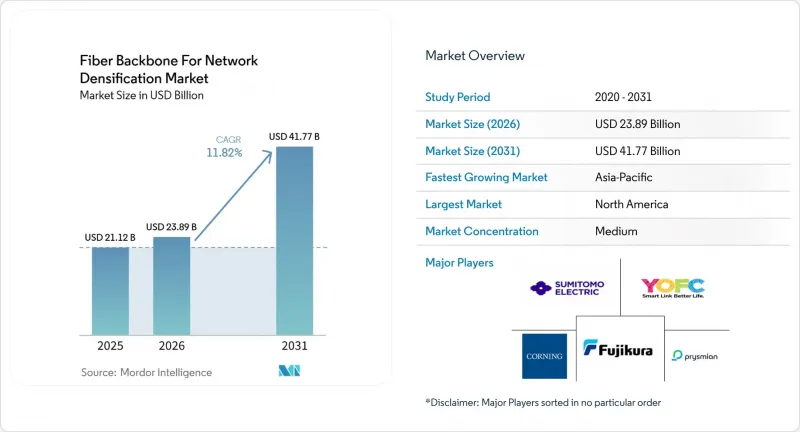
Mordor Intelligence에 의하면, 네트워크 고밀도화용 광섬유 백본 시장 규모는 2025년에 211억 2,000만 달러로 평가되었고, 2031년까지 417억 7,000만 달러에 이를 것으로 예측되며, 2026년부터 2031년에 걸쳐 CAGR 11.82%로 성장할 전망입니다.
본 보고서는 구축 유형(지하, 공중, 기타), 광섬유 유형(단일 모드, 다중 모드), 구성 요소(광섬유 케이블, 전송 장비, 기타), 최종 사용자(통신 사업자, 하이퍼스케일, 기업, 공공 부문, 기타), 지역(북미, 남미, 아시아태평양, 기타)별로 분류되어 있습니다. 시장 전망은 금액(달러) 기준으로 제시되어 있습니다.
세계의 네트워크 고밀도화용 광섬유 백본 시장 동향 및 인사이트
5G 스몰셀의 고밀도화 및 용량 확대
모바일 네트워크 밀도 향상은 광섬유 백본 시장에 있어 가장 시급한 단기 수요 견인 요인입니다. 독립형 5G 및 클라우드 RAN 구성에는 신뢰성이 높은 프론트홀 및 집약 링크가 필요하며, 이로 인해 고밀도 무선 기지국 구축에서 광섬유가 계속해서 핵심적인 역할을 수행하고 있습니다. 통신 사업자가 스몰 셀을 증설하고 전송 용량을 확대함에 따라, 네트워크 계획은 개별 기지국의 업그레이드에서 보다 광범위한 지역 백본 구축으로 전환되고 있습니다. 이는 도시 지역의 네트워크 밀도가 높아짐에 따라 무선 클러스터와 코어 계층 간의 지연 제어 강화, 경로 다양성 향상, 그리고 전송 안정화가 요구되기 때문에 중요합니다. 또한, 서비스 품질 요건을 완화하기 어려운 프론트홀 링에서는 무선 기반의 대체 수단이 실질적으로 채택될 여지가 좁아집니다. 그 결과, 향후 AI 및 엔터프라이즈 트래픽 증가가 완전히 표면화되기 전부터 네트워크 고밀도화 시장에서의 광섬유 백본 구축 주기는 더욱 안정화될 것입니다.
AI로 인한 트래픽 증가와 동서 방향 백본의 혼잡
AI 워크로드는 기존의 트래픽 증가 주기와는 다른 형태로, 네트워크 고밀도화용 광섬유 백본의 모습을 변화시키고 있습니다. 기존 인터넷의 성장은 주로 사용자에서 서버로 향하는 트래픽에 의해 주도되었으나, AI 훈련 및 추론은 컴퓨팅 클러스터 내부 및 클러스터 간에 대규모 동서 방향 트래픽을 발생시킵니다. 이러한 변화로 인해 혼잡이 발생하는 위치도 변화하고 있습니다. 주요 AI 데이터센터 허브에 연결된 경로에서는 광역 국내 네트워크보다 더 빠르게 트래픽 부하가 증가하고 있기 때문입니다. 또한, AI 캠퍼스는 기존 서버 시설에 비해 더 높은 밀도, 더 많은 경로 중복성, 그리고 더 큰 광 용량을 필요로 하기 때문에 사이트당 광섬유 요구 사항도 높아지고 있습니다. 그 결과, 하이퍼스케일러의 대규모 경로 발주는 기간이 장기화되고 광섬유 본수도 증가하고 있어, 이는 케이블 제조의 경제성과 조달 시기에 변화를 가져오고 있습니다. 네트워크 고밀도화용 광섬유 백본의 경우, 네트워크의 다른 부분에서 수요가 정상화되기 전에 특정 회랑을 따라 장거리 및 메트로 백본에 대한 투자가 촉진되고 있습니다.
높은 토목 공사비 및 부지 확보 지연
토목 공사비 및 인허가 취득 비용은 네트워크 고밀도화용 광섬유 백본에 있어 단기적으로 가장 큰 걸림돌이 되고 있습니다. 파이버 브로드밴드 협회(Fiber Broadband Association)의 보고서에 따르면, 2025년에 미국 광섬유 구축 사업자의 92%가 비용 증가에 직면했으며, 지하 매설 비용의 중앙값은 1피트당 18달러, 공중 매설 비용은 1피트당 8달러에 달했습니다. 동 업계 조사에 따르면, 응답자의 88%가 2026년에 추가적인 비용 상승을 예상하고 있으며, 그 주요 요인으로 인건비, 자재비, 인허가 취득 비용 및 개통 준비 작업이 꼽혔습니다. 백본 회선은 수익을 창출하는 서비스가 단 하나라도 가동되기 전에 막대한 초기 토목 투자가 필요하기 때문에 이러한 비용 압박은 중요한 문제가 됩니다. 또한, 부지 사용 허가의 지연은 프로젝트 공정 계획에도 악영향을 미칩니다. 단 한 곳의 교차 지점에서 허가가 나지 않는 것만으로도 회랑 전체의 수익성이 훼손될 가능성이 있기 때문입니다. 네트워크 고밀도화용 광섬유 백본 분야에서는 이러한 제약으로 인해 장기적인 수요 감소라기보다는 오히려 일정 및 비용 관리 측면에서 노선의 가동 개시가 지연되고 있습니다.
부문 분석
2025년, 지하 광섬유 백본은 도입 형태별 매출의 45.98%를 차지하며, 네트워크 고밀도화용 광섬유 백본 시장에서 가장 큰 비중을 차지하는 도입 형태가 되었습니다. 이러한 우위는 고밀도 회랑에서 사업자가 매설형 인프라를 선호하는 경향을 반영합니다. 이러한 회랑에서는 노선의 안전성, 자산의 내구 연수, 그리고 장기적인 유지 관리 비용의 낮음이 초기 건설 비용보다 더 중요하게 여겨지기 때문입니다. 메트로 링 및 주요 도시 간 백본 구간에서도 5G 프론트홀 및 데이터센터 간 연결 트래픽의 경우 경로 불안정성에 대한 허용도가 낮기 때문에 지하 매설이 계속해서 선호되고 있습니다. 해저 및 도시 간 광섬유 백본은 2026년부터 2031년에 걸쳐 연평균 성장률(CAGR) 12.87%를 나타낼 것으로 예측되며, 이는 광섬유 백본에서 메트로 지역의 보완과 병행하여 장거리 노선 구축이 탄력을 받고 있으며, 네트워크의 고도화와 시장 규모 확대를 견인하고 있음을 보여줍니다.
또한, 많은 새로운 AI 시설이 기존 광섬유 부설권 범위 밖의 전력 공급이 풍부한 그린필드 지역에 설치됨에 따라 그 구성도 변화하고 있습니다. 이러한 배치로 인해 새로운 컴퓨팅 거점과 기존 교환점 및 클라우드 리전을 연결하는 도시 간 구간에 대한 새로운 수요가 발생하고 있습니다. 시애틀과 미니애폴리스를 연결하는 Lumen사의 ‘NorthLine’ 노선은 이러한 추세를 명확히 보여줍니다. 이 노선은 미국 북부에서 부상하고 있는 데이터센터 회랑을 중심으로 설계되었으며, 2026년 말까지 이용 가능해질 전망입니다. 동시에, 도시 지역의 매설 공사에서는 마이크로 트렌치 공법이 점점 더 중요해지고 있습니다. 이는 포장된 도시 도로에서 공사로 인한 혼란을 줄이고 구축 시간을 단축할 수 있기 때문입니다. 이러한 새로운 도시 간 수요와 더 신속한 도시 내 설치 기법의 결합으로 인해, 네트워크 고밀도화용 광섬유 백본 구축 엔지니어링의 역할이 확대되고 있습니다. 또한, 이는 경로 설계가 점점 더 지역 특화형으로 바뀌고 있음을 의미하며, 핵심 회랑에서는 지하 매설이 주류를 이루는 반면, 새로 연결되는 장거리 경로에서는 새로운 기회가 증가하고 있습니다.
2025년에는 싱글모드 광섬유가 매출의 89.96%를 차지하며, 네트워크 고밀도화용 광섬유 백본 시장에서 확고한 우위를 유지했습니다. 이러한 우위는 백본, 메트로 링 및 5G 프론트홀 네트워크가 더 긴 전송 거리와 코히런트 광통신과의 호환성을 필요로 하며, 이 분야에서 단일모드가 여전히 표준적인 선택지로 자리 잡고 있다는 사실을 반영합니다. ITU-T G.652.D와 같은 표준 규격은 여전히 주류 백본 구축의 기반이 되고 있지만, G.654.E는 장거리에서 저감쇠가 필요한 대용량 장거리 통신 및 해저 통신 분야에서 그 중요성이 커지고 있습니다. 또한 중국에서는 백본 업그레이드를 400 Gbps 및 800 Gbps 네트워크 용량으로 추진하고 있어, 고밀도 전송 계층을 위한 고성능 단일 모드 인프라의 지속적인 조달을 뒷받침하고 있습니다. 다중모드 광섬유는 2031년까지 연평균 성장률(CAGR) 9.99%를 나타낼 것으로 예측되지만, 그 성장은 코어 전송이 아닌 단거리 캠퍼스 내 및 데이터센터 간 연결 용도에 집중되어 있습니다.
싱글모드 광섬유 역시 더 고밀도인 케이블 설계를 통해 경쟁력을 확대되고 있습니다. 프리즘(Prismian)사는 2025년 10월, BendBrightXS 160µm 싱글모드 광섬유를 출시했습니다. 이를 통해 새로운 토목 공사를 필요로 하지 않고도, 케이블 1개나 덕트 1개당 더 많은 광섬유를 수용할 수 있게 됩니다. 도시 지역이나 캠퍼스 환경에서 덕트 공간이 전략적 제약 요인으로 대두되고 있기 때문에 이러한 설계는 중요합니다. 케이블 밀도가 향상됨에 따라, 물리적 배치 제약으로 인해 과거에는 멀티모드에 의존했던 이용 사례에도 싱글모드 솔루션을 도입할 수 있게 됩니다. 네트워크 고밀도화용 광섬유 백본 시장에서는 단거리 용도가 확대되고 있음에도 불구하고, 이러한 추세로 인해 광섬유 유형의 전반적인 구성 비율이 급격히 변화하는 것을 막고 있습니다. 또한, 전송 거리뿐만 아니라 용량 밀도가야말로 네트워크 고밀도화 업계 전체의 광섬유 백본 조달 결정을 좌우하고 있다는 관점을 뒷받침하고 있습니다.
지역별 분석
2025년, 북미는 매출의 33.12%를 차지하며 네트워크 고밀도화용 광섬유 백본 시장에서 가장 큰 시장 점유율을 기록했습니다. 이 지역에서는 5G 고밀도화가 활발히 진행되고 있는 데다, 하이퍼스케일 AI 인프라에 대한 막대한 투자와 공공 광대역 지원이 맞물려 메트로 회선 및 장거리 회선 수요가 모두 높은 수준을 유지하고 있습니다. 각 하이퍼스케일러 기업들이 광섬유 조달, 건설 및 전송 시스템 업그레이드를 앞당길 정도로 대규모로 연산 능력과 상호 연결 용량을 확대하고 있어, 미국은 여전히 주요 견인차 역할을 하고 있습니다. 또한, 데이터센터에 대한 투자가 전력 공급 상황과 안정적인 운영 환경을 추구하는 형태로 진행되고 있어 캐나다의 중요성도 높아지고 있으며, 이로 인해 백본에 대한 수요가 미국의 주요 허브 지역 이외로도 확대되고 있습니다.
아시아태평양은 2026년부터 2031년에 걸쳐 연평균 성장률(CAGR) 13.87%로 확대될 것으로 예측되며, 네트워크 고밀도화 시장 내 광 백본 분야에서 가장 빠르게 성장하는 지역 블록이 될 전망입니다. 중국은 대용량 광전송과 주요 컴퓨팅 허브 간 연결 강화를 중시하는 백본 현대화 계획을 통해 이 지역의 성장을 주도하고 있습니다. 일본도 비슷한 길을 걷고 있으며, KDDI는 2026년 6월에 상용 디스어그리게이트형 백본 라우터 제공을 시작했고, 소프트뱅크는 2027년까지 전국 규모의 전광 메트로 네트워크 구축을 목표로 하고 있습니다. 또한, NTT 및 NTT 동일본은 올-포토닉스 네트워킹을 위한 고속 광파장 경로 전환 기술을 실증하고 있으며, 이는 AI 시대에 더욱 민첩한 전송을 목표로 하는 이 지역의 노력을 뒷받침하고 있습니다. 인도와 한국은 5G의 지속적인 확대와 데이터센터 간 연결 수요 증가를 통해 더욱 탄력을 받고 있으며, 아시아태평양은 단일 국내 시장에 집중하기보다는 폭넓은 기반을 유지하고 있습니다.
유럽은 민간 사업자의 수익이 압박받는 상황에서도 규제 및 정책적 지원이 백본 투자 유지에 기여하고 있어, 전략적으로 중요한 지역으로 남아 있습니다. 이 지역의 디지털 연결 관련 과제는 여전히 회원국 전체에 걸쳐 기가비트급 인프라에 대한 대규모 투자가 필요하며, 이것이 노선의 지속적인 확장 및 현대화를 뒷받침하고 있습니다. 영국, 독일, 프랑스, 이탈리아가 주요 시장으로 자리 잡고 있는 반면, 중동유럽에서는 보급률이 낮은 지역에서 그린필드형 노선 투자가 여전히 수익성을 기대할 수 있는 여지가 있습니다. 중동 및 아프리카의 기여도는 비교적 작지만, 사우디아라비아, 아랍에미리트(UAE), 이집트, 남아프리카공화국에서는 각국의 광대역 계획 및 도시 지역 연결 프로그램이 백본 수요를 뒷받침하고 있습니다. 남미에서는 하이퍼스케일 및 상호 연결 활동이 활발해짐에 따라 브라질에서 집중적인 성장이 나타나고 있지만, 지역 전체의 개발은 여전히 보다 선택적이며, 회랑 기반의 확장이 중심을 이루고 있습니다.
기타 혜택 :
- 엑셀 형식 시장 예측(ME) 시트
- 3개월간의 애널리스트 지원
자주 묻는 질문
목차
제1장 서론
제2장 조사 방법
제3장 주요 요약
제4장 시장 구도
제5장 시장 규모 및 성장 예측
제6장 경쟁 구도
제7장 시장 기회 및 향후 전망
KTH 26.08.10According to Mordor Intelligence, the fiber backbone for network densification market size was USD 21.12 billion in 2025 and is forecast to reach USD 41.77 billion by 2031, growing at a CAGR of 11.82% over 2026-2031.
This report is Segmented by Deployment Type (Underground, Aerial, and More), Fiber Type (Single-Mode and Multi-Mode), Component (Optical Fiber Cable, Transmission Equipment, and More), End User (Telecom Operators, Hyperscale, Enterprises, Public Sector, and More), and Geography (North America, South America, Asia-Pacific, and More). The Market Forecasts are Provided in Terms of Value (USD).
Global Fiber Backbone For Network Densification Market Trends and Insights
5G Small Cell Densification and Capacity Expansion
Mobile network densification is the most immediate near-term demand lever for the fiber backbone market. Standalone 5G and cloud-RAN layouts require highly reliable fronthaul and aggregation links, which keep fiber at the center of dense radio site buildouts. As operators add more small cells and raise transport capacity, network planning is moving from isolated site upgrades toward broader regional backbone commitments. That matters because denser urban footprints need tighter latency control, higher route diversity, and more stable transport between radio clusters and core layers. It also reduces the practical room for wireless substitutes in fronthaul rings, where service-quality requirements are harder to relax. The result is a steadier build cycle for the fiber backbone for the network densification market, even before later AI and enterprise traffic gains become fully visible.
AI-Driven Traffic Growth and East-West Backbone Congestion
AI workloads are reshaping the fiber backbone for the network densification market in ways that differ from earlier traffic growth cycles. Traditional internet growth was driven mainly by user-to-server traffic, whereas AI training and inference generate large east-west flows within and across compute clusters. That shift changes where congestion appears, because routes connected to major AI data center hubs are seeing traffic strain earlier than broad national networks. It also raises the fiber requirement per site, since AI campuses need greater density, more route redundancy, and more optical headroom than legacy server facilities. Large route orders from hyperscalers are therefore becoming longer in duration and larger in fiber count, which is changing cable manufacturing economics and procurement timing. In the fiber backbone for network densification market, this is driving long-haul and metro backbone investment along selected corridors before demand normalizes across the rest of the network.
High Civil Works Cost and Right-Of-Way Delays
Civil works and permitting costs are the largest near-term drag on the fiber backbone for the network densification market. The Fiber Broadband Association reported that 92% of US fiber deployers faced cost increases in 2025, while median underground deployment costs reached USD 18.00 per foot and aerial deployment costs reached USD 8.00 per foot. The same industry feedback showed that 88% of respondents expected further cost increases in 2026, with labor, materials, permitting, and make-ready work remaining the main drivers. These pressures matter because backbone routes require high up-front civil spending before a single revenue-generating service goes live. Delays in right-of-way approvals also weaken project sequencing, since a single blocked crossing can disrupt the economics of an entire corridor. In the fiber backbone for network densification market, this restraint is slowing route activation more through timing and cost discipline than through any drop in long-term demand.
Other drivers and restraints analyzed in the detailed report include:
- Hyperscale and Edge Data Center Interconnect Expansion
- Government Fiberization Programs and Public Funding
- Limited Duct and Pole Availability in Dense Urban Corridors
For complete list of drivers and restraints, kindly check the Table Of Contents.
Segment Analysis
Underground fiber backbone accounted for 45.98% of deployment-type revenue in 2025, making it the largest deployment format in the fiber backbone for network densification market share. That lead reflects the operator's preference for buried infrastructure in high-density corridors, where route security, asset life, and lower long-term maintenance costs carry more weight than initial build cost. Metro rings and major intercity backbone sections also continue to favor underground placement because 5G fronthaul and data center interconnect traffic leave less tolerance for route instability. Aerial routes remain relevant where speed and lower up-front cost matter most, but they face more timeline risk in dense zones because access and permitting can delay installation. The submarine and intercity fiber backbone is projected to grow at a 12.87% CAGR from 2026 to 2031, indicating that long-haul route creation is gaining momentum alongside metro infill in the fiber backbone, driving network densification and market size.
The mix is also changing because many new AI facilities are being placed in power-rich greenfield locations outside legacy fiber rights-of-way. That placement is creating fresh demand for intercity segments that connect new compute locations to existing exchange points and cloud regions. Lumen's NorthLine route between Seattle and Minneapolis clearly shows this pattern, as it was designed around emerging northern US data center corridors and is expected to be available by the end of 2026. At the same time, micro-trenching is becoming increasingly important in metropolitan infill because it reduces disruption and shortens deployment time on sealed urban surfaces. This combination of new intercity demand and faster urban installation methods is broadening the role of deployment engineering in the fiber backbone for the network densification market. It also means route design is becoming more location-specific, with underground strength in core corridors and rising opportunities across newly connected long-haul paths.
Single-mode fiber accounted for 89.96% of revenue in 2025, keeping it firmly dominant in the fiber backbone for network densification market size. Its lead reflects the fact that backbone, metro ring, and 5G fronthaul networks depend on longer reach and coherent optical compatibility, where single-mode remains the standard choice. Standard references such as ITU-T G. 652. D still anchors mainstream backbone deployment, while G. 654. E is gaining relevance in higher-capacity long-haul and submarine applications that need lower attenuation over longer distances. China is also pushing backbone upgrades toward 400 Gbps and 800 Gbps network capabilities, supporting continued procurement of high-performance single-mode infrastructure for dense transport layers. Multi-mode fiber is still projected to grow at a 9.99% CAGR through 2031, but that growth remains centered on short-reach campus and data center interconnect use rather than core transport.
Single-mode fiber is also extending its competitive reach through denser cable design. Prysmian launched BendBrightXS 160µm single-mode fiber in October 2025, enabling more fibers per cable and per duct without requiring new civil works. That kind of design matters because duct space is becoming a strategic constraint in urban and campus environments. As cable density improves, single-mode solutions can enter use cases that once relied more on multi-mode due to physical packing constraints. In the fiber backbone for network densification market, this keeps the overall fiber type mix from shifting quickly, even as short-reach applications grow. It also reinforces the view that capacity density, not only transmission reach, is shaping procurement decisions across the broader fiber backbone for the network densification industry.
Complete Report Scope:
- By Deployment Type
- Underground Fiber Backbone
- Aerial Fiber Backbone
- Submarine and Intercity Fiber Backbone
- By Fiber Type
- Single-Mode Fiber
- Multi-Mode Fiber
- By Component
- Optical Fiber Cable
- Optical Transmission Equipment
- Passive Components
- Other Components
- By End User
- Telecom Operators
- Cloud and Hyperscale Data Center Operators
- Enterprises and Private Network Operators
- Public Sector and Utilities
- Other End-users
- By Geography
- North America
- United States
- Canada
- Mexico
- South America
- Brazil
- Argentina
- Rest of South America
- Europe
- United Kingdom
- Germany
- France
- Italy
- Rest of Europe
- Asia-Pacific
- China
- Japan
- India
- South Korea
- Rest of Asia-Pacific
- Middle East and Africa
- Middle East
- Saudi Arabia
- United Arab Emirates
- Rest of Middle East
- Africa
- South Africa
- Egypt
- Rest of Africa
- Middle East
- North America
Geography Analysis
North America accounted for 33.12% of revenue in 2025, giving the region the largest market share in the fiber backbone for network densification market. The region combines active 5G densification, large hyperscale AI infrastructure spending, and public broadband support, which keeps both metro and long-haul route demand elevated. The United States remains the core driver because hyperscalers are expanding compute and interconnect capacity at a scale that pulls forward fiber procurement, construction, and transport upgrades. Canada is also becoming more relevant as data center investment follows power availability and stable operating conditions, which extends backbone demand beyond the main US hubs.
Asia-Pacific is projected to expand at a 13.87% CAGR from 2026 to 2031, making it the fastest-growing regional block in the fiber backbone for network densification market. China is pushing the region through backbone modernization plans that emphasize higher-capacity optical transport and stronger links between major computing hubs. Japan is advancing on a parallel path, with KDDI launching commercial disaggregated backbone routers in June 2026 and SoftBank pursuing nationwide all-optical metro deployment by 2027. NTT and NTT East also demonstrated rapid optical wavelength-path switching for all-photonics networking, which supports the region's push toward more agile AI-era transport. India and South Korea add incremental momentum through continued 5G expansion and rising data center interconnect needs, keeping Asia-Pacific broadly based rather than concentrated in a single national market.
Europe remains strategically important because regulatory and policy support are helping sustain backbone investment even when private operator returns are under pressure. The region's digital connectivity agenda still points to a major investment requirement for gigabit-capable infrastructure across member states, which supports continued route expansion and modernization. The United Kingdom, Germany, France, and Italy remain the main deployment markets, while Central and Eastern Europe still offer room for greenfield-style route economics in underpenetrated areas. The Middle East and Africa are smaller contributors, but national broadband plans and urban connectivity programs are supporting backbone demand in Saudi Arabia, the UAE, Egypt, and South Africa. South America is seeing focused growth in Brazil as hyperscale and interconnection activity rise, while wider regional development remains more selective and corridor-based.
- Corning Incorporated
- Prysmian S.p.A.
- Nexans
- Fujikura Ltd.
- Sumitomo Electric Industries, Ltd.
- Furukawa Electric Co., Ltd.
- Sterlite Technologies Limited
- Hengtong Optic-Electric Co., Ltd.
- YOFC (Yangtze Optical Fibre and Cable Joint Stock Limited Company)
- AFL
- LS Cable and System Ltd.
- Adtran Holdings, Inc.
- Nokia Corporation
- Ciena Corporation
- ZTE Corporation
- Huawei Technologies Co., Ltd.
- FiberHome Telecommunication Technologies Co., Ltd.
- Infinera Corporation
Additional Benefits:
- The market estimate (ME) sheet in Excel format
- 3 months of analyst support
TABLE OF CONTENTS
1 INTRODUCTION
- 1.1 Study Assumptions and Market Definition
- 1.2 Scope of the Study
2 RESEARCH METHODOLOGY
3 EXECUTIVE SUMMARY
4 MARKET LANDSCAPE
- 4.1 Market Overview
- 4.2 Market Drivers
- 4.2.1 5G Small Cell Densification and Capacity Expansion
- 4.2.2 Hyperscale and Edge Data Center Interconnect Expansion
- 4.2.3 Open RAN and Cloud-RAN Transport Upgrades
- 4.2.4 Government Fiberization Programs and Public Funding
- 4.2.5 Fiber Route Sharing, Micro-Trenching, and Utility Corridor Design Innovations
- 4.2.6 AI-Driven Traffic Growth and East-West Backbone Congestion
- 4.3 Market Restraints
- 4.3.1 High Civil Works Cost and Right-of-Way Delays
- 4.3.2 Limited Duct and Pole Availability in Dense Urban Corridors
- 4.3.3 Fiber Route Security, Vandalism, and Sabotage Risk
- 4.3.4 Long Payback Periods and Lease Rate Pressure in Secondary Cities
- 4.4 Supply Chain Analysis
- 4.5 Regulatory Landscape
- 4.6 Technological Outlook
- 4.7 Porter's Five Forces Analysis
- 4.7.1 Bargaining Power of Suppliers
- 4.7.2 Bargaining Power of Buyers
- 4.7.3 Threat of New Entrants
- 4.7.4 Threat of Substitutes
- 4.7.5 Industry Rivalry
- 4.8 Pricing Analysis
5 MARKET SIZE AND GROWTH FORECASTS (VALUE)
- 5.1 By Deployment Type
- 5.1.1 Underground Fiber Backbone
- 5.1.2 Aerial Fiber Backbone
- 5.1.3 Submarine and Intercity Fiber Backbone
- 5.2 By Fiber Type
- 5.2.1 Single-Mode Fiber
- 5.2.2 Multi-Mode Fiber
- 5.3 By Component
- 5.3.1 Optical Fiber Cable
- 5.3.2 Optical Transmission Equipment
- 5.3.3 Passive Components
- 5.3.4 Other Components
- 5.4 By End User
- 5.4.1 Telecom Operators
- 5.4.2 Cloud and Hyperscale Data Center Operators
- 5.4.3 Enterprises and Private Network Operators
- 5.4.4 Public Sector and Utilities
- 5.4.5 Other End-users
- 5.5 By Geography
- 5.5.1 North America
- 5.5.1.1 United States
- 5.5.1.2 Canada
- 5.5.1.3 Mexico
- 5.5.2 South America
- 5.5.2.1 Brazil
- 5.5.2.2 Argentina
- 5.5.2.3 Rest of South America
- 5.5.3 Europe
- 5.5.3.1 United Kingdom
- 5.5.3.2 Germany
- 5.5.3.3 France
- 5.5.3.4 Italy
- 5.5.3.5 Rest of Europe
- 5.5.4 Asia-Pacific
- 5.5.4.1 China
- 5.5.4.2 Japan
- 5.5.4.3 India
- 5.5.4.4 South Korea
- 5.5.4.5 Rest of Asia-Pacific
- 5.5.5 Middle East and Africa
- 5.5.5.1 Middle East
- 5.5.5.1.1 Saudi Arabia
- 5.5.5.1.2 United Arab Emirates
- 5.5.5.1.3 Rest of Middle East
- 5.5.5.2 Africa
- 5.5.5.2.1 South Africa
- 5.5.5.2.2 Egypt
- 5.5.5.2.3 Rest of Africa
- 5.5.5.1 Middle East
- 5.5.1 North America
6 COMPETITIVE LANDSCAPE
- 6.1 Market Concentration
- 6.2 Strategic Moves
- 6.3 Market Share Analysis
- 6.4 Company Profiles (includes Global Level Overview, Market Level Overview, Core Segments, Financials as available, Strategic Information, Market Rank/Share, Products and Services, Recent Developments)
- 6.4.1 Corning Incorporated
- 6.4.2 Prysmian S.p.A.
- 6.4.3 Nexans
- 6.4.4 Fujikura Ltd.
- 6.4.5 Sumitomo Electric Industries, Ltd.
- 6.4.6 Furukawa Electric Co., Ltd.
- 6.4.7 Sterlite Technologies Limited
- 6.4.8 Hengtong Optic-Electric Co., Ltd.
- 6.4.9 YOFC (Yangtze Optical Fibre and Cable Joint Stock Limited Company)
- 6.4.10 AFL
- 6.4.11 LS Cable and System Ltd.
- 6.4.12 Adtran Holdings, Inc.
- 6.4.13 Nokia Corporation
- 6.4.14 Ciena Corporation
- 6.4.15 ZTE Corporation
- 6.4.16 Huawei Technologies Co., Ltd.
- 6.4.17 FiberHome Telecommunication Technologies Co., Ltd.
- 6.4.18 Infinera Corporation
7 MARKET OPPORTUNITIES AND FUTURE OUTLOOK
- 7.1 White-Space and Unmet-Need Assessment
- 7.2 Infrastructure Sharing and Open-Access Backbone Opportunities
- 7.3 Edge Transport for AI-Ready Networks
- 7.4 Resilience and Route Diversity Investment Themes


