

|
시장보고서
상품코드
2099315
섬유 이식물 : 시장 점유율 분석, 업계 동향 및 통계, 성장 예측(2026-2031년)Textile Implants - Market Share Analysis, Industry Trends & Statistics, Growth Forecasts (2026 - 2031) |
||||||
 Mordor Intelligence
Mordor Intelligence에 의하면, 섬유 이식물 시장은 2025년에 66억 달러 규모로 평가되었습니다. 2026년 69억 9,000만 달러에서 2031년까지 95억 3,000만 달러에 이를 것으로 예상되며, 2026년부터 2031년까지 CAGR은 6.39%를 나타낼 전망입니다.
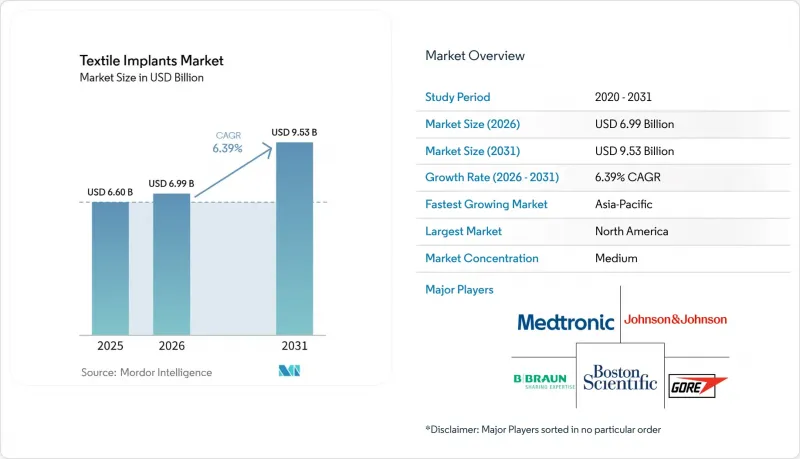
본 보고서는 섬유 유형(합성 섬유 이식물, 2D 섬유 이식물, 기타), 적응증(탈장 복구, 심혈관 외과, 기타 적응증), 최종 사용자(병원 및 진료소, 외래수술센터(ASC) 등), 지역(북미, 유럽, 아시아태평양, 중동 및 아프리카, 남미)별로 분류되어 있습니다. 시장 전망은 금액(달러) 기준으로 제시되어 있습니다.
세계의 섬유 이식물 시장 동향 및 인사이트
바이오엔지니어링 메쉬 및 보강용 텍스타일에 대한 선호도 증가
섬유 이식물 시장에서는 기존의 폴리프로필렌 메쉬에서 폴리-4-하이드록시부틸레이트, 콜라겐 보강 및 기타 생체 흡수성 섬유 구조물로 명확한 전환이 나타나고 있습니다. 이러한 변화는 단순히 외과의사의 선호에 기인한 것만은 아닙니다. 영구적인 합성 메쉬와 관련된 법적 책임의 위험 또한 병원과 공급업체를 새로운 소재로 이끌고 있습니다. 2025년, BD사는 'Phasix ST 제대 탈장 패치'에 대해 FDA의 510(k) 승인을 획득했습니다. 이는 제대 탈장 복원을 위해 특별히 설계된 최초의 완전 흡수성 탈장 메쉬로 자리매김하고 있으며, 섬유 이식물 시장에서 대규모 상용화가 점점 더 현실화되고 있음을 보여줍니다. 제품 혁신은 단순한 생체 흡수성에 그치지 않고, 다기능 메쉬 설계에 항균성 및 유착 방지 기능이 텍스타일 구조에 직접 통합되고 있습니다. 이러한 폭넓은 가치 제안은 수복 전략의 중심에 텍스타일 기반 보강재를 유지하면서 치료 성과 향상을 뒷받침하기 때문에 섬유 이식물 시장에서 중요합니다. 이러한 제제에 대한 증거가 축적됨에 따라, 섬유 이식물 시장의 조달 결정은 위험 관리와 임상 성과 모두를 반영하게 될 것입니다.
탈장, 정형외과, 심혈관 재건 분야의 수술 건수 증가
섬유 이식물 시장에서 탈장 복원술은 여전히 가장 큰 시술 수요 원천이며, 그 수요 기반은 향후 더욱 확대될 전망입니다. 2025년 『BMC Gastroenterology』지에 게재된 연구에 따르면, 인구 증가와 고령화를 주요 요인으로 하여 2050년까지 전 세계 탈장 사례 수가 절대 수치 기준으로 19.7% 증가할 것으로 예측됩니다. 또한, 수술 건수 증가에 따라 로봇 보조 및 복강경 수술에서 더 고도화된 사양의 임플란트가 채택되는 사례가 늘어나고 있어, 섬유 이식물 시장은 밸류체인의 업스트림로 이동하고 있습니다. 이는 중요한 점입니다. 왜냐하면 수술 건수가 많은 치료 경로에서는 더 이상 표준 메쉬에만 의존하지 않고, 강성, 전개성, 전달 요건이 더 엄격한 프리미엄 구조체가 보급되고 있기 때문입니다. 심혈관 및 정형외과 수술은 텍스타일 구조가 여전히 필요한 임상 시나리오의 폭을 넓힘으로써 섬유 이식물 시장을 더욱 견인하고 있습니다. 그 결과, 섬유 이식물 시장은 양극화되고 있으며, 표준 합성 제품은 처리량이 많은 환경에서 시장 점유율을 유지하는 한편, 첨단 섬유 제품은 보다 전문적인 치료 경로에서 더 높은 가격 책정을 실현하고 있습니다.
엄격한 규제 승인 및 임상 증거 요건
섬유 이식물 시장은 규정 준수 측면에서 압박이 커지고 있습니다. 이는 현재 이식형 제품에 대해 기존 제품 포트폴리오가 예상했던 것보다 더 엄격한 시판 후 추적 관리와 더 광범위한 증거 자료가 요구되고 있기 때문입니다. 이는 특히 골반저 및 관련 메쉬 부문에서 두드러지며, 과거의 합병증 발생 양상이 이미 제품 리콜이나 더 엄격한 심사로 이어지고 있습니다. 섬유 이식물 시장에서 새로운 실크 계열, 콜라겐 계열 및 3D 니트 구조의 제품은 더 광범위한 채택이 이루어지기 전에 생체 내에서의 지속적인 성능을 입증해야 하므로 규제 부담이 더욱 커지고 있습니다. 이러한 요건으로 인해 개발 기간이 길어지고 상품화 비용이 상승하므로, 다각화된 의료 기술 기업보다 소규모 혁신 기업이 그 영향을 더 크게 받을 가능성이 있습니다. 그 결과, 섬유 이식물 시장에서는 이미 품질 관리 시스템, 장기적 증거 프로그램 및 의료기기 추적성 체계를 갖춘 제조업체가 점점 더 우대받고 있습니다. 이는 섬유 이식물 시장의 혁신을 저해하는 것은 아니지만, 효율적으로 사업을 확장할 수 있는 기업에게 더 높은 장벽을 만들고 있습니다.
부문 분석
2025년, 합성 섬유 이식물은 섬유 이식물 시장 규모의 52.10%를 차지했습니다. 이는 탈장 복구, 혈관 이식, 연조직 보강 등 각 분야에서 지속적으로 널리 사용되고 있는 폴리프로필렌, 폴리에스터 및 발포 폴리테트라플루오로에틸렌으로 제작된 제품군에 힘입은 결과입니다. 섬유 이식물 시장에서 이러한 제품들의 위상은 오랜 임상 실적, 표준화된 멸균 절차, 그리고 외과의사 및 조달 팀 사이에서 널리 인정받고 있음을 반영합니다. 섬유 이식물 업계의 많은 공급업체들에게 있어, 확립된 규제 경로와 기존 제품을 기반으로 한 제품 개발은 여전히 새로운 대체품보다 합성 소재 제품을 우선시하는 경향을 보이고 있습니다. 이로 인해 섬유 이식물 시장에서 이미 수요가 많은 재건 분야에 제품을 공급하고 있는 기존 공급업체들에게는 구조적인 우위가 생기고 있습니다.
3D 섬유 이식물은 복잡한 재건 수술에서 평면 2D 메쉬로는 반드시 실현할 수 없는 환자의 형태에 맞는 기하학적 형상과 제어된 기공 프로파일을 제공할 수 있어, 섬유 이식물 시장에서 2026년부터 2031년에 걸쳐 연평균 성장률(CAGR) 7.19%를 나타낼 것으로 예측됩니다. 비단이나 콜라겐 등의 천연 섬유 이식물은 여전히 시장 규모가 작지만, 단순한 비용 비교보다 조직과의 통합성이 중시되는 용도에서 연구 및 임상적 관심이 높아지고 있습니다. 따라서 섬유 이식물 시장은 합성 제품이 기반을 유지하면서도, 첨단 구조가 다음 단계의 가치 창출을 주도하는 보다 폭넓은 제품 구성으로 전환되고 있습니다.
지역별 분석
북미는 높은 수술 건수, 성숙한 보험 환급 제도, 그리고 첨단 외과용 플랫폼의 탄탄한 도입 기반에 힘입어 2025년에는 섬유 이식물 시장 점유율의 46.80%를 차지했습니다. 미국은 탈장 메쉬, 혈관 이식편, 정형외과용 텍스타일 스캐폴드에 이르는 섬유 이식물 시장에서 여전히 주요 수익원으로 자리 잡고 있습니다. 또한, 이 지역은 확립된 상용화 경로와 합성 소재 및 프리미엄 보강재에 대한 폭넓은 임상적 이해의 혜택도 누리고 있습니다. 섬유 이식물 시장에서 이는 대량으로 시행되는 일상적인 수복 수술과 더 높은 부가가치를 지닌 전문적인 재건 수술 모두에 대응할 수 있는 공급업체에게 유리한 환경을 조성하고 있습니다. 유럽 역시 강력한 전문 외과 인프라와 독일, 영국, 프랑스, 이탈리아, 스페인에서의 꾸준한 수요에 힘입어 섬유 이식물 시장에서 중요한 위치를 차지하고 있습니다.
아시아태평양의 섬유 이식물 시장은 2026년부터 2031년까지 연평균 성장률(CAGR) 8.22%로 확대될 것으로 예측되며, 섬유 이식물 시장에서 가장 두드러진 성장을 보일 것으로 전망됩니다. 이 지역의 성장은 중국, 인도, 한국, 호주에서의 외과 수술 역량 확대에 더해, 만성 질환 유병률 상승에 따라 탈장 및 심혈관 수술 건수가 증가하고 있는 점이 뒷받침하고 있습니다. 또한, 아시아태평양의 섬유 이식물 시장은 정형외과 재건 수술 기반의 확대로부터도 혜택을 받고 있으며, 이로 인해 직물 및 편물형 임플란트에 대한 수요가 확대되고 있습니다. 일본의 경우 고령화가 진행됨에 따라 심혈관 및 정형외과 수술에서의 사용이 안정적이며, 이는 섬유 이식물 시장에 프리미엄 수요층을 형성하고 있습니다. 인도와 한국 역시 의료 관광 유입 및 의료 인프라 투자를 통해 표준 임플란트부터 첨단 임플란트에 이르기까지 폭넓은 접근성을 확보함으로써, 섬유 이식물 시장에서의 입지를 강화하고 있습니다.
중동 및 아프리카는 섬유 이식물 시장에서 여전히 규모는 작지만, GCC 국가들의 민간 병원 투자를 통해 고도의 외과 수술 역량이 향상되면서 프리미엄 임플란트 제품에 대한 수요가 발생하고 있습니다. 남아프리카는 민간 의료 네트워크를 통해 섬유 이식물 시장에서 사하라 이남 아프리카 수요를 지속적으로 뒷받침하고 있으나, 공공 조달 분야에서는 여전히 비용에 대한 민감도가 두드러집니다. 남미의 섬유 이식물 시장은 브라질과 아르헨티나가 주도하고 있으며, 탈장 교정이 여전히 주요 임상 용도이고, 병원에서의 수술이 임플란트 소비의 대부분을 차지하고 있습니다. 지방 도시에서의 복강경 수술 역량이 점차 향상됨에 따라, 인구 통계학적 예측을 뛰어넘는 범위에서 표준 섬유 이식물 제품의 잠재적 시장 규모가 확대될 가능성이 있습니다. 전반적으로, 섬유 이식물 시장은 성숙한 고부가가치 지역과 인프라 확충이 다음 확산 물결을 주도하고 있는 급성장 시장 사이에서 뚜렷한 양극화가 나타나고 있습니다.
기타 혜택 :
- 엑셀 형식 시장 예측(ME) 시트
- 3개월간의 애널리스트 지원
자주 묻는 질문
목차
제1장 서론
제2장 조사 방법
제3장 주요 요약
제4장 시장 구도
제5장 시장 규모 및 성장 예측
제6장 경쟁 구도
제7장 시장 기회 및 향후 전망
KTH 26.08.10According to Mordor Intelligence, the textile implants market was valued at USD 6.60 billion in 2025 and estimated to grow from USD 6.99 billion in 2026 to reach USD 9.53 billion by 2031, at a CAGR of 6.39% during the forecast period 2026-2031.
This report is Segmented by Textile Type (Synthetic Textile Implants, 2D Textile Implants, and Others), Indication (Hernia Repair, Cardiovascular Surgery, and Other Indications), End-User (Hospitals and Clinics, Ambulatory Surgical Centers, and More), and Geography (North America, Europe, Asia-Pacific, Middle East and Africa, South America). The Market Forecasts are Provided in Terms of Value (USD).
Global Textile Implants Market Trends and Insights
Rising Preference for Bioengineered Meshes and Reinforcement Textiles
The textile implants market is seeing a clear move away from legacy polypropylene mesh toward poly-4-hydroxybutyrate, collagen-reinforced, and other bioresorbable textile constructs. This change is not only about surgeon preference, because liability exposure tied to permanent synthetic mesh has also pushed hospitals and suppliers toward newer materials. In 2025, BD received FDA 510(k) clearance for the Phasix ST Umbilical Hernia Patch, which was positioned as the first fully absorbable hernia mesh designed specifically for umbilical repair, showing that scale commercialization is becoming more practical in the textile implants market. Product innovation is also moving beyond absorbability alone, because multifunctional mesh designs now incorporate antimicrobial and anti-adhesive features directly into textile architecture. That broader value proposition matters in the textile implants market because it supports outcome improvement while keeping textile-based reinforcement central to repair strategies. As more evidence builds around these formulations, procurement decisions in the textile implants market are likely to reflect both risk management and clinical performance.
Higher Surgical Volumes in Hernia, Orthopedic, and Cardiovascular Reconstruction
The textile implants market continues to draw its largest procedural demand from hernia repair, and that demand base is set to expand over time. A 2025 study in BMC Gastroenterology projected that global hernia case incidence will rise by 19.7% in absolute terms by 2050, with population growth and aging acting as the main drivers.The textile implants market is also moving up the value chain because growing procedure volumes are increasingly paired with more advanced implant specifications in robotic and laparoscopic settings. That matters because higher-volume surgical pathways are no longer relying only on standard mesh, and premium constructs with tighter stiffness, unfolding, and delivery requirements are gaining ground. Cardiovascular and orthopedic procedures add further support to the textile implants market by widening the number of clinical scenarios where textile architectures remain necessary. The result is a bifurcated textile implants market, where standard synthetic products keep volume in high-throughput settings while advanced textile formats capture stronger pricing in more specialized care pathways.
Stringent Regulatory Approval and Clinical Evidence Requirements
The textile implants market faces rising compliance pressure because implantable products now require stronger post-market follow-up and broader evidence packages than many legacy portfolios were built to support. This is particularly relevant for pelvic floor and related mesh categories, where historical complication patterns have already led to product withdrawals and tighter scrutiny. In the textile implants market, the regulatory burden is heavier for newer silk-based, collagen-based, and 3D knitted constructs because they must show durable in vivo performance before broader adoption can follow. That requirement lengthens development timelines and raises the cost of commercialization, which can slow smaller innovators more than diversified medtech companies. As a result, the textile implants market increasingly rewards manufacturers that already have quality systems, long-term evidence programs, and device traceability infrastructure in place. This does not stop innovation in the textile implants market, but it does raise the threshold for who can scale it efficiently.
Other drivers and restraints analyzed in the detailed report include:
- Expansion of Outpatient and Ambulatory Surgical Workflows
- Growing Aging Population and Rising Incidence of Tissue Degeneration Disorders
- High Cost of Advanced Textile Implant Materials and Procedures
For complete list of drivers and restraints, kindly check the Table Of Contents.
Segment Analysis
Synthetic textile implants accounted for a 52.10% share of the textile implants market size in 2025, supported by polypropylene, polyester, and expanded polytetrafluoroethylene constructs that remain widely used across hernia repair, vascular grafting, and soft tissue reinforcement. Their position in the textile implants market reflects long clinical histories, standardized sterilization practices, and broad familiarity among surgeons and procurement teams. For many providers in the textile implants industry, established regulatory pathways and predicate-based product development still favor synthetic variants over newer alternatives. That creates a structural advantage for incumbent suppliers that already serve high-volume repair categories in the textile implants market.
3D textile implants are projected to grow at a 7.19% CAGR from 2026 to 2031 in the textile implants market, because they can provide patient-conforming geometries and controlled pore profiles that flat 2D mesh cannot always achieve in complex reconstructions. Natural textile implants such as silk and collagen variants remain smaller in volume, but the textile implants market is seeing stronger research and clinical interest in applications where tissue integration matters more than simple cost comparison. The textile implants market is therefore moving toward a broader mix where synthetic products keep the base and advanced architectures drive the next layer of value creation.
Complete Report Scope:
- By Textile Type
- Synthetic Textile Implants
- 2D Textile Implants
- 3D Textile Implants
- Hybrid Textile Implants
- Natural Textile Implants
- Collagen-Based Textile Implants
- Silk-Based Textile Implants
- By Indication
- Hernia Repair
- Cardiovascular Surgery
- Orthopedic Surgery
- Dental Grafts
- Soft Tissue Reconstruction
- Pelvic Floor Repair
- Other Indications
- By End-User
- Hospitals and Clinics
- Ambulatory Surgical Centers
- Specialty Surgical Centers
- Other End-Users
- By Geography
- North America
- United States
- Canada
- Mexico
- Europe
- Germany
- United Kingdom
- France
- Italy
- Spain
- Rest of Europe
- Asia-Pacific
- China
- Japan
- India
- Australia
- South Korea
- Rest of Asia-Pacific
- Middle East and Africa
- GCC
- South Africa
- Rest of Middle East and Africa
- South America
- Brazil
- Argentina
- Rest of South America
- North America
Geography Analysis
North America held 46.80% of the textile implants market share in 2025, supported by high procedure volumes, mature reimbursement systems, and a dense installed base of advanced surgical platforms. The United States remains the main revenue driver in the textile implants market across hernia mesh, vascular grafts, and orthopedic textile scaffolds. The region also benefits from established commercialization pathways and broad clinical familiarity with synthetic as well as premium reinforcement options. In the textile implants market, this creates a favorable setting for suppliers that can serve both high-volume routine repair and higher-value specialized reconstruction. Europe also holds a substantial position in the textile implants market, supported by strong specialist surgical infrastructure and steady demand across Germany, the United Kingdom, France, Italy, and Spain.
Asia-Pacific textile implants market is projected to expand at an 8.22% CAGR between 2026 and 2031, making it the fastest-growing geography in the textile implants market. Growth in the region is being supported by expanding surgical capacity in China, India, South Korea, and Australia, along with rising chronic disease prevalence that increases hernia and cardiovascular procedure volumes. The textile implants market in Asia-Pacific is also gaining from a growing orthopedic reconstruction base, which broadens the need for woven and braided implant formats. Japan adds a premium demand layer to the textile implants market because its older population supports steady use in cardiovascular and orthopedic procedures. India and South Korea are also strengthening their positions in the textile implants market through medical tourism inflows and healthcare infrastructure investment that widens access to both standard and advanced implant categories.
The Middle East and Africa remain smaller in the textile implants market, but private hospital investment in GCC countries is improving tertiary surgical capacity and opening space for premium implant formats. South Africa continues to anchor sub-Saharan demand in the textile implants market through its private healthcare network, although public procurement is still highly cost-sensitive. South America is led by Brazil and Argentina in the textile implants market, with hernia repair remaining the main clinical use and hospital-based procedures accounting for most implant consumption. A gradual increase in laparoscopic capability across secondary cities could still expand the reachable base for standard textile implants market products beyond what demographics alone would suggest. Overall, the textile implants market shows a clear split between mature high-value regions and faster-growing markets where infrastructure expansion is driving the next wave of adoption.
- Aran Biomedical Teoranta
- B. Braun
- Beckton Dickinson
- Boston Scientific
- Coloplast
- Conmed
- Cook Group
- Corza Medical
- Cousin Biotech
- Integra LifeSciences
- Johnson & Johnson
- Medtronic
- Serag-Wiessner GmbH and Co. KG
- Smiths Group
- Stryker
- TELA Bio, Inc.
- Teleflex
- Titanium Textiles AG
- W. L. Gore and Associates, Inc.
- Zimmer Biomet
Additional Benefits:
- The market estimate (ME) sheet in Excel format
- 3 months of analyst support
TABLE OF CONTENTS
1 Introduction
- 1.1 Study Assumptions and Market Definition
- 1.2 Scope of the Study
2 Research Methodology
3 Executive Summary
4 Market Landscape
- 4.1 Market Overview
- 4.2 Market Drivers
- 4.2.1 Rising Preference for Bioengineered Meshes and Reinforcement Textiles
- 4.2.2 Higher Surgical Volumes in Hernia, Orthopedic, and Cardiovascular Reconstruction
- 4.2.3 Improved Clinical Adoption of Resorbable and Hybrid Textile Implants
- 4.2.4 Expansion of Outpatient and Ambulatory Surgical Workflows
- 4.2.5 Advancements in Biomaterial Engineering and Smart Textile Technologies
- 4.2.6 Growing Aging Population and Rising Incidence of Tissue Degeneration Disorders
- 4.3 Market Restraints
- 4.3.1 Stringent Regulatory Approval and Clinical Evidence Requirements
- 4.3.2 Procedure and Device-Related Complication Risk
- 4.3.3 High Cost of Advanced Textile Implant Materials and Procedures
- 4.3.4 Risk of Post-Surgical Infections and Foreign Body Reactions
- 4.4 Supply Chain Analysis
- 4.5 Regulatory Landscape
- 4.6 Technological Outlook
- 4.7 Porter's Five Forces Analysis
- 4.7.1 Threat of New Entrants
- 4.7.2 Bargaining Power of Suppliers
- 4.7.3 Bargaining Power of Buyers
- 4.7.4 Threat of Substitutes
- 4.7.5 Competitive Rivalry
5 Market Size & Growth Forecasts (Value, USD)
- 5.1 By Textile Type
- 5.1.1 Synthetic Textile Implants
- 5.1.2 2D Textile Implants
- 5.1.3 3D Textile Implants
- 5.1.4 Hybrid Textile Implants
- 5.1.5 Natural Textile Implants
- 5.1.6 Collagen-Based Textile Implants
- 5.1.7 Silk-Based Textile Implants
- 5.2 By Indication
- 5.2.1 Hernia Repair
- 5.2.2 Cardiovascular Surgery
- 5.2.3 Orthopedic Surgery
- 5.2.4 Dental Grafts
- 5.2.5 Soft Tissue Reconstruction
- 5.2.6 Pelvic Floor Repair
- 5.2.7 Other Indications
- 5.3 By End-User
- 5.3.1 Hospitals and Clinics
- 5.3.2 Ambulatory Surgical Centers
- 5.3.3 Specialty Surgical Centers
- 5.3.4 Other End-Users
- 5.4 By Geography
- 5.4.1 North America
- 5.4.1.1 United States
- 5.4.1.2 Canada
- 5.4.1.3 Mexico
- 5.4.2 Europe
- 5.4.2.1 Germany
- 5.4.2.2 United Kingdom
- 5.4.2.3 France
- 5.4.2.4 Italy
- 5.4.2.5 Spain
- 5.4.2.6 Rest of Europe
- 5.4.3 Asia-Pacific
- 5.4.3.1 China
- 5.4.3.2 Japan
- 5.4.3.3 India
- 5.4.3.4 Australia
- 5.4.3.5 South Korea
- 5.4.3.6 Rest of Asia-Pacific
- 5.4.4 Middle East and Africa
- 5.4.4.1 GCC
- 5.4.4.2 South Africa
- 5.4.4.3 Rest of Middle East and Africa
- 5.4.5 South America
- 5.4.5.1 Brazil
- 5.4.5.2 Argentina
- 5.4.5.3 Rest of South America
- 5.4.1 North America
6 Competitive Landscape
- 6.1 Market Concentration
- 6.2 Market Share Analysis
- 6.3 Company Profiles (includes Global level Overview, Market level overview, Core Segments, Financials as available, Strategic Information, Market Rank/Share for key companies, Products & Services, Recent Developments)
- 6.3.1 Aran Biomedical Teoranta
- 6.3.2 B. Braun Melsungen AG
- 6.3.3 BD (Becton Dickinson and Company)
- 6.3.4 Boston Scientific Corporation
- 6.3.5 Coloplast Group
- 6.3.6 Conmed Corporation
- 6.3.7 Cook Medical LLC
- 6.3.8 Corza Medical
- 6.3.9 Cousin Biotech
- 6.3.10 Integra LifeSciences Holdings Corporation
- 6.3.11 Johnson and Johnson
- 6.3.12 Medtronic plc
- 6.3.13 Serag-Wiessner GmbH and Co. KG
- 6.3.14 Smith and Nephew plc
- 6.3.15 Stryker Corporation
- 6.3.16 TELA Bio, Inc.
- 6.3.17 Teleflex Incorporated
- 6.3.18 Titanium Textiles AG
- 6.3.19 W. L. Gore and Associates, Inc.
- 6.3.20 Zimmer Biomet Holdings, Inc.
7 Market Opportunities & Future Outlook
- 7.1 White-space & Unmet-need Assessment


