

|
시장보고서
상품코드
2099321
가정용 폐기능 측정기 : 시장 점유율 분석, 업계 동향 및 통계, 성장 예측(2026-2031년)Home Spirometer - Market Share Analysis, Industry Trends & Statistics, Growth Forecasts (2026 - 2031) |
||||||
 Mordor Intelligence
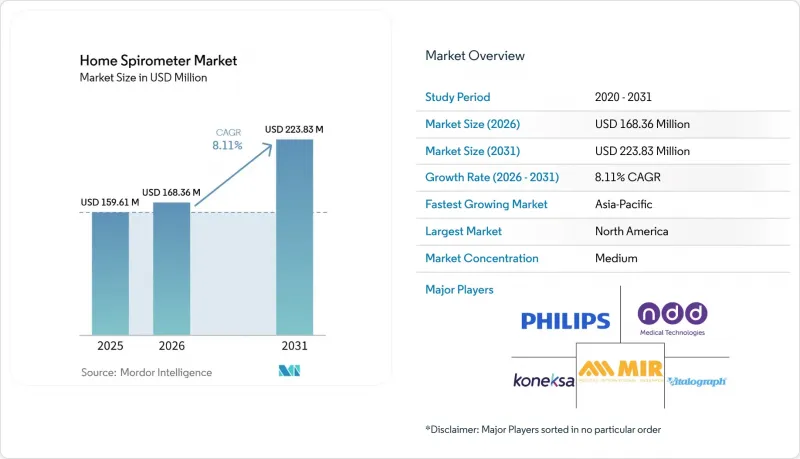
Mordor Intelligence에 의하면, 가정용 폐기능 측정기 시장은 2025년 1억 5,961만 달러로 평가되었습니다. 2026년에는 1억 6,836만 달러로 확대되어 2031년까지 2억 2,383만 달러에 이를 것으로 예상되고 2026년부터 2031년에 걸쳐 CAGR 8.11%로 성장할 전망입니다.
본 보고서는 제품 유형(핸드헬드형 폐기능 측정기, 휴대용 무선형 폐기능 측정기, 스마트폰 연동형 스피로미터), 기술(유량식 스피로미터 등), 용도(만성 폐쇄성 폐질환(COPD) 관리 등), 판매 채널(병원 약국 등), 지역(북미, 유럽 등)별로 분류되어 있습니다. 시장 전망은 금액(달러) 기준으로 제시되어 있습니다.
세계의 가정용 폐기능 측정기 시장 동향 및 인사이트
가정용 호흡 모니터링 도입 확대
환자와 임상의의 가정용 호흡 모니터링에 대한 수용도가 높아짐에 따라, 가정용 폐기능 측정기 시장의 타겟층은 확정 진단을 받은 만성 질환 환자에 그치지 않고, 새로 진단받은 환자, 급성기 이후의 환자, 그리고 예방 목적의 사용자까지 확대되고 있습니다. 코로나19 이후 폐 기능 회복에 대한 수요, 재택치료의 보급 확대, 그리고 외래 호흡기 진료의 부담 증가로 인해, 폐기능 검사는 가끔 진료소에서 사용하는 것보다는 일상적인 재택 사용으로 전환되고 있습니다. 2025년 9월 『npj Primary Care Respiratory Medicine』지에 게재된 연구에 따르면, 성인을 대상으로 한 감독 없는 가정용 폐기능 측정기 검사에서 이용자가 기본적인 교육을 받은 경우, 진료소에서의 측정값과 높은 일치율이 확인되었습니다. 이는 가정 환경에서의 처방에 대한 신뢰성을 직접 뒷받침하는 것입니다. 현재 환자 수준 수요가 더욱 빈번하게 발생하고 있으며, 이로 인해 가정용 폐기능 검사기 시장에서 기기가 구매 단계에서 가정 내 정기적인 사용 단계로 전환되는 속도가 변화하고 있습니다. 이러한 변화로 인해 환자들이 가정 모니터링을 시도하기 전에 전문의의 소개에 그다지 의존하지 않게 되었기 때문에 새로운 형태의 기기 도입에 대한 장벽이 낮아지고 있습니다.
COPD 및 천식 유병률 증가
2024년 『Respiratory Research』 저널의 GBD 2021 데이터셋 분석에 따르면, 전 세계 COPD 유병자 수는 2억 1,340만 명으로 추정되며, 특히 저· 중소득 국가에서 가정용 폐기능 측정기 시장에 있어 모니터링이 미흡한 대규모 환자층이 존재함을 보여주고 있습니다. 이러한 수요 패턴은 2023년 기준 3억 6,300만 명이 천식을 앓았음을 보여주는 WHO 데이터로도 뒷받침되며, 이에 따라 진료소 밖에서 정기적인 폐기능 검사의 혜택을 받을 수 있는 사용자층이 확대되고 있습니다. 2025년 『Frontiers in Pediatrics』지에 게재된 연구 역시 소아 천식에서 가정용 원격 폐활량 측정을 지지하고 있으며, 계급 간 상관계수가 0.9를 상회함에 따라 변화가 심한 의료 현장 중 하나에서 임상적 주저함을 완화하고 있습니다. 일부 도시 지역에서는 COPD와 천식이 젊은 층 및 디지털 기기를 적극적으로 이용하는 계층으로 확산되고 있어, 가정용 폐기능 측정기 시장에서 연결형 기기를 활용한 자가 관리에 적극적인 사용자가 증가하고 있습니다. 또한, 질병 부담에 관한 데이터가 의료 시스템에 휴대용 폐기능 검사 프로그램 도입의 명확한 근거를 제공함으로써, 이를 통해 단기적인 조달 주기를 넘어선 수요가 뒷받침되고 있습니다.
환자의 측정 기술 차이와 검사의 신뢰성
측정값의 정확도는 여전히 환자가 검사를 수행하는 숙련도에 크게 좌우되기 때문에 측정법에 대한 의존성은 가정용 폐기능 측정기 시장에 있어 분명한 제약 요인으로 남아 있습니다. 2025년 『JMIR Formative Research』 저널에 게재된 무작위 대조 시험에서는 온라인 및 자율 학습을 통한 훈련을 통해 대면 지도와 동등한 통계적 신뢰성을 지닌 폐기능 측정값을 얻을 수 있음이 입증되었습니다. 그러나 저자들은 가정에서 측정된 값이 여전히 골드 스탠다드로 여겨지는 진료소에서의 측정값과는 다를 가능성이 있다고 지적하고 있습니다. 따라서 제조업체가 가정 측정값을 장기적으로 임상적으로 유용한 것으로 유지하고 싶다면, 단순한 기기 본체뿐만 아니라 지도가 포함된 도입 지원 및 코칭 도구도 제공해야 합니다.
부문 분석
2025년 시점에서 휴대용 폐활량계는 시장 점유율의 57.84%를 차지하며, 가정용 폐기능 측정기 시장의 주요 제품 카테고리가 되었습니다. 이러한 위상은 오랜 기간에 걸친 임상 검증 실적, 단일 사용자가 가정에서 조작하기에 적합한 컴팩트한 형태, 그리고 새로운 유형의 기기보다 친숙한 조달 경로를 반영한 것입니다. 이러한 기반은 당초 휴대용 측정 기준을 중심으로 구축된 준수 기대감에 의해 강화되었으며, 그 결과 이 카테고리는 임상의의 수용성과 보험 급여 대응 준비 양면에서 실질적인 선점 우위를 확보했습니다. 가정용 폐기능 측정기 시장에서 원격 데이터 전송이 호흡기 질환의 정기적인 경과 관찰의 일부로 자리 잡음에 따라, 휴대용 무선 폐기능 측정기는 2026년부터 2031년까지 연평균 성장률(CAGR) 8.21%를 나타낼 것으로 예측됩니다. 이러한 성장은 제품의 가치가 검사 그 자체를 넘어, 데이터가 의료진, 케어 팀, 디지털 케어 플랫폼에 얼마나 신속하게 전달되는지로 초점이 이동하고 있음을 보여줍니다.
스마트폰 연동형 제품은 여전히 시장 점유율이 낮은 편이지만, 환자가 이미 개인 모바일 기기를 사용하고 있거나, 임상의가 원격 사용을 위한 보다 간소화된 운영 체계를 요구하는 상황에서 그 중요성이 커지고 있습니다. 실용적인 관점에서 볼 때, 환자는 휴대 및 사용이 간편한 기기를 원하고 있는 반면, 임상의는 확립된 치료 및 기록 기준에 부합하는 기기를 원하고 있습니다. 이러한 요구 사항은 더 이상 상호 배타적이지 않으며, 이로 인해 혼합형 제품의 보급 전망이 밝아지고 있습니다. 따라서 가정용 폐기능 측정기 시장의 제품 유형 구성은 현재 시점에서 여전히 휴대용 기기가 주류를 이루고 있지만, 휴대성, 연결성 및 워크플로우 적합성을 중심으로 한 보다 융합적인 모델로 전환되고 있습니다.
2025년에는 유량식 폐기능 측정기가 54.63%의 점유율을 차지하며 기술 구성에서 1위를 기록했고, 가정용 폐기능 측정기 시장의 중심적인 위치를 유지했습니다. 그 강점은 주요 호흡기 관리 지침에서 사용되는 핵심 폐기능 측정값인 FEV1 및 FVC 측정에서 입증된 정확도에 있다고 할 수 있습니다. 또한, 터빈식 및 폐활량-호흡속도계식 센서의 성숙한 밸류체인 역시 비용 관리와 의료 기관 및 소매 채널에서의 광범위한 확장을 뒷받침하고 있습니다. 블루투스/Wi-Fi 지원 폐기능 측정기는 2026년부터 2031년까지 연평균 성장률(CAGR) 8.34%를 나타낼 것으로 예측되며, 이는 가정용 폐기능 측정기 시장에서 연결성이 점점 더 중요한 구매 기준이 되고 있음을 보여줍니다. 구매자들은 폐 기능을 측정하고 별도의 절차 없이 텔레헬스나 원격 환자 모니터링 시스템으로 결과를 전송할 수 있는 기기를 점점 더 중요하게 여기고 있습니다.
장기간 사용 시 교정 안정성이 중요한 상황, 특히 프로토콜에 기반한 모니터링이나 임상 연구 현장에서는 용적식 폐기능 측정기의 가치가 여전히 유지되고 있습니다. 따라서 가정용 폐기능 측정기 업계는 특정 기술 계열을 다른 것으로 대체하기보다는 여러 센서 유형을 갖춘 연결형 모델로 전환하고 있습니다. 소프트웨어 계층, 배터리 설계, 통합 기능이 임상적 요구를 충족한다면 유량식이나 초음파식 기기 모두 매력적일 수 있습니다. 따라서 가정용 폐기능 측정기 시장이 연결 성능을 더욱 중시하게 됨에 따라, 하드웨어와 디지털 검증 양쪽 모두에 경험이 있는 제조업체는 더 유리한 입장에 있습니다. 기술적 평가는 여전히 센서의 신뢰성에서 시작되지만, 현재는 해당 센서가 보다 광범위한 원격 의료 시스템에 얼마나 잘 부합하는지에 따라 결정되는 추세입니다.
지역별 분석
2025년, 북미는 가정용 폐기능 측정기 시장 점유율의 40.26%를 차지하며 지역별로는 가장 큰 기여도를 보였습니다. 이 지역은 성숙한 원격 의료 환경, 진단받은 환자 수의 많음, 그리고 가정용 호흡기 기기에 대한 확립된 규제 경로의 혜택을 받고 있습니다. 또한, 2025년 REACH-SPIRO 연구에서 온라인 및 대면 방식의 가정용 폐기능 측정기 교육이 동등한 측정 결과를 가져온다는 사실이 밝혀짐에 따라, 분산된 환자 집단에서의 더 광범위한 활용이 촉진되었으며, 북미에서는 임상적 확대도 더욱 실현 가능할 것으로 전망됩니다. 캐나다와 멕시코도 계속해서 이 지역의 성장 기회 중 일부를 차지하고 있지만, 보험 적용 범위나 시스템 수준의 도입이 미국만큼 진전되지 않았기 때문에 도입 상황은 여전히 미국만큼 성숙하지 않습니다.
유럽은 만성 호흡기 질환의 부담이 여전히 높고, 치료 순응도 기준도 엄격하게 유지되고 있어 가정용 폐기능 측정기 시장에서 가장 중요한 지역 중 하나로 남아 있습니다. EU의 MDR 전환에 따라 휴대용 호흡기 기기에 대한 기대가 높아지면서, 규제 대응 능력이 더 뛰어난 제조업체로 시장이 집중되었습니다. 영국과 독일은 확립된 가정용 폐기능 측정기 사용 및 원격 의료를 활용한 치료 경로와 가장 직접적으로 연관되어 있어, 유럽 내에서 여전히 가장 명확한 기준점이 되고 있습니다.
아시아태평양은 2026년부터 2031년까지 연평균 성장률(CAGR) 10.52%를 나타낼 것으로 예측되며, 가정용 폐기능 측정기 시장에서 가장 빠르게 성장하는 지역 블록이 될 것입니다. 이 지역은 질병 부담의 크기, 디지털 헬스에 대한 수용성 증가, 그리고 휴대용 선별 검사 도구에 대한 관심 고조라는 혜택을 누리고 있습니다. 일본에서는 소형 클라우드 연결형 모니터링 솔루션에 대한 수요가 성장세를 뒷받침하고 있는 반면, 한국과 인도에서는 의료 디지털화라는 광범위한 주제가 성장을 지탱하고 있습니다. 남미, 중동 및 아프리카는 보험 환급 범위와 유통망이 아직 충분히 정비되지 않아 가정용 폐기능 측정기 시장에서는 여전히 초기 단계의 기회에 머물러 있습니다. 그럼에도 불구하고 브라질과 GCC(걸프협력회의) 국가들은 이 지역에서 가장 주목할 만한 진입 거점으로 두각을 나타내고 있습니다.
기타 혜택 :
- 엑셀 형식 시장 예측(ME) 시트
- 3개월간의 애널리스트 지원
자주 묻는 질문
목차
제1장 서론
제2장 조사 방법
제3장 주요 요약
제4장 시장 구도
제5장 시장 규모 및 성장 예측
제6장 경쟁 구도
제7장 시장 기회 및 향후 전망
KTH 26.08.10According to Mordor Intelligence, the home spirometer market is expected to increase from USD 159.61 million in 2025 to USD 168.36 million in 2026 and reach USD 223.83 million by 2031, growing at a CAGR of 8.11% over 2026-2031.
This report is Segmented by Product Type (Handheld Spirometers, Portable Wireless Spirometers, Smartphone-Connected Spirometers), Technology (Flow-Based Spirometers and More), Application (Chronic Obstructive Pulmonary Disease Management, and More), Distribution Channel (Hospital Pharmacies and More), and Geography (North America, Europe, and More). The Market Forecasts are Provided in Terms of Value (USD).
Global Home Spirometer Market Trends and Insights
Rising Home-Based Respiratory Monitoring Adoption
Growing patient and clinician acceptance of home respiratory monitoring is widening the addressable population in the home spirometer market beyond confirmed chronic cases to include newly diagnosed, post-acute, and preventive users. Post-COVID lung recovery needs, broader home healthcare adoption, and pressure on outpatient respiratory services have pushed spirometry closer to routine home use rather than occasional clinic use. A September 2025 study in npj Primary Care Respiratory Medicine found that unsupervised home spirometry in adults showed strong agreement with in-clinic measurements when users received basic training, which directly supports prescribing confidence in home settings. Demand is now forming more often at the patient level, and this changes how quickly devices move from purchase to regular use in the home spirometer market. That shift lowers adoption friction for newer device formats because patients no longer depend as heavily on specialist referral before trying home monitoring.
Rising COPD and Asthma Prevalence
A 2024 Respiratory Research analysis of the GBD 2021 dataset estimated 213.4 million prevalent COPD cases worldwide, which leaves a large under-monitored population for the home spirometer market, especially in low- and middle-income settings. The same demand pattern is reinforced by WHO data showing 363 million people living with asthma in 2023, which expands the pool of users who can benefit from repeat lung-function checks outside clinics. A 2025 study in Frontiers in Pediatrics also supported home telespirometry in pediatric asthma, with interclass correlation coefficients above 0.9, which reduces clinical hesitation in one of the faster-moving care settings.As COPD and asthma spread across younger and more digitally engaged groups in some urban settings, the home spirometer market is gaining users who are more willing to self-manage through connected devices. Disease burden documentation is also giving health systems a clearer basis for portable spirometry programs, which supports demand beyond short-term procurement cycles.
Inconsistent Patient Technique and Test Reliability
Technique dependence remains a clear restraint for the home spirometer market because the value of each reading still depends heavily on how well the patient performs the test. A 2025 randomized controlled trial in JMIR Formative Research found that virtual and self-directed training produced spirometry measurements statistically equivalent to face-to-face teaching, but the authors also noted that home readings can still differ from gold-standard clinic measurements. Manufacturers therefore need guided onboarding and coaching tools, not just device hardware, if they want home readings to remain clinically useful over longer periods.
Other drivers and restraints analyzed in the detailed report include:
- Telehealth Integration with Remote Spirometry Workflows
- AI-Enabled Trend Detection in Longitudinal Lung-Function Data
- Reimbursement Fragmentation Across Care Settings
For complete list of drivers and restraints, kindly check the Table Of Contents.
Segment Analysis
Handheld spirometers held 57.84% of the segment in 2025, which made them the leading product category in the home spirometer market. Their position reflects a long record of clinical validation, compact formats that suit single-user home operation, and more familiar procurement pathways than newer device types. This base was reinforced by compliance expectations that were first built around handheld measurement standards, which gave the category a practical head start in both clinician acceptance and reimbursement readiness. Portable wireless spirometers are forecasted to grow at a 8.21% CAGR from 2026 to 2031 as remote data transfer becomes part of routine respiratory follow-up in the home spirometer market. That growth shows that product value is moving beyond the test itself and toward how quickly data can reach clinicians, care teams, and digital care platforms.
Smartphone-linked products still hold a smaller base, but they are gaining relevance where patients already use personal mobile hardware and where clinicians want simpler logistics for remote use. In practical terms, patients want a device that is easy to carry and easy to use, while clinicians want a device that can fit established care and documentation standards. These needs are no longer mutually exclusive, which strengthens adoption prospects for mixed-format products. The product type structure in the home spirometer market therefore still favors handheld devices today, but it is moving toward a more blended model built around portability, connectivity, and workflow fit.
Flow-based spirometers led the technology mix with 54.63% share in 2025, which kept them at the center of the home spirometer market. Their advantage comes from established accuracy in measuring FEV1 and FVC, which are the core spirometric values used in major respiratory care guidelines. Mature supply chains for turbine and pneumotachograph sensors also support cost control and wide deployment across institutional and retail channels. Bluetooth/Wi-Fi-enabled spirometers are projected to grow at an 8.34% CAGR from 2026 to 2031, which shows how connectivity is becoming a stronger purchase criterion in the home spirometer market. Buyers increasingly value devices that can measure lung function and send results into telehealth or remote patient monitoring systems without extra steps.
Volume-based spirometers still retain value where calibration stability matters over long use periods, especially in protocol-driven monitoring and clinical research settings. The home spirometer industry is therefore moving toward connected versions of multiple sensor types rather than replacing one technology family with another. A flow-based or ultrasonic device can both be attractive if the software layer, battery design, and integration features meet clinical needs. For that reason, manufacturers with experience across both hardware and digital validation are in a stronger position as the home spirometer market places more weight on connected performance. The technology segment still begins with sensor credibility, but it now ends with how well that sensor fits a broader remote care system.
Complete Report Scope:
- By Product Type
- Handheld Spirometers
- Portable Wireless Spirometers
- Smartphone-Connected Spirometers
- By Technology
- Flow-Based Spirometers
- Volume-Based Spirometers
- Bluetooth/Wi-Fi Enabled Spirometers
- By Application
- Chronic Obstructive Pulmonary Disease Management
- Asthma Monitoring
- Pulmonary Function Testing
- Postoperative Recovery
- By Distribution Channel
- Hospital Pharmacies
- Retail Pharmacies
- Online Pharmacies
- Other Distribution Channels
- By Geography
- North America
- United States
- Canada
- Mexico
- Europe
- Germany
- United Kingdom
- France
- Italy
- Spain
- Rest of Europe
- Asia-Pacific
- China
- Japan
- India
- Australia
- South Korea
- Rest of Asia-Pacific
- Middle East and Africa
- GCC
- South Africa
- Rest of Middle East and Africa
- South America
- Brazil
- Argentina
- Rest of South America
- North America
Geography Analysis
North America held 40.26% of the home spirometer market share in 2025, which made it the largest regional contributor. The region benefited from a mature telehealth environment, a large diagnosed patient pool, and established regulatory pathways for home-use respiratory devices. Clinical scale-up also looks more workable in North America because the 2025 REACH-SPIRO trial found that virtual and face-to-face home spirometry training produced equivalent measurement outcomes, which supports broader use in dispersed patient populations. Canada and Mexico remain part of the regional opportunity, but adoption is still less mature than in the United States because coverage and system-level rollout are less developed.
Europe remained one of the most important regions for the home spirometer market because chronic respiratory disease burden stayed high and compliance standards remained stringent. The EU MDR transition raised expectations for portable respiratory devices, which filtered the field toward manufacturers with stronger regulatory depth. The United Kingdom and Germany remained the clearest reference points in Europe because they are most directly associated with established home spirometry use and telehealth-enabled care pathways.
Asia-Pacific is projected to grow at an 10.52% CAGR from 2026 to 2031, which makes it the fastest-growing regional block in the home spirometer market. The region benefits from a large disease burden, rising digital health readiness, and stronger interest in portable screening tools. Japan adds momentum through demand for compact, cloud-connected monitoring solutions, while South Korea and India support growth through broader healthcare digitalization themes. South America and the Middle East and Africa still remained earlier-stage opportunities in the home spirometer market because reimbursement depth and distribution coverage were less developed. Even so, Brazil and the GCC stood out as the most visible entry points in those regions.
- Aluna Health Inc.
- CareSimple Inc.
- CMI Health Inc.
- Contec Medical Systems
- e-LinkCare Meditech Co. Ltd.
- Geratherm Medical
- Jones Medical Instrument Company
- Koneksa Health
- Koninklijke Philips
- Medcaptain Medical Technology Co. Ltd.
- Medical International Research S.p.A.
- Medikro Oy
- MIR - Medical International Research
- NDD Medical Technologies
- NuvoAir AB
- OMRON
- Schiller
- Sibelmed S.L.
- Smart Respiratory Products Ltd.
- Vitalograph Ltd.
Additional Benefits:
- The market estimate (ME) sheet in Excel format
- 3 months of analyst support
TABLE OF CONTENTS
1 Introduction
- 1.1 Study Assumptions and Market Definition
- 1.2 Scope of the Study
2 Research Methodology
3 Executive Summary
4 Market Landscape
- 4.1 Market Overview
- 4.2 Market Drivers
- 4.2.1 Rising Home-Based Respiratory Monitoring Adoption
- 4.2.2 Rising COPD and Asthma Prevalence
- 4.2.3 Telehealth Integration with Remote Spirometry Workflows
- 4.2.4 Consumerization of Connected Respiratory Devices
- 4.2.5 AI-Enabled Trend Detection in Longitudinal Lung-Function Data
- 4.2.6 Subscription-Based Monitoring and Clinical Follow-Up Models
- 4.3 Market Restraints
- 4.3.1 Inconsistent Patient Technique and Test Reliability
- 4.3.2 Reimbursement Fragmentation Across Care Settings
- 4.3.3 Low Clinical Confidence in Unsupervised Use Cases
- 4.3.4 Cybersecurity and Data-Interoperability Friction in Connected Devices
- 4.4 Supply Chain Analysis
- 4.5 Regulatory Landscape
- 4.6 Technological Outlook
- 4.7 Porter's Five Forces Analysis
- 4.7.1 Threat of New Entrants
- 4.7.2 Bargaining Power of Suppliers
- 4.7.3 Bargaining Power of Buyers
- 4.7.4 Threat of Substitutes
- 4.7.5 Competitive Rivalry
5 Market Size & Growth Forecasts (Value, USD)
- 5.1 By Product Type
- 5.1.1 Handheld Spirometers
- 5.1.2 Portable Wireless Spirometers
- 5.1.3 Smartphone-Connected Spirometers
- 5.2 By Technology
- 5.2.1 Flow-Based Spirometers
- 5.2.2 Volume-Based Spirometers
- 5.2.3 Bluetooth/Wi-Fi Enabled Spirometers
- 5.3 By Application
- 5.3.1 Chronic Obstructive Pulmonary Disease Management
- 5.3.2 Asthma Monitoring
- 5.3.3 Pulmonary Function Testing
- 5.3.4 Postoperative Recovery
- 5.4 By Distribution Channel
- 5.4.1 Hospital Pharmacies
- 5.4.2 Retail Pharmacies
- 5.4.3 Online Pharmacies
- 5.4.4 Other Distribution Channels
- 5.5 By Geography
- 5.5.1 North America
- 5.5.1.1 United States
- 5.5.1.2 Canada
- 5.5.1.3 Mexico
- 5.5.2 Europe
- 5.5.2.1 Germany
- 5.5.2.2 United Kingdom
- 5.5.2.3 France
- 5.5.2.4 Italy
- 5.5.2.5 Spain
- 5.5.2.6 Rest of Europe
- 5.5.3 Asia-Pacific
- 5.5.3.1 China
- 5.5.3.2 Japan
- 5.5.3.3 India
- 5.5.3.4 Australia
- 5.5.3.5 South Korea
- 5.5.3.6 Rest of Asia-Pacific
- 5.5.4 Middle East and Africa
- 5.5.4.1 GCC
- 5.5.4.2 South Africa
- 5.5.4.3 Rest of Middle East and Africa
- 5.5.5 South America
- 5.5.5.1 Brazil
- 5.5.5.2 Argentina
- 5.5.5.3 Rest of South America
- 5.5.1 North America
6 Competitive Landscape
- 6.1 Market Concentration
- 6.2 Market Share Analysis
- 6.3 Company Profiles (includes Global level Overview, Market level overview, Core Segments, Financials as available, Strategic Information, Market Rank/Share for key companies, Products & Services, Recent Developments)
- 6.3.1 Aluna Health Inc.
- 6.3.2 CareSimple Inc.
- 6.3.3 CMI Health Inc.
- 6.3.4 Contec Medical Systems Co. Ltd.
- 6.3.5 e-LinkCare Meditech Co. Ltd.
- 6.3.6 Geratherm Medical AG
- 6.3.7 Jones Medical Instrument Company
- 6.3.8 Koneksa Health
- 6.3.9 Koninklijke Philips N.V.
- 6.3.10 Medcaptain Medical Technology Co. Ltd.
- 6.3.11 Medical International Research S.p.A.
- 6.3.12 Medikro Oy
- 6.3.13 MIR - Medical International Research
- 6.3.14 NDD Medical Technologies
- 6.3.15 NuvoAir AB
- 6.3.16 Omron Healthcare
- 6.3.17 Schiller AG
- 6.3.18 Sibelmed S.L.
- 6.3.19 Smart Respiratory Products Ltd.
- 6.3.20 Vitalograph Ltd.
7 Market Opportunities & Future Outlook
- 7.1 White-space & Unmet-need Assessment

(주말 및 공휴일 제외)


