

|
시장보고서
상품코드
2099332
임상시험 지원 소프트웨어 솔루션 : 시장 점유율 분석, 업계 동향 및 통계, 성장 예측(2026-2031년)Clinical Trials Support Software Solutions - Market Share Analysis, Industry Trends & Statistics, Growth Forecasts (2026 - 2031) |
||||||
 Mordor Intelligence
2025년에는 클라우드 및 웹 기반 도입이 제공 형태 수요 68.24%를 차지해 이것이 임상시험 소프트웨어 시장에서 가장 명확한 구조적 선택사항이 되었습니다.
또한, 2031년까지 연평균 성장률(CAGR)이 15.37%로 예측되어 가장 빠르게 성장하는 제공 형태가 될 것으로 전망됨에 따라, 최대 부문은 여전히 그 우위를 확대해 나가고 있습니다.
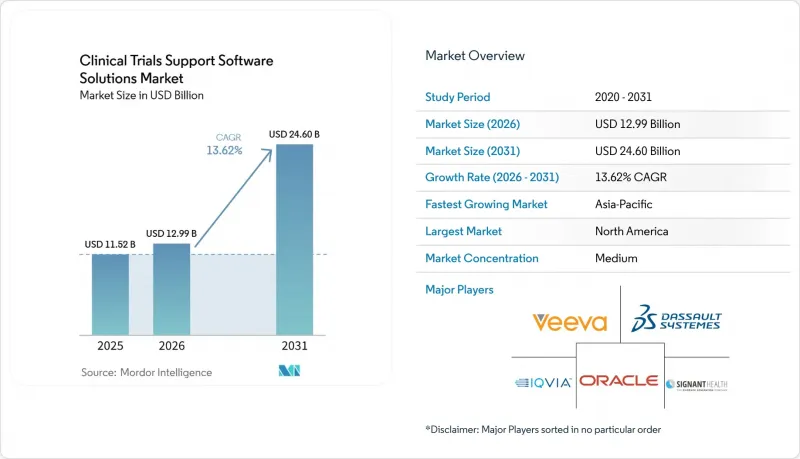
Mordor Intelligence에 따르면, 임상시험 지원 소프트웨어 솔루션 시장은 2025년에 115억 2,000만 달러 규모에 달했고, 2026년에는 129억 9,000만 달러에 이를 것으로 예측됩니다. 본 보고서는 제품 유형(임상 분석 플랫폼 등), 제공 형태(On-Premise 등), 임상시험 단계(1상 등), 시험 모델(하이브리드 시험 솔루션 등), 치료 분야(종양학 등), 최종 사용자(병원 및 의료 서비스 제공업체 등), 지역(북미, 유럽 등)별로 분류되어 있습니다. 시장 규모 예측(미 달러).
세계의 임상시험 지원 소프트웨어 솔루션 시장 동향 및 인사이트
다국적·다프로토콜 임상시험 운영의 복잡화
임상시험 지원 소프트웨어 솔루션 시장은 더 많은 시험 시설, 더 많은 국가, 그리고 더 많은 병렬 워크플로우를 수반하는 다국적 시험 운영의 복잡성 증가를 배경으로 지지를 확대되고 있습니다. 대규모 프로그램에서는 현재 데이터 수집, 시험 관리, 문서 관리, 안전성 보고 및 감독 기능에 걸친 긴밀한 연계가 요구되고 있으며, 이로 인해 파편화된 시스템 구성을 관리하기가 어려워지고 있습니다. 이러한 압박은 프로토콜 변경, 지역별 운영상의 차이, 그리고 엄격한 보고 요건으로 인해 워크플로우 조정이 반복적으로 필요한 후기 단계 프로그램이나 종양학을 주축으로 하는 프로그램에서 가장 두드러지게 나타나고 있습니다. 이러한 상황에서 통합 플랫폼의 매력이 높아지고 있습니다. 이는 업데이트할 때마다 여러 개별 도구를 조정할 필요 없이, 단일 운영 구조 내에서 변경 사항을 관리할 수 있기 때문입니다. 이러한 변화로 인해 임상시험 수행의 일관성이 향상되며, 대규모 세계 포트폴리오를 보유한 의뢰사에게 플랫폼 표준화의 가치가 높아집니다. 또한 규제 환경에서 재현 가능한 임상시험 구축, 메타데이터 공유, 그리고 임상시험 간 재사용을 지원할 수 있는 벤더가 유리해집니다.
단일 솔루션에서 통합형 임상시험 운영 시스템으로의 전환
임상시험 지원 소프트웨어 솔루션 시장은 EDC, CTMS, eTMF, eConsent 및 관련 기능을 위한 개별 도구로부터의 명확한 탈피라는 움직임에 힘입어 성장하고 있습니다. 스폰서는 시스템 간 이관 횟수를 줄이고자 합니다. 인터페이스가 하나 늘어날 때마다 대조 작업, 검증 작업 및 운영상의 지연이 발생할 가능성이 있기 때문입니다. 규제 당국이 임상시험의 전체 라이프사이클에 걸쳐 감독 조치, 프로토콜 이행 및 데이터 처리가 어떻게 문서화되는지에 대해 더 높은 가시성을 요구함에 따라, 통합된 운영 모델로의 전환이 탄력을 받고 있습니다. 2025년에는 M11 기술 사양에 따라 공식적이고 구조화된 프로토콜에 대한 기대가 높아졌으며, 이는 보다 일관된 디지털화된 임상시험 설계 워크플로우로의 광범위한 전환을 촉진했습입니다. Veeva의 2026년 보고서에 따르면, 임상 데이터 조직은 간소화와 표준화를 우선시하고 있으며, 이는 임상시험 지원 소프트웨어 솔루션 시장의 유사한 동향과 일치합니다. 그 결과, 핵심 모듈 전반에 걸쳐 네이티브 워크플로우를 갖춘 벤더는 주로 ‘스티치드 통합(외부 시스템과의 피팅가 있는 통합)’에 의존하는 벤더보다 유리한 입장에 있습니다.
스폰서, CRO 및 임상시험 기관의 시스템에 걸쳐 분산된 레거시 데이터 모델
임상시험 지원 소프트웨어 솔루션 시장은 오랜 개발 역사 속에서 구축된 레거시 데이터 구조로 인한 저항에 여전히 직면해 있습니다. 대규모 스폰서는 많은 경우 검증된 구식 시스템과 새로운 클라우드 도구를 병행하여 사용하고 있으며, 이로 인해 수요 동향만으로는 예상되는 것보다 완전한 전환 속도가 더딘 임베디드니다. 규제 대상 시스템에 대한 변경은 매번 검증 작업, 문서 검토, 업무 재교육을 필요로 하기 때문에 전환을 서두르면 비용이 증가하게 됩니다. 이는 여러 시스템이 하나의 임상시험 프로그램에 데이터를 제공하고, 각 시스템이 임상시험 로직, 보고 또는 문서 관리를 약간씩 다른 방식으로 처리하는 경우 특히 어려워집니다. 그 결과, 많은 조직은 대규모 시스템 교체 프로그램 대신 단계적인 현대화를 선택하고 있습니다. 이로 인해 통합의 전략적 중요성이 이미 명확한 경우에도 임상시험 지원 소프트웨어 솔루션 시장의 도입 속도는 둔화되고 있습니다.
부문 분석
2025년, 전자 데이터 수집(EDC) 및 임상 데이터 관리 시스템은 제품 유형별 수요의 34.76%를 차지하며, 임상시험 지원 소프트웨어 솔루션 시장의 중심적인 위치를 계속 유지했습니다. 이는 데이터 수집과 임상 데이터 처리가 모든 시험에서 여전히 필수적이기 때문입니다. 이러한 시스템은 시험 활동의 핵심이 되는 기록과 밀접하게 연관되어 있기 때문에 새로운 프로그램에서 가장 먼저 도입이 결정되는 소프트웨어가 되는 경우가 많습니다. 모니터링, 문서화, 분석과 같은 후속 단계의 기능도 여전히 데이터 수집 단계에서 나오는 정확하고 시기적절한 원본 데이터의 흐름에 의존하고 있다는 사실로 인해, 그 위상은 더욱 공고해지고 있습니다. 실제로, 스폰서나 CRO는 인접 모듈에 대한 지출을 확대하고 있는 경우에도 EDC 및 CDMS를 기반으로 계속 활용하고 있습니다. 그 결과, 임상시험 소프트웨어 시장 전체에서 보다 전문적인 기능이 성장하고 있음에도 불구하고, 이 카테고리가 최고 점유율을 유지하고 있는 것입니다.
가장 빠르게 성장하고 있는 제품 유형은 임상시험 관리 시스템(CTMS)으로, 2031년까지 연평균 성장률(CAGR) 16.84%로 확대될 것으로 예측됩니다. 이러한 성장세는 임상시험 팀이 CTMS를 활용하는 방식이 수동적인 기록 관리 도구에서 마일스톤 관리, 감독, 운영 가시화를 위한 실시간 조정 시스템으로 전환되고 있음을 반영합니다. 적응형 임상시험이나 다군 비교 임상시험에서는 특수한 배정 및 공급 로직이 필요하기 때문에 RTSM은 여전히 독자적인 위치를 유지하고 있습니다. 또한, 분석 및 데이터 통합 계층도 운영 시스템과 웨어러블 기기, 의료 기록 입력 등 외부 피드를 단일 의사결정 환경으로 통합함으로써 그 가치가 높아지고 있습니다. 즉, 제품 간 경쟁은 모듈별 기능뿐만 아니라 통합의 깊이에 의해서도 좌우되고 있습니다.
클라우드를 통한 제공은 확장 용이성, 소프트웨어 업데이트 신속화, 후원사, CRO, 임상시험 기관의 각 팀에 걸친 광범위한 접근을 지원하므로 다국적 임상시험의 요구에 적합합니다. 또한, 현지 도입에 따른 인프라 부담 없이 각국에서 새로운 워크플로를 보다 일관되게 전개하는 것도 가능합니다. 많은 구매자에게 있어 도입 형태는 더 이상 단순한 IT상의 선호 문제가 아닙니다. 현재는 플랫폼이 규정 준수 변경, 전 세계 임상시험의 확대, 그리고 연계된 감독을 얼마나 신속하게 지원할 수 있는지에 영향을 미치고 있습니다.
On-Premise 모델은 특히 대규모 레거시 환경이나 데이터 상주 요건이 엄격한 지역에서 여전히 존재합니다. 하지만 이러한 도입 형태는 완전한 독립형 시스템이 아니라 하이브리드 클라우드나 프라이빗 클라우드 구조로 전환되고 있습니다. 이는 진정한 과제가 ‘클라우드가 주류가 될 것인가’가 아니라, ‘검증된 운영을 중단하지 않고 기존 환경을 얼마나 신속하게 전환할 수 있는가’에 있음을 시사합니다. 또한, 이러한 제공 형태의 변화는 벤더 상황에도 영향을 미치고 있습니다. 클라우드 네이티브 설계 덕분에 중규모 후원사나 성장 단계에 있는 바이오의약품 기업에게 도입이 더욱 용이해지기 때문입니다.
지역별 분석
2025년, 북미는 임상시험 지원 소프트웨어 솔루션 시장 규모의 40.18%를 차지하며 지역별 부문 중 1위를 기록했습니다. 미국은 업계가 후원하는 2상 및 3상 임상시험이 집중되어 있을 뿐만 아니라, 디지털 임상시험 관행을 적극적으로 조성하는 규제 환경을 갖추고 있어 여전히 주요 거점으로 자리 잡고 있습니다. FDA가 2024년에 발표한 분산형 임상시험에 관한 지침 및 2025년의 Dataset-JSON 제안에 따라, 후원사와 벤더는 디지털 워크플로우 및 제출 가능한 데이터 처리에 관한 보다 명확한 운영 방침을 확보할 수 있게 되었습니다. 캐나다와 멕시코도 지역 내 임상시험 활동을 뒷받침하고 있으며, 멕시코는 비용 효율성을 중시하는 후기 단계 피험자 모집 프로그램에서 계속해서 중요한 역할을 수행하고 있습니다.
유럽은 임상시험 지원 소프트웨어 솔루션 시장에서 여전히 2위의 규모를 유지하고 있으며, 중요한 규제적 전환기를 맞이하고 있습니다. EU 임상시험 규정 프레임워크와 CTIS의 표준화를 통해, 스폰서 및 CRO는 회원국 간에 보다 일관된 신청 및 워크플로우 관행을 따르게 되었습니다. 2025년 말부터 2026년 초에 걸쳐 진전이 있었던 FAST-EU는 지역 내 다국적 승인 효율화를 목표로 함으로써 이러한 방향성을 더욱 뒷받침하고 있습니다. 또한, ‘유럽 헬스 데이터 스페이스(European Health Data Space)’도 장기적인 촉진요인으로 작용하고 있습니다. 연구 목적으로 국경을 초월한 헬스 데이터 접근이 확대되면, 더욱 강력한 통합 및 데이터 거버넌스 도구에 대한 필요성이 높아지기 때문입니다.
아시아태평양은 2031년까지 연평균 성장률(CAGR) 17.82%를 나타낼 것으로 예측되며, 임상시험 소프트웨어 시장에서 가장 빠르게 성장하는 지역 부문이 될 전망입니다. 중국과 일본이 주요 앵커 시장인 반면, 인도와 한국은 이 지역의 임상 허브로서 계속해서 확장하고 있습니다. 2026년 6월에 공표되어 2026년 9월부터 시행되는 중국의 개정 GCP 프레임워크는 해당 지역의 데이터 거버넌스 방향을 강화하고, 진행 중이거나 향후 진행될 임상시험에서 검증된 소프트웨어 제어의 가치를 높일 것입니다. 이러한 변화로 인해 전자 감사 추적, 메타데이터 처리 및 보다 광범위한 전산화 시스템에 대한 규율에 대한 수요가 증가하고 있습니다. 남미, 중동 및 아프리카는 절대적인 규모 면에서는 여전히 작지만, 후원사들이 더 광범위한 지역에서 환자 다양성을 높이고 피험자 등록을 가속화하려는 가운데 계속해서 주목을 받고 있습니다. 이 지역 중에서는 브라질, 남아프리카공화국, GCC 국가들이 여전히 가장 두드러진 활동 거점으로 자리 잡고 있습니다. 전체적으로 볼 때, 이 지역의 상황은 현재 규모 면에서 북미가 주도하고, 유럽의 규제 일관성에 의해 뒷받침되며, 아시아태평양의 급속한 확장에 의해 가속화되고 있는 임상시험 지원 소프트웨어 솔루션 시장을 보여줍니다.
기타 혜택 :
- 엑셀 형식 시장 예측(ME) 시트
- 3개월간의 애널리스트 지원
자주 묻는 질문
목차
제1장 서론
제2장 조사 방법
제3장 주요 요약
제4장 시장 구도
제5장 시장 규모 및 성장 예측
제6장 경쟁 구도
제7장 시장 기회 및 향후 전망
KTH 26.08.10Cloud and web-based deployment represented 68.24% of delivery mode demand in 2025, and that leads to this being the clearest structural choice inside the clinical trial software market. It is also expected to be the fastest-growing delivery mode, with a projected 15.37% CAGR through 2031, so the largest segment is still widening its lead.
According to Mordor Intelligence, the clinical trials support software solutions market was valued at USD 11.52 billion in 2025 and is projected to be valued at USD 12.99 billion in 2026. This report is Segmented by Product Type (Clinical Analytics Platforms and More), Delivery Mode (On-Premises and More), Clinical Trial Phase (Phase I and More), Trial Model (Hybrid Trial Solutions and More), Therapeutic Area (Oncology and More), End-User (Hospitals and Healthcare Providers, and More), and Geography (North America, Europe, and More). Forecasts in Value (USD).
Global Clinical Trials Support Software Solutions Market Trends and Insights
Rising Complexity of Multinational Multi-Protocol Trial Operations
The clinical trials support software solutions market is gaining support from the rising operational complexity of multinational studies that involve more sites, more countries, and more parallel workflows. Large programs now require tight coordination across data capture, trial management, document control, safety reporting, and oversight functions, which makes fragmented system setups harder to manage. This pressure is strongest in later-stage and oncology-heavy programs where protocol changes, regional operating differences, and dense reporting requirements create repeated workflow adjustments. Unified platforms are becoming more attractive in this setting because they allow teams to manage changes inside one operating structure rather than reconciling several point tools after each update. That shift improves consistency in trial execution and makes platform standardization more valuable for sponsors with large global portfolios. It also favors vendors that can support repeatable study builds, shared metadata, and cross-study reuse in regulated environments.
Shift from Point Solutions to Unified Trial Operating Systems
The clinical trials support software solutions market is also being pushed by a clear move away from separate tools for EDC, CTMS, eTMF, eConsent, and related functions. Sponsors want fewer system handoffs because each extra interface can add reconciliation work, validation effort, and operational delay. The move toward a unified operating model is gaining force because regulators are asking for better visibility into how oversight actions, protocol execution, and data handling are documented across the full study lifecycle. In 2025, the M11 technical specification advanced formal structured protocol expectations, which supports the broader push toward more consistent and digital study design workflows. Veeva's 2026 report also shows that clinical data organizations are prioritizing simplification and standardization, which fits the same direction of travel in the clinical trials support software solutions market. As a result, vendors with native workflows across core modules are in a stronger position than vendors that depend mainly on stitched integrations.
Fragmented Legacy Data Models Across Sponsor, CRO, and Site Systems
The clinical trials support software solutions market still faces resistance from legacy data structures that have been built over long development histories. Large sponsors often run a mix of old validated systems and newer cloud tools, and that makes full migration slower than the demand story alone would suggest. Every change to a regulated system can trigger validation work, documentation reviews, and operational retraining, which raises the cost of moving too quickly. This is especially difficult when multiple systems feed one trial program and each one handles study logic, reporting, or document control in a slightly different way. As a result, many organizations are choosing phased modernization instead of broad replacement programs. That slows adoption speed in the clinical trials support software solutions market even when the strategic case for consolidation is already clear.
Other drivers and restraints analyzed in the detailed report include:
- Sponsor Demand for Real-Time Site, Patient, and Supply Visibility
- Compliance-Driven Digitization of Audit Trails and Inspection Readiness
- Site-Level Software Overload Reducing User Adherence
For complete list of drivers and restraints, kindly check the Table Of Contents.
Segment Analysis
Electronic data capture (EDC) & clinical data management systems held 34.76% of product type demand in 2025, which kept them at the center of the clinical trials support software solutions market because data capture and clinical data handling remain essential in every study. These systems sit close to the core record of trial activity, so they are often the first software decision in a new program. Their position is strengthened by the fact that later functions such as monitoring, documentation, and analytics still depend on clean and timely source data flow from the capture layer. In practical terms, sponsors and CROs continue to treat EDC and CDMS as foundational even when they are broadening spend into adjacent modules. That is why the leading share stayed with this category despite the growth of more specialized functions across the clinical trial software market.
The fastest-growing product type is clinical trial management systems (CTMS), which is projected to expand at a 16.84% CAGR through 2031. That pace reflects a shift in how trial teams use CTMS, from a passive record-keeping tool toward a live coordination system for milestones, oversight, and operational visibility. RTSM still retains a distinct position because adaptive and multi-arm studies require specialized allocation and supply logic. Analytics and data integration layers are also becoming more valuable because they connect operational systems with external feeds, including wearables and health record inputs, into one decision environment. That means product competition is now shaped as much by integration depth as by module-specific features.
Cloud delivery fits the needs of multinational trials because it supports easier scaling, faster software updates, and broader access across sponsor, CRO, and site teams. It also supports more consistent rollout of new workflows across countries without the same infrastructure burden associated with local installations. For many buyers, deployment is no longer a simple IT preference. It now affects how quickly a platform can support compliance changes, global study expansion, and connected oversight.
On-premises models still exist, especially in large legacy environments or places with strict data residency expectations. Even so, these deployments are increasingly moving toward hybrid or private cloud structures instead of full stand-alone systems. That suggests the real question is not whether cloud will lead, but how fast holdout environments can transition without disrupting validated operations. The delivery pattern also changes the vendor landscape because cloud-native design can make deployment simpler for mid-sized sponsors and growth-stage biopharma companies.
Complete Report Scope:
- By Product Type
- Electronic Data Capture and Clinical Data Management Systems
- Clinical Trial Management Systems
- Clinical Analytics Platforms
- Randomization and Trial Supply Management Solutions
- Electronic Clinical Outcome Assessment Solutions
- Electronic Trial Master File Solutions
- Regulatory Information Management Solutions
- Clinical Data Integration Platforms
- Risk Based Quality Management Solutions
- Payments and Investigator Payments Solutions
- Other Product Types
- By Delivery Mode
- Cloud and Web-Based
- On-Premises
- By Clinical Trial Phase
- Phase I
- Phase II
- Phase III
- Phase IV
- By Trial Model
- Traditional Site-Based Trial Solutions
- Hybrid Trial Solutions
- Decentralized Clinical Trial Solutions
- By Therapeutic Area
- Oncology
- Central Nervous System and Neurology
- Cardiovascular and Metabolic Diseases
- Rare Diseases
- Infectious Diseases
- Other Therapeutic Diseases
- By End-User
- Contract Research Organizations (CROs)
- Pharmaceutical and Biotechnological Companies
- Hospitals and Healthcare Providers
- Other End-Users
- By Geography
- North America
- United States
- Canada
- Mexico
- Europe
- Germany
- United Kingdom
- France
- Italy
- Spain
- Rest of Europe
- Asia-Pacific
- China
- Japan
- India
- Australia
- South Korea
- Rest of Asia-Pacific
- Middle East and Africa
- GCC
- South Africa
- Rest of Middle East and Africa
- South America
- Brazil
- Argentina
- Rest of South America
- North America
Geography Analysis
North America held 40.18% of the clinical trials support software solutions market size in 2025, which made it the leading regional segment. The United States remains the main anchor because it has a high concentration of industry-sponsored Phase II and Phase III studies and a regulatory environment that is actively shaping digital trial practice. The FDA's 2024 decentralized trial guidance and its 2025 Dataset-JSON proposal have given sponsors and vendors a clearer operating path for digital workflows and submission-ready data handling. Canada and Mexico support regional trial activity as well, with Mexico retaining a role in cost-sensitive late-stage enrollment programs.
Europe remained the second-largest region in the clinical trials support software solutions market and is moving through an important regulatory transition. The EU Clinical Trials Regulation framework and CTIS standardization have pushed sponsors and CROs toward more consistent submission and workflow practices across member states. FAST-EU, which moved forward in late 2025 and early 2026, adds to that direction by aiming to streamline multinational approvals within the region. The European Health Data Space also adds a longer-term driver because wider cross-border health data access for research can increase the need for stronger integration and data governance tools.
Asia-Pacific is forecasted to grow at a 17.82% CAGR through 2031, making it the fastest-growing regional segment in the clinical trial software market. China and Japan are the main anchor markets, while India and South Korea are expanding as clinical hubs in the regional mix. China's revised GCP framework, issued in June 2026 and effective from September 2026, strengthens the region's data governance direction and raises the value of validated software controls in ongoing and future studies. That change supports stronger demand for electronic audit trails, metadata handling, and broader computerized system discipline. South America and the Middle East and Africa remain smaller in absolute size, but they continue to gain attention as sponsors seek wider patient diversity and faster enrollment across more geographies. Within those regions, Brazil, South Africa, and GCC countries remain the most visible activity centers. Taken together, the regional picture shows a clinical trials support software solutions market led by North America in current scale, supported by Europe's regulatory alignment, and accelerated by Asia-Pacific's faster expansion.
- 4G Clinical
- Advarra
- Castor
- Clario
- Clinion
- Dassault Systemes
- eClinical Solutions
- Ennov
- Fountayn
- ICON
- IQVIA
- MaxisIT
- Medidata
- OpenClinica, LLC
- Oracle
- Saama
- Signant Health
- Suvoda LLC
- Thermo Fisher Scientific
- Veeva Systems
Additional Benefits:
- The market estimate (ME) sheet in Excel format
- 3 months of analyst support
TABLE OF CONTENTS
1 Introduction
- 1.1 Study Assumptions and Market Definition
- 1.2 Scope of the Study
2 Research Methodology
3 Executive Summary
4 Market Landscape
- 4.1 Market Overview
- 4.2 Market Drivers
- 4.2.1 Rising Complexity of Multinational, Multi-Protocol Trial Operations
- 4.2.2 Shift from Point Solutions to Unified Trial Operating Systems
- 4.2.3 Sponsor Demand for Real-Time Site, Patient, and Supply Visibility
- 4.2.4 Compliance-Driven Digitization of Audit Trails and Inspection Readiness
- 4.2.5 Direct Integration Pressure from Decentralized Trial Workflows
- 4.2.6 Clinical Finance and Payments Automation Becoming a Trial Retention Lever
- 4.3 Market Restraints
- 4.3.1 Fragmented Legacy Data Models Across Sponsor, CRO, and Site Systems
- 4.3.2 Validation, Configuration, and Change-Control Burden for Regulated Deployments
- 4.3.3 Site-Level Software Overload Reducing User Adherence
- 4.3.4 Interoperability Gaps with eSource, EHR, and Safety Stacks
- 4.4 Value Chain Analysis
- 4.5 Regulatory Landscape
- 4.6 Technological Outlook
- 4.7 Porter's Five Forces Analysis
- 4.7.1 Threat of New Entrants
- 4.7.2 Bargaining Power of Suppliers
- 4.7.3 Bargaining Power of Buyers
- 4.7.4 Threat of Substitutes
- 4.7.5 Competitive Rivalry
5 Market Size & Growth Forecasts (Value, USD)
- 5.1 By Product Type
- 5.1.1 Electronic Data Capture and Clinical Data Management Systems
- 5.1.2 Clinical Trial Management Systems
- 5.1.3 Clinical Analytics Platforms
- 5.1.4 Randomization and Trial Supply Management Solutions
- 5.1.5 Electronic Clinical Outcome Assessment Solutions
- 5.1.6 Electronic Trial Master File Solutions
- 5.1.7 Regulatory Information Management Solutions
- 5.1.8 Clinical Data Integration Platforms
- 5.1.9 Risk Based Quality Management Solutions
- 5.1.10 Payments and Investigator Payments Solutions
- 5.1.11 Other Product Types
- 5.2 By Delivery Mode
- 5.2.1 Cloud and Web-Based
- 5.2.2 On-Premises
- 5.3 By Clinical Trial Phase
- 5.3.1 Phase I
- 5.3.2 Phase II
- 5.3.3 Phase III
- 5.3.4 Phase IV
- 5.4 By Trial Model
- 5.4.1 Traditional Site-Based Trial Solutions
- 5.4.2 Hybrid Trial Solutions
- 5.4.3 Decentralized Clinical Trial Solutions
- 5.5 By Therapeutic Area
- 5.5.1 Oncology
- 5.5.2 Central Nervous System and Neurology
- 5.5.3 Cardiovascular and Metabolic Diseases
- 5.5.4 Rare Diseases
- 5.5.5 Infectious Diseases
- 5.5.6 Other Therapeutic Diseases
- 5.6 By End-User
- 5.6.1 Contract Research Organizations (CROs)
- 5.6.2 Pharmaceutical and Biotechnological Companies
- 5.6.3 Hospitals and Healthcare Providers
- 5.6.4 Other End-Users
- 5.7 By Geography
- 5.7.1 North America
- 5.7.1.1 United States
- 5.7.1.2 Canada
- 5.7.1.3 Mexico
- 5.7.2 Europe
- 5.7.2.1 Germany
- 5.7.2.2 United Kingdom
- 5.7.2.3 France
- 5.7.2.4 Italy
- 5.7.2.5 Spain
- 5.7.2.6 Rest of Europe
- 5.7.3 Asia-Pacific
- 5.7.3.1 China
- 5.7.3.2 Japan
- 5.7.3.3 India
- 5.7.3.4 Australia
- 5.7.3.5 South Korea
- 5.7.3.6 Rest of Asia-Pacific
- 5.7.4 Middle East and Africa
- 5.7.4.1 GCC
- 5.7.4.2 South Africa
- 5.7.4.3 Rest of Middle East and Africa
- 5.7.5 South America
- 5.7.5.1 Brazil
- 5.7.5.2 Argentina
- 5.7.5.3 Rest of South America
- 5.7.1 North America
6 Competitive Landscape
- 6.1 Market Concentration
- 6.2 Market Share Analysis
- 6.3 Company Profiles (includes Global level Overview, Market level overview, Core Segments, Financials as available, Strategic Information, Market Rank/Share for key companies, Products & Services, Recent Developments)
- 6.3.1 4G Clinical
- 6.3.2 Advarra
- 6.3.3 Castor
- 6.3.4 Clario
- 6.3.5 Clinion
- 6.3.6 Dassault Systemes
- 6.3.7 eClinical Solutions LLC
- 6.3.8 Ennov
- 6.3.9 Fountayn
- 6.3.10 ICON Plc
- 6.3.11 IQVIA
- 6.3.12 MaxisIT
- 6.3.13 Medidata
- 6.3.14 OpenClinica, LLC
- 6.3.15 Oracle
- 6.3.16 Saama
- 6.3.17 Signant Health
- 6.3.18 Suvoda LLC
- 6.3.19 Thermo Fisher Scientific Inc.
- 6.3.20 Veeva Systems
7 Market Opportunities & Future Outlook
- 7.1 White-space & Unmet-need Assessment


