|
시장보고서
상품코드
2099334
AI PC 및 초슬림 노트북용 LPDDR5X DRAM : 시장 점유율 분석, 업계 동향 및 통계, 성장 예측(2026-2031년)LPDDR5X DRAM For AI PC and Thin-and-Light Laptop - Market Share Analysis, Industry Trends & Statistics, Growth Forecasts (2026 - 2031) |
||||||
 Mordor Intelligence
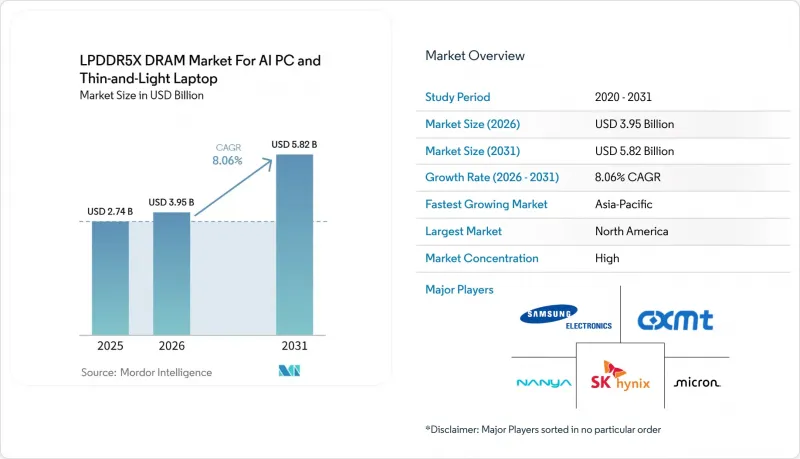
Mordor Intelligence에 의하면, AI PC 및 초슬림 노트북용 LPDDR5X DRAM 시장 규모는 2025년에 27억 4,000만 달러로 평가되었습니다. 2031년 58억 2,000만 달러에 이를 것으로 예측되며, 2026년부터 2031년에 걸쳐 CAGR 8.06%로 성장할 전망입니다.
본 보고서는 프로세서 플랫폼(x86 플랫폼 및 ARM 플랫폼), 메모리 용량(16GB, 24GB, 32GB, 48GB 및 그 이상), 최종 사용자(프리미엄 소비자, 크리에이티브 전문가 및 개발자, 기업/상업 사용자, 교육·공공 부문, 중소기업/프로슈머 사용자), 그리고 지역별로 분류되어 있습니다. 시장 전망은 금액(달러) 기준으로 제시되어 있습니다.
AI PC 및 초슬림 노트북용 LPDDR5X DRAM 시장 인사이트 및 동향
Copilot+의 16GB 메모리 요구 사항이 DRAM 수요의 구조적 기준을 확립
마이크로소프트의 Copilot+ PC 인증에 따라, AI 노트북의 인증 기준으로 DDR5 또는 LPDDR5 메모리 16GB가 절대적인 최소 요구 사항이 되었으며, 메모리는 선택적 업그레이드에서 플랫폼 요구 사항으로 그 위상이 변화했습니다. 조달 실무에서는 16GB가 더 이상 최종 목표가 아니라 출발점 역할을 하게 되었습니다. 많은 기업 구매 담당자들은 이미 24GB나 32GB 구성을 선호하는 경향을 보이고 있습니다. 이는 로컬 AI 기능이 일상적인 일반 생산성 워크로드와 병행하여 사용되게 되었기 때문입니다. ‘Recall’, ‘Click to Do’, 실시간 번역 등의 기능을 포함하는 마이크로소프트의 Copilot+ 기능 세트는 AI 워크로드의 더 많은 부분을 기기 내에서 처리함으로써, 시간이 지남에 따라 대용량 메모리에 대한 필요성을 더욱 높이고 있습니다. 이로 인해 AI PC 및 초슬림 노트북용 LPDDR5X DRAM 시장에서는 리프레시 주기에 진입하는 모든 호환 노트북에 LPDDR5X의 기본 수요가 연계되고 있습니다.
AI 노트북의 보급이 대당 DRAM 탑재량을 끌어올리고 있습니다.
AI PC 및 초슬림 노트북용 LPDDR5X DRAM 시장은 노트북 출하 대수뿐만 아니라 대당 메모리 탑재량 증가에 의해서도 견인되고 있습니다. NVIDIA의 RTX Spark 플랫폼은 프리미엄 Windows 노트북의 로컬 AI 워크로드를 위해 최대 128GB의 통합형 LPDDR5X를 지원함으로써 상한선을 높였습니다. 이로 인해 상한선은 ‘Copilot+’의 최소 기준인 16GB를 훨씬 초과하게 되었으며, 대용량 구성이 프리미엄층 구매자들에게 더욱 현실적인 선택지가 되었습니다. 크리에이티브 전문가와 개발자들은 이러한 변화를 가장 명확하게 체감하고 있습니다. 대규모 컨텍스트 창, 코드 어시스턴트, 컨텐츠 도구가 모두 동시에 로컬 메모리를 경쟁적으로 사용하기 때문입니다. 기기당 탑재 용량이 확대됨에 따라, 시스템 가격 책정이 광범위한 보급을 제한하는 경우에도 수익을 유지할 수 있게 되었습니다.
DRAM과 CPU 가격 급등이 OEM 및 소비자용 노트북 예산을 압박
메모리와 프로세서 비용 상승은 노트북 부품 원가에 직접적인 압박을 가하고 있으며, 적극적인 사양 업그레이드의 여지를 좁히고 있습니다. 16GB에서 32GB LPDDR5X로의 전환을 감당하기 어려워지면, 각 OEM 업체들은 더 높은 사양을 추구하는 대신 더 많은 모델을 Copilot+의 최소 요구 사양 수준으로 유지할 가능성이 있습니다. Samsung Electronics는 2026년에 설비에 대한 대규모 투자를 계획하고 1c DRAM으로의 전환을 가속화할 방침임에도 불구하고, 단기적인 공급 완화는 여전히 어려울 것이라는 견해를 밝혔습니다. 교육 기관 및 공공 부문의 구매 담당자들은 고정된 조달 예산으로 인해 부품 가격 급등을 흡수할 여지가 제한적이기 때문에 특히 영향을 받기 쉬운 상황에 놓여 있습니다. 이러한 압박이 수요를 소멸시키지는 않겠지만, AI PC 및 초슬림 노트북용 LPDDR5X DRAM 시장에서 대용량 노트북으로의 제품 구성 전환을 둔화시킬 가능성이 있습니다.
부문 분석
2025년, AI PC 및 초슬림 노트북용 LPDDR5X DRAM 시장에서 16GB 대역은 44.78%의 점유율을 차지했으나, 64GB 이상 대역은 2031년까지 연평균 성장률(CAGR) 9.44%로 확대될 것으로 예측됩니다. 이러한 경향은 최소 요구 사항을 충족하는 수준과 프리미엄 워크로드를 처리하는 상한 수준 사이에 명확한 격차가 있음을 보여줍니다. 16GB 구성은 Copilot+의 요구 사항을 충족하면서도 노트북의 제한된 예산에 부합하기 때문에 여전히 주요 판매량을 지탱하는 주축으로 자리 잡고 있습니다. 한편, 각 OEM 업체들이 AI 성능, 전력 소비, 판매 가격의 균형을 맞추려 노력하는 가운데, 24GB, 32GB, 48GB 옵션이 중급 시장 수요를 충족시키고 있습니다.
JEDEC의 LPDDR5X 규격은 다이당 고밀도화를 지원하여, 기판 면적을 비례적으로 확대하지 않고도 대용량 멀티칩 패키지를 구현할 수 있습니다. 이를 통해 미드티어 및 프리미엄급 설계에서 보다 효율적인 스케일업이 가능해집니다. NVIDIA의 RTX Spark 플랫폼은 최대 128GB의 통합형 LPDDR5X를 탑재하여 노트북 메모리의 상한선을 확대함과 동시에, 프리미엄 AI 노트북에 새로운 용량 기준을 제시했습니다. 또한, Framework사의 ‘Laptop 13 Pro’는 LPCAMM2를 통해 사용자가 직접 교체할 수 있는 LPDDR5X를 슬림형 노트북 설계에 통합할 수 있음을 입증했습니다. 이를 통해 시스템 수명 주기 전반에 걸쳐 대용량 메모리 채택이 더욱 확대될 것으로 기대됩니다. 따라서 AI PC 및 초슬림 노트북용 LPDDR5X DRAM 시장의 메모리 구성은 베이직 계층과 프리미엄 계층 모두에서 다양화가 진행되고 있습니다.
지역별 분석
2025년, 북미는 전 세계 매출의 62.28%를 차지하며, AI PC 및 초슬림 노트북용 LPDDR5X DRAM 시장에서 최대 점유율을 기록했습니다. 이 지역이 조기에 움직이기 시작한 배경으로는 기업용 단말기들이 Copilot+ 탑재 노트북을 가장 먼저 도입한 점과, Windows 10 지원 종료에 따라 많은 조직에서 단말기 교체 시기가 앞당겨진 점을 들 수 있습니다. 또한, 2025년 3월에 발령된 미국 연방 정부의 엔드포인트 지침에 따라 민간 기관이 AI 대응 시스템으로의 전환을 추진함에 따라 공공 부문의 성장세도 더욱 강화되었습니다. 이 지역의 프리미엄층 소비자와 크리에이티브 사용자들도 32GB 이상의 사양으로의 전환을 가속화하여, 노트북 1대당 평균 메모리 탑재량이 증가했습니다. 캐나다는 2026 회계연도 AI PC 조달 예산으로 4억 5,000만 캐나다 달러(3억 3,300만 달러 상당)를 편성하여 구조적인 지원을 한층 더 강화했습니다.
아시아태평양은 2031년까지 연평균 성장률(CAGR) 9.89%로 확대될 것으로 예측되며, 지역별 AI PC 및 초슬림 노트북용 LPDDR5X DRAM 시장 규모에서 가장 빠르게 성장하는 지역이 될 전망입니다. 이 지역은 첨단 메모리의 주요 생산 거점인 동시에 AI 노트북 수요가 확대되고 있는 중심지이기도 하여, 두 가지 중요한 역할을 겸비하고 있습니다. 한국과 대만은 삼성, SK하이닉스, 난야를 통해 공급의 핵심 역할을 계속하고 있는 반면, 중국은 CXMT와 현지 노트북 OEM 제조업체를 중심으로 보다 국내 주도형 LPDDR5X 공급망을 구축하고 있습니다. CXMT는 2025년 10월에 LPDDR5X 양산을 시작했으며, 이후 보도에 따르면 이 기업의 제품이 중국 노트북 제조업체들에 샘플로 제공되고 있는 것으로 밝혀져 이 지역공급 체제가 강화되었습니다. 일본과 한국은 수요 측면에서도 중요한데, 두 시장 모두에서 기업의 기기 교체 및 프리미엄 소비자층을 대상으로 한 보급이 여전히 활발하기 때문입니다.
유럽 및 기타 지역은 현재로서는 시장 점유율이 작지만, 향후 제품 구성의 질이라는 관점에서 볼 때 전략적으로 중요한 위치를 차지하고 있습니다. 유럽에서는 금융 서비스, 자동차, 전문 서비스 등 규제 대상 부문에서 기기 내 AI 처리를 우선시하는 이유가 더 강해, 이에 따라 더 대용량의 LPDDR5X를 탑재한 노트북이 선호되고 있습니다. 중동 및 아프리카 및 남미는 여전히 수요 규모가 작지만, 걸프협력회의(GCC) 국가들의 정부 조달 및 프리미엄 소비자 대상 구매가 단기적으로는 가장 두드러진 수요원으로 부각되고 있습니다. 남미는 계속해서 가격에 민감한 경향이 강하기 때문에 채택률은 상승하겠지만, 대용량 메모리의 구성 비율은 북미나 유럽의 일부 지역에 비해 여전히 뒤처질 것으로 보입니다.
기타 혜택 :
- 엑셀 형식 시장 예측(ME) 시트
- 3개월간의 애널리스트 지원
자주 묻는 질문
목차
제1장 서론
제2장 조사 방법
제3장 주요 요약
제4장 시장 구도
제5장 시장 규모 및 성장 예측
제6장 경쟁 구도
제7장 시장 기회 및 향후 전망
KTH 26.08.10According to Mordor Intelligence, the LPDDR5X DRAM market for AI PC and thin-and-light laptop industry size stood at USD 2.74 billion in 2025 and is projected to reach USD 5.82 billion by 2031, advancing at a CAGR of 8.06% from 2026 to 2031.
This report is Segmented by Processor Platform (x86 Platform, and ARM Platform), Memory Capacity (16 GB, 24 GB, 32 GB, 48 GB, and More), End User (Premium Consumers, Creative Professionals and Developers, Enterprise/Commercial Users, Education and Public Sector, and Small Business/Prosumer User), and Geography. The Market Forecasts are Provided in Terms of Value (USD).
Insights and Trends of LPDDR5X DRAM Market For AI PC and Thin-and-Light Laptop
Copilot+ 16 GB Memory Floor Creates A Structural DRAM Demand Baseline
Microsoft's Copilot+ PC certification made 16 GB of DDR5 or LPDDR5 memory a hard minimum for qualifying AI notebooks, and that shifted memory from an optional upgrade into a platform requirement. In procurement practice, 16 GB now works as the starting point instead of the final destination. Many enterprise buyers are already leaning toward 24 GB and 32 GB configurations because local AI features now sit beside regular productivity workloads throughout the day. Microsoft's Copilot+ feature set, including experiences such as Recall, Click to Do, and live translation, keeps more of the AI workload on the device and strengthens the case for higher memory footprints over time. This keeps baseline LPDDR5X demand tied to every compliant notebook that enters the refresh cycle in the LPDDR5X DRAM market for AI PC and thin-and-light laptop industry.
AI Notebook Penetration Lifting DRAM Content Per Device
The LPDDR5X DRAM market for AI PC and thin-and-light laptops is being lifted by rising memory content per device, not only by the number of notebooks shipped. NVIDIA's RTX Spark platform raised the ceiling by supporting up to 128 GB of unified LPDDR5X for local AI workloads in premium Windows laptops. That pushed the upper boundary far beyond the 16 GB Copilot+ floor and made high-capacity configurations more relevant to premium buyers. Creative professionals and developers are the clearest expression of this shift because large context windows, code assistants, and content tools all compete for local memory at the same time. This content-per-unit expansion helps revenue hold up even when system pricing limits broader volume adoption.
DRAM And CPU Price Spikes Compressing OEM And Consumer Notebook Budgets
Rising memory and processor costs are putting direct pressure on notebook bills of materials and narrowing the room for aggressive configuration upgrades. When the jump from 16 GB to 32 GB LPDDR5X becomes harder to absorb, OEMs may hold more models at the Copilot+ minimum instead of pushing higher specifications. Samsung indicated that near-term supply relief remains difficult even as it planned to invest heavily in facilities in 2026 and accelerate the move toward 1c DRAM. Education and public sector buyers are especially exposed because fixed procurement budgets leave less room to absorb component inflation. This pressure does not erase demand, but it can slow the mix shift toward higher-capacity notebooks in the LPDDR5X DRAM market for AI PC and thin-and-light laptop industry.
Other drivers and restraints analyzed in the detailed report include:
- LPDDR5X Bandwidth And Power Edge Over DDR5
- Premium AI Notebook Refresh Across x86 And ARM Platforms
- HBM-Led Capacity Reallocation Constraining Client LPDDR5X Availability
For complete list of drivers and restraints, kindly check the Table Of Contents.
Segment Analysis
The 16 GB tier held 44.78% share of the LPDDR5X DRAM market for AI PC and thin-and-light laptop industry in 2025, while the 64 GB and above tier is projected to expand at a 9.44% CAGR through 2031. That pattern shows a clear split between the compliance floor and the premium workload ceiling. The 16 GB configuration remains the main volume anchor because it satisfies Copilot+ requirements and still fits tighter notebook budgets. At the same time, 24 GB, 32 GB, and 48 GB options are filling the middle of the range as OEMs try to balance AI performance, power use, and selling price.
JEDEC's LPDDR5X standard supports per-die densities that make higher-capacity multi-chip packages possible without a matching increase in board footprint, which helps mid-tier and premium designs scale up more efficiently. NVIDIA's RTX Spark platform, with up to 128 GB of unified LPDDR5X, widened the upper end of the notebook memory envelope and gave premium AI laptops a new capacity reference point. Framework's Laptop 13 Pro also showed that LPCAMM2 can bring user-replaceable LPDDR5X into thin notebook designs, which supports wider adoption of higher capacities over a system's life cycle. The memory mix inside the LPDDR5X DRAM market for AI PC and thin-and-light laptop is therefore widening at both the baseline tier and the premium tier.
Complete Report Scope:
- By Processor Platform
- x86 Platforms
- ARM Platforms
- By Memory Capacity
- 16 GB
- 24 GB
- 32 GB
- 48 GB
- 64 GB and Above
- By End User
- Premium Consumers
- Enterprise / Commercial Users
- Creative Professionals and Developers
- Education and Public Sector
- Small Business / Prosumer Users
- By Geography
- North America
- Europe
- Asia-Pacific
- China
- Japan
- South Korea
- Taiwan
- Rest of Asia-Pacific
- Rest of the World
Geography Analysis
North America held 62.28% of global revenue in 2025, giving it the largest position in the LPDDR5X DRAM market for AI PC and thin-and-light laptop. The region moved early because enterprise fleets adopted Copilot+ notebooks sooner and because the Windows 10 support transition narrowed the refresh window for many organizations. A U.S. federal endpoint directive issued in March 2025 also added public-sector momentum by pushing civilian agencies toward AI-capable systems. Premium consumers and creative users in the region also moved faster into 32 GB and above configurations, which raised average memory content per notebook. Canada added another layer of structural support through a fiscal 2026 AI PC procurement allocation of CAD 450 million, which was equivalent to USD 333 million.
Asia-Pacific is projected to expand at a 9.89% CAGR through 2031, making it the fastest-growing geography within the LPDDR5X DRAM market for AI PC and thin-and-light laptop industry size by region. The region combines two powerful roles because it is both the main production base for advanced memory and a rising demand center for AI notebooks. South Korea and Taiwan remain central to supply through Samsung, SK hynix, and Nanya, while China is building a more domestic LPDDR5X chain around CXMT and local notebook OEMs. CXMT began mass production of LPDDR5X in October 2025, and later reporting indicated that its parts were being sampled by Chinese notebook makers, which strengthened the regional supply story. Japan and South Korea are also important on the demand side because enterprise refresh activity and premium consumer adoption remain active in both markets.
Europe and the Rest of the World represent smaller shares today, but they remain strategically important for future mix quality. In Europe, regulated sectors such as financial services, automotive, and professional services have a stronger reason to favor on-device AI processing, which supports notebooks with larger LPDDR5X configurations. The Middle East and Africa and South America still form a smaller demand pool, with government procurement and premium consumer purchases in Gulf Cooperation Council countries standing out as the clearest near-term pockets. South America is likely to remain more price sensitive, which means adoption can rise while higher-capacity memory mixes still lag North America and parts of Europe.
- Samsung Electronics Co., Ltd.
- SK hynix Inc.
- Micron Technology, Inc.
- Nanya Technology Corporation
- ChangXin Memory Technologies, Inc.
- ADATA Technology Co., Ltd.
- Innodisk Corporation
- BIWIN Storage Technology Co., Ltd.
- Team Group Inc.
- Longsys Electronics Co., Ltd. / FORESEE
- Framework Computer Inc.
- Integrated Silicon Solution, Inc.
Additional Benefits:
- The market estimate (ME) sheet in Excel format
- 3 months of analyst support
TABLE OF CONTENTS
1 INTRODUCTION
- 1.1 Study Assumptions and Market Definition
- 1.2 Scope of the Study
2 RESEARCH METHODOLOGY
3 EXECUTIVE SUMMARY
4 MARKET LANDSCAPE
- 4.1 Market Overview
- 4.2 Market Drivers
- 4.2.1 Copilot+ 16GB Memory Floor
- 4.2.2 AI Notebook Penetration Lifting DRAM Content
- 4.2.3 LPDDR5X Bandwidth and Power Edge Over DDR5
- 4.2.4 Premium AI Notebook Refresh Across x86 and ARM Platforms
- 4.2.5 LPCAMM2 Making LPDDR More Serviceable in PCs
- 4.2.6 On-Package Memory Freeing Battery and Thermal Budget
- 4.3 Market Restraints
- 4.3.1 DRAM and CPU Price Spikes Inflating Notebook BOMs
- 4.3.2 HBM-Led Capacity Shifts Tightening Client LPDDR5X Supply
- 4.3.3 Soldered and On-Package Memory Limits Upgradeability
- 4.3.4 Windows on ARM and AI Software Fragmentation Risk
- 4.4 Industry Supply Chain Analysis
- 4.5 Regulatory Landscape
- 4.6 Technological Outlook
- 4.7 Impact of Macroeconomic Factors
- 4.8 Porter's Five Forces Analysis
- 4.8.1 Threat of New Entrants
- 4.8.2 Bargaining Power of Suppliers
- 4.8.3 Bargaining Power of Buyers
- 4.8.4 Threat of Substitutes
- 4.8.5 Competitive Rivalry
5 MARKET SIZE AND GROWTH FORECASTS (VALUE)
- 5.1 By Processor Platform
- 5.1.1 x86 Platforms
- 5.1.2 ARM Platforms
- 5.2 By Memory Capacity
- 5.2.1 16 GB
- 5.2.2 24 GB
- 5.2.3 32 GB
- 5.2.4 48 GB
- 5.2.5 64 GB and Above
- 5.3 By End User
- 5.3.1 Premium Consumers
- 5.3.2 Enterprise / Commercial Users
- 5.3.3 Creative Professionals and Developers
- 5.3.4 Education and Public Sector
- 5.3.5 Small Business / Prosumer Users
- 5.4 By Geography
- 5.4.1 North America
- 5.4.2 Europe
- 5.4.3 Asia-Pacific
- 5.4.3.1 China
- 5.4.3.2 Japan
- 5.4.3.3 South Korea
- 5.4.3.4 Taiwan
- 5.4.3.5 Rest of Asia-Pacific
- 5.4.4 Rest of the World
6 COMPETITIVE LANDSCAPE
- 6.1 Market Concentration
- 6.2 Strategic Moves
- 6.3 Market Share Analysis
- 6.4 Company Profiles (includes Global level Overview, Market level overview, Core Segments, Financials as available, Strategic Information, Market Rank/Share for key companies, Products and Services, and Recent Developments)
- 6.4.1 Samsung Electronics Co., Ltd.
- 6.4.2 SK hynix Inc.
- 6.4.3 Micron Technology, Inc.
- 6.4.4 Nanya Technology Corporation
- 6.4.5 ChangXin Memory Technologies, Inc.
- 6.4.6 ADATA Technology Co., Ltd.
- 6.4.7 Innodisk Corporation
- 6.4.8 BIWIN Storage Technology Co., Ltd.
- 6.4.9 Team Group Inc.
- 6.4.10 Longsys Electronics Co., Ltd. / FORESEE
- 6.4.11 Framework Computer Inc.
- 6.4.12 Integrated Silicon Solution, Inc.
7 MARKET OPPORTUNITIES AND FUTURE OUTLOOK
- 7.1 White-space and unmet-need assessment