

|
시장보고서
상품코드
2099410
민간항공기 정비, 수리 및 점검(MRO) : 시장 점유율 분석, 업계 동향 및 통계, 성장 예측(2026-2031년)Commercial Aircraft Maintenance, Repair, and Overhaul - Market Share Analysis, Industry Trends & Statistics, Growth Forecasts (2026 - 2031) |
||||||
 Mordor Intelligence
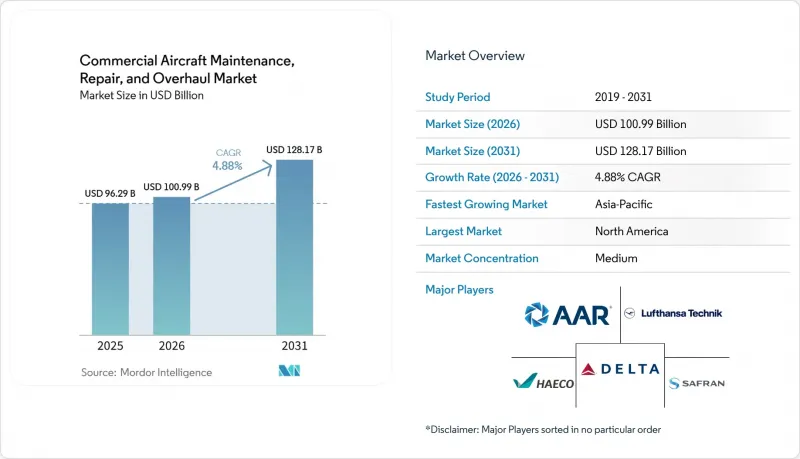
Mordor Intelligence에 의하면, 민간항공기 정비, 수리 및 점검(MRO) 시장 규모는 2025년 962억 9,000만 달러로 평가되었습니다. 2026년에는 1,009억 9,000만 달러로 확대되어 2026년부터 2031년에 걸쳐 CAGR 4.88%로 성장을 지속하여, 2031년까지 1,281억 7,000만 달러에 이를 것으로 예측됩니다.
본 보고서는 항공기 유형(고정익기 및 회전익기), MRO 유형(기체 정비, 엔진 오버홀 등), 최종 사용자(민간 여객 항공사, 화물 항공사 등), 서비스 제공업체 유형(항공사 산하 MRO 등), 지역(북미, 유럽 등)별로 분류되어 있습니다. 시장 전망은 금액(달러) 기준으로 제시되어 있습니다.
세계의 민간항공기 정비, 수리 및 점검(MRO) 시장 동향과 인사이트
노후화되는 전 세계 항공기 기단으로 인해 대규모 점검이 필요해지고 있습니다.
구형 항공기의 운항 기간이 길어짐에 따라, 대규모 정비 시 필요한 구조적 철저한 점검의 양이 증가하고 있습니다. 『Aviation Week』지는 2026년, 노후화된 B777 기단에 대해 구조적 수명의 한계에 대한 관심이 높아지고 있다고 보도했는데, 이는 대규모 점검 시의 검사 및 수리 작업에 대한 수요가 증가하고 있음을 시사합니다. 라이언에어도 노후화된 B737-800 기단이 중정비 전략 수립으로 이어지고 있으며, 이에 따라 해당사는 선정된 외부 위탁 지원을 계속 활용하는 한편, 사내 체제 확충을 서둘러야 한다고 밝혔습니다. 이는 중요한 점입니다. 왜냐하면 노후된 항공기는 정비 횟수를 늘릴 뿐만 아니라, 한 번의 정비 작업에 드는 노력을 증가시키고 예측을 어렵게 만들기 때문입니다. MRO 사업자에게는 이로 인해 더 복잡한 구조 작업, 더 긴 턴어라운드 시간, 그리고 더 엄격한 슬롯 관리로 용량 계획의 중점이 이동하게 됩니다.
코로나19 사태 이후 나로우드바디 항공기 가동률 급증
나로우드바디 항공기는 항공 수요 회복에서 큰 비중을 차지하고 있으며, 일일 운항 증가로 인해 주요 기단 전체에서 정비 실시 시기가 앞당겨지고 있습니다. 『에비에이션 위크』지의 보도에 따르면, 중동의 협폭기 비행 주기는 2025년에 2019년 수준을 30% 상회하고, 2024년 대비 5% 증가했습니다. 보잉은 2025년 ‘상업 시장 전망’ 보고서에서 단일 통로 항공기의 일일 평균 블록 시간이 팬데믹 이전 수준보다 15% 높으며, 이로 인해 많은 항공사에서 예정되어 있던 C-체크 시기가 12-18개월 앞당겨질 것이라고 밝혔습니다. 미국에서는 유나이티드 항공이 2026년 1분기까지 기체당 사이클 수를 거의 유지한 채 운항 기체 수를 약 100대 확대함에 따라, 이 항공사는 특히 어려운 상황에 처해 있는 것으로 간주됩니다. 이로 인해 협폭기(narrow-body)의 정비 수요는 경기 순환적인 성격이라기보다 구조적인 성격을 띠게 되었으며, 이는 민간항공기 정비, 수리 및 점검(MRO) 시장의 격납고 공간, 인력, 부품 공급에 대한 장기적인 투자를 촉진하고 있습니다.
자격증을 보유한 A&P 정비사의 심각한 부족
인력 부족은 업무량이 견조한 상태가 지속되는 경우에도, 민간항공기 정비, 수리 및 점검(MRO) 시장이 실제로 얼마나 많은 수요에 대응할 수 있는지에 있어 여전히 구조적인 제약 요인으로 작용하고 있습니다. 『ATEC 2025 파이프라인 보고서』에 따르면, 2025년에는 상업 항공 운송 부문에서 인증 정비사에 대한 수요 대비 10%의 부족 현상이 발생할 것으로 전망됩니다. 이 부족 폭은 2035년까지 7%로 축소될 것으로 예상되지만, 그럼에도 불구하고 해당 부문에서는 약 1만 명의 정비사가 부족한 상태가 지속될 것으로 전망됩니다. 동 보고서에 따르면, 2024년 AMTS(항공 정비사 양성 학교)의 입학생 수는 9% 증가한 반면, 지도원 수는 제자리걸음을 보이며, 교육 정원의 약 3분의 1이 채워지지 않은 상황입니다. 이는 병목 현상이 채용뿐만 아니라 교육 체계, 지도원의 수용 능력, 그리고 신규 기술자가 현장에서 생산적인 역할을 수행하기까지 걸리는 속도에도 있음을 의미합니다.
부문 분석
2025년에는 고정익 항공기가 매출의 95.18%를 차지했으며, 상업용 제트기의 대규모 운항으로 인해 계속해서 수요의 기반을 형성할 것입니다. 나로우드 기종은 민간항공기 정비, 수리 및 점검(MRO) 시장의 상당 부분을 주도하고 있으며, 이용 패턴의 변화로 인해 기체 및 부품 각 라인에서 작업 카드의 빈도가 증가하고 있습니다. 와이드바디 기종의 중정비는 장거리 노선 수요 회복이 완만한 속도로 지속됨에 따라 안정적인 수준을 유지했습니다.
회전익 항공기 민간항공기 정비, 수리 및 점검(MRO) 시장은 2031년까지 연평균 성장률(CAGR) 5.70%라는 비교적 빠른 속도로 확대될 것으로 예상되며, 시장 내에서 가장 높은 성장률을 기록할 전망입니다. 회전익 항공기에 대한 수요는 낮은 수준이지만 견조하며, 국방 현대화 프로그램과 높은 가동률이 요구되는 헬리콥터를 필요로 하는 해양 에너지 사업에 의해 주도되고 있습니다. 로터 블레이드 정밀 정비에 대한 전문 역량, 엄격한 항공 적합성 요건, 그리고 정부 예산 전망의 명확성이 안정적인 이익률을 뒷받침하고 있습니다. 군사 계약을 수주한 서비스 제공업체들은 고정익 항공기가 주류를 이루는 민간항공기 정비, 수리 및 점검(MRO) 시장의 경기 변동을 상쇄하는 예측 가능한 수익원의 혜택을 누리고 있습니다.
2025년 매출액 중 엔진 정비가 46.12%를 차지해 민간항공기 정비, 수리 및 점검(MRO) 시장에서 동력 장치의 정비가 자본 집약적임을 여실히 보여주었습니다. OEM 인증 센터는 LEAP 및 GTF의 각 변형 모델에 대응하는 공구 라인을 확충한 반면, 독립 기업들은 경쟁력을 유지하기 위해 성숙한 엔진 제품군에 특화했습니다. 팬데믹 이후 정비 입고 주기가 정착됨에 따라, 민간항공기 정비, 수리 및 점검(MRO) 시장 내 엔진 관련 업무 시장 규모는 확대될 것으로 예측됩니다.
라인 정비는 운항사의 수익 일수를 극대화하는 퀵턴 서비스를 통해 5.62%라는 가장 높은 연평균 성장률(CAGR)을 나타낼 전망입니다. 태블릿 단말기를 활용한 점검 앱과 웨어러블형 헤드업 디스플레이의 도입으로 정기 점검 시간이 단축되고, 게이트 타임 준수가 개선되었습니다. 항공사의 운항 일정이 밀집되는 가운데, 공항 내에 팀을 배치하는 서비스 제공업체들이 시장 점유율을 확대하며 민간항공기 정비, 수리 및 점검(MRO) 시장 전체의 성장 궤도를 더욱 공고히 했습니다.
지역별 분석
북미는 해당 지역의 대규모 현역 기단과 성숙한 정비 생태계 덕분에 2025년 매출의 38.60%를 차지했습니다. 애틀랜타, 댈러스, 마이애미의 주요 허브에서는 엔진, 부품 및 중정비에 관한 종합적인 역량과 효율적인 물류가 제공되었습니다. 프랫 앤드 휘트니(Pratt & Whitney)사가 델타 테크옵스(Delta TechOps)와 체결한 GTF 엔진 처리 능력을 30% 증대하는 계약 등 최근의 투자를 통해 정비 역량이 강화되었습니다. 엄격한 인증 기준과 디지털 기술 도입으로 생산성 향상이 지속되어, 인건비 상승에도 불구하고 민간항공기 정비, 수리 및 점검(MRO) 시장의 경쟁력은 유지되었습니다.
각 항공사가 기단을 확대하고, 각국 정부가 국내 정비를 장려하고 있는 만큼, 아시아태평양은 연평균 성장률(CAGR) 6.01%로 가장 빠른 성장을 이룰 것으로 예측됩니다. 싱가포르 에어로 엔진 서비스는 2억 4,200만 달러 규모의 신규 시설 건설을 발표했으며, 한편 에어 인디아는 방갈로르에서 35에이커 규모의 캠퍼스 건설에 착수하여 1,200개의 일자리가 창출될 것으로 예측됩니다. 이러한 확장을 통해 이전에는 유럽이나 중동으로 유출되던 지역 내 지출을 지역 내에 유지할 수 있게 되어, 민간항공기 정비·수리·오버홀 시장에서 아시아의 기여도가 높아질 것입니다.
유럽은 기술 면에서 계속해서 선도적인 위치를 유지했으나, 비용 면에서 압박에 직면했습니다. 루프트한자 테크닉(Lufthansa Technik)은 향후 와이드바디 항공기 정비 수요를 확보하기 위해 포르투갈에 새로운 중정비 거점을 설립하는 것을 포함한 수십억 유로 규모의 투자 계획을 승인했습니다. 동유럽 국가들은 경쟁력 있는 인건비를 무기로 폴란드의 XEOS사와 같은 엔진 오버홀 시설을 유치했습니다. 중동은 지리적 이점을 활용하여 환승 관련 점검 업무를 유치했습니다. 남미에서는 화물기 기단을 지원하기 위한 틈새 부품 수리 클러스터가 형성되어, 전 세계 민간항공기 정비, 수리 및 점검(MRO) 시장의 균형 잡힌 발전에 기여했습니다.
기타 혜택 :
- 엑셀 형식 시장 예측(ME) 시트
- 3개월간의 애널리스트 지원
자주 묻는 질문
목차
제1장 서론
제2장 조사 방법
제3장 주요 요약
제4장 시장 구도
제5장 시장 규모 및 성장 예측
제6장 경쟁 구도
제7장 시장 기회 및 향후 전망
KTH 26.08.10According to Mordor Intelligence, the commercial aircraft maintenance, repair, and overhaul market size is expected to grow from USD 96.29 billion in 2025 to USD 100.99 billion in 2026, and is forecast to reach USD 128.17 billion by 2031, at a 4.88% CAGR over 2026-2031.
This report is Segmented by Aircraft Type (Fixed-Wing and Rotary Wing), MRO Type (Airframe Maintenance, Engine Overhaul, and More), End User (Commercial Passenger Airlines, Cargo Operators, and More), Service Provider Type (Airline-Affiliated MROs, and More), and Geography (North America, Europe, and More). The Market Forecasts are Provided in Terms of Value (USD).
Global Commercial Aircraft Maintenance, Repair, and Overhaul Market Trends and Insights
Aging Global Fleet Necessitating Heavy Checks
Older aircraft are staying in service longer, which is increasing the amount of deep structural work required during heavy maintenance visits. Aviation Week reported in 2026 that mature B777 fleets were drawing greater attention to structural life limits, which points to rising demand for inspection and repair work during major checks. Ryanair also said its aging B737-800 fleet was shaping a heavy maintenance strategy, which pushed the airline to expand internal capability while still using selected outsourcing support. This matters because older aircraft not only increase the number of visits; they also make each visit more labor-intensive and less predictable. For MRO providers, this shifts capacity planning toward more complex structural work, longer turnaround times, and tighter slot management.
Surging Narrowbody Utilization post-COVID
Narrowbody aircraft are carrying a larger share of traffic recovery, and higher daily use is bringing maintenance events forward across major fleets. Aviation Week reported that narrowbody flight cycles in the Middle East were 30% above 2019 levels in 2025, up 5% year over year from 2024. Boeing mentioned in its 2025 Commercial Market Outlook that average daily block hours for single-aisle aircraft were 15% above pre-pandemic norms, which was enough to move scheduled C-check timing forward by 12 to 18 months across many fleets. In the US, United Airlines is regarded as a high-pressure case after the carrier expanded its in-service fleet by around 100 aircraft while keeping similar cycles per tail through Q1 2026. This is making narrowbody maintenance demand more structural than cyclical, which supports longer-term commitments to hangar space, labor, and parts support in the commercial aircraft maintenance, repair, and overhaul market.
Acute Shortage of Licensed A&P Technicians
The labor shortage remains a structural limit on how much demand the commercial aircraft maintenance, repair, and overhaul market can actually serve, even when workloads remain strong. The ATEC 2025 Pipeline Report said the commercial air transport segment was 10% short of demand for certificated mechanics in 2025. That gap is expected to narrow to 7% by 2035, but it would still leave the sector short by around 10,000 mechanics. The same report showed that AMTS enrollment rose 9% in 2024, while the instructor workforce remained flat, leaving around one-third of training seats unfilled. This means the bottleneck is not only hiring but also the training pipeline, educator capacity, and the speed at which new technicians can move into productive shop roles.
Other drivers and restraints analyzed in the detailed report include:
- AI-Driven Predictive Maintenance Adoption
- Regional Government Incentives for Indigenous MRO
- Persistent Engine Shop Visit Capacity Crunch
For complete list of drivers and restraints, kindly check the Table Of Contents.
Segment Analysis
Fixed-wing fleets accounted for 95.18% of revenue in 2025 and continue to anchor demand owing to the scale of commercial jet operations. Narrowbody aircraft drive a sizable portion of the commercial aircraft maintenance, repair, and overhaul market, with utilization patterns increasing task card frequency across airframe and component lines. Widebody heavy checks remained steady because long-haul traffic recovery continued at a measured pace.
Rotary-wing maintenance, repair, and overhaul is expected to expand at a faster 5.70% CAGR through 2031, recording the highest growth rate within the market. Demand for rotary-wing aircraft is lower but resilient, driven by defense modernization programs and offshore energy operations that require highly available helicopters. Specialized rotor-blade overhaul capabilities, strict airworthiness requirements, and government budget visibility support stable margins. Providers that have secured military contracts benefit from a predictable revenue stream that offsets cyclicality in the fixed-wing-dominated commercial aircraft maintenance, repair, and overhaul market.
Engine overhaul accounted for 46.12% of 2025 revenue, underscoring the capital-intensive nature of powerplant maintenance in the aircraft maintenance, repair, and overhaul market. OEM-certified centers expanded tooling lines for LEAP and GTF variants, while independents specialized in mature engine families to retain competitiveness. The commercial aircraft maintenance, repair, and overhaul market size for engine work is expected to grow as shop-visit intervals settle into post-pandemic patterns.
Line maintenance is projected to register the highest CAGR of 5.62% due to quick-turn services that maximize operator revenue days. Tablet-based inspection apps and wearable head-up displays shortened routine checks, improving gate-time discipline. As airline schedules densified, providers with on-airport teams captured incremental share and reinforced the broader growth trajectory of the commercial aircraft maintenance, repair, and overhaul market.
Complete Report Scope:
- By Aircraft Type
- Fixed-Wing
- Narrowbody Aircraft
- Widebody Aircraft
- Regional Transport Aircraft
- Rotary Wing
- Fixed-Wing
- By MRO Type
- Airframe Maintenance
- Engine Overhaul
- Component Repair and Overhaul
- Line Maintenance
- By End User
- Commercial Passenger Airlines
- Cargo Operators
- Leasing Companies
- Charter Operators
- By Service Provider Type
- Airline-Affiliated MROs
- Independent Third-Party MROs
- OEM-Affiliated MROs
- By Geography
- North America
- United States
- Canada
- Mexico
- Europe
- Germany
- United Kingdom
- France
- Italy
- Russia
- Rest of Europe
- Asia-Pacific
- China
- India
- Japan
- South Korea
- Australia
- Rest of Asia-Pacific
- South America
- Brazil
- Rest of South America
- Middle East and Africa
- Middle East
- United Arab Emirates
- Saudi Arabia
- Turkey
- Rest of Middle East
- Africa
- South Africa
- Rest of Africa
- Middle East
- North America
Geography Analysis
North America generated 38.60% of 2025 revenue from the region's large active fleets and mature maintenance ecosystems. The major Atlanta, Dallas, and Miami hubs offered comprehensive engine, component, and heavy-check capabilities and efficient logistics. Recent investments, such as Pratt & Whitney's agreement with Delta TechOps to lift GTF throughput by 30%, reinforced capacity. Strong certification standards and digital adoption sustained productivity growth, keeping the commercial aircraft maintenance, repair, and overhaul market competitive despite higher labor rates.
Asia-Pacific is projected to witness the fastest growth, at a 6.01% CAGR, as carriers expand their fleets and governments incentivize domestic maintenance. Singapore Aero Engine Services announced USD 242 million in new facilities, while Air India began work on a 35-acre campus in Bengaluru, expected to create 1,200 jobs. These expansions help retain regional spend that previously moved to Europe or the Middle East and raise Asia's contribution to the commercial aircraft maintenance, repair, and overhaul market.
Europe remained a technology leader but faced cost pressure. Lufthansa Technik approved a multi-billion euro investment program that included a new heavy-maintenance site in Portugal to secure future widebody workload. Eastern European countries offered competitive labor costs, attracting engine-overhaul facilities such as XEOS in Poland. The Middle East used geographic connectivity to attract transit-related checks. South America developed niche component-repair clusters to support cargo fleets, helping ensure balanced development of the commercial aircraft maintenance, repair, and overhaul market worldwide.
- Lufthansa Technik AG
- AAR CORP.
- Singapore Technologies Engineering Ltd.
- Delta Air Lines, Inc.
- Hong Kong Aircraft Engineering Company Limited
- General Electric Company
- Rolls-Royce Holdings plc
- Safran SA
- RTX Corporation
- Air France-KLM Group
- MTU Aero Engines AG
- StandardAero Aviation Holdings, Inc.
- SR Technics Switzerland Ltd.
- Turkish Airlines Technic Inc.
- Aircraft Maintenance and Engineering Corporation
- Guangzhou Aircraft Maintenance Engineering Co.,Ltd.
- SIA Engineering Company Limited
- Emirates Engineering (Emirates Group)
- TAP Maintenance and Engineering
- PT GMF AeroAsia Tbk
- AI Engineering Services Ltd.
Additional Benefits:
- The market estimate (ME) sheet in Excel format
- 3 months of analyst support
TABLE OF CONTENTS
1 INTRODUCTION
- 1.1 Study Assumptions and Market Definition
- 1.2 Scope of the Study
2 RESEARCH METHODOLOGY
3 EXECUTIVE SUMMARY
4 MARKET LANDSCAPE
- 4.1 Market Overview
- 4.2 Market Drivers
- 4.2.1 Aging global fleet necessitating heavy checks
- 4.2.2 Surging narrowbody utilization post-COVID
- 4.2.3 OEM aftermarket strategy expansion
- 4.2.4 AI-driven predictive maintenance adoption
- 4.2.5 Regional government incentives for indigenous MRO
- 4.2.6 Used-serviceable-material (USM) supply chain formalization
- 4.3 Market Restraints
- 4.3.1 Acute shortage of licensed A&P technicians
- 4.3.2 Persistent engine shop visit capacity crunch
- 4.3.3 Tier-2 component supply chain volatility
- 4.3.4 OEM price escalation on spare parts
- 4.4 Value Chain Analysis
- 4.5 Regulatory Landscape
- 4.6 Technological Outlook
- 4.7 Porter's Five Forces Analysis
- 4.7.1 Bargaining Power of Buyers
- 4.7.2 Bargaining Power of Suppliers
- 4.7.3 Threat of New Entrants
- 4.7.4 Threat of Substitute Products
- 4.7.5 Intensity of Competitive Rivalry
5 MARKET SIZE AND GROWTH FORECASTS (VALUE)
- 5.1 By Aircraft Type
- 5.1.1 Fixed-Wing
- 5.1.1.1 Narrowbody Aircraft
- 5.1.1.2 Widebody Aircraft
- 5.1.1.3 Regional Transport Aircraft
- 5.1.2 Rotary Wing
- 5.1.1 Fixed-Wing
- 5.2 By MRO Type
- 5.2.1 Airframe Maintenance
- 5.2.2 Engine Overhaul
- 5.2.3 Component Repair and Overhaul
- 5.2.4 Line Maintenance
- 5.3 By End User
- 5.3.1 Commercial Passenger Airlines
- 5.3.2 Cargo Operators
- 5.3.3 Leasing Companies
- 5.3.4 Charter Operators
- 5.4 By Service Provider Type
- 5.4.1 Airline-Affiliated MROs
- 5.4.2 Independent Third-Party MROs
- 5.4.3 OEM-Affiliated MROs
- 5.5 By Geography
- 5.5.1 North America
- 5.5.1.1 United States
- 5.5.1.2 Canada
- 5.5.1.3 Mexico
- 5.5.2 Europe
- 5.5.2.1 Germany
- 5.5.2.2 United Kingdom
- 5.5.2.3 France
- 5.5.2.4 Italy
- 5.5.2.5 Russia
- 5.5.2.6 Rest of Europe
- 5.5.3 Asia-Pacific
- 5.5.3.1 China
- 5.5.3.2 India
- 5.5.3.3 Japan
- 5.5.3.4 South Korea
- 5.5.3.5 Australia
- 5.5.3.6 Rest of Asia-Pacific
- 5.5.4 South America
- 5.5.4.1 Brazil
- 5.5.4.2 Rest of South America
- 5.5.5 Middle East and Africa
- 5.5.5.1 Middle East
- 5.5.5.1.1 United Arab Emirates
- 5.5.5.1.2 Saudi Arabia
- 5.5.5.1.3 Turkey
- 5.5.5.1.4 Rest of Middle East
- 5.5.5.2 Africa
- 5.5.5.2.1 South Africa
- 5.5.5.2.2 Rest of Africa
- 5.5.5.1 Middle East
- 5.5.1 North America
6 COMPETITIVE LANDSCAPE
- 6.1 Market Concentration
- 6.2 Strategic Moves
- 6.3 Market Share Analysis
- 6.4 Company Profiles (includes Global level Overview, Market level overview, Core Segments, Financials as available, Strategic Information, Market Rank/Share for key companies, Products and Services, and Recent Developments)
- 6.4.1 Lufthansa Technik AG
- 6.4.2 AAR CORP.
- 6.4.3 Singapore Technologies Engineering Ltd.
- 6.4.4 Delta Air Lines, Inc.
- 6.4.5 Hong Kong Aircraft Engineering Company Limited
- 6.4.6 General Electric Company
- 6.4.7 Rolls-Royce Holdings plc
- 6.4.8 Safran SA
- 6.4.9 RTX Corporation
- 6.4.10 Air France-KLM Group
- 6.4.11 MTU Aero Engines AG
- 6.4.12 StandardAero Aviation Holdings, Inc.
- 6.4.13 SR Technics Switzerland Ltd.
- 6.4.14 Turkish Airlines Technic Inc.
- 6.4.15 Aircraft Maintenance and Engineering Corporation
- 6.4.16 Guangzhou Aircraft Maintenance Engineering Co.,Ltd.
- 6.4.17 SIA Engineering Company Limited
- 6.4.18 Emirates Engineering (Emirates Group)
- 6.4.19 TAP Maintenance and Engineering
- 6.4.20 PT GMF AeroAsia Tbk
- 6.4.21 AI Engineering Services Ltd.
7 MARKET OPPORTUNITIES AND FUTURE OUTLOOK
- 7.1 White-space and Unmet-Need Assessment


