

|
시장보고서
상품코드
2099412
항공 전자전 : 시장 점유율 분석, 업계 동향 및 통계, 성장 예측(2026-2031년)Airborne Electronic Warfare - Market Share Analysis, Industry Trends & Statistics, Growth Forecasts (2026 - 2031) |
||||||
 Mordor Intelligence
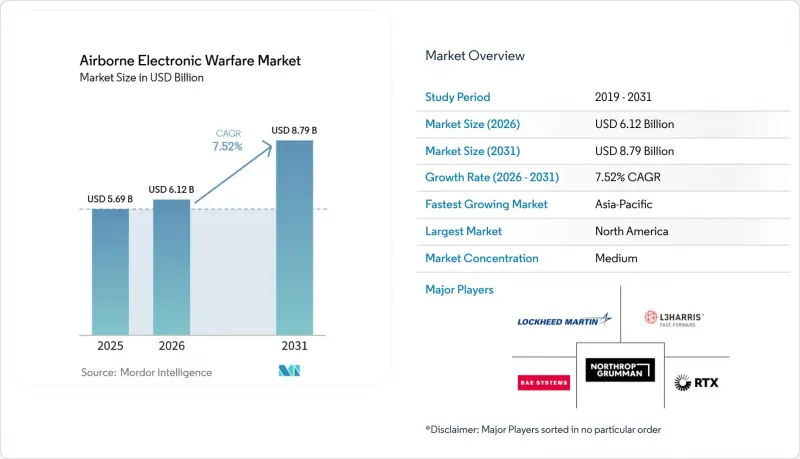
Mordor Intelligence에 의하면, 항공 전자전 시장 규모는 2025년 56억 9,000만 달러로 평가되었습니다. 2026년에는 61억 2,000만 달러로 확대되어 2026년부터 2031년에 걸쳐 CAGR 7.52%로 성장을 지속하여, 2031년에는 87억 9,000만 달러에 이를 것으로 예측됩니다.
본 보고서는 기능별(전자 공격, 전자 방어 등), 플랫폼 유형별(유인 항공기 및 무인 항공기), 주파수 대역별(HF/VHF, UHF/L/S, C/X, Ku/Ka), 아키텍처별(포드 탑재형, 내장형 및 UAV용 페이로드/포드), 지역(북미, 유럽, 아시아태평양, 기타)별로 분류되어 있습니다. 시장 전망은 금액(달러) 기준으로 제시되어 있습니다.
세계의 항공 전자전 시장 동향 및 인사이트
국방 예산 증가 및 장비 교체 주기
방위비 증가로 인해 차세대 전자전(EW) 시스템 조달이 가속화되었습니다. 미국 국방부(DoD)는 향후 5년간 최소 210억 달러를 전자전 개발에 투입할 계획을 세우고 있으며, 이는 이전 주기에 비해 40% 증가한 규모입니다. 유럽 국가들은 단위 비용 절감과 상호 운용성 향상을 도모하기 위해 전자전 자원을 공동으로 활용하는 다국적 연합을 결성했습니다. 사우디아라비아 및 기타 걸프 국가들도 이러한 추세를 따르며, 러시아의 접근 거부(A2/AD) 시스템에 대항하기 위해 레이더, 미사일, 전자전 시스템을 완벽하게 통합한 솔루션에 투자하고 있습니다. 각 지역에서 예산 증가로 인해 업데이트 주기가 단축되면서, 개방형 시스템 표준을 준수하는 포드 탑재형 및 내장형 전자전 아키텍처에 대한 수주가 더욱 증가하고 있습니다.
고도화된 다중 대역 지대공 미사일(SAM) 및 레이더 시스템의 위협 증가
적응성이 뛰어난 SAM의 보급으로 인해 각국 공군은 인지 전자전을 채택하고, 밀리초 단위로 재프로그래밍을 수행할 수밖에 없게 되었습니다. 중국 인민해방군(PLA)의 시제기는 3,600개의 가짜 레이더 표적을 생성할 수 있는 재머를 시연했으며, 이로 인해 미국 및 NATO의 광대역 능동 전자 주사식 위상배열(AESA) 대응에 대한 관심이 가속화되고 있습니다. 동시 다중 대역 기만 기능이 가능한 디지털 무선 주파수 메모리(DRFM) 기술은 현재 조달 로드맵의 중심이 되고 있습니다. 이는 미국 해군 및 호주 공군의 요구 사항을 포괄하는 RTX사의 '차세대 재머 미드밴드' 계약에서도 분명하게 드러납니다.
차세대 전자전 포드의 조달 및 수명 주기 비용 초과
NGJ-Mid Band와 같은 포드 프로그램에서는 계약 수정이 여러 차례 이루어졌으며, 그 결과 비용이 증가하고 마일스톤이 지연되면서 이미 빠듯한 국방 예산에 추가적인 압박이 가해졌습니다. AI/ML 알고리즘을 구형 전투기에 통합하는 과정에서 예상치 못한 기술적 위험이 발생했고, 개발자들이 항공전자 장비 전체의 전자기 호환성(EMC) 문제를 해결하는 과정에서 일정이 지연되었습니다. 적응형 위협에 대한 신뢰성을 입증하기 위해서는 시험 기간 연장이 필수적이며, 이로 인해 제품 수명 주기 전반에 걸쳐 유지 관리 비용이 증가하고 있습니다.
부문 분석
2025년, 항공 전자전 시장에서 전자 공격이 시장 점유율의 47.63%를 차지하며, 실탄 무기 발사에 앞서 적의 레이더와 통신을 공격하는 것의 중요성이 부각되었습니다. 광대역 호위 재밍 및 스탠드오프형 미끼에 대한 수요로 인해, 2026년 공격용 페이로드 부문의 항공 전자전 시장 규모는 29억 달러를 넘어섰습니다. 각 군이 인지형 재머에 정보를 제공하는 실시간 위협 라이브러리와 방위 감지 센서에 투자한 결과, 전자 지원 분야가 연평균 성장률(CAGR) 9.72%로 가장 빠르게 성장했습니다. 전자 방어 분야에서는 특히 GPS 신호 상실이 작전 활동을 마비시킬 우려가 있는 합동 작전에서 위성 링크 및 정밀 항법 신호의 내성을 강화하기 위해 안정적인 예산이 유지되었습니다. 이 세 가지 임무를 단일 처리 스택으로 통합한 통합 제품군이 신형 전투기 및 폭격기 프로그램의 표준 장비로 채택되어, 상황 인식 능력을 향상시키는 동시에 유지 비용을 절감했습니다.
전자 공격 분야에 대한 지금까지의 투자는 수출 가능한 솔루션으로 성숙되어, NATO 회원국들이 공통 파형을 도입하고 데이터 지연을 최소화하며 공격 패키지를 조정할 수 있게 되었습니다. 현재 항공 전자전 시장에서는 단일 개구 영역 내에서 ‘감지·분류·방해’ 기능을 동시에 제공하는 시스템이 주류를 이루고 있습니다. 이러한 추세로 인해 여러 개의 라인 교체 가능 유닛(LRU)의 필요성이 줄어들어 유지보수 작업이 효율화되고 있습니다. 또한, 훈련장에 고충실도 위협 에미터가 도입되어 승무원이 현실적인 다중 대역 레이더 클러스터를 상정한 훈련을 수행할 수 있게 된 점도 시장 성장을 뒷받침하고 있습니다.
2025년에도 유인 항공기는 항공 전자전 시장의 73.92%를 계속 차지했습니다. 이는 F-16, F-35, 타이푼 및 EA-18G 각 기체에 대한 현대화 프로그램 덕분에 전 세계적으로 수천 대의 현역 기체가 유지되었기 때문입니다. 이러한 성장은 F-35에 탑재된 AN/ASQ-239와 같은 임베디드 아키텍처에 의해 주도되고 있습니다. 한편, 무인 시스템은 GA-ASI의 MQ-20 어벤저 자율 교란 시험이 성공한 덕분에 2031년까지 연평균 성장률(CAGR)이 11.08%에 달했습니다. 승무원에게 가해지는 위험을 줄이고 운용 비용을 절감하기 위해, 전장 전역에 전자전 노드를 분산시키는 소모성 공대지 효과 무기의 조달이 촉진되었습니다. 전술적으로는 무인 플랫폼이 위협의 발원지를 유인하는 미끼로 점점 더 많이 활용되고 있으며, 이를 통해 유인 항공기는 스텔스성을 유지하면서 협동적인 공격 순서를 지휘할 수 있게 되었습니다.
각 UAV 제조업체들은 최종 사용자가 전자전 카트리지를 신속하게 교체할 수 있도록 개방형 시스템 방식의 페이로드 베이 개발에 주력했습니다. 시장에서는 전력 소비를 20% 줄이고 MALE UAV의 체공 시간을 24시간 이상으로 연장한 경량 갈륨 질화물 송신기가 호평을 받았습니다. 이와 동시에 유인 플랫폼에는 무인기용으로 개발된 자율형 의사결정 지원 시스템이 통합되어, 하드웨어와 소프트웨어의 상호 작용을 통해 기체군 전체의 회복력이 향상되었습니다.
지역별 분석
2025년, 북미는 항공 전자전 시장 매출의 44.78%를 차지했습니다. 이는 보잉사가 미 공군의 차세대 전자전 시스템을 위해 수주한 6억 1,500만 달러 규모의 계약을 비롯한 미국의 다년 계약에 힘입은 결과입니다. 이 지역의 항공 전자전 시장 규모는 F-15, F-16, EA-18G 기체군의 현대화 및 B-21 폭격기의 방어 시스템군에 대한 지속적인 개발에 힘입어, 2031년까지 연평균 성장률(CAGR) 6.37%로 확대될 것으로 예측됩니다. 캐나다의 국방 정책 재검토에 따라, 향후 전투기에 탑재될 호위용 재머에 자금이 배정되어 지역 내 수요를 더욱 강화할 것으로 보입니다.
아시아태평양은 중국의 6G 대응 재밍 시험과, F-35 및 차세대 전투기 프로그램을 위한 전자전 장비 조달을 가속화한 일본의 정책 재검토를 반영하여, 연평균 성장률(CAGR) 9.58%로 가장 빠른 성장을 기록할 것으로 예측됩니다. 한국과 인도의 국내 제조 거점은 포드형 시스템을 현지에서 조립하기 위한 기술 이전 계약을 체결하여, 비용 절감과 자립적인 정비 능력 구축을 실현했습니다. 이처럼 항공 전자전 시장은 수입을 통한 조달과 새롭게 부상한 국내 생산 라인 모두로부터 혜택을 받았습니다.
유럽은 독일의 ‘유로파이터 EK’나 영국의 ‘템페스트’ 차세대 전투 항공 시스템 등, 전자전(EW) 전술을 조화시키는 다국간 이니셔티브에 힘입어 견조한 성장세를 유지했습니다. 공동 자금 조달을 통해 규모의 경제가 향상되었고, 개방형 아키텍처 표준의 채택이 촉진되었습니다. 이는 연합군의 상호 운용성을 보장하기 위해 미국의 SOSA 프로파일과 호환되는 것입니다. 한편, 중동 및 아프리카에서는 소수의 구매자에게 지출이 집중되었습니다. 그러나 사우디아라비아의 통합 레이더·전자전 로드맵과 UAE의 EDGE 그룹에 의한 수출 추진은 신뢰성 높은 전파 우위 능력을 배치하겠다는 전략적 의도를 부각시켰습니다.
기타 혜택 :
- 엑셀 형식 시장 예측(ME) 시트
- 3개월간의 애널리스트 지원
자주 묻는 질문
목차
제1장 서론
제2장 조사 방법
제3장 주요 요약
제4장 시장 구도
제5장 시장 규모 및 성장 예측
제6장 경쟁 구도
제7장 시장 기회 및 향후 전망
KTH 26.08.10According to Mordor Intelligence, the airborne electronic warfare market size is expected to grow from USD 5.69 billion in 2025 to USD 6.12 billion in 2026, and is forecast to reach USD 8.79 billion by 2031, at a 7.52% CAGR over 2026-2031.
This report is Segmented by Capability (Electronic Attack, Electronic Protection, and More), Platform Type (Manned Aircraft and Unmanned Aircraft), Frequency Band (HF/ VHF, UHF/L/S, C/X, and Ku/Ka), Architecture (Pod-Mounted, Internally Integrated, and Payload/Pod for UAVs), Geography (North America, Europe, Asia-Pacific, and More). The Market Forecasts are Provided in Terms of Value (USD).
Global Airborne Electronic Warfare Market Trends and Insights
Rising Defense Budgets and Recapitalization Cycles
Accelerated defense spending boosted procurement of next-generation EW suites. The US Department of Defense (DoD) planned at least USD 21 billion for EW development over five years, a 40% uplift versus the previous cycle. European states formed a multinational coalition to pool EW resources to achieve lower unit costs and greater interoperability. Saudi Arabia and other Gulf nations have mirrored the trend, investing in fully integrated radar, missile, and EW solutions to counter Russian anti-access systems. Across regions, higher budgets shortened replacement cycles, pushing more orders for pod-mounted and embedded EW architectures that comply with open-system standards.
Growing Threat of Advanced Multi-Band SAM and Radar Systems
The spread of adaptable SAMs has forced air forces to adopt cognitive EW and reprogram within milliseconds. PLA prototypes demonstrated jammers capable of creating 3,600 false radar targets, accelerating US and NATO interest in wideband Active Electronically Scanned Array (AESA) countermeasures. Digital Radio Frequency Memory (DRFM) technology capable of simultaneous multi-band deception is now central to acquisition roadmaps, as evidenced by RTX's Next Generation Jammer Mid-Band contract, which covers requirements for the US Navy and the Royal Australian Air Force.
Acquisition and Life-Cycle Cost Overruns of Next-Gen EW Pods
Pod programs such as the NGJ-Mid Band experienced multiple contract modifications that expanded cost profiles and delayed milestones, placing pressure on already stretched defense budgets. Integrating AI/ML algorithms into legacy fighters raised unforeseen technical risks, pushing schedules to the right as developers worked through electromagnetic compatibility issues across avionics suites. Extended test campaigns are now mandatory to demonstrate reliability against adaptive threats, inflating support costs throughout product life cycles.
Other drivers and restraints analyzed in the detailed report include:
- Fighter Recapitalization Programmes Integrating Organic EW Suites
- UAV Fleet Expansion Requiring Ultra-Lightweight EW Payloads
- Electromagnetic-Spectrum Congestion and Deconfliction Hurdles
For complete list of drivers and restraints, kindly check the Table Of Contents.
Segment Analysis
Electronic attack accounted for 47.63% of the airborne electronic warfare market share in 2025, underscoring the premium placed on striking adversary radar and communications before kinetic weapons launch. Demand for wideband escort jamming and stand-off decoys kept the airborne electronic warfare market size for offensive payloads above USD 2.90 billion in 2026. Electronic support grew the fastest, at a 9.72% CAGR, as the armed services invested in real-time threat libraries and direction-finding sensors that feed into cognitive jammers. Electronic protection maintained steady budgets to harden satellite links and precision navigation signals, particularly in joint operations where the loss of GPS could cripple maneuver. Integrated suites that merge these three missions into a single processing stack became standard on new fighter and bomber programs, enhancing situational awareness while lowering sustainment costs.
Historical investments in electronic attack matured into exportable solutions, enabling NATO partners to field common waveforms and coordinate strike packages with minimal data latency. The airborne electronic warfare market now favors systems that deliver simultaneous detect-classify-jam capabilities within a single aperture. This trend reduces the need for multiple line-replaceable units and streamlines maintenance. Growth is also fueled by training ranges adopting high-fidelity threat emitters, enabling aircrews to rehearse against realistic multi-band radar clusters.
Manned aircraft continued to account for 73.92% of the airborne electronic warfare market in 2025 because recapitalization programs for the F-16, F-35, Typhoon, and EA-18G fleets maintained thousands of active airframes worldwide. The growth is driven by embedded architectures such as AN/ASQ-239 on the F-35. Unmanned systems, however, achieved an 11.08% CAGR through 2031 thanks to successful MQ-20 Avenger autonomous jamming trials by GA-ASI. Reduced risk to crews and lower operating costs supported the procurement of attritable air-launched effects that distribute EW nodes across the battlespace. Doctrinally, unmanned platforms increasingly act as decoys to draw out threat emitters, allowing crewed aircraft to preserve stealth while orchestrating coordinated attack sequences.
UAV producers focused on open-systems payload bays to enable end users to quickly swap EW cartridges. The market welcomed lightweight gallium nitride transmitters that reduced power draw by 20%, extending loiter to beyond 24 hours on MALE UAVs. In parallel, manned platforms integrated autonomous decision aids developed for unmanned craft, illustrating cross-pollination of hardware and software that elevates the entire fleet's resilience.
Complete Report Scope:
- By Capability
- Electronic Attack
- Electronic Protection
- Electronic Support
- By Platform Type
- Manned Aircraft
- Unmanned Aircraft
- By Frequency Band
- HF/ VHF
- UHF/L/S
- C/X
- Ku/Ka
- By Architecture
- Pod-mounted
- Internally Integrated
- Payload/Pod for UAVs
- By Geography
- North America
- United States
- Canada
- Mexico
- Europe
- United Kingdom
- Germany
- France
- Russia
- Rest of Europe
- Asia-Pacific
- China
- Japan
- India
- South Korea
- Rest of Asia-Pacific
- South America
- Brazil
- Rest of South America
- Middle East and Africa
- Middle East
- Saudi Arabia
- United Arab Emirates
- Israel
- Rest of Middle East
- Africa
- South Africa
- Rest of Africa
- Middle East
- North America
Geography Analysis
North America generated 44.78% of the airborne electronic warfare market revenue in 2025, anchored by multi-year US contracts, including Boeing's USD 615 million award for a next-generation Air Force EW system. The region's airborne electronic warfare market size is projected to grow at a 6.37% CAGR through 2031, supported by the modernization of the F-15, F-16, and EA-18G fleets and the ongoing development of the B-21 bomber's defensive suites. Canada's defense policy update earmarked funds for escort jammers on its future fighter, further strengthening regional demand.
Asia-Pacific is expected to post the fastest growth at 9.58% CAGR, reflecting China's 6G-enabled jamming trials and Japan's policy revisions that accelerated EW procurement for F-35 and next-generation fighter programs. Indigenous manufacturing centers in South Korea and India secured technology-transfer deals to assemble podded systems locally, reducing cost and building sovereign maintenance capacity. The airborne electronic warfare market thus benefited from both import acquisitions and emergent domestic production lines.
Europe remained resilient, buoyed by multinational initiatives to harmonize EW doctrines, including Germany's Eurofighter EK and the UK's Tempest future combat air system. Cooperative funding streams improved economies of scale and encouraged adoption of open-architecture standards, aligning with US SOSA profiles to guarantee coalition interoperability. Meanwhile, the Middle East and Africa saw spending concentrated among a smaller set of buyers. Yet, Saudi Arabia's integrated radar-EW roadmap and the UAE EDGE Group's export push highlighted a strategic intent to field credible spectrum-dominance capabilities.
- RTX Corporation
- Northrop Grumman Corporation
- BAE Systems plc
- L3Harris Technologies, Inc.
- Lockheed Martin Corporation
- Saab AB
- Thales Group
- Leonardo S.p.A.
- Elbit Systems Ltd.
- Israel Aerospace Industries Ltd.
- Mercury Systems, Inc.
- HENSOLDT AG
- Rohde & Schwarz GmbH & Co. KG
- Terma A/S
- QinetiQ Group
- Rafael Advanced Defense Systems Ltd.
- Honeywell Aerospace Inc.
Additional Benefits:
- The market estimate (ME) sheet in Excel format
- 3 months of analyst support
TABLE OF CONTENTS
1 INTRODUCTION
- 1.1 Study Assumptions and Market Definition
- 1.2 Scope of the Study
2 RESEARCH METHODOLOGY
3 EXECUTIVE SUMMARY
4 MARKET LANDSCAPE
- 4.1 Market Overview
- 4.2 Market Drivers
- 4.2.1 Rising defense budgets and recapitalization cycles
- 4.2.2 Growing threat of advanced multi-band SAM and radar systems
- 4.2.3 Fighter recapitalization programmes integrating organic EW suites
- 4.2.4 UAV fleet expansion requiring ultra-lightweight EW payloads
- 4.2.5 AI-enabled cognitive EW for adaptive jamming
- 4.2.6 Shift toward SOSA-aligned open EW architectures
- 4.3 Market Restraints
- 4.3.1 Acquisition and life-cycle cost overruns of next-gen EW pods
- 4.3.2 Electromagnetic-spectrum congestion and deconfliction hurdles
- 4.3.3 Export-control regimes (ITAR/ML5) throttling cross-border deals
- 4.3.4 SWaP limits when integrating EW on Group 1-3 drones
- 4.4 Value Chain Analysis
- 4.5 Regulatory Landscape
- 4.6 Technological Outlook
- 4.7 Porter's Five Forces Analysis
- 4.7.1 Threat of New Entrants
- 4.7.2 Bargaining Power of Suppliers
- 4.7.3 Bargaining Power of Buyers
- 4.7.4 Threat of Substitutes
- 4.7.5 Intensity of Competitive Rivalry
5 MARKET SIZE AND GROWTH FORECASTS (VALUE)
- 5.1 By Capability
- 5.1.1 Electronic Attack
- 5.1.2 Electronic Protection
- 5.1.3 Electronic Support
- 5.2 By Platform Type
- 5.2.1 Manned Aircraft
- 5.2.2 Unmanned Aircraft
- 5.3 By Frequency Band
- 5.3.1 HF/ VHF
- 5.3.2 UHF/L/S
- 5.3.3 C/X
- 5.3.4 Ku/Ka
- 5.4 By Architecture
- 5.4.1 Pod-mounted
- 5.4.2 Internally Integrated
- 5.4.3 Payload/Pod for UAVs
- 5.5 By Geography
- 5.5.1 North America
- 5.5.1.1 United States
- 5.5.1.2 Canada
- 5.5.1.3 Mexico
- 5.5.2 Europe
- 5.5.2.1 United Kingdom
- 5.5.2.2 Germany
- 5.5.2.3 France
- 5.5.2.4 Russia
- 5.5.2.5 Rest of Europe
- 5.5.3 Asia-Pacific
- 5.5.3.1 China
- 5.5.3.2 Japan
- 5.5.3.3 India
- 5.5.3.4 South Korea
- 5.5.3.5 Rest of Asia-Pacific
- 5.5.4 South America
- 5.5.4.1 Brazil
- 5.5.4.2 Rest of South America
- 5.5.5 Middle East and Africa
- 5.5.5.1 Middle East
- 5.5.5.1.1 Saudi Arabia
- 5.5.5.1.2 United Arab Emirates
- 5.5.5.1.3 Israel
- 5.5.5.1.4 Rest of Middle East
- 5.5.5.2 Africa
- 5.5.5.2.1 South Africa
- 5.5.5.2.2 Rest of Africa
- 5.5.5.1 Middle East
- 5.5.1 North America
6 COMPETITIVE LANDSCAPE
- 6.1 Market Concentration
- 6.2 Strategic Moves
- 6.3 Market Share Analysis
- 6.4 Company Profiles (includes Global level Overview, Market level overview, Core Segments, Financials as available, Strategic Information, Market Rank/Share for key companies, Products and Services, and Recent Developments)
- 6.4.1 RTX Corporation
- 6.4.2 Northrop Grumman Corporation
- 6.4.3 BAE Systems plc
- 6.4.4 L3Harris Technologies, Inc.
- 6.4.5 Lockheed Martin Corporation
- 6.4.6 Saab AB
- 6.4.7 Thales Group
- 6.4.8 Leonardo S.p.A.
- 6.4.9 Elbit Systems Ltd.
- 6.4.10 Israel Aerospace Industries Ltd.
- 6.4.11 Mercury Systems, Inc.
- 6.4.12 HENSOLDT AG
- 6.4.13 Rohde & Schwarz GmbH & Co. KG
- 6.4.14 Terma A/S
- 6.4.15 QinetiQ Group
- 6.4.16 Rafael Advanced Defense Systems Ltd.
- 6.4.17 Honeywell Aerospace Inc.
7 MARKET OPPORTUNITIES AND FUTURE OUTLOOK
- 7.1 White-space and Unmet-Need Assessment


