

|
시장보고서
상품코드
2099442
AI 기반 망막 스크리닝 기기 시장 : 점유율 분석, 업계 동향 및 통계, 성장 예측(2026-2031년)AI-Driven Retinal Screening Device - Market Share Analysis, Industry Trends & Statistics, Growth Forecasts (2026 - 2031) |
||||||
 Mordor Intelligence
Mordor Intelligence에 의하면, AI 기반 망막 스크리닝 기기 시장 규모는 2025년 4억 8,453만 달러에서 2026년에는 5억 7,052만 달러로 확대되어 2026년부터 2031년까지 CAGR 17.85%로 성장을 지속하여, 2031년에는 12억 9,860만 달러에 이를 것으로 예측됩니다.
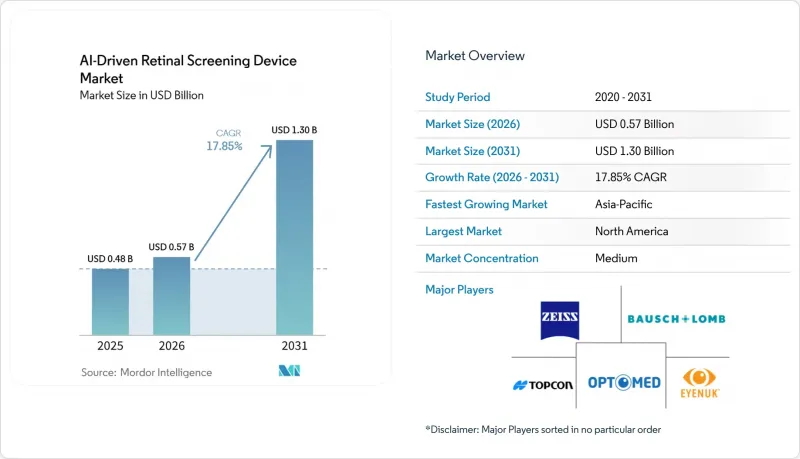
본 보고서는 구성 요소(하드웨어, 소프트웨어, 서비스), 기술(안저 이미지 기반 AI, OCT 기반 AI 등), 도입 형태(클라우드 기반, On-Premise형), 용도(당뇨성 망막병증, 노인성 황반변성 등), 최종 사용자(병원, 안과 클리닉 등), 지역(북미, 유럽 등)별로 분류되어 있으며, 시장 전망은 금액(달러) 기준으로 제시되어 있습니다.
전 세계 AI 기반 망막 스크리닝 기기 시장 동향과 인사이트
당뇨병 부담 증가와 미진단 망막병증의 위험
AI 기반 망막 스크리닝 시장은 정기적인 안과 검진이 필요함에도 불구하고 여전히 공식적인 의료 서비스 체계에서 소외되어 있는 대규모의 지속적인 환자층에 의해 지탱되고 있습니다. 2024년 기준, 전 세계적으로 5억 8,900만 명의 성인이 당뇨병을 앓고 있으며, 이 중 42.80%는 미진단 상태였습니다. 이로 인해 망막 질환의 조기 발견이 지연될 위험에 노출된 매우 많은 사람들이 존재합니다. 21개국을 대상으로 한 2025년 조사에 따르면, 당뇨병 환자 중 당뇨병성 망막병증 유병률이 28.40%로 보고되었으며, 이는 스크리닝의 부담이 구조적으로 크고 장기적이라는 견해를 뒷받침합니다. 당뇨병 환자의 81%가 저·중소득 국가에 거주하고 있기 때문에 AI 기반 망막 스크리닝 기기 시장은 고가 기기의 구매 가능성에 크게 좌우되는 것이 아니라, 오히려 시장 규모 확대와 저비용 제공이라는 수요에 의해 주도되고 있습니다. 이러한 경향은 전문의 중심의 서비스 모델보다 1차 의료 현장이나 의료 서비스가 미치지 못하는 사람들에게 더 신속하게 접근할 수 있기 때문에 소프트웨어 주도형 플랫폼과 휴대형 스크리닝 워크플로우를 뒷받침하고 있습니다.
안과 의사 부족과 전문의에 의한 병목 현상
AI 기반 망막 스크리닝 기기 시장이 확대되고 있는 또 다른 이유는 안과 의료 종사자의 수가 여전히 부족하고 분포도 불균형하여, 필요한 규모로 전문의 주도의 스크리닝를 실시하기 어렵기 때문입니다. 2026년 의료 종사자 수 예측에 따르면, 전 세계 안과 전문의 수는 27만 5,551명으로, 인구 100만 명당 34명에 해당하며, 그 절반을 불과 6개국이 차지하고 있습니다. 인도의 경우 인구 6만 5,000명당 안과 의사가 단 1명에 불과한 것으로 보고되고 있으며, 이는 대규모 전문의 팀에 의존하지 않는 분류 및 스크리닝 모델에 대한 수요가 높아지고 있는 이유를 보여줍니다. 다른 지역에서도 유사한 공급 격차가 나타나고 있으며, 발표된 조사에 따르면 고소득 국가조차도 의료 접근성 기준을 유지하기 위해서는 향후 막대한 수의 의료 인력이 필요할 것으로 나타났습니다. 따라서 AI 기반 스크리닝는 단순한 선택적 도구라기보다는 의뢰 네트워크가 당뇨병 관련 안과 질환 환자 수 증가를 감당할 수 있도록 지원하는 의료 시스템의 대안으로서 그 역할이 강화되고 있습니다.
데이터 개인정보 보호, 모델 거버넌스 및 국경을 넘는 데이터 규제
AI 기반 망막 스크리닝 기기 시장은 주요 의료 시스템 전반에 걸쳐 데이터 거버넌스 규제가 강화됨에 따라 큰 제약에 직면해 있습니다. 2025년 3월에 공포된 ‘유럽 건강 데이터 공간 규정’에서는 기존의 GDPR(EU 개인정보보호규정) 기준과 연계된 새로운 2차 이용에 관한 거버넌스 의무가 추가되어, 의료 영상 데이터의 국경을 넘는 취급이 복잡해지고 있습니다. 또한 중국도 당뇨성 망막병증의 안저 영상에 관한 최초의 산업별 데이터 세트 표준인 YY/T 1949-2024를 도입했습니다. 이는 훈련 데이터의 품질과 검증에 대한 보다 공식적인 접근 방식을 보여주는 것입니다. 2025년에 발간된 독일의 지침은 망막 영상 데이터의 경우, 단순한 가명화 워크플로우만으로는 제공할 수 없는 더 강력한 보호가 필요한 경우가 많다는 견해를 더욱 뒷받침했습니다. 이러한 중복된 규제는 규정 준수 비용을 증가시키고, 지역 간 모델 이전을 지연시키며, AI 기반 망막 스크리닝 기기 시장에서 주요 공급업체에 명확한 우위를 제공합니다.
부문 분석
2025년 기준, AI 기반 망막 스크리닝 기기 시장에서 소프트웨어의 점유율은 55.16%를 차지하고 있는 반면, 서비스 부문은 2031년까지 연평균 성장률(CAGR) 21.98%를 나타낼 것으로 예측됩니다. 이러한 추세는 상업적 가치가 어디에 집중되어 있는지를 보여줍니다. 알고리즘에 대한 지속적인 접근, 워크플로우 통합, 클라우드 호스팅 및 지원 계약은 단순히 기기 출하만 하는 경우보다 지속 가능한 수익을 창출하기 때문입니다. 따라서 AI 기반 망막 선별 기기 시장은 소프트웨어가 주요 가치 계층이 되고, 하드웨어가 이미지 획득을 위한 접근 지점이 되는 ‘플랫폼 경제’로 전환되고 있습니다. 이미지 품질은 모든 스크리닝 시스템에서 기본적인 입력 요소이므로 하드웨어의 중요성은 여전히 높지만, 여러 브랜드의 카메라 군과의 호환성을 요구하는 벤더가 늘어남에 따라 하드웨어의 가격 결정력은 압박을 받고 있습니다.
이러한 균형은 왜 워크플로우의 깊이가 단일 진단 성능보다 중요해지고 있는지를 설명해 줍니다. 망막 스크리닝 결과를 전자의무기록(EMR), 의뢰, 원격 안과 시스템과 연동할 수 있는 벤더는 계약 갱신을 유지하고 장기적으로 고객 기반을 확대하는 데 있어 더 유리한 입장에 있습니다. 따라서 AI 기반 망막 스크리닝 기기 업계에서는 알고리즘 자체뿐만 아니라, 알고리즘과 관련된 운영 업무를 관리할 수 있는 플랫폼이 높이 평가받고 있습니다. 병원 및 의료 시스템이 조달의 일환으로 도입 지원, 검증 지원, 교육, 시판 후 모니터링을 점점 더 요구하고 있기 때문에 서비스 수요는 계속해서 증가할 전망입니다. 이러한 동향은 임상, 기술, 규제와 관련된 지원을 장기 계약 하에 일괄적으로 제공할 수 있는 벤더에게 유리하게 작용합니다.
2025년에는 안저 이미지 기반 AI가 56.18%의 점유율을 차지했으나, 멀티모달 AI는 2031년까지 연평균 성장률(CAGR) 24.15%를 나타낼 것으로 예측됩니다. 안저 영상 기반 시스템이 조기에 채택된 이유는 저비용 비산동 카메라와의 호환성, 1차 진료에서의 간단한 워크플로우, 그리고 자율적인 규제 승인의 첫 물결과 부합했기 때문입니다. 따라서 AI 기반 망막 스크리닝 기기 시장은 OCT를 많이 사용하는 방식에 따르는 비용이나 워크플로우상의 부담 없이 도입 가능한 기술을 통해 초기 규모를 구축해 왔습니다. 현재 멀티모달 AI가 급속히 확대되고 있는 이유는 의료 제공업체들이 두 가지 입력 데이터를 바탕으로 당뇨성 망막병증, 노인성 황반변성, 녹내장을 평가할 수 있는 보다 광범위한 단일 방문 스크리닝을 원하고 있기 때문입니다.
2025년 동료 심사를 거친 연구에 따르면, 안저 사진과 OCT를 결합한 모델은 단일 모달리티 시스템에 비해 여러 망막 질환에서 성능이 향상된 것으로 나타났습니다. 또한, 2025년의 또 다른 연구에서는 안저 이미지를 기반으로 한 하이브리드형 녹내장 선별 모델의 민감도 93.52%, 특이도 95.00%가 보고되었으며, 이는 보다 광범위한 임상 적용을 향한 지속적인 진전을 뒷받침하는 것입니다. OCT를 기반으로 하는 AI, 머신러닝, 딥러닝 및 자연어 처리는 여전히 워크플로우에서 역할이 제한적이지만, AI 기반 망막 스크리닝 기기 시장이 단일 질환 선별에서 보다 통합적인 망막 평가로 전환됨에 따라 그 중요성은 높아지고 있습니다. AI 기반 망막 스크리닝 기기 업계에서는 단일 적응증에 특화된 도구보다, 다중 질환에 대한 의사 결정 지원을 뒷받침하는 기술 스택으로 가치의 중심이 더욱 이동할 것으로 보입니다.
지역별 분석
2025년, 북미는 AI 기반 망막 스크리닝 기기 시장의 43.18% 점유율을 차지하며, 계속해서 지역별 매출의 최대 거점을 유지했습니다. 이 지역은 여러 상용 자율형 AI 선별 시스템이 도입되어 있고, 자율형 망막 스크리닝에 대한 보험 환급 체계가 보다 확립되어 있으며, 1차 진료 기반의 당뇨병성 안질환 선별 워크플로우에 대한 의료 제공업체의 이해도가 높다는 등의 이점이 있습니다. 미국은 도입이 대형 학술 의료 센터에서 지역 의료시설 및 연방 인증 의료 기관으로 확대되고 있어, 계속해서 지역 수요의 중심지 역할을 하고 있습니다. 2025년 11월에 보고된 유타주의 도입 사례에 따르면, 선별검사를 받은 당뇨병 환자 약 4명 중 1명이 3개월 이내에 긴급 안과 의뢰가 필요한 것으로 밝혀졌으며, 이는 1차 진료 현장에서의 대규모 활용에 있어 선별검사의 실용적 가치를 입증하는 것입니다. 유럽은 두 번째로 큰 지역 시장이 되었으며, 2026년 기준으로 13개의 CE 인증을 받은 AI 당뇨병성 망막병증 스크리닝 시스템이 상용화되어 있습니다.
독일, 영국, 프랑스는 계속해서 유럽 내 도입의 중심지 역할을 하고 있습니다. 또한 영국에서는 HERMES 임상시험을 통해 원격 안과 진료에 대한 초기 근거를 제시했으며, 이는 원격 망막 분류에 대한 폭넓은 신뢰를 뒷받침하는 데 일조했습니다. 유럽에서는 새로운 규제에 따라 국경을 초월한 데이터 거버넌스 및 재훈련 요건이 더욱 엄격해지고 있어, 북미에 비해 사업 환경의 발전은 여전히 완만한 임베디드니다. 즉, 유럽은 AI 기반 망막 스크리닝 기기 시장에서 여전히 중요하지만, 그 성장은 규제 대응 및 현지 도입 설계에 크게 좌우될 가능성이 있습니다.
아시아태평양은 2031년까지 연평균 성장률(CAGR) 25.67%를 나타낼 것으로 예측되며, AI 기반 망막 스크리닝 기기 시장에서 가장 두드러진 성장을 보일 지역이 될 것입니다. 이 지역은 매우 많은 당뇨병 환자, 전문의 부족, 그리고 활발한 의료 디지털화 프로그램이 맞물려 성장의 원동력이 되고 있습니다. 중국은 규제 당국이 당뇨병성 망막병증용 AI에 대한 데이터 세트 요건을 공식적으로 정하고 있는 한편, 의료 제공업체들이 AI를 활용하여 전문의에 의존하는 병원 모델을 넘어선 스크리닝의 확대를 도모하고 있어 계속해서 중심적인 위치를 차지하고 있습니다. 인도 역시 매우 높은 당뇨병 부담에 더해, 눈에 띄는 현지 공급업체 기반과 만성적인 안과 전문의 부족이 맞물려 중요한 시장으로 부상하고 있습니다.
기타 혜택:
- 엑셀 형식 시장 예측(ME) 시트
- 3개월간의 애널리스트 지원
자주 묻는 질문
목차
제1장 서론
제2장 조사 방법
제3장 주요 요약
제4장 시장 구도
제5장 시장 규모와 성장 예측
제6장 경쟁 구도
제7장 시장 기회와 향후 전망
JHS 26.08.05According to Mordor Intelligence, the AI-driven retinal screening device market size is expected to grow from USD 484.53 million in 2025 to USD 570.52 million in 2026 and is forecast to reach USD 1,298.60 million by 2031 at 17.85% CAGR over 2026-2031.
This report is Segmented by Component (Hardware, Software, Services), Technology (Fundus Image-Based AI, OCT-Based AI, and More), Deployment (Cloud-Based, On-Premise), Application (Diabetic Retinopathy, AMD, and More), End User (Hospitals, Ophthalmology Clinics, and More), Geography (North America, Europe, and More), Market Forecasts are Provided in Terms of Value (USD).
Global AI-Driven Retinal Screening Device Market Trends and Insights
Rising Diabetes Burden and Undiagnosed Retinopathy Risk
The AI-driven retinal screening device market is being supported by a large and persistent pool of people who need regular eye screening but are still outside formal care pathways. In 2024, 589 million adults worldwide lived with diabetes, and 42.80% of them were undiagnosed, which left a very large population exposed to delayed retinal disease detection. A 2025 review covering 21 countries reported pooled diabetic retinopathy prevalence of 28.40% among people with diabetes, which supports the view that the screening burden is structurally large and long-lasting. Because 81% of people with diabetes live in low- and middle-income countries, the AI-driven retinal screening device market is not tightly tied to premium device affordability and is instead pushed by the need for scale and lower cost delivery. This pattern supports software-led platforms and portable screening workflows, since they can reach primary care sites and underserved populations faster than specialist-centered service models.
Shortage of Ophthalmologists and Specialist Bottlenecks
The AI-driven retinal screening device market is also advancing because the eye care workforce remains too limited and too unevenly distributed to support specialist-led screening at the needed scale. A 2026 workforce estimate placed the global supply at 275,551 ophthalmologists, or 34 per million people, with only 6 countries accounting for half of the total supply. India was reported to have only 1 ophthalmologist for every 65,000 people, which shows why demand is moving toward triage and screening models that do not depend on large specialist teams. The same supply gap appears in other regions, and published research has shown that even high-income countries face large future workforce requirements to maintain access standards. This makes AI screening less of an optional tool and more of a capacity substitute that helps referral networks absorb rising diabetes-related eye disease volumes.
Data Privacy, Model Governance, and Cross-Border Data Restrictions
The AI-driven retinal screening device market faces a meaningful restraint from tightening data governance rules across major healthcare systems. The European Health Data Space Regulation, published in March 2025, added new secondary-use governance obligations that interact with existing GDPR standards and complicate cross-border handling of health imaging data. China also introduced YY/T 1949-2024, its first industry-specific dataset standard for diabetic retinopathy fundus images, which signaled a more formal approach to training data quality and validation. German guidance issued in 2025 further reinforced the view that retinal imaging data often require stronger protection than simple pseudonymization workflows can provide. These overlapping rules raise compliance costs and slow model transfer across regions, which gives larger vendors a clearer advantage in the AI-driven retinal screening device market.
Other drivers and restraints analyzed in the detailed report include:
- Shift Toward Point-of-Care and Primary Care Screening
- Cloud Integration and Teleophthalmology Workflow Adoption
- Reimbursement Fragmentation Across Care Settings
For complete list of drivers and restraints, kindly check the Table Of Contents.
Segment Analysis
Software held 55.16% of the AI-driven retinal screening device market share in 2025, while services are forecast to grow at 21.98% CAGR through 2031. That pattern shows where commercial value is concentrating, since recurring algorithm access, workflow integration, cloud hosting, and support contracts carry more durable revenue than device shipments alone. The AI-driven retinal screening device market is therefore moving toward platform economics where software becomes the main value layer, and hardware becomes the access point for image capture. Hardware still matters because image quality remains the base input for any screening system, but its pricing power is under pressure as more vendors seek compatibility across multi-brand camera fleets.
This balance also explains why workflow depth now matters more than stand-alone diagnostic performance. Vendors that can connect retinal screening outputs into EMR, referral, and teleophthalmology systems are in a stronger position to hold renewals and expand accounts over time. The AI-driven retinal screening device industry is, therefore, rewarding platforms that can manage operational tasks around the algorithm, not just the algorithm itself. Services should continue to rise because hospitals and health systems increasingly require onboarding, validation support, training, and post-market monitoring as part of procurement. That trend favors vendors that can package clinical, technical, and regulatory support together under longer-term contracts.
Fundus image-based AI held 56.18% share in 2025, while multi-modal AI is forecast to grow at 24.15% CAGR through 2031. Fundus-based systems led early adoption because they aligned with lower-cost non-mydriatic cameras, simpler primary care workflows, and the first wave of autonomous regulatory clearances. The AI-driven retinal screening device market has therefore built its initial scale on technologies that can be deployed without the cost and workflow demands of OCT-heavy pathways. Multi-modal AI is now expanding faster because providers want broader single-encounter screening that can assess diabetic retinopathy, age-related macular degeneration, and glaucoma from paired inputs.
Peer-reviewed research from 2025 showed that models combining fundus photography and OCT improved performance across multiple retinal conditions when compared with single-modality systems. Another 2025 study reported 93.52% sensitivity and 95.00% specificity for a hybrid glaucoma screening model based on fundus images, which supports continued progress toward broader clinical use. OCT-based AI, machine learning, deep learning, and natural language processing still serve narrower workflow roles, but their relevance rises as the AI-driven retinal screening device market moves from single-disease screening to more integrated retinal assessment. The AI-driven retinal screening device industry is likely to see more value shift toward technology stacks that support multi-disease decision support rather than narrow single-indication tools.
Complete Report Scope:
- By Component
- Hardware
- Software
- Services
- By Technology
- Fundus Image-Based AI
- Optical Coherence Tomography-Based AI
- Multi-Modal AI
- Others (OCTA-Based AI, Ultra-Widefield (UWF) Imaging AI, etc.)
- By Deployment
- Cloud-Based
- On-Premise
- By Application
- Diabetic Retinopathy
- Age-Related Macular Degeneration
- Glaucoma
- Cataract
- (Diabetic Macular Edema, Retinal Vein Occlusion, etc.)
- By End User
- Hospitals
- Ophthalmology Clinics
- Diagnostic Centers
- Academic and Research Institutions
- Others (Telemedicine Providers, Mobile Clinics, etc.)
- By Geography
- North America
- United States
- Canada
- Mexico
- Europe
- Germany
- United Kingdom
- France
- Italy
- Spain
- Rest of Europe
- Asia-Pacific
- China
- India
- Japan
- South Korea
- Australia
- Rest of Asia-Pacific
- Middle East and Africa
- GCC
- South Africa
- Rest of Middle East and Africa
- South America
- Brazil
- Argentina
- Rest of South America
- North America
Geography Analysis
North America held 43.18% of the AI-driven retinal screening device market share in 2025, which kept it as the leading regional revenue base. The region benefits from the presence of multiple commercially available autonomous AI screening systems, a more established reimbursement pathway for autonomous retinal screening, and stronger provider familiarity with primary care-based diabetic eye screening workflows. The United States remained the center of regional demand because the rollout is extending beyond large academic centers into community and federally qualified health settings. A Utah deployment reported in November 2025 found that around 1 in 4 screened diabetes patients required urgent ophthalmology referral within 3 months, which supports the practical screening value of scaled primary care use. Europe ranked as the second-largest regional market, with 13 CE-certified AI diabetic retinopathy systems in commercial deployment as of 2026.
Germany, the United Kingdom, and France have remained the leading European adoption centers. The United Kingdom also contributed early teleophthalmology evidence through the HERMES trial, which helped support broader confidence in remote retinal triage. Europe still faces a slower operating environment than North America because cross-border data governance and retraining requirements are becoming more demanding under newer regulatory rules. That means Europe remains important in the AI-driven retinal screening device market, but growth can be more dependent on regulatory navigation and local deployment design.
Asia-Pacific is forecast to grow at 25.67% CAGR through 2031, which makes it the fastest-growing region in the AI-driven retinal screening device market. The region combines very large diabetes populations, specialist shortages, and active healthcare digitization programs. China remains central because regulators are formalizing dataset expectations for diabetic retinopathy AI, while providers are using AI to scale screening beyond specialist-heavy hospital models. India is also important because it combines a very high diabetes burden with a visible local vendor base and persistent ophthalmologist shortages.
- AEYE Health
- Airdoc Technology (Beijing) Co., Ltd.
- Bosch Healthcare Solutions GmbH
- Canon
- Carl Zeiss
- Digital Diagnostics
- Eyenuk, Inc.
- EyRIS Pte. Ltd.
- Heidelberg Engineering
- Intelligent Retinal Imaging Systems, Inc.
- Kowa Company, Ltd.
- Nidek
- Optomed Plc
- Remidio Innovative Solutions Pvt. Ltd.
- RetinaLyze System A/S
- Shenzhen Sibionics Technology Co., Ltd.
- Thirona B.V.
- Topcon
- Verily Life Sciences LLC
- Visionix Ltd.
- VUNO Inc.
Additional Benefits:
- The market estimate (ME) sheet in Excel format
- 3 months of analyst support
TABLE OF CONTENTS
1 INTRODUCTION
- 1.1 Study Assumptions and Market Definition
2 RESEARCH METHODOLOGY
3 EXECUTIVE SUMMARY
4 MARKET LANDSCAPE
- 4.1 Market Overview
- 4.2 Market Drivers
- 4.2.1 Rising Diabetes Burden and Undiagnosed Retinopathy Risk
- 4.2.2 Shortage of Ophthalmologists and Specialist Bottlenecks
- 4.2.3 Shift Toward Point-of-Care and Primary Care Screening
- 4.2.4 Cloud Integration and Teleophthalmology Workflow Adoption
- 4.2.5 Regulatory Clearance Momentum for Autonomous Screening
- 4.2.6 Under-Served Rural and Non-Acute Screening Channels
- 4.3 Market Restraints
- 4.3.1 Data Privacy, Model Governance, and Cross-Border Data Restrictions
- 4.3.2 Reimbursement Fragmentation Across Care Settings
- 4.3.3 Clinical Validation Burden Across Multiple Pathologies
- 4.3.4 High Integration Friction with Legacy Imaging and EHR Systems
- 4.4 Value Chain Analysis
- 4.5 Regulatory Landscape
- 4.6 Technological Outlook
- 4.7 Porter's Five Forces Analysis
- 4.7.1 Threat of New Entrants
- 4.7.2 Bargaining Power of Suppliers
- 4.7.3 Bargaining Power of Buyers
- 4.7.4 Threat of Substitutes
- 4.7.5 Competitive Rivalry
5 MARKET SIZE AND GROWTH FORECASTS (VALUE, USD)
- 5.1 By Component
- 5.1.1 Hardware
- 5.1.2 Software
- 5.1.3 Services
- 5.2 By Technology
- 5.2.1 Fundus Image-Based AI
- 5.2.2 Optical Coherence Tomography-Based AI
- 5.2.3 Multi-Modal AI
- 5.2.4 Others (OCTA-Based AI, Ultra-Widefield (UWF) Imaging AI, etc.)
- 5.3 By Deployment
- 5.3.1 Cloud-Based
- 5.3.2 On-Premise
- 5.4 By Application
- 5.4.1 Diabetic Retinopathy
- 5.4.2 Age-Related Macular Degeneration
- 5.4.3 Glaucoma
- 5.4.4 Cataract
- 5.4.5 (Diabetic Macular Edema, Retinal Vein Occlusion, etc.)
- 5.5 By End User
- 5.5.1 Hospitals
- 5.5.2 Ophthalmology Clinics
- 5.5.3 Diagnostic Centers
- 5.5.4 Academic and Research Institutions
- 5.5.5 Others (Telemedicine Providers, Mobile Clinics, etc.)
- 5.6 By Geography
- 5.6.1 North America
- 5.6.1.1 United States
- 5.6.1.2 Canada
- 5.6.1.3 Mexico
- 5.6.2 Europe
- 5.6.2.1 Germany
- 5.6.2.2 United Kingdom
- 5.6.2.3 France
- 5.6.2.4 Italy
- 5.6.2.5 Spain
- 5.6.2.6 Rest of Europe
- 5.6.3 Asia-Pacific
- 5.6.3.1 China
- 5.6.3.2 India
- 5.6.3.3 Japan
- 5.6.3.4 South Korea
- 5.6.3.5 Australia
- 5.6.3.6 Rest of Asia-Pacific
- 5.6.4 Middle East and Africa
- 5.6.4.1 GCC
- 5.6.4.2 South Africa
- 5.6.4.3 Rest of Middle East and Africa
- 5.6.5 South America
- 5.6.5.1 Brazil
- 5.6.5.2 Argentina
- 5.6.5.3 Rest of South America
- 5.6.1 North America
6 COMPETITIVE LANDSCAPE
- 6.1 Market Concentration
- 6.2 Market Share Analysis
- 6.3 Company Profiles (includes Global Level Overview, Market Level Overview, Core Segments, Financials as available, Strategic Information, Market Rank/Share, Products and Services, Recent Developments)
- 6.3.1 AEYE Health
- 6.3.2 Airdoc Technology (Beijing) Co., Ltd.
- 6.3.3 Bosch Healthcare Solutions GmbH
- 6.3.4 Canon Inc.
- 6.3.5 Carl Zeiss Meditec AG
- 6.3.6 Digital Diagnostics Inc.
- 6.3.7 Eyenuk, Inc.
- 6.3.8 EyRIS Pte. Ltd.
- 6.3.9 Heidelberg Engineering GmbH
- 6.3.10 Intelligent Retinal Imaging Systems, Inc.
- 6.3.11 Kowa Company, Ltd.
- 6.3.12 NIDEK Co., Ltd.
- 6.3.13 Optomed Plc
- 6.3.14 Remidio Innovative Solutions Pvt. Ltd.
- 6.3.15 RetinaLyze System A/S
- 6.3.16 Shenzhen Sibionics Technology Co., Ltd.
- 6.3.17 Thirona B.V.
- 6.3.18 Topcon Corporation
- 6.3.19 Verily Life Sciences LLC
- 6.3.20 Visionix Ltd.
- 6.3.21 VUNO Inc.
7 MARKET OPPORTUNITIES AND FUTURE OUTLOOK
- 7.1 White-Space and Unmet-Need Assessment


