

|
시장보고서
상품코드
2099446
민간 항공기 기내 엔터테인먼트 및 연결 시스템 : 시장 점유율 분석, 업계 동향 및 통계, 성장 예측(2026-2031년)Commercial Aircraft Inflight Entertainment and Connectivity System - Market Share Analysis, Industry Trends & Statistics, Growth Forecasts (2026 - 2031) |
||||||
 Mordor Intelligence
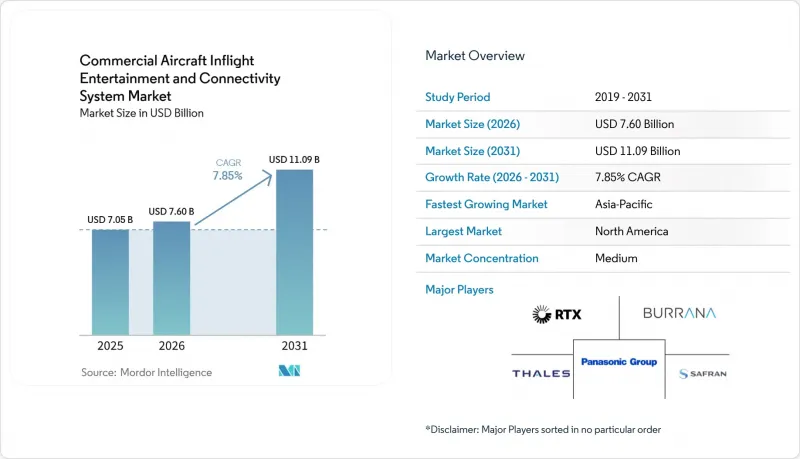
Mordor Intelligence에 의하면, 민간 항공기 기내 엔터테인먼트 및 연결 시스템 시장 규모는 2025년에 70억 5,000만 달러로 평가되었습니다. 2026년 76억 달러에서 2031년까지 110억 9,000만 달러에 이를 것으로 예상되며, 예측 기간(2026-2031년) CAGR은 7.85%를 나타낼 전망입니다.
본 보고서는 항공기 유형(나로우드, 와이드바디 등), 시스템 유형(좌석 등받이 내장형 IFEC, 무선 및 BYOD형 IFE 등), 객실 등급(일등석 등), 설치 유형(OEM 및 애프터마켓), 지역(북미, 유럽 등)별로 분류되어 있습니다. 시장 전망은 금액(달러) 기준으로 제시되어 있습니다.
세계의 민간 항공기 기내 엔터테인먼트 및 연결 시스템 시장 동향과 인사이트
승객 경험을 중시한 객실 차별화
민간 항공기 기내 엔터테인먼트 및 연결 시스템 시장은 현재, 기내 디지털 기기를 단순한 유지보수상의 선택지가 아닌 제품 선정의 일환으로 간주하는 항공사의 투자에 의해 형성되고 있습니다. 싱가포르항공은 41대의 항공기를 대상으로 KrisWorld 업데이트, 새로운 좌석, 프리미엄 이코노미 클래스 업그레이드, 퍼스트 클래스 스위트 개조를 포함한 수년에 걸친 A350 개조에 주력하고 있습니다. 에미레이트 항공도 50억 달러 규모의 A380 개조 프로그램을 계속하고 있으며, 219대의 항공기에 13.3인치 기내 엔터테인먼트(IFE) 디스플레이를 갖춘 프리미엄 이코노미를 도입했습니다. 나머지 2개 클래스 구성의 A380 개조는 GCAA의 승인을 전제로 2026년 말까지 완료될 전망입니다. 이러한 지출 추세는 기내 엔터테인먼트가 장거리 노선이나 수익성이 높은 노선에서 프리미엄 입지를 지키기 위한 항공사의 노력과 점점 더 밀접하게 연관되어 있음을 보여줍니다. 또한, 신뢰할 수 있는 대안이 없는 상태에서 기내 디지털 품질을 저하시키는 항공사는 특히 승객이 경쟁사의 엔터테인먼트 및 연결 환경 수준을 비교할 경우, 가치 제안의 약화에 직면할 가능성이 있음을 시사합니다. 따라서 민간 항공기 기내 엔터테인먼트 및 연결 시스템 시장은 객실 자체를 눈에 띄는 차별화 요소로 활용하는 항공사들로부터 계속해서 지지를 얻고 있습니다.
아시아태평양의 항공기 대수와 여객 수의 급증
아시아태평양이 여전히 신규 항공기 수요의 최대 중심지인 만큼, 민간 항공기 기내 엔터테인먼트 및 연결 시스템 시장도 계속 확대되고 있습니다. IATA는 2026년 아시아태평양의 여객 수송량이 7.30% 증가할 것으로 예측하고 있으며, 이 지역은 이미 전 세계 RPK의 34.50%를 차지하고 있어 앞으로도 항공기 수용 능력 확대의 중심적인 역할을 계속할 전망입니다. 에어아시아 X는 2026년 5월, A220 기종 150대를 확정 발주했습니다. 이 계약의 정가 총액은 190억 달러에 달하며, 인도는 2028년부터 시작될 예정입니다. 또한, 베트남항공도 2026년 2월, B737 MAX-8 기종 50대의 주문을 확정했습니다. 이는 해당 항공사로서 최초의 보잉제 단일 통로기 주문이며, 향후 기단 확장을 국내 여객 수요 증가와 연계하기 위한 조치입니다. 이러한 항공기 발주가 중요하게 여겨지는 이유는 기내 엔터테인먼트 및 연결성(IFEC)의 라인 핏에 관한 결정이 기단 계획 주기의 더 이른 단계에서 확정되는 경향이 강해지고 있기 때문입니다. 각 항공사가 라인 핏(line-fit) 슬롯을 조기에 확보하여 인도 후 개조(retrofit)를 기다리는 상황을 피하려는 가운데, 아시아태평양의 민간 항공기 기내 엔터테인먼트 및 연결 시스템 시장에서는 공급업체 간의 경쟁이 더욱 격화될 것으로 예측됩니다.
시트백형 시스템에 대한 설비 투자와 중량 증가
민간 항공기 기내 엔터테인먼트 및 연결 시스템 시장은 여전히 내장형 시트백 시스템으로 인한 구조적인 비용 문제에 직면해 있습니다. 내장형 좌석 등받이 하드웨어의 좌석당 설치 비용은 1만 달러이지만, 여기에는 컨텐츠 라이선스 비용이나 항공기 수명 주기 전반에 걸친 유지보수 비용은 포함되어 있지 않습니다. 이러한 비용 부담은 중량, 가동 중단 시간, 그리고 항공기 자체의 수명 주기가 절반에 도달하기도 전에 기내 하드웨어가 구식이 될 위험으로 인해 더욱 가중됩니다. 탈레스(Thales)는 2026년, FlytEDGE Aura가 이전 세대 모델보다 30% 이상 가볍다고 발표했습니다. 이는 많은 협폭기 운항사들이 BYOD(개인 기기 지참) 대안에 계속 집중해 온 요인인 연료 소비량 및 중량에 대한 우려를 공급업체가 직접적으로 해결하고 있음을 보여줍니다. 파나소닉 역시 ‘Astrova’를 수명이 긴 인프라와 업그레이드 가능한 하드웨어 요소를 갖춘 모듈형 플랫폼으로 추진하고 있으며, 이는 동일한 수명 주기 비용 문제를 다른 각도에서 해결하는 것입니다. 이러한 개선에도 불구하고, 민간 항공기 기내 엔터테인먼트 및 연결 시스템 시장은 여전히 제약을 받고 있으며, 항공사들은 항공기의 신속한 운항, 가동 중단 시간 최소화, 그리고 개조 복잡성 감소를 우선시하고 있습니다.
부문 분석
2025년, 좌석 등받이형 IFEC는 민간 항공기 기내 엔터테인먼트 및 연결 시스템 시장 점유율의 52.88%를 차지하며, 매출 기준 최대 시스템 유형이 되었습니다. 민간 항공기 기내 엔터테인먼트 및 연결 시스템 시장은 여전히 내장형 시스템에 의존하고 있으며, 풀서비스 항공사(FSC)는 프리미엄 차별화를 뒷받침할 눈에 띄는 객실 기준을 요구하고 있습니다. 파나소닉 아비오닉스에 따르면, ‘아스트로바’는 2025년 말까지 30개 항공사에서 총 100건의 개별 프로그램에 도입되었으며, 4K OLED HDR10+ 디스플레이, 블루투스 공간 오디오, 각 좌석당 최대 67W의 USB-C 전원 공급 등의 기능을 갖추고 있습니다. 이후 사우디아 항공은 2026년 6월 A321XLR 기단에 ‘아스트로바’를 도입했습니다. 이는 이전 도입 주기에서는 무게가 큰 IFE 시스템의 도입을 종종 보류했던 협폭체 장거리 항공기에서도 좌석 등받이에 내장된 시스템에 대한 수요가 확대되고 있음을 보여줍니다.
무선 및 BYOD(Bring Your Own Device)형 IFE는 2031년까지 연평균 성장률(CAGR) 10.41%를 나타낼 것으로 예측되며, 민간 항공기 기내 엔터테인먼트 및 연결 시스템 업계에서 가장 빠르게 성장하는 시스템 카테고리가 될 전망입니다. 민간 항공기 기내 엔터테인먼트 및 연결 시스템 시장에서 이러한 변화가 나타나는 이유는 BYOD가 내장형 스크린을 완전히 설치하지 않고도 연결성과 승객의 참여도를 추구하는 항공사에게 하드웨어 부담을 줄여주기 때문입니다. 뷰링 항공은 자사 항공기 함대의 절반 이상에 Viasat의 BYOD 엔터테인먼트 시스템을 도입하여, 외부 인터넷에 실시간으로 연결되지 않아도 기내 컨텐츠를 승객의 기기로 스트리밍할 수 있음을 입증했습니다. 또한, Burrana는 AIX 2026에서 자사의 'RISE Power' 플랫폼이 전 세계 880대 이상의 항공기에 채택되었다고 보고했습니다. 이는 AIX 2025에서 발표된 도입 실적의 2배 이상에 해당하며, BYOD 및 하이브리드형 객실 구성에서 전력 인프라가 중요함을 여실히 보여줍니다. 실제로 민간 항공기 기내 엔터테인먼트 및 연결 시스템 시장은 프리미엄 객실에서는 내장형 시스템이 주류를 이루는 반면, 기타 객실에서는 전원, 포털, 기기 지원이 확대되는 혼합 모델로 전환되고 있습니다.
2025년, 협폭기(narrow-body)는 민간 항공기 기내 엔터테인먼트 및 연결 시스템 시장의 49.35%를 차지했으며, 이는 전 세계 항공기 구성에서 협폭기가 중심적인 역할을 하고 있음을 반영합니다. 각 항공사가 장거리 및 경쟁이 치열한 노선에서 단일 통로 항공기를 점점 더 많이 활용함에 따라, 민간 항공기 기내 엔터테인먼트 및 연결 시스템 시장은 협폭기 플랫폼에 대한 의존도를 높이고 있습니다. 에어 캐나다의 ‘아스트로바(Astrova)’ 프로그램은 19대의 A321에 대한 사후 개조 외에도, 30대의 A321XLR, 23대의 A220-300, 향후 인도될 B787-10에 대한 공장 출고 시 기본 사양이 대상이며, 이는 협폭기 기종의 IFEC가 선택적 업그레이드에서 특정 기체군의 표준 사양으로 전환되고 있음을 보여줍니다. 와이드바디 기종은 여전히 기체당 지출액이 가장 높습니다. 그 이유로는 첫째, 비즈니스 클래스나 프리미엄 이코노미 클래스에서 더 고성능의 디스플레이, 오디오, 컨텐츠용 하드웨어가 채택되고 있다는 점을 들 수 있습니다.
리저널 제트는 2031년까지 연평균 성장률(CAGR) 10.92%를 나타낼 것으로 예측되며, 민간 항공기 기내 엔터테인먼트 및 연결 시스템 업계에서 가장 빠르게 성장하는 기체 유형입니다. 민간 항공기 기내 엔터테인먼트 및 연결 시스템 시장에서 이러한 가속화가 나타나는 것은 리저널 제트 기단이 더 빠르고 다운타임이 적은 연결성 업그레이드의 현실적인 대상이 되고 있기 때문입니다. 2025년 초까지 인텔샛의 멀티오빗 ESA는 100대 이상의 지역 제트기에 탑재되었으며, 도입 실적에는 아메리칸 항공, 에어 캐나다, 알래스카 항공 등이 포함되었고, 기체당 설치 기간은 2일 미만이었습니다. 엠브라에르(Embraer)는 E2형 쌍발 제트기에서 인텔샛(Intelsat)의 ESA를 라인 핏(line-fit) 옵션으로 제공하기 시작했습니다. 이를 통해 연결 기능에 대한 결정은 추후 개조에 맡기는 것이 아니라 항공기 주문 과정에 직접 반영되게 되었습니다. 이는 민간 항공기 기내 엔터테인먼트 및 연결 시스템 시장이, 지금까지 동등한 수준의 승객용 디지털 기능을 거의 또는 전혀 갖추지 못했던 항공기 카테고리로 그 대상 범위를 확대하고 있음을 의미합니다.
지역별 분석
2025년, 북미는 민간 항공기 기내 엔터테인먼트 및 연결 시스템 시장 점유율의 30.88%를 차지하며, 지역별 최대 기여 지역으로서의 위상을 유지했습니다. 이는 항공사의 투자 주기, 위성 인프라, 그리고 ‘게이트 투 게이트(gate-to-gate)’ 연결성을 이미 당연한 것으로 기대하는 승객들의 요구에 의해 주도되고 있습니다. 아메리칸 항공은 2026년 1월부터 연간 200만 편 이상의 항공편에서 무료 Wi-Fi 제공을 시작했습니다. 이 회사는 약 500대의 지역 제트기를 포함한 기체의 약 90%에서 Viasat 및 Intelsat의 시스템을 채택하고 있습니다. 델타항공이나 유나이티드항공의 사례에서도 볼 수 있듯이, 미국에서 무료 고속 통신이 기본적인 기대 사항이 되어가고 있음을 알 수 있습니다. 아스트로닉스(Astronics)는 2025년 4분기 매출이 전년 동기 대비 15.10% 증가한 2억 4,010만 달러를 기록하며 사상 최고치를 달성했다고 보고했습니다. 이는 기존 기내 설비와 관련된 좌석용 전원 하드웨어 및 IFEC 부품에 대한 수요가 지속되고 있음을 반영합니다.
아시아태평양은 2031년까지 연평균 성장률(CAGR) 10.34%를 나타낼 것으로 예측되며, 민간 항공기 기내 엔터테인먼트 및 연결 시스템 시장에서 가장 빠르게 성장하는 지역이 될 전망입니다. IATA가 2026년 RPK(여객 킬로미터)의 전년 대비 성장률을 7.30%로 예측하고 있는 점도 이러한 전망을 뒷받침합니다. 여객 수 증가가 항공기 인도를 촉진하고, 설치 일정 단축으로 이어지고 있기 때문입니다. 에어아시아 X는 2026년 5월에 A220 기종 150대를 발주했으며, 에어 인디아는 ‘Wings India 2026’에서 보잉사 제작의 단일 통로 제트기 30대 추가 발주를 발표하여, 향후 IFEC 라인핏 프로젝트가 확대될 전망임을 시사하고 있습니다. 중국의 주요 항공사들은 와이드바디 항공기 전 기종에서 IFE 스트리밍 커버율 85% 이상을 달성했으며, C919의 도입이 현지화에 관한 논의에 탄력을 주고 있습니다. 인도가 두드러지는 점은 와이드바디 기종의 IFE에 대해서는 파나소닉과, 장기 지원에 대해서는 탈레스와 병행하여 계약을 체결하고 있다는 점에서 기존 항공사의 업그레이드 주기보다 훨씬 짧은 기간 내에 뒤처진 부분을 만회하기 위한 투자가 집중되고 있음을 알 수 있기 때문입니다.
유럽은 2025년, 민간 항공기 기내 엔터테인먼트 및 연결 시스템 시장에서 안정적인 입지를 유지했습니다. 투자는 대규모 신규 도입 프로그램이 아닌, 개조, 연결성 업그레이드, 그리고 지속가능성을 고려한 플랫폼 선정에 중점을 두고 있습니다. 루프트한자, SAS, 버진 애틀랜틱은 2024년 및 2025년에 위성 연결 관련 제휴를 확정했는데, 이는 유럽의 풀서비스 항공사(FSC)들이 기내 Wi-Fi에 대한 높아지는 기대에 대응하고 있음을 보여줍니다. 중동 및 아프리카에서는 에미레이트 항공의 A380 개조, 에티하드 항공의 통신 서비스 추진, 사우디아 항공의 A321XLR에 대한 ‘아스트로바’ 도입과 같은 프로그램을 통해 시장이 급속히 확대되고 있으며, 이러한 움직임들이 해당 지역의 기내 사양 향상을 주도하고 있습니다. 유텔샛(Eutelsat)과 아누브(Anuv)는 2026년 5월, EUTELSAT 10B의 Ku 대역 용량에 관한 다년 계약을 체결하여, 한 세계 대형 항공사를 대상으로 중동 및 유럽 전역의 항공 노선에서 기내 Wi-Fi(IFC) 서비스를 강화하게 되었습니다. 한편, 남미 시장은 여전히 규모가 작지만, 아르헨티나 항공(Aerolineas Argentinas) 등의 항공사가 멀티오빗(Multi-Orbit) 연결을 채택하고 있어, 기존 주요 항공 시장을 넘어 지역적인 IFC 수요가 확대되고 있음을 시사하고 있습니다.
기타 혜택 :
- 엑셀 형식 시장 예측(ME) 시트
- 3개월간의 애널리스트 지원
자주 묻는 질문
목차
제1장 서론
제2장 조사 방법
제3장 주요 요약
제4장 시장 구도
제5장 시장 규모 및 성장 예측
제6장 경쟁 구도
제7장 시장 기회 및 향후 전망
KTH 26.08.10According to Mordor Intelligence, the commercial aircraft inflight entertainment and connectivity system market size was valued at USD 7.05 billion in 2025 and is forecast to grow from USD 7.6 billion in 2026 to reach USD 11.09 billion by 2031, at a CAGR of 7.85% during the forecast period (2026-2031).
This report is Segmented by Aircraft Type (Narrowbody, Widebody, and More), System Type (Seat-Back Embedded IFEC, Wireless and BYOD IFE, and More), Cabin Class (First Class, and More), Fit (Original Equipment Manufacturer and Aftermarket), and Geography (North America, Europe, and More). The Market Forecasts are Provided in Terms of Value (USD).
Global Commercial Aircraft Inflight Entertainment and Connectivity System Market Trends and Insights
Passenger-Experience Driven Cabin Differentiation
The commercial aircraft inflight entertainment and connectivity system market is being shaped by airline spending that now treats cabin digital equipment as a product decision rather than a maintenance choice. Singapore Airlines is committed to a multiyear A350 retrofit covering KrisWorld updates, new seating, premium economy upgrades, and revised first-class suites across 41 aircraft. Emirates also continued its USD 5 billion A380 retrofit program, adding premium economy with 13.3-inch inflight entertainment (IFE) displays across 219 aircraft, with the remaining two-class A380 retrofits expected to be completed by the end of 2026, subject to GCAA approval. This spending pattern shows that embedded entertainment is increasingly linked to airlines' efforts to defend premium positioning on long-haul and high-yield routes. It also suggests that carriers that reduce onboard digital quality without a credible substitute may face a weaker value proposition, especially when passengers compare entertainment and connectivity standards across competing airlines. The commercial aircraft inflight entertainment and connectivity system market, therefore, continues to gain support from airlines that use the cabin itself as a visible point of differentiation.
Asia-Pacific Fleet and Passenger Boom
The commercial aircraft inflight entertainment and connectivity system market is also advancing, as Asia-Pacific remains the strongest center of new aircraft demand. IATA forecasts Asia-Pacific passenger traffic growth of 7.30% in 2026, and the region already accounts for 34.50% of global RPK, keeping it at the center of future aircraft capacity expansion. AirAsia X placed a firm order for 150 A220 aircraft in May 2026, with the deal valued at USD 19 billion at list prices and deliveries set to begin from 2028. Vietnam Airlines also finalized an order for 50 B737 MAX-8 aircraft in February 2026, marking its first Boeing single-aisle order and linking future fleet growth to rising domestic passenger demand. These aircraft commitments matter because linefit decisions for IFEC are increasingly being locked in much earlier in the fleet planning cycle. The commercial aircraft inflight entertainment and connectivity system market is likely to see stronger supplier competition in Asia-Pacific as airlines seek earlier access to linefit slots and avoid waiting for retrofit queues after delivery.
Capex and Weight Penalty of Seat-Back Systems
The commercial aircraft inflight entertainment and connectivity system market still faces a structural cost challenge from embedded seat-back systems. The per-seat installation cost of USD 10,000 for embedded seat-back hardware, before content licensing and maintenance are added over the aircraft lifecycle. That cost burden is amplified by weight, downtime, and the risk that onboard hardware becomes dated before the aircraft itself reaches midlife. Thales stated in 2026 that FlytEDGE Aura is more than 30% lighter than the prior generation, indicating that suppliers are directly targeting fuel burn and weight objections that have kept many narrowbody operators focused on BYOD alternatives. Panasonic also promoted Astrova as a modular platform with long-life infrastructure and upgradeable hardware elements, which addresses the same lifecycle cost problem from a different angle. Even with these improvements, the commercial aircraft inflight entertainment and connectivity system market remains constrained, where airlines prioritize fast aircraft utilization, minimal downtime, and lower retrofit complexity.
Other drivers and restraints analyzed in the detailed report include:
- High-Speed SATCOM Enabling Streaming-Grade Bandwidth
- IFE-Enabled Onboard E-Commerce Revenue
- Cybersecurity Risks in Open Wi-Fi Architectures
For complete list of drivers and restraints, kindly check the Table Of Contents.
Segment Analysis
Seat-back IFEC held 52.88% of the commercial aircraft inflight entertainment and connectivity system market share in 2025, making it the largest system type by revenue. The commercial aircraft inflight entertainment and connectivity system market still relies on embedded systems, where full-service carriers (FSCs) want a visible cabin standard that supports premium differentiation. Panasonic Avionics said Astrova reached 100 individual airline programs across 30 airlines by the end of 2025, with features including 4K OLED HDR10+ displays, Bluetooth spatial audio, and up to 67W USB-C power at each seat. Saudia then introduced Astrova on its A321XLR fleet in June 2026, which showed that embedded seat-back demand is expanding into narrowbody long-range aircraft that had often skipped heavier IFE systems in earlier cycles.
Wireless and BYOD IFE is projected to grow at a 10.41% CAGR through 2031, making it the fastest-growing system category in the commercial aircraft inflight entertainment and connectivity system industry. The commercial aircraft inflight entertainment and connectivity system market is seeing this shift because BYOD offers a lower hardware burden for carriers seeking connectivity and engagement without the full installation of embedded screens. Vueling deployed Viasat BYOD entertainment across more than half of its fleet, demonstrating that onboard content can be streamed to passenger devices even without a live external internet connection. Burrana also reported selections for its RISE Power platform on more than 880 aircraft globally at AIX 2026, more than double the footprint disclosed at AIX 2025, which highlights the importance of power infrastructure in BYOD and hybrid cabin setups. In practice, the commercial aircraft inflight entertainment and connectivity system market is moving toward a mixed model in which embedded systems dominate premium cabins, while power, portals, and device support expand across the rest of the cabin.
Narrowbody aircraft accounted for 49.35% of the commercial aircraft inflight entertainment and connectivity system market in 2025, reflecting their central role in the global fleet composition. The commercial aircraft inflight entertainment and connectivity system market has become increasingly dependent on narrowbody platforms as airlines increasingly use single-aisle aircraft on longer, more competitive routes. Air Canada's Astrova program covers retrofits on 19 A321 aircraft and linefit on 30 A321XLRs, 23 A220-300s, and incoming B787-10 deliveries, which shows how narrowbody IFEC is moving from an optional upgrade to a standard specification on selected fleets. Widebody aircraft still attract the highest spending per unit because, first, business and premium economy cabins support more advanced displays, audio, and content hardware.
Regional jets are forecast to grow at a 10.92% CAGR through 2031, making them the fastest-growing aircraft type in the commercial aircraft inflight entertainment and connectivity system industry. The commercial aircraft inflight entertainment and connectivity system market is seeing this acceleration because regional fleets are finally becoming viable targets for faster, lower-downtime connectivity upgrades. Intelsat's multi-orbit ESA had been installed on more than 100 regional jets by early 2025, and the deployment base included American Airlines, Air Canada, and Alaska Airlines, with installation timelines of under 2 days per aircraft. Embraer began offering the Intelsat ESA as a linefit option on E2 twinjets, bringing connectivity decisions directly into the aircraft order process rather than leaving them for later retrofit. This means the commercial aircraft inflight entertainment and connectivity system market is extending its coverage to aircraft categories that previously operated with little or no comparable passenger digital capability.
Complete Report Scope:
- By System Type
- Seat-back IFEC
- Wireless and BYOD IFE
- In-seat Power and Peripherals
- By Aircraft Type
- Narrowbody Aircraft
- Widebody Aircraft
- Regional Jets
- By Fit Type
- Original Equipment Manufacturer (OEM)
- Aftermarket
- By Cabin Class
- First Class
- Business Class
- Premium Economy Class
- Economy Class
- By Geography
- North America
- United States
- Canada
- Mexico
- Europe
- United Kingdom
- Germany
- France
- Spain
- Italy
- Russia
- Rest of Europe
- Asia-Pacific
- China
- India
- Japan
- South Korea
- Indonesia
- Singapore
- Rest of Asia-Pacific
- South America
- Brazil
- Argentina
- Rest of South America
- Middle East and Africa
- Middle East
- Saudi Arabia
- United Arab Emirates
- Turkey
- Qatar
- Rest of Middle East
- Africa
- South Africa
- Nigeria
- Rest of Africa
- Middle East
- North America
Geography Analysis
North America held 30.88% of the commercial aircraft inflight entertainment and connectivity system market share in 2025, maintaining its position as the largest regional contributor. It is driven by airline investment cycles, satellite infrastructure, and passenger expectations, which are already aligned around gate-to-gate connectivity. American Airlines launched complimentary Wi-Fi across more than 2 million annual flights from January 2026, using Viasat and Intelsat systems across roughly 90% of the fleet, including nearly 500 regional jets. Delta and United are evidence that free, high-speed connectivity is becoming a baseline expectation in the US. Astronics reported record Q4 2025 revenue of USD 240.10 million, up 15.10% from the prior-year quarter, which reflects sustained demand for in-seat power hardware and IFEC components tied to this installed base.
Asia-Pacific is projected to grow at a 10.34% CAGR through 2031, making it the fastest-growing region in the commercial aircraft inflight entertainment and connectivity system market. IATA's forecast of 7.30% year-on-year RPK growth in 2026 supports this view, as rising passenger traffic is driving aircraft deliveries and tighter installation timelines. AirAsia X ordered 150 A220 aircraft in May 2026, while Air India announced 30 additional Boeing single-aisle jets at Wings India 2026, suggesting a widening future IFEC linefit pipeline. China's major carriers have achieved IFE streaming coverage above 85% across widebody fleets, and that the C919 is adding momentum to localization discussions. India stands out because parallel commitments to Panasonic for widebody IFE and to Thales for long-term support show that catch-up investment is being compressed into a much shorter period than earlier airline upgrade cycles.
Europe held a stable position in 2025 in the commercial aircraft inflight entertainment and connectivity system market, with investment focused on retrofit, connectivity upgrades, and sustainability-linked platform choices rather than large greenfield programs. Lufthansa, SAS, and Virgin Atlantic confirmed satellite connectivity partnerships in 2024 and 2025, which shows that European FSCs are responding to rising onboard Wi-Fi expectations. The Middle East and Africa segment is expanding quickly through programs such as Emirates' A380 retrofit, Etihad's connectivity commitment, and Saudia's Astrova deployment on the A321XLR, which are raising regional cabin specifications. Eutelsat and Anuvu signed a multiyear Ku-band capacity agreement on EUTELSAT 10B in May 2026 to strengthen IFC across the Middle East and European aviation corridors for a major global airline. South America remains smaller, however, operators such as Aerolineas Argentinas are adopting multi-orbit connectivity, suggesting that regional IFC demand is broadening beyond the largest established aviation markets.
List of Companies Covered in this Report:
- Panasonic Holdings Corporation
- Thales Group
- Safran SA
- RTX Corporation
- Burrana Pty Ltd.
- Astronics Corporation
- Viasat Inc.
- Gogo Inc.
- Lufthansa Systems GmbH & Co. KG (DEUTSCHE LUFTHANSA AG)
- Shenzhen Donica Avionics Co., Ltd.
- Imagik Corp.
- LATECOERE S.A.
- Anuvu Operations LLC
- SKYTRAC Systems Ltd.
- FTS Systems LLC
- Spafax Airline Networks Limited
- THOMMEN AIRCRAFT EQUIPMENT AG
- ThinKom Solutions, Inc.
Additional Benefits:
- The market estimate (ME) sheet in Excel format
- 3 months of analyst support
TABLE OF CONTENTS
1 INTRODUCTION
- 1.1 Study Assumptions and Market Definition
- 1.2 Scope of the Study
2 RESEARCH METHODOLOGY
3 EXECUTIVE SUMMARY
4 MARKET LANDSCAPE
- 4.1 Market Overview
- 4.2 Market Drivers
- 4.2.1 Passenger-experience driven cabin differentiation
- 4.2.2 Asia-Pacific fleet and passenger boom
- 4.2.3 High-speed SATCOM enabling streaming-grade bandwidth
- 4.2.4 Low Earth Orbit (LEO) satellite bandwidth cost collapse
- 4.2.5 Bring Your Own Device (BYOD) retrofit cost advantage
- 4.2.6 IFE-enabled onboard e-commerce revenue
- 4.3 Market Restraints
- 4.3.1 Capex and weight penalty of seat-back systems
- 4.3.2 Certification hurdles for EMI/EMC
- 4.3.3 Cross-border content licensing complexity
- 4.3.4 Cyber-security risks in open Wi-Fi architectures
- 4.4 Value Chain Analysis
- 4.5 Regulatory Landscape
- 4.6 Technological Outlook
- 4.7 Porter's Five Forces Analysis
- 4.7.1 Threat of New Entrants
- 4.7.2 Bargaining Power of Suppliers
- 4.7.3 Bargaining Power of Buyers
- 4.7.4 Threat of Substitutes
- 4.7.5 Intensity of Competitive Rivalry
5 MARKET SIZE AND GROWTH FORECASTS (VALUE)
- 5.1 By System Type
- 5.1.1 Seat-back IFEC
- 5.1.2 Wireless and BYOD IFE
- 5.1.3 In-seat Power and Peripherals
- 5.2 By Aircraft Type
- 5.2.1 Narrowbody Aircraft
- 5.2.2 Widebody Aircraft
- 5.2.3 Regional Jets
- 5.3 By Fit Type
- 5.3.1 Original Equipment Manufacturer (OEM)
- 5.3.2 Aftermarket
- 5.4 By Cabin Class
- 5.4.1 First Class
- 5.4.2 Business Class
- 5.4.3 Premium Economy Class
- 5.4.4 Economy Class
- 5.5 By Geography
- 5.5.1 North America
- 5.5.1.1 United States
- 5.5.1.2 Canada
- 5.5.1.3 Mexico
- 5.5.2 Europe
- 5.5.2.1 United Kingdom
- 5.5.2.2 Germany
- 5.5.2.3 France
- 5.5.2.4 Spain
- 5.5.2.5 Italy
- 5.5.2.6 Russia
- 5.5.2.7 Rest of Europe
- 5.5.3 Asia-Pacific
- 5.5.3.1 China
- 5.5.3.2 India
- 5.5.3.3 Japan
- 5.5.3.4 South Korea
- 5.5.3.5 Indonesia
- 5.5.3.6 Singapore
- 5.5.3.7 Rest of Asia-Pacific
- 5.5.4 South America
- 5.5.4.1 Brazil
- 5.5.4.2 Argentina
- 5.5.4.3 Rest of South America
- 5.5.5 Middle East and Africa
- 5.5.5.1 Middle East
- 5.5.5.1.1 Saudi Arabia
- 5.5.5.1.2 United Arab Emirates
- 5.5.5.1.3 Turkey
- 5.5.5.1.4 Qatar
- 5.5.5.1.5 Rest of Middle East
- 5.5.5.2 Africa
- 5.5.5.2.1 South Africa
- 5.5.5.2.2 Nigeria
- 5.5.5.2.3 Rest of Africa
- 5.5.5.1 Middle East
- 5.5.1 North America
6 COMPETITIVE LANDSCAPE
- 6.1 Market Concentration
- 6.2 Strategic Moves
- 6.3 Market Share Analysis
- 6.4 Company Profiles (includes Global level Overview, Market level overview, Core Segments, Financials as available, Strategic Information, Market Rank/Share for key companies, Products and Services, and Recent Developments)
- 6.4.1 Panasonic Holdings Corporation
- 6.4.2 Thales Group
- 6.4.3 Safran SA
- 6.4.4 RTX Corporation
- 6.4.5 Burrana Pty Ltd.
- 6.4.6 Astronics Corporation
- 6.4.7 Viasat Inc.
- 6.4.8 Gogo Inc.
- 6.4.9 Lufthansa Systems GmbH & Co. KG (DEUTSCHE LUFTHANSA AG)
- 6.4.10 Shenzhen Donica Avionics Co., Ltd.
- 6.4.11 Imagik Corp.
- 6.4.12 LATECOERE S.A.
- 6.4.13 Anuvu Operations LLC
- 6.4.14 SKYTRAC Systems Ltd.
- 6.4.15 FTS Systems LLC
- 6.4.16 Spafax Airline Networks Limited
- 6.4.17 THOMMEN AIRCRAFT EQUIPMENT AG
- 6.4.18 ThinKom Solutions, Inc.
7 MARKET OPPORTUNITIES AND FUTURE OUTLOOK
- 7.1 White-Space and Unmet-Need Assessment


