

|
시장보고서
상품코드
2099454
AI 기반 행동 요법 시장 : 점유율 분석, 업계 동향 및 통계, 성장 예측(2026-2031년)AI-Powered Behavioral Therapy - Market Share Analysis, Industry Trends & Statistics, Growth Forecasts (2026 - 2031) |
||||||
 Mordor Intelligence
Mordor Intelligence에 의하면, AI 기반 행동 요법 시장은 2025년 16억 8,000만 달러에서 2026년에는 18억 5,000만 달러로 확대되어 2026년부터 2031년까지 CAGR 10.73%로 성장을 지속하여, 2031년에는 30억 8,000만 달러에 이를 것으로 예측됩니다.
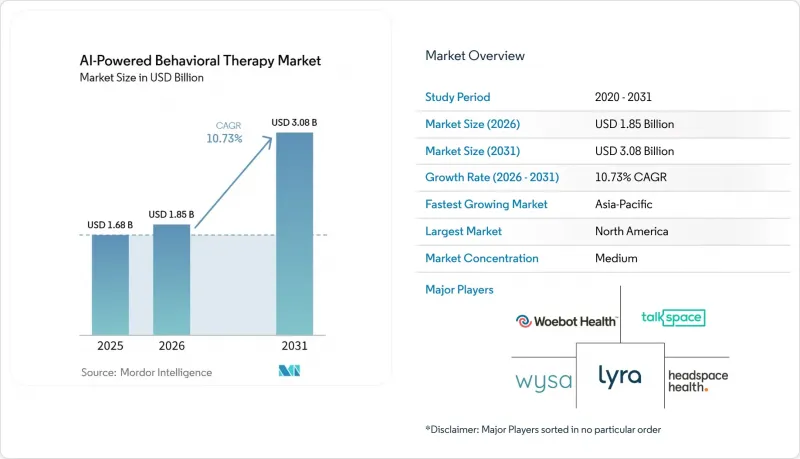
본 보고서는 제품 유형(AI 치료용 챗봇 및 가상 동반자, 기타), 도입 형태(클라우드, On-Premise), 적용 분야(불안 장애 및 우울증, 기타), 기술(머신러닝, 기타), 최종 사용자(개인, 기타), 지역(북미, 유럽, 기타)별로 분류되어 있습니다. 시장 전망은 금액(달러) 기준으로 제시되어 있습니다.
전 세계 AI 기반 행동 요법 시장 동향 및 인사이트
확장 가능한 정신 건강 관리 서비스에 대한 접근성 수요 증가
행동 요법 분야의 수급 격차는 기존의 채용 방식만으로는 상업적으로 타당한 기간 내에 해소하기 어려울 정도로 확대되고 있습니다. 2024년 하반기 데이터에 따르면, 미국에는 6,807곳의 지정 정신건강 전문 인력 부족 지역이 있으며, 해당 대상 인구는 1억 3,700만 명에 달할 전망입니다. 정신건강 수요 중 충족되고 있는 비율은 고작 27.3%에 불과하며, 기존 부족 지정 지역 문제를 해소하는 데만도 추가로 6,800명의 의료 인력이 필요합니다. 다른 인력 예측 모델에 따르면, 미국의 성인 정신과 의사 공급 수는 2026년 풀타임 환산 3만 7,470명에서 2038년에는 3만 6,550명으로 감소할 것으로 전망됩니다. 반면, 연간 수요는 7만 3,330명으로 증가하여 인력 충족률은 71.9%에서 49.8%로 떨어질 전망입니다. 이러한 불균형으로 인해 경증에서 중등도의 증상에 대해서는 AI 기반 행동 요법 시장이 구조적으로 필수 불가결해지고 있습니다. 왜냐하면 디지털 도구를 활용하면 의료 종사자 수의 확대를 기다리지 않고도 의료 접근성을 확대할 수 있기 때문입니다. 이러한 상업적 영향은 의료 종사자 충족률이 이미 대도시권 수준을 훨씬 밑돌고 있으며, 대면 서비스 확대에 드는 비용을 정당화하기 어려운 지방이나 대도시권 외 지역에서 가장 두드러집니다. 이러한 상황에서 AI 기반 행동 요법 시장이 탄력을 받고 있는 것은 의료 시스템이 자동화를 선호하기 때문이 아니라, 그 대안으로서 치료받지 못한 수요가 여전히 뿌리 깊게 남아 있기 때문입니다.
기업 대상 행동 요법 복리후생 확대
고용주에 의한 구매는 AI 기반 행동 요법 시장에 있어 가장 명확한 단기 유통 채널 중 하나가 되고 있습니다. Lyra Health는 2026년 3월, 근로자 3명 중 1명이 정신적으로 ‘간신히 버티고 있는’ 상태이며, 복리후생 담당자의 69%가 정신 건강 문제가 직원의 업무 성과를 현저히 저하시키고 있다고 응답했다고 보고했습니다. Spring Health 플랫폼을 이용하는 미국 고용주 589곳을 대상으로 한 코호트 연구에 따르면, 고용주가 제공하는 디지털 정신 건강 서비스는 근거 기반 치료 기준에 부합하는 회복 및 완화 성과를 가져오는 것으로 밝혀졌습니다. 또한, Businessolver의 2025년 복리후생 설문조사에서는 직원 지원 프로그램(EAP)이 희망하는 복리후생 상위 3위에 선정된 반면, 대기업에서 정신 건강에 대한 고용주의 보장 범위는 계속해서 확대되고 있는 것으로 나타났습니다. 이에 따라 시장의 주도권은 소비자용 앱 스토어에서 대규모 구매가 가능한 보험사, 고용주 및 인사 기술(HR 테크) 생태계로 이동하고 있습니다. 그 결과, AI 기반 행동 요법 시장에서는 단순한 일상적인 사용자 참여뿐만 아니라, 엔터프라이즈급 보고 기능, 내비게이션 기능 및 성과 추적 기능을 입증할 수 있는 공급업체가 점점 더 중요시되고 있습니다.
임상적 타당성과 성과 귀속의 격차
임상적 근거는 AI 기반 행동 요법 시장의 체계적인 확산을 지연시키는 주요 요인 중 하나로 남아 있습니다. FDA(미국 식품의약국)의 디지털 헬스 자문위원회는 2025년 11월 회의를 열어 생성형 AI 기반 정신건강 기기에 대해 논의했으며, 시간 경과에 따른 모델의 드리프트를 관리하기 위해 사전에 정해진 변경 관리 계획, 무작위 대조 시험, 시판 후 모니터링 등의 도구를 권장했습니다. 또한, 치료사, 앱, 약물 처방, 고용주에 의한 내비게이션 지원 등이 동시에 결합된 혼합 치료 환경에서 환자의 증상이 개선된 경우, 그 성과가 무엇에 기인하는지 특정하기 어렵습니다. 이러한 불확실성으로 인해 구매자는 결과 중 어느 부분이 플랫폼 자체에 의한 것인지 알고 싶어 하므로, 조달이 진전되지 않는 요인이 되고 있습니다. 실제 환경에서의 성과를 보다 쉽게 파악하고 비교할 수 있게 될 때까지는 AI 기반 행동 요법 시장이 본래 예상되는 수요 규모보다 지불자나 임상 현장의 구매자들로부터 더 신중한 태도를 보이는 상황이 지속될 것입니다.
부문 분석
2025년, AI 치료용 챗봇 및 가상 동반자는 AI 기반 행동 요법 시장 점유율의 49.23%를 차지하며, 매출 기준 최대 제품 유형이 되었습니다. 이러한 우위는 연중무휴 24시간 이용 가능성, 낮은 한계 상호작용 비용, 그리고 대규모 의료진 체계를 필요로 하지 않으면서 고용주, 지불자 및 일반 소비자를 대상으로 한 각 채널에 전개할 수 있는 형식 덕분입니다. 이러한 추세는 AI 기반 행동 요법 시장 전체를 지탱하는 요인이 되고 있습니다. 챗봇 제품은 대규모 접근성 확대를 실현하는 동시에, 정식 치료의 틈새에서도 지속적인 참여를 촉진할 수 있기 때문입니다.
또한 챗봇은 단순한 웰니스 도구라기보다는 치료 인프라에 가까워지고 있습니다. 무작위 대조 임상시험에서 대화형 AI 에이전트가 집단 치료보다 더 높은 불안 완화 효과를 가져온다는 사실이 밝혀졌을 뿐만 아니라, 치료적 유대감 인식도가 높을수록 참여도와 증상 개선이 모두 향상될 것으로 예측된다는 점도 드러났습니다. 인지행동치료(CBT) 앱은 2031년까지 연평균 성장률(CAGR)이 11.33%로, 가장 빠르게 성장하고 있는 제품 유형입니다. 이는 구조화된 프로토콜에 기반한 치료 소프트웨어에 대한 규제 당국의 관심이 높아지고 있으며, 디지털 보조 치료에 대해 점점 더 개방적인 태도를 보이고 있는 보험 급여 환경을 반영한 것입니다. AI 기반 행동 요법 업계에서 대화형 유연성과 구조화된 CBT 제공 간의 균형이 향후 제품 경쟁의 향방을 결정지을 것입니다.
클라우드 기반 플랫폼은 2025년 AI 기반 행동 요법 시장 규모의 62.17%를 차지하고 있으며, 2031년까지 연평균 성장률(CAGR) 11.68%를 나타낼 것으로 예측됩니다. 이러한 우위는 도입의 신속성, 기기 간 원활한 연동의 용이성, 그리고 사용자 경험을 저해하지 않으면서 모델과 컨텐츠를 일원적으로 업데이트할 수 있는 능력에서 기인합니다. AI 기반 행동 요법 시장에서는 행동 지원이 빈번한 상호작용, 실시간 업데이트, 그리고 모바일, 웹, 복지 채널 간의 통합에 의존하고 있기 때문에 클라우드 기반 제공이 선호되고 있습니다.
데이터 소재지, 조직별 관리, 제3자에 의한 처리 제한이 여전히 엄격한 시장의 일부에서는 On-Premise 구축이 여전히 중요하게 여겨지고 있습니다. 정부 의료 시스템, 엄격한 보안이 요구되는 정신과 시설, 그리고 일부 유럽의 도입 사례에서는 기밀성이 높은 행동 정보에 대한 현지 관리를 양보할 수 없는 요건으로 계속해서 중시하고 있습니다. 따라서 AI 기반 행동 요법 시장은 대규모 배포에서 클라우드가 기본 선택지로 남아 있더라도, 완전히 클라우드 전용 구조로 전환될 가능성은 낮다고 볼 수 있습니다. 대신 하이브리드 모델이 정착될 가능성이 높습니다. 이는 하이브리드 모델이라면 벤더가 기밀 데이터나 거버넌스·워크플로우에 대한 직접적인 관리권을 포기하지 않으면서도, 최신 AI 기능을 원하는 기업 고객에게 서비스를 제공할 수 있기 때문입니다.
지역별 분석
2025년, 북미는 AI 기반 행동 요법 시장의 51.55% 점유율을 차지하며 매출액 측면에서 세계 최대의 위치를 확립했습니다. 이 지역의 우위는 가장 탄탄한 보험 환급 체계, 고용주에 의한 복리후생에 대한 가장 깊은 도입, 그리고 행동 요법의 병목 현상 해소에 대한 가장 명확한 압박에서 기인합니다. 또한, 미국의 정신 건강 치료비는 2024년부터 2025년까지 10.9% 증가하여, 이에 따라 비용 억제 압박이 높아지고 있습니다. 이러한 상황은 전문의에 의한 치료 경로보다 AI 기반 경증 환자 대상 모델에 유리하게 작용할 가능성이 있습니다. 캐나다와 멕시코도 유사한 의료 제공업체 부족 문제에 직면해 있지만, 디지털 행동 요법 도구에 대한 보험 환급 제도는 여전히 미비한 상태이므로 이 지역의 동향은 계속해서 미국이 중심이 되고 있습니다.
유럽은 규모 면에서는 주도적이지 않지만, 규제 체계가 AI 기반 행동 요법 시장에 어떤 플랫폼이 진입할 수 있는지를 결정짓고 있기 때문에 여전히 중요한 위치를 차지하고 있습니다. 영국에서는 도입이 진행되고 있습니다. 독일이 계속해서 중요한 이유는 이 나라의 디지털 치료제 보험 급여 제도가 유럽 내 체계적인 임상 근거와 지불자 측의 수용성 기준이 되고 있기 때문입니다. 따라서 이 지역은 현재 양적인 시장이라기보다는 규정 준수 준비 상황이나 증거의 엄격성이 시장 진입을 좌우하는 ‘검증의 장’으로서의 역할을 수행하고 있습니다.
아시아태평양은 2031년까지 연평균 성장률(CAGR) 14.27%를 나타낼 것으로 예측되며, AI 기반 행동 요법 시장에서 가장 빠르게 성장하는 지역이 될 전망입니다. 이러한 성장은 심각한 미충족 수요, 주요 국가에서의 전문의 부족, 그리고 정신 건강 지원의 초기 단계로서 AI 도구를 활용하려는 의욕의 고조에 힘입고 있습니다. 2026년에 일본에서 최초로 소아 ADHD용 디지털 치료제가 상용화되는 것도, 보험 급여 모델에 편차가 있기는 하지만, 보다 공식적인 소프트웨어 기반 행동 요법 경로가 이 지역에 도입되고 있음을 보여줍니다. 남미, 중동 및 아프리카는 여전히 초기 단계 시장이며, 디지털 헬스 분야에 대한 투자는 증가 추세에 있지만, AI 행동 요법에 특화된 보험 적용 체계는 북미나 유럽 일부 지역에 비해 아직 충분히 확립되지 않았습니다.
기타 혜택:
- 엑셀 형식 시장 예측(ME) 시트
- 3개월간의 애널리스트 지원
자주 묻는 질문
목차
제1장 서론
제2장 조사 방법
제3장 주요 요약
제4장 시장 구도
제5장 시장 규모와 성장 예측
제6장 경쟁 구도
제7장 시장 기회와 향후 전망
JHS 26.08.05According to Mordor Intelligence, the AI-powered behavioral therapy market is expected to grow from USD 1.68 billion in 2025 to USD 1.85 billion in 2026 and is forecast to reach USD 3.08 billion by 2031 at 10.73% CAGR over 2026-2031.
This report is Segmented by Product Type (AI Therapy Chatbots and Virtual Companions, and Others), Deployment Mode (Cloud, On-Premises), Application (Anxiety and Depression, and Others), Technology (Machine Learning, and Others), End-User (Individuals, and Others), and Geography (North America, Europe, and Others). The Market Forecasts are Provided in Terms of Value (USD).
Global AI-Powered Behavioral Therapy Market Trends and Insights
Rising Demand for Scalable Mental Health Access
The supply and demand gap in behavioral care has widened to a point that conventional hiring alone is unlikely to close in a commercially relevant period. Late 2024 data showed 6,807 designated mental health professional shortage areas in the United States, covering 137 million people, with only 27.3% of mental health needs being met and 6,800 additional practitioners needed just to remove existing shortage designations. Separate workforce modeling projects a decline in U.S. adult psychiatrist supply from 37,470 full-time equivalents in 2026 to 36,550 by 2038, even as annual demand rises to 73,330 and workforce adequacy falls from 71.9% to 49.8%. That imbalance makes the AI-powered behavioral therapy market structurally necessary for mild and moderate presentations, because digital tools can extend access without waiting for the workforce base to expand. The commercial implication is strongest in rural and non-metropolitan areas, where workforce adequacy is already far below metropolitan levels and the cost of in-person service expansion is harder to justify. In this setting, the AI-powered behavioral therapy market is gaining traction not because care systems prefer automation, but because the alternative is persistent untreated demand.
Employer-Grade Behavioral Care Benefits Expansion
Employer purchasing has become one of the clearest near-term distribution channels for the AI-powered behavioral therapy market. Lyra Health reported in March 2026 that 1 in 3 workers was merely surviving mentally and that 69% of benefits leaders said mental health challenges were materially reducing employee performance.A cohort study covering 589 U.S. employers using Spring Health's platform found that employer-sponsored digital mental health delivery produced recovery and remission outcomes aligned with evidence-based therapy norms. Businessolver's 2025 benefits survey also found that employee assistance programs ranked among the top 3 desired benefits, while employer coverage for mental health continued to broaden across large organizations. This is shifting channel power away from consumer app stores and toward payer, employer, and HR technology ecosystems that can buy at scale. As a result, the AI-powered behavioral therapy market is increasingly favoring vendors that can show enterprise-grade reporting, navigation, and outcomes tracking rather than only daily user engagement.
Clinical Validation and Outcome Attribution Gaps
Clinical evidence remains one of the main factors slowing broader institutional adoption in the AI-powered behavioral therapy market. The FDA's Digital Health Advisory Committee met in November 2025 to discuss generative AI-enabled mental health devices and recommended tools such as predetermined change control plans, randomized trials, and postmarket monitoring to manage model drift over time. Outcome attribution is also difficult when a patient improves in a mixed-care setting that includes a therapist, an app, medication, and employer navigation support at the same time. That uncertainty slows procurement because buyers want to know what part of the result belongs to the platform itself. Until real-world outcomes become easier to isolate and compare, the AI-powered behavioral therapy market will continue to face more caution from payers and clinical buyers than the underlying demand picture would otherwise suggest.
Other drivers and restraints analyzed in the detailed report include:
- AI-Assisted Clinical Triage for Shorter Wait Times
- Under-Supplied Specialist Capacity in High-Burden Conditions
- Privacy Sensitivity of Psychiatric and Behavioral Data
For complete list of drivers and restraints, kindly check the Table Of Contents.
Segment Analysis
AI therapy chatbots and virtual companions held 49.23% of the AI-powered behavioral therapy market share in 2025, making them the largest product type by revenue. Their lead reflects 24/7 availability, low marginal interaction cost, and a format that can be deployed across employer, payer, and direct consumer channels without requiring large clinician capacity. The same pattern supports the AI-powered behavioral therapy market because chatbot products can expand access at scale while also building repeated engagement between formal care episodes.
Chatbots are also moving closer to care infrastructure than to stand-alone wellness tools. A randomized clinical trial also found that a conversational AI agent delivered greater anxiety reduction than group therapy, while stronger perceived therapeutic alliance predicted both engagement and symptom improvement. Cognitive behavioral therapy apps are the fastest-growing product type at 11.33% CAGR through 2031, which reflects stronger regulatory interest in structured protocol-based therapy software and a reimbursement environment that is becoming more open to digital adjuncts. Within the AI-powered behavioral therapy industry, that balance between conversational flexibility and structured CBT delivery is likely to define the next phase of product competition.
Cloud-based platforms commanded 62.17% share of the AI-powered behavioral therapy market size in 2025 and are also projected to grow at 11.68% CAGR through 2031. The lead comes from faster implementation, easier cross-device continuity, and the ability to update models and content centrally without disrupting the user experience. The AI-powered behavioral therapy market has favored cloud delivery because behavioral support depends on frequent interaction, real-time updates, and integration across mobile, web, and benefits channels.
On-premises deployment still matters in parts of the market where data residency, institutional control, and third-party processing limits remain strict. Government health systems, high-security psychiatric settings, and some European deployments continue to treat local control over sensitive behavioral information as a non-negotiable requirement. The AI-powered behavioral therapy market is therefore unlikely to move to a fully cloud-only structure, even if cloud remains the default for large-scale rollout. Instead, hybrid models are likely to persist because they let vendors serve enterprise buyers that want modern AI functionality without giving up direct control over sensitive data and governance workflows.
Complete Report Scope:
- By Product Type
- AI Therapy Chatbots and Virtual Companions
- Cognitive Behavioral Therapy Apps
- AI-Driven Biofeedback Devices
- AI-Powered Sleep and Stress Management Tools
- Emotion Recognition and Monitoring Systems
- By Deployment Mode
- Cloud-Based
- On-Premises
- By Application
- Anxiety and Depression
- ADHD and Cognitive Disorders
- Sleep Disorders
- Substance Abuse and Addiction
- Post-Traumatic Stress Disorder
- By Technology
- Machine Learning
- Natural Language Processing
- Deep Learning
- Emotion AI and Affective Computing
- By End-User
- Individuals
- Mental Health Clinics and Hospitals
- Corporate Wellness Providers
- Payers and Insurers
- Academic and Research Institutes
- By Geography
- North America
- United States
- Canada
- Mexico
- Europe
- Germany
- United Kingdom
- France
- Italy
- Spain
- Rest of Europe
- Asia-Pacific
- China
- Japan
- India
- Australia
- South Korea
- Rest of Asia-Pacific
- Middle East and Africa
- GCC
- South Africa
- Rest of Middle East and Africa
- South America
- Brazil
- Argentina
- Rest of South America
- North America
Geography Analysis
North America held 51.55% of the AI-powered behavioral therapy market share in 2025, giving the region the largest global position by revenue. The region's lead comes from the strongest reimbursement infrastructure, the deepest employer-benefit adoption, and the clearest pressure to reduce behavioral care bottlenecks. U.S. mental health treatment costs also increased 10.9% from 2024 to 2025, which adds cost-containment pressure that can favor AI-supported lower-acuity models over specialist-only pathways. Canada and Mexico face similar provider shortages, but reimbursement systems for digital behavioral tools are still less developed, which keeps the regional story centered on the United States.
Europe does not lead on scale, but it remains important because regulatory structure is shaping which platforms can participate in the AI-powered behavioral therapy market. The United Kingdom introduced. Germany continues to matter because its digital therapeutic reimbursement system has become a reference point for structured clinical evidence and payer acceptance in Europe. The region is therefore acting less as a volume market today and more as a proving ground where compliance readiness and evidence discipline can determine market access.
Asia-Pacific is projected to grow at 14.27% CAGR through 2031, making it the fastest-growing region in the AI-powered behavioral therapy market. Growth is being supported by severe unmet need, lower specialist density in several major countries, and rising willingness to use AI tools as an early point of contact for mental health support. Japan's first commercial pediatric ADHD digital therapeutic launch in 2026 also signals that more formal software-based behavioral treatment pathways are entering the region, even if reimbursement models remain uneven. South America and the Middle East and Africa remain earlier-stage opportunities, where digital health investment is improving but AI behavioral therapy-specific coverage structures are still less established than in North America and parts of Europe.
- AbleTo, Inc.
- BetterHelp, LLC
- Big Health, Inc.
- Brightside Health, Inc.
- Calm.com, Inc.
- Cognoa, Inc.
- Ellipsis Health
- Headspace Health, Inc.
- Kintsugi Mindful Wellness, Inc.
- Koa Health, S.L.
- Limbic
- Lyra Health, Inc.
- Meru Health
- Quartet Health, Inc.
- SilverCloud Health Ltd.
- Spring Health, Inc.
- Talkspace Inc.
- Unmind Ltd.
- Woebot Health
- Wysa Ltd.
Additional Benefits:
- The market estimate (ME) sheet in Excel format
- 3 months of analyst support
TABLE OF CONTENTS
1 Introduction
- 1.1 Study Assumptions and Market Definition
- 1.2 Scope of the Study
2 Research Methodology
3 Executive Summary
4 Market Landscape
- 4.1 Market Overview
- 4.2 Market Drivers
- 4.2.1 Rising Demand for Scalable Mental Health Access
- 4.2.2 Employer-Grade Behavioral Care Benefits Expansion
- 4.2.3 AI-Assisted Clinical Triage for Shorter Wait Times
- 4.2.4 Under-Supplied Specialist Capacity in High-Burden Conditions
- 4.2.5 Reimbursement Acceptance for Digital Behavioral Interventions
- 4.2.6 Multimodal Emotion AI Improving Engagement and Adherence
- 4.3 Market Restraints
- 4.3.1 Clinical Validation and Outcome Attribution Gaps
- 4.3.2 Privacy Sensitivity of Psychiatric and Behavioral Data
- 4.3.3 Model Hallucination and Unsafe Escalation Risk
- 4.3.4 Workflow Friction in Provider and Payer Integration
- 4.4 Value Chain Analysis
- 4.5 Regulatory Landscape
- 4.6 Technological Outlook
- 4.7 Porter's Five Forces
- 4.7.1 Threat of New Entrants
- 4.7.2 Bargaining Power of Suppliers
- 4.7.3 Bargaining Power of Buyers
- 4.7.4 Threat of Substitutes
- 4.7.5 Competitive Rivalry
5 Market Size & Growth Forecasts (Value in USD)
- 5.1 By Product Type
- 5.1.1 AI Therapy Chatbots and Virtual Companions
- 5.1.2 Cognitive Behavioral Therapy Apps
- 5.1.3 AI-Driven Biofeedback Devices
- 5.1.4 AI-Powered Sleep and Stress Management Tools
- 5.1.5 Emotion Recognition and Monitoring Systems
- 5.2 By Deployment Mode
- 5.2.1 Cloud-Based
- 5.2.2 On-Premises
- 5.3 By Application
- 5.3.1 Anxiety and Depression
- 5.3.2 ADHD and Cognitive Disorders
- 5.3.3 Sleep Disorders
- 5.3.4 Substance Abuse and Addiction
- 5.3.5 Post-Traumatic Stress Disorder
- 5.4 By Technology
- 5.4.1 Machine Learning
- 5.4.2 Natural Language Processing
- 5.4.3 Deep Learning
- 5.4.4 Emotion AI and Affective Computing
- 5.5 By End-User
- 5.5.1 Individuals
- 5.5.2 Mental Health Clinics and Hospitals
- 5.5.3 Corporate Wellness Providers
- 5.5.4 Payers and Insurers
- 5.5.5 Academic and Research Institutes
- 5.6 By Geography
- 5.6.1 North America
- 5.6.1.1 United States
- 5.6.1.2 Canada
- 5.6.1.3 Mexico
- 5.6.2 Europe
- 5.6.2.1 Germany
- 5.6.2.2 United Kingdom
- 5.6.2.3 France
- 5.6.2.4 Italy
- 5.6.2.5 Spain
- 5.6.2.6 Rest of Europe
- 5.6.3 Asia-Pacific
- 5.6.3.1 China
- 5.6.3.2 Japan
- 5.6.3.3 India
- 5.6.3.4 Australia
- 5.6.3.5 South Korea
- 5.6.3.6 Rest of Asia-Pacific
- 5.6.4 Middle East and Africa
- 5.6.4.1 GCC
- 5.6.4.2 South Africa
- 5.6.4.3 Rest of Middle East and Africa
- 5.6.5 South America
- 5.6.5.1 Brazil
- 5.6.5.2 Argentina
- 5.6.5.3 Rest of South America
- 5.6.1 North America
6 Competitive Landscape
- 6.1 Market Concentration
- 6.2 Market Share Analysis
- 6.3 Company Profiles (includes Global level Overview, Market level overview, Core Segments, Financials as available, Strategic Information, Market Rank/Share for key companies, Products & Services, and Recent Developments)
- 6.3.1 AbleTo, Inc.
- 6.3.2 BetterHelp, LLC
- 6.3.3 Big Health, Inc.
- 6.3.4 Brightside Health, Inc.
- 6.3.5 Calm.com, Inc.
- 6.3.6 Cognoa, Inc.
- 6.3.7 Ellipsis Health
- 6.3.8 Headspace Health, Inc.
- 6.3.9 Kintsugi Mindful Wellness, Inc.
- 6.3.10 Koa Health, S.L.
- 6.3.11 Limbic
- 6.3.12 Lyra Health, Inc.
- 6.3.13 Meru Health
- 6.3.14 Quartet Health, Inc.
- 6.3.15 SilverCloud Health Ltd.
- 6.3.16 Spring Health, Inc.
- 6.3.17 Talkspace Inc.
- 6.3.18 Unmind Ltd.
- 6.3.19 Woebot Health
- 6.3.20 Wysa Ltd.
7 Market Opportunities & Future Outlook
- 7.1 White-space & unmet-need assessment


