

|
시장보고서
상품코드
2099459
보안 및 양자 안전 광섬유 백본 네트워크 : 시장 점유율 분석, 업계 동향 및 통계, 성장 예측(2026-2031년)Secure and Quantum-Safe Fiber Backbone Network - Market Share Analysis, Industry Trends & Statistics, Growth Forecasts (2026 - 2031) |
||||||
 Mordor Intelligence
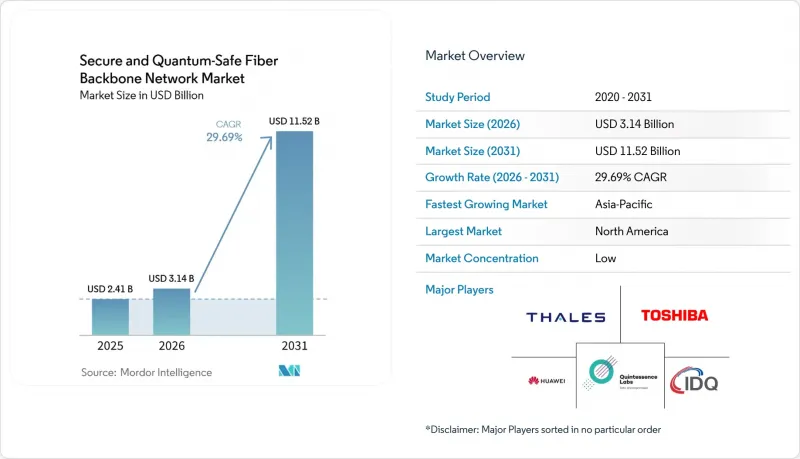
Mordor Intelligence에 의하면, 보안 및 양자 안전 광섬유 백본 네트워크 시장 규모는 2025년 24억 1,000만 달러로 평가되었습니다. 2026년 31억 4,000만 달러에서 2031년까지 115억 2,000만 달러로 확대되어 2026년부터 2031년에 걸쳐 CAGR 29.69%를 나타낼 것으로 예측됩니다.
본 보고서는 구성 요소(하드웨어 등), 기술(양자 키 배포 등), 용도(통신, 데이터센터 등), 최종 사용자 산업(통신 사업자, 메트로 광섬유 네트워크 등), 네트워크 유형(지상 광섬유 네트워크, 메트로 광섬유 네트워크 등), 지역별로 분류되어 있습니다. 시장 전망은 금액(달러)으로 표시되어 있습니다.
세계의 보안 및 양자 안전 광섬유 백본 네트워크 시장 동향 및 인사이트
'지금 수집, 나중에 복호화' 방식에 따른 위험 노출 증가
'지금 수집, 나중에 복호화'라는 모델은 더 이상 이론의 영역을 넘어, 현재 보안 및 양자 안전 광섬유 백본 네트워크 시장에서 통신 사업자 및 중요 인프라 운영자가 백본의 보안 위험을 어떻게 인식하는지를 형성하고 있습니다. 2026년에 발표된 조사에 따르면, 전 세계 암호화 트래픽 중 감청된 데이터의 단 1%만을 저장하는 것만으로도, 보수적인 상용 클라우드 가격을 전제로 할 경우 국가 주체의 행위자에게 연간 약 10억 달러의 비용이 소요되는 것으로 밝혀졌습니다. 이는 고가치 정보 수집에 있어서는 관리 가능한 수준입니다. 장거리 광섬유 경로는 예측 가능한 물리적 경로를 따라 대량의 트래픽을 전송하기 때문에 파이버 탭이나 수집 의무를 통해 일괄 도청이 더 현실화될 수 있다는 점에서 특히 취약합니다. 아카이브된 5G 및 향후 6G의 제어 플레인 기록은 세션 데이터와 인증 데이터를 보유하고 있어, 향후 암호학적으로 관련성이 있는 양자 시스템이 등장할 경우 해독될 가능성이 있으므로 장기적인 취약성을 초래합니다. 현재, 감청 비용은 낮고 복호화는 나중에 처리할 수 있다는 이러한 비용 불균형으로 인해, 공식적인 전환 법안이 없는 국가들에서도 보안 및 양자 안전 광섬유 백본 네트워크 시장 전반에 걸쳐 조달 주기가 단축되고 있습니다.
NIST의 포스트 양자 전환 기한
NIST의 표준화 노력에 따라, 보안 및 양자 안전 광섬유 백본 네트워크 시장은 초기 평가 단계에서 기한 주도형 조달 단계로 전환되었습니다. NIST는 2024년 8월에 FIPS 203, FIPS 204 및 FIPS 205를 최종 확정했으며, 이후 2025년 3월에는 향후 확장을 위한 키 설정 옵션을 확대하기 위해 HQC를 채택했습니다. 그 후, 백악관은 2026년 6월 대통령령 제14412호를 통해 그 속도를 가속화했습니다. 이 명령은 연방 기관에 대해 2030년 12월 31일까지 고가치 자산을 PQC 키 생성 방식으로 전환하고, 2031년 12월 31일까지 디지털 서명을 전환할 것을 의무화했습니다. 또한 OMB 각서 M-26-15에서는 각 기관에 120일 이내에 전환 계획을 수립할 것을 의무화했으며, 연방 정부 전체의 전환 비용을 10년간 71억 달러로 추산했습니다. 이를 통해 공급업체와 네트워크 사업자에게 명확한 예산 지침이 제시되었습니다. 연방 정부의 계약업체와 국방 통신 공급업체는 이러한 규정을 준수해야 하므로, 보안 및 양자 안전 광섬유 백본 네트워크 시장에서는 수요가 정부 기관을 훨씬 넘어 더 광범위한 백본 공급망으로 확대되는 추세를 보이고 있습니다.
신뢰 노드 및 QKD 도입에 수반되는 고액의 설비 투자
자본 집약성은 보안 및 양자 안전 광섬유 백본 네트워크 시장의 단기적 확장에 있어 가장 명백한 제약 요인 중 하나로 남아 있습니다. QKD 장치의 현재 단가는 대당 20만 유로(22만 8,000달러)이며, 포인트-투-포인트 도입에는 운영 비용이 추가되기 전에 일반적으로 25만 달러에서 50만 달러의 초기 투자가 필요합니다. 이러한 가격 수준 때문에 전용 보안 예산을 확보할 수 있는 국가 주도 프로그램, Tier 1 통신사 및 규제 대상 금융 기관에 조기 도입이 집중되고 있습니다. 많은 신흥 시장에서는 QKD에 대한 지출이 기존의 광 보안 및 백본 현대화 예산과 직접적으로 경쟁하고 있어, 중동 및 아프리카 및 남미의 일부 지역에서는 도입 속도가 둔화되고 있습니다. 포토닉 집적 기술의 발전에 따라 비용 곡선은 개선될 전망이지만, 보안 및 양자 안전 광섬유 백본 네트워크 시장의 대부분에서 이러한 개선은 즉각적이지 않고 여전히 중기적인 수준에 그칠 것입니다.
부문 분석
2025년, 하드웨어는 보안 및 양자 안전 광섬유 백본 네트워크 시장 점유율의 56.29%를 차지하며, 현재 도입 사례에서 가장 큰 수익원이 되었습니다. 이러한 우위는 중국, 유럽, 미국, 한국, 중동의 전체 백본 프로그램에서 DWDM 시스템, 광전송 플랫폼, QKD 단말기 및 트러스트 노드 장비를 직접 조달한 데 기인합니다. 하드웨어의 우위는 구조적인 것입니다. 왜냐하면 물리적 양자 링크나 보안 광 노드가 설치되어야만 해당 경로상에서 상위 소프트웨어 계층이 대규모로 가동될 수 있기 때문입니다. 따라서 확정된 공공 및 통신 사업자의 프로그램은 다른 어떤 구성 요소 카테고리보다 신속하게 하드웨어 수주로 이어졌습니다. 보안 및 양자 안전 광섬유 백본 네트워크 시장에서 통신 사업자들이 하드웨어의 완전한 전환에 앞서 암호화 지원 키 관리, FIPS 준수 라이브러리, 그리고 양자 안전 도구를 도입함에 따라, 소프트웨어 시장은 2031년까지 연평균 성장률(CAGR) 34.33%로 확대될 것으로 예측됩니다.
소프트웨어가 주목받고 있는 이유는 초기 투자 장벽을 낮추면서도, 향후 하드웨어 통합을 위한 여지를 남겨둘 수 있기 때문입니다. 따라서 현재 암호화 관련 위험을 파악하고 자본 투자를 단계적으로 진행하고자 하는 통신 사업자나 기업에게 소프트웨어 계층은 매력적인 선택지가 되고 있습니다. 또한, 특히 사내 양자암호화 기술 인력이 제한적인 경우, 사업자가 전환 계획, 아키텍처 설계, 시스템 통합에 대해 외부 지원을 요청함에 따라 서비스 분야도 확대되고 있습니다. 보안 및 양자 안전 광섬유 백본 네트워크 시장의 대략적인 방향성은 여전히 하드웨어와 소프트웨어의 보다 긴밀한 통합을 향해 가고 있습니다. 예측 기간 동안에는 포토닉 설계의 소형화와 제어 플랫폼의 유연성 향상으로 인해 비용 격차가 축소될 것으로 전망됩니다.
2025년에는 포스트 양자암호가 51.10%의 점유율을 차지하며, 현재 도입 규모 측면에서 주요 기술 경로로 자리매김했습니다. 이러한 위상은 NIST 표준화 알고리즘을 통해 가능해진 즉각적인 도입 가능성과, 전용 QKD 하드웨어나 전용 광섬유 경로에 의존하지 않는 비용 구조 덕분입니다. 이러한 소프트웨어 주도형 접근 방식은 하이퍼스케일 클라우드 환경에도 적합하며, 주요 제공업체들은 이미 보다 광범위한 인프라 보안 스택에 PQC를 통합하기 시작했습니다. 장기 보존에 따른 위험에 신속한 대응이 필요했던 구매자들에게 PQC는 물리적 양자 네트워크가 성숙해질 때까지 실용적인 과도기 수단이 되었습니다. 이를 통해 PQC는 보안 및 양자 안전 광섬유 백본 네트워크 시장의 초기 조달에서 계속해서 중심적인 위치를 차지했습니다.
QKD는 정부 및 통신 사업자의 프로그램이 시범 단계에서 본격적인 백본 구축 단계로 전환됨에 따라 2031년까지 연평균 성장률(CAGR) 33.61%를 나타낼 것으로 예측됩니다. QKD에 대한 가장 강력한 수요는 국가 인프라, 국방 통신, 그리고 정보 이론에 기반한 보호가 전략적 매력을 지닌 고부가가치 금융 회랑과 관련되어 있습니다. 하이브리드형 양자 보안 솔루션은 전용 또는 고우선순위 광섬유 경로에서의 QKD와 보다 광범위한 네트워크 부문에서의 PQC를 결합함으로써, 표준화 주기가 진행 중인 기간 동안 단일 접근 방식에 전적으로 의존하는 위험을 줄일 수 있어 보급이 확대되고 있습니다. 2025년 및 2026년의 정부 주도 전개 속도를 살펴보면, 보안 및 양자 안전 광섬유 백본 네트워크 시장에서는 더 이상 PQC와 QKD 중 하나를 절대적으로 선택해야 하는 단계를 지나, 네트워크 경제성이 허용하는 한 두 가지를 병용하는 경향이 강해지고 있습니다.
지역별 분석
2025년, 북미는 32.12%의 점유율을 차지하며 보안 및 양자 안전 광섬유 백본 네트워크 시장에서 가장 규모가 큰 지역이 되었습니다. 이러한 우위는 PQC로의 전환에 관한 가장 강력한 규제 체계에 기인하며, 특히 미국에서는 대통령령 제14412호에 따라 계획을 위한 명확한 조달 일정이 의무화되었습니다. 동 대통령령에서는 고가치 연방 자산에 대해 2030년 12월 31일까지 PQC를 통한 키 생성으로 전환하고, 2031년 12월 31일까지 디지털 서명을 사용하도록 요구했습니다. 또한 OMB(행정관리예산국)는 10년간 71억 달러의 지출을 상정한 이행 계획을 수립했습니다. 이러한 규제의 명확화로 인해 방위 관련 기업, 연방 네트워크 사업자 및 규제 대상 금융 기관이 지역 전체에서 활발한 구매 주기에 접어들었습니다. 캐나다 역시 주요 네트워크 이니셔티브와 장거리 통신 계획을 통해 양자 안전 인프라 구축을 추진했습니다. 한편, 멕시코는 여전히 초기 단계에 머물러 있었으나, 향후 북미의 기준 통합으로부터 혜택을 볼 것으로 전망되었습니다.
유럽에서는 EuroQCI 및 관련 국가별 프로그램을 통해, 보안 및 양자 안전 광섬유 백본 네트워크 시장에서 가장 긴밀하게 연계된 지역 생태계 중 하나를 지속적으로 구축하고 있습니다. 독일이 베를린과 본 사이에 설치한 총 길이 923km의 ‘DemoQuanDT’는 유럽의 통신 사업자들에게 장거리 QKD 도입을 위한 실제 가동 중인 캐리어 등급 모델을 제공했습니다. 그 후, 2026년 1월, 도이치 텔레콤의 T-Labs와 Qunnect는 베를린의 상용 광섬유 회선 30km 이상을 통해 양자 텔레포테이션에 성공함으로써, 양자 얽힘에 기반한 기능이 실제 통신 사업 환경으로 전환되고 있음을 보여주었습니다. 영국은 양자 네트워크에 1억 2,500만 파운드(1억 5,900만 달러)를 투자했으며, 2026년 6월에는 정부 자금 1,000만 파운드(1,322만 달러)의 지원을 받아 ‘ '국가 양자 표준 네트워크'를 출범시킴으로써 이 움직임에 더욱 무게를 실었습니다. 유럽 전역에 걸친 국경을 초월한 프로그램 또한, 도입이 더 이상 해당 지역의 최대 서방 경제국에 국한되지 않음을 보여주었습니다.
아시아태평양은 2031년까지 연평균 성장률(CAGR) 32.89%를 나타낼 것으로 예측되며, 이로 인해 보안 및 양자 안전 광섬유 백본 네트워크 시장에서 가장 빠르게 확장되는 지역 블록이 될 것입니다. 중국은 17개 성과 80개 도시에 걸쳐 12,000km가 넘는 국가 QKD 백본, 145개의 광섬유 백본 노드, 그리고 20개의 대도시권 네트워크를 보유하고 있어 이 성장 추세를 주도하고 있습니다. 2026년 4월 인도가 달성한 1,000km QKD 도입이라는 이정표는 전국 규모의 전개가 초기 조사 단계를 벗어났음을 입증하는 것이었습니다. 한편, 한국의 통신 사업자들도 향후 6G 계획을 위해 양자 보안 도입을 추진하고 있습니다. 중동 시장에서는 정부 기관 및 금융 기관을 대상으로 한 다크 파이버의 상용화가 진행되고 있어 시장이 부상하고 있습니다. 반면, 남미 및 아프리카는 하드웨어의 광범위한 도입에 앞서 소프트웨어 오버레이부터 시작하는 등 도입 초기 단계에 머물러 있습니다.
기타 혜택 :
- 엑셀 형식 시장 예측(ME) 시트
- 3개월간의 애널리스트 지원
자주 묻는 질문
목차
제1장 서론
제2장 조사 방법
제3장 주요 요약
제4장 시장 구도
제5장 시장 규모 및 성장 예측
제6장 경쟁 구도
제7장 시장 기회 및 향후 전망
KTH 26.08.10According to Mordor Intelligence, the secure and quantum-Safe fiber backbone network market size is projected to expand from USD 2.41 billion in 2025 and USD 3.14 billion in 2026 to USD 11.52 billion by 2031, registering a CAGR of 29.69% from 2026 to 2031.
This report is Segmented by Component (Hardware and More), Technology (Quantum Key Distribution, and More), Application (Telecommunications, Data Centers, and More), End-User Industry (Telecom Operators, Metro Fiber Networks, and More), Network Type (Terrestrial Fiber Networks, Metro Fiber Networks, and More), and Geography. The Market Forecasts are Provided in Value (USD).
Global Secure and Quantum-Safe Fiber Backbone Network Market Trends and Insights
Rising Harvest-Now, Decrypt-Later Exposure
The harvest-now, decrypt-later model has moved beyond theory and now shapes how carriers and critical infrastructure operators view backbone security risk in the secure and quantum-safe fiber backbone network market. Research published in 2026 found that storing even 1% of intercepted global encrypted traffic could cost nation-state actors around USD 1 billion per year under conservative commercial cloud pricing, which is a manageable level for high-value intelligence collection. Long-haul fiber routes are especially vulnerable because they carry heavy traffic along predictable physical paths, making bulk interception more practical through fiber taps or collection mandates. Archived 5G and future 6G control-plane records create a lasting vulnerability because they preserve session and authentication data that could be decrypted later if cryptographically relevant quantum systems emerge. This cost imbalance, where interception is cheap today and decryption can wait, is shortening procurement cycles across the secure and quantum-safe fiber backbone network market even in countries without formal migration laws.
NIST Post-Quantum Migration Deadlines
The NIST standardization effort has shifted the secure and quantum-safe fiber backbone network market from early evaluation into deadline-driven procurement. NIST finalized FIPS 203, FIPS 204, and FIPS 205 in August 2024, and then selected HQC in March 2025 to widen key-establishment options for future deployments. The White House then accelerated the pace in June 2026 through Executive Order 14412, which required federal agencies to migrate high-value assets to PQC key establishment by December 31, 2030, and digital signatures by December 31, 2031. OMB Memorandum M-26-15 also required agency migration plans within 120 days and placed total federal transition costs at USD 7.1 billion over a decade, providing suppliers and network operators with a clear budget signal. Because federal contractors and defense communications vendors must align with these rules, the secure and quantum-safe fiber backbone network market is seeing demand spread well beyond government agencies into the broader backbone supply chain.
High CAPEX For Trusted-Node And QKD Rollouts
Capital intensity remains one of the clearest constraints on near-term expansion in the secure and quantum-safe fiber backbone network market. QKD devices currently cost EUR 200,000 (USD 228,000) per unit, and point-to-point deployments usually require USD 250,000 to USD 500,000 in initial spending before operating costs are added. That pricing keeps early adoption concentrated among sovereign programs, Tier-1 carriers, and regulated financial institutions that can justify dedicated security budgets. In many emerging markets, QKD spending competes directly with existing optical security and backbone modernization budgets, slowing deployment in parts of the Middle East, Africa, and South America. The cost curve should improve as photonic integration advances, but the relief is still medium-term rather than immediate for much of the secure and quantum-safe fiber backbone network market.
Other drivers and restraints analyzed in the detailed report include:
- Telecom Backbone Modernization For 5G And 6G
- Sovereign Quantum Network Programs
- Limited Fiber Reach Without Trusted Nodes
For complete list of drivers and restraints, kindly check the Table Of Contents.
Segment Analysis
Hardware held 56.29% of the secure and quantum-safe fiber backbone network market share in 2025, making it the largest revenue contributor across current deployments. That lead came from direct procurement of DWDM systems, optical transport platforms, QKD terminals, and trusted-node equipment across backbone programs in China, Europe, the United States, South Korea, and the Middle East. The hardware position is structural because physical quantum links and secure optical nodes must be installed before higher software layers can operate at scale on those routes. Confirmed public and carrier programs, therefore, converted more quickly into hardware bookings than into any other component category. Within the secure and quantum-safe fiber backbone network market, software is projected to expand at a 34.33% CAGR through 2031 as operators adopt crypto-agile key management, FIPS-compliant libraries, and quantum-readiness tools ahead of full hardware migration.
Software is gaining traction because it lowers the first spending threshold while preserving room for later hardware integration. That makes the software layer attractive for carriers and enterprises that want to map cryptographic exposure now and phase capital deployment over time. Services are also expanding as operators seek outside support for migration planning, architecture design, and system integration, especially where in-house quantum cryptography talent is limited. The broader direction of the secure and quantum-safe fiber backbone network market still points toward tighter hardware and software integration, with smaller photonic designs and more flexible control platforms expected to narrow the cost gap over the forecast period.
Post-quantum cryptography accounted for a 51.10% share in 2025, making it the leading technology path by current adoption volume. Its position came from immediate deployability enabled by NIST-standardized algorithms and a cost structure that does not depend on dedicated QKD hardware or special-purpose fiber routes. That software-led approach also fits well with hyperscale cloud environments, where large providers have already begun embedding PQC into broader infrastructure security stacks. For buyers who needed faster action against long-retention exposure, PQC offered a practical migration step while physical quantum networking matured. This kept PQC at the center of early procurement across the secure and quantum-safe fiber backbone network market.
QKD is projected to grow at a 33.61% CAGR through 2031 as sovereign and carrier programs move from pilot stages into live backbone deployments. The strongest QKD demand is tied to national infrastructure, defense communications, and high-value financial corridors where information-theoretic protection has strategic appeal. Hybrid quantum-safe solutions are becoming more common because they combine QKD on dedicated or high-priority fiber paths with PQC on wider network segments, thereby reducing the risk of relying entirely on a single approach during an active standards cycle. The pace of government-backed rollouts in 2025 and 2026 showed that the secure and quantum-safe fiber backbone network market is no longer choosing between PQC and QKD in absolute terms, and is increasingly using both where network economics permit.
Complete Report Scope:
- By Component
- Hardware (Includes Optical Transport Equipment (DWDM/CWDM Systems), Optical Transponders and Muxponders, ROADM (Reconfigurable Optical Add-Drop Multiplexer) Systems, Optical Line Systems (OLS), Coherent Optical Modules, Optical Amplifiers (EDFA/Raman))
- Software (Includes Post-Quantum Cryptography (PQC) Software, Quantum-Safe Key Management Systems (KMS), Network Encryption Management Platforms, SDN Controllers with Security Orchestration, Network Management Systems (NMS))
- Services (Includes Security Consulting, Quantum-Readiness Assessments, Cryptographic Risk Assessments, Network Security Architecture Design, Deployment and Integration of Quantum-Safe Solutions)
- By Technology
- Quantum Key Distribution
- Post-Quantum Cryptography
- Hybrid Quantum-Safe Solutions
- By Application
- Telecommunications
- Data Centers
- Government and Defense
- BFSI
- Healthcare
- Energy and Utilities
- By End-User Industry
- Telecom Operators
- Hyperscalers and Cloud Providers
- Financial Institutions
- Public Sector Agencies
- Critical Infrastructure Operators
- By Network Type
- Terrestrial Fiber Networks
- Metro Fiber Networks
- Long-Haul Fiber Networks
- Subsea and Cross-Border Fiber Links
- By Geography
- North America
- United States
- Canada
- Mexico
- South America
- Brazil
- Argentina
- Rest of South America
- Europe
- Germany
- United Kingdom
- France
- Rest of Europe
- Asia-Pacific
- China
- Japan
- India
- South Korea
- Rest of Asia-Pacific
- Middle East
- Saudi Arabia
- United Arab Emirates
- Rest of the Middle East
- Africa
- South Africa
- Nigeria
- Rest of Africa
- North America
Geography Analysis
North America held a 32.12% share in 2025, making it the largest region in the secure and quantum-safe fiber backbone network market. That lead came from the strongest regulatory framework for PQC migration, especially in the United States, where Executive Order 14412 mandated a defined procurement schedule for planning. The order required high-value federal assets to move to PQC key establishment by December 31, 2030, and to use digital signatures by December 31, 2031, while OMB also framed the transition around USD 7.1 billion in spending over 10 years. That regulatory clarity pulled defense contractors, federal network operators, and regulated financial institutions into active buying cycles across the region. Canada also advanced quantum-safe infrastructure work through critical network initiatives and long-distance communication planning, while Mexico remained at an earlier stage but stood to benefit from North American standards alignment over time.
Europe continued to build one of the most coordinated regional ecosystems in the secure and quantum-safe fiber backbone network market through EuroQCI and related national programs. Germany's 923 km DemoQuanDT deployment between Berlin and Bonn provided European operators with a live, carrier-grade model for long-distance QKD implementation. Deutsche Telekom T-Labs and Qunnect then achieved quantum teleportation over 30 km of commercial fiber in Berlin in January 2026, which showed that entanglement-based capabilities were moving into real operator environments. The United Kingdom added further weight by committing GBP 125 million (USD 159 million) to quantum networking and by launching a National Quantum Standards Network in June 2026, supported by GBP 10 million (USD 13.22 million) in government funding. Cross-border programs in broader Europe also showed that deployment was no longer limited to the region's largest western economies.
Asia-Pacific is projected to grow at a 32.89% CAGR through 2031, which makes it the fastest-expanding regional block in the secure and quantum-safe fiber backbone network market. China anchors that trajectory with a national QKD backbone of more than 12,000 km, 145 fiber backbone nodes, and 20 metropolitan networks across 17 provinces and 80 cities. India's 1,000 km QKD milestone in April 2026 confirmed that national-scale deployment had moved beyond the earliest research stage, while South Korean carriers also pushed quantum security closer to future 6G planning. Middle Eastern markets are emerging through live commercial dark-fiber deployments for sovereign and financial communications, while South America and Africa remain earlier-stage adopters, starting with software overlays before broader hardware rollout.
- Toshiba Corporation
- ID Quantique SA
- Thales S.A.
- Huawei Technologies Co., Ltd.
- QuintessenceLabs Pty Ltd.
- SK Telecom Co., Ltd.
- Nokia Corporation
- Ciena Corporation
- Cisco Systems, Inc.
- Juniper Networks, Inc. (HPE Ltd.)
- NEC Corporation
- Fujitsu Limited
- Colt Technology Services Group Limited
- Orange S.A.
- BT Group plc
- Deutsche Telekom AG
- Telefonica, S.A.
- Adtran Holdings, Inc.
- LuxQuanta Technologies S.L.
- Quantum Xchange, Inc.
Additional Benefits:
- The market estimate (ME) sheet in Excel format
- 3 months of analyst support
TABLE OF CONTENTS
1 INTRODUCTION
- 1.1 Study Assumptions and Market Definition
- 1.2 Scope of the Study
2 RESEARCH METHODOLOGY
3 EXECUTIVE SUMMARY
4 MARKET LANDSCAPE
- 4.1 Market Overview
- 4.2 Market Drivers
- 4.2.1 Rising Harvest Now, Decrypt Later Exposure
- 4.2.2 NIST Post-Quantum Migration Deadlines
- 4.2.3 Telecom Backbone Modernization for 5G and 6G
- 4.2.4 Sovereign Quantum Network Programs
- 4.2.5 Quantum-Safe Data Retention for Critical Infrastructure
- 4.2.6 Hybrid QKD and PQC Deployment Economics
- 4.3 Market Restraints
- 4.3.1 High CAPEX for Trusted-Node and QKD Rollouts
- 4.3.2 Limited Fiber Reach Without Trusted Nodes
- 4.3.3 Interoperability Gaps Across Vendor Stacks
- 4.3.4 Quantum Hardware Supply Chain and Testbed Scarcity
- 4.4 Industry Value Chain Analysis
- 4.5 Regulatory Landscape
- 4.6 Porter's Five Forces Analysis
- 4.6.1 Threat of New Entrants
- 4.6.2 Bargaining Power of Suppliers
- 4.6.3 Bargaining Power of Buyers
- 4.6.4 Threat of Substitutes
- 4.6.5 Competitive Rivalry
- 4.7 Impact of Macroeconomic Factors on the Market
5 MARKET SIZE AND GROWTH FORECASTS (VALUE)
- 5.1 By Component
- 5.1.1 Hardware (Includes Optical Transport Equipment (DWDM/CWDM Systems), Optical Transponders and Muxponders, ROADM (Reconfigurable Optical Add-Drop Multiplexer) Systems, Optical Line Systems (OLS), Coherent Optical Modules, Optical Amplifiers (EDFA/Raman))
- 5.1.2 Software (Includes Post-Quantum Cryptography (PQC) Software, Quantum-Safe Key Management Systems (KMS), Network Encryption Management Platforms, SDN Controllers with Security Orchestration, Network Management Systems (NMS))
- 5.1.3 Services (Includes Security Consulting, Quantum-Readiness Assessments, Cryptographic Risk Assessments, Network Security Architecture Design, Deployment and Integration of Quantum-Safe Solutions)
- 5.2 By Technology
- 5.2.1 Quantum Key Distribution
- 5.2.2 Post-Quantum Cryptography
- 5.2.3 Hybrid Quantum-Safe Solutions
- 5.3 By Application
- 5.3.1 Telecommunications
- 5.3.2 Data Centers
- 5.3.3 Government and Defense
- 5.3.4 BFSI
- 5.3.5 Healthcare
- 5.3.6 Energy and Utilities
- 5.4 By End-User Industry
- 5.4.1 Telecom Operators
- 5.4.2 Hyperscalers and Cloud Providers
- 5.4.3 Financial Institutions
- 5.4.4 Public Sector Agencies
- 5.4.5 Critical Infrastructure Operators
- 5.5 By Network Type
- 5.5.1 Terrestrial Fiber Networks
- 5.5.2 Metro Fiber Networks
- 5.5.3 Long-Haul Fiber Networks
- 5.5.4 Subsea and Cross-Border Fiber Links
- 5.6 By Geography
- 5.6.1 North America
- 5.6.1.1 United States
- 5.6.1.2 Canada
- 5.6.1.3 Mexico
- 5.6.2 South America
- 5.6.2.1 Brazil
- 5.6.2.2 Argentina
- 5.6.2.3 Rest of South America
- 5.6.3 Europe
- 5.6.3.1 Germany
- 5.6.3.2 United Kingdom
- 5.6.3.3 France
- 5.6.3.4 Rest of Europe
- 5.6.4 Asia-Pacific
- 5.6.4.1 China
- 5.6.4.2 Japan
- 5.6.4.3 India
- 5.6.4.4 South Korea
- 5.6.4.5 Rest of Asia-Pacific
- 5.6.5 Middle East
- 5.6.5.1 Saudi Arabia
- 5.6.5.2 United Arab Emirates
- 5.6.5.3 Rest of the Middle East
- 5.6.6 Africa
- 5.6.6.1 South Africa
- 5.6.6.2 Nigeria
- 5.6.6.3 Rest of Africa
- 5.6.1 North America
6 COMPETITIVE LANDSCAPE
- 6.1 Market Concentration
- 6.2 Strategic Moves
- 6.3 Market Share Analysis
- 6.4 Company Profiles (includes Global Level Overview, Market Level Overview, Core Segments, Financials as available, Strategic Information, Market Rank/Share, Products and Services, Recent Developments)
- 6.4.1 Toshiba Corporation
- 6.4.2 ID Quantique SA
- 6.4.3 Thales S.A.
- 6.4.4 Huawei Technologies Co., Ltd.
- 6.4.5 QuintessenceLabs Pty Ltd.
- 6.4.6 SK Telecom Co., Ltd.
- 6.4.7 Nokia Corporation
- 6.4.8 Ciena Corporation
- 6.4.9 Cisco Systems, Inc.
- 6.4.10 Juniper Networks, Inc. (HPE Ltd.)
- 6.4.11 NEC Corporation
- 6.4.12 Fujitsu Limited
- 6.4.13 Colt Technology Services Group Limited
- 6.4.14 Orange S.A.
- 6.4.15 BT Group plc
- 6.4.16 Deutsche Telekom AG
- 6.4.17 Telefonica, S.A.
- 6.4.18 Adtran Holdings, Inc.
- 6.4.19 LuxQuanta Technologies S.L.
- 6.4.20 Quantum Xchange, Inc.
7 MARKET OPPORTUNITIES AND FUTURE OUTLOOK
- 7.1 White-Space and Unmet-Need Assessment


