

|
시장보고서
상품코드
2099461
중동 및 아프리카의 5G 광섬유 백본 전송 : 시장 점유율 분석, 업계 동향 및 통계, 성장 예측(2026-2031년)Middle East and Africa 5G Fiber Backbone Transport - Market Share Analysis, Industry Trends & Statistics, Growth Forecasts (2026 - 2031) |
||||||
 Mordor Intelligence
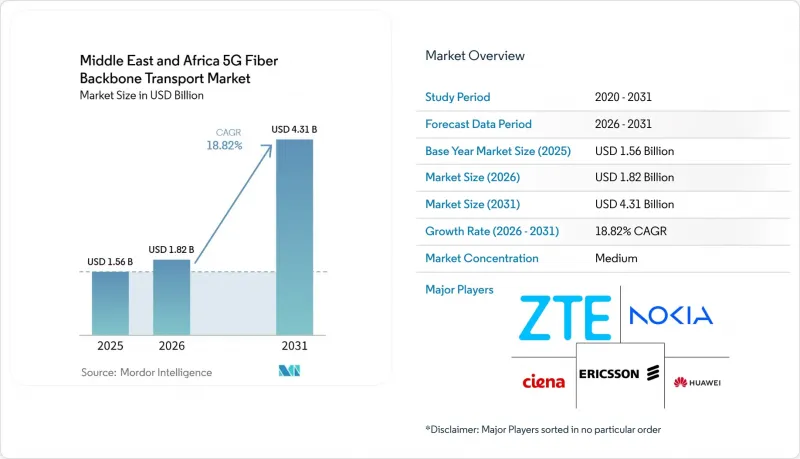
Mordor Intelligence에 의하면, 중동 및 아프리카의 5G 광섬유 백본 전송 시장 규모는 2025년에 15억 6,000만 달러로 평가되었습니다. 2026년 18억 2,000만 달러에서 2031년까지 43억 1,000만 달러에 이를 것으로 예측되며, 2026년부터 2031년까지 연평균 복합 성장률(CAGR)은 18.82%를 나타낼 전망입니다.
본 보고서는 구성 요소(하드웨어, 소프트웨어, 네트워크 관리 등), 용량(최대 10 Gbps, 10-100 Gbps, 100 Gbps 이상), 용도(모바일 네트워크 백홀, 데이터센터 상호 연결 등), 최종 사용자 산업(모바일 네트워크 사업자, 인터넷 서비스 제공업체 등), 지역별로 분류되어 있습니다. 시장 전망은 금액(달러)으로 제시되어 있습니다.
중동 및 아프리카의 5G 광섬유 백본 전송 시장 동향 및 인사이트
클라우드 및 데이터센터 상호 연결 분야의 400G 및 800G 백본에 대한 수요
GCC(걸프협력회의) 회원국의 통신 사업자들이 이미 시험 단계에서 실제 운영 단계로 전환하여 대용량 구축을 추진하고 있는 만큼, 클라우드 및 데이터센터 트래픽은 중동 및 아프리카의 5G 광섬유 백본 전송 시장에 있어 단기적인 주요 성장 요인으로 작용하고 있습니다. 노키아와 stc 그룹은 2025년 1월, 850km에 달하는 이 지역 최초의 1Tbps 장거리 현장 시험을 완료하며, 사우디아라비아에서 초대용량 백본의 성능이 이미 상용화에 적용 가능함을 입증했습니다. 이어 e&UAE는 2025년 2월 Ciena사의 ‘WaveLogic 6 Extreme’을 도입하여 기존 서비스 지역 내에서 파장당 1.6Tbps를 달성했습니다. 이를 통해 AI 및 클라우드 허브 주변의 광통신 인프라를 급속히 확장해야 할 필요성이 다시 한번 입증되었습니다. 또한, MTN 나이지리아와 화웨이는 2025년 7월, 나이지리아 최초의 하이브리드 400G-800G 자동 전환 광 네트워크를 가동했습니다. 여기에는 나이지리아 최초의 단일 파장 800G 광 채널도 포함되어 있어, 이와 유사한 용량 전환이 이제 아프리카의 개척 시장으로도 확산되고 있음을 보여주었습니다. 더욱이, e&UAE는 2025년 11월, DWDM 상의 듀얼 800GE가 지연 시간을 줄이고 비트당 비용을 절감할 수 있음을 입증했습니다. 이를 통해 가입자 트래픽이 완전히 성숙하기 전에 백본에 대한 조기 투자를 진행하는 것의 사업적 타당성이 더욱 높아졌습니다.
5G 스몰셀 및 도시 지역 매크로 기지국의 고밀도화
중동 및 아프리카의 5G 광섬유 백본 전송 시장도 5G 기지국의 고밀도 구축의 혜택을 받고 있습니다. 이는 스몰셀이나 첨단 매크로 아키텍처의 경우, 기존의 모바일 통신 레이아웃보다 훨씬 더 많은 광섬유가 필요하기 때문입니다. 나이로비에서 사파리콤(Safaricom)의 5G 구축은 스몰셀 및 DAS(분산 안테나 시스템) 설치에 의해 뒷받침되고 있으며, 밀집된 상업 지역에서 일반적으로 400 Mbit/s에서 700 Mbit/s의 속도를 실현하고 있습니다. 이는 무선 수준에서 직접적인 광섬유 연결의 필요성을 여실히 보여주고 있습니다. 알제리에서도 2025년 2월 알제리 텔레콤과 화웨이가 전국 58개 윌라야 전역에서 국가 광섬유 백본을 400G WDM으로 업그레이드한 후, 2025년 12월 Ooredoo, Djezzy, Mobilis가 상용 5G 서비스를 개시함으로써 또 하나의 명확한 사례가 추가되었습니다. eCPRI 옵션 7.2x에 기반한 5G 스몰셀의 각 활성화 시, 지연에 민감한 처리가 무선 유닛에 더 가까운 위치에서 이루어지게 되므로, 종단 간 지연 허용 범위가 100-150마이크로초로 엄격해지며, 전송 요구 사항이 급격히 높아집니다. 노키아의 ‘MEA 모바일 브로드밴드 지수 2025’ 역시 5G 투자의 가속화를 지적하고 있습니다. 통신 사업자들은 5G-Advanced 기능, 산업용 이용 사례, 네트워크 슬라이싱을 도입하고 있으며, 이 모든 것은 표준 소비자용 브로드밴드 서비스보다 더 높은 전송 정밀도를 필요로 합니다.
높은 토목 공사비와 부지 확보 지연
토목 공사비와 인허가 지연은 중동 및 아프리카의 5G 광섬유 백본 전송 시장에 있어 여전히 가장 시급한 걸림돌로 남아 있습니다. 특히 승인 절차가 더디게 진행되는 사하라 이남 아프리카나 지방 도시에서 그 영향은 두드러집니다. 『Africa Broadband Outlook 2024』에 따르면, 아프리카의 지상 광섬유 총 연장 거리는 210만 km를 초과하며, 이 중 130만 km가 가동 중이며, 2024년 6월까지의 12개월 동안 5만 8,000km가 새롭게 서비스를 개시했으나, 이러한 속도로는 대규모 5G 통신의 완전한 구축에 필요한 밀도에 여전히 미치지 못하고 있습니다. 주요 문제는 자금 부족뿐만이 아닙니다. 나이지리아나 사우디아라비아의 지방 도시에서 진행되는 프로젝트의 경우, 통신 규제 당국, 기획 기관, 도로 당국에 의한 승인 절차가 중복되어 18-24개월에 달하는 경우도 있기 때문입니다. Ciena사는 AfricaCom 2025에서 가장 중요한 전송 경로 중 일부가 여전히 긴 납기 기간에 직면해 있는 반면, AI 인프라로 인해 데이터센터 전체의 데이터 양이 증가하고 있다고 밝혔습니다. 이것이 공유 트렌치 및 오픈 액세스형 광섬유 모델이 지지를 얻고 있는 이유 중 하나입니다. 즉, 단일 컨세션 사업자가 단일 허가 절차를 거침으로써 여러 통신 사업자에게 용량을 임대할 수 있기 때문입니다.
부문 분석
2025년에는 하드웨어가 62.12%의 점유율을 차지하고 있으며, 중동 및 아프리카의 5G 광섬유 백본 전송 시장은 여전히 구축 단계에 있어 통신 사업자들이 우선적으로 물리적 광통신 계층에 투자하고 있는 것으로 나타났습니다. 광 전송 시스템, DWDM 및 ROADM 플랫폼, 그리고 패킷 광 장비는 GCC의 백본 경로와 아프리카의 장거리 회랑에서 여전히 주요 조달 품목으로 자리 잡고 있습니다. 이러한 추세는 통신 사업자들이 소프트웨어 계층에 대한 지출 비율을 높이기 전에 네트워크 커버리지와 순수한 전송 용량 확대에 주력하고 있는 실태를 반영합니다. 또한, 아프리카의 개척 시장에서 통신 사업자들은 계획, 도입, 통합 및 운영 관리를 벤더에 의존하는 경우가 많기 때문에 서비스의 중요성이 높아지고 있습니다. 소프트웨어 및 네트워크 관리는 2026년부터 2031년까지 연평균 성장률(CAGR) 24.57%로 확대될 것으로 예상되며, 중동 및 아프리카의 5G 광섬유 백본 전송 시장에서 가장 빠르게 성장하는 구성 요소 카테고리가 될 것입니다.
이 소프트웨어 분야의 급속한 성장은 중동 및 아프리카의 5G 광섬유 백본 전송 업계의 경쟁 양상이 광범위하게 변화하고 있음을 반영합니다. 이는 가치가 하드웨어 자체에서 네트워크 제어, 오케스트레이션, 최적화로 이동하고 있기 때문입니다. 노키아는 2025년 1월, 23억 달러에 인피니라(Infinera) 인수를 완료하며 코히런트 포토닉스와 클라우드 네이티브 네트워크 관리를 융합했습니다. 이는 주요 벤더들이 두 계층을 동시에 강화하고 있음을 보여줍니다. 또한, 오마텔이 2025년에 시에나사와 공동으로 ‘관리형 광섬유 네트워크’를 출시한 것은 통신 사업자들이 단순한 광용량뿐만 아니라, 네트워크-어즈-어-서비스(NaaS) 모델 하에서 실시간 SLA 모니터링, 온디맨드 대역폭, 자동 프로비저닝을 구매하고 있음을 보여줍니다. 아울러, ITU-T G.709 광전송 네트워크 프레밍 및 IETF YANG 데이터 모델과 같은 표준 규격도, 확대되는 전송 인프라 전반에 걸친 상호 운용성을 추구하는 통신 사업자들에 의해 지역별 입찰에서 소프트웨어 아키텍처 선택에 영향을 미치고 있습니다. 그 결과, 중동 및 아프리카의 5G 광섬유 백본 전송 시장에서 구성 요소는 여전히 하드웨어가 주도하고 있지만, 향후 차별화 요소는 점점 더 소프트웨어 정의 관리 계층으로 이동하고 있습니다.
2025년 중동 및 아프리카의 5G 광섬유 백본 전송 시장에서 10-100 Gbps 부문은 50.59%를 차지했으며, 이는 4G에서 5G로 전환되는 시기에 구축된 코히런트 100G 시스템의 도입 기반이 방대함을 반영합니다. 이 지역의 많은 통신 사업자들은 여전히 이러한 시스템을 용량 한계에 가깝게 운영하고 있어, 이 대역은 현재도 상용 운영의 기반이 되고 있습니다. 한편, GCC 국가들의 데이터센터 간 연결 트래픽 증가와 아프리카 주요 도시권의 5G 전송 부하 증가에 따라, 100 Gbps를 초과하는 대역폭은 2026년부터 2031년에 걸쳐 연평균 성장률(CAGR) 20.20%로 확대될 것으로 예측됩니다. 최대 10 Gbps의 대역폭은 트래픽 밀도가 아직 대용량 플랫폼으로의 전환을 정당화하지 못하는 아프리카의 개척 시장에서 원격 지역의 지상 링크나 초기 단계의 백홀 경로에서 여전히 중요한 역할을 하고 있습니다. 이러한 구성으로 인해 중동 및 아프리카의 5G 광섬유 백본 전송 시장은 대규모 레거시 인프라와 신속한 업그레이드 주기를 모두 갖추고 있습니다.
2025년 및 2026년의 상용화는 대용량 전송으로의 전환이 단순한 계획에 그치지 않고, 이미 실제 운영 중인 네트워크에서 진행 중임을 보여줍니다. e&UAE는 2025년 12월, 시스코와 제휴하여 EMIX IP 트랜짓 백본을 400G로 업그레이드하고, 국제 PoP(접속 지점)로 대용량 서비스를 확대했습니다. 이는 통신 사업자 수요가 이미 초기 시범 단계를 넘어섰음을 입증하는 것입니다. 이후 노키아, e&UAE 및 NPS는 2026년 153 Tbps 규모의 시험에서 중공 코어 광섬유를 채택함으로써, 100 Gbps를 초과하는 범주에는 향후 멀티 Tbps급의 단일 광섬유 성능도 포함될 것임을 시사했습니다. 따라서 중동 및 아프리카의 5G 광섬유 백본 전송 시장에서 조달 팀은 기존의 100G 계획 모델이 가정했던 것보다 훨씬 더 넓은 미래의 성능 범위를 염두에 두고 새로운 광섬유 경로를 계획해야 합니다. 이로 인해 용량에 관한 의사 결정은 더욱 신중을 기해야 합니다. 왜냐하면 현재의 업그레이드 주기를 위해 설치되는 광섬유는 예측 기간의 나머지 기간 동안 훨씬 더 대규모의 워크로드를 지원해야 하기 때문입니다.
기타 혜택 :
- 엑셀 형식 시장 예측(ME) 시트
- 3개월간의 애널리스트 지원
자주 묻는 질문
목차
제1장 서론
제2장 조사 방법
제3장 주요 요약
제4장 시장 구도
제5장 시장 규모 및 성장 예측
제6장 경쟁 구도
제7장 시장 기회 및 향후 전망
KTH 26.08.10According to Mordor Intelligence, the Middle East and Africa 5G Fiber Backbone Transport Market size was valued at USD 1.56 billion in 2025 and is estimated to grow from USD 1.82 billion in 2026 to reach USD 4.31 billion by 2031, at a CAGR of 18.82% during the forecast period (2026-2031).
This report is Segmented by Component (Hardware, Software and Network Management, and More), Capacity (Up To 10 Gbps, 10 To 100 Gbps, and Above 100 Gbps), Application (Mobile Network Backhaul, Data Center Interconnect, and More), End User Industry (Mobile Network Operators, Internet Service Providers, and More), and Geography. The Market Forecasts are Provided in Value (USD).
Middle East and Africa 5G Fiber Backbone Transport Market Trends and Insights
Cloud and Data Center Interconnect Demand for 400G and 800G Backbones
Cloud and data center traffic is a major near-term support factor for the Middle East and Africa 5G fiber backbone transport market, as GCC operators are already moving beyond trial conditions into live, high-capacity deployments. Nokia and stc Group completed the region's first 1Tbps long-haul field trial in January 2025 over 850 km, which showed that very high-capacity backbone performance is already practical for commercial use in Saudi Arabia. e& UAE then deployed Ciena's WaveLogic 6 Extreme in February 2025 and reached 1.6Tbps per wavelength within its existing footprint, which strengthened the case for rapid optical scaling around AI and cloud hubs. MTN Nigeria and Huawei also launched Nigeria's first hybrid 400G-800G Automatically Switched Optical Network in July 2025, including the country's first single-wavelength 800G optical channel, which showed that the same capacity shift is now reaching frontier African markets as well. e& UAE further demonstrated in November 2025 that dual-800GE over DWDM can reduce latency and lower cost per bit, which improves the business case for early backbone investment before subscriber traffic fully matures.
5G Small-Cell and Urban Macro Densification
The Middle East and Africa 5G fiber backbone transport market is also benefiting from dense 5G site rollouts, because small-cell and advanced macro architectures require much more fiber than legacy mobile layouts. Safaricom's 5G deployment in Nairobi has been supported by small-cell and DAS installations that delivered typical speeds of 400 Mbit/s to 700 Mbit/s in dense commercial areas, underscoring the need for direct fiber support at the radio level. Algeria added another clear example when Ooredoo, Djezzy, and Mobilis launched commercial 5G in December 2025 after Algerie Telecom and Huawei had upgraded the national optical backbone to 400G WDM across all 58 wilayas in February 2025. The transport requirement rises sharply because each 5G small-cell activation under eCPRI option 7.2x shifts latency-sensitive processing closer to the radio unit, tightening the end-to-end latency budget to 100-150 microseconds. Nokia's MEA Mobile Broadband Index 2025 also pointed to accelerating 5G investment, with operators adding 5G-Advanced capabilities, industrial use cases, and network slicing, all of which require tighter transport precision than standard consumer broadband services.
High Civil Works Cost and Right-Of-Way Delays
Civil works costs and permitting delays remain the most immediate brake on the Middle East and Africa 5G fiber backbone transport market, especially across sub-Saharan Africa and secondary cities, where approvals move slowly. Africa's terrestrial fiber footprint passed 2.1 million km, with 1.3 million km active as of the Africa Broadband Outlook 2024, and 58,000 km entered service in the 12 months to June 2024, yet this pace still falls short of the density required for full 5G transport readiness at scale. The main issue is not a lack of capital alone, because projects in Nigeria and secondary Saudi cities can still face overlapping approvals from telecom regulators, planning bodies, and road authorities that stretch for 18-24 months. Ciena stated at AfricaCom 2025 that AI infrastructure is increasing data volumes across data centers, even as some of the most important transport routes still face long delivery schedules. This is one reason shared trench and open-access fiber models are gaining support: a single concessionaire can move through a single permitting process and lease capacity to several operators.
Other drivers and restraints analyzed in the detailed report include:
- Sovereign Digital Infrastructure Programs in GCC And North Africa
- Open RAN and eCPRI Disaggregation of Transport Layers
- Power, Cooling, And Site Access Constraints In Remote African Markets
For complete list of drivers and restraints, kindly check the Table Of Contents.
Segment Analysis
Hardware held a 62.12% share in 2025, indicating that the Middle East and Africa 5G fiber backbone transport market is still in a build phase, with operators spending first on physical optical layers. Optical transport systems, DWDM and ROADM platforms, and packet-optical equipment remain the main items in procurement cycles across GCC backbone routes and African long-haul corridors. This pattern reflects the fact that carriers are still expanding network reach and raw transport capacity before they shift a larger share of spending toward software layers. Services are also gaining relevance because operators in frontier African markets often rely on vendors for planning, deployment, integration, and managed operations. Software and network management is projected to expand at a 24.57% CAGR from 2026 to 2031, which makes it the fastest-growing component category in the Middle East and Africa 5G fiber backbone transport market.
That faster software growth reflects a broader change in how the Middle East and Africa 5G fiber backbone transport industry is competing, because value is moving toward network control, orchestration, and optimization rather than hardware alone. Nokia completed its acquisition of Infinera for USD 2.3 billion in January 2025, combining coherent photonics with cloud-native network management and demonstrating that major vendors are strengthening both layers simultaneously. Omantel's 2025 launch of its Managed Optical Fiber Network with Ciena also showed that operators are buying real-time SLA monitoring, bandwidth-on-demand, and automated provisioning under a network-as-a-service model, not just raw optical capacity. Standards such as ITU-T G.709 optical transport network framing and IETF YANG data models are also shaping software architecture choices in regional tenders, as operators seek interoperability across expanding transport estates. As a result, the component mix in the Middle East and Africa 5G fiber backbone transport market is still led by hardware, but future differentiation is increasingly moving toward software-defined management layers.
The 10 to 100 Gbps segment accounted for 50.59% of the Middle East and Africa 5G fiber backbone transport market in 2025, reflecting the large installed base of coherent 100G systems built during the 4G-to-5G transition. Many carriers across the region are still running these systems near capacity, so this tier remains the present backbone of commercial operations. At the same time, above 100 Gbps is projected to expand at a 20.20% CAGR from 2026 to 2031 as data center interconnect traffic rises in the GCC and 5G transport loads increase in major African metros. The up to 10 Gbps tier still has a role in remote terrestrial links and early-stage backhaul routes in frontier African markets where traffic density has not yet justified a move to higher-capacity platforms. This mix means the Middle East and Africa 5G fiber backbone transport market has both a large legacy installed base and a fast upgrade cycle.
Commercial moves in 2025 and 2026 show that the shift toward higher-capacity transport is already happening in live networks rather than remaining a plan. e& UAE upgraded its EMIX IP transit backbone to 400G in partnership with Cisco in December 2025, extending higher-capacity services to international points of presence and demonstrating that operator demand has moved beyond early pilots. Nokia, e& UAE, and NPS then used hollow-core fiber in a 2026 trial at 153 Tbps, pointing to a future where the above 100 Gbps category will also include multi-Tbps single-fiber performance. Procurement teams in the Middle East and Africa 5G fiber backbone transport market, therefore, need to plan new fiber routes against a much wider future performance range than older 100G planning models assumed. This makes capacity decisions more sensitive because fiber laid for today's upgrade cycle will need to support much larger workloads over the rest of the forecast window.
Complete Report Scope:
- By Component
- Hardware (Includes Optical Transport Systems, DWDM and ROADM Platforms, Packet-Optical Transport Platforms, Routers and Switches, Fiber Optic Cables, Optical Transceivers, Amplifiers, and OTN Equipment)
- Software and Network Management (Includes Network Management Systems, SDN Controllers, Transport Orchestration Software, Analytics and Assurance Tools, Automation Platforms, and Inventory Management Software)
- Services (Includes Network Planning and Design, Deployment and Installation, Integration and Commissioning, Managed Services, Maintenance and Support, Optimization, Consulting, and Training)
- By Capacity
- Up to 10 Gbps
- 10 to 100 Gbps
- Above 100 Gbps
- By Application
- Mobile Network Backhaul
- Mobile Network Fronthaul and Midhaul
- Data Center Interconnect
- Enterprise and Private 5G Transport
- Other Applications (Submarine Landing Station Backhaul, etc.)
- By End User Industry
- Mobile Network Operators
- Internet Service Providers
- Cloud and Hyperscale Providers
- Enterprises and Private Networks
- Other End User Industry (Government and Public Safety, etc.)
- By Geography
- Middle East
- Saudi Arabia
- United Arab Emirates
- Qatar
- Kuwait
- Turkey
- Rest of Middle East
- Africa
- South Africa
- Nigeria
- Egypt
- Kenya
- Rest of Africa
- Middle East
List of Companies Covered in this Report:
- Huawei Technologies Co., Ltd.
- Nokia Corporation
- Ciena Corporation
- ZTE Corporation
- Telefonaktiebolaget LM Ericsson
- Cisco Systems, Inc.
- Infinera Corporation
- ADTRAN Holdings, Inc.
- Ribbon Communications Inc.
- Juniper Networks, Inc.
- NEC Corporation
- Fujitsu Limited
- CommScope Holding Company, Inc.
- Sterlite Technologies Limited
- Prysmian S.p.A.
- Corning Incorporated
- Tejas Networks Limited
- FiberHome Telecommunication Technologies Co., Ltd.
- Coherent Corp.
- Aviat Networks Inc.
- Ekinops S.A.
Additional Benefits:
- The market estimate (ME) sheet in Excel format
- 3 months of analyst support
TABLE OF CONTENTS
1 INTRODUCTION
- 1.1 Study Assumptions and Market Definition
- 1.2 Scope of the Study
2 RESEARCH METHODOLOGY
3 EXECUTIVE SUMMARY
4 MARKET LANDSCAPE
- 4.1 Market Overview
- 4.2 Market Drivers
- 4.2.1 5G Small-Cell and Urban Macro Densification
- 4.2.2 Open RAN and eCPRI Disaggregation of Transport Layers
- 4.2.3 Cloud and Data Center Interconnect Demand for 400G and 800G Backbones
- 4.2.4 Sovereign Digital Infrastructure Programs in GCC and North Africa
- 4.2.5 Utility-Grade Fiberization of Ports, Industrial Zones, and Energy Corridors
- 4.2.6 Route Design Shift Toward Multi-Tenant Wholesale Fiber Backbones
- 4.3 Market Restraints
- 4.3.1 High Civil Works Cost and Right-of-Way Delays
- 4.3.2 Power, Cooling, and Site Access Constraints in Remote African Markets
- 4.3.3 Interoperability Friction Across Multi-Vendor Optical and Packet Layers
- 4.3.4 FX Pressure and Import Dependency for Coherent Optics and Line Systems
- 4.4 Industry Value Chain Analysis
- 4.5 Regulatory Landscape
- 4.6 Technological Outlook
- 4.7 Porter's Five Forces Analysis
- 4.7.1 Threat of New Entrants
- 4.7.2 Bargaining Power of Suppliers
- 4.7.3 Bargaining Power of Buyers
- 4.7.4 Threat of Substitutes
- 4.7.5 Competitive Rivalry
- 4.8 Impact of Macroeconomic Factors on the Market
5 MARKET SIZE AND GROWTH FORECASTS (VALUE)
- 5.1 By Component
- 5.1.1 Hardware (Includes Optical Transport Systems, DWDM and ROADM Platforms, Packet-Optical Transport Platforms, Routers and Switches, Fiber Optic Cables, Optical Transceivers, Amplifiers, and OTN Equipment)
- 5.1.2 Software and Network Management (Includes Network Management Systems, SDN Controllers, Transport Orchestration Software, Analytics and Assurance Tools, Automation Platforms, and Inventory Management Software)
- 5.1.3 Services (Includes Network Planning and Design, Deployment and Installation, Integration and Commissioning, Managed Services, Maintenance and Support, Optimization, Consulting, and Training)
- 5.2 By Capacity
- 5.2.1 Up to 10 Gbps
- 5.2.2 10 to 100 Gbps
- 5.2.3 Above 100 Gbps
- 5.3 By Application
- 5.3.1 Mobile Network Backhaul
- 5.3.2 Mobile Network Fronthaul and Midhaul
- 5.3.3 Data Center Interconnect
- 5.3.4 Enterprise and Private 5G Transport
- 5.3.5 Other Applications (Submarine Landing Station Backhaul, etc.)
- 5.4 By End User Industry
- 5.4.1 Mobile Network Operators
- 5.4.2 Internet Service Providers
- 5.4.3 Cloud and Hyperscale Providers
- 5.4.4 Enterprises and Private Networks
- 5.4.5 Other End User Industry (Government and Public Safety, etc.)
- 5.5 By Geography
- 5.5.1 Middle East
- 5.5.1.1 Saudi Arabia
- 5.5.1.2 United Arab Emirates
- 5.5.1.3 Qatar
- 5.5.1.4 Kuwait
- 5.5.1.5 Turkey
- 5.5.1.6 Rest of Middle East
- 5.5.2 Africa
- 5.5.2.1 South Africa
- 5.5.2.2 Nigeria
- 5.5.2.3 Egypt
- 5.5.2.4 Kenya
- 5.5.2.5 Rest of Africa
- 5.5.1 Middle East
6 COMPETITIVE LANDSCAPE
- 6.1 Market Concentration
- 6.2 Strategic Moves
- 6.3 Market Share Analysis
- 6.4 Company Profiles (includes Global Level Overview, Market Level Overview, Core Segments, Financials as available, Strategic Information, Market Rank/Share, Products and Services, Recent Developments)
- 6.4.1 Huawei Technologies Co., Ltd.
- 6.4.2 Nokia Corporation
- 6.4.3 Ciena Corporation
- 6.4.4 ZTE Corporation
- 6.4.5 Telefonaktiebolaget LM Ericsson
- 6.4.6 Cisco Systems, Inc.
- 6.4.7 Infinera Corporation
- 6.4.8 ADTRAN Holdings, Inc.
- 6.4.9 Ribbon Communications Inc.
- 6.4.10 Juniper Networks, Inc.
- 6.4.11 NEC Corporation
- 6.4.12 Fujitsu Limited
- 6.4.13 CommScope Holding Company, Inc.
- 6.4.14 Sterlite Technologies Limited
- 6.4.15 Prysmian S.p.A.
- 6.4.16 Corning Incorporated
- 6.4.17 Tejas Networks Limited
- 6.4.18 FiberHome Telecommunication Technologies Co., Ltd.
- 6.4.19 Coherent Corp.
- 6.4.20 Aviat Networks Inc.
- 6.4.21 Ekinops S.A.
7 MARKET OPPORTUNITIES AND FUTURE OUTLOOK
- 7.1 White-Space and Unmet-Need Assessment


