
|
시장보고서
상품코드
2099465
컨테이너화 소프트웨어 시장 : 점유율 분석, 업계 동향 및 통계, 성장 예측(2026-2031년)Containerization Software - Market Share Analysis, Industry Trends & Statistics, Growth Forecasts (2026 - 2031) |
||||||
 Mordor Intelligence
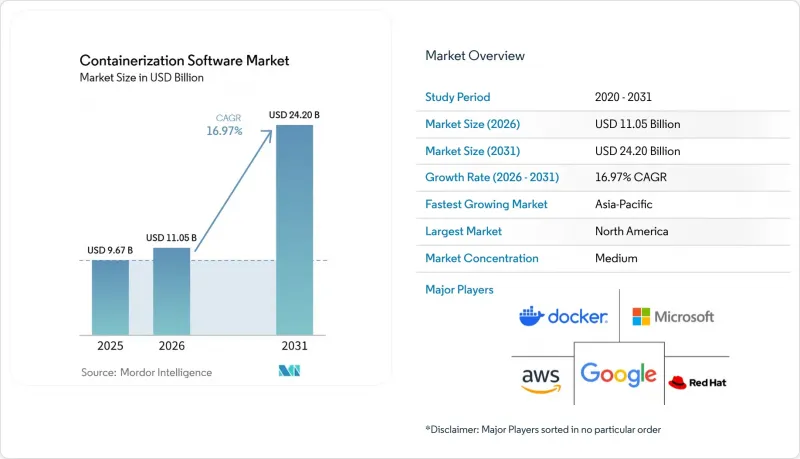
Mordor Intelligence에 의하면, 컨테이너화 소프트웨어 시장 규모는 2025년에 96억 7,000만 달러, 2026년에 110억 5,000만 달러가 되어, 2031년까지 242억 달러에 이를 것으로 예측되며, 2026년부터 2031년까지 CAGR 16.97%로 성장할 전망입니다.
본 보고서는 도입 형태(On-Premise, 퍼블릭 클라우드, 하이브리드 클라우드, 멀티 클라우드), 플랫폼(Docker, Kubernetes, Red Hat OpenShift 등), 컨테이너 유형(애플리케이션 컨테이너 등), 용도(애플리케이션 개발·테스트 등), 최종 사용자(IT 및 통신 등), 지역별로 분류되어 있습니다. 시장 예측은 금액(달러) 기준으로 제시되어 있습니다.
전 세계 컨테이너화 소프트웨어 시장 동향과 인사이트
엔터프라이즈 워크로드의 클라우드 네이티브 전환
기업의 현대화는 시범 운영 단계를 넘어섰으며, 컨테이너화 소프트웨어 시장은 현재 프로덕션 환경 전반에서 컨테이너의 대규모 활용을 지속 가능하게 할 필요성을 반영하고 있습니다. CNCF의 ‘2025년 연례 클라우드 네이티브 설문조사’에 따르면, 2025년에는 조직의 56%가 프로덕션 환경 용도의 대부분 또는 전부에 컨테이너를 도입하고 있으며, 시범 운영 단계에 머무르는 곳은 불과 6%에 불과했습니다. 이에 따라 컨테이너화 소프트웨어 시장의 지출 패턴이 변화하고 있습니다. 이미 핵심 워크로드를 컨테이너화한 기업들은 더 강력한 텔레메트리, 정책 적용, 비용 배분 및 거버넌스 계층을 필요로 하기 때문입니다. Portworx는 2026년에 74%의 조직이 워크로드 현대화 또는 마이그레이션을 계획하고 있다고 보고했으며, 쿠버네티스는 이러한 환경의 상당수에서 장기적으로 선호되는 호스트 플랫폼으로 꼽혔습니다. 이러한 전환 경로는 레거시 가상화 전환 프로그램과 최신 오케스트레이션, 거버넌스, 플랫폼 서비스에 대한 수요를 연결함으로써 컨테이너화 소프트웨어 시장을 뒷받침하고 있습니다.
AI 및 ML 워크로드의 컨테이너화
AI 추론 및 모델 운영을 통해 컨테이너는 컨테이너화 소프트웨어 시장에서 단순한 2차 패키징 수단이 아닌 핵심 배포 기법으로 자리 잡고 있습니다. CNCF의 조사에 따르면, 2025년에는 생성형 AI 모델을 호스팅하는 조직의 66%가 추론 워크로드의 일부 또는 전부에 쿠버네티스를 사용하고 있었습니다. Nutanix는 2026년 1월, 조사 대상 경영진의 82%가 현재의 On-Premise 인프라로는 AI 워크로드를 완전히 지원할 준비가 되어 있지 않다고 응답했다고 보고했으며, 이는 컨테이너화된 AI 플랫폼으로의 업그레이드 주기를 촉진하고 있습니다. Amazon Web Services는 2025년 7월, Amazon EKS를 확장하여 클러스터당 최대 10만 개의 워커 노드를 지원하게 되었습니다. 이 회사에 따르면, 이는 최대 80만 개의 NVIDIA GPU까지 확장 가능하다고 합니다. AI를 도입한 기업들은 대규모 컴퓨팅 환경 전반에 걸친 이식성, 버전 관리, 재현 가능한 런타임 동작을 점점 더 요구하고 있기 때문에 이러한 규모 확대는 컨테이너화 소프트웨어 시장에 중요한 의미를 지닙니다.
Kubernetes 기술 인력 부족과 플랫폼의 복잡성
컨테이너화 소프트웨어 시장은 여전히 인력 부족이라는 병목 현상에 직면해 있습니다. 이는 프로덕션 환경의 컨테이너 환경이 단순한 기본 클러스터 관리 이상의 고도의 엔지니어링을 필요로 하게 되었기 때문입니다. CNCF의 'State of Platform Engineering Report'에 따르면, 대기업들은 이미 플랫폼 엔지니어링에 연간 500만-1,000만 달러를 지출하고 있음에도 불구하고, 자사의 플랫폼을 '성숙한' 상태로 평가하는 곳은 고작 25%에 불과합니다. 이러한 격차는 컨테이너화 프로그램이 웹 용도에서 AI 스케줄링, 정책 제어, 사내 개발자 플랫폼으로 확대됨에 따라 배포 일정이 종종 지연되는 이유를 보여줍니다. 이 문제는 GPU 지원 오케스트레이션, 보다 정교한 보안 제어, 그리고 클라우드와 On-Premise 환경을 아우르는 하이브리드 인프라 운영이 필요한 환경에서 더욱 심각합니다. 그 결과, 컨테이너화 소프트웨어 시장은 성장을 이어가고 있지만, 성숙도가 낮은 구매 기업들은 실행 위험 증가, 도입 주기 장기화, 그리고 소유 비용 증가에 직면하고 있습니다.
부문 분석
2025년 컨테이너화 소프트웨어 시장에서 퍼블릭 클라우드는 46.83%를 차지하며, 현재 지출에서 매니지드 서비스가 여전히 가장 큰 점유율을 차지하고 있는 것으로 나타났습니다. AWS EKS, ECS, Azure AKS, Google GKE와 같은 퍼블릭 클라우드 플랫폼은 기업 팀이 사내에서 감당해야 했던 인프라 부담을 상당 부분 덜어주기 때문에 여전히 매력적입니다. 이러한 가치는 조직이 통합된 가시성, 정책 제어, 확장 가능한 런타임 서비스를 갖춘 AI 지원 환경을 추구할 때 더욱 강화됩니다. 아마존은 2026년 6월, SageMaker AI가 자동 컨테이너 이미지 캐시 기능을 통해 생성형 AI 추론의 스케일아웃에 소요되는 시간을 최대 절반까지 단축할 수 있다고 발표했습니다. 이는 추론 부하가 높은 워크로드에서 매니지드 클라우드 환경이 가진 운영상의 이점을 부각시키는 것입니다. 컨테이너화 소프트웨어 업계에서는 주권, 지연 시간 또는 내부 통제 요건으로 인해 퍼블릭 클라우드 배치가 제한되는 규제 산업 분야에서 여전히 상당한 On-Premise 수요가 유지되고 있습니다.
기밀성이 높은 워크로드의 경우, 데이터 저장 위치나 런타임 구성에 대한 보다 엄격한 관리가 필요하기 때문에 정부 기관이나 의료, 기타 규제가 엄격한 이용 사례에서 On-Premise 배포는 여전히 중요합니다. 하이브리드 클라우드는 버스트 용량이나 워크로드 부하 분산이 필요할 때, 관리되는 환경과 탄력적인 인프라를 연결함으로써 이러한 고객을 지원합니다. 또한, 쿠버네티스가 혼합 환경 전반에 걸쳐 기업에 공통된 제어 플레인을 제공하고 용도 마이그레이션에 따른 재작업을 줄여주기 때문에 컨테이너화 소프트웨어 시장도 하이브리드 수요의 혜택을 받고 있습니다. 유니커널과 시스템 컨테이너는 광범위한 기능의 확충보다는 실적 소형화 및 엄격한 분리가 중시되는 하이브리드 엣지 환경에서 주목을 받고 있습니다. 멀티 클라우드 시장은 2031년까지 연평균 성장률(CAGR) 19.62%를 나타낼 것으로 예측되며, 이러한 성장세는 이식성 확보와 특정 하이퍼스케일러에 대한 의존도 저감을 목적으로 한 신중한 아키텍처 선택을 반영하고 있습니다. 구매자들은 단순히 내결함성을 높이기 위해서만 멀티클라우드를 채택하는 것이 아니라, 주권 및 거버넌스 요건이 엄격해지는 가운데 표준화된 컨테이너 API를 활용하여 배포의 자유도를 유지하고자 합니다.
2025년, 쿠버네티스는 컨테이너화 소프트웨어 시장 점유율의 42.18%를 차지하고 있으며, 이는 엔터프라이즈용 컨테이너 환경 전체에서 표준 오케스트레이션 계층으로서의 역할을 입증하는 것입니다. CNCF의 조사에 따르면, 2025년에는 컨테이너 사용자의 82%가 프로덕션 환경에서 쿠버네티스를 운영하고 있으며, 이는 이 플랫폼이 현대 소프트웨어 제공에 얼마나 깊이 침투해 있는지를 뒷받침합니다. 같은 조사에서는 조직의 66%가 생성형 AI 추론 워크로드의 일부 또는 전부에 쿠버네티스를 활용하고 있는 것으로 보고되어, 이 플랫폼이 AI 인프라에 대한 수요 증가와 직접적으로 연결되어 있음을 보여줍니다. Docker는 빌드 및 개발 단계에서 여전히 중요한 위치를 차지하고 있는 반면, Amazon ECS는 쿠버네티스와 같은 복잡한 운영 절차 없이 AWS 네이티브 컨테이너 관리를 원하는 팀에서 활용되고 있습니다. Google Kubernetes Engine은 TPU 및 NVIDIA GPU 인프라와의 보다 긴밀한 연동을 원하는 구매자들 사이에서 계속해서 두각을 나타내고 있으며, 쿠버네티스 주도 플랫폼 부문 내에서도 경쟁이 활발하게 이어지고 있습니다.
Azure Kubernetes Service(AKS)는 2031년까지 연평균 성장률(CAGR) 22.14%를 나타낼 것으로 예측되며, 컨테이너화 소프트웨어 시장에서 가장 빠르게 성장하는 플랫폼이 될 전망입니다. 마이크로소프트는 ‘Red Hat Summit 2026’에서 AKS가 75,000노드까지 확장된 클러스터에서 OpenAI 및 Anthropic의 워크로드를 실행하고 있다고 발표했습니다. 또한, 요구 사항이 까다로운 AI 훈련 환경을 위해 NVLink 및 RDMA에 대한 직접 액세스를 가능하게 하는 베어메탈 AKS 구성에 대해서도 강조했습니다. 플랫폼 간 경쟁이 기본적인 오케스트레이션에서 AI 네이티브 스케줄링, 성능 튜닝, 통합된 가시성으로 이동하고 있는 만큼, 이러한 포지셔닝은 중요합니다. Mirantis k0s, SUSE K3s, Canonical MicroK8s 등을 포함한 또 다른 플랫폼 그룹은 본격적인 배포 도입이 정당화되기 어려운 엣지 환경, 에어갭 환경 및 경량 환경에서 여전히 중요한 역할을 수행하고 있습니다. 그 결과, 쿠버네티스가 여전히 대부분의 엔터프라이즈 도입에서 공통된 기반임에도 불구하고, 컨테이너화 소프트웨어 시장은 플랫폼 수준에서 점점 더 차별화가 진행되고 있습니다.
지역별 분석
2025년, 북미는 39.84%의 점유율을 차지하며 컨테이너화 소프트웨어 시장에서 가장 규모가 큰 지역 블록이 되었습니다. 이 지역은 하이퍼스케일러의 인프라, 기업 소프트웨어 구매자, 그리고 플랫폼 엔지니어링 인력이 가장 집중되어 있다는 이점을 가지고 있습니다. 주요 매니지드 쿠버네티스, 개발자용 도구 및 엔터프라이즈 플랫폼 공급업체 대부분이 미국에 상당한 사업 기반을 두고 있기 때문에 미국은 여전히 명확한 핵심 거점입니다. CNCF의 조사에 따르면, 2025년에도 이 지역에서는 프로덕션 환경에서의 쿠버네티스 성숙도가 계속해서 높은 수준을 유지할 것으로 보이며, 이는 단순한 핵심 오케스트레이션에 그치지 않고 부가가치가 높은 도구에 대한 지속적인 수요를 뒷받침하고 있습니다. 캐나다와 멕시코는 금융 서비스의 현대화 및 제조업 관련 컨테이너 기술 도입을 통해 시장을 견인하고 있으며, 이로 인해 이 지역의 성장이 미국 단일 시장에 국한되지 않고 확대되고 있습니다.
아시아태평양은 2031년까지 연평균 성장률(CAGR) 19.73%를 나타낼 것으로 예측되며, 컨테이너화 소프트웨어 시장에서 가장 빠르게 성장하는 지역이 될 전망입니다. 2025년 5월에 발표된 Linux Foundation Japan의 보고서에 따르면, 조사 대상인 일본 기업의 91%가 프로덕션 환경에서 컨테이너를 활용하고 있으며, 이는 이 지역 내 가장 선진적인 엔터프라이즈 시장 중 하나에서 운영 측면의 성숙도가 높음을 보여줍니다. 인도는 데이터센터 및 클라우드 인프라의 대규모 확장으로 성장세가 가속화되고 있는 반면, 중국은 계속해서 자체 관리 레지스트리와 국내 쿠버네티스 개발을 중시하고 있습니다. 일본, 한국, 호주는 보다 성숙한 수요를 창출하고 있는 반면, 인도, 인도네시아, 베트남은 새로운 디지털 인프라 계층을 기반으로 한 고성장 도입을 뒷받침하고 있습니다. 이러한 조합 덕분에 아시아태평양은 성숙한 엔터프라이즈 이용 사례와 기존 가상화 환경의 제약이 적은 새로운 인프라 구축을 모두 갖추고 있어, 향후 성장에서 중심적인 위치를 계속 차지하고 있습니다.
유럽, 중동 및 아프리카에서는 컨테이너화 소프트웨어 시장에서 보다 다양한 양상이 관찰됩니다. 서유럽에서는 독일, 영국, 프랑스가 계속해서 주도적인 역할을 수행하고 있으며, 이들 국가에서는 기업의 현대화 및 규정 준수를 주도하는 클라우드 프로그램이 활발히 추진되고 있습니다. 중동에서는 관리형 도입 환경이 필요한 정부 및 에너지 관련 워크로드를 정부 주도의 클라우드 투자가 뒷받침하고 있어 성장세가 강해지고 있습니다. 남미는 여전히 지역별로는 시장 규모가 가장 작은 편이지만, 브라질과 아르헨티나에서는 금융 서비스 및 미디어 분야의 디지털 전환 혜택을 지속적으로 누리고 있습니다. 아프리카는 여전히 초기 단계에 있지만, 기업의 클라우드 인프라가 확대되고 컨테이너화된 도입을 위한 기반이 확산됨에 따라 남아프리카공화국과 나이지리아가 시장 진입의 관문 역할을 하고 있습니다.
기타 혜택:
- 엑셀 형식 시장 예측(ME) 시트
- 3개월간의 애널리스트 지원
자주 묻는 질문
목차
제1장 서론
제2장 조사 방법
제3장 주요 요약
제4장 시장 구도
제5장 시장 규모와 성장 예측
제6장 경쟁 구도
제7장 시장 기회와 향후 전망
JHS 26.08.05According to Mordor Intelligence, the containerization software market size is projected to be USD 9.67 billion in 2025, USD 11.05 billion in 2026, and reach USD 24.2 billion by 2031, growing at a CAGR of 16.97% from 2026 to 2031.
This report is Segmented by Deployment Type (On-Premises, Public Cloud, Hybrid Cloud, and Multi-Cloud), Platform (Docker, Kubernetes, Red Hat OpenShift, and More), Container Type (Application Containers, and More), Application (Application Development and Testing, and More), End User (IT and Telecommunications, and More), and Geography. The Market Forecasts are Provided in Terms of Value (USD).
Global Containerization Software Market Trends and Insights
Cloud-Native Migration Across Enterprise Workloads
Enterprise modernization has moved past trial activity, and the containerization software market now reflects the need to make large-scale container use sustainable across production estates. The CNCF 2025 Annual Cloud Native Survey found that 56% of organizations used containers for most or all production applications in 2025, while only 6% remained in pilot mode. This changes spending patterns inside the containerization software market because enterprises that already containerized core workloads now need stronger telemetry, policy enforcement, cost attribution, and governance layers. Portworx reported in 2026 that 74% of organizations planned to modernize or migrate workloads, and Kubernetes was identified as the preferred long-term host platform for many of those estates. That migration path supports the containerization software market by linking legacy virtualization transformation programs with demand for modern orchestration, governance, and platform services.
AI And ML Workload Containerization
AI inference and model operations are making containers a core deployment method rather than a secondary packaging option within the containerization software market. The CNCF survey found that 66% of organizations hosting generative AI models used Kubernetes for some or all inference workloads in 2025. Nutanix reported in January 2026 that 82% of surveyed executives said their current on-premises infrastructure was not fully ready to support AI workloads, which is pushing upgrade cycles toward containerized AI platforms. Amazon Web Services expanded Amazon EKS in July 2025 to support up to 100,000 worker nodes per cluster, which it said could scale to 800,000 NVIDIA GPUs. That scale matters for the containerization software market because AI buyers increasingly want portability, version control, and reproducible runtime behavior across large compute environments.
Kubernetes Skills Shortage and Platform Complexity
The containerization software market still faces a talent bottleneck because production container estates now require deeper engineering than just basic cluster administration. The CNCF State of Platform Engineering Report found that large organizations were already spending USD 5-10 million annually on platform engineering, yet only 25% considered their platforms mature. That gap shows why delivery timelines often slow once container programs expand from web applications into AI scheduling, policy controls, and internal developer platforms. The problem is more acute in environments that need GPU-aware orchestration, deeper security controls, and mixed infrastructure operations across cloud and on-premises estates. As a result, the containerization software market continues to grow, but less mature buyers face higher execution risk, longer rollout cycles, and rising ownership costs.
Other drivers and restraints analyzed in the detailed report include:
- DevOps and CI/CD Standardization
- Platform Engineering Adoption in Large Enterprises
- Container Security and Supply Chain Risk Exposure
For complete list of drivers and restraints, kindly check the Table Of Contents.
Segment Analysis
Public cloud accounted for 46.83% of the containerization software market in 2025, indicating that managed services still account for the largest share of current spending. Public cloud platforms remain attractive because AWS EKS and ECS, Azure AKS, and Google GKE remove much of the infrastructure burden that enterprise teams would otherwise carry in-house. That value becomes stronger when organizations want AI-ready environments with integrated observability, policy controls, and scalable runtime services. Amazon said in June 2026 that SageMaker AI could cut the time to scale out generative AI inference by up to half through automatic container image caching, underscoring the operational advantages of managed cloud environments for inference-heavy workloads. The containerization software industry still keeps meaningful on-premises demand in regulated sectors where sovereignty, latency, or internal control requirements limit public cloud placement.
On-premises deployments remain important for government, healthcare, and other tightly regulated use cases because sensitive workloads often need stricter control over data location and runtime configuration. Hybrid cloud supports those buyers by connecting controlled environments with elastic infrastructure when burst capacity or workload balancing becomes necessary. The containerization software market also benefits from hybrid demand because Kubernetes gives enterprises a common control plane across mixed estates, which reduces rework during application movement. Unikernels and system containers are gaining attention in hybrid edge settings where smaller footprints and tighter isolation are valued over broad feature depth. Multi-cloud is projected to grow at a 19.62% CAGR through 2031, and that pace reflects deliberate architecture choices aimed at portability and lower dependency on any single hyperscaler. Buyers are not adopting multi-cloud only for resilience, they are also using standardized container APIs to preserve freedom of deployment as sovereignty and governance requirements become stricter.
Kubernetes held 42.18% of the containerization software market share in 2025, which confirms its role as the standard orchestration layer across enterprise container environments. The CNCF survey found that 82% of container users ran Kubernetes in production in 2025, which reinforces how deeply the platform is embedded in modern software delivery. The same survey reported that 66% of organizations used Kubernetes for some or all of their generative AI inference workloads, tying the platform directly to rising AI infrastructure demand. Docker remains important at the build and development layer, while Amazon ECS serves teams that want AWS-native container management without the full operational complexity of Kubernetes. Google Kubernetes Engine continues to stand out among buyers seeking closer alignment with TPU and NVIDIA GPU infrastructure, keeping competition active even within a Kubernetes-led platform segment.
Azure Kubernetes Service is projected to grow at a 22.14% CAGR through 2031, making it the fastest-growing platform in the containerization software market. Microsoft stated at Red Hat Summit 2026 that AKS was running OpenAI and Anthropic workloads on clusters that scaled to 75,000 nodes, and it also highlighted bare-metal AKS configurations that enabled direct NVLink and RDMA access for demanding AI training environments. That positioning matters because platform competition is moving away from basic orchestration and toward AI-native scheduling, performance tuning, and integrated observability. The other platform group, including Mirantis k0s, SUSE K3s, and Canonical MicroK8s, remains relevant in edge, air-gapped, and lightweight environments where full-scale distributions are harder to justify. As a result, the containerization software market is becoming more differentiated at the platform level even though Kubernetes remains the common operating base across most enterprise deployments.
Complete Report Scope:
- By Deployment Type
- On-Premises
- Public Cloud
- Hybrid Cloud
- Multi-Cloud
- By Platform
- Docker
- Kubernetes
- Red Hat OpenShift
- Amazon Elastic Container Service
- Google Kubernetes Engine
- Azure Kubernetes Service
- Other Platforms
- By Container Type
- Application Containers
- System Containers
- Hypervisor Containers
- Unikernels
- By Application
- Application Development and Testing
- DevOps and CI/CD Automation
- Production Deployment
- Cloud Migration
- Microservices Management
- Edge Computing and IoT
- Big Data and Analytics Workloads
- AI and ML Model Deployment
- By End User
- IT and Telecommunications
- BFSI
- Healthcare and Life Sciences
- Retail and E-Commerce
- Manufacturing and Industrial Automation
- Government and Public Sector
- Media and Entertainment
- Energy and Utilities
- Transportation and Logistics
- Other End Users
- By Geography
- North America
- United States
- Canada
- Mexico
- South America
- Brazil
- Argentina
- Chile
- Rest of South America
- Europe
- Germany
- United Kingdom
- France
- Italy
- Spain
- Rest of Europe
- Asia-Pacific
- China
- Japan
- India
- South Korea
- Australia
- Rest of Asia-Pacific
- Middle East
- United Arab Emirates
- Saudi Arabia
- Qatar
- Rest of Middle East
- Africa
- South Africa
- Egypt
- Nigeria
- Rest of Africa
- North America
Geography Analysis
North America held a 39.84% share in 2025, making it the largest regional block in the containerization software market. The region benefits from the deepest concentration of hyperscaler infrastructure, enterprise software buyers, and platform engineering talent. The United States remains the clear anchor because most leading managed Kubernetes, developer tooling, and enterprise platform suppliers have significant operational depth there. The CNCF survey continued to show strong production Kubernetes maturity in this region in 2025, which supports sustained demand for higher-value tooling rather than just core orchestration. Canada and Mexico add support through financial services modernization and the adoption of manufacturing-linked container technology, broadening the region beyond the United States alone.
Asia-Pacific is projected to grow at a 19.73% CAGR through 2031, making it the fastest-growing region in the containerization software market. A Linux Foundation Japan report published in May 2025 found that 91% of surveyed Japanese enterprises used containers in production, indicating strong operational maturity in one of the region's most advanced enterprise markets. India is gaining momentum through the large-scale expansion of data centers and cloud infrastructure, while China continues to emphasize sovereign registries and domestic Kubernetes development. Japan, South Korea, and Australia contribute more mature demand, while India, Indonesia, and Vietnam support high-growth adoption built on newer digital infrastructure layers. That mix keeps Asia-Pacific central to future growth because it combines mature enterprise use cases with newer buildouts that are less constrained by older virtualization estates.
Europe, the Middle East, and Africa present a more mixed profile across the containerization software market. Western Europe continues to be led by Germany, the United Kingdom, and France, where enterprise modernization and compliance-led cloud programs remain active. The Middle East is recording stronger momentum as sovereign cloud investments support government and energy workloads that need controlled deployment environments. South America remains the smallest regional opportunity, but Brazil and Argentina continue to benefit from digital transformation in financial services and media. Africa is still at an early stage, with South Africa and Nigeria acting as entry points as enterprise cloud infrastructure expands and creates a broader base for containerized deployments.
- Docker, Inc.
- Red Hat, Inc.
- Amazon Web Services, Inc.
- Microsoft Corporation
- Google LLC
- IBM Corporation
- Mirantis, Inc.
- SUSE S.A.
- Oracle Corporation
- Canonical Group Limited
- Cisco Systems, Inc.
- Hewlett Packard Enterprise Company
- Broadcom Inc.
Additional Benefits:
- The market estimate (ME) sheet in Excel format
- 3 months of analyst support
TABLE OF CONTENTS
1 INTRODUCTION
- 1.1 Study Assumptions and Market Definition
- 1.2 Scope of the Study
2 RESEARCH METHODOLOGY
3 EXECUTIVE SUMMARY
4 MARKET LANDSCAPE
- 4.1 Market Overview
- 4.2 Market Drivers
- 4.2.1 Cloud-Native Migration Across Enterprise Workloads
- 4.2.2 DevOps and CI/CD Standardization
- 4.2.3 Platform Engineering Adoption in Large Enterprises
- 4.2.4 AI and ML Workload Containerization
- 4.2.5 Sovereign Cloud and Hybrid Control Requirements
- 4.2.6 Runtime Economics Shift Toward Usage-Based Platform Pricing
- 4.3 Market Restraints
- 4.3.1 Kubernetes Skills Shortage and Platform Complexity
- 4.3.2 Container Security and Supply Chain Risk Exposure
- 4.3.3 Legacy Application Constraints and VM Stickiness
- 4.3.4 Fragmented Tooling and Integration Overhead
- 4.4 Industry Value Chain Analysis
- 4.5 Technological Outlook
- 4.6 Impact of Macroeconomic Factors on the Market
- 4.7 Porter's Five Forces Analysis
- 4.7.1 Bargaining Power of Suppliers
- 4.7.2 Bargaining Power of Buyers
- 4.7.3 Threat of New Entrants
- 4.7.4 Threat of Substitutes
- 4.7.5 Industry Rivalry
5 MARKET SIZE AND GROWTH FORECASTS (VALUE)
- 5.1 By Deployment Type
- 5.1.1 On-Premises
- 5.1.2 Public Cloud
- 5.1.3 Hybrid Cloud
- 5.1.4 Multi-Cloud
- 5.2 By Platform
- 5.2.1 Docker
- 5.2.2 Kubernetes
- 5.2.3 Red Hat OpenShift
- 5.2.4 Amazon Elastic Container Service
- 5.2.5 Google Kubernetes Engine
- 5.2.6 Azure Kubernetes Service
- 5.2.7 Other Platforms
- 5.3 By Container Type
- 5.3.1 Application Containers
- 5.3.2 System Containers
- 5.3.3 Hypervisor Containers
- 5.3.4 Unikernels
- 5.4 By Application
- 5.4.1 Application Development and Testing
- 5.4.2 DevOps and CI/CD Automation
- 5.4.3 Production Deployment
- 5.4.4 Cloud Migration
- 5.4.5 Microservices Management
- 5.4.6 Edge Computing and IoT
- 5.4.7 Big Data and Analytics Workloads
- 5.4.8 AI and ML Model Deployment
- 5.5 By End User
- 5.5.1 IT and Telecommunications
- 5.5.2 BFSI
- 5.5.3 Healthcare and Life Sciences
- 5.5.4 Retail and E-Commerce
- 5.5.5 Manufacturing and Industrial Automation
- 5.5.6 Government and Public Sector
- 5.5.7 Media and Entertainment
- 5.5.8 Energy and Utilities
- 5.5.9 Transportation and Logistics
- 5.5.10 Other End Users
- 5.6 By Geography
- 5.6.1 North America
- 5.6.1.1 United States
- 5.6.1.2 Canada
- 5.6.1.3 Mexico
- 5.6.2 South America
- 5.6.2.1 Brazil
- 5.6.2.2 Argentina
- 5.6.2.3 Chile
- 5.6.2.4 Rest of South America
- 5.6.3 Europe
- 5.6.3.1 Germany
- 5.6.3.2 United Kingdom
- 5.6.3.3 France
- 5.6.3.4 Italy
- 5.6.3.5 Spain
- 5.6.3.6 Rest of Europe
- 5.6.4 Asia-Pacific
- 5.6.4.1 China
- 5.6.4.2 Japan
- 5.6.4.3 India
- 5.6.4.4 South Korea
- 5.6.4.5 Australia
- 5.6.4.6 Rest of Asia-Pacific
- 5.6.5 Middle East
- 5.6.5.1 United Arab Emirates
- 5.6.5.2 Saudi Arabia
- 5.6.5.3 Qatar
- 5.6.5.4 Rest of Middle East
- 5.6.6 Africa
- 5.6.6.1 South Africa
- 5.6.6.2 Egypt
- 5.6.6.3 Nigeria
- 5.6.6.4 Rest of Africa
- 5.6.1 North America
6 COMPETITIVE LANDSCAPE
- 6.1 Market Concentration
- 6.2 Strategic Moves
- 6.3 Vendor Positioning Analysis
- 6.4 Company Profiles (includes Global Level Overview, Market Level Overview, Core Segments, Financials as available, Strategic Information, Market Rank/Share, Products and Services, Recent Developments)
- 6.4.1 Docker, Inc.
- 6.4.2 Red Hat, Inc.
- 6.4.3 Amazon Web Services, Inc.
- 6.4.4 Microsoft Corporation
- 6.4.5 Google LLC
- 6.4.6 IBM Corporation
- 6.4.7 Mirantis, Inc.
- 6.4.8 SUSE S.A.
- 6.4.9 Oracle Corporation
- 6.4.10 Canonical Group Limited
- 6.4.11 Cisco Systems, Inc.
- 6.4.12 Hewlett Packard Enterprise Company
- 6.4.13 Broadcom Inc.
7 MARKET OPPORTUNITIES AND FUTURE OUTLOOK
- 7.1 White-Space and Unmet-Need Assessment

(주말 및 공휴일 제외)


