

|
시장보고서
상품코드
2099466
기업 서비스 관리 스토어 앱 시장 : 점유율 분석, 업계 동향 및 통계, 성장 예측(2026-2031년)Enterprise Service Management Store Apps - Market Share Analysis, Industry Trends & Statistics, Growth Forecasts (2026 - 2031) |
||||||
 Mordor Intelligence
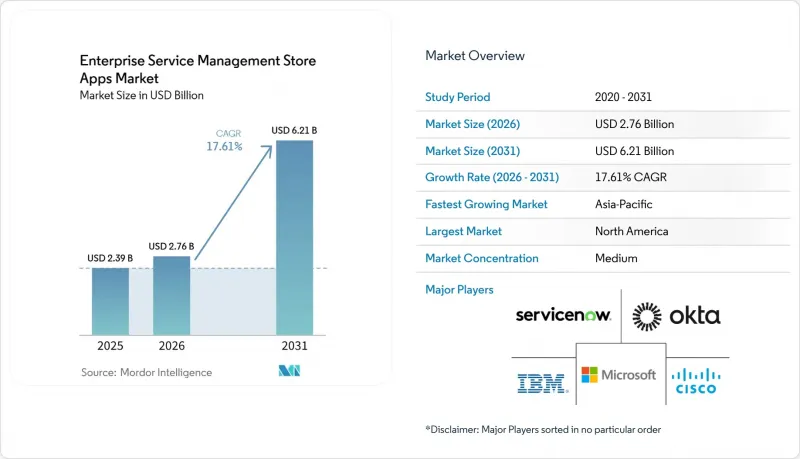
Mordor Intelligence에 의하면, 기업 서비스 관리 스토어 앱 시장 규모는 2025년에 23억 9,000만 달러, 2026년에 27억 6,000만 달러가 되어, 2031년까지 62억 1,000만 달러에 이를 것으로 예측되며, 2026년부터 2031년까지 CAGR 17.61%로 성장할 전망입니다.
본 보고서는 도입 형태(클라우드 기반 및 웹형), 기업 규모(중소기업 및 대기업), 용도(IT 운영 관리 확장 기능, 인사 서비스 제공 확장 기능 등), 지역(북미, 남미, 유럽, 아시아태평양 등)별로 분류되어 있습니다. 시장 전망은 금액(달러) 기준으로 제시되어 있습니다.
전 세계 기업 서비스 관리 스토어 앱 시장 동향 및 인사이트
'클라우드 퍼스트' 엔터프라이즈 워크플로우 생태계의 도입 확대
클라우드 퍼스트 운영 모델에 따라, 기업 서비스 관리 스토어 앱 시장은 단순한 옵션형 애드온 환경이 아닌 핵심 배포 계층으로 변모하고 있습니다. 기업이 클라우드 네이티브 서비스 플랫폼을 표준화하면, 대부분의 경우 새로운 워크플로우 기능을 도입하기 위한 기본 경로로 플랫폼 마켓플레이스를 채택하게 되며, 이에 따라 일상 업무에서 스토어 앱의 역할이 커지고 있습니다. ServiceNow는 2025년 4분기 구독 매출이 34억 6,600만 달러에 달하고, 전년 동기 대비 21% 성장을 기록했다고 보고했으며, 이러한 성장은 핵심 IT 이용 사례를 넘어선 기능 간 워크플로우의 보급과 관련이 있습니다. 또한 플랫폼 운영자가 구매 후 도입을 지연시키던 이용 권한 부여, 승인, 앱 표시와 같은 절차를 간소화함으로써 도입 장벽이 낮아졌고, 기업 서비스 관리 스토어 앱 시장도 그 혜택을 누리고 있습니다. 이는 상업적으로 중요한 의미를 지닙니다. 클라우드 플랫폼의 신규 고객은 모두 동일한 마켓플레이스 채널을 통해 제공되는 관련 확장 기능, 업그레이드, 워크플로우 기능 강화의 지속적인 구매자가 되기 때문입니다. 그 결과, 클라우드 전환은 더 이상 소프트웨어 도입을 지원하는 데 그치지 않고, 앱의 반복 구매 및 파트너 참여 확대를 통해 벤더가 기업 서비스 관리 스토어 앱 시장에서 수익을 창출하는 구조 자체를 형성하고 있습니다.
기업 서비스 관리(ESM) 분야의 AI 지원 워크플로우 자동화
AI를 활용한 워크플로우 자동화가 진전됨에 따라, 기업 서비스 관리 스토어의 앱 시장에서 어떤 확장 기능이 지출을 주도하는지가 변화하고 있습니다. 이는 구매자들이 자동화 기능을 나중에 추가하는 것이 아니라, 서비스 도구에 이미 내장되어 있기를 기대하게 되었기 때문입니다. ServiceNow는 자사의 마켓플레이스가 전년 대비 67% 성장했다고 밝혔습니다. 또한 Now Assist는 2025년에 연간 계약액(ACV)이 6억 달러를 돌파할 전망이며, 2026년에는 10억 달러 이상을 목표로 하고 있습니다. 이러한 추세는 구매자들이 플랫폼 수준에서 AI를 도입할 뿐만 아니라, 인증된 스토어 확장 기능으로 판매되는 패키지화된 AI 기능에 대해서도 비용을 지불하고 있음을 보여줍니다. 아울러 거버넌스에 대한 압박도 커지고 있습니다. 2026년 C1 조사에 따르면, 조직의 95%가 현재 IT 및 보안 작업을 자율적으로 수행하는 AI 에이전트를 운영 중이며, 기계 주도형 조치에 대한 검증된 ID 및 보안 제어의 필요성이 부각되고 있습니다. 아울러 ServiceNow는 2026년 초 ‘Build Program’의 위치를 재검토하여, 파트너가 개발한 AI 에이전트 시장 출시 경로로 ‘Store’를 활용하기 시작했습니다. 이를 통해 에이전트를 통한 자동화가 마켓플레이스의 유통 경제와 직접 연계되게 되었습니다. 그 결과, 기업 서비스 관리(ESM) 스토어 앱 시장은 기본적인 확장 기능 판매에서 도입 시간을 단축하고 기존 거버넌스 규칙과의 정합성을 보다 용이하게 확보할 수 있는 부가가치가 높은 자동화 번들로 전환되고 있습니다.
레거시 ID 관리 및 ITSM 스택과의 통합 복잡성
레거시 시스템과의 통합 문제는 여전히 기업 서비스 관리(ESM) 스토어 앱 시장의 성장을 둔화시키고 있습니다. 특히 서비스, ID, 워크플로우 시스템 전반에 걸쳐 수년에 걸쳐 커스터마이징이 축적되어 온 대규모 조직에서 이러한 경향이 두드러집니다. 구식 ID 프레임워크는 새로운 AI 지원 확장 기능에 필요한 권한 모델과 일치하지 않는 경우가 많기 때문에 구매자가 앱 도입을 진행하려면 별도로 ID 시스템 현대화 작업을 수행해야 할 수도 있습니다. 2026년 Teleport의 조사에 따르면, 43%의 조직이 AI 활용과 관련하여 공식적인 거버넌스 관리를 수행하지 않거나 비공식적인 지침만 보유하고 있는 것으로 나타났습니다. 이로 인해 여러 시스템에 걸쳐 특권 액세스가 필요한 에이전트형 확장 기능을 평가할 때, 구매자는 더욱 주의를 기울여야 합니다. 구매자는 프로덕션 환경에서의 사용을 승인하기 전에 권한, 워크플로우 의존성, 데이터 액세스 규칙을 검증해야 하는 경우가 많기 때문에 이러한 상황은 기업 서비스 관리 스토어의 앱 시장에서 단기적인 계약 성사율을 저하시킵니다. 서비스 관리가 IT의 범위를 넘어 확대됨에 따라 이 문제는 더욱 심각해집니다. 새로운 부서가 추가될 때마다 일관성을 유지해야 하는 ID 역할, 정책 점검, 레거시 커넥터가 증가하기 때문입니다. 수요가 활발한 경우에도 통합 위험으로 인해 기업 서비스 관리 스토어 전체에서 앱의 등록, 구매 및 실제 가동 일정이 지연될 가능성이 있습니다.
부문 분석
기업 서비스 관리 스토어 앱 시장에서 2025년에는 클라우드 기반 앱이 매출의 84.37%를 차지하고, 2031년까지 연평균 성장률(CAGR) 18.64%로 성장할 것으로 전망됩니다. 이러한 집중 경향은 플랫폼 사업자들이 로컬에서 관리되는 배포 방식이 아닌, 클라우드 배포를 중심으로 인증, 이용 권한, 버전 관리 및 배포 프로세스를 구축해 온 것을 반영합니다. 그 결과, 기업 서비스 관리 스토어의 앱 시장은 구조적으로 클라우드 릴리스 주기와 일치하게 되었습니다. 이는 새로운 기능이 설치 절차가 간소화된 통합 마켓플레이스를 통해 제공되게 되었기 때문입니다. ServiceNow의 ‘Application Manager’에서 2025년에 이루어진 변경 사항은 이러한 방향성을 명확히 보여줍니다. 기업 수준의 이용 약관이 승인되면 해당 앱이 자동으로 표시되도록 되어, 배포 워크플로우에서 반복적인 수고가 줄어들었습니다. 이러한 운영 모델은 수익 창출을 가속화하는 데에도 기여합니다. 퍼블리셔는 초기 활성화 처리와 동일한 관리 프레임워크를 통해 업그레이드나 기능 추가를 배포할 수 있기 때문입니다. 구매자에게 주어지는 실질적인 이점은 설치, 사용 권한, 버전 관리와 관련된 수작업이 줄어든다는 점이며, 이를 통해 스토어 기반의 도입을 여러 기능으로 쉽게 확대할 수 있게 됩니다.
웹 기반 배포는 기업 서비스 관리 스토어 앱 시장에서 여전히 일정한 역할을 수행하고 있습니다. 특히, 관할 구역별 호스팅, 사내 데이터 마이그레이션, 또는 단계적 마이그레이션 계획에 대해 보다 엄격한 관리를 유지해야 하는 조직의 경우 더욱 그렇습니다. 일부 기업은 여전히 전환 단계에 있으며, 기존 서비스 관리 환경의 현대화나 클라우드 거버넌스 요건의 재평가를 진행하는 동안 웹 기반 형식을 선호하고 있습니다. 즉, 웹 기반 모델이 사라지는 것은 아니지만, 그 역할은 주류로서의 성장을 주도하는 입장에서 관리된 이용 사례로 점차 전환되고 있습니다. 또한 AI 에이전트가 보급됨에 따라 클라우드의 우월성에 이의를 제기하기는 점점 더 어려워지고 있습니다. 지속적인 모델 업데이트와 높은 연산 능력에 대한 요구는 제약이 많은 도입 환경보다 클라우드 네이티브 환경에 더 자연스럽게 부합하기 때문입니다. 보다 고도화된 확장 기능이 우선 매니지드 클라우드 스택을 위해 설계됨에 따라, 기업 서비스 관리 스토어의 앱 시장에서는 클라우드 형식과 웹 기반 형식 간의 성능 격차가 시간이 지남에 따라 더욱 확대될 가능성이 있습니다. 그럼에도 불구하고, 웹 기반 배포에 대한 과도기적인 수요는 플랫폼의 급속한 표준화보다는 점진적인 변화를 중시하는 구매자층 사이에서 규모는 작지만 견고한 틈새 시장을 계속해서 지탱하고 있습니다.
지역별 분석
2025년, 북미는 매출의 41.28%를 차지하며 기업 서비스 관리 스토어 앱 시장에서 가장 규모가 큰 지역 시장이 되었습니다. 이 지역은 대규모 엔터프라이즈 플랫폼 도입이 집중되어 있고, 하이퍼스케일러와의 폭넓은 연계, 그리고 다양한 워크플로우 범주에 걸친 스토어 기반 확장 기능 개발을 뒷받침하는 성숙한 공급업체 생태계와 같은 이점을 갖추고 있습니다. 미국이 여전히 이 지역의 주요 기여자이지만, 다국적 기업들이 공통된 서비스 거버넌스 모델을 지역 간 사업 운영으로 확대함에 따라 캐나다와 멕시코도 수요를 끌어올리고 있습니다. 이로 인해 북미는 기업 서비스 관리 스토어 앱 시장에서 구조적인 우위를 확보하고 있습니다. 이는 해당 지역의 구매자들이 새로운 앱 카테고리를 조기에 채택하고 대규모 배포 환경 전반에 걸쳐 이를 확장할 수 있기 때문입니다. 유럽은 두 번째로 큰 지역이며, 규정 준수를 주도하는 수요 측면에서 특히 중요한 위치를 계속 차지하고 있습니다. 독일, 영국, 프랑스의 구매자들은 감사 가능한 통제, 데이터 처리 규율, 공급업체의 책임성을 더욱 중시하고 있으며, 이로 인해 스토어에 등록된 앱의 품질 기준이 높아지고, 보다 견고한 거버넌스 인프라를 갖춘 공급업체가 선호되고 있습니다.
아시아태평양은 2031년까지 연평균 성장률(CAGR) 20.71%로 확대될 것으로 예상되며, 기업 서비스 관리 스토어 앱 시장에서 가장 빠르게 성장하는 지역이 될 것입니다. 이 지역의 성장 추세는 기업 소프트웨어 지출 증가, 디지털 현대화 프로그램 강화, 그리고 부족한 개발 자원에 대한 의존도를 줄여주는 신속한 도입 모델에 대한 구매자의 선호에 힘입고 있습니다. 인도, 중국, 일본, 한국, 호주는 이러한 확장의 중심적인 역할을 담당하고 있지만, 각 시장은 클라우드 도입 준비 상황, 조달 규정, 내부 워크플로우의 디지털화 측면에서 서로 다른 속도로 진행되고 있어, 그 기반이 되는 수요 패턴은 시장마다 다릅니다. 일본은 공공 부문의 뚜렷한 사례를 보여주고 있으며, 디지털청이 2025년 초에 ‘디지털 마켓플레이스’를 공식적으로 출범시켜 각 부처, 도도부현, 시정촌에 걸친 SaaS 조달을 지원하고 있습니다. 이러한 움직임은 기업 서비스 관리 스토어의 앱 시장에 중요한 의미를 지닙니다. 왜냐하면 행정 분야에서 거버넌스가 확립된 마켓플레이스 모델을 표준화하여, 인증된 워크플로우 도구를 위한 보다 명확한 길을 마련하게 될 것이기 때문입니다. 이 지역 전체를 살펴보면, 비즈니스 프로세스 자동화가 필요한 곳이나 장기적인 맞춤형 개발 주기에 대응할 수 없는 조직에서 미리 구축된 앱 번들의 매력도 높아지고 있습니다. 따라서 성장 기회는 소프트웨어 예산뿐만 아니라, 더 간편한 도입과 더 강력한 거버넌스에 대한 실질적인 요구와도 연결되어 있습니다.
남미, 중동 및 아프리카는 기업 서비스 관리 스토어 앱 시장에서 여전히 차지하는 비중은 작지만, 성장이 많은 경우 공식적인 현대화 프로그램이나 규정 준수 주도형 도입과 연계되어 있기 때문에 전략적으로 중요한 위치를 계속 차지하고 있습니다. 남미에서는 브라질이 수요를 주도하고 있으며, 다국적 기업 및 공공 부문 구매자들은 정책 일관성 및 감사 대응을 지원할 수 있는 구조화된 워크플로우 플랫폼에 높은 관심을 보이고 있습니다. 중동에서는 아랍에미리트(UAE)와 사우디아라비아가 인증된 스토어 앱의 운영 환경을 개선하기 위한 디지털 정부 및 기업 혁신 프로그램에 대한 투자를 지속하고 있습니다. 아프리카는 도입 초기 단계에 있지만, 남아프리카공화국과 나이지리아에서는 금융 서비스 및 통신 업계에서 지역 전체 평균보다 더 엄격한 서비스 관리 요건이 요구되고 있어 특히 두드러집니다. 이러한 지역들을 종합해 보면, 현재로서는 매출 규모는 작지만, 기업 서비스 관리 스토어 앱 시장에서 가격 책정, 규정 준수, 도입 모델을 현지 사업 실정에 맞출 수 있는 벤더에게는 성장 가능성이 내재되어 있습니다.
기타 혜택:
- 엑셀 형식 시장 예측(ME) 시트
- 3개월간의 애널리스트 지원
자주 묻는 질문
목차
제1장 서론
제2장 조사 방법
제3장 주요 요약
제4장 시장 구도
제5장 시장 규모와 성장 예측
제6장 경쟁 구도
제7장 시장 기회와 향후 전망
JHS 26.08.05According to Mordor Intelligence, the enterprise service management store apps market size is projected to be USD 2.39 billion in 2025, USD 2.76 billion in 2026, and reach USD 6.21 billion by 2031, growing at a CAGR of 17.61% from 2026 to 2031.
This report is Segmented by Deployment Type (Cloud-Based, and Web-Based), Enterprise Size (Small and Medium Enterprises, and Large Enterprises), Application (IT Operations Management Extensions, Human Resources Service Delivery Extensions, and More), and Geography (North America, South America, Europe, Asia-Pacific, and More). The Market Forecasts are Provided in Terms of Value (USD).
Global Enterprise Service Management Store Apps Market Trends and Insights
Increased Adoption of Cloud-First Enterprise Workflow Ecosystems
Cloud-first operating models are turning the enterprise service management store apps market into a core distribution layer rather than an optional add-on environment. When enterprises standardize on cloud-native service platforms, they often adopt the platform marketplace as the default route for deploying new workflow features, thereby elevating the role of store apps in day-to-day operations. ServiceNow reported USD 3,466 million in subscription revenue in Q4 2025, with 21% year-over-year growth, and that expansion was tied to broader workflow adoption across functions beyond core IT use cases. The enterprise service management store apps market is also benefiting from lower installation friction because platform operators now streamline entitlement, acceptance, and app surfacing steps that previously delayed adoption after purchase. This matters commercially because every new cloud platform customer becomes a recurring buyer of adjacent extensions, upgrades, and workflow enhancements distributed through the same marketplace channel. The result is that cloud migration no longer only supports software deployment; it also shapes how vendors monetize the enterprise service management store apps market through repeat app purchases and growing partner participation.
AI-Assisted Workflow Automation in Enterprise Service Management
AI-assisted workflow automation is changing, which extensions attract spending across the enterprise service management store apps market, because buyers now expect automation features to be embedded into service tools rather than added later. ServiceNow disclosed that its Marketplace grew 67% year over year, while Now Assist surpassed USD 600 million in annual contract value in 2025 and targeted more than USD 1 billion in 2026. That momentum shows that buyers are not only adopting AI at the platform level but are also paying for packaged AI functions sold as certified store extensions. The governance pressure is also rising because a 2026 C1 survey found that 95% of organizations now run AI agents that autonomously perform IT or security tasks, underscoring the need for validated identity and security controls for machine-led actions. ServiceNow also repositioned its Build Program in early 2026 to use the Store as a route to market for partner-built AI agents, which ties agentic automation directly to marketplace distribution economics. As a result, the enterprise service management store apps market is moving from basic extension sales toward higher-value automation bundles that reduce deployment time and align more easily with existing governance rules.
Integration Complexity with Legacy Identity and ITSM Stacks
Legacy integration problems continue to slow the enterprise service management store apps market, especially in large organizations that have accumulated years of customization across service, identity, and workflow systems. Older identity frameworks often do not align with the permission models required by newer AI-enabled extensions, which means app deployment can depend on a separate identity modernization effort before buyers can proceed. A 2026 Teleport survey found that 43% of organizations had no formal governance controls or only informal guidelines for AI use, which adds to the caution buyers should exercise when evaluating agentic extensions that require privileged access across multiple systems. This weakens near-term conversion in the enterprise service management store apps market, because buyers often need to validate permissions, workflow dependencies, and data access rules before approving production use. The problem becomes more serious as service management expands beyond IT, since each new department adds additional identity roles, policy checks, and legacy connectors that must be aligned. Even when demand is strong, integration risk can delay app listings, purchases, and go-live schedules across the enterprise service management store.
Other drivers and restraints analyzed in the detailed report include:
- Rapid Expansion of Cross-Functional Service Orchestration
- Rising Demand for Low-Code and No-Code Store Apps
- High Certification, Maintenance, And Licensing Costs
For complete list of drivers and restraints, kindly check the Table Of Contents.
Segment Analysis
Cloud-based apps accounted for 84.37% of revenue in 2025 and are projected to grow at an 18.64% CAGR through 2031 in the enterprise service management store apps market. This concentration reflects how platform operators have built certification, entitlement, version control, and distribution processes around cloud delivery rather than around locally managed deployment formats. The enterprise service management store apps market has therefore become structurally aligned with cloud release cycles, because new capabilities now move through centralized marketplaces with fewer installation steps. ServiceNow's Application Manager changes in 2025 clearly show that direction, as eligible apps can now surface automatically after company-level terms are accepted, reducing repetitive friction in deployment workflows. This operating model also favors faster monetization, because publishers can distribute upgrades and feature additions through the same managed framework that handles initial activation. For buyers, the practical advantage is less manual work around installation, entitlement, and version maintenance, which makes store-based adoption easier to scale across multiple functions.
Web-based deployment still retains a role in the enterprise service management store apps market, especially for organizations that must keep tighter control over jurisdictional hosting, internal data movement, or phased migration plans. Some enterprises remain in transition and prefer web-based formats while they modernize older service management environments or reassess cloud governance requirements. That means web-based models are not disappearing, but their role is shifting toward controlled use cases rather than mainstream growth leadership. The cloud advantage is also becoming harder to challenge as AI agents become more common, because continuous model updates and higher compute need fit cloud-native environments more naturally than constrained deployment setups. As more advanced extensions are designed first for managed cloud stacks, the enterprise service management store apps market is likely to widen the performance gap between cloud and web-based formats over time. Even so, transitional demand for web-based deployment still supports a smaller but durable niche among buyers that value staged change over rapid platform standardization.
Complete Report Scope:
- By Deployment Type
- Cloud-Based
- Web-Based
- By Enterprise Size
- Small and Medium Enterprises
- Large Enterprises
- By Application
- IT Operations Management Extensions
- Human Resources Service Delivery Extensions
- Customer Service Management Extensions
- Security Operations and Identity Extensions
- Custom Workflow and Productivity Extensions
- By Geography
- North America
- United States
- Canada
- Mexico
- South America
- Brazil
- Argentina
- Chile
- Rest of South America
- Europe
- Germany
- United Kingdom
- France
- Italy
- Spain
- Rest of Europe
- Asia-Pacific
- China
- Japan
- India
- South Korea
- Australia
- Rest of Asia-Pacific
- Middle East
- United Arab Emirates
- Saudi Arabia
- Qatar
- Rest of Middle East
- Africa
- South Africa
- Egypt
- Nigeria
- Rest of Africa
- North America
Geography Analysis
North America accounted for 41.28% of revenue in 2025, making it the largest regional market for enterprise service management store apps. The region benefits from a dense concentration of large enterprise platform deployments, broad alignment with hyperscalers, and a mature supplier ecosystem that supports store-based extension development across many workflow categories. The United States remains the main regional contributor, while Canada and Mexico add demand as multinational organizations extend common service governance models across regional operations. This gives North America a structural lead in the enterprise service management store apps market, because buyers there often adopt new app categories earlier and can scale them across large installed environments. Europe is the second-largest geography and remains especially important for compliance-led demand. Buyers in Germany, the United Kingdom, and France place greater weight on auditable controls, data-handling discipline, and vendor accountability, raising the quality bar for store listings and supporting vendors with stronger governance infrastructure.
Asia-Pacific is projected to expand at a 20.71% CAGR through 2031, which makes it the fastest-growing geography in the enterprise service management store apps market. The regional growth profile is supported by rising enterprise software spending, stronger digital modernization programs, and buyer preference for faster deployment models that reduce dependence on scarce developer resources. India, China, Japan, South Korea, and Australia are central to that expansion, but the underlying demand patterns differ across them, as each market moves at a different pace in cloud readiness, procurement rules, and internal workflow digitization. Japan offers a clear public-sector example, as its Digital Agency formalized the Digital Marketplace in early 2025 to support SaaS procurement across ministries, prefectures, and municipalities. That move matters for the enterprise service management store apps market because it normalizes a governed marketplace model in public administration and creates a clearer path for certified workflow tools. Across the broader region, prebuilt app bundles are also becoming more attractive where organizations need business process automation but cannot support long custom build cycles. The growth opportunity is therefore tied not only to software budgets, but also to a practical need for simpler deployment and stronger governance.
South America, the Middle East, and Africa still account for a smaller portion of the enterprise service management store apps market, yet they remain strategically relevant because growth is often linked to formal modernization programs and compliance-driven adoption. Brazil leads South American demand, with multinational and public-sector buyers showing greater interest in structured workflow platforms that can support policy consistency and audit readiness. In the Middle East, the United Arab Emirates and Saudi Arabia continue to invest in digital government and enterprise transformation programs that improve the operating environment for certified store apps. Africa remains earlier in its adoption curve, with South Africa and Nigeria standing out where financial services and telecommunications create stronger service management requirements than the broader regional average. Taken together, these geographies represent a smaller revenue pool today, but they offer expansion potential for vendors that can align pricing, compliance, and deployment models to local operating realities within the enterprise service management store apps market.
- ServiceNow, Inc.
- IBM Corporation
- Microsoft Corporation
- Cisco Systems, Inc.
- Okta, Inc.
- PagerDuty, Inc.
- Dynatrace, Inc.
- SailPoint Technologies Holdings, Inc.
- Talkdesk, Inc.
- xMatters, Inc.
- Freshworks Inc.
- Atlassian Corporation Plc
- BMC Software, Inc.
- Ivanti, Inc.
- TOPdesk Nederland B.V.
- Matrix42 AG
- EasyVista
Additional Benefits:
- The market estimate (ME) sheet in Excel format
- 3 months of analyst support
TABLE OF CONTENTS
1 INTRODUCTION
- 1.1 Study Assumptions and Market Definition
- 1.2 Scope of the Study
2 RESEARCH METHODOLOGY
3 EXECUTIVE SUMMARY
4 MARKET LANDSCAPE
- 4.1 Market Overview
- 4.2 Market Drivers
- 4.2.1 Increased Adoption of Cloud-First Enterprise Workflow Ecosystems
- 4.2.2 Rapid Expansion of Cross-Functional Service Orchestration
- 4.2.3 Rising Demand for Low-Code and No-Code Store Apps
- 4.2.4 Growing Preference for Certified Marketplace Extensions Over Custom Builds
- 4.2.5 AI-Assisted Workflow Automation in Enterprise Service Management
- 4.2.6 Compliance-Driven Demand for Governed App Distribution
- 4.3 Market Restraints
- 4.3.1 High Certification, Maintenance, and Licensing Costs
- 4.3.2 Integration Complexity With Legacy Identity and ITSM Stacks
- 4.3.3 Security, Data Sovereignty, and Vendor Lock-In Concerns
- 4.3.4 Buyer Resistance to Fragmented App Catalog Governance
- 4.4 Industry Value Chain Analysis
- 4.5 Technological Outlook
- 4.6 Impact of Macroeconomic Factors on the Market
- 4.7 Porter's Five Forces Analysis
- 4.7.1 Bargaining Power of Suppliers
- 4.7.2 Bargaining Power of Buyers
- 4.7.3 Threat of New Entrants
- 4.7.4 Threat of Substitutes
- 4.7.5 Industry Rivalry
5 MARKET SIZE AND GROWTH FORECASTS (VALUE)
- 5.1 By Deployment Type
- 5.1.1 Cloud-Based
- 5.1.2 Web-Based
- 5.2 By Enterprise Size
- 5.2.1 Small and Medium Enterprises
- 5.2.2 Large Enterprises
- 5.3 By Application
- 5.3.1 IT Operations Management Extensions
- 5.3.2 Human Resources Service Delivery Extensions
- 5.3.3 Customer Service Management Extensions
- 5.3.4 Security Operations and Identity Extensions
- 5.3.5 Custom Workflow and Productivity Extensions
- 5.4 By Geography
- 5.4.1 North America
- 5.4.1.1 United States
- 5.4.1.2 Canada
- 5.4.1.3 Mexico
- 5.4.2 South America
- 5.4.2.1 Brazil
- 5.4.2.2 Argentina
- 5.4.2.3 Chile
- 5.4.2.4 Rest of South America
- 5.4.3 Europe
- 5.4.3.1 Germany
- 5.4.3.2 United Kingdom
- 5.4.3.3 France
- 5.4.3.4 Italy
- 5.4.3.5 Spain
- 5.4.3.6 Rest of Europe
- 5.4.4 Asia-Pacific
- 5.4.4.1 China
- 5.4.4.2 Japan
- 5.4.4.3 India
- 5.4.4.4 South Korea
- 5.4.4.5 Australia
- 5.4.4.6 Rest of Asia-Pacific
- 5.4.5 Middle East
- 5.4.5.1 United Arab Emirates
- 5.4.5.2 Saudi Arabia
- 5.4.5.3 Qatar
- 5.4.5.4 Rest of Middle East
- 5.4.6 Africa
- 5.4.6.1 South Africa
- 5.4.6.2 Egypt
- 5.4.6.3 Nigeria
- 5.4.6.4 Rest of Africa
- 5.4.1 North America
6 COMPETITIVE LANDSCAPE
- 6.1 Market Concentration
- 6.2 Strategic Moves
- 6.3 Vendor Positioning Analysis
- 6.4 Company Profiles (includes Global Level Overview, Market Level Overview, Core Segments, Financials as available, Strategic Information, Market Rank/Share, Products and Services, Recent Developments)
- 6.4.1 ServiceNow, Inc.
- 6.4.2 IBM Corporation
- 6.4.3 Microsoft Corporation
- 6.4.4 Cisco Systems, Inc.
- 6.4.5 Okta, Inc.
- 6.4.6 PagerDuty, Inc.
- 6.4.7 Dynatrace, Inc.
- 6.4.8 SailPoint Technologies Holdings, Inc.
- 6.4.9 Talkdesk, Inc.
- 6.4.10 xMatters, Inc.
- 6.4.11 Freshworks Inc.
- 6.4.12 Atlassian Corporation Plc
- 6.4.13 BMC Software, Inc.
- 6.4.14 Ivanti, Inc.
- 6.4.15 TOPdesk Nederland B.V.
- 6.4.16 Matrix42 AG
- 6.4.17 EasyVista
7 MARKET OPPORTUNITIES AND FUTURE OUTLOOK
- 7.1 White-Space and Unmet-Need Assessment


